Tuesday, April 15, 2025


ABS Recognized by National Safety Council for Reaching Safety Milestones

ABS
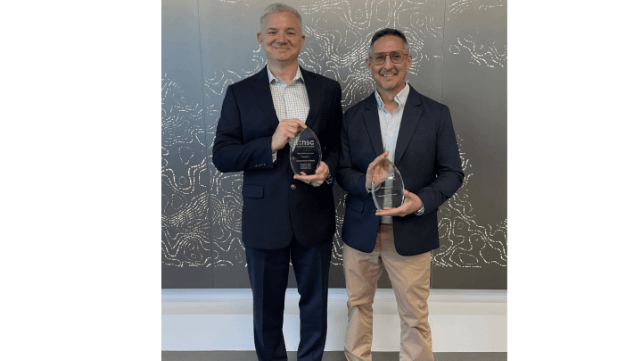
Joshua LaVire, Vice President, HSQE and Chris Reiblein, Director, HSQE display the awards presented by the NSC

Published Apr 14, 2025 12:30 PM by The Maritime Executive


[By: ABS]

In recognition of its exceptional achievement in maintaining a safe work environment, the National Safety Council (NSC) presented ABS with two safety awards.

The NSC is a globally recognized nonprofit organization committed to eliminating leading causes of preventable death and injury in the workplace and on roadways. Their awards program recognizes organizations and individuals who have made significant contributions to upholding the safety of their workplaces and communities.

The two awards celebrate ABS’ accomplishment of reaching a significant number of consecutive hours without incurring occupational injury or illness that resulted in days away from work. Since January 2023, ABS has accumulated more than 15 million hours worked without a lost-time incident (LTI). The second award recognizes six million hours worked without an LTI specific to North American operations dating back to 2021.

“This achievement is a testament to the dedication and hard work of ABS employees in maintaining a safe work environment across all of ABS globally,” said John McDonald, ABS President and COO. “We are incredibly proud to receive these awards and will continue to prioritize a strong culture of safety so that ABS can strive to set new benchmarks within the industry.”

Safety is at the heart of everything ABS does, whether in its own operations or in promoting safety for the maritime industry at large. ABS staff have regular safety meetings to discuss specific safety issues relevant to individual teams and offices. Staff are also empowered with the knowledge, tools and authority to maintain safety at work and in everyday life.

This safety-centric mission extends to ABS’ industry-leading classification and technical advisory services, providing a crucial foundation in helping the global marine and offshore industries achieve a safer, cleaner future. Learn more about how ABS Training Solutions support a safer industry here.

The products and services herein described in this press release are not endorsed by The Maritime Executive.


NTSB: Two Tankers Had the Same Accident in Two Years on Cooper River

Hafnia Amessi damage
Courtesy NTSB

Published Apr 13, 2025 10:50 PM by The Maritime Executive


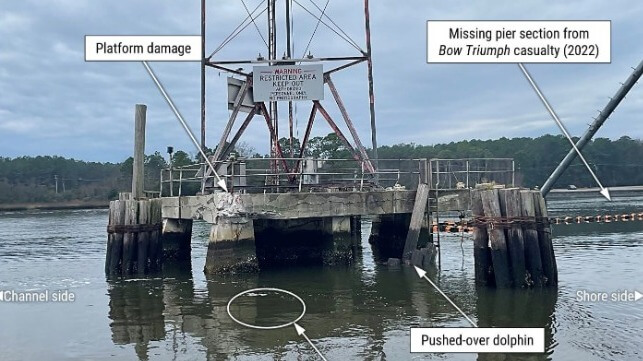
The NTSB has determined that the tanker Hafnia Amessi struck a pier on the Cooper River last year because the pilot let the vessel get too close to the riverbank. The combination of bank effect and current overwhelmed the force of the tanker's rudder and propulsion, sending it into the end of the pier - much like the tanker Bow Triumph, which hit the same pier under similar circumstances in 2022. 

"Bank effect can have an undesired effect on vessels, even for the most experienced ship handlers. Pilots, masters, and other vessel operators should consider the risks in areas known for shoaling when planning transits," cautioned NTSB. "Where appropriate, employ additional measures to mitigate the risk, including use of tugboats, reducing or increasing speed, and/or delaying the transit until more favorable conditions exist."

On the morning of January 14, 2024, Hafnia Amessi finished offloading at a terminal on the Cooper River in Wando, South Carolina. The vessel prepared to get under way on a ballast voyage to Texas City, Texas. A local marine pilot with 25 years' experience and 5,000 transits - including more than 20 on this stretch of river - boarded to guide the outbound transit. Because the pilot was aware of the Bow Triumph's allision with Naval Weapons Station Pier B two years before, he instructed the escort tug to take a position on the starboard side and accompany Hafnia Amessi down the river as a precaution. "This order was a direct result of what I had learned from the Bow Triumph incident in 2022," he told NTSB. 

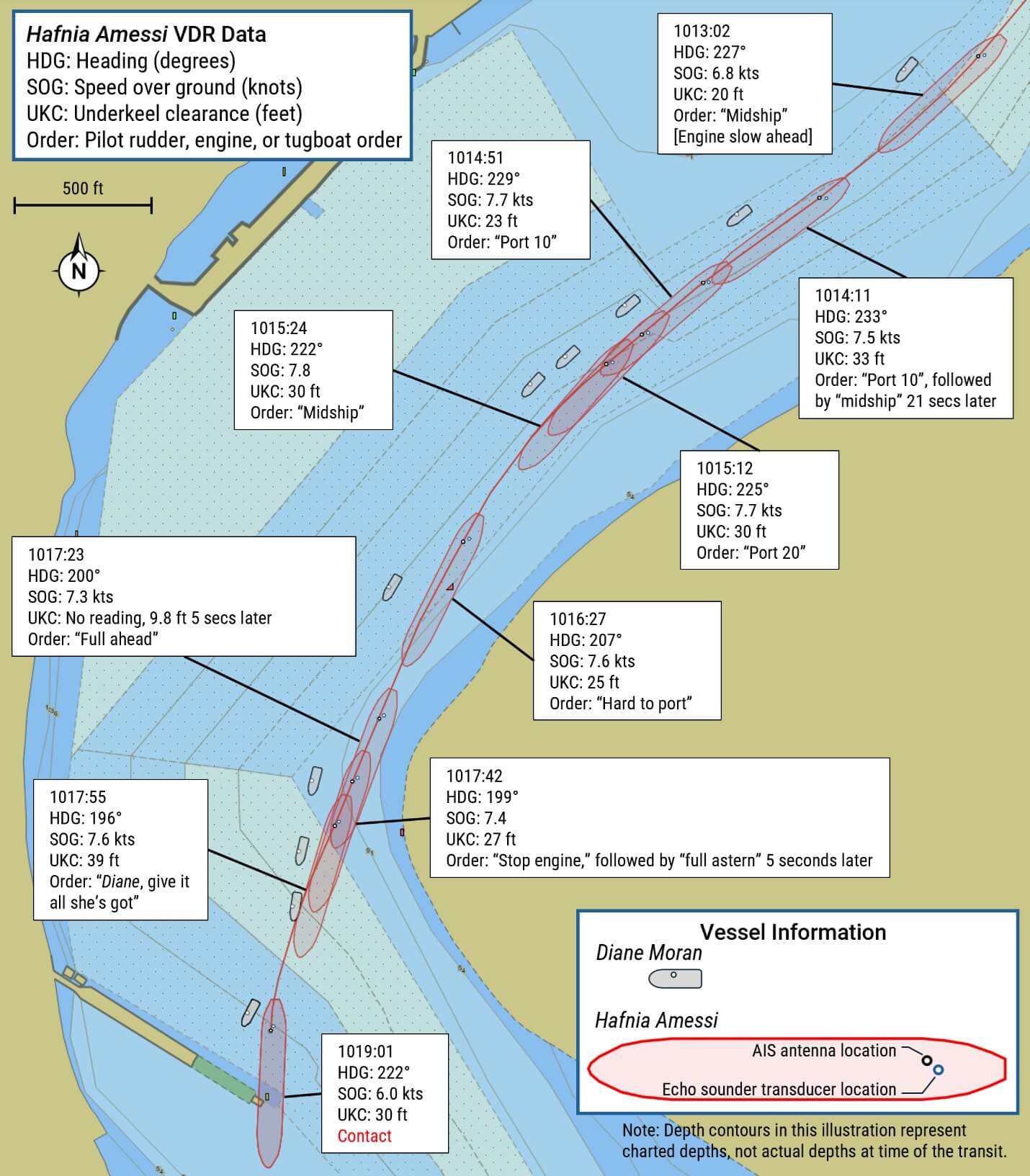
Hafnia Amessi got under way. At 1000, nearing a river bend at buoy 80, the pilot noted an extreme flood current rushing past the buoy - strong enough to reduce the tanker's speed to just five knots. 

The pilot lined up to take the next bend, a hard 90-degree turn to port that would take the tanker past Pier B. The pilot aimed for the east side of the channel, expecting that the strong current would set Hafnia Amessi further out towards the center. That did not occur, and the tanker ended up passing tight against the eastern bank, a maneuver that the pilot had not intended. The eastern bank had a ledge that tended to shoal rapidly with silt, and it had to be dredged every few years. 

At 1016:27, the pilot ordered hard to port, but the rudder order had no effect on the rate of turn. At 1017:23, the ship's echo sounder read zero feet, indicating shallow water. Pier B was dead ahead, and the pilot ordered full ahead to push more water over the rudder. He also directed the escort tug to push on the starboard bow with "all she's got."

Courtesy NTSB

The last-minute maneuvers were not enough to avert an allision, and Hafnia Amessi hit the end of the pier at six knots. The impact dented in the tanker's hull plating up to three inches and buckled three transverse bulkheads inward by about 1-2 inches, causing about $30,000 in damage. The end of the pier sustained about $8 million in damage to dolphins, pilings and concrete, in addition to the previous damage caused by Bow Triumph. (There was no disruption to cargo operations at the pier, as it was already out of service because of the earlier accident.) 

According to NTSB, bank effect from a known shoal on the eastern channel edge likely pulled Hafnia Amessi's stern to port. Meanwhile, the strong flood current pushed her bow to starboard. The effects were strong enough to neutralize the force of Hafnia Amessi's rudder, even hard over to port with engine full ahead. 

NTSB noted that Bow Triumph's allision with the same pier happened under very similar circumstances: the Triumph passed too close to the east side of the channel, suffered bank suction, lost effective control of her heading and destroyed a 300-foot section of the pier. 

The shoal was a known hazard, and the Coast Guard had previously scheduled the installation of a buoy to mark the danger zone at the bend. The buoy was installed on the planned date, three days after Hafnia Amessi hit the pier. "If this Buoy 72A had been there [during the transit] . . . that would have given me the tools to come more to the right and the information that I needed to avoid that spot," the pilot told NTSB after the casualty. 

After two allisions in two years, the Coast Guard Captain of the Port issued a standing order requiring all vessels over 10,000 GT or drawing more than 25 feet to use a tethered, two-tug escort when transiting through this challenging section of the river. 


Grounded Scallop Boat Spills Diesel in Boston Harbor

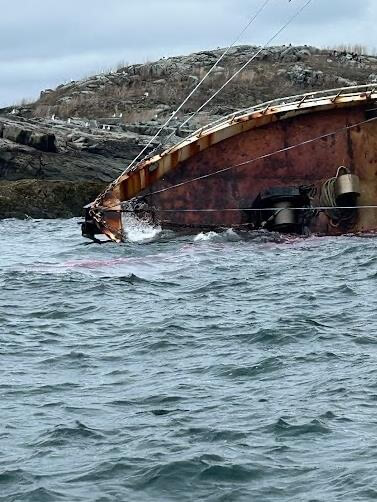
Eileen Rita
Courtesy USCG

Published Apr 11, 2025 10:10 PM by The Maritime Executive


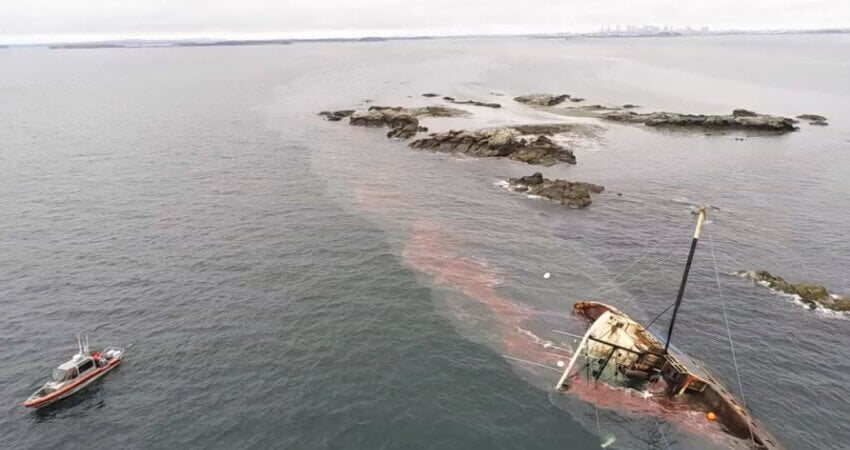
On Friday morning, the U.S. Coast Guard and the Boston Police Department rescued three fishermen from a scallop boat that went aground near Green Island, a rocky islet near the entrance to Boston Harbor. Pollution control efforts are under way to reduce the impact of a spill.

At about 0745 on Friday, Coast Guard Sector Boston received a broken-up radio call from a commercial fishing vessel, the scallop boat Eileen Rita. The Rita's crew confirmed that they had gone aground at the entrance to the harbor. 

Coast Guard crews from stations in Point Allerton and Boston responded to the scene near Green Island (North Brewster Island), joined by units from the Boston Police Department and Boston Fire Department. Two Coast Guard boats and a Boston Police boat rescued the three crewmembers from atop the partially capsized vessel's hull, and no injuries were reported. 

Images courtesy USCG

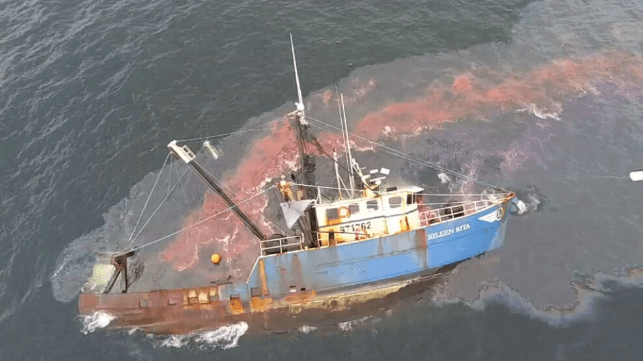
After the grounding, the Eileen Rita took on a list and settled onto her port side. The vessel soon began to discharge diesel fuel and oil into the water, according to the Coast Guard. 

Eileen Rita is carrying as much as 4,000 gallons of fuel and 50 gallons of lubricating oil; the exact amount on board and the quantity of the spill are unknown. Video footage obtained by the Coast Guard shows a substantial quantity of what appears to be red dye diesel spilling from the Eileen Rita's tanks. Multiple state and federal agencies are involved in the pollution-response effort. 

“The Coast Guard is working closely with the responsible party to mitigate fuel discharge. Simultaneously, methods to safely remove the vessel from the island are being evaluated,” said Lt. Cmdr. Alfred Betts, the public affairs officer for Sector Boston. “The contracted oil recovery organization is deploying absorbent boom to mitigate the spread of spilled fuel. Contracted divers are assessing the vessel to plan a path forward.”


Italian Ferry Operator Tirrenia Investigated on Bribery and False Documents

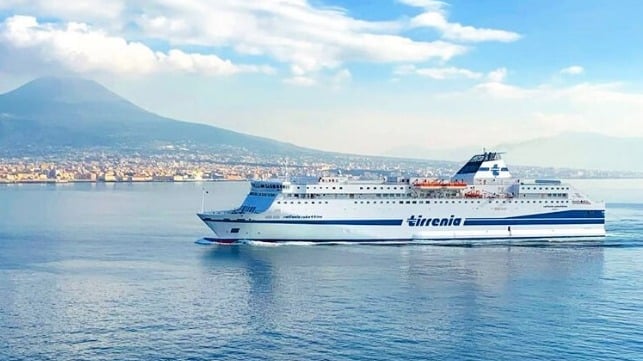
Tirrenia passenger ferry
Tirrenia operates passenger and cargo ferries (Tirrenia file photo)

Published Apr 14, 2025 3:47 PM by The Maritime Executive


Italian prosecutors moved last week to seize three ferries in the fleet of Tirrenia-Compagnia Italiana di Navigazione on charges the company falsified documents regarding the environmental performance of its ships and presented the class society and registers with counterfeit documents. Today, April 14, the media is reporting that the investigation has expanded to widespread bribery of government officials, police officers, and other officials receiving illegal gifts including free travel.

According to media reports, approximately 40 officials are under investigation in a case that will begin presentation to a panel of judges on Wednesday, April 16. Prosecutors asked for two individuals to be placed under house arrest and 11 others to be suspended from their roles pending the outcome of the investigation. The accusations are that the company was giving out “gold cards” which provided free travel and making other gifts to the officials.

This builds on the investigation in which it is being charged that the ferry company tampered with vessels operating on its route between Genoa and Porto Torres. Tirrena has a government contract to provide the service and receives government payments for critical ferry operations.

The allegations include that Tirrena was concealing non-compliance by its vessels by making false reports to the registers or by counterfeiting public authentication on documents used to obtain and maintain certification for the vessels. The company is alleged to have been embezzling public funds by operating ships that were not meeting regulations.

The investigation reportedly revealed that “Components of the main engines and diesel generators had been tampered with, altered, or replaced with non-original spare parts.” As such, the vessels were reported to be non-compliant but kept in service with counterfeit and false documents.

Three ships were placed under arrest under “precautionary custody” to protect public funds. The company however was permitted to continue to operate them to ensure consistency of service. The prosecutors were seeking to protect more than €64 million (nearly $77 million) in public funds that could be involved in the fraud case.

The shipping company responded through its lawyers saying it was “astonished” over the allegations. They said the company has faced significant expenses and made large investments to conform with regulations on pollution.

Prosecutors said the investigation into the vessels began in 2023 and dated back to issues in 2021. They believe since then Tirrenia has rectified the compliance issues on its ships. The bribery of officials with free trips is believed to be widespread involving police, magistrates, and other regional officials.


NTSB: Two Tankers Had the Same Accident in Two Years on Cooper River

Hafnia Amessi damage
Courtesy NTSB

Published Apr 13, 2025 10:50 PM by The Maritime Executive


The NTSB has determined that the tanker Hafnia Amessi struck a pier on the Cooper River last year because the pilot let the vessel get too close to the riverbank. The combination of bank effect and current overwhelmed the force of the tanker's rudder and propulsion, sending it into the end of the pier - much like the tanker Bow Triumph, which hit the same pier under similar circumstances in 2022. 

"Bank effect can have an undesired effect on vessels, even for the most experienced ship handlers. Pilots, masters, and other vessel operators should consider the risks in areas known for shoaling when planning transits," cautioned NTSB. "Where appropriate, employ additional measures to mitigate the risk, including use of tugboats, reducing or increasing speed, and/or delaying the transit until more favorable conditions exist."

On the morning of January 14, 2024, Hafnia Amessi finished offloading at a terminal on the Cooper River in Wando, South Carolina. The vessel prepared to get under way on a ballast voyage to Texas City, Texas. A local marine pilot with 25 years' experience and 5,000 transits - including more than 20 on this stretch of river - boarded to guide the outbound transit. Because the pilot was aware of the Bow Triumph's allision with Naval Weapons Station Pier B two years before, he instructed the escort tug to take a position on the starboard side and accompany Hafnia Amessi down the river as a precaution. "This order was a direct result of what I had learned from the Bow Triumph incident in 2022," he told NTSB. 

Hafnia Amessi got under way. At 1000, nearing a river bend at buoy 80, the pilot noted an extreme flood current rushing past the buoy - strong enough to reduce the tanker's speed to just five knots. 

The pilot lined up to take the next bend, a hard 90-degree turn to port that would take the tanker past Pier B. The pilot aimed for the east side of the channel, expecting that the strong current would set Hafnia Amessi further out towards the center. That did not occur, and the tanker ended up passing tight against the eastern bank, a maneuver that the pilot had not intended. The eastern bank had a ledge that tended to shoal rapidly with silt, and it had to be dredged every few years. 

At 1016:27, the pilot ordered hard to port, but the rudder order had no effect on the rate of turn. At 1017:23, the ship's echo sounder read zero feet, indicating shallow water. Pier B was dead ahead, and the pilot ordered full ahead to push more water over the rudder. He also directed the escort tug to push on the starboard bow with "all she's got."

Courtesy NTSB

The last-minute maneuvers were not enough to avert an allision, and Hafnia Amessi hit the end of the pier at six knots. The impact dented in the tanker's hull plating up to three inches and buckled three transverse bulkheads inward by about 1-2 inches, causing about $30,000 in damage. The end of the pier sustained about $8 million in damage to dolphins, pilings and concrete, in addition to the previous damage caused by Bow Triumph. (There was no disruption to cargo operations at the pier, as it was already out of service because of the earlier accident.) 

According to NTSB, bank effect from a known shoal on the eastern channel edge likely pulled Hafnia Amessi's stern to port. Meanwhile, the strong flood current pushed her bow to starboard. The effects were strong enough to neutralize the force of Hafnia Amessi's rudder, even hard over to port with engine full ahead. 

NTSB noted that Bow Triumph's allision with the same pier happened under very similar circumstances: the Triumph passed too close to the east side of the channel, suffered bank suction, lost effective control of her heading and destroyed a 300-foot section of the pier. 

The shoal was a known hazard, and the Coast Guard had previously scheduled the installation of a buoy to mark the danger zone at the bend. The buoy was installed on the planned date, three days after Hafnia Amessi hit the pier. "If this Buoy 72A had been there [during the transit] . . . that would have given me the tools to come more to the right and the information that I needed to avoid that spot," the pilot told NTSB after the casualty. 

After two allisions in two years, the Coast Guard Captain of the Port issued a standing order requiring all vessels over 10,000 GT or drawing more than 25 feet to use a tethered, two-tug escort when transiting through this challenging section of the river. 

Saya de Malha: Creating a New Nation

The Legend of Landi by Oswald Horowitz / The Outlaw Ocean Project

Published Apr 14, 2025


Vast and sometimes brutal, the high seas are also a place of aspiration, reinvention and an escape from rules. This is why the oceans have long been a magnet for libertarians hoping to flee governments, taxes and other people by creating their own sovereign micronations in international waters.

The Saya de Malha Bank has been especially attractive for such ambitions. Covered with sea grass and interspersed with small coral reefs, the bank is among the largest submerged ocean plateaus in the world—less than 33 feet deep in some areas. Near the equator, the water temperature at the Saya de Malha varies from 23°C to 28°C, depending on the season. Waves are broken in the shallower areas. But the biggest allure is that the bank is hundreds of miles beyond the jurisdictional reach of any nation’s laws.

On March 9, 1997, an architect named Wolf Hilbertz and a marine biologist named Thomas Goreau sailed to the bank. Launching from Victoria, the capital of the Seychelles, the voyage took 3 days. With solar panels, metal scaffolding and cornerstones, they began constructing their vision for a sovereign micronation that they planned to call Autopia (the place that builds itself).“Having about the size of Belgium, most of Saya lies in international waters, ‘in the high seas’ legally speaking, governed only by the U.N. Law of the Sea,” Hilbertz told Celestopea Times in 2004.

In 2002, the two men returned to the bank in three sailboats with a team of architects, cartographers and marine biologists from several countries to continue building. They intended to erect their dwellings on top of existing coral, reinforcing steel scaffolding using a patented process that Hilbertz had developed called Biorock, a substance formed by the electro-accumulation of materials dissolved in seawater. This involved sinking steel frames into the shallow waters then putting these steel poles under a weak direct electrical current. Little by little, limestone is deposited on the steel poles and at their base, creating an ideal habitat for corals and other shellfish and marine animals.

Rushing because a cyclone was headed their way in a matter of days, the team built in six days a steel structure five by five by two meters high. The structure, located specifically at 9°12′ south latitude and 61°21′ east longitude, was anchored in the seabed and a small battery provided steady charge. In later interviews, Hilbertz, who was a professor at the University of Houston, said he hoped to create building materials with a lower carbon footprint and create a self-sufficient settlement in the sea “that belongs to the residents who live and work there, a living laboratory in which new environmental technologies are developed.” His plans ultimately stalled for lack of funds.

Two decades later, a 58-year-old Italian businessman named Samuele Landi began promoting a new vision for a micronation in the Saya de Malha Bank. He planned to park a massive barge near the seagrass patch far from the reach of extradition and police. “Because the Saya de Malha is not far from the equator, cyclones are born there but they are not so terrible,” Landi said in an interview in a yet-unreleased documentary film by Oswald Horowitz called “The Legend of Landi.” A gifted computer programmer, avid skydiver, and motorcycle racer, Landi had been a man on the lam for roughly a decade. Accused of fraud after his company, Eutelia, declared bankruptcy in 2010, Landi and some of its executives were tried and convicted in Italy. Landi was sentenced in absentia to 14 years, which led him to relocate to Dubai where he dabbled in crypto, hid money in Switzerland, and skated around extradition treaties. While living comfortably in Dubai, he registered companies in bespoke tax-free zones, and eventually procured diplomatic credentials from Liberia, according to a New York Times profile of him.

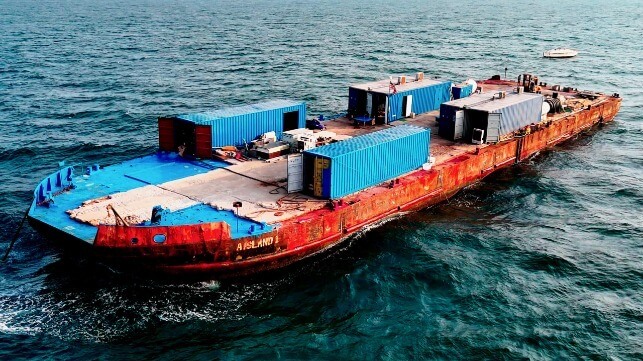
As he prepared this plan for moving to the Saya de Malha Bank, Landi purchased an initial 800-ton deck barge that he named Aisland. Anchoring it roughly 30 miles off the coast of Dubai, he lived on the vessel with three sailors, a cook and five cats. Aisland’s deck was fitted with six blue shipping containers bolted in place—living quarters, equipped with solar-powered air-conditioners and a desalination system. Landi stayed there for over a year as he raised money to buy another barge twice as large as the Aisland. He even hired an architect named Peter de Vries to help design plans for the re-fit of the new barge so that it could sail to the Saya de Malha Bank and survive there. Landi hoped to eventually expand his Saya de Malha project to create a floating city consisting of about twenty barges, which would, by 2028, house thousands of permanent residents in luxury villas and apartments. Since the area has been known to entice pirates and other sea marauders, Landi also planned to mount a Gatling gun on the Aisland. “That’s one of these guns that fires 1,000 rounds a minute—very heavy-duty stuff,” Peter de Vries said in an interview with the Times. “I actually got the specs for the gun.”

The movement to create sovereign states on the high seas has a colorful history. Typically such projects have been imbued with the view that government was a kind of kryptonite that weakened entrepreneurialism. Many held a highly optimistic outlook on technology and its potential to solve human problems. The founders of these micronations—in the 2000s quite a few dot-com tycoons—were usually men of means, steeped in Ayn Rand and Thomas Hobbes. Conceptualized as self-sufficient, self-governing, sea-bound communities, the vision for these waterborne cities was part libertarian utopia, part billionaire’s playground. Fittingly, they have been called, in more recent years, seasteads, after the homesteads of the American West.

In 2008, these visionaries coalesced around a non-profit organization called The Seasteading Institute. Based in San Francisco, the organization was founded by Patri Friedman, a Google software engineer and grandson of Milton Friedman, the Nobel Prize-winning economist best known for his ideas about the limitations of government. The institute’s primary benefactor was Peter Thiel, a billionaire venture capitalist and the co-founder of PayPal, who put over $1.25 million into the organization and related projects. Where Elon Musk has promoted a vision of fleeing earthly encumberments by colonizing Mars, these libertarians had similar aspirations for the high seas.

Long before the Seasteading Institute, the interest in offshore micronations spurred dozens of daring and often ill-fated schemes. In the early 1970s, a Las Vegas real-estate magnate named Michael Oliver sent barges loaded with sand from Australia to a set of shallow reefs near the island of Tonga in the Pacific Ocean, declaring his creation The Republic of Minerva. Within months, Tonga sent troops to the site to enforce its 12-mile offshore territorial claim, expelling the Minervan occupants and removing their flag—a single torch on a blue background. In 1982, a group of Americans led by Morris C. “Bud” Davis tried to occupy the reefs. Within weeks, they too were forced off by Tongan troops.

Other projects met a similar fate. In 1968, a wealthy American libertarian named Werner Stiefel attempted to create a floating micronation called Operation Atlantis in international waters near the Bahamas. He bought a large boat and sent it to his presumptive territory. It sank soon thereafter in a hurricane. Another wealthy libertarian, Norman Nixon, raised about $400,000 to create a floating city called the Freedom Ship, a 4,500-foot vessel about four times the length of the Queen Mary 2. The ship was never built.

Part of the reason these projects failed to get off the drawing board was that the ocean is a far less inviting place than architectural renderings tend to suggest. At sea, there is plenty of wind, wave and solar energy, but building renewable-energy systems that can survive the weather and corrosive seawater is difficult and costly.

On February 2, 2024, Landi and his crew tragically learned this hard lesson. The Aisland was slammed by a rogue wave, which breached the hull, breaking the barge in two. Two members of Landi’s crew survived by clinging onto pieces of wood until a passing vessel rescued them the next day. Landi and the two remaining seafarers died. According to Italian news reports, Landi put out a call for help, but it didn’t come in time. His body was found several days later, when it washed up on the beach about 40 miles up the coastline from Dubai.

Ian Urbina is the director of The Outlaw Ocean Project, a non-profit journalism organization based in Washington D.C. that produces investigative stories about human rights, environment and labor concerns on the two thirds of the planet covered by water.

Reporting and writing was contributed additionally by Outlaw Ocean Project staff, including Maya Martin, Joe Galvin, Susan Ryan, and Austin Brush.

The opinions expressed herein are the author's and not necessarily those of The Maritime Executive.


South Pacific Coalition Moves to Protect Nazca Ridge Ecosystems

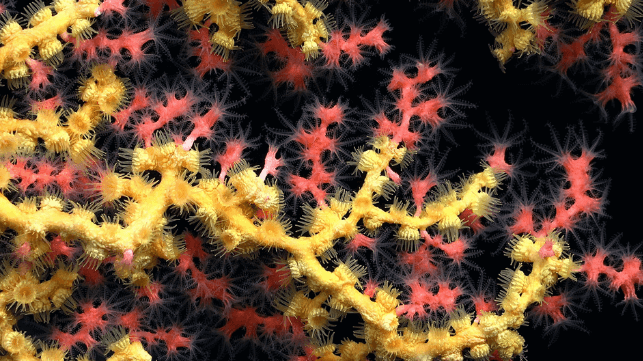
Bubblegum coral (Paragorgia) covered with yellow Midas touch (Parazoanthidae). These species, found in the Nazca Ridge, are vulnerable to bottom trawling. (Schmidt Ocean Institute, CC BY NC SA)

Published Apr 11, 2025 10:56 PM by Dialogue Earth


[By Felipe Paredes]

Hidden beneath the vast expanse of the Southeast Pacific Ocean are underwater mountain chains that are among the most ecologically rich places on Earth.

Stretching almost 3,000km from Rapa Nui in the South Pacific towards the coasts of northern Chile and southern Peru, the seamounts of the Salas y Gómez and Nazca ridges support over 90 species that are considered endangered, near threatened or vulnerable to extinction, including sharks, seabirds, whales, turtles and corals.

These peaks boast the highest ever recorded levels of marine endemism – meaning species found there and nowhere else. They are vital breeding and nursery grounds for marine life, including commercially important jack mackerel and Humboldt giant flying squid, and hold deep cultural significance for island communities in the Pacific.
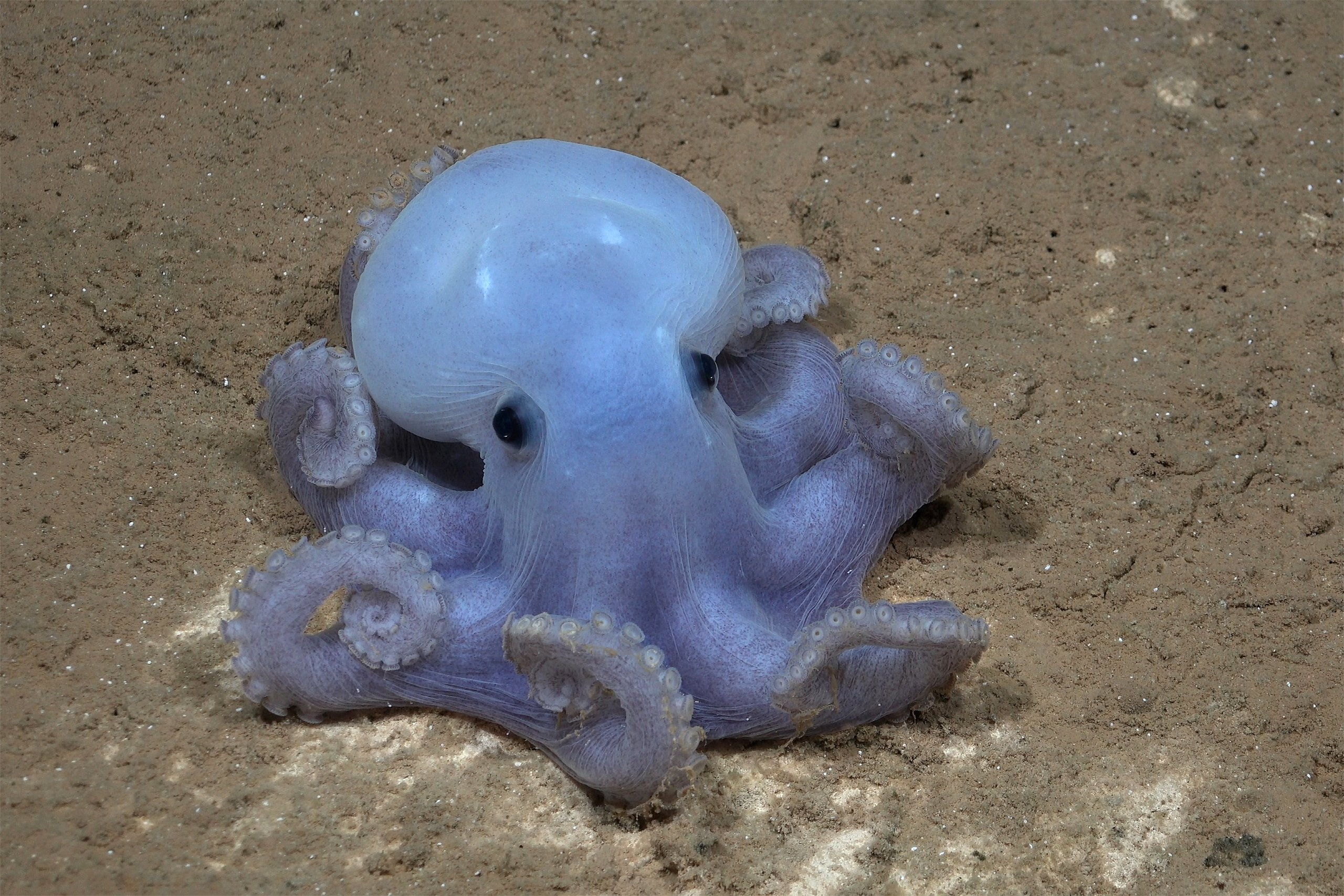
A rare species nicknamed the Caspar octopus but not yet scientifically described, seen on the Nazca Ridge. The area boasts exceedingly high marine endemism, meaning species found only there (Image: ROV SuBastian / Schmidt Ocean Institute, CC BY NC SA)

Despite their remoteness, these ecosystems are under siege. Industrial fishing, including bottom trawling, threatens to strip these biodiverse waters of life before they can be fully studied or protected. Politicians and campaigners have made strides toward moving the conservation of these underwater sanctuaries higher up the agenda. But without urgent action, they could be lost forever.

A turning point in ocean protection

At a recent meeting of the South Pacific Regional Fisheries Management Organisation (SPRFMO) in Santiago, governments took a step forward by agreeing a plan to secure protection for this biodiversity hotspot. But the process remains slow. 

The SPRFMO is an intergovernmental body established in 2012 to ensure the sustainability of fish stocks and the responsible use of marine resources. It sets catch limits, monitors fishing, and conducts scientific research.
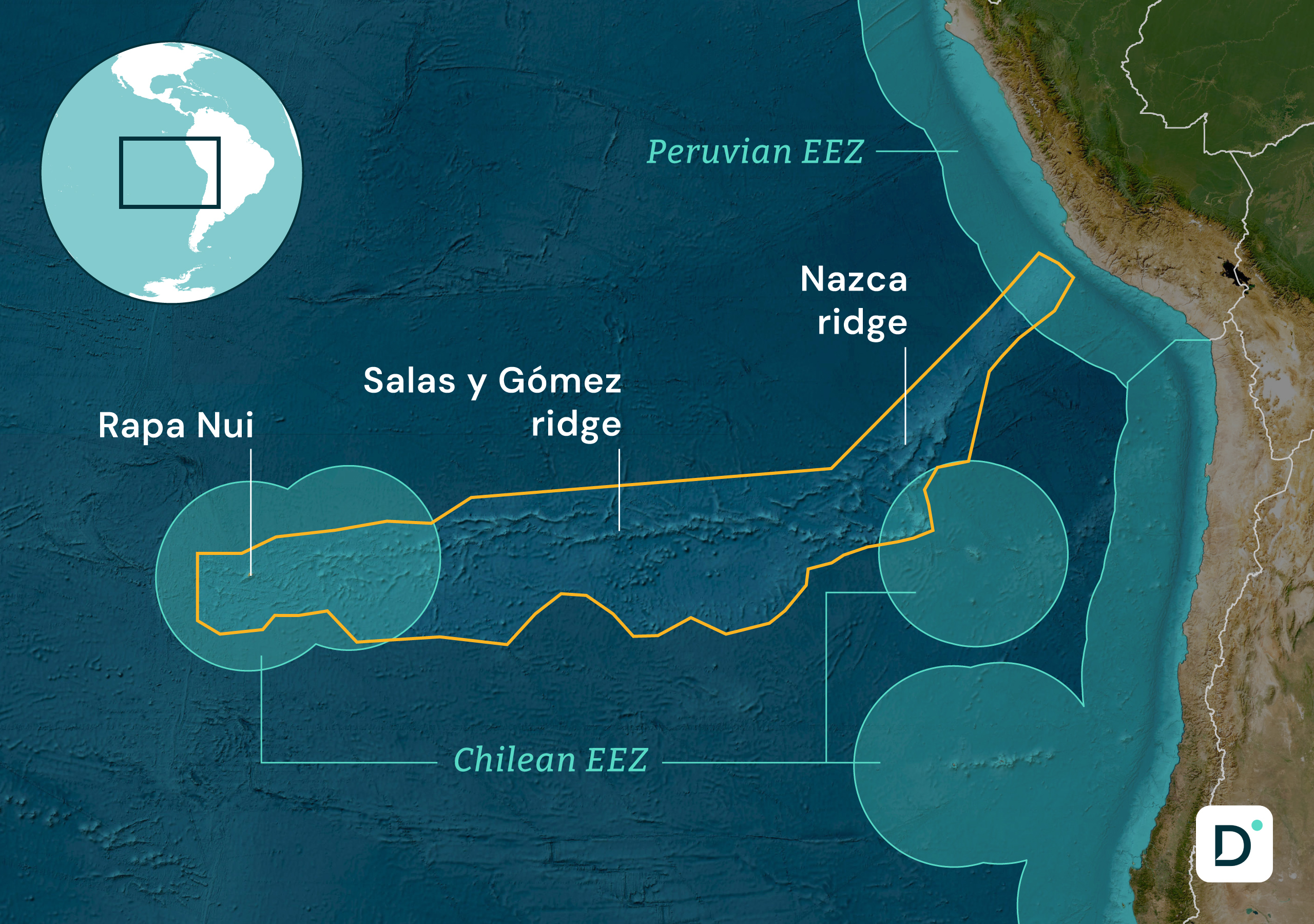
(Map: Dialogue Earth)

The Chilean government has already pledged to protect the ridges that lie within its national waters, designating large-scale marine protected areas (MPAs) that cover the most critical areas. Now, it is advocating to conserve the majority of the Salas y Gómez and Nazca ridges. These ridges lie within the shared high seas, beyond any nation’s jurisdiction, and are overseen by the SPRFMO.

This effort, backed by the Coral Reefs of the High Seas Coalition, whose members include Oceana (where I work), Conservation International, the Center for Ecology and Sustainable Management of Oceanic Islands and other NGOs, sets a precedent for broader high seas protection efforts. The first critical step would be a fisheries closure, which will pave the way for these ridges to become a high seas MPA in the coming years.

A path to protection in the South Pacific

The Chilean government called for the protection of the ridges in 2021. By 2022, it formally proposed a permanent fishing ban at SPRFMO covering both jack mackerel and Humboldt flying squid. The proposal was analysed during a 2024 SPRFMO meeting in Ecuador and, in a significant step forward, a mandate was agreed for the group’s scientific committee to “compile and review all relevant scientific information and data about the area and recommend possible measures”.

A task team is now working to assemble this information, with the support of the Coral Reefs of the High Seas Coalition. Based on the task team’s analysis, the scientific committee will recommend options for conservation measures, including a fisheries closure. The SPRFMO commission itself will need to decide and approve one of the options.

At the 2025 SPRFMO meeting in Santiago, the commission agreed to make a decision by 2026 on the management of the region, including the fisheries closure originally submitted by the government of Chile.

But we need rapid action to safeguard this special environment beneath the ocean’s surface. With each expedition to the region, new species are discovered and we learn more about how critical the ecosystem is to planetary health. It is our mission to ensure that the Salas y Gómez and Nazca ridges, despite being out of sight, are not forgotten in talks that determine their future.

We are pouring our efforts into helping the work of the task team, with support from our regional research partners, so the scientific committee understands the urgent need for protection.

The 2026 deadline for a management decision cannot be missed, and governments must involve their best scientists in the process.

Bridging policy, conservation and industry

The ocean is so vast, productive and biodiverse that we have enough space to have both healthy fisheries and an important portion designated as MPAs, which, in turn, help fisheries. The safeguarding of ecosystems supports nature, climate regulation, coastal communities and livelihoods.

The SPRFMO is more than just a policy forum. It’s a space to show that conservation and sustainable fishing can go hand in hand on the high seas. These efforts must not be seen as opposing forces.

The High Seas Treaty, agreed in 2023, is a historic milestone that will enable us to designate MPAs in all of the oceans worldwide beyond national jurisdiction. For it to enter into force and become international law, the treaty must be ratified by 60 countries. Currently, 21 nations have done so. A growing and united community of NGOs have joined forces in a campaign, Together for the Ocean, that calls for governments to commit to ratify it by June, coinciding with the landmark UN Ocean Conference in France. 

The high seas cover 43% of our planet and their protection, as MPAs or other effective area-based conservation measures (OECMs), is essential in achieving the globally agreed goal of protecting at least 30% of the ocean by 2030 (also known as 30×30). We’ve witnessed a surge in commitments, yet only 8.3% of the world’s ocean is currently designated as protected. Most of it is either protected in name only or so loosely regulated that substantial harmful activities are often allowed to continue. 

Nations must now follow through on their 30×30 pledges to implement effective ocean protection measures, prioritising the most ecologically and biologically significant areas.

That is exactly what we are working toward now: bridging policy, conservation and industry to protect the Salas y Gómez and Nazca ridges. 

We are calling on governments to take bold, science-led steps to secure lasting protection for these irreplaceable underwater havens for biodiversity – starting with a fisheries closure in early 2026, followed by urgent action to deliver MPA designation under the High Seas Treaty. 

Felipe Paredes is director of habitat protection campaigns at Oceana in Chile and a marine biologist with more than 20 years of experience in scientific research, education and marine conservation public policy.

This article appears courtesy of Dialogue Earth and may be found in its original form here

The opinions expressed herein are the author's and not necessarily those of The Maritime Executive.
 ALT. FUELS

Port of Rotterdam Hosts Pilot to Test Steps for Ammonia Bunkering

Rotterdam ammonia bunkering pilot
Ammonia bunkering pilot at the Port of Rotterdam (Bob van Bruggen photo courtesy of Port of Rotterdam Authority)

Published Apr 14, 2025 8:15 PM by The Maritime Executive


The first test steps were undertaken at the Port of Rotterdam to test the port’s capabilities for future ammonia bunkering operations. Rotterdam is the world’s second-largest bunker port and expects that ammonia-fueled vessels requiring bunkering will begin in 2026 or 2027. It looks to build on its existing efforts for LNG bunkering and now methanol to prepare for the future alternative fuel.

The port highlights that the safety protocol levels were raised to prepare for the test. The port has already implemented assessment tools so that it is fully ready for LNG and now methanol. Port officials said the raised levels and testing of the process will ensure it is prepared for bunkering of the first ammonia-fueled vessels.

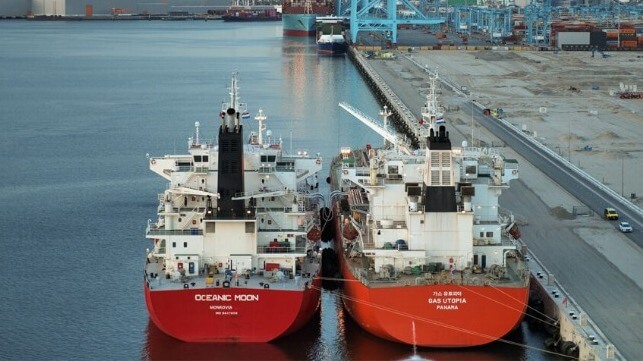
The pilot on April 12 involved transferring 800 cubic meters of liquid, cold ammonia at -33 degrees Celsius between two ships. It took about 2.5 hours and was conducted alongside a new quay at the Maasvlakte 2 APM terminal. For this test grey ammonia was used but the port anticipates that clean (low carbon) ammonia will be used when the bunkering operations begin. They noted that the gray ammonia shares the same chemical properties as the future clean product helping to test the protocols.


Various parties collaborated on the pilot, facilitated by the Port of Rotterdam Authority. OCI, owner and operator of the port’s ammonia terminal, partnered with Trammo, which supplied the two tankers carrying OCI’s ammonia. James Fisher Fendercare provided equipment and expertise to ensure the safe execution of the ship-to-ship transfer at the berth location provided by APM Terminal. Bunker barge operator Victrol shared its bunkering expertise during the preparation of the pilot. The DCMR Environmental Protection Agency, Rijnmond Safety Region (VRR), and the Joint Fire Service (GB) were involved to ensure the pilot was conducted safely and smoothly.

Rotterdam’s test followed a similar testing process that was carried out last year in Singapore. Fortescue’s converted offshore support vessel received the first bunkering as the Maritime and Port Authority tested its protocols and certified the vessel. In Japan, they are using tanker trucks to fuel the world’s first tugboat using ammonia. Demonstrations of the tug have been undergoing in Tokyo Bay with it supporting ship traffic after having operated for a decade as an LNG-fueled tug.

DNV calculates that there are currently 33 vessels on order due for delivery in the next four years that will be capable of sailing using ammonia as a fuel. CMB.TECH and Fortescue announced a deal today, April 14, for the Australian mining company to use one of the Belgian company’s first ammonia-fueled Newcastlemax bulkers due for delivery in 2026. Mitsui O.S.K. Lines has also announced that it will co-own and operate three of the 210,000 dwt ammonia-fueled bulkers. 

Developing the infrastructure for bunkering is a critical step. Last year, Fortescue complained that it could not demonstrate its vessel on ammonia due to a lack of infrastructure and enable regulations. The companies look at their current efforts as pioneering and contributing to the development of the infrastructure needed to encourage the industry to accelerate the conversion to ammonia as one of the alternative fuels.


Fortescue to Operate Ammonia-Fueled Ore Carrier from CMB.TECH

ammonia dual-fuel bulker
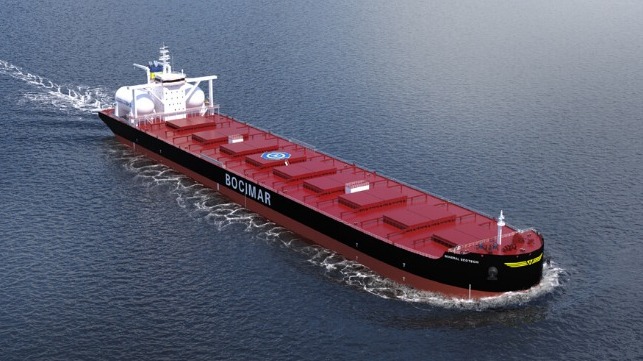
Fortescue looks to pioneer with one of the first ammonia dual-fuel bulkers developed by CMB.TECH with WinGD engines (CMB.TECH)

Published Apr 14, 2025 4:41 PM by The Maritime Executive


 Australian mining giant Fortescue and the Saverys family’s CMB.TECH signed a charter agreement which the companies are calling a landmark in the efforts to accelerate the deployment of ammonia-fueled vessels and the decarbonization of large, long-distance vessels. Fortescue will deploy one of the fleet of 210,000 dwt ammonia-fueled bulkers currently being built by CMB.TECH.

Bocimar, the bulker operator under the CMB.TECH umbrella reported in 2023 that it was working with WinGD to co-develop large ammonia-fuelled engines. The companies said they were aiming to install the ammonia dual-fuel X72DF engine on a series of 10 bulk carriers to be built at a Chinese shipyard in 2025 and 2026. By the end of 2023, they had progressed in announcing an agreement with CSSC Qingdao Beihai Shipbuilding (QBS) to build the vessels and engine builder CSSC Engine Co (CSE) to construct China’s first ammonia dual-fuel engines.

The project was based on WinGD’s X92B engine, which they said would be an ideal starting point for developing large-bore ammonia-fueled engines. The design was for a 72-bore ammonia engine operating using high-pressure fuel injection with a small portion of pilot fuel.

“Our landmark agreement with Bocimar sends a clear signal to the market – now is the time for shipowners to invest in green ammonia-powered ships. The days of ships operating on dirty bunker fuel, which is responsible for three percent of global carbon emissions, are numbered,” said Dino Otranto, CEO of Fortescue Metals. “We will continue to work with like-minded companies like Bocimar to transition our fleet to low and zero-emissions vessels and help accelerate the widespread adoption of green ammonia as a marine fuel.”

The vessel is expected to be delivered by the end of 2026. Will be a dual-fuel Newcastle bulker. It will be employed to transport iron ore from the Pilbara region of Australia to customers in China and around the world.

Alander Saverys who is a strong advocate for decarbonization and at the forefront for ammonia and hydrogen-fueled vessels called the deal the “beginning of an exciting journey to build more ammonia-powered ships.” He believes that it will “stimulate more green ammonia production projects.”

Fortescue launched the first ammonia dual-fuel vessel last year with a converted offshore support vessel which also conducted the first ammonia bunkering operation in Singapore. The vessel went through extensive testing as part of a certification progress in Singapore. The vessel sailed to London in early March to call attention to ammonia ahead of the recent IMO meetings and according to the company will soon embark on a tour of global ports.

The agreement with Fortescue follows a deal between CMB.TECH and Mitsui O.S.K. Lines announced in March that the Japanese shipping company would jointly own three of the 210,000 dwt bulk carriers. It will take the three vessels on a long-term charter for operations and also plans to build six chemical tankers. Two of the vessels will be ammonia-fitted on delivery and the other four will be built ammonia-ready with delivery between 2028 and 2029.


Crowley Adds First New LNG-Powered Ship for Caribbean and Central America

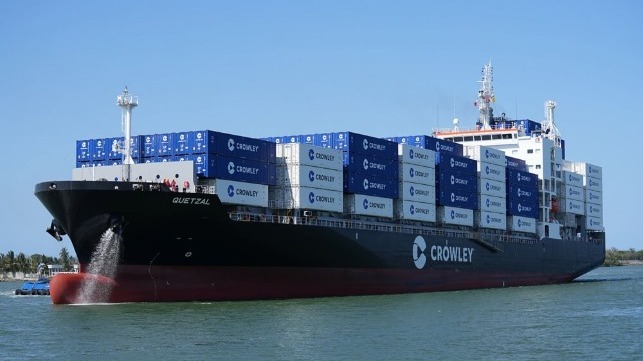
The newly-delivered Quetzal (Crowley)

Published Apr 14, 2025 6:45 PM by The Maritime Executiv


U.S. logistics company Crowley has begun operations with the first of its new LNG-powered boxships for operation in the Caribbean and Central American market. 

The newly-delivered Quetzal is a 1,400 TEU feeder powered by dual-fuel LNG propulsion. The design is fitted to accommodate high volumes of reefer cargo for the region's busy cold chain trade, capable of handling 300 reefer unit plugs. Flexibility for a variety of cargo types and sizes was at top of mind during the design process, including breakbulk cargoes.  

Crowley’s "Avance-class" ships are built with high pressure ME-GI engines from MAN, which greatly reduce methane slippage and make the four ships the most environmentally efficient in their category, according to Crowley. 

Quetzal's first commercial port call was at Santo Tomas, Guatemala on April 11-12. Like her sisters, she is owned by Singapore's Eastern Pacific Shipping and built at Hyundai Mipo, and she is flagged with the international registry of Liberia.

"Quetzal and the Avance Class ships represent the next generation of Crowley’s innovation and leadership in supply chain solutions for international shipping in the Caribbean Basin," said Tom Crowley, Chairman and CEO. "The vessels provide frequent service and greater capabilities to deliver cargo at peak timing while carrying forward Crowley’s high operational standards. With the company’s decades of service in Central America and the Dominican Republic, the Avance Class is a strategic investment by Crowley in the future of this international trade."


US Navy Deploys a Third Destroyer to Defend Southern Border

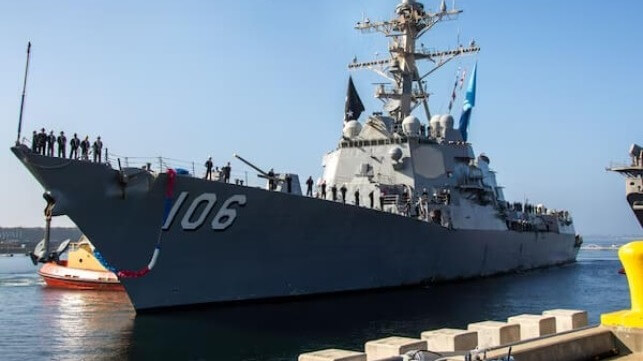
USS Stockdale at San Diego, Feb. 2025 (USN)

Published Apr 13, 2025 3:27 PM by The Maritime Executive


The U.S. Navy has deployed another Arleigh Burke-class destroyer to patrol waters around the U.S. southern border, the third announced in a month. The previously-deployed destroyer USS Spruance (DDG 111) will return to port. 

USS Stockdale, a veteran of the Red Sea maritime security campaign, departed San Diego on Friday to perform duties in support of border security. President Donald Trump has ordered a surge of military and civilian assets to support border enforcement and deportation operations, drawing on personnel and equipment from the U.S. Coast Guard, the U.S. Army and Navy, the FBI and the Bureau of Alcohol, Tobacco and Firearms. Stockdale and other Navy vessels with law-enforcement missions ship out with embarked Coast Guard boarding teams (LEDETs), with personnel who have the training and legal authority to perform routine arrests. 

Stockdale deployed to 5th Fleet and 7th Fleet last year in support of the campaign to defend shipping from Houthi attacks, and spent seven months away from home port. While she was in 5th Fleet, Stockdale repelled "multiple Iranian-backed Houthi attacks" in the Strait of Bab el-Mandeb and escorted U.S.-flagged ships through the Gulf of Aden. She also joined the Abraham Lincoln Carrier Strike Group for part of the tour. Her crew engaged the full spectrum of Houthi threats, including drones, antiship ballistic missiles and antiship cruise missiles. 

After transiting a total of 44,000 nautical miles, Stockdale returned to San Diego on February 21, and has now departed on mission again after seven weeks in port. 

"Stockdale’s departure reinforces the Navy’s role in the Department of Defense’s coordinated efforts to comply with the [presidential] order," the Navy said in a statement. 

Indirectly, the destroyer deployments illustrate the cost-effectiveness of Coast Guard vessel platforms for low-end interdiction missions. Whether operating in U.S. coastal waters or deploying to the Persian Gulf, coast guard cutters go to sea without a surface combatant's massive overhead: running an Arleigh Burke-class destroyer requires salaries and training for 300 crewmembers, plus parts and maintenance for an advanced air defense radar, sonar system, Aegis combat system, and the most sophisticated assortment of missiles found on any surface combatant. The U.S. Navy estimates that the total operating costs of one destroyer exceed $220,000 per day.