Monday, May 12, 2025

UK to argue F-35 export outweighs Gaza genocide risk in landmark case

London is facing a High Court case over allegations that its continued export of F-35 fighter jet components to Israel breaches domestic and international laws.


The New Arab Staff
12 May, 2025


The government's legal argument centres on the claim that any disruption to the F-35 supply chain would damage NATO's security [Getty]


The UK government is set to argue in a landmark High Court case that preserving Britain's role in the global F-35 fighter jet programme takes precedence over compliance with domestic arms export laws or any legal duty to prevent genocide in Gaza.

The four-day hearing, beginning on Tuesday, will test whether ministers acted unlawfully by continuing to supply parts for F-35 jets that may be used by Israel in its ongoing assault on Gaza.

The case has been brought by Palestinian human rights organisation Al-Haq, and is backed by leading UK-based groups including Amnesty International, Human Rights Watch, Oxfam, and the Global Legal Action Network (GLAN).

The government's legal argument centres on the claim that any disruption to the F-35 supply chain would damage NATO's security, the Guardian reported on Monday.

Britain supplies around 15 percent of the jet's value, including ejector seats, rear fuselage parts, targeting lasers, and other components primarily through BAE Systems. It is the second-largest contributor to the F-35 programme after the United States.

Government lawyers acknowledge that UK arms export laws prohibit supplying equipment where there is a clear risk of it being used to commit serious violations of international humanitarian law.

However, they argue that parts are supplied to a global stockpile, not "directly" to Israel, and that halting the supply could harm UK credibility within NATO and damage relations with the US.

In submissions to the court, Defence Secretary John Healey claimed that suspending exports would have a "profound impact on international peace and security", and that such a move could undermine US confidence in the UK at a "critical juncture in our collective history.” He further warned that adversaries could “take advantage of any perceived weakness".

GLAN lawyer Charlotte Andrews-Briscoe, representing Al-Haq, said the UK's continued support for the F-35 programme has enabled Israeli attacks on Gaza with "catastrophic and continuing" consequences.

She cited more than 15,000 air missions by Israeli F-35s since 7 October, including the 18 March strikes that killed over 400 Palestinians in a single day, among them 183 children and 94 women.

Related
Oliver Mizzi

"These warplanes cause deaths and life-changing injuries," Andrews-Briscoe told the Guardian. "They also support ground troops that are intentionally starving an already decimated population."

She warned that the government's approach risks gutting the legal meaning of genocide prevention. "They’ve effectively said the Geneva Conventions have no domestic application unless an international court conclusively rules on genocide - something they admit could take years. If this argument is accepted, it would strip the duty to prevent genocide of any practical relevance."

Al-Haq's barrister Jennine Walker also criticised the government's reliance on national security arguments, saying: "Of course it is possible to stop British-made F-35 parts from reaching Israel without collapsing the entire programme. What really threatens international peace and security are these flagrant violations of international law."

Speaking to The New Arab, Campaign Against Arms Trade (CAAT)’s media coordinator Emily Apple said: "The government's position in this case is untenable, illegal and immoral. In continuing to supply F-35 spare parts through the global stockpile, it is breaking both domestic and international law.

"It is not disputed that there is a clear risk that Israel is using F-35s to commit war crimes, and that it is not committed to upholding international law. Yet this government is making the outrageous assertion that stopping the supply of F-35 parts would put global security at risk. However, ignoring the Genocide Convention, and ignoring domestic and international law, is the greatest threat to global peace and security we could possibly face."

Apple added that it was "a moral and legal outrage that this legal case is necessary", and accused the UK government of putting arms industry profits above Palestinian lives. "We hope this court case will finally end the UK’s complicity in Israel’s horrific war crimes," she said.

Related
Anam Alam

The case comes amid renewed attention to the UK’s military support for Israel. In September 2023, the government suspended 30 arms export licences just 90 minutes before a scheduled court hearing, but notably excluded F-35 parts from the suspension, arguing they were too critical to NATO to restrict.

Human Rights Watch UK director Yasmine Ahmed said the government had failed its responsibilities under the Genocide Convention.

"By 2 September, ministers knew over 41,000 Palestinians had been killed, including 15,000 children, and that 1.9 million people had been forcibly displaced. Yet they still maintained the supply of F-35 parts without even considering the risk of genocide," she said.
The strategic illogic of Israel's actions in Syria

Israel has adopted a more aggressive and high-risk approach that readily employs military force to escalate conflicts to reshape the regional balance of power


Analysis
Rob Geist Pinfold
12 May, 2025
THE NEW ARAB

For much of the international community, the jury is still out over Ahmed al-Sharaa’s near-transformation from jihadist revolutionary to Syria’s sober statesman.

Israel, by contrast, has long ago passed judgment on al-Sharaa and his administration, with Israeli ministers describing Syria’s interim president as “pure evil” and “an al-Qaeda terrorist.”

Since Assad’s regime fell, Israel has struck Syria an unprecedented number of times. Its troops have captured over 460 square kilometres of Syrian territory and on several occasions exchanged fire with and killed the territory’s residents.

Israel’s justifications for these actions are not credible. Its officials claimed that its expansion into Syria would be temporary. But Israel’s troops have pushed further into Syria, whilst Defence Minister Israel Katz later declared that the occupation would be “indefinite,” contradicting the earlier statements by his own officials.

In December 2024, Israel argued its airstrikes were necessary to eliminate the Assad regime’s conventional and chemical weapon stocks. Yet if this were true, why is Israel not only still striking Syria today, but escalating its attacks?

Equally implausible is Israel’s claim that its latest intervention in early May 2025 was to protect Syria’s Druze from a “pogrom” by al-Sharaa’s forces. What is true is that from 28 April, scores of Syrian Druze were killed. The attackers, though, were not the security forces, who later intervened to restore order, but primarily militias outside government control.

Despite Israel’s self-designated role as the protector of Syria’s Druze, most community leaders condemned the strikes. Druze leaders then reached a power-sharing agreement with Syria’s central government that restored a tentative calm.

But this did not stop Israel from launching the most extensive series of strikes this year so far. Gone were any pretences of targeting former regime installations or weapons caches. Israel’s attacks killed members of the security forces and deliberately struck just 500 metres from al-Sharaa’s presidential palace to “send a message” that it could “reach” Syria’s leader.

This episode reveals Israel’s true strategic logic in Syria. It sees al-Sharaa as a threat and is responding as it often does when it feels threatened, through military force and territorial conquest. This perception also informs its furtive objective: not to protect the Druze, but to exacerbate instability in Syria to keep the government and country as weak as possible.

On the face of it, none of this makes sense. Israel and the al-Sharaa government share common foes, most notably Hezbollah and Iran. There have been no attacks on Israel from Syria since Assad’s departure from the country. Al-Sharaa, in turn, has repeatedly stressed he does not seek conflict with Israel - words that Assad himself would rarely dare utter.

Why, then, is Israel determined to destabilise Syria? The roots of its policies there are little to do with what the al-Sharaa government does or does not believe and more a product of systemic changes in Israel’s foreign and security policy - its “grand strategy” - after 7 October.

Since Assad's regime fell, Israel has struck Syria an unprecedented number of times, while its troops have captured over 460 square kilometres of Syrian territory. [Getty]

Before the current regional conflict, Israel adopted a “better the devil you know” policy towards its neighbours. It was, in political science language, a “status quo power” that sought to freeze and perpetuate the Middle East’s balance of power.

Israel employed its qualitative military edge to “mow the lawn” and trim any threats to itself or the regional order down to size.

This was exceptionally bad if you were a Palestinian living under an indefinite Israeli military occupation. But it did mean that Israel was unlikely to start or escalate a regional war. Prime Minister Benjamin Netanyahu regularly advocated regime change in Lebanon, the Gaza Strip and Syria. Israel’s actions, however, did not match his bellicose rhetoric; Israel even helped supply fuel, energy and money to Gaza to keep Hamas’s impoverished regime afloat.

There was an underlying strategic logic to Israel’s tolerance of threats on its borders. In leaked remarks from 2019, Netanyahu claimed that “anyone who opposed” Palestinian statehood should support the status quo, because it kept the West Bank and Gaza divided.

That same logic worked in Syria. Israel tolerated the Assad regime because it was too weak and too illegitimate to pose a threat. Assad’s callous massacres of his own citizens ensured that any external pressure on Israel to return the Golan Heights - Syrian territory it captured in the ‘Six Day War’ of June 1967 - dried up overnight.

Conversely, after Russia’s intervention in the Syrian Civil War, Israel deemed the now propped-up Assad regime strong enough to keep both countries’ mutual border clear of any threats, such as jihadists or other militias.

But 7 October engineered a fundamental change in Israel’s grand strategy. In response to its colossal intelligence failure, Israel adopted a more aggressive and high-risk approach that readily employed military force to escalate conflicts in order to reshape the regional balance of power.

This is as evident in Syria as it is on any of Israel’s borders. Finance Minister Bezalel Smotrich recently boasted that Israel will strike Syria until the country is “partitioned” and effectively ceases to exist.

In May 2025, an Israeli soldier serving in the Golan ominously warned that the distance between the Syrian city of Quneitra and an Israeli kibbutz “is about five minutes.” The Israeli media article that the quote appears in describes the Israel-Syria border as “an illusion of calm”.

Related
Post-Assad Syria
Mawada Bahah

The implication here is obvious: another 7 October awaits on Israel’s border with Syria. The only way to stop it is through a buffer zone (read: occupation) and pre-emptive military force.

This is the real reason why Israel is destabilising Syria. This is an outcome that is eminently achievable, given that Syria is already unstable. Yet it is also a poor one in that it is a self-fulfilling prophecy.

Israel is repeatedly striking Syria and expanding its occupation because it fears al-Sharaa’s government and Turkey’s influence in the country. But it is these actions that are putting it on a collision course with both Turkey and the new Syrian government.

At the time of writing, Israel’s strikes have relented after talks with Turkey. Al-Sharaa even admitted to a UAE-sponsored backchannel between his government and Israel that has sought to simmer down tensions. Yet the backchannel has existed since 13 April and failed to stop Israel’s recent escalation.

The same is true of Israel’s “deconfliction” agreement with Turkey that both sides instituted in early April. Equally, given that all the conditions that drove Syria’s recent internecine conflict remain - poverty, sectarian tension and the lack of a strong central government - it may only be a matter of time before another outbreak of violence occurs.

If and when it does, Israel will likely use it as an excuse to intervene and create more chaos.

Rob Geist Pinfold is a Lecturer in Defence Studies (International Security) in the School of Security Studies at King's College London. His book, Understanding Territorial Withdrawal: Israeli Occupations and Exits, was published by Oxford University Press in 2023
Engulfed in paranoia Israel sets stage for Gaza 'final solution'

Setting the wildfires aside, Israel and its society must confront the crimes, both ecological and engineered, it is committing in Gaza, writes Alex Foley.


Alex Foley
09 May, 2025


The settler-colony is known for its siege mentality, a product of, depending who you ask, either its being surrounded by hostile neighbours or the latent knowledge of the mass graves under its beaches, writes Alex Foley [photo credit: Getty Images]


On the evening of April 29, a spasm of panic broke out at a Memorial Day ceremony in Tel Aviv’s Habima Square. Ushers at the event were arrested after someone pointed out the “suspicious individuals wearing vests” to police. The arrests cause attendees to flee. Video footage shows crowds running from the square in a near-crush that left twenty injured. Rumours began circulating of gunfire, which the police later had to quell.

The next morning, Israel was burning. According to Israeli fire services, a fire broke out near the Mesilat Zion settlement near Jerusalem, and was quickly blown by strong winds first West, then eastward, causing fears they would reach Jerusalem itself.

By the end of the week, with help from Italy, Croatia, and North Macedonia, firefighters had largely managed to control the blaze, but not before it had consumed over 6,000 acres of land.

On the face of it, these were two independent events connected only temporally. But as I watched footage of the fires my mind went to Joan Didion’s 1968 essay The Santa Anas, a meditation on the katabanic wind event that occurs when high-pressure air masses from over the Great Basin and the Mojave Desert drive down the mountains into low-pressure areas over the Pacific.

These hot winds, Didion understood, bring not only a risk of wildfires, but a mood, a general agitation that makes classrooms unmanageable and drives people to murder or suicide. “The wind,” she writes, “shows us how close to the edge we are.”

In Didion's essay, she name-checks a number of other similar foehn winds, including the khamsin winds of Egypt and the Levant. Perhaps, then, a similar agitation had blown over the crowds at Habima Square the night before the fires broke out.

Israel has certainly been close to the edge for a while. It is easy to forget, with the intervening genocide, how precarious the situation in Israel was before the Al-Aqsa Flood. People were openly discussing the “curse of the eighth decade,” the tendency of Jewish states to begin collapsing around 80 years into their existence. Months before October 7, I had the displeasure of being stuck in a room with a prominent Zionist figure as she expressed her feelings that the only thing that could keep Israeli society together was “an all-out war on the Arab nations.”

Israel is, at the best of times, a paranoid nation. The settler-colony is known for its siege mentality, a product of, depending who you ask, either its being surrounded by hostile neighbours or the latent knowledge of the mass graves under its beaches. It did not take long for a paranoid discourse to take hold in relation to the fire.

Yair Netanyahu, son of the Prime Minister, announced on X (Twitter) that, “Something here is suspicious,” and intimated that the Israeli left could be behind the fires in a plot to stop “Independence Day” celebrations.

Elsewhere, predictable claims that the Arabs were responsible came thick and fast while authorities stressed they were still investigating the cause, though they made arrests of suspects. Some inverted, with glee, the usual line around indigeneity and who respects the land, conveniently ignoring the total destruction of the South and West in Gaza.

In reality, the speed and ferocity of the fires were due, in large part, to settlement. Didion, the neurotic, was obsessed with infrastructure and wrote about LA freeways, aqueducts, shopping centres, urban sprawl, and the Hoover Dam as a means of keeping the chaos at bay.

She would likely have taken interest in Ghada Sasa’s explanations of how Israel’s efforts to “make the desert bloom” have contributed to the likelihood of wildfires. The large-scale planting of non-native trees like Australian eucalyptus and increased desertification of the Negev due to plantations has made the landscape a tinderbox.

Back in Didion’s native California, another set of embers have been catching, seeds of a coming inferno. Shaiel Ben-Ephraim, an Israeli academic and host of Israel Explained, took to Substack to announce he had, reluctantly, come to the conclusion that Israel is committing a genocide. In the lengthy piece, he outlines how he came to the conclusion that Israel’s assault on Gaza was not being carried out for the stated aims, but rather to eradicate the Palestinians in part or in whole.

Crucially, much of the evidence he presents, especially the statements from Israeli politicians, date from the early days of the genocide. The argument he constructs for dolus specialis, or specific genocidal intent, is based on a pattern of Israeli actions spanning the decades since its inception. The question that presents itself, then, is what changed for him now?

After all, he spent the first year and a half of the genocide engaging in the classic “liberal Zionist” two-step, vacillating between expressing horror over the violence necessary for Israel’s existence and outright atrocity denial.

Back in January of last year, under a video of women and children being forced to flee, Ben-Ephraim commented, “Genocide [sic] are famous for allowing people to leave for their own safety.”

After Aaron Bushnell’s self-immolation, he said, “The American left is solely responsible for his death,” for having pushed the “lie” of genocide. “Your cheap propaganda killed a gullible and mentally disturbed individual.”

Most egregious, in response to a now deleted photo of Sidra Hassouna’s body, the 7-year-old girl who was found hanging from a wall following an Israeli air strike, both her legs shorn from her body, Ben-Ephraim said, “Nice AI bullshit.”

None of this stopped Owen Jones from hosting him on his YouTube channel for what he described as a “robust interview.” The ethics of giving a platform to this man for his image rehabilitation given the above could be the subject of its own piece. Ben-Ephraim seems largely lacking in contrition; when Jones pressed him on his past accusations of “blood libel” towards those calling out the genocide, he claimed he believes that was still an accurate description in many instances.

However, the interview does get to the question of why now. At the beginning of the video, Ben-Ephraim states that one of the things that pushed him over the line was the polarisation forming within his “moderate” sources in the Israeli military between those who began blowing the whistle that the IOF was carrying out mass death atrocities and those who were spouting increasingly genocidal rhetoric.


Gaza War
Alex Foley

This tension will presumably only worsen as Israel moves to enact its forced displacement campaign, “Gideon’s Chariots,” likely the final act of the genocide.

Self-professed liberals, like Ben-Ephraim, will have to contend with the crimes committed for their benefit. There is an open-ended question as to how to react to those who have, like Shaiel, come to the realisation this late in the game, but it is certain that more and more will come.

Already, the Israeli army is facing a crisis of huge numbers of reservists refusing to show up for military service. The Shin Bet has announced they are increasing security measures for Netanyahu at public events in response to increasing political tensions.

The winds appear to have blown in pre-October 7 discontent, along with some other anxiety about the edge on which Israel is perched. In the crackle of the blaze was the echo of the final moments for Shaban al-Dalou and the countless others Israel has burned alive.

As the old spiritual says, "God gave Noah the rainbow sign / No more water, the fire next time."


Alex Foley is a researcher and painter living in Brighton, UK. They have a background in molecular biology of health and disease. They are the co-founder of the Accountability Archive, a web tool preserving fragile digital evidence of pro-genocidal rhetoric from power holders.
Follow them on X: @foleywoley
Susan Sarandon, Frankie Boyle, and Lindsey Hilsum among 600 media figures urging BBC to air shelved Gaza medics documentary

Over 600 media figures have called on the BBC to air a shelved documentary about Palestinian medics under Israeli fire.


Sarah Khalil
12 May, 2025
THE NEW ARAB


The signatories of the letter urging BBC to air the documentary on Gaza's medical workers include Oscar-winning actor Susan Sarandon [Getty]

More than 600 leading figures from the media, arts, and cultural sectors have signed an open letter demanding that the BBC immediately broadcast 'Gaza: Medics Under Fire', a completed yet unaired documentary exposing Israeli attacks on Palestinian healthcare workers in Gaza.

The signatories include Oscar-winning actor Susan Sarandon, comedian Frankie Boyle, Channel 4's news editor Lindsey Hilsum, and more than a dozen current BBC staff. They accuse the broadcaster of suppressing the film for political reasons, despite it having already undergone months of editorial reviews and fact-checking.

"This is not editorial caution. It's political suppression," the letter states, calling out what it describes as a double standard when it comes to Palestinian testimony. "Every day this film is delayed, the BBC fails in its commitment to inform the public, fails in its journalistic responsibility to report the truth, and fails in its duty of care to these brave contributors."

The documentary, produced by Basement Films and directed by an award-winning team including Ben de Pear, Karim Shah, and Ramita Navai, focuses on Palestinian medics working under fire during Israel's ongoing assault on Gaza.

It features eyewitness accounts from frontline doctors and nurses who describe treating the wounded in overwhelmed hospitals and targeted clinics.

British filmmaker Sophie Binyon told The New Arab that several independent and prominent journalists had exposed the BBC's clear bias in covering Gaza over the past 19 months and that the findings were "damning".

Binyon referenced the BBC's recent decision to pull the Gaza documentary 'Gaza: How to Survive a War Zone', after it was revealed that one of the 13-year-old narrator was the son of a "Hamas official" in a move widely criticised as a disturbing precedent for censoring Palestinian narratives based on family affiliations.

"The BBC's self-preservation at Portland Place has overtaken its duty to report the truth. It's disgraceful," Binyon added.

An internal source at the BBC, who asked to remain anonymous due to fear of professional repercussions, told TNA that the current controversy reflects long-standing internal concerns:

"This isn't an isolated incident. Many filmmakers and journalists who have worked with the BBC have long encountered similar patterns - stories reshaped, voices sidelined, and editorial decisions made to appease political sensitivities rather than serve the public," the source sad.

"This moment reveals a deeper structural problem: who gets to tell the story, whose pain is seen as legitimate, and which narratives are allowed to reach the screen."

Also among the signatories is veteran documentary filmmaker Ruhi Hamid, who emphasised the stakes involved in reporting from conflict zones like Gaza.

"As a documentary filmmaker, I know how much work, risk, and responsibility go into telling the truth – especially in places like Gaza," she said.

"When the BBC chooses to suppress a film that highlights the lifesaving work of doctors under siege, it doesn’t just fail the filmmakers. It fails the public."

Documentary editor Rose Glandfield added: "As a Jewish woman from a family of pacifists, I was raised with the belief that our humanity is defined by how we respond to the suffering of others. Bearing witness to injustice and standing up for those in danger is not only a moral imperative - it is part of who I am."

The advocacy group Health Workers 4 Palestine has also condemned the delay, warning that it obscures critical evidence of violations of international humanitarian law and undermines accountability efforts.

Basement Films confirmed it was still waiting for a release date.

"We gathered searing testimony from multiple Palestinian doctors and health care workers," the team said. "We are desperate to tell the surviving doctors and medics when their stories will be shared."

The letter, addressed to BBC Director-General Tim Davie, ends with a call for the broadcaster to honour its public service mandate and broadcast the documentary without further political interference.
Hundreds march in West Bank against Israel's killing of medics

Hundreds of Palestinian Red Crescent staff marched in the occupied West Bank city of Ramallah on Monday to protest Israel's killing of medical workers.


The New Arab Staff & Agencies
12 May, 2025


Israeli forces have killed 1,400 humanitarian and medical workers since the beginning of the war. [Getty]

Hundreds of Palestinian Red Crescent staff marched in the occupied West Bank city of Ramallah on Monday to protest Israel's killing of medical workers in Gaza over the past 19 months of war.

Gathering in the city's Clock Square, medical personnel, support staff and volunteers wore white and orange vests and waved flags bearing the Red Crescent's emblem.

The demonstration marked World Red Cross and Red Crescent Day, usually observed on 8 May, and called for the "protection for medical and humanitarian workers".

In a statement released Monday, the Red Crescent said 48 of their staff members have been killed in Gaza and the West Bank since the war began on 7 October, 2023 - including 30 who "were killed while performing their humanitarian duty wearing the Red Crescent emblem".

Protesters carried symbolic white shrouds bearing the names and pictures of the dead, as well as signs demanding the release of three staff members who have been detained by the Israeli army for over a year.

Israeli forces have killed 1,400 humanitarian and medical workers in Gaza since the beginning of the war, according to the statement, which added that "dozens of medical personnel working in Gaza... were detained while performing their humanitarian duties."

It highlighted a particularly deadly attack in March in the southern Gaza city of Rafah, when 15 first responders including eight Red Crescent paramedics were massacred by Israeli soldiers.

The first responders were answering distress calls after Israeli air strikes.

The incident drew international condemnation, including concern about possible war crimes from UN human rights commissioner Volker Turk.

An Israeli military investigation, the results of which were published, acknowledged "professional failures" and "violations of orders" during the shooting.

(AFP and TNA staff)


Israel’s total war on healthcare in Gaza is designed to deprive Palestinians of their means of survival

The endless slaughter of Gaza medics reveals the truth: Israel’s disregard for Palestinian life isn’t a mistake, it’s the strategy, says Ghassan Abu-Sittah.


Ghassan Abu-Sittah
12 May, 2025
THE NEW ARAB


The martyrs of the aid worker convoy massacre join over a thousand other healthcare and humanitarian workers killed by Israel in Gaza, writes Dr. Ghassan Abu-Sittah [photo credit: Getty Images]


In the last minutes before dawn, seven emergency response vehicles travel through Al-Hashashin, north of Rafah in Gaza. They’ve been called out to recover and treat casualties from Israeli fire overnight. The convoy stops and pulls over, its personnel get out to begin their work: “It looks like an accident”, one man says, as they reach the site of Israel’s overnight attack.

Within minutes, without warning, they are under fire. Shots from distance by Israeli troops kill some convoy members immediately. Others are found by approaching troops. They are then bound and later executed. Two paramedics are abducted from the scene and taken into detention.

Rifatt Radwan, of the Red Crescent, recorded his last moments before his execution by the Israeli troops. "There is no God but God, and Muhammad is his messenger. Forgive me, mother, because I chose this way, the way of helping people. Accept my martyrdom, God, and forgive me."

Fifteen paramedics and emergency personnel were killed during the massacre, including Palestine Red Crescent medics Mostafa Khufaga, Saleh Muamer and Ezzedine Shaath, first responder volunteers Mohammad Bahloul, Mohammed al-Heila, Ashraf Abu Labda, Raed al-Sharif and Rifatt Radwan.

Civil Defence Head of Mission Anwar Al-Attar was killed alongside his team members Fouad Al-Jammal, Yousef Khalifa, Zuheir Al-Farra, Sameer Al-Bahabsah, and Ibrahim Al-Mughari, as was one worker from the UN Relief and Works Agency.


In Gaza, Israel mark medics for murder

Their bodies were found four days after their killing, buried in a shallow grave along with their destroyed vehicles. Rifatt’s phone, and its recording of the team’s last moments, was found on his body. There were only two survivors, paramedic Munther Abed and ambulance driver Assad al-Nasasra, both of whom were beaten and detained – Assad for over five weeks.

The martyrs of the aid worker convoy massacre join over a thousand other healthcare and humanitarian workers killed by Israel in Gaza. These workers were killed in a deliberate nature: an ambush was set for them, in which they were trapped, before being executed and buried.

It took numerous days before a UN-led mission was able to find their bodies. Many other healthcare and aid workers have not been extended this ritual – they have been blown apart by American-made bombs, or sniped and left dead on the streets. Many hundreds more have been abducted. For some, including my friend Dr Adnan Al-Bursh, they have been killed by the torture inflicted upon them during their kidnapping.
Related


Gaza medic massacre
Mohamed Duar

Regardless of method, the effect of their killing is the same: Palestinians are deprived of those with the means and the expertise of saving lives. In murdering individual doctors or launching a total war on healthcare in Gaza, Israel intends to deprive Palestinians of the means of their survival.

These acts of genocide intend to erase Palestinian life and the evidence of its existence. Gaza’s hospitals, some of them older than the State of Israel itself, were filled with world-leading Palestinian healthcare specialists. Despite the siege, this system was built to the highest degree of excellence in care. These hospitals, despite the war against them, continue to treat and rehabilitate those whom Israel has attempted to murder.

The success of these facilities and the resilience of their doctors and emergency staff are a thorn in Israel’s side. The aid workers tirelessly, courageously recovering wounded or dead Palestinians, or the doctors and hospital staff who refuse to leave their patients — they are a nuisance and a problem for Israel. In a war of extermination, they are marked for killing.

But it matters, too, to see how these fifteen were killed, and the public display of their deaths. The occupying military knew that vehicles would be found. Their bodies were buried shallowly – the Israelis not even bothering to remove the hand-ties, which show that they were executed.

Their deaths and the manner of their killing serve as a spectacle, to show how little Israel cares for even its most liberal, soft-handed critics. They know that the lies spun about the incident – of ‘suspicious vehicles’ and ‘Hamas operatives’ – would not hold water, but that is not their purpose.
Related


Gaza War
Sally Ibrahim

A UN Commission identifies that the destruction of Gaza’s healthcare system amounts to a crime of extermination. The International Criminal Court indicts Israel’s leaders for depriving Palestinians of their right to health. The UK government calls for Israel to ‘adhere to international law’ – this massacre happens not in spite of but because of these developments.

To maintain its occupation, Israel needs to show that it does not care for its liberal critics or the language of humanitarianism they use. By making the display of their disregard for international law, for human decency, the occupier deprives its critics of the logic of their appeals for restraint.


The worse the atrocities, the less believable their excuses, the stronger their hand. Israel’s soft-handed critics in the UK, EU, and UN have not yet come to understand what genocide, extermination, military occupation, and settler colonialism mean. When they do, they will understand why these healthcare workers in Gaza were made to die in the way that they did.


Professor Ghassan Abu-Sittah is a renowned, multi-award-winning Plastic and Reconstructive Surgeon, internationally recognised as a leading expert in craniofacial surgery (facial deformities), aesthetic surgery, cleft lip and palate repair, and trauma-related injuries. A dedicated humanitarian, he has served as a war surgeon in several conflict zones, including Syria, Yemen, Iraq, South Lebanon, and the Gaza Strip.

Of British Palestinian heritage, he is the Clinical Lead for the Operational Trauma Initiative at the World Health Organisation’s EMRO Office and Professor of Conflict Medicine at the American University of Beirut. He also sits on the board of directors of INARA, a charity that provides reconstructive surgery to children injured by war in the Middle East, and on the Board of Trustees of Medical Aid for Palestinians, a UK-based organisation.

Follow Ghassan on X: @GhassanAbuSitt1


PRIVATIZATION BY ANY OTHER NAME

Iraq probes brutality in prisons after leaked TikTok videos of inmate abuse

"Militias control many Iraqi prisons," said a civil society activist, who asked not to be named. "The strong abuse the weak with impunity."

Dana Taib Menmy
Iraq
12 May, 2025
THE NEW ARAB


"Inmates buy drugs from staff, and others are bought and sold for systematic rape," Iraqi journalist Othman al-Mukhtar wrote on X social media platform. [AFP]

The Iraqi government has launched an investigation into alleged abuse at a Baghdad prison after leaked footage emerged online showing inmates being beaten, humiliated, and, according to activists, sexually assaulted by fellow detainees.

While The New Arab could not verify the footage, Iraq's justice ministry spokesperson Ahmed Al-Luaibi confirmed the incidents took place, telling state media that the videos, which surfaced on social platforms, were "mostly old" but did not specify when they were filmed.

Al-Luaibi added that the ministry had formed a committee to investigate the matter and would pursue legal action to deter further violations in the prison system.

The videos, reportedly recorded inside Taji Central Prison in Baghdad, appear to show prisoners from the capital assaulting fellow inmates from Najaf province. Activists allege the abuse included sexual violence, beatings with sharp objects, and sectarian insults.

Some of the inmates shown in the footage appear to be using mobile phones and posting content to social media platforms, including TikTok, raising concerns about security breaches and oversight failures inside Iraqi prisons.


The leaks have triggered widespread anger among the public and renewed criticism of Iraq's prison conditions, which rights groups have long described as overcrowded, poorly supervised and rife with abuse.

Justice Minister Khalid Shwani confirmed he dismissed the director of Taji Prison in January, around the time the abuses are believed to have taken place.

"Militias control many Iraqi prisons," said a civil society activist, who asked not to be named. "The strong abuse the weak with impunity. Even some prison officers fear intervening, knowing the consequences outside the prison walls."

Journalists and activists have described a climate of impunity and a lack of accountability.

"Inmates buy drugs from staff, and others are bought and sold for systematic rape," Iraqi journalist Othman al-Mukhtar wrote on X, formerly Twitter. "Some prisoners must pay for medicine, sunlight, or access to the Qur'an. If they don't pay, they're punished."

In parliament, MP Mukhtar al-Mousawi told local Iraqi media that the clips revealed "a serious failure in prison management". He questioned how inmates had gained access to mobile phones and warned that some may be using them to coordinate with outside networks, including criminal and militant groups.

"The inspection procedures are clearly insufficient," he said. "This level of internal collapse is a threat to national security."

Former MP and judge Wael Abdul Latif told Al-Rasheed TV that Iraqi prisons were in a state of collapse. "The Justice Ministry oversees food and services, but internal security falls under the interior and defence ministries," he said. "Sexual assaults, drug trafficking and mobile phone circulation are all criminal acts under Iraqi law—yet they are rampant."

A report by the Justice Network for Prisoners in Iraq, published in January, found that more than 80 percent of the country';s prisons and detention centres are unfit for human habitation. The report cited severe overcrowding, lack of medical care, and systemic mismanagement.

Earlier this month, Justice Minister Shwani told the Associated Press that Iraq's 31 prisons are holding approximately 65,000 inmates—double their intended capacity. "When we took office, overcrowding stood at 300 percent," he said. "After two years of reform, we've reduced it to 200 percent. Our goal is to bring that down to 100 percent by next year, in line with international standards."

He said thousands more detainees remain in the custody of security forces, awaiting transfer to the prison system once space is available. Four new prisons are under construction, while two have recently opened, and six others have been expanded.

Last week, two inmates escaped from Hillah Central Prison, south of Baghdad, in a separate incident that has raised further concerns about prison security in Iraq.

The scandal comes amid growing public anger over broader allegations of abuse by Iraqi law enforcement. Last month, the death of engineer Bashir Khalid ignited a fierce debate over police brutality, triggering protests and demands for urgent reform.
Southeast Asia, Australia, and the Trumpian Worldview

A conversation about the crisis of integrity with journalist Huw Watkin.


By Luke Hunt
May 12, 2025
The Diplomat


Huw Watkin chats with Thai troops on the country’s border with Myanmar.
Credit: Luke Hunt


Tragedy and major events have dominated headlines across Southeast Asia and beyond in recent months, including the civil war and earthquake in Myanmar, half-century commemorations marking the fall of Indochina to communism, and elections in Australia and Singapore.

Among the headline writers was veteran correspondent Huw Watkin, who began his career in journalism in Australia in the mid-1980s before moving to Asia where, over the course of three decades, he lived and worked in Cambodia, Thailand, Vietnam, Malaysia, and Hong Kong.

He is also the principal of Drakon Associates, a research and investigation consultancy focusing on the Asia Pacific. Now based in Australia, he continues to travel widely and writes about a range of subjects and issues from across the region.

Watkin returns to Beyond the Mekong for a conversation with The Diplomat’s Luke Hunt after they both traveled through Cambodia, Vietnam, and Thailand.

He says the crisis of integrity, which he spoke about at length during a previous podcast, has escalated in the West with the return to office of U.S. President Donald Trump, but this has provoked a backlash, evident at recent elections in Australia and Canada.

Rapidly developing nations in Southeast Asia, like Vietnam and Thailand, are also in focus with Asian and Western countries like Australia looking to bolster alternative trade destinations that bypass the U.S., as Trump imposes a new and harshly protectionist tariff regime.


Contributing Author
Luke Hunt is a Southeast Asia correspondent for The Diplomat. He has spent three decades working in the region and produces the Beyond the Mekong podcast. He can be followed on Patreon and X – formerly Twitter.View Profile
Despite doubts, international students eye US graduate school as enrollment dips under Trump

Students have expressed concern about securing visas, but most of the school's international students are from India and report they are getting appointments

(AP) Published 12.05.25


Representational Image Shutterstock

As he finishes college in China, computer science student Ma Tianyu has set his sights on graduate school in the United States. No country offers better programmes for the career he wants as a game developer, he said.

He applied only to US schools and was accepted by some. But after the initial excitement, he began seeing reasons for doubt.

First, there was President Donald Trump's trade war with China. Then, China's Ministry of Education issued a warning about studying in America. When he saw the wave of legal status terminations for international students in the US, he realised he needed to consider how American politics could affect him.

The recent developments soured some of his classmates on studying in the US, but he plans to come anyway. He is ready “to adapt to whatever changes may come," he said.

American universities, home to many programmes at the top of their fields, have long appealed to students around the world hoping to pursue research and get a foothold in the US job market. The durability of that demand faces a test under the Trump administration, which has taken actions that have left international students feeling vulnerable and considering alternate places to study.

“All of the Trump administration's activities have been sending a message that international students are not welcome in the US," said Clay Harmon, executive director of AIRC, a professional association for international enrolment managers at colleges.

Competitors see an opening to carve into US dominance

Around 1.1 million international students were in the US last year. A large decline in their ranks could cripple school budgets that rely on tuition from foreign students, who are ineligible for federal student aid and often pay full price to attend.

It's too early to quantify any impact from the administration's crackdown, which has included new scrutiny of student visas and efforts to deport foreign students for involvement in pro-Palestinian activism. But many fear the worst.

“Students and their families expect and need certainty,” said Fanta Aw, executive director and CEO of NAFSA, an association of international educators. “And they do not function well in a volatile environment like the one we have currently.”

The US has been rebounding from a decline in international enrolment that was exacerbated by the COVID-19 pandemic. As top competitors such as Canada, Australia and the United Kingdom rolled back recruiting efforts and made immigration policies less welcoming, the U.S. appeared ready to bring in far more students.


Now, a few months into the Trump administration, industry experts say it's unlikely the U.S. will be able to capitalize.

“The U.S. was so perfectly positioned to become the far and away, clear first-choice destination for international students,” said Mike Henniger, CEO of Illume Student Advisory Services. His company works with colleges in the U.S., Canada and Europe to recruit international students. "Then it just went out the door."

In Canada, where colleges saw enrolment increases during the first Trump administration, they are hoping for another bounce. In a letter following the recent election, a member organization for Canadian universities urged the new Liberal government to address immigration policies that have affected recruitment of foreign students.

“This is a moment of real opportunity for the country to attract international talent,” said Gabriel Miller, president of Universities Canada.


America's appeal as a place to start a career remains resilient

The US holds strong appeal for students prioritizing career outcomes, in part because of the “optional practical training” program, which allows foreign students to stay on their student visas and work for up to three years, said Lindsey Lopez of ApplyBoard, an application platform for students seeking to study abroad.

Graduates earning this post-college work experience were among the foreigners whose legal status or visas were terminated this spring.

Still, the diversity and size of the US job market could help American schools stay ahead of the competition, López said.

“The US is the largest economy in the world,” she said. “It's just the vastness and also the economic diversity that we have in the US, with a whole variety of different industries, both public and private, for students to choose from.”

William Paterson University, a public institution of 10,000 students in New Jersey, typically has around 250 international students. It expects an increase in foreign students in the fall, according to George Kacenga, vice president for enrollment management. The school has focused on designing programs around STEM majors, which appeal to international students because they open access to OPT programmes.

Students have expressed concern about securing visas, but most of the school's international students are from India and report they are getting appointments, he said.

In Shanghai, many students in Austin Ward's 12th grade class have either committed to attending U.S. colleges or are considering it. Ward teaches literature in a high school program offering an American Common Core curriculum for Chinese students.

Ward said he avoids discussing politics with his students, but some have asked him about the US government's termination of students' legal statuses, signalling their concern about going to the US.

To Ward's knowledge, the students who planned to attend American colleges have not changed their minds. Frustrated with the stress the situation has caused, Ward said he wrote a letter to his US representative on the need to protect international students.

His students are coming to America to “expand their horizons,” he said, not threaten the country.

“If my students have to worry about that, and if students are losing their visas, then America is not going to have that strength of being an academic centre,” he said.
New Pope, new Chancellor, same old Trump

12 May 2025
Dennis Sammut
 commonspace.eu


The Catholic Church has a new leader. Robert Prevost was not discussed by the media before being announced as the new Pope on Friday. He will follow the Church’s mantra, which has served it well over two thousand years, to be as flexible as necessary and as rigid as possible Europe has fresh energy in the person of the new German chancellor, Friedrich Merz. Despite the wobbly start in the German Parliament, Merz in the four days after his swearing-in met key European leaders, and laid the basis for his Chancellorship. Meanwhile, Donald Trump's statements continue to hanker for the past. His call for the re-opening of the prison on Alcatraz is a case in point. Trump marks the end of the “American era”. The US will remain a rich and powerful country, but its global role will be much diminished.

We have a new Pope, Cardinal Robert Prevost

A week of speculation after the death of Pope Francis saw a media frenzy around the names of those considered “papabile”. In the programmes I listened to, or the articles I read, the name of Robert Prevost did not feature amongst those with a chance of becoming Pope. In the one hour between the white smoke coming out of the Sistine Chapel, a sign that a new Pope had been chosen, and the name of the new Pope being announced, the BBC interviewed one Vatican expert who speculated, that given the relatively short time taken to choose a new Pope, he was probably a Vatican insider. In the end, the media had to eat humble pie, and admit that it had gotten it all wrong, and scramble to find out who Robert Prevost was.

I will not repeat the same mistake, and will not speculate whether he will continue, perhaps accelerate, the reforms initiated by Pope Francis, or whether he will prefer to consolidate around the established teachings of the Roman church.

The Roman Catholic Church is a large institution, deeply embedded in tradition, and parts of it are very corrupt. It has survived for two thousand years by being as flexible as necessary and as rigid as possible. Cardinal Robert Prevost will follow this mantra. How the world will remember Pope Leo will depend on how he and his retinue will decide on presenting themselves.

The new Pope knows the world. He was born and raised in Chicago, but lived for a long time in Peru, where he saw poverty first hand. Apart from English he also speaks fluently Spanish and Italian. One suspects he will quickly become very popular amongst the 1.4 billion Catholics and beyond. But he will have to manage the labyrinth and intrigue of the Vatican, and that is no mean task.

During the 1946 Potsdam Conference Stalin reportedly interrupted Churchill who was speaking about Poland, and the need not to displease the Pope, asking “How many divisions does the Pope have?”

Pope Leo will soon learn that whilst he does not have army divisions at his behest, his word carries moral authority. Thus, he will shape global opinion and thinking on multiple issues. One suspects that the new Pope has the skills to do this efficiently and effectively.

Despite a wobbly start, Chancellor Friedrich Merz, brings a fresh energy to Europe

The other person who came on the world stage in the last week is Friedrich Merz, who on Tuesday became the Chancellor of Germany. Untypical of Germany, the process in the German Parliament was messy. Merz could not be elected in the first round of voting in a secret ballot, and there was a lot of finger-pointing. Some blamed the JUSOS, the youth wing of the coalition social democratic partner, the SPD. Others however said that it was disgruntled members of Merz’s own party (CDU/CSU) who were left out of cabinet posts and other government appointments, who derailed the plans. However, a second vote was hastily called for later in the day, and Merz duly received the votes necessary, and was sworn in minutes later by the German President. CDU General Secretary Carsten Linnemann said it was important to press ahead. "Europe needs a strong Germany, that's why we can't wait for days," he told German TV.

As if to press the point that this was an election for Europe, as much as for Germany, the following day Merz visited Paris for meetings with French President, Emanuel Macron, and Warsaw for meetings with Polish Prime Minister, Donald Tusk. Poland also at the moment has the presidency of the EU. German leaders normally visit Paris early in their term, but Merz's decision to visit Poland on the same days adds a new twist to German diplomacy.

And before the week was out, Merz was in Brussels for a whirlwind six hours of meetings with European leaders, including with European Council President Antonio Costa, European Commission President Ursula von der Leyen, European Parliament President Roberta Metsola, and NATO Secretary-General Mark Rutte.

Antonio Costa summed the situation best, referring to the fresh energy Merz brought to Brussels. In Brussels, Merz, speaking mostly in German in his public utterings, highlighted four priorities: New trade deals; strengthening European defence, curbing irregular migration and managing and de-escalating the tariff conflict with the United States.

Conscious that Germany still carries on its shoulders the burden of history, Merz emphasised that his country wanted to be a reliable partner, including by doing more on defence. But he was also careful to point out the role of the US, saying that "America is indispensable for Europe’s security, now and for the long term". Chancellor Merz expressed hope that the upcoming NATO summit in The Hague in June would result in a "shared strategy" with Washington. From Brussels, Merz went to Kyiv, were together with Macron, Tusk and British Prime Minister Starmer he reiterated once more support for Ukraine, and for the leadership of President Zelensky.

On the whole, the first days of the Merz chancellorship were a good preview of what was to come. In the coming years, Merz and his Germany, will be at the forefront of European processes, and will be instrumental in the forging of the new world order.

Trump’s presidency marks the end of the “American era”

Donald Trump is not the beginning of something, but the end. The 20th century has often been called the American century. It ended with the US being the only superpower, and with the American order being supreme across the world. In the 21st century, China has risen, Russia broke loose from the world order, and many countries in the global south cheered. Trump put the final nail in the American coffin. But to be fair the process had started before. Many think that America could have done this more elegantly. Under Trump the process has been crude, and in many cases nasty. And he has only been in office for a little more than a hundred days. The decline is now irreversible. The US will remain a rich and powerful country, but its global role will be much diminished.

Trump himself is a symbol of the past. A US president who seriously thinks that re-opening the prison on Alcatraz is a good idea is not the future, but the faraway ugly past. An American leader, that alienates with his statements and actions the two closest neighbours, Canada and Mexico, raises question marks across the world. Most of the world, China apart, is being polite. But the US has already lost its moral authority.

This week Trump goes on his first trip abroad in his second term, apart from a quick trip to Rome to attend the funeral of Pope Francis. He will go to Saudi Arabia, Qatar and the United Arab Emirates. Of course, he will be greeted and feted. But the three countries have long ago decided not to put all their eggs in the American basket. They want to talk business with Trump, which is a language that he understands. But when it comes to regional and global issues: Iran, Gaza, and China to name a few, the differences are big, and they are likely to agree to disagree. Trump wants his “deal”, so he will acquiesce.

The Catholic Church has a new leader. Europe has fresh energy in the person of the new German chancellor. The United States has opted for Donald Trump whose statements hanker for the past. He symbolises the end of the American era.

Please click here to download this week's Monday Commentary.
Source: Dr Dennis Sammut is the Director of LINKS Europe and Managing Editor of commonspace.eu.
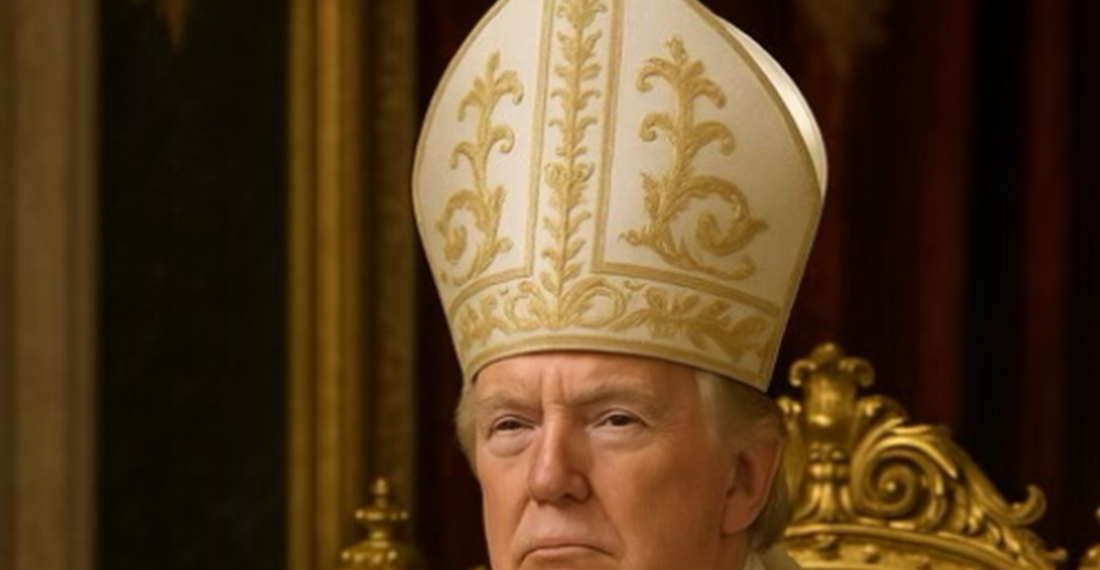
Photo: USA President Donald Trump posts AI-generated image of himself dressed as pope/Truth Social platform

The views expressed in opinion pieces and commentaries do not necessarily reflect the position of commonspace.eu or its partners.
Why Donald Trump is going after Europe’s Green Deal

The US administration is cutting funds and jobs in areas that will be critical to tackling (and even monitoring) climate change. But Donald Trump also seems intent on entrenching dependence on fossil fuels beyond America's borders. How is Europe responding?

Published on 5 May 2025 
Angelo Romano - Valigia Blu
Translated by Voxeurop

 
Derkaoui Abdellah | Cartoon movement

“A180-degree pivot.” This is how US energy secretary Chris Wright described, to a group of oil-industry bosses in March, the new direction the Trump administration intends to impose on America’s climate and energy policies.

During the meeting, Wright argued that climate change “is a side effect of building the modern world.” In other words: to power the planet there is no alternative to fossil fuels.

The Inflation Reduction Act, approved by President Joe Biden in 2022, was the biggest federal investment in United States history. It was designed to combat climate change. The law's reversal will mean budget cuts that affect the entire scientific sector and could lead to the cancellation of whole research programmes, from climate to space.
More : Environmental journalist Hervé Kempf: ‘The ecological and social issues are inextricably intertwined’

Indeed, the Trump administration is seeking to shut down virtually all research conducted by the National Oceanic and Atmospheric Administration (NOAA), the federal agency that leads the world in climate modelling. Across the USA, NOAA operates dozens of research labs that study the atmosphere, oceans, rivers and lakes. They monitor many of the natural and artificial processes that occur on Earth, including greenhouse-gas emissions and phenomena such as heat waves and droughts.

As in other policy areas, President Trump has been forcing major changes in climate and environmental policy by means of executive order.

On the first day of his term, he withdrew the United States from the Paris climate agreement, launched plans to open up parts of Alaska to mining, blocked federal permits for new wind farms, ordered federal agencies to halt subsidies for electric vehicles, and suspended authorizations for renewable-energy projects on public lands.

Trump also set his sights on the Environmental Protection Agency. Its new director, Lee Zeldin, began dismantling regulations and investments in clean energy the moment he took office. The axed projects were related to climate, scientific research and emissions data collection by private companies.

The White House has decided to cut funding for the US Global Change Research Program, which issues the government's main climate report and assesses the effects of global warming on the USA every four years. A similar fate has befallen the National Weather Service. Meanwhile, subsidies are being ramped up for the fossil-fuel industry, starting with coal.

Europe, the tariff war and the Green Deal

Tariffs, which have been repeatedly announced, withdrawn and reintroduced, are part of the Trump administration's new approach to industrial and energy policy. It amounts to a form of trade warfare.

And this is where Europe comes in, with its Green Deal.

In late February, Trump announced that he wanted to impose 25% tariffs on cars and other goods, including steel and aluminium, imported from the EU. Brussels initially considered countermeasures but then proposed to Washington a mutual elimination of tariffs on such goods. This proposal was rejected by Trump. He instead raised the stakes, arguing that the only way to achieve a trade truce would be for the EU to purchase $350 billion worth of US energy, particularly liquefied natural gas (LNG).

What was Trump's motive for this demand and for the 25% tariff on EU industrial goods and cars? After all, 50% of European LNG already comes from the US: Europe turned to it to replace Russian supplies. And there is no major EU-USA trade imbalance (3%) that could justify a trade war.

More : How Big Oil buys our consent through sports, arts and more

Trump’s real goal is something else: it is to undermine the EU's Green Deal. As highlighted in an analysis by the think tank ECCO, more than 50% of US exports to Europe are fossil-fuel products. The EU and countries around the world are supposed to be phasing these out following the 2015 Paris climate agreements (from which the US is once again pulling out).

Through the Green Deal, the EU is freeing itself from fossil fuels and building its own independence, energy security, and competitiveness.

In the electricity sector alone, since the launch of the Green Deal in 2019, renewable energies have made it possible to avoid hydrocarbon imports worth €59 billion. The United States is already the world's leading exporter of LNG. Europe's Green Deal poses a serious threat to Donald Trump's industrial and energy policy of “drill, baby drill”.

Trump's goal, says ECCO, is to keep Europe buying gas for the long term, thus undermining its independence from fossil fuels. This would prevent Europe from turning to other partners, primarily China. Unlike the USA, China is pushing forward its energy transition and is becoming dominant in the whole clean-tech sector.

So what will Europe do? And what role will Italy play? Prime Minister Giorgia Meloni's government has repeatedly said that it wants to focus on LNG and make Italy a gas hub.

At EU level, Energy Commissioner Dan Jørgensen has expressed interest in purchasing American LNG, but his words suggest that this must not undermine the Green Deal. For ECCO, the Green Deal “represents a strategic lever to enhance European and Italian competitiveness, promoting innovation in production processes, products and energy efficiency.” Abandoning it would mean being anchored to outdated economic models tied to fossil fuels and “aligning with Trump's policies, which transparently seek to protect only partisan interests.”

“The great climate disconnect”

“Trump's return to power must be a strong push for the EU and its members to overcome political divisions and unite around the objective of pursuing decarbonisation”, say Simone Tagliapietra and Cecilia Trasi of Bruegel, a think tank.
More : Renewable energy frenzy triggers land grabbing in ‘Wonderful Puglia’

The signals coming from various European capitals are not encouraging. Pilitia Clark, of the Financial Times, believes we are witnessing an ever-deepening disconnect between the climate crisis and climate policy. Just as extreme weather events continue to escalate and each successive year becomes the hottest on record, it seems that the whole planet has agreed to put the fight against global warming on hold.

In Europe's largest economy, Germany, the far-right Alternative for Germany (AfD) has enjoyed huge electoral success by promising to tear down wind farms, which it calls “windmills of shame”.

In Austria, the far-right ÖVP focused its election campaign on a complete rethink of climate policy. The party is part of Patriots for Europe, the third-largest group in the European Parliament. Its leaders attacked the “ideology” of the Green Deal during a recent rally in Madrid.

The narrative pushed by these groups, that green policies are a burden on ordinary people, is gaining traction. Last year's massive farmers' protests in Central Europe provided some evidence of that.

More : How Italy’s largest fossil fuel company uses climate-related bonds as a loophole to keep financing hydrocarbons

Meanwhile, the list of companies scaling back their environmental efforts continues to grow. Even Norwegian energy giant Equinor (which changed its name from Statoil seven years ago in a green pivot) now plans to ramp up its hydrocarbons business and halve its spending on renewables.

This is the backdrop as we approach the tenth anniversary of the 2015 Paris Agreement, the global pact that should be driving action to slow global warming. “Why is all this happening now?”, asks Clark. ”What has changed since 2020, when companies and countries alike were scrambling to support net zero policies? There is no single answer, but it is no coincidence that the green backlash has emerged as countries stop merely setting net zero goals and start launching policies to meet them.”

And the window of opportunity for the fossil-fuel industry just keeps getting larger.
Original article on Valigia Blu