INDIA
‘Fear Sold as Safety’: Domestic Workers’ Groups Slam Hiring Platforms, Seek Regulation
Analysis
Labour
THE WIRE
26/Jan/2026
The criticism follows the release of a public statement by the Bengaluru-based Domestic Workers Rights Union and allied groups, condemning the way platforms were advertising.
26/Jan/2026
The criticism follows the release of a public statement by the Bengaluru-based Domestic Workers Rights Union and allied groups, condemning the way platforms were advertising.
Representative image. Photo: mdreza jalali/Unsplash
New Delhi: Domestic workers’ rights organisations, labour law experts and feminist activists have criticised what they describe as a growing trend of fear-based advertising by digital domestic work hiring platforms, warning that such campaigns criminalise an already vulnerable workforce while operating with little regulatory oversight.
The criticism follows the release of a public statement by the Bengaluru-based Domestic Workers Rights Union (DWRU) and allied groups, condemning advertisements and platforms such as BookMyBai that promote paid “background verification” services through claims suggesting domestic workers are disproportionately involved in crime. One widely circulated claim; that “3 out of 10 maids have committed some form of crime”, has been flagged by experts as unsupported by publicly available data, peer-reviewed research or transparent methodology.
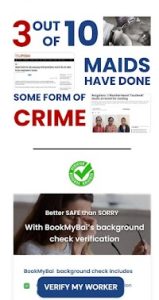
BookMyBai App Interface
‘Marketing built on class bias’
“Framed as safety advisories, these claims function as marketing tools that trade on class bias,” Flavia Agnes, senior advocate and women’s rights lawyer, told The Wire. “Portraying domestic workers as potential offenders without credible evidence amounts to defamation.”
Activists argue that such messaging does not enhance safety but instead fuels suspicion against an entire category of workers. According to the statement, these narratives rely on entrenched social hierarchies of class, caste, and gender, turning fear into a business model.
Speaking to The Wire, human rights activist Geeta Menon said, “India’s domestic work sector employs millions of workers, the vast majority of whom are women from migrant, Dalit, Adivasi, and minority communities.”
“Despite their central role in sustaining urban households and care economies, domestic workers remain outside the scope of comprehensive labour protections, leaving them particularly vulnerable to abuse,” added Menon.
Invisible labour, routine abuse
As outlined in the statement, domestic workers routinely face wage theft, excessive working hours, arbitrary termination, and verbal abuse. The risks are significantly higher for live-in domestic workers, many of whom report being denied freedom of movement, prevented from returning home, or having identity documents and wages withheld.
“Live-in domestic workers are among the most invisible workers in this country,” labour researcher Nirmala Banerjee told The Wire. “What we see repeatedly is illegal confinement and unpaid labour, but there is almost no institutional outrage when employers violate the law.”
In contrast, accusations against domestic workers, particularly allegations of theft, often trigger immediate police action.
“The presumption of guilt is automatic,” Menon told The Wire. “Workers are detained, interrogated, and sometimes coerced into confessions without any evidence or due process. This imbalance is core to the structure, not incidental.”
Platforms as informal ‘blacklists’
A major concern flagged in the statement is the role of digital platforms in amplifying this imbalance. Several platforms allow employers to post complaints, upload photographs and circulate allegations against domestic workers without verification. These posts often function as informal “blacklists” that permanently damage workers’ employability.
“Once a worker is labelled ‘unsafe’ online, there is no way back,” Agnes told The Wire. “Even when platforms add disclaimers saying allegations may be unverified, the damage is irreversible. A worker loses income, dignity, and sometimes personal safety.”
Activists also point out the asymmetry built into these systems: while employers are given expansive digital spaces to accuse and warn others, domestic workers have no comparable mechanisms to report wage theft, abuse or unlawful confinement.
“This is a one-way accountability system,” Banerjee told The Wire. “Employers can accuse publicly; workers cannot defend themselves publicly. That asymmetry tells you exactly whose safety matters in these platforms’ business models.”
Verification vs fear
The statement clarifies that background verification itself is not the issue. Instead, the concern lies in how verification is framed and operationalised.
“Verification is not inherently unethical,” human rights advocate Shalini Gera told The Wire. “What is unethical is framing verification through fear, suggesting that domestic workers as a group are dangerous and must be policed.”
Campaigns that portray domestic workers as inherent risks, the statement argues, cross ethical and moral boundaries by normalising suspicion and collective punishment.
Religious filtering and domestic gaps
Experts have also raised alarm over reports that some platforms allow employers to filter domestic workers by religion.
“This is unconstitutional, plain and simple,” constitutional law expert Faizan Mustafa told The Wire. “Filtering workers by religion violates the principles of equality and secularism and normalises discrimination in the labour market.” The practice, activists warn, entrenches social exclusion and further marginalises a workforce that already lacks legal and institutional protection.
The statement draws attention to India’s ratification of the International Labour Organisation’s Convention 189 on Decent Work for Domestic Workers, which mandates legal recognition, fair working conditions and effective grievance redressal mechanisms.
“India has ratified the convention on paper, but not in practice,” Mustafa told The Wire. “Instead of strengthening worker protections, we are allowing private platforms to act as judge, jury, and executioner.”
Union’s demands
The DWRU has called for the immediate withdrawal of misleading and stigmatising advertisements, legal scrutiny of discriminatory hiring practices, and accountability for platforms that publish unverified accusations. The union has also demanded mandatory registration, regulation, and oversight of all placement agencies and digital platforms involved in the recruitment and hiring of domestic workers.
Emphasising the need for a shift in public discourse, the union said domestic workers must be recognised as individuals with enforceable rights, access to grievance redressal mechanisms, and legal protections. It urged policymakers and the public to focus on systemic issues such as wage theft, abuse, and employer violations, rather than relying on fear-driven narratives.
Speaking to The Wire, economist and gender studies scholar Ritu Dewan said: “This is not about denying safety concerns.”
“It is about insisting that safety cannot be built on humiliation, suspicion, and profit-driven fear.”

No comments:
Post a Comment