The penguin’s origins lie in Werner Herzog’s 2007 documentary Encounters at the End of the World, which captured the animal’s inexplicable march towards the Antarctic interior — behaviour ecologists could not explain.
Ainnie Arif
27 January 2026
OUTLOOK, INDIA
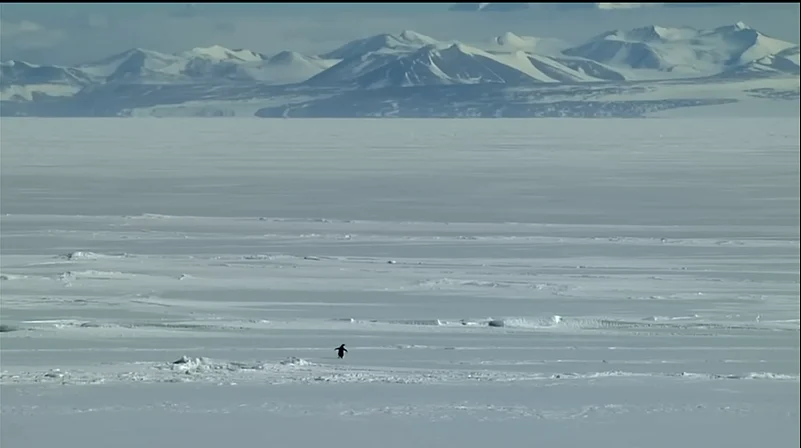
Screengrab from original video
Summary of this article
A decades-old clip of an Adélie penguin walking away from its colony has resurfaced as a viral meme.
It is widely interpreted as a symbol of vulnerability, non-conformity, and existential defiance.
The White House’s recent reimagining of the penguin, recast alongside Trump and an American flag, marks a sharp departure from the clip’s original, introspective aura.
Why is the White House suddenly posting edited images of the President alongside a penguin?
The source is a video of a penguin waddling away from its tribe — a lone blip of colour against a vast white landscape — heading towards the unknown, towards mountains at least 70 kilometres away. At one point, it pauses, turns back, takes in a final look, and then continues on.
The internet has found this quiet exaltation of vulnerability painfully relatable. Unsurprisingly, the clip has been repurposed across contexts, with viewers turning it into a source of inspiration and motivation — a metaphor for another living creature confronting, and blissfully accepting, the state of loneliness.
The penguin was recast as a warrior of human cause, a fiduciary tantamount to championing the unknown, taking that trust fall. He is a global star now, a clear winner of 2026 January meme world, being posted and reposted with soundtracks of Gangsta rap to Emo music, monikered ‘The Nihilist Penguin’, making one wonder what 19th-century German philosopher Friedrich Nietzsche would have to say about him.
However, the origin story of the ‘The Nihilist Penguin’ is much different than the one popularly perceived. The viral clip is not recent; it is almost two decades old, with viewers now commenting, “it took almost 20 years for a Penguin to be understood.”
It comes from a 19-year-old documentary. Directed by German filmmaker Werner Herzog, Encounters at the End of the World from 2007 features an Adélie penguin walking away from its colony.
Instead of heading towards the sea — where the birds find food, survive, and thrive — the penguin moves inland, towards remote, icy mountains.
“He would neither go towards the feeding grounds at the edge of the ice, nor return to the colony,” the narrator of the documentary, Herzog, said as the sombre opera vocals amplified the gravity of his decision. “Shortly afterwards, we saw him heading straight towards the mountains some 70-kms away.”
As wildlife-documentary filmmakers have a strict no-intervention policy, the narrator explained that as per ecologists’ advice, even if the film crew intervened and brought him back, “he would immediately head right back for the mountains.”
“But, why?” the narrator says, and stops. The film crew decided to let him on his way. He headed to the interior of the continent, “heading towards certain death.”
The viewers have found meaning in his action, which ecologists have failed to ascertain. “I’m not going there to die. I’m going to find out if I’m really alive,” one of them commented.
“The others survived, he lived,” another stated.
Was it illness, nihilism, rebellion, or disorientation that the penguin’s behaviour revealed? We may never know. However, nearly two decades later, the White House’s rendition of the penguin — originally from Antarctica — now wielding an American flag, with Trump standing tall beside it and walking towards what is clearly marked as Greenland territory, becomes a runaway narrative far removed from the aura the original clip acquired.
It struck a chord with audiences for mirroring human emotions of non-conformity, revolt, and unconventional deviation, yet it has now been repurposed into something wholly different.
The White House has politicised what was once a quiet, existential moment, turning it into spectacle. "The penguin does not concern himself with the opinions of those who cannot comprehend," the caption read.
The clip’s inescapable undertone of self-destruction, combined with its overwhelming relatability, points to a deeper unease about the state of mental health across the world. Across borders, political inclinations, genders, and ages, viewers seem to arrive at a shared emotional register — one rooted in nihilism, withdrawal, and the impulse to walk away, even when the endpoint appears bleak.
Is this resonance disturbing, or is it a cruel mirror held up to contemporary society — one bound by deadlines, productivity, and rigid social norms? It may be “just a meme”, but it invites a more serious reading. Viewed through the lenses of Foucault’s structuralism or Plato’s allegory of the cave, the penguin’s walk becomes less a viral joke and more a commentary on constraint, conformity, and the longing to step outside imposed realities, regardless of the cost.
One can only wonder what the penguin itself would make of this transformation.
A bird that chose to walk away from everything familiar and secure, only to resurface years later as a ubiquitous symbol on everyone’s timeline, would almost certainly not have imagined — let alone desired — such an afterlife.
Published At: 27 January 2026


No comments:
Post a Comment