The FTA will boost investment between India and the European Union and foster new innovation partnerships
Seema Guha
Updated on: 27 January
BY Outlook News Desk
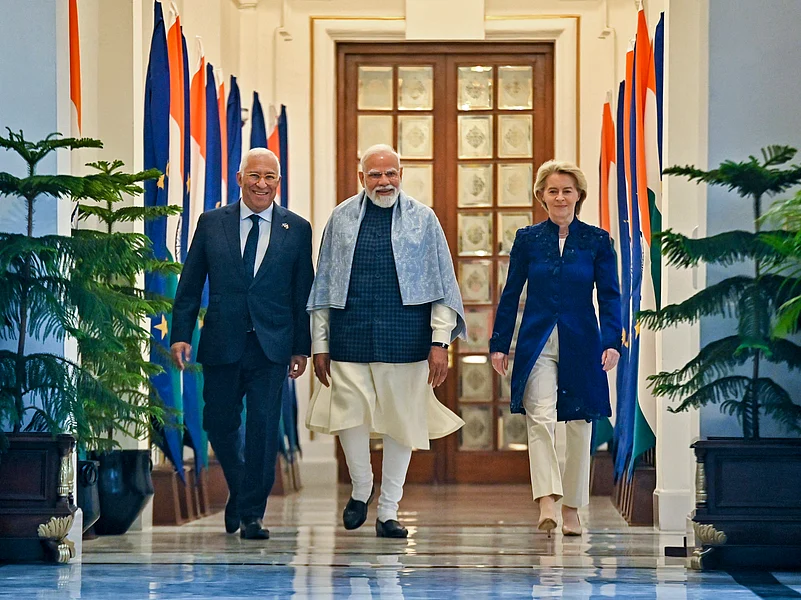
In this image received on Jan. 27, 2026, Prime Minister Narendra Modi with European Council President Antonio Costa, left, and European Commission President Ursula von der Leyen, right, during their meeting at the Hyderabad House, in New Delhi. Photo: | PTI |
Summary of this article
PM Modi called the India-EU relationship a ``partnership for global good’’ and a stabilising force in a ruptured world.
European Council President António Costa called it a new chapter in relations on trade, security and people to people ties
"PM Modi, we did it! We delivered the mother of all deals," beamed European Commission President Ursula von der Leyen
After nearly 18 years of on-again, off-again negotiations, India and the European Union on Tuesday announced a long-awaited free trade agreement, a deal triggered by economic logic and fast-tracked by the disruptive force of US President Donald Trump’s trade war. It would be interesting to see Trump’s reaction to the announcement from New Delhi and Brussels and whether this prompts action from Washington.
Today’s announcement does not mean that tariffs will drop immediately. It marks the political finish line: the whole complicated legal marathon will take more time. By all counts the pact is unlikely to come into force before 2027. But its announcement marks a decisive shift, signalling New Delhi’s deepening turn towards Europe. A security pact has also been signed, as both sides move to insulate themselves from growing uncertainty in the global trading order and put in place a vision for further defence and strategic co operation.
Prime Minister Narendra Modi called the India-EU relationship a "partnership for global good’’ and a stabilising force in a ruptured world. He said the two powers will advance trilateral projects from the Indo-Pacific to the Caribbean and establish the India-Middle East-Europe Economic Corridor (IMEC) as a vital link for global trade.
Related Content
India-EU FTA Blueprint for Shared Prosperity: PM Modi
PM Modi Says EU Agreement Signed, Hails ‘Mother Of All Deals’

EU, India On Verge Of Historic Free Trade Agreement, Says Ursula Von Der Leyen
India, EU Reaffirm Commitment To Early Conclusion Of Free Trade Agreement Talks
"Today, India has concluded the largest Free Trade Agreement in its history. It is a happy coincidence that on the 27th day of the month, India is entering into this FTA with the 27 Member States of the European Union. This historic agreement will facilitate easier access for our farmers and small enterprises to European markets, create new opportunities in manufacturing, and further strengthen cooperation across our services sectors.
In this image received on Jan. 27, 2026, Prime Minister Narendra Modi with European Council President Antonio Costa, left, and European Commission President Ursula von der Leyen, right, during their meeting at the Hyderabad House, in New Delhi. Photo: | PTI |
Summary of this article
PM Modi called the India-EU relationship a ``partnership for global good’’ and a stabilising force in a ruptured world.
European Council President António Costa called it a new chapter in relations on trade, security and people to people ties
"PM Modi, we did it! We delivered the mother of all deals," beamed European Commission President Ursula von der Leyen
After nearly 18 years of on-again, off-again negotiations, India and the European Union on Tuesday announced a long-awaited free trade agreement, a deal triggered by economic logic and fast-tracked by the disruptive force of US President Donald Trump’s trade war. It would be interesting to see Trump’s reaction to the announcement from New Delhi and Brussels and whether this prompts action from Washington.
Today’s announcement does not mean that tariffs will drop immediately. It marks the political finish line: the whole complicated legal marathon will take more time. By all counts the pact is unlikely to come into force before 2027. But its announcement marks a decisive shift, signalling New Delhi’s deepening turn towards Europe. A security pact has also been signed, as both sides move to insulate themselves from growing uncertainty in the global trading order and put in place a vision for further defence and strategic co operation.
Prime Minister Narendra Modi called the India-EU relationship a "partnership for global good’’ and a stabilising force in a ruptured world. He said the two powers will advance trilateral projects from the Indo-Pacific to the Caribbean and establish the India-Middle East-Europe Economic Corridor (IMEC) as a vital link for global trade.
Related Content
India-EU FTA Blueprint for Shared Prosperity: PM Modi
PM Modi Says EU Agreement Signed, Hails ‘Mother Of All Deals’
EU, India On Verge Of Historic Free Trade Agreement, Says Ursula Von Der Leyen
India, EU Reaffirm Commitment To Early Conclusion Of Free Trade Agreement Talks
"Today, India has concluded the largest Free Trade Agreement in its history. It is a happy coincidence that on the 27th day of the month, India is entering into this FTA with the 27 Member States of the European Union. This historic agreement will facilitate easier access for our farmers and small enterprises to European markets, create new opportunities in manufacturing, and further strengthen cooperation across our services sectors.
Moreover, this FTA will boost investment between India and the European Union, foster new innovation partnerships, and strengthen supply chains at the global level. In other words, this is not merely a trade agreement; it is a new blueprint for shared prosperity.
European Council President António Costa said: “Today is a historic moment, we are opening new chapter in our relations on trade, security and people to people ties.’’ He went on to add, “Our summit sends a clear message to the world when the global order is being fundamentally reshaped that India and the EU stand together as strategic and reliable partners. Today we are taking our partnership to the next level as two largest democracies.’’ Costa, whose family migrated from Goa, also held up his PIO card and said “I am President of the European Council but I am also an Overseas Indian Citizen. As you can imagine, it has a very special meaning. I am very proud of my roots in Goa.”
He highlighted the significance of the newly signed agreement on a security and defence partnership, noting it is the first such overarching framework ever established between India and the European Union to counter the full range of threats across the Indo-Pacific, Europe, and the world.
The bonhomie in the room was evident as Modi, Costa and European Commission President Ursula von der Leyen were all smiles. "PM Modi, we did it! We delivered the mother of all deals," Leyen beamed at the PM as she began her speech.
Slashing of tariffs will give a fillip to trade with EU. India will give market access to European products, including cars and wine, while EU will make exports of textiles and pharmaceuticals among other goods easier.
“The EU stands to gain the highest level of access ever granted to a trade partner in the traditionally protected Indian market,” von der Leyen said on Sunday, adding that she expected exports to India to double. “We will gain a significant competitive advantage in key industrial and agri-good sectors,” Reuters quoted her as saying. Ironically the US is pushing India hard on opening up its agriculture to American exports.
Expected Timeline for the FTA
FTAs take time to implement. After today’s announcement, the next five to six months will be spent on legal scrubbing as lawyers from both sides go into each clause in minute details to ensure it is water tight legally. Ratification by EU parliament is expected mid 2026. The formal signing of the agreement will perhaps be in the middle of the year when Prime Minister Modi visits Brussels and come into effect by 2027. However Commerce Minister Piyush Goyal says India will try to fast-track the deal by the end of this year.
While for India the pact is endorsed by the Cabinet, the EU Parliament will have to endorse the trade part of the pact with a vote. This includes tariffs, services and digital trade. The 27 members do not have to vote in their home Parliaments. Yet there could be domestic pressures from many of the 27-nation groups that are in different levels of development. So far nothing is known on this but will probably surface once the agreement is announced and details known. Legal wrangling will come up for the Investment Protection Agreement which includes dispute settlements and what happens if a company flaunts rules is left for later negotiations.
India already has a $100 billion free trade agreement with the European Free Trade Association nations comprising Norway, Switzerland, Iceland and Liechtenstein, which was signed in 2024.
Besides the announcement of the FTA, a number of other important agreements were signed during the India-EU summit. These include a comprehensive document on strategic partnership that would elevate India’s ties with the EU to another level. But the question remains will this hold if Washington decides to put pressure on both the EU and India? How many nations can withstand American pressure, more so as NATO members?
Several Memorandum of Understanding (MOU) were also signed, one between the Reserve Bank of India and European Securities and Marker Authority, as well as oadministrative arrangement for electronic signatures and seals to help trade and make payments easier. Negotiations for an India-EU security of Information agreement was launched today. This could take a few months to complete. A Mou on mobility was also signed today. Together with this a Legal Gateway Office in India to enhance skill mobility.
A agreement to jointly implement four projects under the India-EU Trilateral Co-operation on Digital Innovation and Skills Hub for Women and Youth. These include Solar-Based Solutions for Empowering Women Farmers in Agriculture and Food Systems; Early Warning Systems; and Solar Based Sustainable Energy Transition in Africa, and Small Island Developing States in the Indo-Pacific and Caribbean.

No comments:
Post a Comment