Saturday, September 27, 2025


China’s Geely Expands Methanol Technology with First Hybrid Hydrogen Barge

methanol hydrogen electric barge
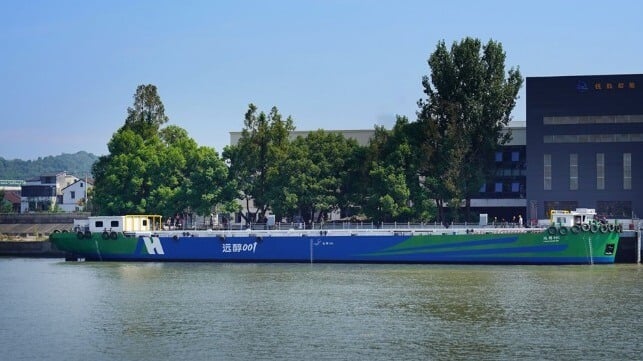
Geely's 64 TEU inland vessel uses a combination of liquid methanol and alcohol-hydrogen to increase range and efficiency (Geely)

Published Sep 26, 2025 9:09 PM by The Maritime Executive


The first inland cargo barge that combines methanol and hydrogen electric for a more efficient operation was launched earlier this month in China. The vessel also represents an expansion of Chinese auto manufacturer Geely’s methanol technology into the maritime sector as the company looks to expand its international operations.

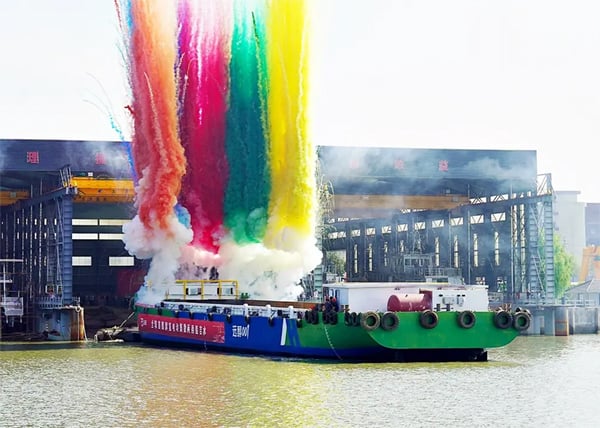
The barge, which has a capacity of 64 TEU, was launched on September 12 at the Hangzhou Qianhang Shipyard. It uses liquid methanol technology combined with alcohol-hydrogen electric technology. Geely reports that the technology has already been employed in over 50,000 hybrid electric vehicles on the road. 

For the inland river vessel named Yuanchum 001, they have installed a 150kW dual motor. It is powered by two 280kW methanol generators and two 258kWh lithium batteries. 

The design permits the vessel to operate in four different modes, and they report it will have a combined range of nearly 1,000 miles (1,500 km). Geely promotes that this will far exceed the 250 km range of the mainstream 3,000kWh class pure electric vessels being deployed today. China has invested in the development of electric inland shipping, including plans for recharging stations along the Yangtze River.

Yuanchum 001, they report will operate in the hybrid mode with the lithium batteries peak shaving during high-load, fast sailing, upstream, or when the vessel is heavily loaded. During long-distance sailing, the vessel switches to generator mode using the methanol generator set when battery charging is low. In ports and other environmentally sensitive areas, the vessel can operate fully in “pure electric mode.” While in port, it can also recharge its batteries from shore power. Geely reports the vessel will consume 42 percent less energy than similar diesel vessels.


Launch of the first hybrid methanol-hydrogen barge (Geely)


Geely has been developing methanol technology for 20 years and, through partnerships, is expanding to produce green methanol, carbon capture, methanol transportation, refueling, and various vehicle applications. It is successfully marketing passenger cars as well as long-distance trucking, urban delivery, construction vehicles, and public transportation using its methanol-hydrogen technology.

In the first half of 2025, the company reports it exported 180,000 vehicles, with pure electric vehicle shipments soaring over 300 percent versus 2024. It has expanded into international markets, including Australia, where it is introducing a new generation sedan, as well as Brazil and Poland. The company is targeting increased European sales.


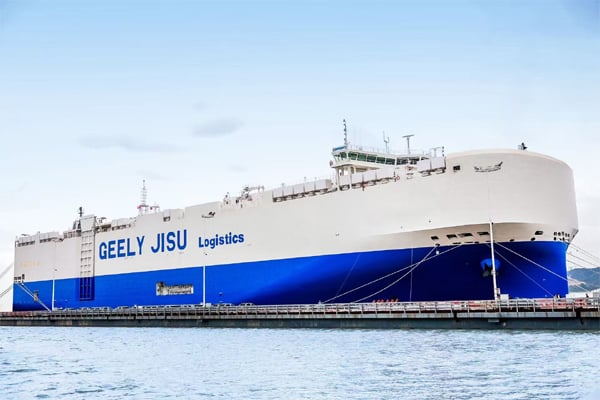
Geely through its Jisu Logistics recently launched two PCTCs equipped to transport EV as well as hydrogen and natural-gas powered new energy vehicles (Geely)


To support the international growth, it is also investing in logistics, including in the maritime sector. In May 2025, Geely's first self-operated RoRo vehicle carrier, Jisu Fortune, sailed on its maiden voyage from China to European markets carrying 5,000 vehicles. Last week, on September 21, its second LNG-fueled PCTC, Jisu Glory, departed the Ningbo Zhoushan port carrying cars from five of the company’s brands bound for European markets, including the UK and Belgium.

The Jisu Glory has a capacity for 7,000 standard vehicles. It has 12 decks and was specifically designed to carry both traditional internal combustion engine vehicles and lithium-battery electric vehicles. On decks 11 and 12, the ship is specifically equipped to transport hydrogen and natural-gas powered new energy vehicles.

The company plans to continue to expand the applications of its methanol-hydrogen technology, including in the maritime sector. It will also strengthen the global supply chain through investments in maritime logistics.


Australian Authorities Highlight Risks Posed by Poorly Secured Cargo

container collapse on ship
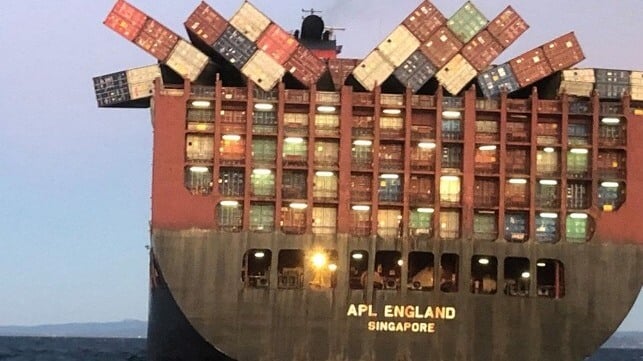
AMSA highlights poorly maintained equipment and improper weight management as issues in container collapses (AMSA file photo)

Published Sep 26, 2025 8:40 PM by The Maritime Executive


The Australian Maritime Safety Authority (AMSA) is raising concerns over high numbers of container ships arriving at the country’s ports with poorly stowed and secured cargo. In its latest edition of the Maritime Safety Awareness Bulletin, AMSA highlights recent inspections of boxships visiting various ports where serious safety deficiencies have been discovered, ranging from overloaded stacks to corroded securing gear and cargo not appropriately secured during voyages.

Safety remains a top priority for AMSA, which is known for its regular enforcement actions, including banning containerships and bulk carriers from Australian waters after repeated safety issues. Despite its focus on safety, it reports that a high number of ships visiting the country’s ports continue to pose risks to humans and the environment owing to poor cargo container stowage and securing practices.

The bulletin gives a glimpse of two cases, the first of which saw a vessel undergoing a series of heavy rolls that resulted in the loss of 50 containers overboard. Following investigations, it was established that the vessel’s fixed container securing arrangements on deck were inadequately maintained, and the strength of the securing fixtures was severely reduced by corrosion. This, in effect, compromised the effective securing of cargo. More alarming is that for extended periods, shipboard inspections failed to detect the deteriorating condition of the vessel’s deck structure and fittings.

In another case, approximately 81 containers were lost overboard, and a further 62 were damaged due to heavy rolling while a ship was en route to Sydney. Investigations identified several failings, including the fact that the calculated resultant forces on the weights and distribution of containers in two bays exceeded the allowable force limits specified in the ship’s cargo securing manual.

Also, the cargo planning process ashore did not ensure that the proposed container stowage plan complied with the stowage and lashing forces requirements of the ship’s cargo securing manual, while the master and chief mate did not check that the proposed container stowage plan complied with the cargo securing manual. Another factor was the fact that, apart from on-the-job training and mentoring, there was no evidence to indicate that the officers had been trained in the use of the loading computer system or the lashing calculation program.

“Poorly stowed and secured cargo can cause serious harm to people, the environment, vessels, and other cargoes—not only at sea, but also during loading and discharge operations. These incidents may result in injuries, environmental pollution, reputational damage, and clean-up costs that can run into the tens of millions of dollars,” states AMSA.

Under the International Convention for the Safety of Life at Sea (SOLAS) and Marine Order 42, cargo must be secured for the entire voyage, which means while at sea, and during loading and discharge.

To improve container security and prevent loss, AMSA wants vessel operators to, among other things, identify cargo risks and manage them through safety management systems, carry out regular inspections and maintain securing equipment like lashing rods, twist locks, and chains in good condition, and ensure crew are appropriately trained.


Containership Diverts to Korea After Fire is Contained

containership
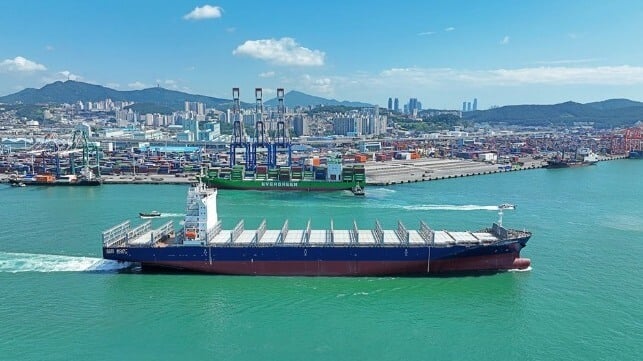
Colorado is one of two new Ecobox ships delivered to MPC in 2024 (MPC file photo)

Published Sep 26, 2025 12:48 PM by The Maritime Executive


Another underway containership is reporting a fire, which, in this case, its crew was able to contain. It again calls attention to the dangers of container fires and the industry’s efforts to manage the continuing threat.

Zim reports that the vessel Colorado (65,924 dwt) suffered a fire while the vessel was beginning its Pacific crossing after port calls in China and Vietnam. The crew activated the emergency and fire procedures, and according to the report, the fire was brought under control. There were no injuries reported, but it is unclear the extent of damage that was incurred.

The vessel has turned back as a precaution and is now bound for South Korea, where it will be inspected. AIS signals show that the Colorado is due to reach Busan on September 27. The containership was bound for California, where schedules say it was due on October 10. 

It is the second setback for Zim this month on its Pacific express operation. The company’s vessel Mississippi suffered a stack collapse in the Port of Long Beach, sending approximately 75 boxes into the harbor. Recovery operations are still underway in Long Beach.

The Colorado was built in South Korea and entered service in 2024 owned by MPC Container Ships of Norway and operating under a seven-year charter to Zim. The ship is registered in Portugal and has a capacity of 5,500 TEU. MPC highlighted on its delivery that it is an eco-design vessel which emits approximately 20 percent less greenhouse gases compared to conventional designs and is prepared for a cost-efficient conversion in the future to operations on methanol.

The World Shipping Council highlighted this month that port inspection data revealed that more than 11.39 percent of containers were found with deficiencies, ranging from misdeclared and undeclared dangerous goods, incorrect documentation, and improper packing. The industry trade group launched its Cargo Safety Program, an industry-led initiative using AI to review documentation to detect potentially misdeclared and undeclared dangerous goods in order to prevent ship fires, protect crews, vessels, customers’ cargo, and the marine environment.


AI-Based Autonomous Navigation Guides Boxship During Pacific Crossing

Ever Max large containership
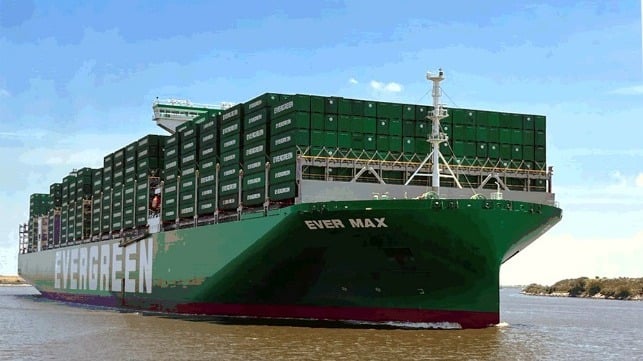
The 15,500 TEU Ever Max (160,000 dwt) was guided by an AI-based navigation system during a Pacific crossing

Published Sep 26, 2025 8:03 PM by The Maritime Executive


The efforts to develop the potential of autonomous navigation or using artificial intelligence (AI) to improve the navigation of vessels took another step forward with the latest long-distance trial. Samsung Heavy Industries reports working with Evergreen, it completed a 10,000 km (5,400 nautical mile) trans-Pacific voyage, demonstrating advancements in its Autonomous Navigation Technology.

Development of the Samsung Autonomous Ship began in 2019 as an autonomous navigation system. Previous tests included a 500-nautical-mile voyage in Korean waters using a university training vessel. For this new test, the system was deployed on one of Evergreen’s largest containerships, the 160,000 dwt Ever Max, which has a capacity to transport approximately 15,500 TEU. The vessel entered service in 2023 as part of the company's M Class.

The demonstration was conducted between August 25 and September 6, sailing from Oakland, California, to Kaohsiung, Taiwan. Samsung reports the system performed 104 optimal guidance operations and 224 automatic ship control operations during the voyage. It analyzed weather conditions every three hours and adjusted the vessel to weather and route situations without crew intervention. 

The system incorporates a range of technologies to create a situation awareness. It combines signals from the radar, GPS, and images from cameras to analyze the situation. It has automatic control of the engines and rudders for collision avoidance.

“SAS has evolved from an autonomous navigation assistance system for collision avoidance to a level where it maintains economical speed on its own and meets arrival times,” said Lee Dong-yeon, vice president and head of the Shipbuilding and Offshore Research Institute at Samsung Heavy Industries. 

The trip on the Ever Max resulted in a fuel saving for the vessel over contention operations. Also, Samsung highlights that the ship achieved an on-time arrival.

Samsung emphasizes the critical need for vessels to maintain their schedules and the impact that weather and variables can have on operations. By constantly analyzing the weather conditions and navigational circumstances, the system can optimize the vessel’s performance. On-time arrival, they note, reduces supply chain problems and costly delays for the shipping company.

South Korean shipbuilders are investing in autonomous technology for shipping as one of their advantages in the market. Samsung Heavy Industries has been testing and demonstrating its systems, as have its competitors. HD Hyundai Heavy Industries demonstrated a version of its autonomous navigation system developed by its subsidiary Avikus in 2022 on another long-distance voyage aboard an LNG carrier. Avikus is commercializing its offering with a version for pleasure craft and looks to also expand to large commercial vessels.


Is AI a threat to jobs? A ‘Tomb Raider’ affair poses the question

By The Associated Press
September 24, 2025 

Francoise Cadol poses in a dubbing studio, in Saint Denis, outside Paris, France, Monday, Sept. 15, 2025. (AP Photo/Nicolas Garriga)

PARIS — A lifelong fan of “Tomb Raider,” French gamer Romain Bos was on tenterhooks when an update of the popular video game went online in August.

But his excitement quickly turned to anger.

The gamer’s ears — and those of other “Tomb Raider” fans — picked up something amiss with the French-language voice of Lara Croft, the game’s protagonist.

It sounded robotic, lifeless even — shorn of the warmth, grace and believability that French voice actor Françoise Cadol has given to Croft since she started playing the character in 1996.

Gamers and Cadol herself came to the same conclusion: A machine had cloned her voice and replaced her.


“It’s pathetic,” says Cadol, who straight away called her lawyer. “My voice belongs to me. You have no right to do that.”

“It was absolutely scandalous,” says Bos. “It was artificial intelligence.”
AI encroaching ‘everywhere’

Aspyr, the game developer based in Austin, Texas, didn’t respond to e-mailed questions from The Associated Press. But it acknowledged in a post last week on its website that what it described as “unauthorized AI generated content” had been incorporated into its Aug. 14 update of “Tomb Raider IV–VI Remastered" that angered fans.

“We’ve addressed this issue by removing all AI voiceover content,” Aspyr’s post said. “We apologize for any inconvenience this may have caused.”

Still, the affair has triggered alarms in the voiceover community, with campaigners saying it’s a sobering example of dangers that AI poses to human workers and their jobs.

“If we can replace actors, we’ll be able to replace accountants, and a whole range of other professions that could also be automated,” says Patrick Kuban, a French-language voice actor who is also a co-president of United Voice Artists, an international federation of voiceover artists.

“So we need to ask ourselves the right questions: How far should we go, and how do we regulate these machines?”

Hollywood has seen similar concerns, with video game performers striking for 11 months for a new contract this year that included AI guardrails.

“This is happening pretty much everywhere. We’re getting alerts from all over the world — from Brazil to Taiwan,” Kuban said in an Associated Press interview.

“Actors’ voices are being captured, either to create voice clones — not perfect ones — but for illicit use on social media by individuals, since there are now many apps for making audio deepfakes," Kuban said.


“These voices are also being used by content producers who aren’t necessarily in the same country,” he said. “So it’s very difficult for actors to reclaim control over their voices, to block these uses.”
Cadol’s ‘Voice Guardians’

Cadol says that within minutes of the release of the “Tomb Raider” update, her phone began erupting with messages, emails and social media notifications from upset fans.

“I took a look and I saw all this emotion — anger, sadness, confusion. And that’s how I found out that my voice had been cloned,” she said in an AP interview.

Cadol says 12 years of recording French-language voiceovers for Lara Croft — from 1996 to 2008 — built an intimate bond with her fans. She calls them the “guardians” of her work.

Once the initial shock subsided, she resolved to fight back. Her Paris lawyer, Jonathan Elkaim, is seeking an apology from Aspyr and financial redress.
Grammar error

In the update, new chunks of voiceover appear to have been added to genuine recordings that Cadol says she made years ago.

Most notably, fans picked up on one particularly awkward segment. In it, a voice instructs players how to use their game controllers to make Lara Croft climb onto an obstacle, intoning in French: “Place toi devant et appuyez sur avancer” — Stand in front and press ‘advance.’

Not only does it sound clunky but it also rings as grammatically incorrect to French speakers — mixing up the polite and less polite forms of language that they use, depending on who they’re addressing.

Gamers were up in arms. Bos posted a video on his YouTube channel that same evening, lamenting: “It’s half Françoise Cadol, half AI. It’s horrible ! Why have they done that?”

“I was really disgusted,” the 34-year-old said in an AP interview. “I grew up with Françoise Cadol’s voice. I’ve been a ‘Tomb Raider’ fan since I was young kid.”

“Lara Croft is a bit — how should I say — a bit sarcastic at times in some of her lines. And I think Françoise played that very, very well,” he said.

“That’s exactly why now is the time to set boundaries,” he added. “It’s so that future generations also have the chance to experience talented actors.”

John Leicester And Nicolas Garriga, The Associated Press
Artificial Intelligence

AI adoption could boost Canada’s GDP to $3.65 trillion by 2035, PwC study estimates


By The Canadian Press
September 24, 2025 

A Royal Canadian Airforce (RCAF) Airbus CC-150 Polaris aircraft is seen near a Boeing CC-177 at Canadian Forces Base (CFB) 8 Wing Trenton in Trenton Ont., on Friday, Aug. 8, 2025. THE CANADIAN PRESS/Spencer Colby

Canada’s economy could grow exponentially by 2035 if businesses fast-track their artificial intelligence adoption and respond to growing climate change threats, a new study predicts.

A PwC Canada report exploring ways to unlock economic growth forecasts that with swift action to close the AI adoption gap, Canada’s GDP could reach as much as $3.65 trillion by the end of the next decade. The report, released Wednesday, lists 2023 Canadian GDP at $2.89 trillion.

The report outlined three growth scenarios, each based on how fast key industries adapt to technological advancement, climate change, geopolitical tensions and demographic shifts, which are increasingly blurring traditional sector boundaries.

The degree to which geopolitical turmoil subsides or escalates is a significant factor in these estimates, as is Canada’s ability to adopt artificial intelligence across industries such as mining, technology and defence, which are increasingly seen as political priorities.

The premise of its most optimistic scenario, where Canada’s GDP jumps 9.3 per cent over baseline expectations for 2035, hinges on a co-operative global approach for AI adoption and public trust in cybersecurity.


Nochane Rousseau, national managing partner at PwC Canada, said he is “confident that the most optimistic scenario is credible,” but that so far, there’s a lag in AI adoption in Canada.

“Considering the economic condition that we have in Canada and the uncertainty also related to the tariffs, some companies are not making the required investment,” Rousseau said in an interview.

AI uptake in Canada is about three-quarters of U.S. adoption, the report, which reviewed survey data, found.

In the middle scenario, where global decarbonization efforts fall short of sustainability goals and AI adoption lags, the report projects a 6.9 per cent GDP boost over the expected baseline, or $3.57 trillion. The least optimistic forecast, which assumes geopolitical tensions hinder global efforts to collaborate and mistrust in technology slows its use, pegs GDP growth at 2.1 per cent above baseline, or $3.41 trillion.

Rousseau said there’s an opportunity for Canada to bridge its AI adoption gap.

Narrowing that gap will require investments and government support, the report suggested. Companies would need to devote more resources to research and development, and consider new approaches to scaling innovation, it added.

“You may remember that Canada was one of the initial players in AI,” Rousseau said. “The challenge for us is the commercialization of those technologies.”

Even if Canada’s economy realizes the most optimistic scenario, it would lag behind the U.S., which is expected to see a bigger boost of a potential 14 per cent over its expected baseline in the next decade.

“When we compare both results between Canada and the U.S., it is explained mostly by a much lower AI adoption by Canadian companies in Canada,” Rousseau said.

Rousseau said there’s an opportunity for the country to grow if different sectors work together alongside supportive government policies.

As Canada adjusts to new trade realities, the report estimates businesses would be left with limited resources to reconfigure and adjust to ongoing changes with climate change and tech.


Corporations will have to collaborate across industries and likely pivot to serve adjacent markets or compete in completely new sectors — similar to the paths larger companies have taken, such as by moving into the nuclear energy space to bridge electricity needs for their data centres, the report suggested.

For example, food production and consumption face pressures not just from climate change but also urbanization and shifts in consumer preferences. The report suggests the mining industry could help increase sustainable supplies of fertilizers, such as potash, to make shrinking lands more arable.

Overall, the report identified mining, technology and defence as key sectors among others that can benefit from AI adoption and government policies, and in turn, boost growth.

Since taking office, Prime Minister Mark Carney has unveiled major spending plans for national defence to help Canada meet the NATO defence spending benchmark of the equivalent of two per cent of GDP per year.

In June, Canada and its NATO allies agreed to substantially hike their defence spending target to five per cent of annual GDP by 2035. The new NATO agreement will see Canada’s annual defence budget increase to roughly $150 billion.

“We have a very critical opportunity to capture the value around the defence opportunity,” said Rousseau.

Earlier this month, business jets maker Bombardier Inc. pivoted its portfolio toward the defence sector, as its chief executive promised a larger portion of the firm’s total sales would be from Bombardier Defense over the next decade.

The defence sector needs everything from raw materials, munitions and vehicles to data, technology and AI – and all the related industries can benefit from the demand, according to the report.

For example, steel manufacturers facing tariff pressures could supply steel to a Canada-based shipbuilder, or a Canadian miner could provide materials for magnets and semiconductors used in modern military equipment.

Rousseau said the defence sector also opens up doors for parts, equipment and infrastructure with dual purpose – something that can be used for defence and civil markets.

Small and medium-sized businesses could also open shop for niche services such as precision machining or testing and certification, the report suggested.

For mining, Rousseau said Canada has an opportunity to leverage its critical minerals repository for electric vehicles and defence.

But tech adoption will be critical for miners, the report suggested.

Canada’s mining sector could benefit from AI and quantum computing to accelerate assessments and the permitting processes, which in turn speed up the mining projects.

This would also help reduce the environmental impact and resource consumption of mining explorations and other activities, the report said.

Rousseau said federal government policies are key to Canada’s growth.

For example, the government could establish a procurement policy that prioritizes buying goods and services from Canadian AI companies.

That means governments will need to set up policies that enable innovation, attract skilled workers and help instill trust in AI among businesses.

“Adoption is inseparable from trust and security, which heightens the imperative for governments to work closely with businesses to build confidence in what AI can do,” the report said.

This report by The Canadian Press was first published Sept. 24, 2025.

Ritika Dubey, The Canadian Press


Ottawa assembling AI task force as it prepares ‘refreshed’ strategy

By The Canadian Press
Published: September 24, 2025 
Minister of AI and Digital Innovation Evan Solomon makes an announcement during a visit to Scale AI in Montreal on July 10, 2025. THE CANADIAN PRESS/Christopher Katsarov

MONTREAL — The federal government is putting together a task force to guide its next steps on artificial intelligence.

Artificial Intelligence Minister Evan Solomon made the announcement at the All In artificial intelligence conference in Montreal today.

The task force will include about 20 representatives from industry, academia and civil society, but the government won’t reveal the membership until later this week.

Ottawa says it expects members to consult with their networks and suggest ideas that are both bold and pragmatic.

The group will look at various topics relating to AI, including research, adoption, commercialization, investment, infrastructure, skills, and safety and security.


Ottawa says both the task force and the feedback it plans to solicit from the public will contribute to a “refreshed” federal AI strategy.

This report by The Canadian Press was first published Sept. 24, 2025.

Anja Karadeglija, The Canadian Press


Brazilian police expand program to trace gold from illegal Amazon mines, nab smugglers


By Reuters
September 24, 2025 

Helicopters are visible at an illegal mining camp during an operation by Brazil's environmental agency aimed at combating illegal mining in Yanomami Indigenous territory, Roraima state, Brazil, Feb. 11, 2023. (AP Photo/Edmar Barros, File) (Edmar Barros/AP)

BRASILIA - Brazil’s Federal Police can trace whether gold came from an illegal mine in the Amazon rainforest, and investigators told Reuters they are expanding the program to other countries, hoping to catch more criminals who are trying to escape Brazil’s tightening enforcement by smuggling gold across borders.

Gold prices have surged to record highs this month as political uncertainty around the world has pushed investors to seek safe havens. Rising prices are a powerful incentive for those illegally mining the precious metal in the Amazon rainforest.

The Brazilian program catalogs “gold DNA,” the metal’s unique morphological signature, to connect each piece of gold police seize from suspects to environmental damage caused by illegal mining in specific sections of the rainforest.

In 2023, Brazil prosecuted its first case using the technique. But, as criminal groups expand their reach, taking gold from illegal mines in one country to smelters in another, police say they need to grow their gold library to keep pace.

“When we have samples from all gold-producing areas across the Pan-Amazon region, our gold database will be complete, allowing us to scientifically identify the origin of seized samples,” said Humberto Freire, who heads the Amazon and Environment Department at Brazil’s Federal Police.

Amazon gold database grows beyond Brazil

Some expansion work has already started.

A series of agreements signed by Brazilian President Luiz Inacio Lula da Silva and France’s Emmanuel Macron allowed police in Brazil and French Guiana to access samples from each other’s databases to increase cooperation between investigators. In August, Freire met with Colombian Defense Minister Pedro Sánchez to discuss implementing the program there.

In Colombia, criminal groups often launder drug trafficking money through illegal mining operations. Officials across the region fear the practice could expand to other countries, making investigations harder.

In recent years, Colombian authorities have increasingly found Brazilians working in illegal gold mines near the border, according to Colombia’s National Police and Defense Ministry.

Two Colombian Defense Ministry officials told Reuters, on condition of anonymity, that the country is interested in cooperating with Brazil and modeling its initiative to develop its own project to analyze “gold DNA.”

The Brazilian Federal Police’s work in tracing also spurred Interpol to develop the Gaia Project, backed by the German government, to train police agencies worldwide to use the Brazilian method of cataloging gold.

Interpol Secretary-General Valdecy Urquiza, a Brazilian Federal Police officer, said he supports initiatives to map gold-producing regions as a strategy for successful investigations against illegal mining.
Crackdown forces gold smugglers to shift tactics

The sharp increase in investigations and raids into illegal gold miners under the Lula administration pushed criminal groups to turn to international routes, exporting gold to neighboring countries for processing and sale, one source at Brazil’s Federal Police told Reuters.

A series of state-led enforcement measures, including a Supreme Court ruling that forced smelters to verify the origin of gold, have also made it harder for illegally mined gold to enter the market.


“We used to see gold coming from Venezuela into Brazil — now it’s the opposite, gold is leaving Brazil,” said Erich Moreira Lima, who heads Brazil’s gold-tracking program.

Investigators say this shift is already evident in data. Last year, there was a sharp drop in gold trade, with Federal Police seizures falling to 80 kg from a record 308 kg in 2023.

But between January and August this year, police have already seized 253 kg of gold – half of which was headed to smelters in Venezuela, investigators believe. Now, federal police officers are working to analyze the “DNA” of the seized gold to figure out where it came from.

As environmental criminals increasingly operate across borders, governments in the region are working to create other tools for cooperation.

This month, Lula joined Colombian President Gustavo Petro and other authorities to inaugurate the Amazon International Police Cooperation Center in Manaus, in the heart of the Brazilian Amazon. The center, first announced in 2023, is designed to facilitate information-sharing across Amazonian countries, with a focus on environmental offenses.

(Reporting by Ricardo Brito in Brasilia and Luis Jaime Acosta in Bogota, writing by Manuela Andreoni and David Gregorio)
‘Move their money where they want’: Wealthsimple wants feds to regulate transfer fees for Canadian investors

By Joshua Santos
Updated: September 25, 2025 

A fintech company is pushing the federal government to regulate the cost Canadians pay to transfer their money from one registered savings account to another at a financial institution of their choice.

Wealthsimple Technologies Inc. is calling for action on transfer fees, known as exist fees, ahead of the federal budget expected on Nov. 4.

“Canadians should be in control of their money,” said Jessica Oliver, Wealthsimple’s head of government and regulatory relations told BNN Bloomberg in a Wednesday interview. “They should have the autonomy to move their money where they want.”

Wealthsimple asked the Financial Consumer Agency of Canada to review practices related to transfers between banks and the federal government.

It also asked Ottawa to amend the Income Tax Act and related regulations to contain exit and transfer fees on registered accounts. The FCAC said it cannot comment on pre-budget consultations.

Exit fees for Canadians moving their Registered Retirement Savings Plan (RRSP) or Tax-Free Savings Account (TFSA) at major Canadian banks, such as TD Bank and RBC Royal Bank, have risen to as much as $150 per savings account from $75 to nil in the early 2010s.

“I think that it is a clear opportunity to show support for Canadians in their right to choose where they where they have their most precious assets,” said Oliver.

Canada’s six big banks, including RBC and TD, are some of the best capitalized financial institutions among the G7 countries and control over 90 per cent of the banking sector.

Wealthsimple said the fee is costing Canadians hundreds of millions of dollars annually and borne disproportionately by Gen Z and millennials.

Wealthsimple serves over three million Canadians with investment, savings, tax, and payment products. They said one in five Canadians aged 18 to 40 is a client. Together, its clients have been charged nearly $30 million in total in exit fees to move their savings to its platform.

The company offers to reimburse new clients some of the cost of moving their funds from other banks.

“Wealthsimple reimburses transfer fees for accounts that are $25,000 or higher,” said Oliver. “In fact, earlier this year, we changed our process. You used to have to ask for the reimbursement, and we decided to make it automatic. [It would be] a nicer experience for our clients, to be honest, a nicer operational experience for us. But what we found was that younger Canadians that were eligible for reimbursements were far less likely to ask for it than older Canadians.”

The push with the feds follows the results from a survey from Wealthsimple stating clients are not happy about exit fees, are discouraged from moving accounts because of fees and want action from Ottawa.

According to the survey conducted by Pollara, 67 per cent of Canadians said it’s unfair for financial institutions to charge transfer fees when moving a registered account. When they found out the average fee is as high as $150, that number increased.

One in four Canadians under the age of 40 said they’ve been deterred from moving an account because of an exit fee.

While it may not seem like much, the average balance of a TFSA for a Canadian younger than 40 is $8,000. A $150 fee accounts to nearly two per cent of their savings.


More than three-quarters of Canadians want Ottawa to eliminate these fees and ensure compensation when banks delay transfers.
Methodology

Survey findings come from an online survey of n=3,000 adult Canadians conducted by Pollara between June 19 and 25, 2025.

With files from Reuters

Joshua Santos

Journalist, BNNBloomberg.ca


Artificial Intelligence

Sharan Kaur: The world needs a neutral host for data; Canada can be it


By Sharan Kaur
September 24, 2025 

(
Getty Images / J Studios)

Sharan Kaur served as the deputy chief of staff for former Liberal finance minister Bill Morneau and is currently a principal at Navigator.

For the past two decades, Canada has been a polite bystander in the global digital economy. We have allowed foreign technology companies to build empires on our soil, extracting value from our intellectual property and our data, while giving little back beyond sales offices and public relations campaigns.

We have signed trade deals that tied our own hands, applauded when foreign firms opened shiny new offices, and called it “investment.” Meanwhile, real innovation, ownership of intellectual property, and sovereign control over critical digital infrastructure have slipped through our fingers.

That was then. This is now.

The truth, long known in Canadian technology circles, is becoming impossible to ignore: Foreign laws governing foreign companies will always take precedence over our own.


Just this summer, in sworn testimony before the French senate, Microsoft France’s legal affairs director admitted he could not guarantee that French citizens’ data would never be transmitted to U.S. authorities without France’s permission.

If a major European power cannot enforce sovereignty over its citizens’ data, how naïve have we been to believe Canada could?

And yet, here lies our chance.

For the first time in its history, Canada has the opportunity to build a truly sovereign digital infrastructure that serves our national interests, strengthens our democracy, and positions us as a trusted broker on the world stage.

This would mean going beyond simply funding research projects that are eventually bought out by foreign investors, or supporting start-ups that never see commercialization at home. It means building, owning, and deploying the digital backbone of our future.
The investment

The proposal is straightforward but transformative: A national, Canadian-built, secret/top secret cloud infrastructure, layered with world-leading artificial intelligence, supported entirely by Canadian companies.

The investment, about $1 billion, would not only modernize our healthcare, education, research, and service delivery, but would also strengthen national security and potentially count toward our NATO spending commitments.

We already have the talent and the companies to do this. Canadian companies like OpenText, Bell, ThinkOn, Cohere, and others are ready to build a “stack” that could serve government, banking, energy, and critical infrastructure within months. This could be developed under defence procurement and then extended to provinces, hospitals, and private industry.

For this truly to lead to a sustainable made-in-Canada technology ecosystem, it must be led and operated by our key strategic Canadian operators, not by consultants and financiers.

The key is speed and political will.


What would set Canada apart is not just the technology, but the law. If we position ourselves as a truly neutral host, a nation where domestic laws prevent the mining of foreign citizens’ data, we can offer something no other country currently does: A safe haven for digital sovereignty.More opinions and analyses on CTVNews.ca

This would give Canadian companies a rare first-mover advantage in a sector where we have historically been behind. It would also align with Canada’s long tradition of serving as an honest broker globally.

If we do not act, Canada will continue to operate as a digital colony, grateful for scraps while others build fortunes from our data. But if we seize this moment, we can correct decades of mistakes and establish Canada as a leader in digital sovereignty, trusted by our citizens and respected abroad.

The opportunity is right in front of us. It is now up to this government to decide whether Canada will continue to play catch-up, or finally step into a position of leadership.

More from Sharan Kaur


Sharan Kaur

Contributor

Ottawa says Chinese EV tariff review is ‘informal,’ with no specific deadline

By The Canadian Press
Published: September 26, 2025 

Leapmotor vehicles are parked outside a showroom in Hangzhou in eastern China's Zhejiang province on Tuesday, May 14, 2024. (AP Photo/Caroline Chen)

OTTAWA — The federal government says it is reviewing its decision to impose 100 per cent tariffs on Chinese EVs — but it can’t or won’t say when the review began, or when it will end.

The tariffs took effect on Oct. 1, 2024, and the regulatory order published imposing them said “the government intends to review this measure within a period of one year from its entry into force.”

Finance officials now say the review is “informal,” with no specific deadline.

The news comes as Canada tries to recalibrate its trade relationship with China, which imposed heavy tariffs on Canada’s canola sector last month. The move was widely seen as an act of retaliation for Canada’s EV tariffs.

Canada introduced the surtax on Chinese EVs a year ago to match those of the United States. Ottawa accused China of unfairly subsidizing its EV industry and overproducing vehicles to flood markets with cheaper cars.


The Canadian Press began asking about the status of the Chinese EV tariff review two weeks ago, after Prime Minister Mark Carney appeared to confuse it with the newly announced review of the government’s EV sales mandate.

On Sept. 11, a reporter at a press conference asked Carney whether Canada would lower the 100 per cent tariffs, after noting they were currently under review.

“Just to be clear,” Carney replied, “what’s under review — I think you know, but for others — is the EV mandate. We’ve suspended it for 2026 and we’re reviewing that overall approach … in the context of the trade environment.

“That review just started. We’re in the first week of a 60-day review, so I don’t want to prejudice it.”

Carney however was referring to the 60-day review of the EV sales mandate his government launched on Sept. 5, which was a separate issue than the tariffs imposed on Chinese vehicles.

The Prime Minister’s Office deferred questions about the issue to Finance Minister François-Phillippe Champagne. His office told The Canadian Press on Sept. 17 the review hadn’t started yet.

After further inquiries, Champagne’s office changed course and said this week the review had started.

“The review was initiated within the prescribed one year timeline and remains underway,” said press secretary John Fragos. “The government is cognizant of the interest that many stakeholders have in the timely completion of this review.”

Asked when the review began, Fragos said only that it began in early September, though a department spokesperson later said there is no “specific date.”

“There is no specific date, I’m afraid, as this is an informal process (i.e., not a public consultation),” wrote a Department of Finance spokesperson in a message forwarded from Champagne’s office.

“But you could say it began this summer. And because it isn’t a formal process per se, there’s no open or close date like with a consultation.”


Officials did say they’re finalizing their advice to Champagne on the EV tariffs, based on what the government heard from stakeholders.

The Canadian auto sector has called for the tariffs to remain in place to protect Canada’s carmakers, while environmental groups have called for them to be lowered or repealed to help boost competition in the EV market.

Last week, Ontario Premier Doug Ford urged the government to keep the tariffs in place in a letter to Carney.

“If the federal government removes its tariffs against Chinese-made EVs, you will contradict and undermine months of engagement with U.S. officials and lawmakers about the need to protect and enhance our highly integrated cross-border automotive supply chains,” Ford wrote.

While the status and the seriousness of the review remains unclear, Canada has prioritized its trade relationship with China over the last several weeks.

Following his trip to China with Saskatchewan Premier Scott Moe earlier this month, Liberal MP Kody Blois said Canadians should expect to see more high-level outreach to Beijing.

“You’re going to see an increased presence of federal ministers visiting China, engaging with their counterparts, and I think there’s ultimately an opportunity for more dialogue on the trade irritants that exist between our two countries,” Blois told reporters last week.

“I would characterize the meetings as positive. It was an opportunity for re-engagement.”

Foreign Affairs Minister Anita Anand is expected to visit China in mid-October, and Carney met with his counterpart Li Qiang while at the United Nations last week. A readout from the Prime Minister’s Office said the two leaders discussed canola and electric vehicles.

“Recently we’ve seen very good signs of engagement between Canada and China. We recognize that as a prerequisite to getting to a solution on the tariff issues,” said Chris Davison, president of the Canola Council of Canada.

Davison did not taking a position on whether the Chinese EV tariffs should stay in place, saying this is a political issue which requires a political solution.

“We’re encouraged by the level of engagement. We anticipate that level of engagement will continue and indeed intensify moving forward. And just want to re-emphasize the urgency attached to that,” he said.

This report by The Canadian Press was first published Sept. 26, 2025

— With files from Dylan Robertson

Nick Murray, The Canadian Press