’Ready to govern’ Hungary: Former ally Magyar challenges Orban with Europe gun
EXPLAINER
“We’re standing on the threshold of victory,” Peter Magyar confidently declared to thousands of cheering supporters in Budapest this weekend, kicking off the centre-right Tisza party's campaign for Hungary’s April 12 parliamentary elections. The former far-right Fidesz party insider turned defector is now Prime Minister Viktor Orban’s biggest threat after 16 years in power. FRANCE 24 lists the key stakes in what is expected to become one of Europe’s most closely watched election races this year.
Issued on: 16/02/2026
FRANCE24
By: Louise NORDSTROM

Who is Peter Magyar?
Forty-four-year-old Peter Magyar burst onto Hungary’s political scene in February, 2024, after having broken ranks with Orban’s Fidesz party over a child sex abuse pardon scandal that led to the resignation of his ex-wife, then justice minister Judit Varga, and then president Katalin Novak.
Magyar, who up until then had been part of Orban’s inner circle, accused the government of walking free from responsibility after letting Varga and Novak take the blame. “I don’t want to be part of a system where the real culprits hide behind women’s skirts,” he said. Shortly afterward he launched his own centre-right party, Tisza (Respect and Freedom), and vowed to crack down on corruption and bring Hungary closer to Europe.
READ MOREHungary's Peter Magyar, Orban disciple turned fierce rival
“Step by step, brick by brick, we are taking back our homeland and building a new country, a sovereign, modern, European Hungary,” Magyar said shortly after founding his party.
Just a few months later, Tisza stunned Hungary’s political establishment by securing almost 30 percent of the votes in the European parliamentary elections – cementing Magyar’s role as Orban’s most serious challenger yet.
As both contenders launched their campaigns over the weekend, Magyar’s Tisza already held a comfortable 10-point lead over Orban’s Fidesz – and has done so over the past year, according to a combined poll by Politico.
“Tisza stands ready to govern,” Magyar said at his launch event.
Why is Orban’s rule in danger?
Aside from the Fidesz “family values” brand taking a serious hit with the 2024 pardon scandal – prompting some of the party’s conservative members to defect to Tisza – Orban has been unable to to get Hungary’s bleeding economy back on track. In 2023, a presidential pardon had been secretly granted to the deputy director of a children’s home convicted of covering up a case of child sex abuse.
In the wake of Russia’s 2022 invasion of Ukraine – which pushed the country’s energy prices to the skies – Orban also introduced new income rebates, which in 2023 resulted in the worst inflationary surge in Europe, at a staggering 25 percent.
Although the worst of the financial crisis has since subsided, a Eurobarometer survey cited by Reuters last autumn showed that rising prices, inflation and cost of living still top Hungarians’ main concerns.
The state of the country’s economy has also been weighed down by the fact that the European Union has blocked some €20 billion in funds over corruption and the rule of law concerns.
The economy is in other words a sore point for Orban, and Magyar has taken every opoortunity to point that out.
Europe in focus
The real battleground in the April ballot will be the two candidates' opposing views on the EU.
While Orban last week declared that the real danger to Hungary is the EU, Magyar has gone the other way: “Hungary will once again be a full-fledged member of the European Union,” he told a Budapest rally last year, touting the EU as the answer to Hungary’s prayers, especially if it releases the withheld EU funds.
On Saturday, Orban told supporters that “Brussels … [is] a source of imminent danger”, adding that the April ballot is therefore a choice between “war and peace”, and that Fidesz, with its anti-EU stance, therefore is the only “safe choice”.
Orban's anti-establishment and nationalist views has won him support from US President Donald Trump, and on Monday US Secretary of State Marco Rubio paid him a symbolic visit, telling him "your success is our success".
READ MORERubio tells Orban ‘your success is our success’ during Hungary visit ahead of elections
Orban hopes his ties with Trump wil help him collect the votes needed to prolong his reign.
If he wins the elections, he has promised to "clear away" the "oppressive machinery of Brussels" in his country.
Views on Russia and Ukraine
Under Orban, Hungary has remained Russia’s closest EU ally throughout the war, routinely blocking any European sanction packages against what has remained – despite pleas from Europe – its main gas supplier.
He has equally tried to stonewall any military or financial aid to Ukraine. And at the end of last year, he even went as far as to say it was “unclear who attacked whom”.
Although Magyar has described Moscow as “the aggressor” in the conflict, and last year told the Financial Times he would push for an immediate ceasefire along with Hungary’s EU allies if he comes to power, he has also said he would not reverse Hungary’s current policy of non-support for Kyiv nor totally sever Budapest’s ties with Russia. He staunchly opposes fast-track EU accession for Ukraine.
"On Ukraine, Tisza’s manifesto is notably thin," an analyst note from the Brussels-based think-tank European Policy Center warned, adding that "EU leaders should not assume that a Magyar government would mark a clean break with Orban-era policies."
Rubio conveys Trump’s full support for Hungary's Orban, says bilateral ties are entering "golden age"
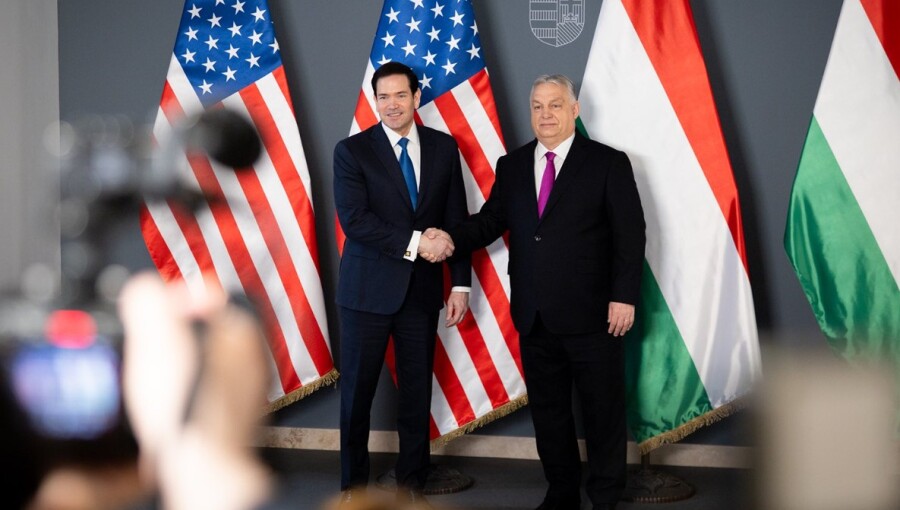
Bilateral relations with Hungary are entering a "golden age", and Washington would be willing to help Budapest financially if needed, US Secretary of State Marco Rubio told his Hungarian host at a joint press conference with Prime Minister Viktor Orban on February 16 in Budapest.
Rubio arrived from Bratislava after attending the Munich Security Conference over the weekend and received a warm welcome at the Carmelite Monastery, the seat of the prime minister.
At a joint press conference with Orban, the US chief diplomat said the new golden era between the two countries was due to the strong relationship between Orban and Trump.
"Hungary’s success is also our success. It is because we want you to continue, want this economy to prosper, and want this country to do well. It’s in our national interest. Especially as long as you’re the prime minister and the leader of this country, it’s in our national interest that Hungary be successful," he added.
When asked about whether ties would remain strong in case of a change of government, Rubio said the outcome of Hungary's election was up to the voters but praised Orban's "extraordinarily strong" relationship with the US, saying it had "tangible benefits" for bilateral ties and "strong personal ties between the two leaders had significantly shaped bilateral relations".
Trump has already publicly endorsed Orban, calling him "a truly strong and powerful leader" in a social media post last week, after the Hungarian prime minister had steadfastly supported him in every election since 2016.
In his opening remarks, the Hungarian premier described the meeting with Rubio as cordial, friendly and substantive, noting that the visit had been agreed during his visit to Washington last November.
Since Trump’s inauguration, 17 new US investments have been launched in Hungary, the visa programme was restored, and Hungary has been invited to join Trump's Peace Council initiative. Orban cited achievements over the last 13 months, adding that he would travel to Washington on February 19 to sign the accession declaration.
Rubio and Orban signed energy agreements that extend to crude, gas and nuclear. Those agreements, together with an exemption allowing Hungary to use Russian oil and gas, contribute to the country's energy security and keep prices affordable for households and businesses, Orban said, adding that talks also evolved around the acquisition of Serbian oil company NIS by its Hungarian peer MOL, but he did not provide more detail.
MOL plans to buy out the majority Russian stake in the company. The deal still requires approval from Washington, which is expected to be a formality.
No new details emerged on the nuclear energy deal, but based on earlier reports, Hungary committed to acquire SMR technology from the US for $20bn. Under the agreements signed last November, Budapest will also be buying $600mn in LNG to diversify its energy supplies and $700mn in military equipment.
After returning from the White House, Orban said he had reached a financial agreement with Trump. Later, his economy minister said this financial arrangement could include a swap agreement, credit lines, and infrastructure financing, designed to strengthen Hungary’s financial stability and provide a shield in times of crisis.
Rubio cordially offered Washington’s help to its ally if needed. "When you face financial difficulties, we are ready to provide assistance. Especially while you serve as prime minister, it is in America’s national interest to maintain strong relations between our two countries, and we appreciate your efforts in furtherance of peace. Your geopolitical role is indispensable," Rubio added.
Asked by CBS News, the secretary of ctate said Hungary’s exemption from US sanctions on Russian energy imports was the result of direct talks between the two leaders, calling it a product of their strong personal ties. He declined to speculate on the future of bilateral relations in the event of a change of government in Hungary. Earlier, Rubio contradicted the government’s claims, saying the exemption was not permanent but valid for one year.
Rubio also addressed questions concerning Hungary’s relations with China, saying every nation pursues its own national interests and that the United States did not expect partners to isolate themselves from other countries.
Analysts commented that the US diplomat was fully aligned with the Hungarian position in these two cases, without having to confront sensitive issues. Independent media also notes that Washington’s open support for Orban in the election appeared to go beyond diplomatic norms.
Analysts said the prime minister is likely to leverage his close relationship with Trump for PR, portraying himself as the reliable leader welcomed by big global players. in the final stretch of what is shaping up to be a closely contested election campaign.
Erik Toth, the research director at the government-funded think-tank, the Centre for Fundamental Rights, also highlighted the political fallout from Rubio's visits and Trump's endorsement. Toth said he believed that the endorsement adheres to diplomatic norms and shows that the current US administration intends to continue close cooperation with the Orban government.
At the press conference, Orban said Hungary remained ready to host a future peace summit if one were to take place. He added that his invitation for Trump to visit Hungary still stands.
When asked whether the US leader would visit Hungary in the near future, Rubio said he could not confirm such plans.

No comments:
Post a Comment