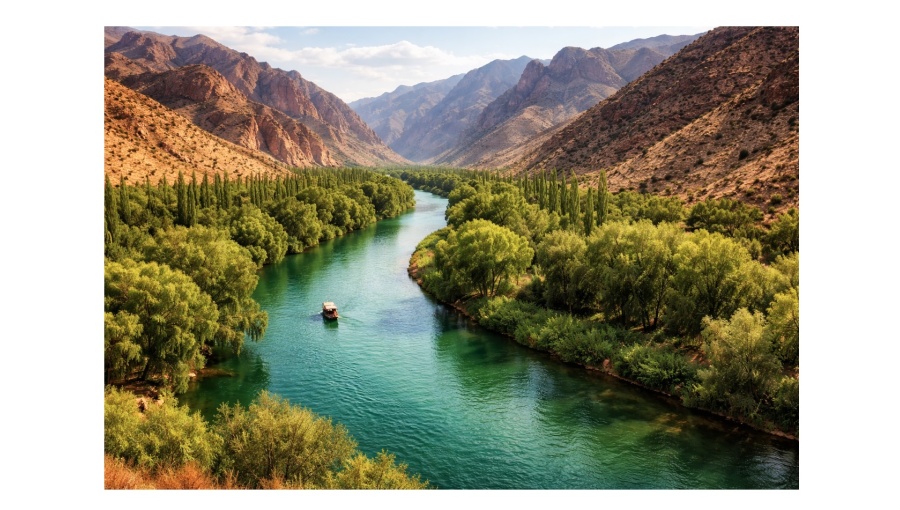
China’s South-to-North Water Transfer Project has delivered 64.73bn cubic metres of water to the country’s arid north over the past year, bringing cumulative transfers to more than 83bn cubic metres since operations began, according to official data released in November 2025. Nearly 118mn people now rely on the system for daily supply, as water security moves up the agenda in the midst of accelerating temperature rises and increasing extreme weather events.
Over the past five years alone, more than 52mn residents have been added to the project’s service area. The Middle Route — the most politically significant of the three channels — now forms the backbone of water provision for the Beijing-Tianjin-Hebei region, long constrained by chronic scarcity. The area holds just 7.2% of China’s water resources but supports almost one-third of its population.
China faces similar problems to the Western US states where a mounting water shortage threatens to become critical after several states with overlapping water interests failed to come to an agreement to make critical and deep cuts to their water usage, the Guardian reported.
This month seven states remained at a stalemate over who should bear the brunt of the enormous water cuts needed to pull the imperilled Colorado River back from the brink. Collectively they need to cut their usage by a quarter of face the prospect of not having enough water. But after months of talks no agreement was reached and now the outlook for water supply for a region that includes cities like Las Vegas looks bleak.
China’s northern region faces similar imbalances but decisive government action appears to have dealt with the biggest problems after groundwater overdraft, land subsidence and seasonal river depletion was already limiting industrial expansion.
Beijing’s groundwater table has risen by more than 13 metres over the past decade, with official figures indicating that over-extraction zones have been eliminated. More than 11.8bn cubic metres of ecological water have been channelled into 50 northern rivers, including the Hutuo and Juma, helping reverse years of environmental degradation.
The easing of resource constraints has gone hand in hand with a broader spatial reorganisation of the Beijing-Tianjin-Hebei economic cluster, which generated CNY11.5tn ($1.6 trillion) in gross domestic product in 2024. Cities have literally been rebuilt on the basis of resource availability to produce sustainable cities that could have otherwise died.
At the centre of this strategy lies Xiong’an New Area, launched in 2017 to absorb Beijing’s non-capital functions. The district has attracted more than CNY830bn ($115bn) in cumulative investment and seen 4,700 buildings constructed.
Institutional infrastructure is following. Beijing No.4 High School has opened a campus in Xiong’an, while Xiong’an Xuanwu Hospital has recorded 200,000 patient visits. The Xiong’an Zhongguancun Science Park hosts more than 130 enterprises. Fifteen Beijing universities, including Beijing Jiaotong University and the University of Science and Technology Beijing, are establishing branch campuses under a “one university, two campuses” model, with capacity for about 250,000 students by 2030.
Researchers from Capital University of Economics and Business wrote in the 2025 Beijing-Tianjin-Hebei Bluebook that deeper integration of education, technology and talent would enable the region to shift from “scale pursuit to capability leap”. Water security underpins that ambition, removing what had been a binding constraint on laboratories, semiconductor fabrication plants and urban expansion.
The infrastructure itself is evolving. Operators have introduced digital twin systems for real-time monitoring, while robotics and AI tools conduct inspections along the route. A supplementary Yangtze-to-Han River diversion, now under construction, will further reinforce supply. By 2027, operators aim to achieve zero-carbon operations along the Middle Route.
The completed Middle Route can transport 9.5bn cubic metres of water annually. For policymakers, the question is no longer whether northern China can sustain its population, but what form of growth it will pursue now that its most basic resource constraint has been eased.

No comments:
Post a Comment