China–United States: Asymmetrical rivalry from a historical and internationalist perspective
First published at CADTM.
Cyn Huang, a student at Berkeley (California) and active member of Democratic Socialists of America (DSA), where he co-chairs the Bread and Roses current, conducted an interview with Éric Toussaint.
Can you explain the terms of the conflict between China and the United States? Where does it come from?
Today, we are witnessing a conflict between two superpowers. However, I would argue that they represent two distinct forms of imperialism. China is an emerging imperialism, whereas the United States embodies an established, consolidated imperialism that is currently in relative decline and exhibiting a high level of aggression.
To understand the evolution of relations between China and the United States, it is crucial to consider the historical context. Following the Chinese revolution of 1949, the United States supported the nationalist regime of Chiang Kai-shek, which had retreated to Taiwan, and refused to recognise the People’s Republic of China, led by Mao Zedong, which was in the process of transitioning to socialism. Relations were particularly conflictual during the Korean War. In the early 1960s, China supported armed struggles in various countries deemed strategic by the United States. Notably, Beijing provided assistance to North Vietnam, under Hồ Chí Minh, as well as to the National Liberation Front of South Vietnam (NLF) also, known as Viet Cong.
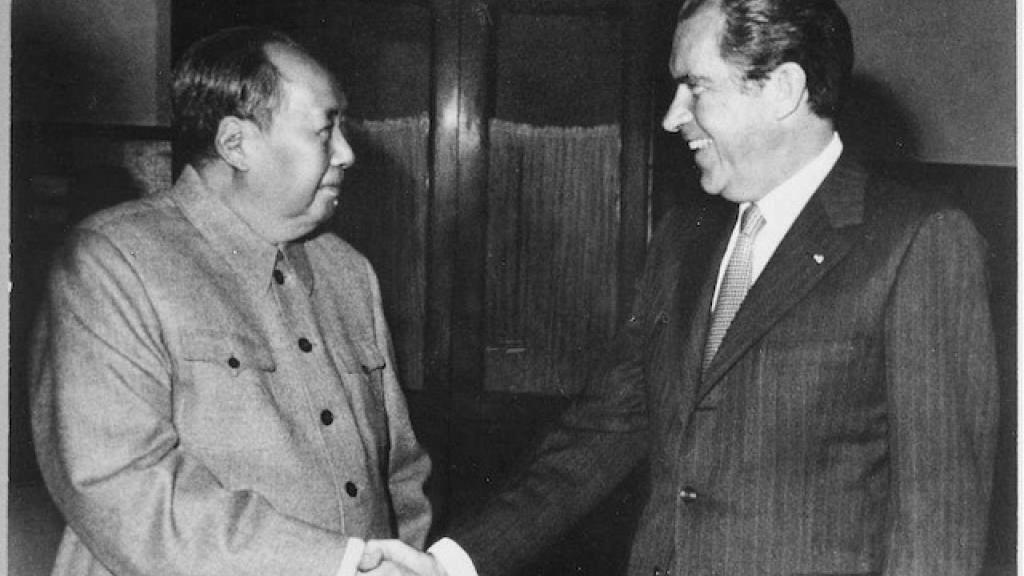
Faced with the impasse of the Vietnam War, the United States then made a strategic shift and moved closer to China. This rapprochement was symbolised by the historic meeting between Richard Nixon and Mao Zedong in the early 1970s, as illustrated by the famous photograph of their handshake in 1972. The United States had recognised the Beijing authorities as the legitimate government of China prior to this meeting. The United States subsequently withdrew its diplomatic recognition of Taiwan and accepted the principle that Taiwan was part of Chinese territory.
This change had concrete consequences. Until 1971, China was represented on the United Nations Security Council by Taiwan. Following the Sino-American agreement, the People’s Republic of China took China’s seat on the UN Security Council. A few years later, in 1980, Beijing replaced Taiwan at the International Monetary Fund (IMF) and the World Bank.
At that time, China was still undergoing a transition to socialism, which was characterised by a high level of bureaucratisation and significant contradictions, particularly those exposed during the Cultural Revolution that began in 1966. Deng Xiaoping initiated reforms from the 1980s onwards, gradually facilitating the restoration of capitalism in China.
The development of China’s political economy and the evolution of its position within the global system are remarkable. As you have just demonstrated, the United States has not always viewed China as its primary strategic adversary. Furthermore, beginning in the 1990s and continuing through the first decade of the 21st century, the American ruling class regarded China as a crucial economic partner from which it could profit, and believed it could be integrated into a world order dominated by the United States.
From the 2000s onwards, China emerged as a significant destination for foreign investment, especially from the United States. Major American corporations — including Apple, Microsoft, and others — established factories in special economic zones in China. For years, both the US government and large multinationals believed they were gaining substantial benefits from this arrangement: they were able to exploit a low-paid Chinese workforce, enduring particularly harsh working conditions, while extracting considerable added value.
Using Karl Marx’s categories, we can discuss the transfer of value through unequal trade, whereby a significant portion of the added value generated by Chinese workers was appropriated by American capitalists. Simultaneously, China’s substantial exports led to the accumulation of enormous trade surpluses and significant dollar foreign exchange reserves. These reserves exceeded $3 trillion — an amount comparable to France’s GDP in 2025 — of which more than $1.3 trillion was invested in US Treasury bonds in 2013. In essence, China reinvested part of its surpluses by lending money to the United States. Following this, China scaled back its purchases of Treasury bonds and is projected to hold $700 billion directly by 2025.
Throughout the period from the 1990s to 2014-2015, the United States believed that it was benefiting greatly from its relationship with China. However, from 2014 onwards, with the launch of the Belt and Road Initiative, China was no longer content to simply export goods. It began to export its capital abroad on a massive scale, lending money to many countries and investing in infrastructure, businesses, and natural resources in Europe, Latin America, Africa, and even the United States.
From that point on, China reached such a level of economic power that the United States — from the end of Obama’s term and even more clearly from 2016–2017 onwards — began to feel that it was no longer benefiting as much as before from this relationship. It began to take protectionist measures and strengthened its military presence around China. This situation must be described as military encirclement: more than 20,000 American soldiers are stationed in South Korea, more than 50,000 in Japan, and around 10,000 on the island of Guam, not to mention other deployments. Additionally, the United States maintains an alliance with Taiwan and provides it with weaponry.
From the Chinese point of view, the United States is therefore encircling China in its own periphery. From the American point of view, China has become a rapidly expanding capitalist rival power, gaining market share and consolidating lasting positions on several continents, including what Donald Trump calls ‘the Western Hemisphere’, from Greenland and Canada to southern Argentina and Chile.
For example, China controls Peru’s main seaport and owns mining and oil extraction companies in many countries. The United States therefore considered that the area it had historically dominated was beginning to be seriously threatened. Under Trump, this logic is brutally assumed: the United States claims the right to act freely in its hemisphere, to attack Venezuela for its oil and appropriate it, to kidnap and hold the Venezuelan president and his wife hostage in New York, and to seek control of Greenland, Canada, and the Panama Canal while demanding that China abandon its positions in this area.
How does Trump define China in the National Security Strategy NSS 2025? Would you like to summarise what you wrote in your article entitled ‘Why Washington has made China its central strategic adversary’ ?
The National Security Strategy document published by the Trump administration in early December 2025 clearly designates China as the United States’ main strategic adversary. Washington seeks to reduce China’s presence in the Western Hemisphere and strengthen its military encirclement in the Indo-Pacific region. Officially, the United States acknowledges that it has 375,000 soldiers and civilian military personnel in this region, 66 permanent military bases, and more than 80 non-permanent bases. This is an absolutely colossal military presence.
Faced with this situation, although China has thus far adopted a strategy centred on economic and peaceful expansion, it is possible that certain factions within its political leadership are gaining influence by advocating preparations to confront the United States directly, citing self-defence. Consequently, we are approaching an extremely precarious situation.
Historically, Trump’s policy bears resemblance to that of the latter half of the 19th century and the early 20th century, during which the United States engaged in direct military interventions to expand its sphere of influence. Notable examples include the war against Mexico in 1847, which allowed the United States to annex Texas, New Mexico, and California. In 1898, Washington waged war against the Spanish colonial empire, subsequently taking control of Cuba, Puerto Rico, and the Philippines. Additionally, the United States occupied Haiti beginning in 1915.
After the Second World War, the United States persisted in its aggressive foreign policy, most notably through the Korean War in the early 1950s and the Vietnam War from 1960 to 1975, which involved the deployment of up to 500,000 soldiers. Additionally, the Gulf War in 1991, the military intervention in Taliban-led Afghanistan from 2001 onwards, and the invasion of Iraq in 2003 are significant examples of this trend.
In the 21st century, we are witnessing a resurgence of classic imperialist policies, as examined by Lenin, Trotsky, Hilferding, Bukharin and Rosa Luxemburg. These Marxist theorists have demonstrated that such confrontations between imperialist powers inherently lead to conflict. Following the Second World War, despite the occurrence of extremely violent wars in Korea and Vietnam, these conflicts, while involving multiple nations, did not escalate to a global scale. However, in the current climate, influenced by Trump’s policies, the prospect of a shift toward a new world war has become a tangible threat once more.
What gives Trump the impression that China could be ‘controlled’?
I believe that Donald Trump and his administration are attempting to contain China’s international economic expansion through various economic, trade, diplomatic, and military strategies. These strategies include enhancing economic and trade protectionism by implementing various barriers aimed at reducing Chinese imports into the United States while promoting US exports on the global market. Additionally, they are exerting pressure on the United States’ trading partners to increase their purchases of US-made products and urging companies in the United States and other nations to either increase their production within the US or repatriate their operations there. Other measures involve increasing subsidies to US companies, asserting control over territory and natural resources in the Western Hemisphere and beyond, and engaging in tough negotiations with China to encourage a reduction in its economic expansion beyond its borders. Regarding military measures, it does not necessarily imply that Trump is directly preparing for war with China. Rather, his intention appears to be to impress Beijing by demonstrating overwhelming military superiority. The aim is to convey to China that, in the event of armed conflict, it would stand little chance against the United States, given the extensive US military presence encircling China, both in the Indo-Pacific region and globally.
The United States is therefore operating on the assumption that it can intimidate the Chinese leadership and, in this way, limit its economic expansion. However, there is no guarantee that China will agree to scale back its strategic and economic objectives under pressure. On the contrary, it is likely that Beijing does not want a direct military confrontation, but that it will be increasingly forced to face one as the United States steps up its threats and military posture.
In this context, Trump’s calculation appears extremely dangerous. It poses a major risk not only to Sino-American relations but also to humanity as a whole: the populations of the United States, China, and, more broadly, the entire world.
How do you currently perceive the balance of power between China and the United States, and what is Russia’s place in this situation?
To get an accurate picture of the current international landscape and Donald Trump’s strategy, it is crucial to incorporate an analysis of both Russia and Europe.
Trump’s primary objective is to create a rift between Russia and China. Over the past fifteen years, Vladimir Putin and Xi Jinping have forged a significantly closer relationship. This rapprochement has led to the establishment of BRICS and the enhancement of trade, financial, and military agreements between Russia and China, particularly in the wake of the sanctions imposed by Western powers on Russia following the annexation of Crimea in 2014. These sanctions were further intensified after the invasion of Ukraine in 2022.
Russia’s ties with China have inadvertently strengthened due to the sanctions imposed on it. In light of this situation, Trump has formulated a distinct strategy: he is subtly offering Vladimir Putin a deal. The essence of this message is as follows: you can act in your regional environment – that is, in the space of the former Soviet republics that have become independent states – in the same way that I act in the Western Hemisphere. In simpler terms, Trump asserts his right to intervene in Venezuela or other locations in Latin America while simultaneously bestowing upon Russia a form of legitimacy to act in its own neighbourhood.
Following this logic, Trump is proposing a ‘deal’ to Putin: he will allow Russia to pursue its objectives in its own region, including Ukraine, in exchange for a commitment to distance itself from China. The strategic aim of the United States, therefore, is to isolate China by creating a rift between it and Russia, while simultaneously providing Russia with assurances regarding its imperialist ambitions.
Let us be clear: Russia has become an exceedingly aggressive capitalist imperialist power, as evidenced on numerous occasions. Consequently, we are witnessing a potential agreement between two imperialist powers: Russia, characterised as aggressive yet second-rate, and the United States, which stands as a dominant and hyper-aggressive imperialist power. This agreement appears aimed at weakening and isolating China.
However, the effectiveness of this strategy remains uncertain. Trump’s current conciliatory stance towards Putin, exemplified by his invitation to the ‘world peace council’ he organised during the Davos meeting on 21 and 22 January, could shift unexpectedly. Should Putin decline to distance himself from China or reject an agreement with Trump that compromises Ukraine, a sudden reversal in the US position is entirely plausible.
It is important to note that we cannot conduct the analysis of US-China relations in isolation from Russia’s stance. US imperialism is actively pursuing an agreement with the Russian government to reduce China’s economic, political, and strategic influence.
What internationalist position should we adopt?
Faced with this situation, the essential question for us, as revolutionaries and internationalists, is this: which side are we on? Our answer is unequivocal. We stand with the people, opposing the calculations and confrontations of the great powers and the various forms of imperialism.
Concretely, this means that we support activists in Russia and Ukraine who oppose Russia’s war in Ukraine. We support workers, students, and social movements in China that are fighting for their rights, better living conditions, and greater political freedoms. We also support workers and the popular masses in the United States who are fighting against Trump’s policies. Finally, we defend the sovereignty of countries in the Western Hemisphere and other parts of the world against the aggressive strategy of domination by the United States. We support the people’s fight for self-determination and control over their natural resources. We oppose all imperialist and colonialist aggression, whatever its origin. In Europe, we oppose the imperialist and neo-colonialist policies of our governments and denounce their complicity with the neo-fascist Netanyahu government, which is committing genocide against the Palestinian people. We oppose the inhumane policies practiced by the majority of governments around the world toward migrants and refugee applicants. We support all internationalist solidarity activities.
We defend a genuinely internationalist perspective. We choose the side of the people against their oppressors. We are actively participating together with other forces to the preparation and organisation of the anti-fascist and anti-imperialist conference in Porto Alegre, Brazil (March 26–29, 2026). We support the International Call for the Strengthening of Anti-Fascist and Anti-Imperialist Action.
The authors would like to thank Gabriella Lima and Maxime Perriot for their review.