Trump’s Cruelty Is Strangling Cuba — Its Oil Reserves Could Be Empty by March
The Supreme Court struck down Trump’s threatened tariffs on countries that send oil to Cuba, but the crisis persists.
For 67 years, the U.S. government has maintained a vicious and illegal embargo/blockade of Cuba.
The blockade cost Cuba $7.5 billion in 2025. Since 1960, it has cost Cuba $170 billion.
February 25, 2026
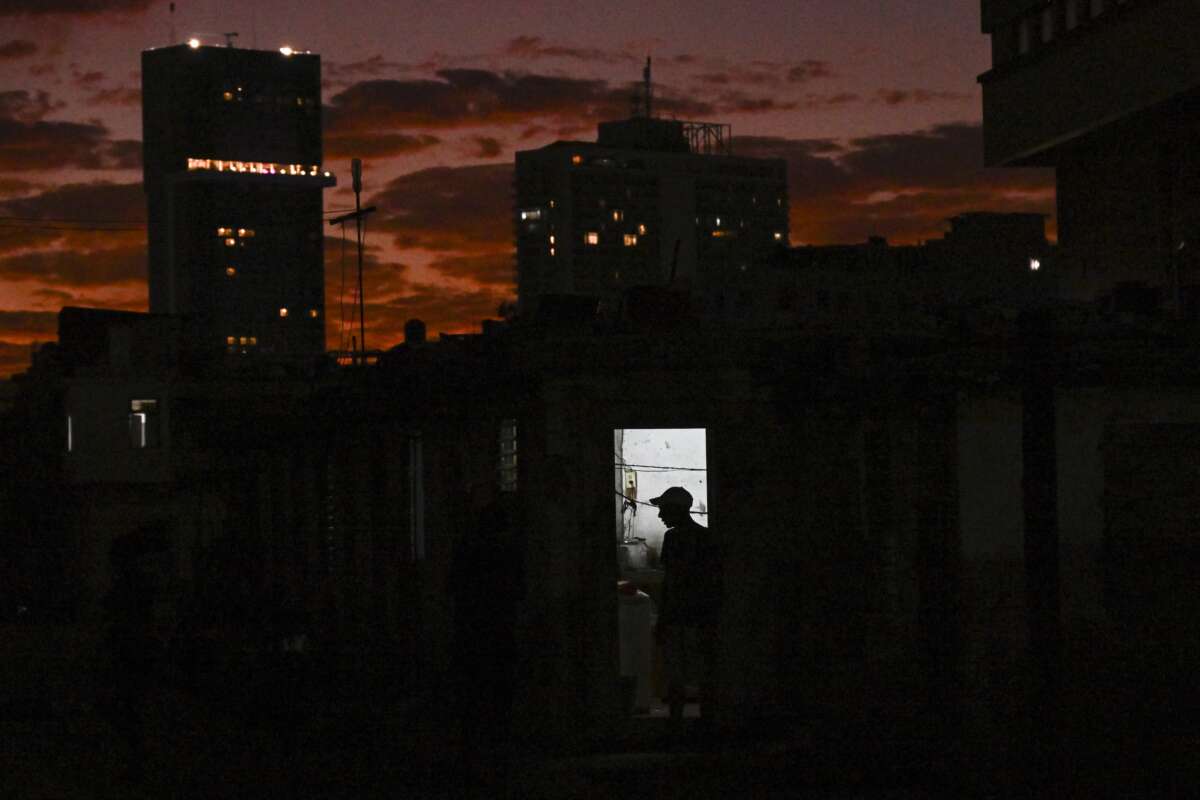
The silhouette of a man is seen at his home during a blackout in Havana, Cuba, on February 21, 2026. On February 23, Cuban Foreign Minister Bruno Rodríguez Parrilla said the United States was trying to trigger a "humanitarian catastrophe" in his country with an oil blockade he called an "aggressive escalation."
YAMIL LAGE / AFP via Getty Images
In accordance with Secretary of State Marco Rubio’s long-standing vendetta against Cuba, Donald Trump issued an executive order on January 29 aimed at tightening the U.S. noose around Cuba’s neck.
Trump’s order preposterously declared Cuba “an unusual and extraordinary threat,” without providing a shred of evidence, and warned that he would impose punitive tariffs on states that deliver fuel to Cuba. His intention is to suffocate the Cuban people, who rely on oil for 80 percent of their electricity.
UN human rights experts called Trump’s order “a serious violation of international law” and “an extreme form of unilateral economic coercion with extraterritorial effects, through which the United States seeks to exert coercion on the sovereign state of Cuba and compel other sovereign third States to alter their lawful commercial relations, under threat of punitive trade measures.”
On February 20, however, the Supreme Court struck down Trump’s massive tariffs because they exceeded authority delegated by Congress under the International Emergency Economic Powers Act (IEEPA). The IEEPA authorizes the president to regulate commerce during national emergencies created by foreign threats.
Later that day, in response to the court’s decision, Trump issued an executive order ending IEEPA-based tariffs, including those that would penalize countries that ship oil to Cuba. That order stops the collection of all IEEPA tariffs, including those threatened in the January 29 Cuba emergency order.
Trump’s attempt to tighten the fuel blockade of Cuba came on the heels of the U.S. oil blockade of Venezuela, which had supplied more than 50 percent of Cuba’s oil. Countries that provided Cuba with oil, particularly Mexico, halted their shipments after January 29.
“Trump’s resort to piracy on the high seas, kidnapping of foreign leaders, and unconstitutional misuse of tariffs to starve the Cuban people into submission is a cruel but pathetic example of the decline in U.S. domination of the hemisphere.”
The U.S. has imposed on Cuba a naval blockade, which is considered an act of war. The Trump administration is militarily seizing oil tankers attempting to deliver fuel to Cuba. On February 20, The New York Times reported that “in recent days, vessels roaming the Caribbean Sea in search of fuel for Cuba have come up empty or been intercepted by the U.S. authorities.” Last week, “the U.S. Coast Guard intercepted a tanker full of Colombian fuel oil en route to Cuba that had gotten within 70 miles of the island.”
A U.S. official anonymously told the Times that “the Coast Guard’s interception of the tanker headed to Cuba last week was part of a blockade that the Trump administration has not yet announced.”
Oil shipments to Cuba have virtually stopped. The lack of electricity has led to widespread blackouts, impacting hospitals and essential services. Cuba’s oil reserves could be totally depleted by March.
Meanwhile, as this article went to press, the crew of a U.S. speedboat registered in Florida came within a nautical mile of Cuba’s coast. After the crew opened fire on Cuban troops, injuring the vessel’s commander, the Cuban forces returned fire, killing four crew members and wounding six, according to a statement by Cuba’s Interior Ministry. The wounded were reportedly receiving medical attention.
“In the face of current challenges, Cuba reaffirms its determination to protect its territorial waters, based on the principle that national defense is a fundamental pillar of the Cuban State in safeguarding its sovereignty and ensuring stability in the region,” the ministry said.
The Long-Standing U.S. Blockade of Cuba Is Illegal
For 67 years, the U.S. government has maintained a vicious and illegal embargo/blockade of Cuba.
After the 1959 Cuban Revolution, the Eisenhower administration declared a partial embargo on trade with Cuba to pressure the people to overthrow their new government. The embargo was a response to a secret State Department memorandum that proposed “a line of action which, while as adroit and inconspicuous as possible, makes the greatest inroads in denying money and supplies to Cuba, to decrease monetary and real wages, to bring about hunger, desperation and overthrow of government.” Two years later, John F. Kennedy expanded the embargo and it persists to this day.
In 2015, Barack Obama loosened some of its restrictions. Then, during his first term, Trump reversed Obama’s progressive measures and imposed 243 onerous new sanctions — 50 of them during the COVID-19 pandemic — as part of his “maximum pressure” strategy against Cuba.
The blockade cost Cuba $7.5 billion in 2025. Since 1960, it has cost Cuba $170 billion.
But although the blockade continues to take a toll on the Cuban people, it has been unsuccessful in causing the Cuban people to overthrow their socialist government.
“The illegal US blockade against Cuba and the measures that intensify it are an act of ruthless economic warfare against the Cuban people, which particularly targets the most vulnerable and the poorest,” Yamila González Ferrer, vice president of the National Union of Cuban Jurists, wrote in an email to Truthout. “It has a devastating impact on families who suffer daily from material deprivation and separation from loved ones who have emigrated. Our ‘sin’ has been defending our independence and sovereignty and showing the world that a path to social justice is possible. We will resist and we will prevail!”
The U.S. government imposed the embargo/blockade (unilateral coercive measures) without UN Security Council approval in violation of Article 41 of the United Nations Charter, which empowers only the Security Council to impose and enforce sanctions. They constitute collective punishment, which is outlawed by Article 33 of the Fourth Geneva Convention.
On October 29, 2025, for the 33rd consecutive year, the UN General Assembly overwhelmingly adopted a resolution calling for an end to the U.S. economic, commercial, and financial embargo of Cuba. The resolution urged states to refrain from promulgating laws like the Helms-Burton Act, “the extraterritorial effects of which affect the sovereignty of other States, the legitimate interests of entities or persons under their jurisdiction and the freedom of trade and navigation.”
Helms-Burton Act Lawsuits
Before the 1959 Cuban Revolution, U.S. companies owned or controlled 90 percent of Cuba’s electricity generation, a large portion of its mining industry, sugar cane fields, telephone system, and several oil refineries and warehouses. After the revolution, the new Cuban government expropriated those assets and transferred them to government-owned companies.
In 1996, Bill Clinton signed the Helms-Burton Act, which codified the embargo against trade with and investment in Cuba, so that no president could unilaterally lift the sanctions.
Title III of the Act allows U.S. citizens to bring lawsuits against U.S. and foreign entities for allegedly “trafficking” in property confiscated in Cuba since 1959. “Trafficking” includes knowingly and intentionally engaging in a commercial activity or otherwise “benefiting from confiscated property.”
U.S. nationals who formerly owned commercial property expropriated by the Cuban government in 1960 were now authorized to file lawsuits in U.S. courts against persons (including non-U.S. companies) that may be “trafficking” in that property.
Every U.S. president, starting with Clinton, delayed the implementation of Title III by suspending its provisions for six-month increments. Clinton put Title III “on hold because it triggered immense opposition from U.S. allies, whose companies operating in Cuba would become targets of litigation in U.S. courts,” American University professor and Cuba scholar William M. LeoGrande wrote in The Conversation.
But in 2019, Trump’s first administration announced that it would no longer suspend the operation of Title III, opening the door to federal lawsuits.
Two of those lawsuits are now pending in the Supreme Court, and it heard arguments in the cases on February 23.
One of the plaintiffs, Havana Docks, is a U.S. company that owned a right to use and operate the docks at the port of Havana before 1960. It filed a lawsuit against four Florida-based cruise ship companies, seeking hundreds of millions of dollars from the cruise lines that transported tourists to the port between 2016 and 2019, even though Havana Docks’ right to use the docks had been set to expire in 2004.
In its lawsuit, Havana Docks asserts that the cruise lines “trafficked” in property it owned when they brought tourists to the Havana Cruise Port Terminal. The case raises the due process question of whether Havana Docks should be permitted to receive much more money than Cuba should have paid it originally.
In the second case, the issue is whether Cuban state-owned companies are immune from a lawsuit filed by ExxonMobil, which seeks more than $1 billion for the confiscation of assets owned by subsidiaries of its predecessor, Standard Oil.
Sovereign immunity generally prevents lawsuits in U.S. courts against foreign governments and their agencies and instrumentalities. Attorney Jules Lobel argued on behalf of the Cuban-owned companies that the court “should not read in an exception where Congress did not enact one.”
Although the members of the court actively engaged with the lawyers on the legal issues, it is hard to predict how the cases will turn out. The court will issue decisions by July 2026.
On several occasions, Cuba has offered to negotiate compensation of the nearly 6,000 claims of U.S. parties, as it has successfully done with claims from other countries. “It is well-known that all nationalizations of foreign property, including that of the U.S., were provided by law with a commitment to compensation, which the U.S. government refused even to discuss, while it was adopted by the governments of claimants of other countries, all of which enjoyed due compensation,” the Ministry of Foreign Affairs of Cuba said in a statement in 2019.
Cuban Resistance and International Solidarity
Trump’s recent actions are consistent with his 2025 National Security Strategy, which says the U.S. seeks to control the Western Hemisphere. As part of its offensive against Venezuela, the Trump administration has illegally attacked civilian and commercial vessels with weapons and drones, boarded vessels, destroyed boats, kidnapped crew members of ships, and killed crew members of smaller boats in the Caribbean and Eastern Pacific. It has imposed an unlawful oil blockade against Venezuela and stolen Venezuela’s oil. It has illegally attacked Venezuela and kidnapped President Nicolás Maduro and First Lady Cilia Flores. And it maintains an unlawful naval blockade of Cuba.
“Trump’s resort to piracy on the high seas, kidnapping of foreign leaders, and unconstitutional misuse of tariffs to starve the Cuban people into submission is a cruel but pathetic example of the decline in U.S. domination of the hemisphere,” Arthur Heitzer, chairperson of the Cuba Subcommittee of the National Lawyers Guild, told Truthout.
“Can a great power be allowed to attempt to destroy a small, peaceful nation, subjecting its people to genocide under the crude pretext of national security?”
“Can a great power be allowed to attempt to destroy a small, peaceful nation, subjecting its people to genocide under the crude pretext of national security?” queried Cuban Foreign Minister Bruno Rodríguez Parrilla, denouncing Trump’s January 29 executive order in a speech to the UN Human Rights Council. “In the face of these threats, the Cuban people reaffirmed their firm decision to defend, with the utmost vigor, their right to self-determination, independence, sovereignty, territorial integrity, and constitutional order, in close unity and broad consensus.”
“Trump implemented every macabre idea that occurred to Marco Rubio against Cuba, but they didn’t count on the resistance and patriotism of the Cuban people. The oil blockade is the latest bullet. What will come next?” Antonio Raudilio Martín Sánchez, a Cuban jurist and professor, and president of the continental advisory council of the American Association of Jurists, told Truthout.
Indeed, Cuba is taking steps to protect its people in the face of Trump’s cruelty.
On February 23, Cuba’s Ministry of Transport launched a new transport system to facilitate the commute of health workers in Havana. Charging stations with solar panels and energy storage systems are being installed.
Mexican President Claudia Sheinbaum warned that Trump’s threat of new tariffs would unleash a “humanitarian crisis of great scope” in Cuba. “Mexico unequivocally reaffirms the principle of sovereignty and free self-determination of peoples, a fundamental pillar of our foreign policy and international law,” she added.
Although Trump has effectively blackmailed other countries, including Mexico, into halting their deliveries of oil to Cuba, Sheinbaum sent two shipments of humanitarian aid and has pledged to send more. Solidarity organizations in Mexico have initiated a nationwide campaign to collect non-perishable food and medical supplies to send to Cuba.
Russian Deputy Prime Minister Alexander Novak pledged to continue to provide critical support to Cuba, although it isn’t clear whether that would include oil. “We are helping, but I will not reveal the details,” he said recently.
Meanwhile, the Chinese government has sent 5,000 solar kits for rooftop energy harvesting and China has pledged to help Cuba build 92 solar farms. Vietnam, the largest investor in Cuba, is also assisting Cuba with wind and solar power, and Canada has also promised to send humanitarian aid to Cuba.
CODEPINK traveled to Holguín, Cuba, and delivered 2,500 pounds of lentils to the people there. Marta Jiménez, a hairdresser in Holguín, sobbed as she told CODEPINK founder Medea Benjamin:
You can’t imagine how it touches every part of our lives. It’s a vicious, all-encompassing spiral downward. With no gasoline, buses don’t run, so we can’t get to work. We have electricity only three to six hours a day. There’s no gas for cooking, so we’re burning wood and charcoal in our apartments. It’s like going back 100 years. The blockade is suffocating us — especially single mothers … and no one is stopping these demons: Trump and Marco Rubio.
On March 21, the Nuestra América Convoy to Cuba will reach Havana, carrying food, medicines, medical supplies, and essential goods. Inspired by the Global Sumud Flotilla to Gaza, the convoy is an “international coalition of movements, trade unionists, parliamentarians, humanitarian organizations, and public figures,” according to its most recent press release.
This article is licensed under Creative Commons (CC BY-NC-ND 4.0), and you are free to share and republish under the terms of the license.

Marjorie Cohn
Marjorie Cohn is professor emerita at Thomas Jefferson School of Law, dean of the People’s Academy of International Law and past president of the National Lawyers Guild. She sits on the national advisory boards of Veterans For Peace and Assange Defense, and is a member of the bureau of the International Association of Democratic Lawyers and the U.S. representative to the continental advisory council of the Association of American Jurists. Her books include Drones and Targeted Killing: Legal, Moral, and Geopolitical Issues.