Saturday, September 20, 2025

France Throws Lifeline To India’s Fighter Jet Dreams As America Keeps Delhi Waiting – Analysis


A HAL Tejas Mark 2 (Mk2). Photo Credit: Government of India, Wikipedia Commons

September 21, 2025 
EURASIA REVIEW
By Girish Linganna

Safran’s surprise engine offer for Tejas Mk-2 could break India’s dependence on unreliable US supplies, but comes with serious design challenges

India’s ambitious fighter jet program stands at a crossroads. While American promises of engine technology transfer remain stuck in bureaucratic delays, French aerospace giant Safran has stepped forward with a game-changing proposal that could reshape India’s military aviation future.

The timing couldn’t be more telling. As nearly a dozen Tejas Mk-1A jets sit grounded at Hindustan Aeronautics Limited (HAL) facilities—ready for delivery but waiting for American F-404 engines that simply aren’t arriving—Safran has offered to establish a complete engine manufacturing ecosystem in India.


HAL’s Growing Frustration with American Delays

For HAL, India’s premier aerospace manufacturer, the current situation represents both a crisis and an opportunity. The company has demonstrated remarkable progress in aircraft production, with Tejas Mk-1A jets rolling off assembly lines faster than ever before. Yet these technological marvels remain earthbound, victims of America’s sluggish supply chain and complex export approval processes.

“We have the capability, we have the infrastructure, but we’re being held hostage by foreign suppliers who don’t share our urgency,” says a senior HAL official, speaking on condition of anonymity. The company has delivered only three F-404 engines against much larger requirements, creating a bottleneck that threatens India’s defense preparedness.

This supply crisis isn’t just about numbers—it’s about national pride and strategic autonomy. HAL has invested decades in building indigenous aerospace capabilities, only to find itself dependent on suppliers who treat India’s defense needs as secondary priorities.


The French Alternative: More Than Just Engines

Safran’s proposal goes far beyond a simple engine supply deal. The French company is offering to establish manufacturing facilities in India for two distinct engines—one optimized for the Tejas Mk-2 and another for India’s future Advanced Medium Combat Aircraft (AMCA). This represents a quantum leap from the limited technology transfer arrangements typically offered by Western suppliers.

Unlike American companies that often come with strings attached and government oversight, Safran brings a track record of genuine partnership. The company already operates successful joint ventures with HAL, manufacturing helicopter engines that power over 400 Advanced Light Helicopters. This existing relationship provides a foundation of trust and technical understanding that would be invaluable for a fighter jet engine program.

France’s approach to defense cooperation has consistently been more pragmatic and less encumbered by geopolitical considerations. While American defense deals often become hostage to broader diplomatic relationships, French partnerships tend to focus on technical merit and mutual benefit.

The Design Challenge: Engineering Complexity

However, switching from General Electric’s F-414 to a Safran engine would present significant technical challenges. The Tejas Mk-2 was specifically designed around the F-414’s specifications, with every component from air intake systems to exhaust configurations optimized for this particular powerplant.

Changing engines would require extensive redesign of the aircraft’s internal architecture. Different engines have varying thrust characteristics, fuel consumption patterns, and cooling requirements. The aircraft’s center of gravity would shift, potentially affecting flight characteristics and requiring modifications to control systems and software.

The air intake design, carefully crafted to feed the F-414’s appetite for air, might need complete restructuring. Engine mounts, fuel lines, and electrical systems would all require reconfiguration. Even the aircraft’s external dimensions might need adjustment to accommodate different engine dimensions and maintenance requirements.

Yet these challenges aren’t insurmountable for an organization of HAL’s caliber. The company has repeatedly demonstrated its ability to adapt and innovate, from the original Tejas development to ongoing upgrade programs. More importantly, the design modifications could result in a superior aircraft optimized for Indian operational requirements rather than constrained by foreign design philosophies.

India-US Relations: Strain Beneath the Surface

The broader context of India-US defense relations adds another layer of complexity to this situation. Despite public declarations of strategic partnership, ground-level cooperation has been marked by delays, restrictions, and bureaucratic hurdles that suggest fundamental differences in approach.

The July 2023 agreement for F-414 engine manufacturing in India was hailed as a breakthrough, but eighteen months later, the deal remains trapped in approval processes. American defense companies operate under a web of export controls and government oversight that often prioritizes US strategic interests over partner nation requirements.

Recent statements by US Ambassador-designate Sergio Gor about expanding military trade ties ring hollow when set against the reality of empty assembly lines and delayed deliveries. India’s defense planners are increasingly questioning whether American promises of technology transfer and co-production will ever translate into tangible capabilities.

This skepticism extends beyond engines to broader questions about reliability and strategic autonomy. Can India build its defense future on partnerships that are subject to political winds in Washington? The current engine crisis provides a stark answer.

The Strategic Imperative

India’s defense establishment faces a critical shortage of fighter aircraft. With the MiG-21 fleet completely retiring by September 2025 and Jaguar aircraft beginning their phased retirement from 2030 (with complete phase-out by 2035), and geopolitical tensions rising in multiple theaters, every delayed fighter jet delivery represents a gap in national security coverage.

The Indian Air Force requires immediate expansion of its fighter fleet, not prolonged negotiations over technology transfer terms. HAL has proven its manufacturing capabilities; what it needs is reliable partners who can deliver on their commitments.

Safran’s offer provides exactly this reliability. The company’s proposal for complete manufacturing infrastructure would create genuine strategic autonomy, reducing dependence on foreign suppliers who may prioritize their own national interests over India’s security needs.

A Window of Opportunity


For HAL and India’s broader aerospace sector, the current situation represents a pivotal moment. Accepting Safran’s proposal would require significant short-term investments in redesign and retooling, but would deliver long-term strategic independence that no American partnership can match.

The success of existing HAL-Safran collaborations in helicopter engines provides a template for expanded cooperation. Both organizations understand each other’s capabilities and working methods, reducing the risks typically associated with new partnerships.

More importantly, choosing Safran would send a clear message about India’s commitment to diversifying its defense partnerships and reducing over-dependence on any single supplier. This strategic diversification has become essential as global supply chains prove increasingly unreliable.

The Path Forward

As DRDO continues evaluating Safran’s proposal, the decision will ultimately rest on more than technical specifications. It will reflect India’s vision of its place in the global defense ecosystem—as a junior partner dependent on foreign goodwill, or as a confident nation capable of making hard choices in pursuit of strategic autonomy.

The French offer arrives at a moment when American reliability is being questioned across multiple defense programs. For HAL, which has invested decades in building indigenous capabilities, Safran represents not just an alternative supplier but a pathway to genuine technological partnership.

The clock is ticking, with Tejas Mk-2’s first flight scheduled for early 2026. Whatever decision emerges from current deliberations will shape India’s fighter aircraft capabilities for decades to come. In this context, Safran’s offer deserves serious consideration as more than just a backup plan—it could be India’s route to true aerospace independence.



Girish Linganna is a Defence, Aerospace & Political Analyst based in Bengaluru. He is also Director of ADD Engineering Components, India, Pvt. Ltd, a subsidiary of ADD Engineering GmbH, Germany. You can reach him at: girishlinganna@gmail.com


India: What's behind PM Modi's 'demographic mission?'


Murali Krishnan in New Delhi
DW
September 19, 2025


Critics are warning that India's demographic mission to curb "infiltration" from neighboring Bangladesh targets minorities.


Indian Prime Minister Narendra Modi has claimed India's demography is being changed as part of a 'conspiracy'
Image: Raj K Raj/Hindustan Times/Sipa USA/picture alliance

On India's Independence Day, Prime Minister Narendra Modi announced a "high-powered demography mission" would deal with the "conspiracy" of irregular migration.

Modi's ruling Hindu nationalist Bharatiya Janata Party (BJP) has repeatedly described immigrants from neighboring Muslim-majority Bangladesh as a "national security crisis," claiming that the Muslim "infiltration" is leading to a demographic shift in India.

"Infiltrators are snatching away the livelihood of our youth, targeting the sisters and daughters of our country, misleading innocent tribals, and capturing their land," Modi said in his August 15 speech at the iconic Red Fort in New Delhi. "This will not be tolerated."

Since then, Modi has doubled down on his declaration, although detailed operational plans have not been made public.

Many critics have pointed out that linking irregular migration to threats against jobs and tribal land rights was nothing but a ruse to justify targeting populations perceived as outsiders — especially in the Indian states that share borders with Bangladesh.

Infiltrations an issue, says government


India's Home Ministry said that irregulr migration from Bangladesh remained a top security concern, with most apprehensions recorded along the West Bengal, Tripura, Assam, and Meghalaya borders.

This concern has led to periodic pushes for identification and deportation of migrants lacking legal status. Many people — most of them reportedly Muslim — have been detained or expelled to neighboring Bangladesh.

Writer and journalist Nilanjan Mukhopadhyay, who has chronicled the issue closely, said the demography mission announcement follows closely on the heels of the Election Commission's revisions of electoral rolls in Bihar — one of India's largest states by population, making it a key election battleground.

"The core rationale behind both efforts chillingly converges to undermine the legitimacy of a substantial segment of Indian citizens by branding them as foreigners," Mukhopadhyay told DW.

"What was once sharply opposed as communal politics is now repositioned as a form of nationalistic policy deemed politically acceptable."
Security imperative — or is it about votes?

Tom Vadakkan, a BJP national spokesperson, stated that opposition parties are riled by the demography mission because they treat outsiders as part of their vote bank.


"As long as bonafide citizens of this country vote, there is no problem at all. There is a process by which people can apply for citizenship in India and not through fraudulent means. This is what we want to check and put a halt to," Vadakkan told DW.

He was referring to the Citizenship Amendment Act that fast-tracks Indian citizen applications from Hindu, Sikh, Buddhist, Jain, Parsi and Christian immigrants who escaped to India from religious persecution in Muslim-majority Pakistan, Bangladesh and Afghanistan. It excludes Muslims from this fast-track process, making it controversial for allegedly discriminating on the basis of religion.

The cut-off date was extended by 10 years earlier this month, making many more people eligible.

"Opposition parties benefit politically by including outsiders or illegal immigrants in their support base, which leads them to oppose governmental measures aimed at curbing illegal immigration and protecting citizenship rights," Vadakkan added.

'Climate of bigotry and demographic scaremongering'


In 2019, an effort by the state of Assam to tackle irregular migration excluded 1.9 million people from the final citizenship list — effectively rendering their political and legal status as Indian citizens unclear. Critics said the list discriminated against Muslims and Bengali-speaking Hindus.

Kavita Krishnan, a women's rights activist, said that the exercise served "an ideological purpose by creating a climate of fear among Muslims, Bengali speakers, Kuki-Zo people from the northeast and Rohingya refugees."

"Then, the ruling BJP will consolidate the majority population around a climate of bigotry and demographic scaremongering that is essential oxygen for the party," she told DW.

"The other purpose is quite practical, demographic engineering of the electorate, by suspending the nationality status and voting rights of entire communities that are not likely to vote BJP," said Krishnan.

Ranjit Sur, general secretary of the Association for Protection of Democratic Rights (APDR), told DW that there are no "illegal migrants," as claimed by the BJP, terming the notion of "illegal immigration" a bogeyman created by the ruling party to stoke fear and justify its demography mission.

"The BJP and its ideological mentor, the RSS [Rashtriya Swayamsevak Sangh] are colluding to artificially change the demography of border states, especially West Bengal," said Sur.

"My team conducted field visits to border districts like Malda, Murshidabad, Cooch Behar and South 24 Parganas and found no evidence of an influx of people from Bangladesh," he added.

"Ironically, Indians cross over to Bangladesh to work in the garment industry periodically, reversing the narrative of large-scale infiltration," Sur concluded.


Edited by: Keith Walker
INDIAN JOB SEEKERS

Trump raises fee for skilled worker visas by $100,000 despite tech sector warnings


US President Donald Trump on Friday ordered the fee for H-1B visas for skilled workers to rise by $100,000 annually despite opposition from the US tech sector, which says it needs skilled foreign workers to fill job vacancies. The US approved about 400,000 H-1B visas in 2024, two-thirds of which were renewals.

20/09/2025 - 
By: FRANCE 24


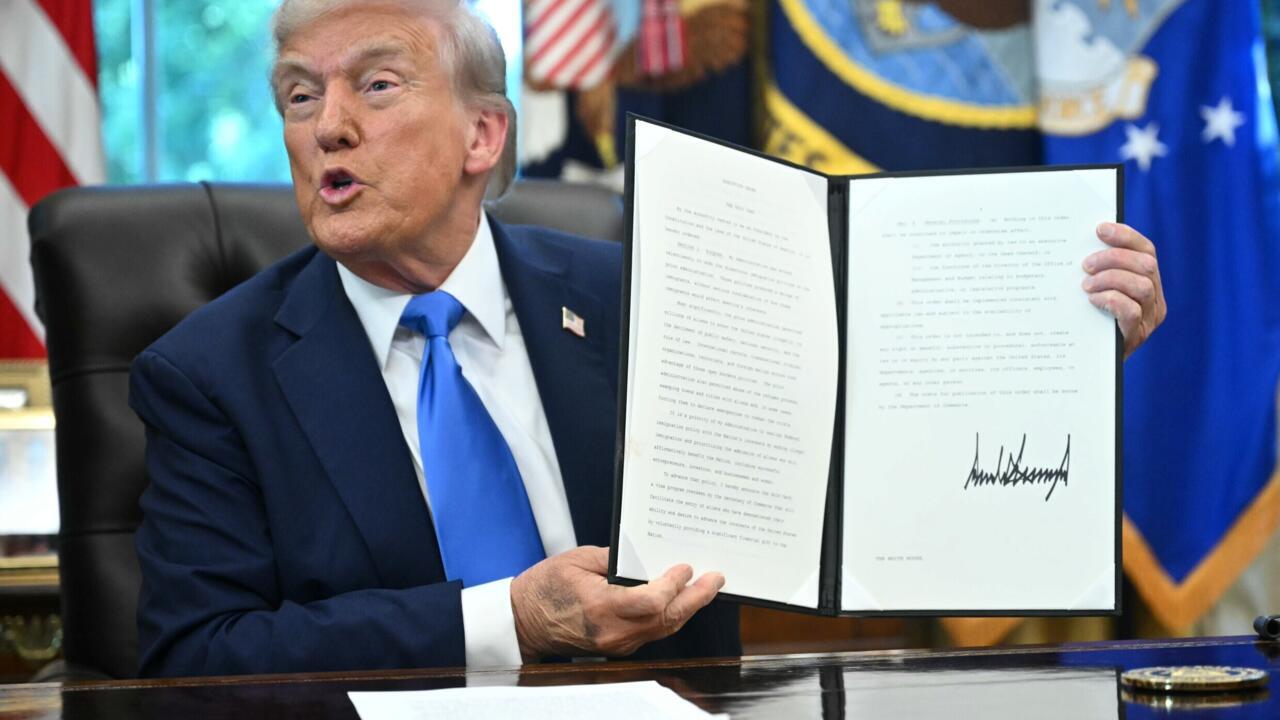
Trump signed orders increasing fees on H-1B visas and creating a new $1 million expedited "gold" residency card. © Mandel Ngan, AFP

US President Donald Trump on Friday ordered an annual $100,000 fee be added to H-1B skilled worker visas, creating potentially major repercussions for the tech industry where such permits are prolific.

The new measure, which could likely face legal challenges, was announced alongside the introduction of a $1 million "gold card" residency program that Trump had previewed months earlier.

"The main thing is, we're going to have great people coming in, and they're going to be paying," Trump told reporters as he signed the orders in the Oval Office.

India's leading trade body Nasscom on Saturday said the timeline for implementing the new fee was a "concern".

"A one-day deadline creates considerable uncertainty for businesses, professionals, and students across the world," it said in a statement after President Donald Trump announced the fee which comes into force from Sunday.

It added that policy changes of this scale were best "introduced with adequate transition periods, allowing organizations and individuals to plan effectively and minimize disruption."

H-1B visas allow companies to sponsor foreign workers with specialized skills – such as scientists, engineers, and computer programmers – to work in the United States, initially for three years, but extendable to six years.

The United States awards 85,000 H-1B visas per year on a lottery system, with India accounting for around three-quarters of the recipients.

Large technology firms rely on Indian workers who either relocate to the United States or come and go between the two countries.

Tech entrepreneurs – including Trump's former ally Elon Musk – have warned against targeting H-1B visas, saying that the United States does not have enough homegrown talent to fill important tech sector job vacancies.

Read moreHow visas for skilled foreign workers are splitting MAGA in two

"All the big companies are on board," said Commerce Secretary Howard Lutnick, who joined Trump in the Oval Office.

Trump has had the H-1B program in his sights since his first term in office, but faced court challenges to his earlier approach, which targeted the types of jobs that qualify. The current iteration has become the latest move in the major immigration crackdown of his second term.

According to Trump's order, the fee will be required for those seeking to enter the country beginning Sunday, with the Homeland Security secretary able to exempt individuals, entire companies or entire industries.

The order expires in a year, though Trump can extend it.

The number of H-1B visa applications has risen sharply in recent years, with a peak in approvals in 2022 under Democratic president Joe Biden.

In contrast, the peak in rejections was recorded in 2018, during Trump's first term in the White House.

The United States approved approximately 400,000 H-1B visas in 2024, two-thirds of which were renewals.

Trump also signed an order creating a new expedited pathway to US residency for people who pay $1 million, or for corporate sponsors to pay $2 million.

"I think it's going to be tremendously successful," Trump added.

(FRANCE 24 with AFP)

India warns new US fee for H-1B visa will have 'humanitarian consequences'


Ben Hatton -
Sun, September 21, 2025 


India's Minister of External Affairs Subrahmanyam Jaishankar, whose office warned the change would disrupt families [EPA]


The Indian government has said a new $100,000 (£74,000) fee for applicants seeking US skilled worker visas will have "humanitarian consequences".

President Donald Trump on Friday ordered the new fee for H-1B visa applications, which is more than 60 times the amount currently charged, to go into effect on 21 September.

Workers from India receive by far the most skilled visas in the programme, at just more than 70% of those issued.

Some US tech companies reportedly advised employees with H-1B visas to stay in the US or, if they were out of the country, to try to return immediately. The White House then on Saturday clarified the fee will not apply to current visas or renewal applications.

A statement from the Indian Ministry of External Affairs on Saturday said the fee would have humanitarian consequences "by way of the disruption caused for families".

The Indian government "hopes that these disruptions can be addressed suitably by the US authorities", it also said.

The exchange of skilled workers has "contributed enormously" to both nations, the statement said, adding: "Policy makers will therefore assess recent steps taking into account mutual benefits, which include strong people-to-people ties between the two countries."


The statement did not provide specifics on any potential response from India's government.

Since Trump imposed punishing tariffs on India last month for purchasing Russian oil, the two countries have been locked in tense trade negotiations. The US exported $41.5bn worth of goods to India in 2024, and imported more than double that, $87.3 bn, according to the US Trade Representative's office.

On Saturday, the Indian government said its commerce minister Piyush Goyal would visit the US on Monday for trade talks, according to Reuters.

Making such a major change to the H-1B programme in such a narrow window of created "considerable uncertainty for businesses, professionals, and students across the world", India's leading trade body Nasscom said.

In announcing the planned change, the White House said the visas were not being used as intended, citing data it said suggests some visas are being "abused" to undercut American wages and outsource IT jobs.

But the order allows for "case-by-case exemptions if in the national interest", the White House said.

The skilled visa route is intended to allow companies in the US to temporarily employ foreign workers with "highly specialised knowledge".

Just under 400,000 H-1B visas were approved in 2024, of which around 260,000 were renewals, according to US-based Pew Research Center.

Data from US Citizenship and Immigration Services (USCIS) shows that in the first half of 2025 Amazon received the most H-1B visa approvals, with 10,044.

In second was Indian technology company Tata Consultancy Services (TCS), with 5,505.

Trump's proclamation applies to applications submitted for workers currently outside the US, which must be "accompanied or supplemented by a payment of $100,000" (about 8.8mn Indian Rupees). Currently, the administrative fees for an application total $1,500.

Amazon, Microsoft and JP Morgan were among the companies to advise employees with H-1B visas to remain in the US, and for those outside of the US to try and return before the deadline, according to Reuters.

The advisories appeared to be precautionary, given the order did not say H-1B visa holders would be barred from re-entering the country or charged the new fee if they were temporarily out of the country, after Sunday.

According to an internal advisory, seen by Business Insider, Amazon said employees unable to return to the US before the order takes effect should avoid attempting US re-entry "until further guidance is provided".
Modi's firm approach to punitive US tariffs could turn the tables on Trump

New negotiations are set to begin this week between Washington and New Delhi on the Trump administration’s steep tariffs on imports from India. So far, India’s Prime Minister Narendra Modi has refused to bow to US economic pressure, counting on his country’s international clout rather than flattery of the US president to get Washington to compromise.


Issued on: 19/09/2025 - 
FRANCE24
Analysis
By: Mehdi BOUZOUINA

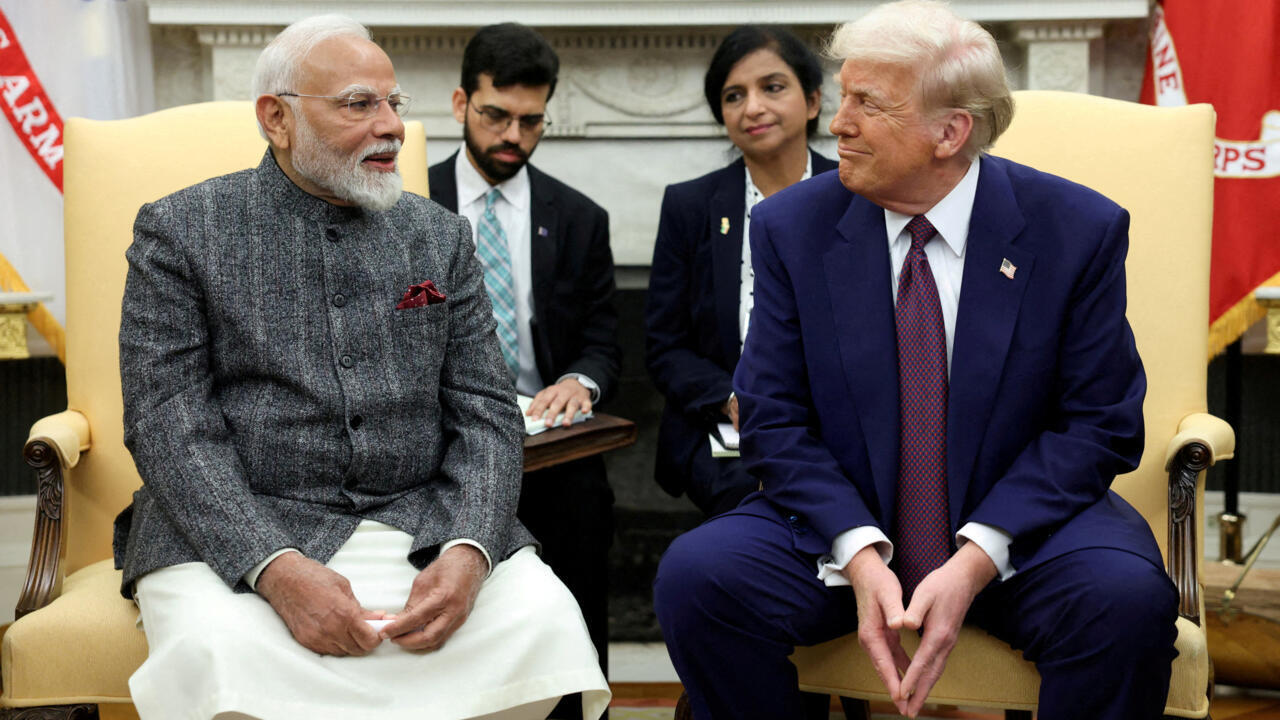
US President Donald Trump meets with Indian Prime Minister Narendra Modi at the White House on February 13, 2025. © Kevin Lamarque, Reuters

Among the many world leaders who called India’s veteran Prime Minister Narendra Modi to wish him a happy birthday on September 17 was one unexpected well-wisher: US President Donald Trump. Modi was celebrating his 75th birthday, the last 11 of which he has spent as the leader of the world's largest democracy.

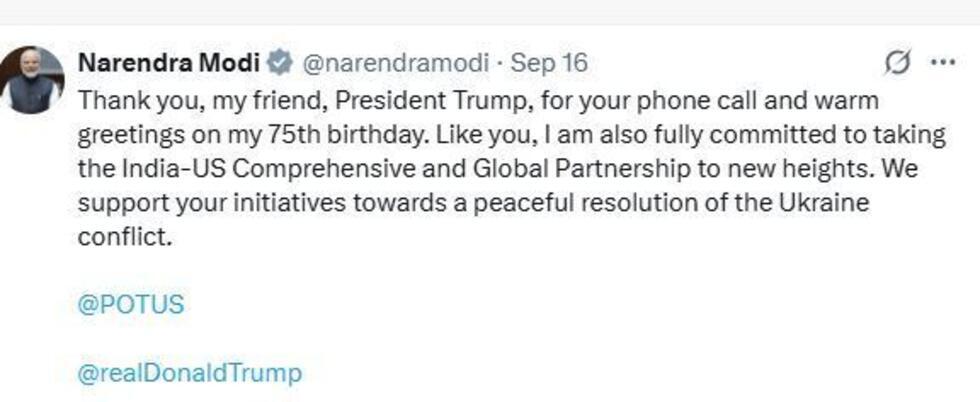
A few hours later, Modi posted on X to thank Trump, his “friend”, saying he was “fully committed” to the India-US partnership and pledging his support for the US president's “initiatives towards a peaceful resolution of the Ukraine conflict”.


Modi X © X


This phone call was noteworthy, coming the day after the resumption of trade negotiations between India and the US following weeks of frosty relations. Although Trump and Modi have long seemed to get along famously when they meet in person, what Trump once called the “special relationship” between the two countries is going through a rough patch.

Modi took exception to the punitive 25 percent tariffs imposed by Trump on goods from India in July, intended to rebalance a trade deficit with India estimated at over $45 billion. It must be said that between Trump’s first election to the White House in 2016 and his return to the Oval Office in 2025, India saw its exports to the United States almost double from $46 billion to $87 billion.


Tensions flared after weeks of fruitless bilateral trade discussions, during which the two leaders traded barbs via social media posts. After Trump sarcastically called India a “dead economy”, Modi declined to respond to four phone calls from the US president.

The spat descended into in a full-blown trade war. Among the areas of disagreement were Washington's rapprochement with Islamabad, which New Delhi considered provocative, and Trump's desire to isolate Russian President Vladimir Putin, with India refusing to stop importing Russian oil and weapons.

Read moreTrump hikes India’s tariffs by 25% for buying Russian oil, bringing total to 50%

Trump escalated the trade war in early August, announcing additional tariffs of 25 percent on Indian goods, bringing the total tax to 50 percent on certain products such as jewelry, shrimp, and clothing.

Trump and his advisors don't understand India

Despite the risk of losing hundreds of thousands of jobs in sectors that are strategic for the Indian economy, Modi has refused to back down.

A bit provocatively, Modi showed that he has cards to play on the international stage, appearing to be all smiles alongside Putin and Chinese President Xi Jinping at a summit of the Shanghai Cooperation Organization in Tianjin, China, on September 1.

This was a blow to US diplomacy, which had been banking on economic and geopolitical cooperation with India as a way to counter China, which India has distrusted for millennia.

Trump and his advisors are showing that they “haven’t quite understood India”, said economist Santosh Mehrotra, visiting professor at the University of Bath’s Centre for Development in the UK.

They have misjudged Modi, “a man of great ego” – as big an ego as Trump’s, Mehrotra said.

It will be difficult to repair the damage from the trade standoff, Mehrotra said, with both the US and India negatively impacted.

"The relationship is hardly likely to go back to where it was during Trump's first term," he added.


Is Modi snubbing Trump amid tariff spat?


ACCESS ASIA © FRANCE 24
12:46


India meanwhile is looking to increase trade ties with the European Union.

"We want to make a deal with India this year," European Commission President Ursula von der Leyen said on Thursday at a conference with German business leaders, adding that Modi had assured her of his commitment to this goal in a phone call on Wednesday.

Mehrotra notes that India is neither a member of NATO nor protected by the US nuclear umbrella, so less susceptible to geopolitical bullying.

Since gaining independence in 1947, India has cultivated its status as a non-aligned power, sometimes at the cost of isolating itself on the international stage.

However, Mehrotra believes that Modi will be willing to negotiate with Trump as long as the US respects the three red lines clearly defined by New Delhi: That India’s purchases of oil are not restricted by US sanctions; that New Delhi maintains its “multipolar” world outlook resistant to “a hegemonic USA”, and, that the country would continue to protect its agricultural sector.

Indian agriculture, a sticking point in negotiations


This third issue is especially contentious. Trump has made the reduction of US tariffs conditional on the opening of the Indian market to US agricultural products – but New Delhi has long used protectionist means to shield its vital farming sector, which employs 40 percent of the country’s workforce.

“If Narendra Modi touches farmers, he is guaranteed a popular uprising,” Mehrotra said.

Time is running out. The 50 percent tariffs, which came into effect on August 27, penalise both India and the US, notably raising prices for US consumers of Indian goods.

New Delhi is prepared to lower tariffs on less sensitive sectors, but there will be no deal unless Washington gives some ground, argued Ajay Srivastava, former trade negotiator for India at the WTO.

"Without dropping those tariffs, negotiations are meaningless” says Srivastava.

Srivastava also said that India’s apparent rapprochement with Beijing must be put into perspective.

“We also have to think about the post-Trump era: China remains a purely transactional partner, there is no emotional bond,” – unlike with the West, he said.

India, the world’s most populous country, does not want be “too close to either Trump or Xi Jinping", Srivastava said.

By refusing to give in to punitive tariffs and US demands, Modi has perhaps managed to turn the tables on Trump. Now it is Washington's negotiators who have flown to New Delhi, proof that India's firm stance can carry as much weight as the flattery lavished upon Trump by other governments.

This article has been adapted from the original in French.
Turkey opposition faces wave of arrests and court fight over leadership


Issued on: 20/09/2025 - RFI


The legal noose is tightening around Turkey’s main opposition party, with waves of arrests targeting mayors and local officials. But the troubles of the Republican People’s Party (CHP) could deepen further, as a court case threatens the removal of its leadership.

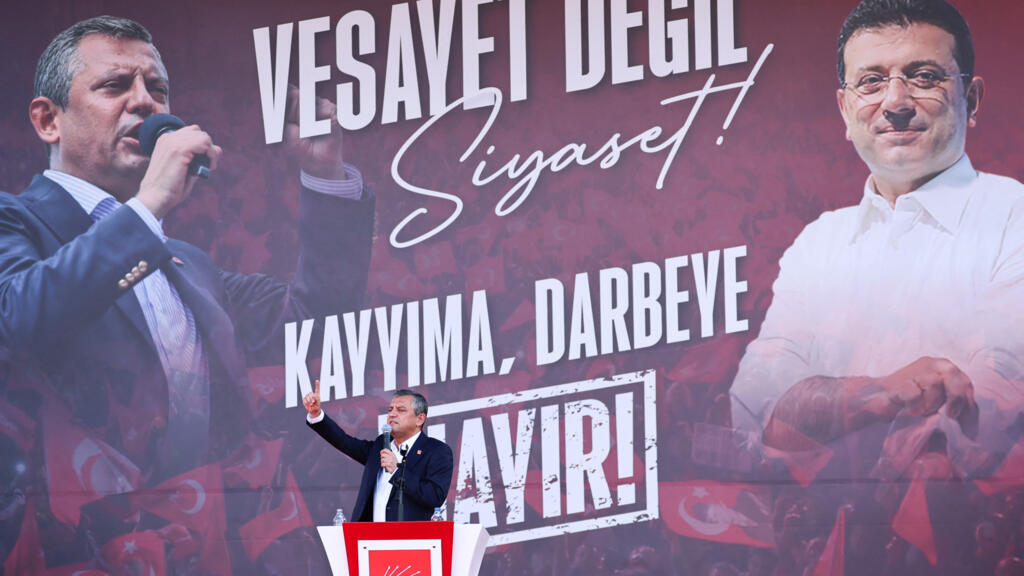
Leader of Turkey's main opposition Republican People's Party (CHP), Ozgur Ozel, speaks on stage during a rally in Ankara on 14 September 2025. AFP - ADEM ALTAN


"We are fighting for the future of Turkey's democracy," said party leader Ozgur Ozel to tens of thousands of supporters at a rally in Ankara on Saturday.

Ozel has been travelling the country since March, when Istanbul mayor Ekrem Imamoglu was arrested on graft charges. The case marked the start of a legal assault on the CHP. Ozel now speaks at rallies twice a week, despite his often hoarse voice.

The party is also defending itself in court over alleged voting irregularities at a congress two years ago that elected Ozel as leader. If the court rules against them, Ozel and the rest of the party leadership could be removed and replaced by state-appointed trustees.

"It's unprecedented," said political analyst Sezin Oney of the Politics news portal. "There has not been such a purge, such a massive crackdown on the opposition, and there is no end in sight, that's the issue."

Arrests and polls

On Wednesday, another CHP mayor in Istanbul was jailed, bringing the total to 16 detained mayors and more than 300 other officials. Most face corruption charges.

The arrests come as the CHP’s new leadership is stepping up its challenge to President Recep Tayyip Erdogan. Recent opinion polls give Imamoglu and other CHP figures double-digit leads over the president.

Oney said the prosecutions are part of Erdogan’s wider strategy.

"He's trying to complete the transformation, the metamorphosis as I call it, of Turkey to become a full authoritarian country," she said.

"There is an opposition but the opposition is a grotesque opposition, that can never have the power actually to be in government. But they give the perception as if the country is democratic because there are elections."

Armenia and Azerbaijan peace deal raises hopes of Turkish border reopening
‘Multi-front attack’

Ilhan Uzgel, the CHP’s foreign affairs coordinator, said the party is under siege.

"We are under a multi-front attack from all directions at almost every level, running from one court case to another," he said.

He argued that Erdogan’s ruling Justice and Development Party (AKP) is using fear to force defections. "Sixteen of our mayors are in jail right now, and they threaten our mayors. You either join our party or you face a jail term," Uzgel said.

Erdogan rejects any suggestion of coercion and insists the judiciary is independent. Since he came to power more than 20 years ago, however, not a single AKP mayor has been convicted on graft charges – though on Friday at least two local mayors from the ruling party were detained as part of a corruption investigation.

Turkey warns Kurdish-led fighters in Syria to join new regime or face attack
Political risks

Despite appearing dominant, Erdogan may face a backlash. Atilla Yesilada, a political analyst with Global Source Partners, said the crackdown is fuelling public anger.

"You look at recent polls, the first complaint remains economic conditions, but justice rose to number two. These things don't escape people's notice; that's what I mean when I say Erdogan took a huge political risk with his career," he said.

Erdogan currently trails behind several potential challengers, but elections are still more than two years away.

Yesilada said much depends on the stance of Erdogan’s ally Devlet Bahceli, leader of the Nationalist Movement Party.

"It's quite possible at some point, Bahceli will say enough is enough, you are destroying the country, and may also end the coalition," he said.

Bahceli formed an informal alliance with Erdogan in 2018, when Turkey switched to a presidential system. Erdogan relies on Bahceli’s parliamentary deputies to pass constitutional reforms needed to secure another term.

Bahceli has voiced concern about the pressure on the CHP, which has been trying to win his support. But with the court expected to rule next month on the party’s leadership, the CHP says it will keep fighting.

"The only thing that we can do is rely on our people, our electorate, and the democratic forces in the country. We are not going to give up," said Uzgel.

By: Dorian Jones
Turkey's government is clamping down on female artists
DW
18/09/2025

Confident Turkish women are facing increasing restrictions. Female artists who do not conform to the government's image of women are being targeted by the justice system. Now the girl band Manifest has been hit.


Manifest was targeted for "immorality"; their tour was canceled to curb dissent, analysts say
Image: ANKA


The atmosphere was exuberant on September 6, when six young women in tight outfits took to the stage in Istanbul's sold-out open-air venue Kucukciftlik Park: A cheer went up from the crowd of 12,000 people who had joined in the dancing to the beat in the late summer heat.

The musicians — Mina, Esin, Zeynep Sude, Emine Hilal, Lidya und Sueda — are the members of Turkish girl band Manifest, which was formed in February following a talent show.

With their simple youthful lyrics and K-pop-inspired dance routines, Manifest quickly captured the hearts of teenagers. The band's debut album, released in July, led to a successful tour.

After the concert in Istanbul, however, the band's promising future seems to now be a part of the past. The public prosecutor's office is investigating them for "indecent and immoral acts" and "exhibitionism." Their stage show is said to have "violated and offended the feelings of shame, morality, and the moral values of society." In addition, it is claimed that they have a bad influence on children and young people.


Targeting female artists

Oktay Saral, chief adviser to Turkish President Recep Tayyip Erdogan, called the band members "immoral, shameless, demonic creatures" in a Turkish post on X and demanded legal action to prevent them from "further alleged exhibitionist acts." He posted a photo of the group with their bodies blurred out.

After the interrogation, the band issued a statement emphasizing that they took responsibility for their show, but that it had never been their intention to hurt anyone. For the time being, they had to give up their dream of representing Turkey on the world stage. On X, they wrote that their Turkey tour, for which tickets sold out weeks ago, has been canceled. "We thank our audience for their interest and love"


The case of Manifest is not an isolated incident. Female artists have increasingly been targeted by the justice system in recent years.

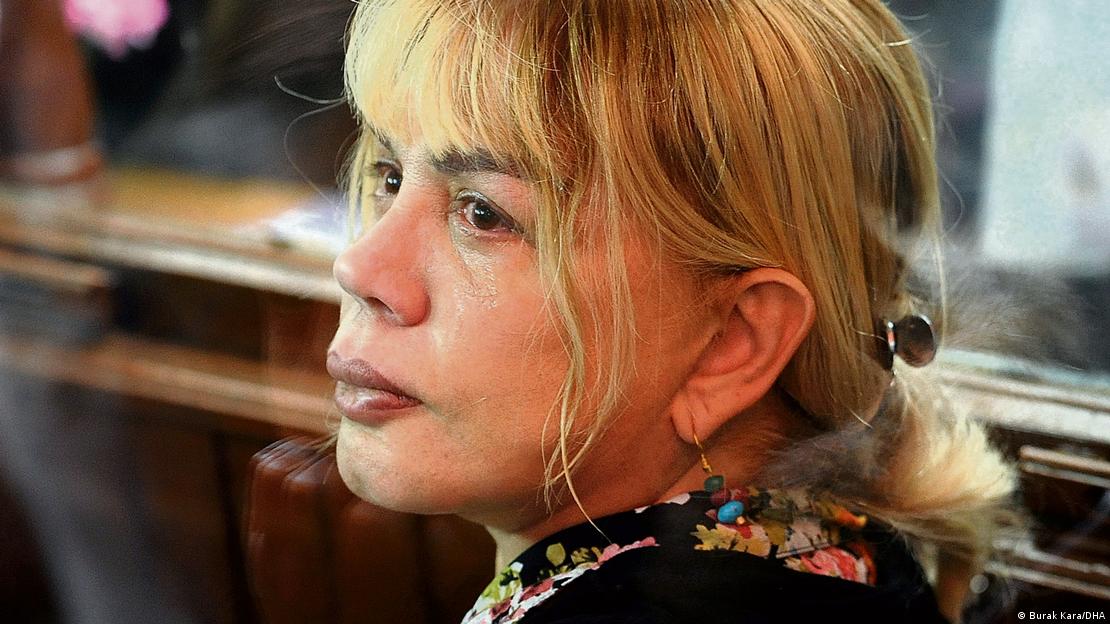
Pop diva Sezen Aksu became the target of smear campaigns over an old song with lyrics that apparently offended religious sensibilities.

Popular musician Gulsen was arrested for a joke she made on stage about religious schools.

In January, Ayse Barim, the manager of an artist agency, was first imprisoned for attempted monopolization and extortion, and later accused of trying to help overthrow the government during the 2013 Gezi Park protests.

Screenwriter Merve Goktem was arrested after an excerpt from a 4-year-old interview about her series "Naked" went viral on social media. She is accused of "supporting prostitution and inciting crime."

Turkish pop diva Sezen Asku became the target of smear campaigns over an old song
Image: Burak Kara/DHA


Diyanet's 'decisive role'

Since Turkey's withdrawal from the Istanbul Convention in 2021, pressure on women has mounted significantly. Initially, female politicians, academics, and activists were targeted, followed by journalists and lawyers. In recent years, female artists have increasingly been affected.

The approach is often the same. First, pro-government columnists write critical articles; then, old interviews or excerpts from works are taken out of context and disseminated on social media. Finally, pro-government groups and Islamist brotherhoods mobilize and call on the authorities to take action until the police arrest the targeted person.

Historian and feminist Berrin Sonmez called this a political strategy. In her opinion, the governing Justice and Development Party, or AKP, has turned religion into the basis of its government policy over the past 10 years in order to secure its own power. She believes the country is now in a phase where religion is not the basis of politics, but is constantly being exploited for political purposes.

"The religious authority Diyanet has a decisive role to play in this," Sonmez said. Through its Friday sermons, Diyanet, which is also called the Presidency of Religious Affairs, publishes weekly fatwas, which are nonbinding but still formal opinions, intended to shape the society according to its will. Sonmez analyzed last year's sermons: 30% of the texts dealt with women, family, and children, while another 30% dealt with sexual orientation, which was portrayed as a "deviation from human nature” and the "result of global propaganda”.

Activist Berrin Sonmez took off her headscarf in protest of the clampdown on women
Image: Berrin Sönmez/dpa/picture alliance


Government silencing dissent

Sonmez, a devout Muslim, took off her headscarf to protest a Diyanet sermon in August on the veiling of women. She considers this development very dangerous, as Diyanet addresses millions of men every Friday in its more than 90,000 mosques nationwide. In such fatwas, the government is essentially calling on men to oppress women and strengthen male dominance.

The effects are noticeable, observers say. Shortly after the sermon in question made headlines, including one in which a doctor refused to treat a young female patient because she appeared at the hospital wearing a crop top.


Sonmez said the increasing oppression of women was part of a comprehensive government plan to silence dissent. The dwindling AKP base is being stabilized through increased religious pressure and legal harassment of dissenters, she said.

She said the attack on the Manifest group was a further message to women who refuse to comply. Even though the artists' revealing clothing and dance performances are in the foreground, Sonmez believes it is crucial that these young musicians chanted opposition slogans such as "law, justice, and equality” in their songs.

Yet the public prosecutor's office deliberately limited the charges to obscenity, immorality and exhibitionism in order not only to intimidate the women but also to defame them. Their political stance was ignored, and the debate was reduced to their bodies, shame, and morality.

AKP has claimed for years that it has liberated women, especially conservative and religious ones, and opened doors wide for them in education, politics and beyond. Sonmez disagreesand argues that even though the proportion of women in many areas has increased, this is only an illusion.

Essentially, even in the AKP era, women are still relegated to the background and have little influence on policymaking, she said. Women, she said, can only exist as unwavering supporters of government policy.


This article was originally published in German.
Far-right activists fined for racist insults against French star Aya Nakamura

Ten people linked to extreme-right group Les Natifs (The Natives) have been fined for aggravated public insult against French-Malian singer Aya Nakamura. The Paris criminal court rejected the prosecution’s request for convictions on the more serious charge of incitement to hatred.


Issued on: 18/09/2025 - RFI

Aya Nakamura is the most listened-to Francophone artist in the world, but extreme-right groups have targeted her with racist insults. © Geoffroy Van der Hasselt / AFP

Thirteen defendants went on trial in June on charges of publicly inciting racial hatred against Nakamura after they unveiled a banner on the banks of the Seine in March 2024 that read: "No way Aya, this is Paris, not the Bamako market" – a reference to Mali's capital, where the singer was born.

The stunt followed rumours Nakamura would take part in the Paris Games opening ceremony, which she did.

The group posted the image on social media platform X, where it was viewed nearly 4.5 million times.

Of the 13 defendants, only three attended the trial, and just two were present in court on Wednesday when the verdict was delivered.

The court imposed fines rather than prison sentences: two defendants were fined €3,000, one €3,000 with €1,000 suspended, four €3,000 with €2,000 suspended, and three €2,000 suspended. Three others were acquitted.

Thirteen on trial over 'racist' stunt targeting French-Malian singer Aya Nakamura
'Recognition of guilt'

The sentences were far lighter than those sought by the prosecution, which had requested up to four months in prison for the defendants, aged between 20 and 31.

The court reclassified the offence, ruling that the case did not amount to incitement to hatred on the grounds of origin, ethnicity, nationality, race or religion, as the prosecution had argued, but to aggravated public insult of a racist nature – a less serious offence.

The fact the defendants had no previous convictions and no violence was used weighed in the balance.

During the trial, the activists described the proceedings as “a political trial”. In a statement, they argued that Nakamura’s music “in no way reflects the identity of our country” and accused the state of attempting to silence dissent.

Both the singer and anti-discrimination NGOs filed complaints with the Paris prosecutor's office over the incident, which was investigated by France's anti-hate crime division.

The defendants were ordered to pay €300 in damages to Nakamura and the other plaintiffs, including anti-racism organisations SOS Racisme and Licra.

Dominique Sopo, president of SOS Racisme, welcomed the verdict as “a recognition of guilt”, despite the lighter penalties.

Repeated stunts

None of the defendants spoke after the judgment was handed down.

Les Natifs subscribe to the far-right, white nationalist "Great Replacement" conspiracy theory, according to which white Europeans are being deliberately supplanted by non-white immigrants.

They are seen as the successors to Génération identitaire – an extreme-right group dissolved in 2021.

In March, Les Natifs covered portraits of veiled women, displayed in a church in the working-class suburb of Saint-Denis, with black sheets. A month earlier, they plastered an Air Algeria office with posters reading "Re-migrate ‘light’ from France to Algeria, for a one-way ticket with no return".

Aya Nakamura: the unstoppable queen of streaming

Aya Nakamura performs in front of the Académie Française at the Paris Olympic Games opening ceremony on 26 July 2024. © AFP - ESA ALEXANDER

Nakamura is the most listened-to Francophone artist in the world, with more than 6 billion streams of her songs and more than nine million monthly listeners on Spotify. But her mix of French with Arabic and Malian slang, along with her sexy look, has been criticised by conservative and far-right groups and politicians.

Ahead of her performance at the Paris Games, Marine Le Pen, figurehead of the far-right National Rally, suggested the singer’s participation would "humiliate" France. She also took aim at what she called the singer's "vulgarity" and "the fact that she doesn't sing in French".
West Africans deported by US sue Ghana for 'unlawful detention'

A group of West African nationals deported from the United States to Ghana earlier this month have filed a lawsuit against the Ghanaian government for unlawful detention. Lawyers representing the deportees report they are still being held in a military camp near Accra, even though there are no formal charges against them and the authorities say they are being returned to their home countries.


Issued on: 19/09/2025 - RFI

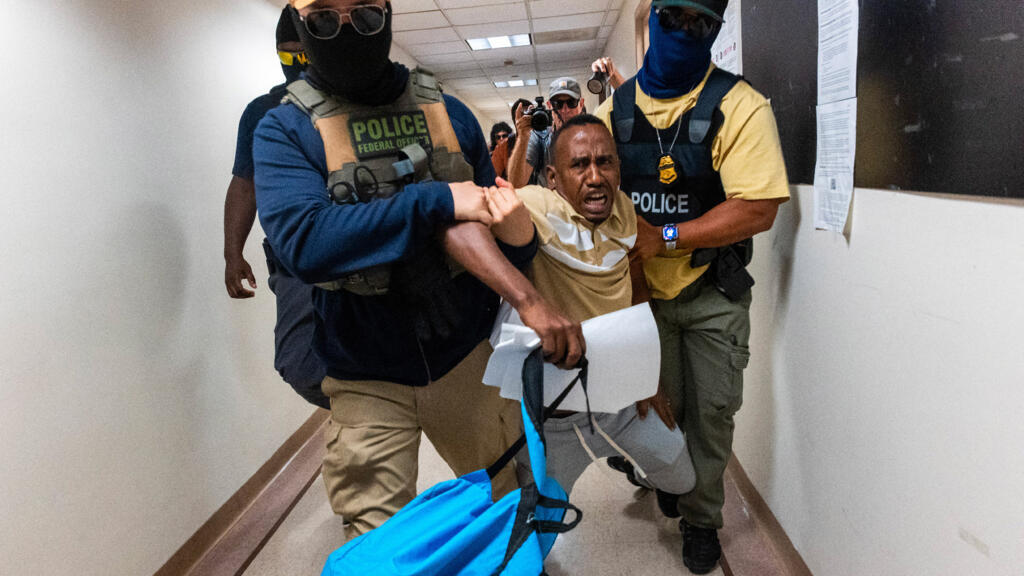
AMERIKAN GESTAPO
United States federal agents drag a man away after his hearing at an immigration court in New York. © Spencer Platt / Getty Images / AFP

By: Zeenat Hansrod

Fourteen people from various countries in West Africa landed in Ghana on 6 September, after the government in Accra agreed to take in third-country nationals expelled from the US.

Ghanaian authorities say all the deportees have since been sent back to their countries of origin. But lawyers for 11 of the deportees claim they are still being detained in a military camp.

The lawsuit alleges that Ghana is in breach of its constitution and international treaties in holding the deportees without charge and demands their release – as well as their right not to be sent to their home countries where their life is at risk.


Conflicting accounts

At the request of the deportees' families and their lawyers in the US, a Ghanaian law firm, Merton & Everett, filed a lawsuit on Wednesday for unlawful detention against Ghana's attorney general, the chief of staff of the armed forces and comptroller general of the immigration service.

Speaking to RFI, the lawyers said that they are satisfied, having cross-checked information provided by the deportees, that their clients are indeed in Ghana. They believe they are detained at Bundase military camp, 70km from Accra, under military surveillance restricting access to them.

Information about the deportees has been difficult to come by, according to Oliver Barker-Vormawor, a lawyer at Merton & Everett.

"We reached out to the Ministry of Foreign Affairs who insisted that all of them have been repatriated. We contacted the Ghana Armed Forces, which said they have no idea about the issue and said they were not holding the people," he told RFI’s Victor Cariou in Accra.

Testimonies


The West African nationals, 10 men and four women from Nigeria, Liberia, Togo, Gambia and Mali, landed in Ghana on 6 September. They said they were taken from their cells in Louisiana, in the middle of the night on 5 September, shackled in chains and put on a military cargo plane without being informed where they were being taken.

Four of them were placed in straitjackets because they refused to get on the plane without speaking to their lawyers.

According to court documents seen by RFI, three of the deportees were removed to their countries of origin between 6 and 10 September.

In a statement filed to the Accra court, a deportee from Gambia said he was placed on a flight back home on 10 September, accompanied by two Ghanaian immigration officials. He was then released, but is living in hiding because of his bisexuality, punishable by law in Gambia.

“I’d won protection from being returned to Gambia under the Convention against Torture. I told them [Ghanaian immigration officials] that I wanted to stay in Ghana for my safety,” he testified.

Being LGBTQ+ in South Africa and Senegal: one continent, worlds apart

Another deportee from Nigeria also said he feared for his life if he was forced to return. He won protection in the US from being returned to his home country and is married to a US citizen. The deportee was a politician in Nigeria and said he had been beaten up by political rivals and tortured by the police before he fled his country.

“If I go back to Nigeria, I will be tortured and possibly killed,” he said.

He claims that neither US immigration officers nor Ghanaian and Nigerian officials heeded his efforts to explain the potential danger.

“They told us they did not care and that we will be sent back to Nigeria anyway,” he said.

Out of US hands

Lawyers in the US also filed a lawsuit, on behalf of five of the deportees, to immediately halt deportations to their countries of origin.

US federal judge in Washington, Tanya S. Chutkan, ruled that now the deportees are in Ghanaian custody, her “hands are tied”.

The judge said she is alarmed and dismayed by the circumstances under which these removals are being carried out.

“It [the court] is aware of the dire consequences Plaintiffs [the deportees] face if they are repatriated… to countries where they face torture and persecution,” she wrote on Monday.


Speaking to journalist Bernard Avle on Channel One TV in Ghana on Wednesday 17 September, Foreign affairs minister, Samuel Okudzeto Ablakwa said that Ghana is not doing the US a favour, but doing fellow Africans a favour.

“The choice is theirs really. For 90 days, if they want to stay, they can stay but so far all of them have indicated that they want to go back and we’ve been facilitating that,” he added.

More deportees to come

According to the minister, another 40 West African deportees are expected in Ghana in the next few days.

Ghana is one of the five African states, along with, Rwanda, Uganda, Eswatini and South Sudan, to accept people deported from the US as part of the Trump’s administration crackdown on illegal migration.

Ghana’s opposition has demanded the immediate suspension of the pact. It also demands to see the memorandum of understanding between the US and Ghana which has not been ratified by parliament.

How Trump’s 'deportation campaign' is reshaping ties with Africa

Minister Ablakwa, insisted that his government’s decision to accept West African deportees from the US “is grounded purely on humanitarian principles and pan-African solidarity”.

“It is important to stress that Ghana has not received and does not seek any financial compensation or material benefit in relation to this understanding [with the United States],” he told journalists on Monday.

Arguing that the deal was designed to “offer temporary refuge when needed”, he rebutted critics’ claims that Accra was aligning itself with the anti-immigration administration in Washington.

“This should not be misconstrued as an endorsement of the immigration policies of the Trump administration,” he said.


Landmark WTO deal shifts course in global effort to curb overfishing

A global deal to protect fish stocks that billions of people rely on for food and jobs came into force this week after more than 20 years of talks. Governments have agreed to stop giving subsidies to boats that break rules against overfishing – but the agreement does not yet cover subsidies that build ever larger fleets.


Issued on: 20/09/2025 - RFI


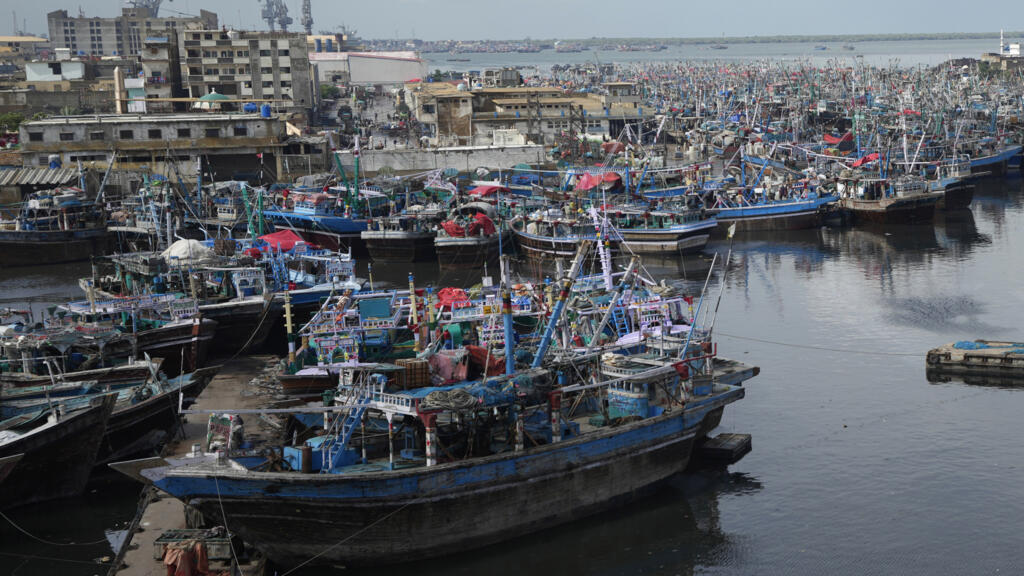
Fishing boats anchored at a fishing harbor in Karachi, Pakistan, August 2024. 
© Fareed Khan/AP

Under negotiation since 2001, the World Trade Organisation (WTO) Agreement on Fisheries Subsidies was adopted in June 2022, and enough countries ratified it for it to officially come into force on Monday, 15 September.

Subsidies to fishing fleets are a key factor in the depletion of fish stocks around the world. Critics have long argued that they incentivise boats to catch fish faster than stocks can replenish.

Around 35 percent of global fish stocks are overfished, compared to just 10 percent in 1974, according to the United Nations Food and Agriculture Organisation, and almost all stocks are fished at their maximum sustainable level.

'Game changer'

The WTO deal, the first to address an environmental issue, is a “game changer”, according to Tristan Irschlinger, an expert on the issue at the International Institute for Sustainable Development, a Canada-based think tank.

“States will no longer implement their subsidy policies in a legal vacuum – they will need to keep sustainability in mind,” he told RFI.

In 2018, states granted fisheries €30.1 billion ($35.4 billion) in public subsidies, according to one study, with China, the European Union, the United States, South Korea and Japan in the lead.

Of that sum, “governments spend around €18.7 billion ($22 billion) on harmful subsidies that contribute to overfishing and the depletion of marine resources”, said WTO Director-General Ngozi Okonjo-Iweala.

The new rules aim to address both environmental concerns and the well-being of fishing communities.

“No one has an interest in financially supporting illegal fishing, or harvesting of already overfished stocks,” Irschlinger said. But there needed to be a mechanism for countries to stop doing so, he suggested, “without losing face in front of other states”.

France defends tuna policy as critics warn of overfishing in the Indian Ocean

Rooting out illegal fishing

The first part of the WTO agreement, called Fish 1, targets illegal, unreported and unregulated (IUU) fishing practices, whether carried out deliberately or not.

“The agreement specifically targets industrial fishing activities that profit illegally because they know the risks are generally quite low,” explains Irschlinger.

IUU practices include vessels operating without authorisation or in violation of the law, such as fishing in protected waters, catching protected species, or using banned gear like dynamite.

Quantifying the effects of IUU fishing is difficult.

2009 study determined the practice accounted for between 11 and 19 percent of all fish caught globally in the 2000s — between 11 and 26 million tonnes of fish. The numbers are almost certainly much higher today.

Beyond its environmental impact and the effects on food security, IUU fishing also intersects with crime, according to French ocean conservation organisation Fondation de la Mer.

IUU is “linked to corruption, mafia practices, modern slavery and organised crime”, it said in a report on the practice last year.
Help for developing countries

The WTO agreement prohibits states from granting subsidies to vessels and operators in three cases: when fishing activities are illegal; when fish stocks are overexploited; or when fishing takes place on the high seas, which are not regulated by any single state.

The UN's High Seas Treaty, which is expected to come into force next week, will reinforce the WTO agreement, particularly through the creation of marine protected areas where some or all forms of fishing would be banned.

French Polynesia unveils world's largest marine protected zone

Developing countries are given a two-year grace period to comply with the agreement, and 17 members have pledged more than €15 million ($18 million) to a fund to help fisheries transition to more sustainable practices.

In theory the agreement would be enforced through the WTO’s Dispute Settlement Body, which resolves conflicts between states – but because the United States has blocked the appointment of judges, it has remained unable to handle new cases since 2019.

The agreement also does not specify the kinds of sanctions that could be imposed.

Aiming to avoid the need for penalties, a fisheries subsidies committee will be tasked with monitoring implementation, while states are also expected to scrutinise each other.
Looking ahead to Fish 2

There is hope that the first part of the agreement will build momentum for the second part, Fish 2, currently under negotiation, to be finalised within four years.

Fish 2 focuses specifically on fishing fleets themselves, which Irschlinger says is “the root of the problem”.

The Fondation de la Mer says that even when fishing fleets are not fishing illegally, or when stocks are not yet overfished, subsidies can still be harmful: “They often promote the development of oversized fishing fleets and encourage excessive fishing pressure, which can ultimately lead to overexploitation or even stock collapse.”

The second part of the agreement sets out a general list of prohibited subsidies, and removes the need to detect illegal fishing or assess fish stocks in order to enforce the rules. Instead it is up to states to prove that they have put management measures in place.

Fish 2 depends on ratification by the United States, which ratified Fish 1 under the previous administration.

The new administration is taking a more ambitious and hardline stance in negotiations, aligned with India and Indonesia, which argue that the text is not strict enough on states that subsidise the most.

Negotiations will likely restart in earnest in March of next year at a WTO meeting in Yaoundé, Cameroon.


Ghana Expands Inshore Exclusion Zone To Curb IUU Fishing – Analysis

By 

Ghana has adopted a new fisheries act aimed at stemming illegal, unreported and unregulated (IUU) fishing. Among other new regulations, the Ghanaian government expanded the country’s inshore exclusion zone (IEZ) from 6 to 12 nautical miles from shore.


Industrial and large-scale vessels are prohibited from fishing in a country’s IEZ, but trawlers from China and other foreign fishing trawlers routinely invade waters meant for Ghana’s artisanal fishermen.

“When the trawlers come close to the area marked solely for our men, they tend to catch a lot of the fish meant for artisanal fishers, and we end up making huge losses,” Regina Solomon, president of the National Fish Processors and Traders Association, told the Environmental Justice Foundation (EJF). “If these fishes had been left for our men to catch, we would have made much more profits buying from them and selling, thereby securing the livelihoods of both our local fishermen and we the fish processors.”

IUU fishing costs Ghana an estimated $14.4 million to $23.7 million annually. Signed into law by President John Mahama on August 19, the act aims to restore stocks of small pelagic fish — such as anchovies, sardines and mackerel, which are near collapse — stimulate the blue economy, and sustain the livelihoods of more than 200,000 artisanal fishermen and 500,000 fish processors and traders.

Addressing ‘Yellow Card’

The new law also is expected to help Ghana shed a 5-year-old European Union (EU) “yellow card” sanction over IUU fishing and address weaknesses in monitoring and enforcement.

“We need to work to immediately get the yellow card lifted, otherwise we risk getting a red card, which means fish from Ghana cannot be exported to the EU market that happens to be the largest market for the fisheries sector,” Emelia Arthur, Ghana’s minister for fisheries and aquaculture, told the Ghanaian newspaper Business and Financial Times.


Exports of tuna contribute nearly $400 million annually to the nation’s economy, Arthur told the Fisheries Committee for the West Central Gulf of Guinea. Lifting the EU warning would restore full market access and demonstrate international recognition of improved fisheries management.

Analysts lauded Ghana’s new law.

“Ghana’s approach could influence other West African nations facing similar challenges with EU trade warnings over fishing practices,” the News Ghana website wrote in an editorial. “Regional coordination may be necessary to address transboundary fishing issues and industrial vessel movements.”

The EJF said that monitoring systems and hefty penalty structures will determine whether the legislation can truly rebuild Ghana’s fisheries.

“This new law marks a turning point for Ghana’s fisheries and coastal communities,” Steve Trent, the EJF’s chief executive officer and founder, said in a statement. “It sends a clear signal of leadership, vision, and commitment to the millions of people who rely on a healthy ocean.”

Beijing’s Bad Actors

Chinese trawlers have pillaged Ghanaian waters for decades, causing the near collapse of some species and driving up prices. China is the world’s worst illegal fishing offender, according to the IUU Fishing Risk Index. In April, Ghana’s Fisheries Commission and Ministry of Fisheries and Aquaculture suspended the fishing licenses of four Chinese trawlers for fishing in restricted areas; harvesting juvenile fish; dumping unwanted fish; and saiko, the unauthorized transshipment of fish at sea.

The Chinese vessels are all flagged to Ghana but are owned by three Chinese companies, the Ghana Business News website reported. Chinese trawlers are notorious for using this practice, known as “flagging in,” in which they abuse local rules to flag a foreign-owned and -operated fishing vessel into an African registry to fish in local waters. Flagging in is a common sign that vessels engage in illegal fishing. According to the EJF, Chinese corporations own at least 90% of the industrial trawlers operating in Ghana.

IUU fishing is often linked to other sea crimes, including human trafficking, drug smuggling and piracy.

Earlier this year, Ghana suspended the fishing licenses of four Chinese vessels. The vessels were accused of saiko – the unauthorized transshipment at sea among other violations. The four vessels include Meng Xin 10, Florence 2, Long Xiang 607 and Long Xiang 608. The fishing ban will last for one year.


Africa Defense Forum

The Africa Defense Forum (ADF) magazine is a security affairs journal that focuses on all issues affecting peace, stability, and good governance in Africa. ADF is published by the U.S. Africa Command.