Showing posts sorted by relevance for query KINDER MORGAN. Sort by date Show all posts

Thursday, May 23, 2024


Why Kinder Morgan is Targeting This Texas Oil Field

American oilfield services provider and pipeline operator Kinder Morgan has acquired nearly 12,000 acres of Texas oil and gas producing assets in its quest to take advantage of carbon capture incentives designed to boost output from producing fields, Reuters reported on Wednesday, citing unnamed sources familiar with the deal. 

According to Reuters, the Kinder acquisition indicates the attractive nature of incentives laid out in the U.S. Inflation Reduction Act, which offers a tax credit for carbon sequestration of $60 per metric ton. That incentive has rendered aging oil and gas fields far more attractive to companies that have the technology to improve production. 

Sources cited by Reuters said that Kinder Morgan already produces around 50,000 barrels of oil per day through the process of injecting carbon dioxide into wells to aid the path of oil to the surface. According to Reuters, that deal, which includes around 265 wells in a large, mature oilfield, is with Avad Energy Partners. One of the unnamed sources said the deal demonstrates that Kinder Morgan is “staying in the E&P business” and has “huge CO2 sources in West Texas”, which the company plans to use to further improve oil output. 

In April, Kinder Morgan said it expected natural gas demand to increase significantly over the next six years. 

The company’s Q1 2024 earnings report showed a 10% increase in earnings per share, though this increase fell slightly below expectations. Kinder Morgan also reported a net profit annual increase, from $679 million in Q1 2023 to $746 million in Q1 2024, with income from the gas pipeline playing a significant role in those numbers. 

Last November, Kinder Morgan also announced its plans to buy NextEra Energy Partners’ natural gas pipeline portfolio for $1.82 billion last November. The NextEra pipeline assets have a 4.9 billion cubic feet per day capacity, according to a Q4 2023 press release from Kinder Morgan.

In November, these assets were described by Kinder Morgan as “highly contracted”, with average contracts running for eight years and with 75% of capacity already under contract. the average length of contract at eight years and that 75% of the capacity was subject to take-or-pay contracts. 

NextEra’s pipeline network sends gas to Mexico as well as to oil producers in Southern Texas.

By Charles Kennedy for Oilprice.com

Sunday, February 02, 2020

Kinder Morgan secures all land needed for pipeline, despite protests from Central Texans

SO CALLED CONSERVATIVE SCOTUS JUSTICE; TONY SCALIA APPROVED THE STATIST RULE OF EXPROPRIATION AKA EMINENT DOMAIN WHICH RESULTS IN THIS: 

Kinder Morgan secures all land needed for pipeline, despite protests from Central Texans

By Christian Flores Friday, January 31st 2020

In just a matter of weeks, Kinder Morgan may soon break ground on construction in Central Texas for a massive natural gas pipeline, after months of back-and-forth with landowners that continue today.

Earlier this week, the energy infrastructure company announced they have secured 100 percent of the right of way for the Permian Highway Pipeline Project, which is a 42-inch, 430-mile pipeline extending from West Texas to the Gulf Coast. They can now begin construction in Central Texas once they get the necessary federal permits.

"To have that piece in a manner that is fair, that takes into account hundreds and hundreds of issues and concerns raised by landowners has led us to adjust the pipeline route almost 200 times," said Kinder Morgan Vice President Allen Fore. "These projects are absolutely critical, not only for the economic benefit for the state of Texas, but for the energy security of the United States. We're confident we followed the regulations."

This development comes amid months-long protest from Hill Country neighbors who own land the pipeline will go through.


Kay Pence says she moved to Fredericksburg for the peace and solitude the countryside has to offer. However, she knows that may soon become a thing of the past when construction begins.

"The quiet we enjoy at night will be gone," Pence said.

Last week, Pence joined a lawsuit with other Hill Country landowners, claiming the pipeline will be carrying natural gas that's not only from Texas, requiring the Federal Energy Regulatory Commission to regulate the pipeline, not the Railroad Commission of Texas.

This week, Hays County commissioners voted to join a lawsuit set to be filed against Kinder Morgan, the U.S. Fish and Wildlife Services, and the U.S. Army Corps of Engineers, in order to try and stop construction, claiming the pipeline will go through environmentally sensitive areas and put endangered species at risk.

Pence says these are attempts to at least slow down the start of construction.

"I give it a 50-50 shot that they won't have issues with their permitting, or I know there's several lawsuits pending, that that may hopefully have a judge place an injunction, and stop any building until it's finally decided in the courts once and for all that will decide whether or not they have the right to put the pipe through here," Pence said.

A court has already dismissed a lawsuit aimed at Kinder Morgan by the City of Kyle.

Fore says they have done everything by the book.

"We've always been confident not only in our legal position, but for the overall public purpose of this project," Fore said.

Pence says she feels she and other landowners never had a chance to decline Kinder Morgan's offers to place the pipeline through their property because of a lack of protections from eminent domain laws.

During the 2019 legislative session, lawmakers did not pass laws that sided with landowners, and throughout the process, Pence and other landowners have fought the assertion that the pipeline is considered a public benefit, which is protected under eminent domain.

Currently, Hill Country neighbors are still in the process of having condemnation hearings, which allows a court to hand down land values after hearing from both sides. More than 70 percent of Hill Country residents have taken this route.

Pence had her hearing after asking Kinder Morgan for $1.8 million to build through her land. The company provided two offers close to $100,000, before a final offer of $45,000. The court awarded Pence just more than $1.2 million.

Kinder Morgan has deposited the $1.2 million in the court registry, allowing them to begin construction. However, Pence is not withdrawing that money yet.

"If I leave it in the registry of the court, I am making a statement that I don't believe they have the right to take my land in the first place."

Pence says now, all she can do is wait for the court process to carry out.

"There is no process. We have no voice. We need a voice in this process," Pence said. "They're taking our land, so myself and the rest of the landowners in Gillespie County are frustrated. We haven't given up the fight. We'll continue the fight until the first shovel goes into the ground, and we'll probably continue to fight during that also."

---30---

Monday, February 28, 2022


Why the TMX Will Endlessly Spill Taxpayers’ Money

Trudeau’s boondoggle — $21.4 billion and rising — includes a sucker’s deal that keeps Canadians forever on the hook, explains economist Robyn Allan.


Andrew Nikiforuk 
23 Feb 2022
TheTyee.ca
Tyee contributing editor Andrew Nikiforuk is an award-winning journalist whose books and articles focus on epidemics, the energy industry, nature and more.
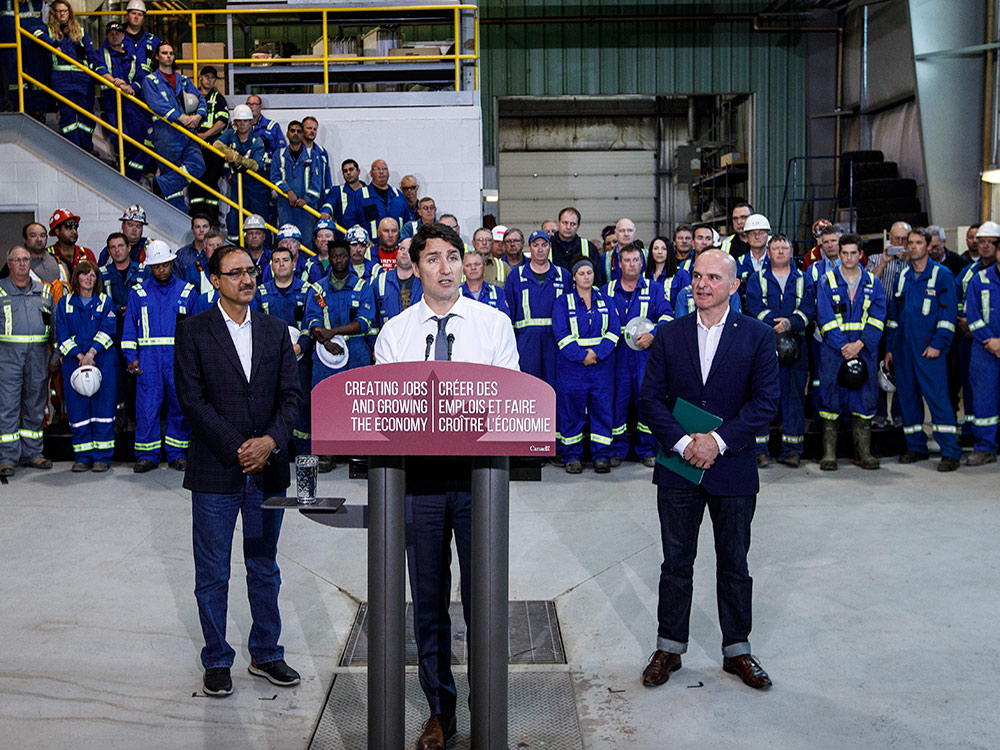
Prime Minister Justin Trudeau boasts of TMX benefits to Canadians at the Trans Mountain Terminal in Edmonton on July 12, 2019. 
Photo by Jason Franon, the Canadian Press.


Don’t say the independent economist Robyn Allan didn’t warn you.


Four years ago, the former CEO and president of ICBC said that Prime Minister Justin Trudeau’s rash purchase of the economically troubled Trans Mountain expansion project would end up costing taxpayers billions.

And then more billions.

At the time Allan accused the Trudeau government of not being transparent or honest about escalating costs on a project that proposed to triple bitumen shipments from 300,000 barrels a day to 890,000 barrels a day for Asian markets.

She then estimated that taxpayers would foot a bill as high $20 billion right here in the pages of The Tyee.

And what did the Trudeau government reveal last week while Ottawa was under siege by angry occupiers? That its uneconomic pipeline, less than 50 per cent complete, will now cost at least $21.4 billion.

That’s a 70 per cent jump above the last inaccurate price tag of $12.6 billion offered by the government just two years ago.

Moreover, the megaproject won’t be finished for another year, if that.

Meanwhile, Finance Minister Chrystia Freeland talked about borrowing more money from public debt markets or the very bank, TD Securities, that originally, in 2018, recommended that Kinder Morgan sell to the Canadian government its 66-year-old pipeline along with engineering plans for an expansion.

Freeland promises that “no more additional public money” will go into the project.

But Allan told The Tyee this week that such a claim is absolute nonsense, because “all borrowing by Crown corporations is ultimately backed by taxpayers.”

Interest charges on existing government loans of $13 billion for the TMX project are already costing $700 million in interest every year, added Allan.

“The government-owned project has been badly mismanaged. The budget is out of control. The shippers, due to their contracts, are not responsible for the cost of the majority of the overruns, and taxpayers are being seriously misled,” Allan said.

Allan isn’t alone in that grim assessment. Gwyn Morgan, the former CEO of Encana (now Ovintiv) told Bloomberg News that the cost overruns posed a grand risk to Canadian taxpayers.

“In the commercial (real) world, no one’s going to finance a project running vastly over budget, with no firm remaining cost or startup date,” Morgan told Bloomberg.

‘It makes even less sense now’

Allan, the former senior economist for the BC Central Credit Union, first challenged the project’s economics back in 2013 and hasn’t stopped since. In her opinion, “It didn’t make any sense then, and Kinder Morgan knew it. And it makes even less sense now.”

Kinder Morgan Canada assured the National Energy Board in its 2013 project application that its U.S. parent had the money to build the then $5.4-billion project at the time. But that heavily indebted company did not.

So the Canadian subsidiary approached the Alberta government in 2014 for financial aid. But then-premier Alison Redford flatly refused to get involved.

The project’s business case has always been dubious. The only reports claiming that a profit could be made selling bitumen to overseas Asian markets were all paid for by Kinder Morgan. Critics have consistently raised doubts about such claims.

The most lucrative market for Canadian bitumen remains U.S. Gulf Coast refineries, which pay a premium for the heavy crude. Last year David Hughes, one of Canada’s foremost energy analysts, calculated that TMX was not needed, given additions to existing North American pipeline systems.

“The federal government, which owns TMX, has claimed higher prices are available in offshore markets that could be accessed by completing the TMX project,” wrote Hughes. “This is clearly not the case, as a detailed analysis of historical prices in Asia and transportation costs has shown. In fact, shippers on TMX stand to lose US$4-6 per barrel compared with U.S. exports on existing pipelines.”

As cost estimates for the project continued to climb, Kinder Morgan realized that the bulk of construction cost overruns would fall on the company and not shippers due to locked-in 20-year shipping contracts. It even warned shareholders of the risk in 2018 as projected costs rose above $7.4 billion.

About that time, the U.S. firm claimed that environmental protests and regulatory hurdles — all duly predicted by the company in its corporate presentations — made the project untenable.

Without providing any public cost benefit analysis or independent reports on the project’s finances, the Trudeau government bought the old pipeline and expansion plans for $4.5 billion in 2018.

Kinder Morgan executives paid their negotiating team US$575,000 in bonuses after sealing the deal. It might seem that Canadian taxpayers paid U.S. executives in Texas approximately C$750,000 in bonuses for outwitting the Trudeau government.

Tolls that keep on leaking money

But the big problem with galloping cost overruns boils down to tolls, says Allan: pipelines typically pay for their capital costs by charging shippers a toll to transport oil through their pipe.

But the contracts with oil products shippers such as Canadian Natural Resources Ltd., Suncor and Cenovus stipulate that a large share of the cost overruns can’t be passed on in tolls. They were signed when the pipeline was budgeted at $7.4 billion. Therefore, fully 75 per cent of the cost overruns at that time could not be passed on.

“No one in Ottawa or the tarsands will discuss the toll rates,” said Allan.

She says that taxpayers, not bitumen shippers, are not only liable for the majority of cost overruns now totalling $14 billion but will be subsidizing some of the richest oil companies in Canada with artificially low tolls that won’t reflect the cost of the project.

This sorry development may also explain why companies like Cenovus, CNRL and Suncor aren’t really complaining or panicking about rampant cost overruns.

“Why should they worry?” asked Allan. “Their tolls have been subsidized for any project costs exceeding $7.4 billion.”

“When Trans Mountain and the shippers know it’s not the shippers but the taxpayers who are paying for the majority of the project overruns, where’s the need for budget control?”

Alex Pourbaix, CEO of Cenovus, the largest shipper on the expanded pipeline, expressed little concern about the cost overruns. “While no one wants to see cost increases, they are often a fact of life with projects of this size,” he told the Globe and Mail last week.

Pourbaix didn’t mention that, if Allan is correct, taxpayers and not Cenovus would be paying for much of these increases.

Fiascos and potential conflicts

Ever since Trudeau bought the project in 2018, the project has been embroiled in one fiasco after another.

Safety issues shut down construction for months in 2020 and 2021 as the company repeatedly replaced contractors. Then came wildfires, floods and galloping inflation as well as upgrades and changes.

Concerns about potential conflicts of interest also dog the project. William Downe, who chairs the Trans Mountain board of directors, had a long career with BMO. And the government now says BMO is one of its financial advisers.

Brian Ferguson, the former CEO of Cenovus Energy, also sits on the Trans Mountain board and has sat on the TD Bank board since 2015. TD Securities advised Kinder Morgan on the sale of the pipeline to Trudeau’s government by providing a Fairness Opinion report.

There is more. Cenovus is the largest shipper on the project’s expansion (125,000 barrels a day). And Finance Minister Chrystia Freeland has identified TD Securities as another key advisor on how to handle project debt.

And then there is that small issue of climate change, added Allan.

“This project is a global-warming machine by the very fact it proposes to move more than half a million barrels of high-carbon bitumen a day. The very people who had their homes flooded by atmospheric rivers or burned by heat domes are now being asked to pay for this global-warming machine.”

Now a project that the government swore would only cost $7.4 billion has soared to $21.4 billion. And it is not even half finished.


Trans Mountain Deal Was Structured to Bleed Billions, Finds Economist
READ MORE

Allan takes no comfort whatsoever in the accuracy of her economic warnings.

“What disturbs me most is this,” said the economist. “As the truth of the full costs unfold and taxpayers realize the huge burden, it will erode faith in our democracy even more, and we can’t afford any more erosion of that faith.”

She still thinks a fiscally prudent government should kill the project: “They can stop it now and cut our losses. Industry doesn’t need the capacity, but they can’t talk about that fact because their shipping contracts forbid them from talking negatively about the project until it is completed.”

Moreover, she adds, the provision of jobs and the wages that go with them have exceeded all estimates due to cost overruns.

“If the government doesn’t cancel the project right away, the pipeline will be a $30-billion boondoggle by the time they close the books.”

And don’t say Robyn Allan didn’t warn you.

Saturday, January 28, 2023

CORPORATE WELFARE BUM
Kinder Morgan sees tax credits speeding up clean energy investments

Wed, January 25, 2023 

HOUSTON, Jan 25 (Reuters) - U.S. funding for clean energy projects will help energy pipeline operator Kinder Morgan accelerate its investments in renewable natural gas and carbon sequestration, executives said on Wednesday.

The $430 billion Inflation Reduction Act (IRA) signed into law last September expanded tax credits for industrial projects that capture, reuse or permanently store carbon dioxide, a gas that contributes to climate change.

The funding "accelerates growth opportunities" in renewable natural gas (RNG), renewable diesel, hydrogen as well as carbon capture and storage (CCS), according to a presentation by Kinder Morgan, the largest operator of carbon dioxide pipelines in North America.

Opportunities to speed up development targets for CCS projects are tied to the increase in credits - to $85 per ton from $50 per ton - for carbon sequestration.

The law also provides $60 per ton for carbon used for enhanced oil recovery, used in Kinder Morgan's oil business.

Earnings before depreciation and amortization in its carbon dioxide business are set to grow 9% to $879 million this year, it said.

The company, which has a network of pipelines that transport natural gas and refined products, recently expanded its energy transition business with three acquisitions and as well as a carbon dioxide transportation and sequestration deal.

Last week, Kinder Morgan said it would move forward with an agreement with Red Cedar Gathering Company to transport and sequester carbon. It also decided to go ahead with a plan to convert its Autumn Hills landfill to an RNG facility, with construction scheduled to begin this month.

The Houston company also is evaluating whether to keep sites dedicated to producing electricity to take advantage of the EPA's proposed regulations allowing for the creation of e-RINs, a new type of credit that would be sold by electric vehicle makers if they can prove their cars and trucks are being powered by electricity from plants that burn biofuels. (Reporting by Arathy Somasekhar in Houston, editing by Deepa Babington)

Thursday, April 18, 2024

Kinder Morgan Sees Strong Natural Gas Demand Over the Next Six Years

Kinder Morgan expects demand for natural gas to increase palpably over the next six years the company said at the release of its first-quarter financial results.

In it, the company reported a 10% increase in its earnings per share, even though these came a bit below analyst expectations, and an annual increase in net profit from $679 million in the first quarter of 2023 to $746 million this year.

Income from Kinder Morgan’s gas pipeline played a big role in its first-quarter performance, the company said in its report, along with oil products.

“Notwithstanding the current low natural gas price environment, the future looks very bright for our Natural Gas Pipelines business segment,” chief executive Kim Dang said.

“We expect demand for natural gas to grow substantially between now and 2030, led by more than a doubling of demand for liquefied natural gas (LNG) exports and a more than 50% increase in exports to Mexico.”

Dang went on to forecast a surge in the demand for natural gas from the power generation industry in response to the increase in electricity demand from the information technology sector as the use of artificial intelligence increases.

At the same time, Dang brushed off the Biden administration’s pause in approvals for new LNG export capacity, saying it would not affect Kinder Morgan’s LNG plans.

Natural gas, which currently meets 43.1% of U.S. utility-scale electricity generation, will continue to meet a large part of American power demand as new wind and solar capacity installations will need backup power generation, according to gas industry executives

Now, AI is proving to be another major driver of demand for natural gas as wind and solar cannot provide the necessary uninterrupted supply of electricity that data centers would require with the increased use of artificial intelligence in their operations.

By Irina Slav for Oilprice.com

Tuesday, November 09, 2021

The Energy Crunch Is Adding Billions To Oil Tycoons’ Net Worth

  • The global energy crunch has sent oil and natural gas prices into the stratosphere, and the tycoons of the industry are reaping the benefits.
  • Some of China’s richest energy tycoons are focused on renewables and electric vehicles.
  • Elon Musk has become the world’s richest man as the world moves to adopt greener transportation solutions.

As the surge in oil prices continues amid increasing demand and a supply crunch, energy stocks have been soaring–and the world's oil tycoons are laughing all the way to the bank. 

According to the Bloomberg Billionaires Index, energy billionaires globally have seen their combined net worth jump more than 20 percent in the first half of the year alone, the highest growth in wealth of any group of billionaires in the index compiled by Bloomberg.

Here's a rundown of how the world's richest energy billionaires have seen their fortunes multiply in this epic oil and gas bull market. The list only includes people who have primarily made their money in oil and gas and does not include clean energy investors.

#1. Mukesh Ambani

      Country:India

      Industry: Oil, Downstream

      Net Worth: $95.8B

      YTD Change: +$19.1B (+24.9%)

With a net worth approaching $100B, Mukesh Ambani is the world's 11th richest man and the richest energy investor.

Ambani controls India's Reliance Industries (NSE: RELIANCE), the world's largest oil refining complex. The Mumbai-based conglomerate's other businesses include a 4G wireless network across India. 

Last year, Reliance Industries overtook ExxonMobil (NYSE:XOM) to become the world's largest publicly traded energy company. However, an epic 56.4% YTD run by XOM has seen it reclaim its position as top dog with a market cap of $272.9B vs. $229.4B by Reliance. RIL shares have climbed at a less torrid pace of 27.7% over the timeframe.

RIL's energy business accounts for ~80% of the company's revenue. However, investors have chosen to focus on Chairman Mukesh Ambani's plan to grow the company's digital and retail arms. Reliance's big bet in non-energy businesses such as telecom, retail, and digital services has helped it to vastly expand its revenue base, clocking in a net profit of Rs 39,588 crore (about $5.3B) in FY19, making it by far India's most profitable company.  For perspective, second-placed Indian Oil Corp. finished the year with a net profit of Rs 17,274 crore ($2.3B). 

#2.  Leonid Mikhelson

       Country: Russia

       Industry: Natural Gas

       Net Worth: $33.3B

       YTD Change: +$8.6B (+34.6%)

Leonid Mikhelson is the chief executive officer of Novatek, Russia's largest non-state-owned natural gas provider. The billionaire owns about one-quarter of the publicly traded company, which produces about 10% of the country's gas. He also holds a 36% stake in closely held petrochemical producer Sibur.       

#3.  Harold Hamm

       Country: United States

       Industry: Oil & Gas

       Net Worth: $14.8B

       YTD Change: +$9.8B (+190.7%)

Harold Hamm is chairman of Continental Resources (NYSE:CLR), the biggest oil producer in the Bakken oil basin in North Dakota and Montana. The Oklahoma City-based publicly traded company has seen its shares climb a blistering 199.4% in the year-to-date hence the massive jump in Hamm's net worth.

As of December 31, 2020, CLR's proved reserves were 1,104 million barrels of crude oil equivalent (MMBoe) with proved developed reserves of 627 MMBoe. The company pumped more than 300,000 barrels of oil or the equivalent per day in 2020, with around two-thirds of that coming from its operations in the Bakken.  CLR has a market cap of $17.6B.   

#4.  Leonid Fedun

       Country: Russia

       Industry: Oil & Gas

       Net Worth: $9.7B

       YTD Change: +$3.0B (+44.9%)

Fedun is a vice president and board member of Lukoil Oil Company, one of the leading oil producers in Russia.

Fedun led the privatization of Lukoil and retains with his family about 12% of the company. According to Bloomberg, the oil billionaire has collected more than $1.5 billion in dividends from his stake in Lukoil.

#5.  Richard Kinder

       Country: United States

       Industry: Oil & Gas

       Net Worth: $8.2B

       YTD Change: +$1.4B (+20.1%)

Richard Kinder is the chairman and largest shareholder of Kinder Morgan Inc. (NYSE:KMI), a publicly traded energy storage and pipeline company. KMI operates 144 terminals and 83,000 miles of pipeline that transport natural gas, crude oil, ethanol, and other petroleum products.

Kinder served as chief executive officer from the company's founding in 1997 until 2015.       

Kinder Morgan shares have been slipping after the company reported Q3 earnings that missed expectations while revenues rose 30% Y/Y to $3.8B. According to Credit Suisse, investors likely were positioning for a better than expected Q3 report given the strong macroeconomic backdrop, but "not all those tailwinds materialized."

Mizuho analysts say tension remains between wanting Kinder Morgan to get more aggressive with areas such as carbon capture, but the firm "continues to like KMI's leverage to the gas macro" as well as its "disciplined approach to not sacrificing returns as more capital is spent on the energy transition."

KMI shares are still up 22.5% in the year-to-date.

Clean energy billionaires

Readers will notice that China is conspicuous by its absence on this list, and for good reason: China's richest energy billionaires have actually made their money in clean energy and not oil and gas.

Zeng Yuqun, Huang Shilin, Pei Zhenhua, and Li Ping together are worth an astounding $62 billion, with the "green" portion of that wealth representing the lion's share, according to Bloomberg Green. These Chinese billionaires all own CATL, which is the global leader in EV battery manufacturing, supplying all the big players on the EV auto scene.

Three other Chinese billionaires--Wang Chuanfu, Lv Xiangyang, Xia Zuoquan--are majority owners of EV company BYD (along with Berkshire Hathaway) and are worth a combined $33.5 billion, about half of which is "green". 

Right up there, too, is Eve Energy chairman Liu Jincheng with a net worth of nearly $11 billion thanks to a company that supplies major EV manufacturers, including Daimler, BMW, and Xpeng Inc. (NYSE:XPEV).

And let's not forget one of the year's most attractive EV stocks where investors made a ton playing the volatility--Tencent-backed Nio Ltd (NYSE:NIO), Chinese biggest EV manufacturer whose founder, Li Bin, has a net worth of over $9 billion--all "green".

Finally, the four majority owners of LONGi Green Energy Technology Co Ltd--Li Zhenguo, Li Chunan, Li Xiyan, and Zhong Baoshen--are worth a combined $16+ billion thanks to their company's status as the biggest manufacturer of monocrystalline silicon wafers in the world. And it's only getting bigger, with the recent completion of a duo floating PV plant in Ho Tam Bo in Vietnam.

But it's not all Chinese in the green billionaire space: There's always American-made Elon Musk, the Tesla CEO whose net worth topped $310 billion this year--a stunning figure that represents an over 80-percent increase in wealth just this year. 

By Alex Kimani for Oilprice.com

Friday, May 07, 2021

Results tally up billions in profit from Texas freeze for gas and power sellers

By Devika Krishna Kumar, Scott DiSavino and Jessica Resnick-Ault
© Reuters/MIKALA COMPTON FILE PHOTO: 
A neighborhood experiences a power outage after winter weather
 caused electricity blackouts in San Marcos

(Reuters) - Natural gas suppliers, pipeline companies and banks that trade commodities have emerged as the biggest market winners from February's U.S. winter blast that roiled gas and power markets, according to more than two dozen interviews and quarterly earnings reports.

The deep freeze caught Texas's utilities off-guard, killed more than 100 people and left 4.5 million without power. Demand for heat pushed wholesale power costs to 400 times the usual amount and propelled natural gas prices to record highs, forcing utilities and consumers to pay exorbitant bills.

After the storm, few companies wanted to talk about their financial gains, unwilling to be seen as profiting off others' hardships. But a clearer picture is emerging from quarterly earnings and as utility companies smarting from big bills sue to recoup their losses.

The biggest winners were companies with access to supplies, including leading energy trader Vitol, gas suppliers Kinder Morgan, Enterprise Products Partners and Energy Transfer, and banks Goldman Sachs, Bank of America (BofA) and Macquarie Group.

The firms combined stand to reap billions of dollars in profits by selling gas and power during the storm, according to interviews and reviews of public documents. It is possible that some companies may never collect on those sales due to ongoing litigation, however.

Losers include producers that could not deliver oil and gas due to frozen wellheads, gathering systems and processing stations. The week-long output loss cost shale producer Pioneer Natural Resources $80 million, Chevron about $300 million, and Exxon Mobil $800 million.

Utilities are complaining of price gouging and of unwarranted supply cancellations. The Federal Energy Regulatory Commission is reviewing gas and power markets for potential market manipulation.

Goldman Sachs and Vitol did not comment. BofA did not respond to a request for comment.

'MAXIMUM WITHDRAWAL'

Energy Transfer, which can store about 60% of U.S. daily gas consumption in areas hit hardest by the February freeze, could report a $850 million profit from selling the fuel to utilities and industrial customers during the storm, according to analysts at East Daley Capital. Other people familiar with its operations say that figure could be higher.

Energy Transfer did not comment for this story. The company reports results on Thursday.

Rival Enterprise Products Partners said the storm led to gains of about $250 million in the first quarter.

Kinder Morgan, another gas storage and pipeline operator, earned about $1 billion during the storm, the vast majority from higher gas prices and sales. Anticipating high demand, Kinder Morgan said it dispatched workers and backup generators ahead of the storm to its gas storage and pipeline facilities.

Graphic: Texas gas prices soars during February freeze, https://fingfx.thomsonreuters.com/gfx/ce/jznvnreddvl/Pasted%20image%201620219759793.png

At the beginning of February, gas prices ranged from $2.50 to $3 per million British thermal unit (mmBtu) at hubs from Houston to Tulsa, Oklahoma. Prices began climbing on Feb. 11 into the hundreds of dollars, with Tulsa's hub surging to a record $1,192.86 on Feb. 17, according to government data.

"That's what happens when you go from a very well supplied market to a very tight market, and in this case a catastrophically tight market," said one natural gas trader. "That was very localized pain, and it really surprised a lot of people."

Energy traders with three Texas electric cooperatives told Reuters they paid as much as $400 per mmBtu during a four-day stretch that began Valentine's Day weekend. They requested anonymity because they were not authorized to speak about the crisis. San Antonio's municipal utility CPS Energy said its gas bill for the week was about $700 million.

"I've been tracking natural gas markets for 20 years. I've never seen price increases like we saw," said Tyson Slocum, an energy and environmental advisory committee member at the Commodity Futures Trading Commission and a director at Public Citizen, a consumer advocacy organization.

WINNING AND LOSING

Australia's Macquarie, the second-largest marketer of U.S. natural gas, said its trading around the storm boosted its overall profit outlook for the year by about 10%, which analysts estimated at about A$400 million ($317 million).

Ahead of the storm, Macquarie traders researched how previous cold fronts disrupted infrastructure to prepare a plan, said sources within the firm, who requested anonymity. The company did not comment for this story.

Texas's grid operator ERCOT canceled $1 billion in service charges and state officials are considering securitizing unpaid ERCOT bills from electric companies that defaulted.

Many of the firms that profited from trading, such as Goldman Sachs and BofA, are also facing losses from their exposure to utilities and electric co-operatives that have declared bankruptcy, according to court filings.

BofA made hundreds of millions via its trading arm, according to a source with direct knowledge of the matter, but it is owed nearly $480 million by Brazos Electric Power Cooperative, which filed for bankruptcy.

Disputes over price gouging and reneged contracts have also emerged after some suppliers declared the freeze was a force majeure event that allowed them to suspend contracts.

Macquarie was sued by Exxon seeking to void an $11 million gas bill. CPS Energy sued BP, Chevron, Energy Transfer and others for submitting bills that ran into the hundreds of millions of dollars.

Texas wind farm operators also have filed lawsuits against trading arms of JP Morgan Chase and Citigroup, maintaining the cold snap was an extreme event that overrode contracts for power generation and delivery.

(Reporting By Devika Krishna Kumar, Scott DiSavino, Jessica Resnick Ault, and Gary McWilliams; additional reporting by Liz Hampton, Stephanie Kelly and Jennifer Hiller; writing by David Gaffen and Gary McWilliams; Editing by Marguerita Choy)