It’s possible that I shall make an ass of myself. But in that case one can always get out of it with a little dialectic. I have, of course, so worded my proposition as to be right either way (K.Marx, Letter to F.Engels on the Indian Mutiny)
BIGFOOT IN CANADA Inside the hunt for proof — or at least a good photo By Saba Aziz Global News August 14, 2021
LONG READ
It’s been 54 years since two men captured the now-famous Bigfoot video, in which the legendary and camera-shy primate can supposedly be seen loping out of the woods in California.
Enthusiasts have been hunting for the mythical beast throughout Canada and the United States ever since. But as cameras and modern research methods have evolved, two questions still remain.
Does Bigfoot really exist? And if it does, why can’t anyone get a good photo of it?
Canadian Bigfoot hunters have been trying to answer that first question for decades. Some have devoted themselves to documenting every alleged encounter. Others have tried to find physical proof, such as hair, bones or a body. One person has even attempted to take the issue to court.
But after more than five decades, the search has yielded little more than a few blurry photos, a bunch of incredible stories and the certainty – at least among believers – that proof is right around the corner.
Here’s why some Canadians are still tracking the mythical Bigfoot, and what they need to finally put the big questions to rest.
Sasquatch watch
Todd Standing, 46, claims his first close encounter with a sasquatch (a.k.a. Bigfoot) was in 2005, and that it dramatically changed his life.
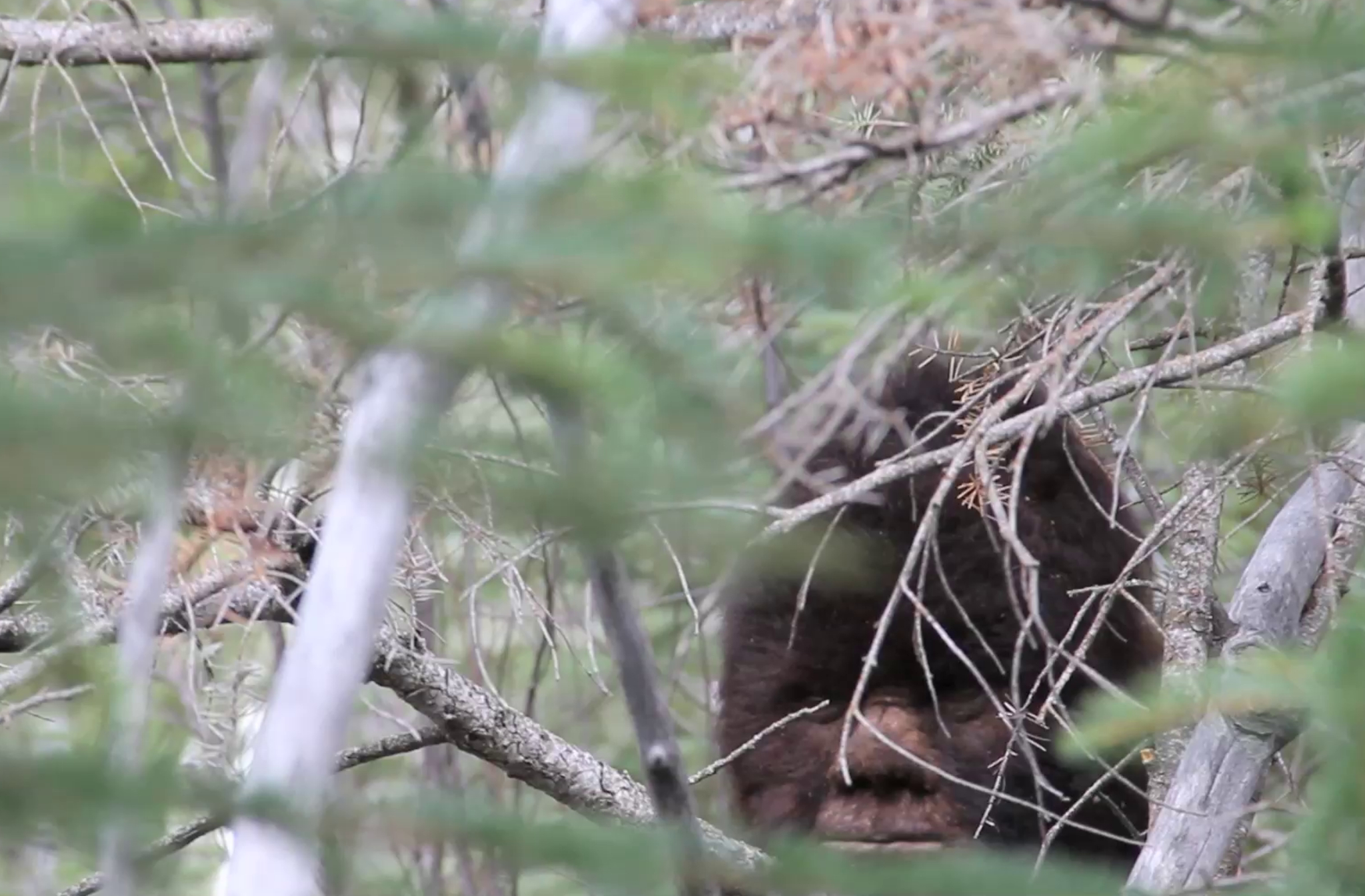
The filmmaker and wilderness guide from Edmonton says he saw a nine-foot-tall bipedal creature with a very human-like face high up in the Rocky Mountains of British Columbia. He says he saw it stand up and squat down.
1:48 Bigfoot believer takes provincial government to court Aug 14, 2018
Since that initial alleged sighting, Standing claims he has shown the actual creature — in the furry flesh — to dozens of other people from all over the world on his paid guided tours. His numerous exploits have been featured on Canadian TV show Survivorman, as well as in his own 2017 documentary Discovering Bigfoot.
“Over 80 per cent of people I take out are either having a live interaction or a sighting with the sasquatch,” Standing told Global News.
“The species is clearly out here and they’re trying to communicate with us with the tree breaks and the signs that they leave behind.”
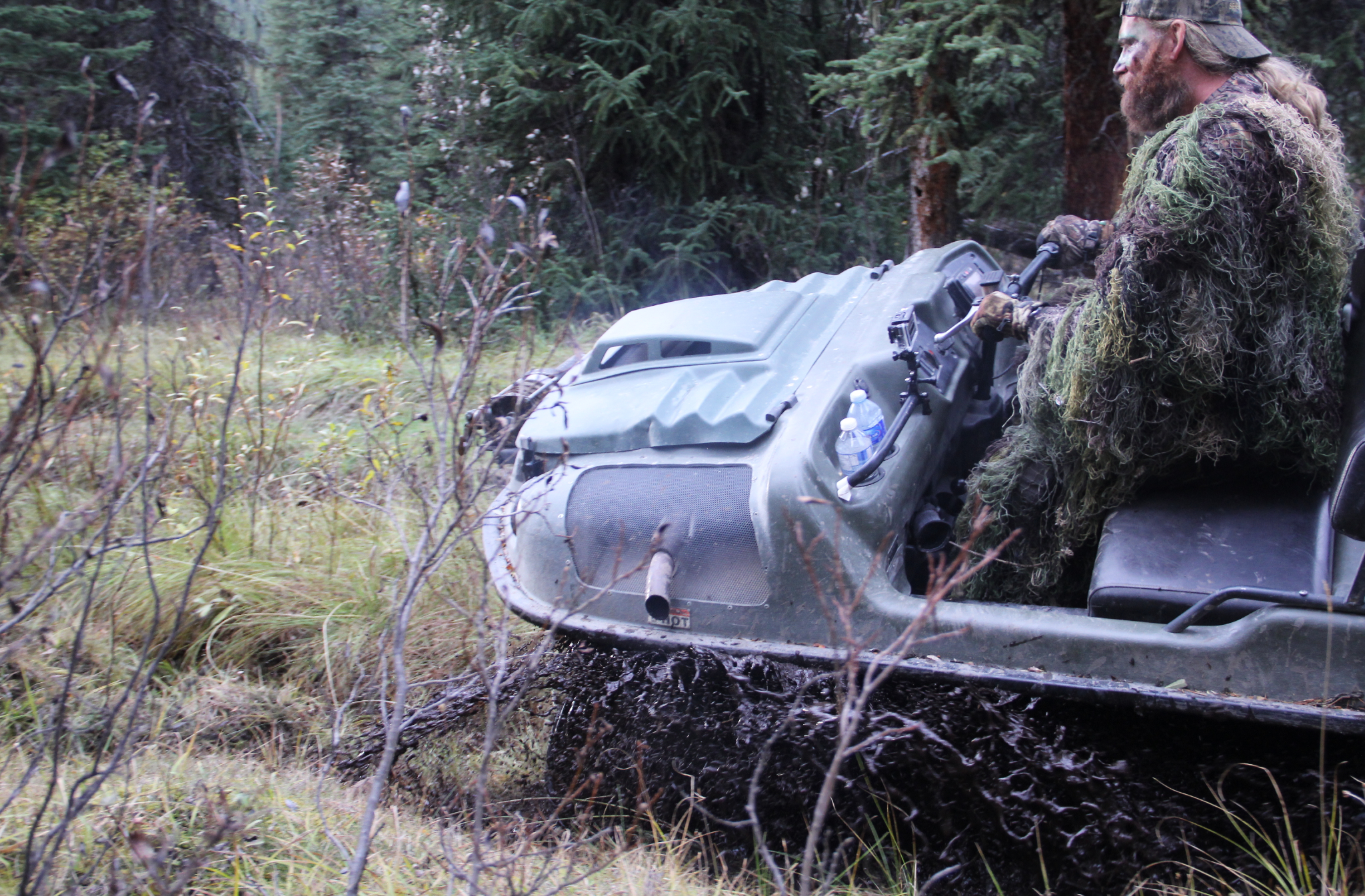
Todd Standing pictured here during a sasquatch hunt in Nordegg, Alta., 2012.
Standing is not alone in his belief of the sasquatch’s existence; the story of Bigfoot is easily one of the most popular in North American folklore. The legend is rooted in Indigenous history, and the First Nations consider the creatures sacred.
Each tribe has its own set of beliefs. For the Sts’alies Nation on the West Coast, the sasquatch is a protector of their land and an entity not to be meddled with, while the Haida people view it as a supernatural being to be respected.
While most of Canada’s sasquatch sightings have been reported in B.C., there have been thousands in the territories, Manitoba and Ontario, and even a couple in Newfoundland and Labrador.
Indeed, the sasquatch “evidence” dossier is thick: there are alleged eyewitness accounts, grainy videos, audio recordings and even purported abductions, but all of it falls short of scientific proof that the sasquatch exists.
To date, the wildlife government agencies in Canada have not acknowledged the existence of sasquatch, and the mythical creature remains the stuff of campfire stories and conspiracy theorists.
Standing sought to prove otherwise, filing two lawsuits in 2018 — one in California and the other in B.C. — suing the fish and wildlife government agencies for not recognizing Bigfoot as an indigenous species. Both times he was unsuccessful in court.
“There’s just so much evidence out there. When you review the evidence, including with the DNA, it’s preposterous to think they don’t exist,” Standing said.
Depending on who you ask, Bigfoot, an ape-like creature that legend says stalks the forests of North America, is either a good subject for a story told around a campfire but not to be taken seriously, a real phenomenon that science has yet to explain, or something between the two.
Also known as sasquatch, Bigfoot has become a larger-than-life icon that is echoed in other parts of the world. In the southeastern United States, legends of the Skunk ape about, while in Asia, Bigfoot is know as the Almas, Yeren and Yeti. In Australia, a similar creature of folklore is called the Yowie.
Southwestern Manitoba is no stranger to accounts of the notoriously elusive Bigfoot, who is usually described as a large, muscular, bipedal creature covered in black, dark brown or dark red fur, standing as tall as 4.6 metres.
A website called the Bigfoot Field Researchers Organization (BFRO) has archives of many Bigfoot sightings across North America. In western Manitoba, the mystical creature is said to have been seen near Brandon, Kenton, Rivers and Rossburn.
One such account, which took place on July 29, 2010 along a dirt road near Brandon, tells the story of an unnamed man who went to check his rural mailbox and decided to take a back road home. Noticing strange tracks on the road, he got out of his truck and was flabbergasted at what he saw — footprints that measured larger than any human foot, showing a seven-foot stride, that appeared to emerge from a field, walk along the edge of the road for nearly a mile and then return to the same field.
In 2000, a possible sasquatch was seen by an unnamed farmer near Highway 21 just outside Kenton, 72 kilometres northwest of Brandon. The farmer claimed his cattle had been spooked on several occasions, and he finally saw what was scaring them one night when he was approaching his uncle’s farm with his tractor. At first, he thought the figure he saw was his uncle walking on the road away from him. As he got closer, the creature turned toward him and walked across the road. Moments later, the farmer’s uncle appeared. The farmer describes the creature he saw as being almost as tall as a tree — at least eight feet — and a gait that didn’t seem human.
One sasquatch-like creature was seen walking across a grain field near Rivers, 41 km northwest of Brandon, in August 1996. The anonymous witness said he was returning home one evening just after dusk had fallen when he saw a shape in the ditch on the west side of the highway. He stopped to check if it was a horse from a nearby farm, but quickly observed a fast-moving creature that was covered in dark brown hair and walking upright.
North of Rossburn, 146 km northwest of Brandon, a suspected sasquatch was seen in summer in the mid-1960s by a group of people picking saskatoon berries behind their garden. The witness claimed the creature made a second appearance shortly after.
On social media, several people claimed to have seen a Bigfoot-like creature near McCreary, 137 km northeast of Brandon, and Killarney, 99 km southeast of Brandon. Whether these sightings, and the ones described on the BFRO website, are legitimate or not is up for interpretation.
But for Ryan Willis, president of the Trent University Sasquatch Society (TUSS) in Peterborough, Ont., Bigfoot is more than just a folk tale — it’s a creature that is just as real as it is elusive.
Willis is the host of a new television show coming to the Wild TV Network this fall called “Sasquatch University.” The show seeks to dive into the phenomenon of Bigfoot in Canada, and is looking for witnesses and people with evidence in Westman and all over Canada to come forward and share their stories.
Having had a keen interest in sasquatch since he was 11 or 12 years old, Willis said similar television programs to the one he is hosting are what sparked his passion for the bipedal creature.
“I was watching Animal Planet one night and I stumbled across the show ‘Finding Bigfoot,’ which aired for a while,” he said. “And then as I got older, I would just research the subject all the time and go into the woods when I could.”
Trent University Sasquatch Society is the first, and currently the biggest, Bigfoot research group in Canada, Willis said. Members speak with Bigfoot researchers from all over the world, and their main goal is to educate students about sasquatch.
The group, consisting of around 200 members, has faced ridicule in the past over its interest in the famed cryptid, but it hasn’t dampened their enthusiasm, Willis said.
“We take it very seriously. We speak with a lot of academics and a lot of scientists,” he said. “I think a lot of people don’t know how many scientists and PhDs are doing work on this and are very involved in the subject.”
Bigfoot research has evolved far beyond grainy videos of people in monkey suits in the ’60s, thanks to groups like his, Willis said. The next step toward finding concrete evidence for Bigfoot’s existence is the new television show, which he said his entire society is excited about, since it’ll afford them opportunities to travel even more extensively throughout Canada in pursuit of the legendary creature.
“We’re doing a hunt for witnesses right now. We already have a bunch that have got in touch with us in the past, but … we’re always looking for more. We’re trying to find the most interesting witnesses we can and followup with them.”
Once they know where they want to travel to shoot episodes of the show, the group will get down to work in actually trying to find Bigfoot, using traditional methods such as tree knocking and howling as well as more cutting-edge, scientific ways of drawing out sasquatch.
“We want to try using drones and certain game cameras, and different things like that.”
Although Willis, the cast and crew are all passionate about finding real evidence of Bigfoot, that doesn’t mean they don’t get a little spooked from time to time when they’re out in the woods doing their field work. From dealing with bears and porcupines to the possibility of seeing the focus of their research itself, things can get a little nerve-wracking, Willis said.
“We just try to focus on the task at hand and not get too freaked out, but there are sometimes where it does get pretty freaky out there. It’s cold and dark, and that does kind of get to you a bit … but it’s all worth it, to us, for sure.”
Anyone who would like to come forward with their own tales of Bigfoot encounters are encouraged to visit sasquatchuniversity.com, which has links to all of the society’s social media channels.
Willis said he has heard some interesting Bigfoot lore coming out of Manitoba and hopes that enough witnesses will come forward to warrant a trip to Westman in the near future, all in hopes of pursuing North America’s most elusive — and captivating — cryptid.
Miranda Leybourne, Local Journalism Initiative Reporter, Brandon Sun
In the summer of 1983 Ted Kaczynski was feeling hemmed in even in remote Lincoln, Montana. “There were too many people around my cabin,” he later wrote, “So I decided I needed some peace.”
In search of the solace that only nature could provide him, he hiked up to a favorite remote spot far from the cars, trucks, RVs, chainsaws, and Americans that plagued him. “I went back to the plateau, and when I got there I found they had put a road right through the middle of it,” Kaczynski recounted. “You just can’t imagine how upset I was.”
Kacyznski’s rage was real. It was already explosive. He’d begun sending bombs through the mail five years earlier.
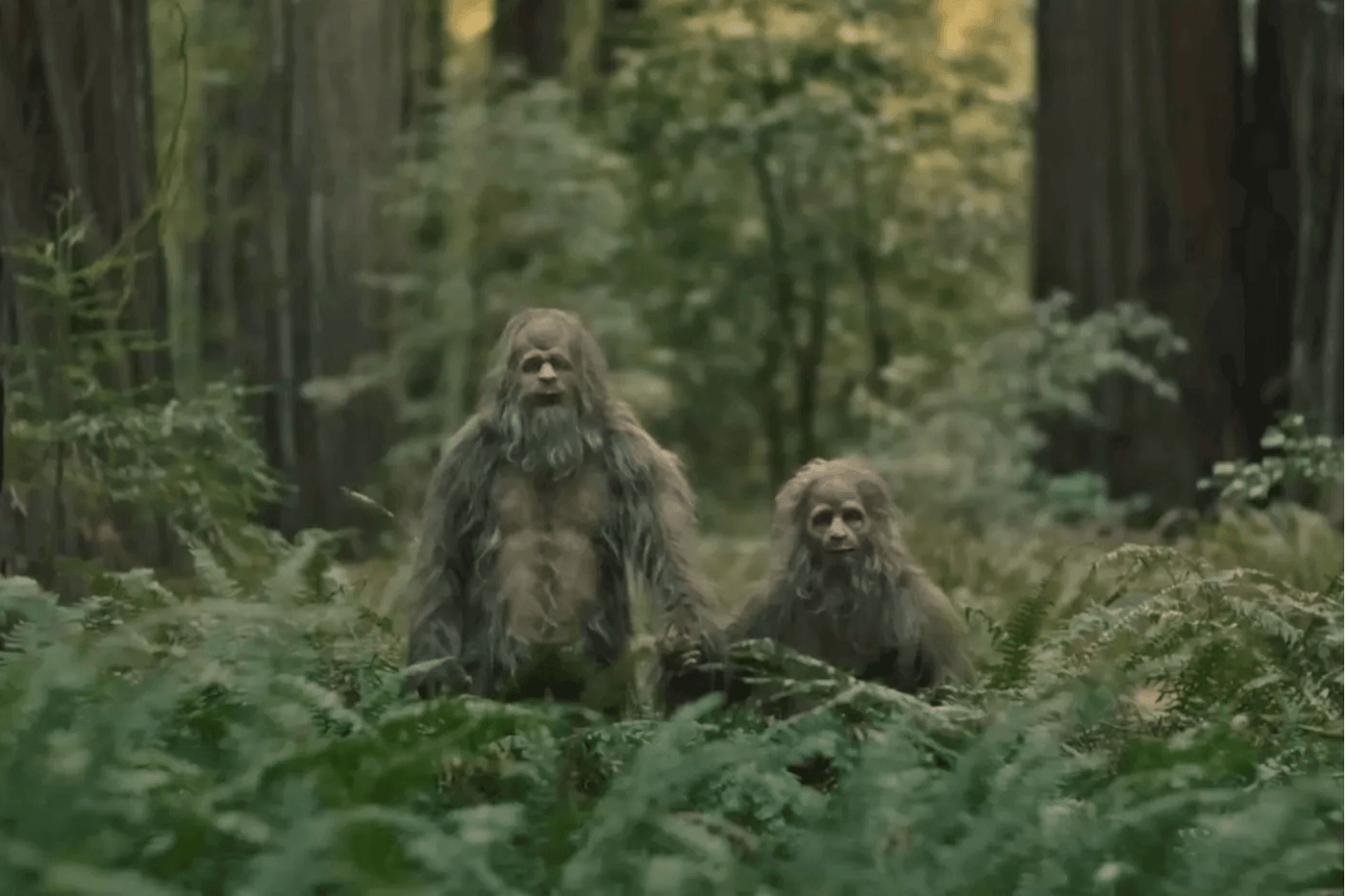
Although there were no witnesses to the Unabomber’s encounter with the newly built road, we can assume it wasn’t as visceral as the reaction to the same scenario by a trio of Big Foots—a companionable, low-IQ male (Jesse Eisenberg); a sensitive and resolute, female (Riley Keough); and an imaginative, even astute adolescent (Christophe Zajac-Denek)—in the latest film from brothers David and Nathan Zellner, Sasquatch Sunset. These hirsute hominids—the Sasquatches not the Zellners, though Nathan in full prosthetics plays the Harvey Weinstein alpha male who dominates, or tries to dominate, the opening stretch of the movie—emerge from the shadows of the redwoods and onto a dirt road packed hard and terrifyingly bright against the sunshine penetrating the cleft in the canopy.
The creatures have apparently never come across anything like this straight, flat, hard, horrible thing and they don’t have the mental faculties to deal with it. What literally strikes them first is the texture of the transformed earth under their outsized feet, its awful strangeness confirmed when they bend down to touch the surface with their hairy, knobbly fingers. The smell is alien too, the lingering residue of rubber and diesel, the whiff of that strangest, most lethal of threats: human beings.
After exploring the road tactilely, the current top male (emotionally more sensitive, Jesse Eisenberg’s character is hardly more acute than Nathan Zellner’s) looks up and sees that the roads runs straight through the woods to a vanishing point. This is even more terrifying than the touch of it. They see the doom of infinity. Turning around they learn that the road also extends unfathomably in the opposite direction and this drives them into a renewed freak-out. Each new blow of perception makes them forget the previous one. They turn back to the original direction and are horrified yet again that the road is still there.
After they’ve taken in the stimuli of sight and touch, the terrible truth sinks deeper into their bodies. All three begin explosively shitting and pissing and vomiting on top of the road. This is not an act of marking the violation with their scents, but an irrepressible, reflexive response to the incommensurability of this danger.
In his Et in arcadio ego, W. H. Auden also tries to get his mind around a road:
I well might think myself A humanist, Could I manage not to see
How the autobahn Thwarts the landscape In godless Roman arrogance
These apes aren’t quite human and certainly aren’t humanists, and unlike Kaczynski they didn’t go to Harvard at age sixteen. But in the bones of their big feet they know what they’re up against. Luckily, perhaps, their memories, individual and collective, are not long. They will tramp on.
Many reviewers seem to consider the extravagant excretions in this road scene a slapstick extravaganza. That’s part of the paradoxical pleasure of the cinema: the enjoyment of watching others, even if they are imaginary or mythic, suffering or literally scared shitless. But these Sasquatch antics are far more unsettling, and profoundly comic, when viewed as a mash-up of the eschatological and the scatological. Try to hold it in when you watch the live-feed of the Thwaites Glacier launching itself into the Amundsen Sea!
One shouldn’t be surprised that the urbanites of the New York Times and others clearcut the backcountry pathos and terror even while these hipster humanists rightly understand the movie as an allegory of extinction for a species (theirs) supposedly more advanced in evolutionary terms. Yet humans, whether clean-shaven or artfully beardsmithed, now appear doomed by the very same forces they have unleashed that will snuff out Sasquatch, or already have. The Sasquatch cohort never sees man or woman but discovers the results of their arts, sciences, and industry: that road; a tree marked for felling with a scarlet X; a bear trap with a denuded bone still in its iron jaws; a docile hen in a chicken-wire cage; rusted logging equipment.
When the Sasquatches come across a campsite in their woods the people who have apparently just set up are inexplicably nowhere to be seen or heard. The tent is shocking red and stocked with even more toxically colored junk food, that the hairy bi-peds tear into. There is also a bright yellow tape deck that, after some fiddling breaks into 1990s Brit synth-pop as garish as the snacks they’ve plundered. Presumably, they don’t know the band’s name, Erasure, which strikes those cineastes in the know as archly oracular, as does the song’s title and refrain “Love to Hate You.” The apogee of human art encountered by these supposedly inferior apes is thumping techno-pap. It drives the Sasquatch not to dance but to destruction.
The filmmaking brothers forage relentlessly through an undergrowth of cinematic allusion: 2001: A Space Odyssey, Sometimes a Great Notion, Deliverance, nature documentaries and the Bigfoot movies that came to our local theater on Bainbridge Island in the Pacific Northwest. But these winking gags and the physical comedy enacted by the human actors in their hairy, fleshy suits are shot through with terrifying melancholy. If we laugh at the Sasquatchian behaviors we are also laughing at ourselves, and it is a bitter Swiftian laugh. It isn’t only Donald Trump’s pussy-grabbing that the rampant libido of Zellner’s horny Sasquatch male sends up. The entire human species is enslaved by lust, not just for sex but for the domination of nature.
The Sasquatch have a language of monosyllabic grunts, groans and shrieks. Eisenberg’s beta-male tries, unsuccessfully, to count the stars. He can’t manage to tally the rings of a tree either, one which we humans, unlike the Sasquatches, know has been felled by a chainsaw.
But intellectual and imaginative advance is coming to the species, even if this evolutionary progress comes too late—or maybe too early. The adolescent Sasquatch has intuition and an imaginary companion that he ventriloquizes with his hand and that speaks in a more complex language than that of his elders. This youngster is inventing art, writing his own script as he makes his way in his vanishing world.
But the ancestral traditions are his too. He takes up baseball bat-sized branches to pound in precise unison with the others on resonant trees like giant drums or organ pipes, vainly trying to summon others of their vanishing kind from their disappearing habitat.
Even in their own primitive language, the Sasquatches are hardly a voluble bunch.
The idyll will be broken and when it is, melodies struggle against pounding electronics. The thumps of drums and shimmer of cymbals sew dread. Industrial eruptions agitate the Sasquatch’s terror. Dissonant collisions, metallic scrapings, wiry janglings terrorize the road scene.
And in the end, the inevitable closing song serenades the credits with the first words of English, said or sung, in the entire movie. The invisible singer is Riley Keough, a granddaughter of Elvis Presley. She also played the female sasquatch, whose sad eyes seem prescient of her clan’s fate. This makes for the most knowing joke of the whole movie, Rock and Roll royalty breathily hymning the “Creatures of Nature.” David Zellner’s goofily grandiloquent doggerel lyric is delivered by Keough above harmonically inert, harplike guitar chords, cello drones, and other precious folkisms:
Stewards of forests and Rivers and mountains All co-habitating In Grand Guignol
To go against Nature Is to face its fury From ancient Pompeii To Hurricane Paul
The vintage machinery, the nylon tents, the boombox and the synthesized hit on its cassette: all of these and other clues suggest that the movie is set in an already vintage past, even if these signs could ambiguously gesture towards possibly retro glampers, as do the tourist-attraction logging museum adorned by bigfoot statues and other practices of the present. The Sasquatches might still have some more time or they may have already disappeared over the horizon of history.
Chaos is order The order of Nature Through Winter and Spring and Through Summer and Fall
They camе here beforе us And shall be long after ’Til the World finally reaches Its last curtain call.
This 90-minute, end-of-an-eon drama concludes as soft-focus choral vocalizations (“la, la, la, la”—a soft syllable decidedly not the bigfoot vocabulary) bathe Sasquatch Sunset in golden, elegiac light. The perspective broadens, time expands towards irrelevance. The road has disappeared from view and memory, reclaimed by the forest or what comes after it.
The film is mostly three-and-a-half minutes of grainy fall foliage, men riding horses, and jerky pans. The famous footage—used for decades afterward in every documentary about whether Bigfoot is real or fake—comes across as just someone having fun with their new camera. But, about two minutes in, the lens of a rented 16mm Cine Kodak camera catches something strange.
“We were just riding out alongside the creek, riding along enjoying the warm sunshine day,” says Bob Gimlin. “Then, across the creek, there was one standing. Everything happened so fast.”
What Gimlin's camera sees is a strange, large ape-like figure limbering on its hind legs across a clearing. For a brief moment, the animal appears to look directly at the camera, and, then, it’s gone. This is the famed Patterson–Gimlin film reportedly shot in October 1967 in the heavily wooded forests of Northern California, and it is one of the most heavily analyzed pieces of film in American history.
To some, this is definitive proof that Bigfoot is as real as mountain gorillas or narwhals. For others, it’s a hoax alongside videos claiming to show ghosts, aliens, and lizard people. But Gimlin knows exactly what he saw that day. “It walked upright and for quite a long ways. It didn’t look like a bear. I’ve been in the woods my whole life,” 86-year-old Gimlin tells Popular Mechanics. “There’s no doubt in my mind at all what it was.” A Centuries-Old Tale Pictographs at the Carrizo Plain National Monument belonging to the Yokut aboriginal tribe in Central California. DAVID MCNEWGETTY IMAGES
This elusive, possibly fictitious animal goes by a number of different names—Bigfoot, Sasquatch, Yowie, Skunk Ape, Yayali—and for centuries, people across North America have had sightings.
Many Native American cultures have written oral legends that tell of a primate-type creature roaming the continent's forests. In these tales, the animals are sometimes more human-like and, other times, more ape-like. In the mythology of the Kwakiutl tribe that once heavily populated the western coast of British Columbia, Dzunukwa is a big, hairy female that lives deep in the mountainous forests]
]
“SOME TRIBES REALLY LOVE BIGFOOT…TO OTHER TRIBES THOUGH…HE’S AN ABSOLUTE ORGE, A MONSTER, AND SOMETHING BEST LEFT ALONE."
According to the legend, she spends most of her time protecting her children and sleeping, hence why she’s rarely seen. In fact, the name “Sasquatch” comes from Halkomelem, a language spoken by several First Nation peoples that occupied the upper Northwest into British Columbia.
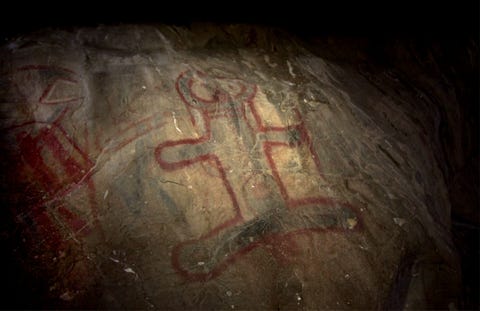
In California, there are century-old pictographs drawn by the Yokuts that appear to show a family of giant creatures with long, shaggy hair. Called “Mayak datat” by the tribe, the image bears a resemblance to the commonly held vision of Bigfoot.
“Some tribes really love Bigfoot, they have a great relationship with him,” says Kathy Moskowitz Strain, author of the book Giants, Cannibals & Monsters: Bigfoot in Native Culture and archaeologist with the U.S. Forest Service. “To other tribes though, like the Miwoks, he’s an absolute orge, a monster, and something best left alone.”
To this day, Strain says, many of the tribesmen she does field research with believe that Bigfoot walks among us. “I’ve been in the field with tribal members where something strange happens and they always blame it on a Bigfoot,” says Strain. There’s Bear Men in Them Hills A still from the famous Patterson–Gimlin film, 1967. BETTMANNGETTY IMAGES
Native Americans weren’t the only ones seeing this hairy, primate creature roaming the wilds of America. Nineteenth- and early 20th-century newspapers had whole sections devoted to the miners, trappers, gold prospectors, and woodsmen claiming to have seen “wild men,” “bear men,” and “monkey men.”
Most famously, in 1924, a group of prospectors hunkering down in a cabin along the shoulder of Mount St. Helen in Washington State claimed they were attacked late one night by a group of “ape-men.” Later, one of the prospectors admitted that they weren’t unprovoked attacks. He had taken potshots at the creatures earlier in the day.
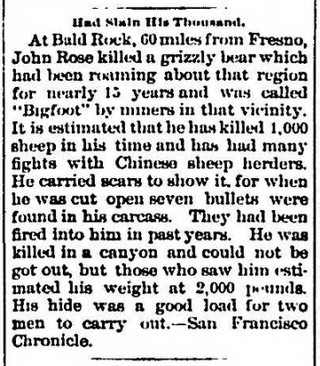
Even then, as noted in Chad Arment’s 2006 book Historical Bigfoot, these accounts like the ones from the prospectors in 1924 were often regarded with a general sense of skepticism often due to the unreliable nature of the witnesses. 1895 article describing a grizzly bear with the nickname "Bigfoot." PLACERVILLE MOUNTAIN DEMOCRATWIKIMEDIA COMMONS
“It’s hard to know what came out of the bottom of a whiskey bottle and what’s real,” says former NPR producer Laura Krantz, who’s a host of the new podcast Wild Thing, which digs deep into the search for Bigfoot.
There were also times when one animal was confused for another, possibly explaining the origin of the name “Bigfoot.” Newspaper accounts show that “Bigfoot” was a common nickname for particularly large, aggressive grizzly bears who ate cattle, sheep, and attacked humans. It wasn’t until 1958 when a California tractor operator named Jerry Crew “found” a series of huge muddy footprints that the term was popularized in reference to the primate-like animals.
That same year, another man named Ray Wallace also said he had discovered large prints belonging to Bigfoot. Upon his death in 2002, it was revealed that this was a hoax. Sasquatch Goes Mainstream
KEVIN SCHAFERGETTY IMAGES
It was in the mid 20th century when Bigfoot stepped from local lore to national phenomenon.
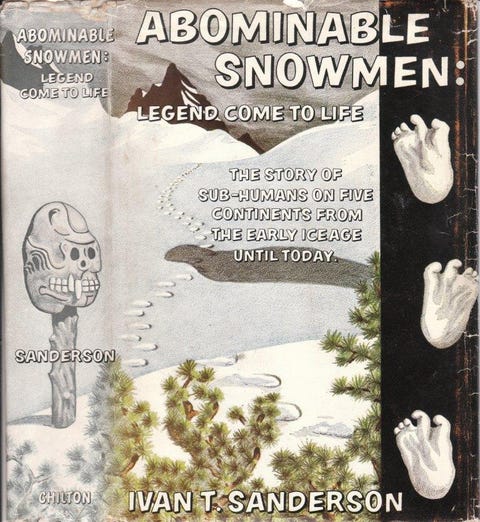
In 1961, naturalist Ivan T. Sanderson published his book Abominable Snowmen: Legend Come to Life. In the book, Sanderson uses footprints, eye witnesses, and bone samples as potential evidence of “sub-humans” living on five continents across the world, including North America’s Sasquatch and the Himalayas’ Yeti (though others believe that the Yeti is a totally different species).
Sanderson’s work caught enough people’s attention that William Straus, a well-regarded primate evolutionary biologist at John Hopkins University, reviewed it for Science Magazine, saying Sanderson’s standards for evidence are “unbelievably low” and that the evidence is “anything but convincing.”
Nonetheless, Strauss admits it would be foolish and quite unscientific to say that the creatures Sanderson describes absolutely don’t exist. Original cover of Ivan T. Sanderson’s book Abominable Snowman: Legend Come To Life. CHILTON
Sanderson’s book was followed by the Patterson–Gimlin film six years later. Gimlin says it happened so fast that he considers himself and Roger Patterson pretty lucky that they were able to get any footage at all of the hairy, mythical animal lumbering along only yards away from them.
When he watched the footage for the first time a few days later, Gimlin was pretty pessimistic that this would be enough to convince anyone. “I didn’t think the film was that good. I saw it [with my two eyes] better than that,” says Gimlin. Yet, it became a phenomenon.
Some, like former director of the primate biology program at the Smithsonian Institution John Napier, saw it as a well-done, elaborate hoax. But not everyone saw it that way, including Grover Krantz.
A professor of physical anthropology at Washington State University and “a leading authority in hominoid evolution” and primate bone structures, Krantz also believed in Sasquatch. His unwavering belief came from eyewitnesses, the creature’s gait in the Patterson–Gimlin film, and, most importantly, the anatomical structure of found footprints. It was the dermal ridges, where sweat pores open on palms and soles, depicted in the prints that left him convinced that at least some were authentic.
His working theory was that Sasquatch was part of the hominid family, the same one humans shared with apes, and was a descendant of thought-to-be-long-extinct humongous primate species that once lived in Asia appropriately named Gigantopithecus. At some point, million of years ago, it had crossed the Bering Strait when it was still a land bridge into North America and evolved into its own species on this continent.
“Grover was eclectic. That’s a good word describe him,” says Jeff Meldrum, author of the book Sasquatch: Legend Meets Science, a professor of anatomy at Idaho State University, and a one-time colleague of Krantz’s. “There were many ideas that he had that were a decade or two ahead of his time and…when he pursued some of these ideas, he would be ridiculed.”
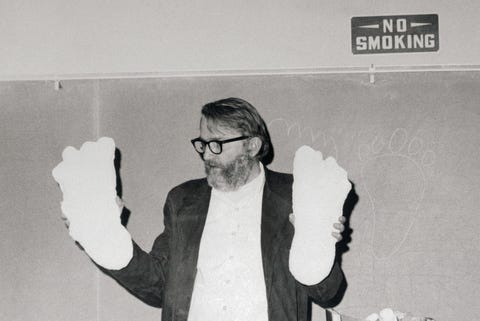
When asked about the possibility of Sasquatch existing, Krantz was always unequivocal, saying that he “guaranteed” it. Family Ties Grover Krantz with casts of footprints supposedly belonging to Sasquatch, 1974. BETTMANNGETTY IMAGES
Krantz’s conviction in Bigfoot didn’t help his academic career, though. Passed over for promotions and nearly missing receiving tenure at Washington State, he knew the only way he would be able to convince his colleagues of this primate’s existence was by producing a body.
So, Krantz was known to spend his nights in the middle of the Pacific Northwest old growth forests with a shotgun quite literally hunting Bigfoot. He rationalized this by saying it was the only way to get the scientific community to believe him and that, technically, it wasn’t against the law.
“It has not yet been established that the Sasquatch exists,” Krantz once wrote. “To pass laws against harming sasquatches presently makes little more sense than protecting unicorns.”
“THE KIND OF REAL PROOF THAT WOULD ACTUALLY MAKE PEOPLE SIT UP AND TAKE NOTICE DOESN’T ACTUALLY EXIST AT THIS POINT."
Krantz died in 2002 as a complex figure in the eyes of the scientific community, highly respected for his work in primate evolution yet mocked for his belief in Bigfoot. However, during Krantz’s life and after it, the search for Bigfoot took on a life of its own. More sightings, films, and books, some from respected researchers, emerged. Bigfoot documentaries captured the public’s imagination. Harry lived with the Hendersons and entertained the masses. Even Jane Goodall, the famed chimpanzee expert, admits that there’s a possibility that a undiscovered large primate may exist in the world.
In 2006, Laura Krantz, at the time an NPR reporter based in D.C., read an article about the quirky anthropologist who shared her last name. “It originally didn’t ring any bells…he just seemed like an eccentric weirdo.
But, then, she saw that he was also from Salt Lake City, like her father’s family—they were related. As Krantz’s grandfather told her at the time, “Oh, yeah. Grover. That was my cousin. He used to come to the family picnics and measure people’s heads with a caliper.” This began Krantz’s own journey into the wilderness in search of Bigfoot, which she documented for her new podcast Wild Thing, which aired its first episode on October 2, 2018.
She acknowledges, much like her cousin Grover, that without a body (or skeleton), it’s hard to convince others that this long-lost primate still exists in North America’s backwoods. “A lot of people who think Bigfoot is out there, they realize…that there’s a lack of evidence,” says Krantz. “The kind of real proof that would actually make people sit up and take notice doesn’t actually exist at this point.”
But the things she’s observed during her research for the podcast has changed her mind about the possibility of Bigfoot.
“I went from ‘Bigfoot is a legend’ to I can’t just say out of hand that Bigfoot never existed or doesn’t exist now,” says Krantz. “I can’t fully dismiss it anymore.”