FASCISTS OF A FEATHER HANG TOGETHER
US Vice President Vance shuns Scholz and meets AfD party leader instead
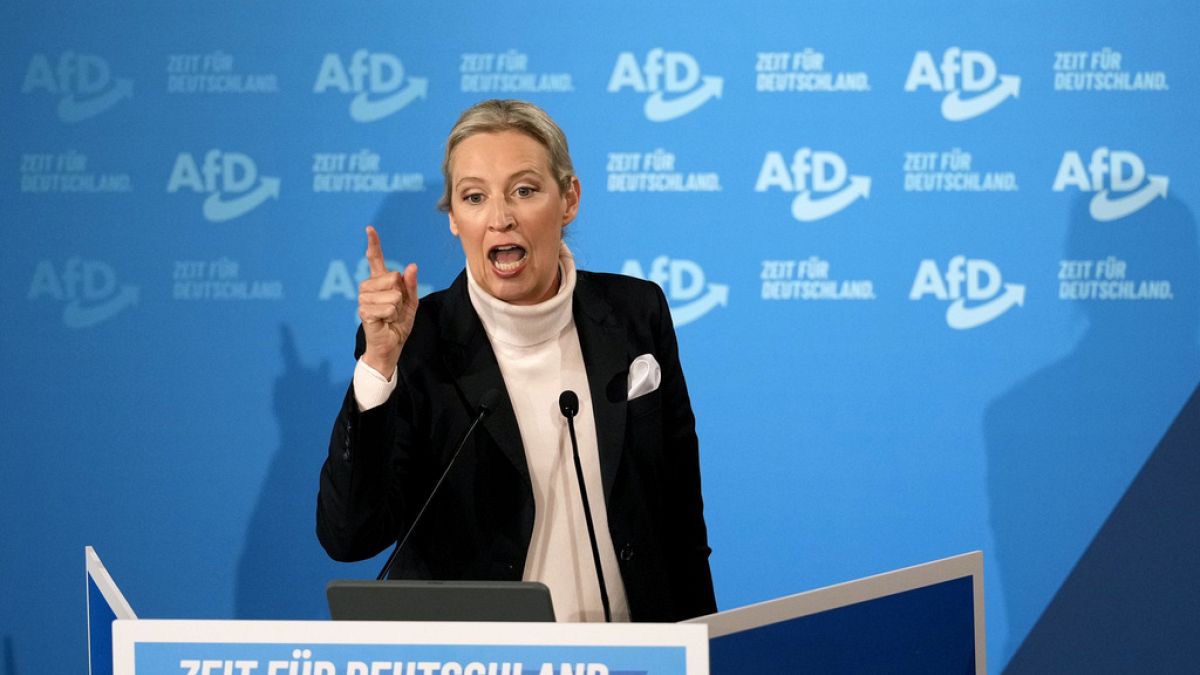
U.S. Vice President shunned Chancellor Scholz whilst in Munich on Friday, preferring to meet AfD party leader Alice Weidel, who is widely regarded as far-right.
U.S. Vice President JD Vance met AfD party leader Alice Weidel during a visit to Munich on Friday, nine days before Germany's election - but pointedly failed to meet with Germany's Chancellor Olaf Scholz.
During his visit he lectured European leaders about the state of democracy and said there is no place for “firewalls."
Mainstream German parties say they won’t work with the AfD party, because they regard it as far-right, as do most political scientists and most of Europe's media. Their stance is often referred to as a “firewall.” Polls put Alternative for Germany, or AfD, in second place going into the Feb. 23 election with about 20% support.
Weidel is the co-leader and candidate for chancellor of the anti-immigrant Alternative for Germany party, his office said.
News of the meeting came after top German officials pushed back hard against Vance's complaints about the state of democracy in Europe, with the defence minister calling it “unacceptable” to draw a parallel with authoritarian governments. He and Chancellor Olaf Scholz defended German mainstream parties' firewall.
Vance said at the Munich Security Conference that he fears free speech is “in retreat” across the continent.
"To many of us on the other side of the Atlantic, it looks more and more like old entrenched interests hiding behind ugly Soviet-era words like misinformation and disinformation, who simply don’t like the idea that somebody with an alternative viewpoint might express a different opinion or, God forbid, vote a different way, or even worse, win an election,” Vance said.

German Defence Minister Boris Pistorius, speaking a couple of hours later, said he couldn't let the speech go without comment.
“If I understood him correctly, he is comparing conditions in parts of Europe with those in authoritarian regimes," Pistorius said. “That is unacceptable, and it is not the Europe and not the democracy in which I live and am currently campaigning.”
Vance also told European leaders that “if you’re running in fear of your own voters, there is nothing America can do for you.” He said no democracy could survive telling millions of voters that their concerns “are invalid or unworthy of even being considered.”
“Democracy rests on the sacred principle that the voice of the people matters," he said. “There’s no room for firewalls.”
Pistorius countered that “every opinion has a voice in this democracy. It makes it possible for partly extremist parties like AfD to campaign completely normally, just like every other party.”
He noted that Weidel was on prime-time German television on Thursday night along with the other contenders.
But he added that “democracy doesn't mean that the loud minority is automatically right," and that “democracy must be able to defend itself against the extremists who want to destroy it.”
Scholz took to social network X to “emphatically reject” Vance's comments.
“Out of the experiences of Nazism, the democratic parties in Germany have a joint consensus — that is the firewall against extreme right-wing parties,” he wrote.
Bavarian governor Markus Söder — a prominent figure in Germany's centre-right opposition bloc, which leads pre-election polls — told reporters that “we take every opinion seriously, but we decide ourselves with whom we form a coalition,” German news agency dpa reported.
Vance's meeting with Weidel came after she was received on Wednesday by Hungary's right-wing nationalist Prime Minister Viktor Orbán. The vice president's office said Vance also met on Friday with German President Frank-Walter Steinmeier and opposition leader Friedrich Merz, while he met Scholz earlier this week when both were in Paris for a summit on artificial intelligence.
Norwegian Prime Minister Jonas Gahr Støre took issue with how Vance urged European officials to stem irregular migration in Friday's speech. Vance said the European electorate didn’t vote to open “floodgates to millions of unvetted immigrants.”
“He speaks as though we are not focused on immigration in Europe,” Gahr Støre said. “I mean, this is the big theme in every country, that we want to have control of our borders.”
He argued that Ukrainian refugees accounted for a significant increase in unvetted immigrants in recent years — and they were accepted “because there is a bloody war going on, which he did not mention, which I think is not really addressing reality.”
“I don’t agree with him that what’s happening in Ukraine, what’s happening in Russia, what’s happening in China is less important than the presumed loss of freedom of speech in Europe,” Gahr Støre said.
EU says Russia is the big threat, but US Vice President Vance disagrees
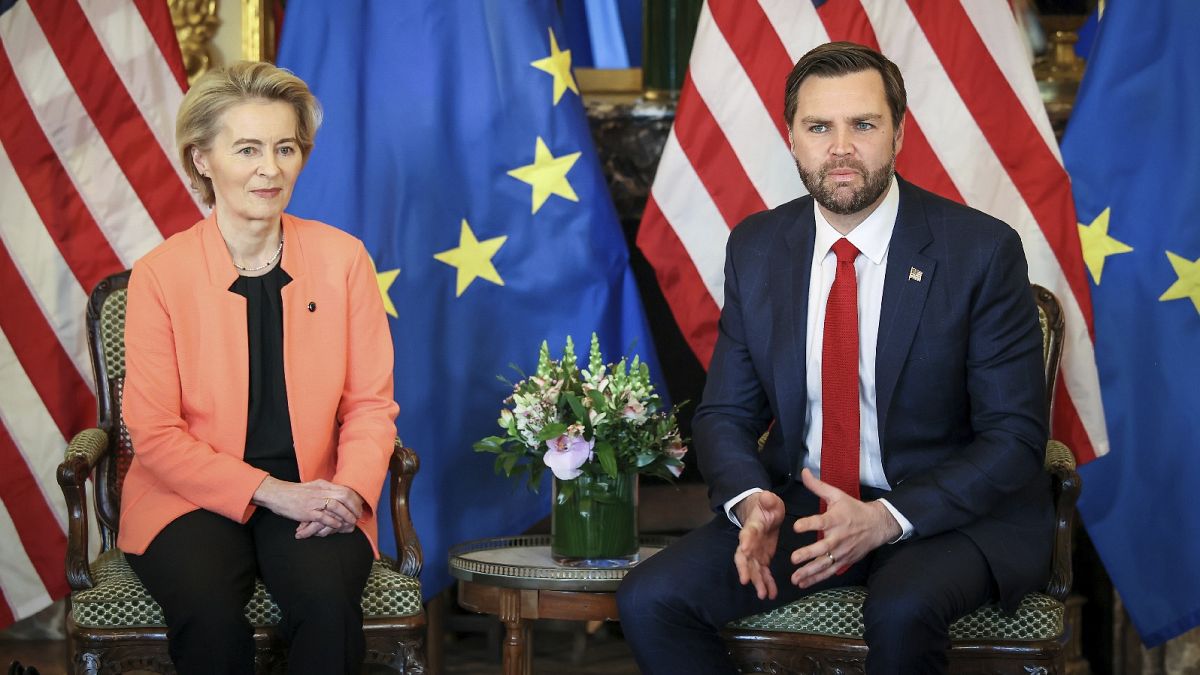
"What I worry about is the threat from within: the retreat of Europe from some of its most fundamental values, values shared with the USA,” JD Vance said.
Ursula von der Leyen and JD Vance on Friday offered wildly different views of the threats ahead with the Commission chief highlighting shared trade and security challenges only for the US vice-president to chide the bloc for a perceived retreat on democratic values.
In her keynote speech, von der Leyen, made a case that Europe is ready to step up to defend its values amidst a quickly-evolving geopolitical landscape and a more transactional approach to global affairs.
Europe, she said, must be “clear-eyed” about “a rogue Russia” seeking to redraw borders and a potential “bipolar conflict between China and the US”, and is already adapting to this new reality by reforming itself to boost its defence and competitiveness.
“We know a stronger Europe is better for all of us. A stronger Europe works with the United States to deter the threats we have in common as partners. And this is why we believe that trade wars and punitive tariffs make no sense,” she said.
Washington announced this week that it would roll out 25% tariffs on all imports of aluminium and steel, including from Europe, and slap reciprocal tariffs on US partners on the basis of “country-by-country” examination.
“We will use our tools to safeguard our economic security and interests,” von der Leyen said, before adding that “of course, we are ready to find agreements that work for all – to work together to make each other more prosperous and more secure.”
She sought to strike a similar conciliatory tone on Ukraine after US President Donald Trump’s announcement that he had had a lengthy phone call with his Russian counterpart and that their “respective teams” would start peace talks “immediately” had alarm bells ringing in European capitals over fears both Ukraine and Europe would be excluded from negotiations.
Von der Leyen, however said, that “it is always instructive to look beyond the words”, that “we need to avoid outrage and outcry”, and that “there are some remarks we can agree on”.
“Because yes, both the EU and the US want an end to the bloodshed. We want a just and lasting peace, one that leads to a sovereign and prosperous Ukraine. And Ukraine should be given solid security guarantees,” she said.
Europe will do its share and bring more to the table, especially through “a surge” in defence spending, the Commission chief said, as repeatedly asked by the US in recent years. She announced that she would propose the activation of the escape clause in the bloc’s fiscal rules to allow member states to “substantially” boost their defence expenditures.
“There is a lot that Europe can do” to meet the moment, she concluded, stressing that Europe’s “values do not change – they are universal".
Yet, it’s Europe’s values that JD Vance attacked minutes after von der Leyen left the podium during his own keynote address.
“The threat that I worry the most about vis-a-vis Europe is not Russia, it's not China, it's not any other external actor. And what I worry about is the threat from within: the retreat of Europe from some of its most fundamental values, values shared with the United States of America,” the US vice-president said.
He cited the Romanian constitutional court’s annulment of the presidential elections’ results over foreign interference concerns, the recent hate crime conviction in Sweden of a man for burning the Quran, the 2024 conviction of a man in the UK for breaching an abortion clinic safe zone to pray, and an EU law that could enable governments to shut down social media in time of social unrest, as evidence Europe is backsliding on democracy.
“Across Europe, free speech, I fear, is in retreat,” he said, accusing the administration of Joe Biden of censoring free speech too.
“It looks more and more like interests hiding behind the ugly Soviet-era words like misinformation and disinformation. They simply don't like the idea that somebody with an alternative viewpoint might express a different opinion or, God forbid, vote a different way or even worse, win an election,” he also said.
He lambasted European politicians who he accused of being “afraid of the voices, the opinions and the conscience that guide your own people”.
“The crisis I believe we all face together is one of our own making. If you're running in fear of your own voters, there is nothing America can do for you,” he said, before seemingly making a link between the growing dissatisfaction with the mainstream European political class with migration, which he views as too high.
He urged the political class in Europe and the US to “not be afraid of our people, even when they express views that disagree with their leadership”.
Ukraine, meanwhile, was mentioned just twice during his address, but he did not address the peace talks Trump announced.


No comments:
Post a Comment