Labor & Capital in Today’s Germany
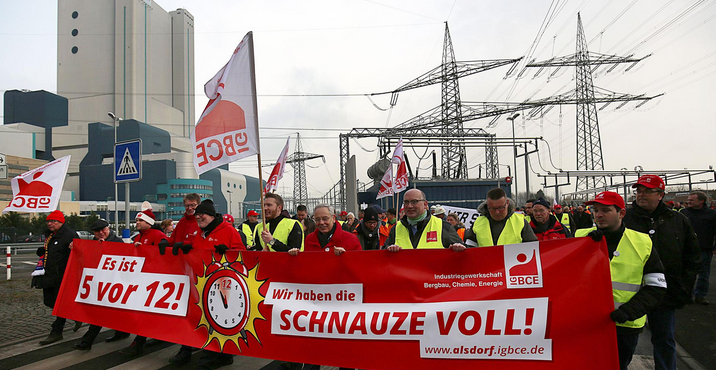
After more than 200-plus years of capitalism and generations of workers confined to authoritarian work regimes, most workers in Germany have learned (read: learned helplessness) – and/or were successfully conditioned – to accept the managerial regime at work.
From pre-schools with a teacher as boss to kindergarten and schools with the same authoritarian structures, virtually everything in society is geared towards a key message that sustains capitalism: there will always be a boss.
To what degree capitalism’s overall message has been accepted by workers, is one of the key findings of a Gallup survey that asked 1,700 workers called “engagement index”. As so often, the survey finds what it was set out to deliver. In general, workers submit themselves to managerial domination.
Meanwhile, many workers aren’t really “enthusiastic” about their work – a rather stable finding during the past decades. Accordingly, the infamous “turnover rate” – that often serves as an indicator on dissatisfaction – has remained almost unchanged for years.
In other words, many workers in Germany remain loyal to their company and they do so for a long time. Yet, such corporate loyalty can quickly turn into a one-way street as many workers – who were all too readily dismissed only a few years ago in the wake of the COVID-19 pandemic – have, rather painfully, experienced.
Interestingly, a whopping 78% of workers in Germany only go to work “to fulfill their duty”. They follow regulations and rules, “I do it by the book” – they do what they are told and no more.
Aligned to this, 13% of all workers have already “quit internally.” Like Zombies, they are at work while being mentally absent, they follow the rules and do what they are told.
Otherwise, they are disengaged, they hardly move or move slowly, they are almost unresponsive, they follow a managerially prescribed routine, they blend in, they are virtually present as bodies but only function at the most minimum level.
For capitalism, businesses, zealous HR-manager, line-supervisors, and the eager enforcers of performance management and KPIs, these are worrisome findings. Modern capitalism demands “fully engaged” workers – not the exact opposite.
In other words, a substantial section of the workforce in Germany is practically absent-minded, lethargic and frustrated. Even more worryingly, the study casts no doubt on this. It is a rather unambiguous finding.
For example, the study measures the commitment of workers by whether they have a good friend in the circle of colleagues – many no longer do.
Since the beginning of the 1990s, workers in Germany have always placed job satisfaction at seven – on a scale of zero to ten – a whopping 30% are dissatisfied with what they do.
A similar survey found that less than half of all workers say that they are satisfied with their work. Unsurprisingly, just about 3% were “completely dissatisfied” with their job.
In other words, many workers in Germany do sit back but are still somewhat satisfied with the work they have been assigned to do.
Of the roughly 5,000 respondents, just thirty (“30”) workers achieved the maximum value of absolute job satisfaction. This 0.60% is a devastating number as 99.4% are not “totally” happy with what they do.
Only 0.60% stated that they were “always enthusiastic” about the work and “never doubted the importance of the job”.
The self-assessment of all respondents on the three work characteristics underlines how uncommitted most workers are to doing their job:
- Close to 90% of workers are still convinced that they “mostly do a good job”.
- Almost 43% are not enthusiastic about their job.
- Only ½ feel “energetic at work”.
The analysis of the survey results also shows that workers with commitment to the job depict a low probability of changing jobs in the next two years. This is neither new nor surprising.
It fits in with the known fact that that turnover in Germany has been fluctuating only very slightly during the last 30 years. From this, one can easily imagine that a significant change of personnel takes place in just about one third of all workplaces.
Yet, an increased level of workers wanting to leave their job should have been found. After all, Germany’s much debated skills shortage and the high demand for skilled labor in recent years, should have told workers that Germany’s labor market offers plenty of options.
Yet, even in Germany’s public administration, the turnover remains low. Similar trends can also be found in Germany’s manufacturing industry, such as the metal and electrical industries, for example.
The relative stable bond that German workers still feel towards the company is also reflected in the duration of the employment relationship.
In 2022, workers in Germany had already been working in their current company for an average of about eleven years. Surprisingly, and this is since 2012, the average length of working for the same company has decreased by just 0.4 years.
For those workers over the age of 50, the average length – in the year 2022 – was still 17 years. In other words, job hopping is not a German virtue.
Meanwhile, one should not forget that – like never before – have so many workers in Germany gone to work with the feeling that they just do their duty, follow the rules, and do what is asked of them.
At the same time, this is spiced up with declining loyalties. The number of “emotionally highly bonded” workers is falling rapidly, reaching only “single digits”.
Simultaneously, a whopping half of all workers (50%) no longer want to be with their current employer – in one year’s time. And, just about a third (34%) want to stay no longer than another three years (it was at 65% in 2018).
Worse, only 34% (a 1/3) of all workers have confidence in their employer’s financial future. And confidence in management has dropped by 20%. Perhaps mismanagement is ripe.
Perhaps, many German managers might still do “something” about demotivation, but way not enough to motivate workers. The result is that many workers just do their job according to “the rules”.
Beyond all that, the current economic crisis in Germany is also affecting the outlook of workers. Simultaneously, attachment to a company, loyalty to the boss, and trust in the financial future of a company have all fallen significantly.
For the first time since 2001, the question of a high significant attachment to a company is in the single-digit range – 9% in 2023 compared to 14% in 2001.
Remarkably, the number of “internal or quiet quitters” – the aforementioned Zombies – has reached worrying levels. With 78% of all workers only “working by the book”, never before had Germany seen so many workers in a category that might be described as: “I have switched off”.
Meanwhile, 78% of workers said they have low attachments to work. They tend to “work according to the rules”. This phenomenon has reached historic heights.
At the same time, just 9% of all workers in Germany experience a work environment characterized by “good managerial leadership”. This is interesting in two respects:
- a change by just one percentage corresponds to over 390,000 workers – these are very serious numbers; and, secondly,
- one wonders why just 9% of all German workers see their managerial “leadership” as good when “leadership” has been pushed by CEOs, business schools – including, rafts of professors – the business press, by think tanks, management consultancies, hundreds of academic articles and endless business conferences?
Perhaps not unrelated to bad management, the “internal/quiet quitter” phenomenon is ripe. This has an impact not only on companies, but also on Germany’s economy. The costs incurred as a result of “productivity losses” (read: lost profits) amounts to a total of somewhere between €113bn and €135bn billion for 2024 – roughly $145bn.
In the midst of economic uncertainties sparked by:
- the Russian war against the Ukraine,
- the high cost of energy,
- the notes shortage of skilled workers,
- Trump’s daily tariff escapades,
- the much-debated labor market shortage, and
- transformational issues like the move towards a sustainable economy that moves human survival during global warming, at least, into the vicinity of being possible,
Managerial leadership in Germany remains highly dysfunctional as reflected in the survey. In short, Germany’s corporate bosses and management leaders have continuously failed to create a motivating organizational culture that leads to high loyalty, increases performance and competitiveness. In other words, the acclaimed managerial “leader” has gone AWOL – absent without leave.
With management gone AWOL, the loyalty of German workers to companies has further decreased. Only half of all respondents (50%, in the previous year it was still: 53%) intend to be with their current employer in one year’s time. Since 2018, this has continuously gone down by a whopping 28%: in 2018, it was at 78% and today, it is 50%.
In short, bad management and a weak attachment contribute to the willingness to change jobs. Despite the bad news on Germany’s economy in recent months, workers seem to assess their chances on the labor market rather positively.
Most certainly, this has to do with the noted shortage of skilled workers that is debated on an almost daily basis. Not unconnected, a third (33%) of all workers have been offered a job by a headhunter in the last twelve months. In the previous year, the figure was just 25%.
At the same time, trust in companies and managers is declining as well as job satisfaction. This happens in the face of a challenging economic environment.
For many workers, there is an increasing lack of confidence in the financial future of their current employer. This serves as an indicator of the economic mood in Germany. Many workers notice whether their company, for example, is winning orders, investing or tendering for new jobs.
In 2019, 49% of all workers in Germany still trusted their managers. This fell to 41% in 2022. It has now fallen by another 20% – to just 21%. In other words, only 1 in 5 workers in Germany still trust their management.
Overall, the survey paints a rather problematic picture of capital and businesses in Germany, today. On the other side, German workers are increasingly dissatisfied with work. And, they are disengaged. Workers simply “switch off” while being physically present at work.
Meanwhile, workers also see that management has failed them – despite the hype about managerial leadership in the past years. While still sticking to their jobs, the willingness to leave is increasing, at least for those workers in areas where the skill shortage is most severe. Add Germany’s demographic changes, the aging society to the mix, and some workers might get closer to balancing the prevailing power asymmetry that defines work in Germany.
DonateEmail


No comments:
Post a Comment