‘Disgraceful Act of Complicity’: Indian Left Denounces Modi’s Israel Visit
“Modi’s embrace of Zionist Israel amidst its relentless genocidal assault on Palestine is a betrayal of India’s anti-colonial legacy,” said one leftist leader.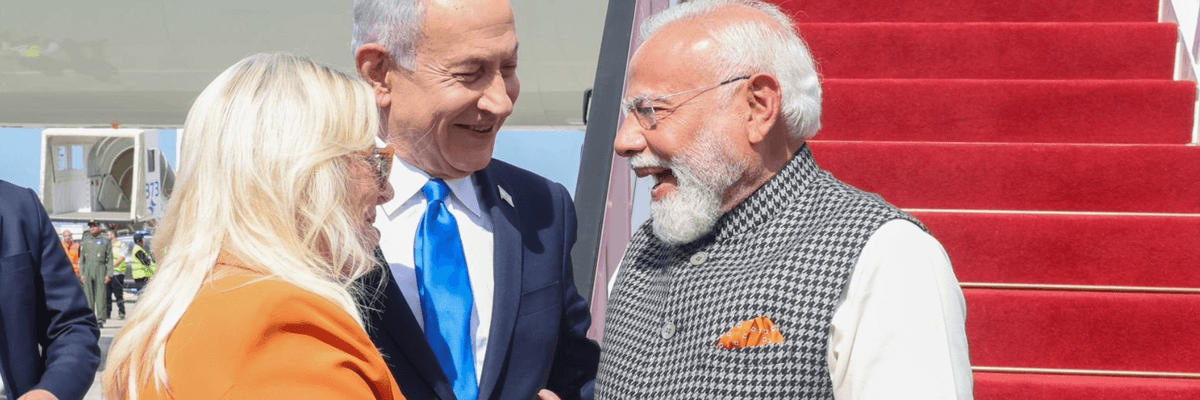
Israeli Prime Minister Benjamin Netanyahu and his wife Sara Netanyahu greet Indian Prime Minister Narendra Modi at Ben Gurion International Airport near Los, Israel on February 25, 2026.
(Photo by Indian Prime Minister’s Office)
Brett Wilkins
Feb 25, 2026
COMMON DREAMS
Indian Prime Minister Narendra Modi’s arrival in Israel on Wednesday sparked widespread condemnation among his country’s leftists, many of whom accused the Hindu nationalist leader of complicity in Israel’s annihilation of Gaza.
Modi was warmly welcomed at Ben-Gurion International Airport by Israeli Prime Minister Benjamin Netanyahu and his wife Sara to kick off a two-day state visit that is expected to focus on issues including military cooperation and arms sales, as Indian purchases of Israeli weaponry have increased exponentially in recent years.
The Indian leader was also joyously greeted at his place of accommodation, the King David Hotel, where in 1946 Jewish militants seeking independence from British occupation carried out a bombing that killed 91 people, including at least 15 Jews.
Modi addressed the Israeli Knesset, or Parliament, lamenting the Hamas-led attack of October 7, 2023 in which 1,195 Israelis and others were killed and 251 abducted. But he said nothing about the more than 250,000 Palestinians killed or wounded by Israel’s genocidal retaliation.
He did say that “no cause can justify the murder of civilians.” But he was talking about Israeli, not Palestinian, civilians.
“Modi endorsed the brutal killing of 71,000 innocent Palestinians from reckless Israeli bombing,” Calcutta-based journalist Seema Sengupta said on social media in response to the Knesset speech. “The death on both sides should’ve been mourned by him. Instead, he sounded like a partisan leader of a party which gained prominence through disharmony, violence, and bloodshed.”
The Communist Party of India-Marxist (CPI-M)—which leads the ruling Left Democratic Front that currently heads the Kerala state government—said it “strongly opposes” Modi’s visit, which it called “a betrayal of the Palestinian cause” that “legitimizes the murderous Netanyahu regime.”
“The visit comes at a juncture when Israel has been waging a genocidal war in Gaza,” the party continued. “Despite a ceasefire, there are daily violations by Israel which conducts strikes killing scores of Palestinians. In the occupied West Bank, there are stepped up attacks on Palestinians and a spurt in illegal settlements.”
“The declared intent of the visit is also to deepen strategic, military, and economic ties with a Zionist expansionist regime which seeks to dominate the region with the help of the United States,” CPI-M added. “The visit is all the more inopportune because it is taking place at a time when the United States is preparing to attack Iran militarily at the instigation of Israel.”
CPI-M General Secretary M A Baby said that “Modi’s embrace of Zionist Israel amidst its relentless genocidal assault on Palestine is a betrayal of India’s anti-colonial legacy.”
The Communist Party of India (Marxist-Leninist) Liberation, whose stronghold is in the eastern state of Bihar, said that it “condemns Prime Minister Narendra Modi’s visit to Israel as a disgraceful act of complicity in the ongoing genocidal assault on the Palestinian people.”
“At a time when Palestinian civilians are being massacred, displaced, and starved under a brutal Israeli occupation, this visit amounts to political endorsement and profiteering on Palestinian blood,” CPI (ML) Liberation continued. “After mortgaging India’s sovereignty and strategic autonomy to [US President Donald] Trump’s racist agenda, Modi is now completely surrendering India’s historic legacy of anti-colonialism and solidarity with the oppressed by visiting Israel.”
“Since assuming office in 2014, the Modi regime has systematically imported Israeli models of repression to consolidate its own politics of hate at home,” the party added. “From bulldozer demolitions and collective punishment tactics against minorities and marginalized, to the expansion of illegal surveillance infrastructures, the [Bharatiya Janata Party]'s fascist politics has found a role model in Israel.”
Israel and India have deepened ties since Modi and the BJP were elected over a decade ago. Both Modi and Netanyahu are right-wing nationalists who utilize religious supremacism to exclude or marginalize Muslims, and both have been accused of increasing authoritarianism, just like their common ally Trump.
Center-leftists including members of the opposition Indian National Congress—which has been criticized for its “pragmatic” engagement with Israel—also condemned Modi’s visit.
Left-leaning members of Indian civil society and academia also decried the visit.
Rebuffing Modi’s claim that this week’s shirtless anti-BJP demonstrations by members of the Indian Youth Congress were an embarrassment for the nation, Delhi School of Economics professor Nandini Sundar said on social media that visiting “genocide-committing Israel has embarrassed and shamed Indians more than a 1,000 shirtless protests.”
The activist group Indian People in Solidarity With Palestine and the India chapter of the Boycott, Divestment, and Sanctions (BDS) movement issued a joint statement accusing the “fascist BJP government” of working “hands-in-gloves with genocidal Israel” to “suppress voices of dissent while maintaining a facade of being democratic.”
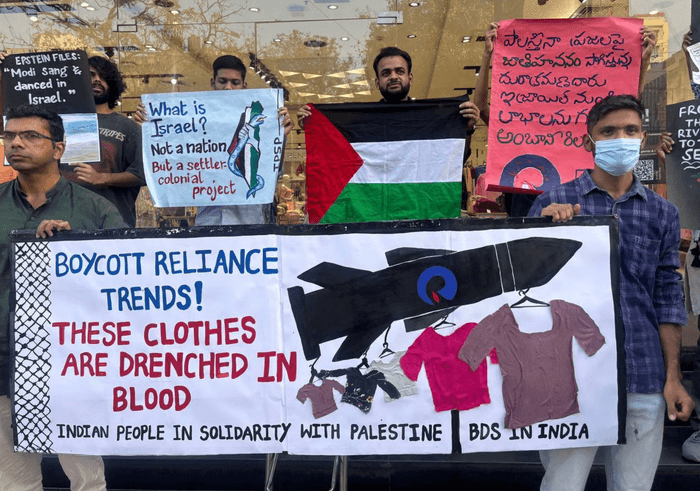
“At a time when the ceasefire is being used as an excuse to bomb and vaporize Palestinians and occupy Gaza,” the groups said, “the Indian government is choosing to stand with genocidal Israel and its imperialist masters like America and is working overtime to benefit the corporations from the occupation of Palestine.”
Update: This article has been updated with additional remarks from Modi.
India’s Modi addresses Israeli Parliament, deal negotiations ongoing
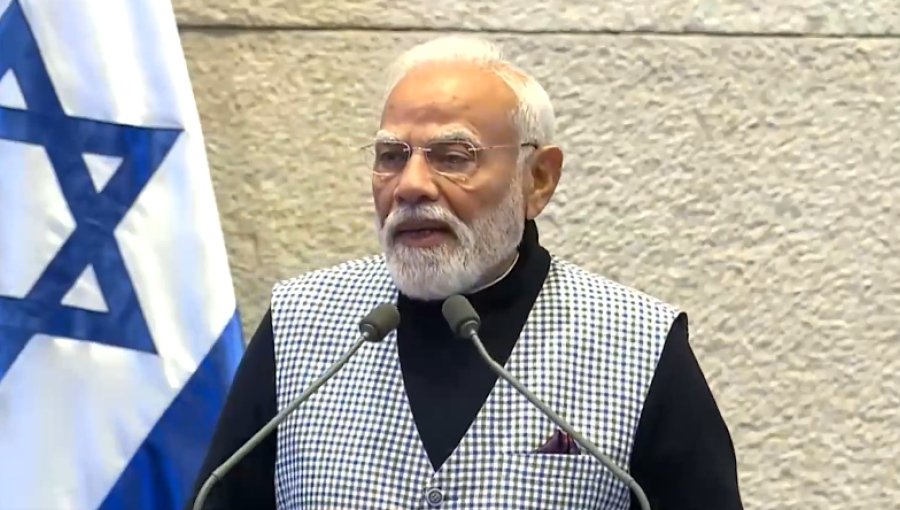
On the first day of his two day visit to Israel Indian Prime Minister Narendra Modi addressed the Israeli parliament, the Knesset in Jerusalem, according to a report by All India Radio.
During the address Modi condoled the loss of life and terrorism perpetrated by the terrorist group Hamas on October 7 2023 in Israel. He drew parallels to India’s own experience of being attacked by terrorists during the November 26 2008 attacks in Mumbai which led to the death of 160 people including civilians, law enforcement and security forces and armed forces personnel.
Some of the civilians killed during the Mumbai attack were also Jewish and Israeli nationals. India subsequently established that the Mumbai attacks were perpetrated by terrorist groups backed, funded and operationally overseen by Pakistan’s military and intelligence agencies.
Modi also revealed that his exact day of birth coincided with the day India officially recognised the state of Israel on September 17 1950.
According to a report by The Times of India, Modi was also honoured with the Speaker of the Knesset Medal and became its first awardee.
Preceding the address to the Israeli parliament the Indian leader was received at the airport by Israeli Prime Minister Benjamin Netanyahu and his spouse. Modi also had a meeting and conversation with Netanyahu and later visited a technology and innovation exhibition with him, with both Israeli and Indian products featured.
The visit to the exhibition included visuals of Modi and Netanyahu posing with a Royal Enfield Motorcycle - the product of a world recognised Indian motorcycle brand Eicher Motors (NSE: EICHERMOT).
While Modi has been in Israel, a delegation of Israeli officials is purportedly negotiating the specifics of a Free Trade Agreement with the Indian side in New Delhi, in parallel according to another report by All India Radio.
An agreement will be a headline maker when confirmed, and may sit beside a list of agreements and memoranda signed between Tel Aviv and New Delhi as Modi’s visit concludes. Defence is also a major pillar of the visit and diplomatic engagement that is underway between India and Israel.
While specific and confirmed cues are not forthcoming from either the Israeli defence establishment or its Indian counterpart. It is likely that India is seeking components for its future nationwide air defence shield dubbed the “Sudarshan Chakra” programme which is conceived to be a multi stage and multi layer system with several components of different origin, range and role.
Possible acquisitions could include jointly developed versions of air defence and precision strike weapons and platforms such as ballistic missile interception capable air defence systems IAI industries’s Arrow and Rafael Advanced Defense Systems’s David’s Sling and shorter ranged Elbit systems’s (TASE:ESLT, NASDAQ:ESLT) Iron Dome and Iron Beam.
Unmanned Aerial Vehicles(UAV)s may also be explored as Israel and IAI industries has been a traditional vendor to India’s military for UAVs which India has successfully used in combat operations. However none of these deals or likelihood of these systems being under discussion has been referred to by any official sources.
Be it coincidental or by design, India has also been negotiating an FTA with the Gulf Cooperation Council (GCC) which can be seen as a hedge strategy for the broader West Asia region in India’s complex foreign policy web.
India has always taken a neutral stance on the Arab-Israeli conflict and has advocated for a peaceful resolution of all conflicts in the region through dialogue and diplomacy as it has strategic ties to both Israel and Arab states that affect its own national interest directly across defence, food, mobility, diaspora and energy security.
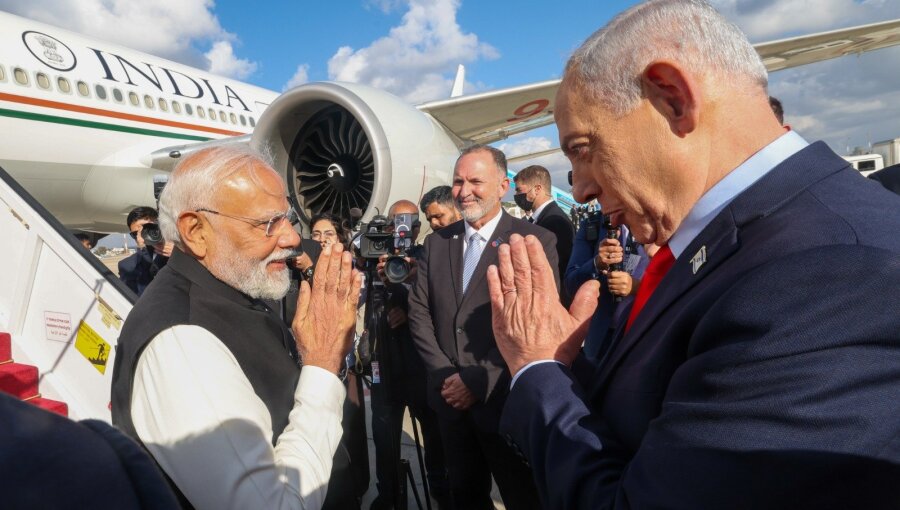
Indian Prime Minister Narendra Modi ended the second and final of his state visit to Israel on February 26, 2026, according to a report by All India Radio.
During his visit a delegation of Israeli officials was in New Delhi negotiating a Free Trade Agreement (FTA) in parallel with their Indian counterparts headed by India’s Minister of Commerce and Industry Piyush Goyal.
The round of FTA negotiations were positive but didn’t conclude with the agreement as was widely expected, and instead a second round of negotiations has been scheduled for May 2026. It is unclear what issues or obstructions remain in concluding the agreement, or if the issues are regulatory or legislative that need to be resolved first before any preferential trade access to either side can be granted by the other.
According to the official website of the Indian prime minister, Modi delivered a joint statement to the press alongside Israeli Prime Minister Benjamin Netanyahu, continuing his comments on terrorism being unacceptable in any form, expressions and manifestations including cross border terrorism which was unequivocally supported by the Israeli side.
The summit’s official outcomes have been listed as 16 agreements across domains such as emerging technologies, cyber, agriculture, water management, health, entrepreneurship, mobility, defence and security. One of these agreements is an MoU between India’s NPCI International (NIPL) and Israel’s MASAV on implementation of India’s Unified Payments Interface (UPI) digital payments system in Israel.
Modi made a reference to being informed that the agreement will now lead the way in enabling UPI to be functional in Israel. The goal behind the agreement is to enable seamless remittances between Israeli and Indian nationals, companies and entities via an instant and well regulated digital mechanism.
UPI is a fully sovereign technology as part of India’s digital public infrastructure and doesn’t rely on any third party services like SWIFT. While SWIFT is the ubiquitous standard for cross border digital payments, the exclusion of Russian financial institutions from it after the 2022 invasion of Ukraine has established a precedent.
States with a high sense of sovereign fiscal patterns in international trade seek to develop or adopt alternatives which can’t be cut off depending on the political and alignment calculations of third parties at any time.
While defence agreements were also expected as the two countries have a burgeoning security relationship and shared cross border threats, nothing substantive on the procurement of new platforms or systems was announced during or in conjunction to the visit.

No comments:
Post a Comment