Thursday, December 01, 2022

HUNTING HUMANS
Israeli forces kill 2 Palestinians in occupied West Bank during raid on Jenin


The Palestinian Health Ministry identified the men as Naeem Jamal Zubaidi, 27, and Mohammad Ayman Saadi, 26 and said they were killed in the Jenin refugee 


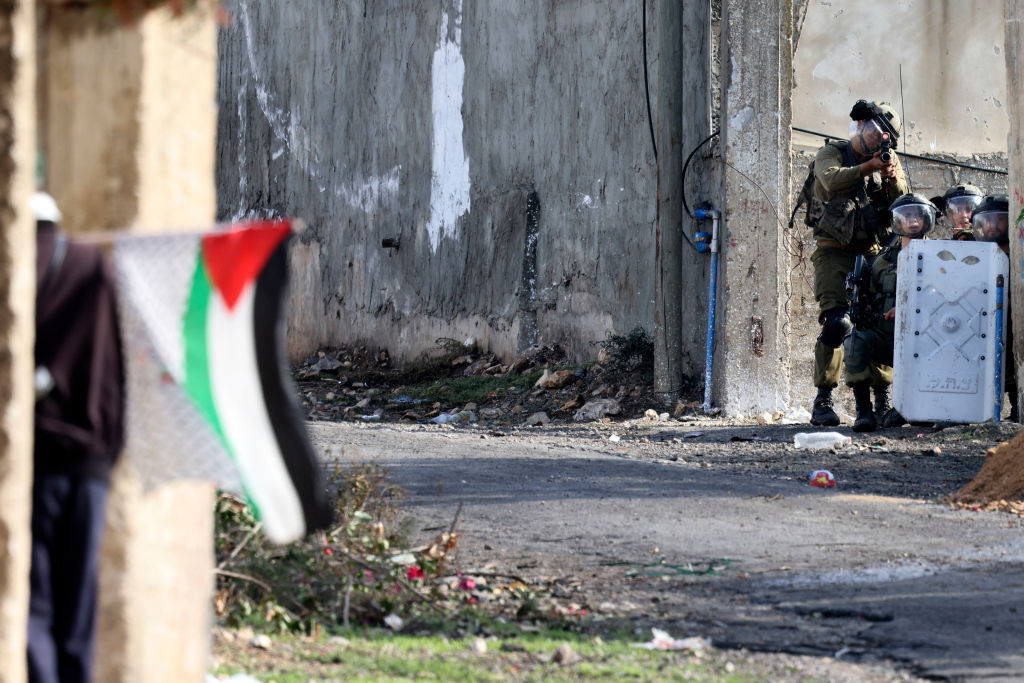
Palestinian demonstrators confront Israeli forces following a protest against the expropriation of Palestinian land by Israel, in the village of Kfar Qaddum in the occupied West Bank, near the Israeli settlement of Kedumim, on 25 November 2022. [Getty]

Israeli forces killed two Palestinian fighters during an arrest raid Thursday in the occupied West Bank, according to the military and the Islamic Jihad militant group.

The Palestinian Health Ministry identified the men as Naeem Jamal Zubaidi, 27, and Mohammad Ayman Saadi, 26 and said they were killed in the Jenin refugee camp.

The Israeli military claimed Saadi was a prominent member of the Islamic Jihad group while Zubaidi was involved in shooting attacks against Israeli troops. Islamic Jihad said the two men were members.

The military also claimed troops were carrying out an arrest raid and were met by gunfire. The forces responded, and the two men were killed in the exchange of fire.

RELATED
MENA
Qassam Muaddi

Israeli attacks on the Islamic Jihad have intensified in recent months, including in the Gaza Strip, where a two-day war by Israel erupted in the summer, killing dozens of Palestinians. The group has a significant presence in Jenin where the Palestinian security forces have less of a foothold, making the area, in the northern occupied West Bank, a focus of Israeli military operations in recent months.

The military has been conducting months of arrest raids that have killed more than 100 Palestinians in the occupied West Bank, which in turn prompted a spate of Palestinian attacks against Israelis in the spring that killed 19. The Israeli military claims the raids were meant to dismantle militant networks and thwart future attacks, but the Palestinians say they entrench Israel's open-ended occupation and undermine their own security forces.

The raids have ratcheted up tensions between Israelis and Palestinians, triggering another wave of Palestinian attacks in recent weeks that have killed an additional nine people.

More than 200 Palestinians have been killed by Israel this year, making 2022 the deadliest since 2006.
Between Assad’s regime and an apathetic world: Syrians are treated like disposable pawns

Voices
Sam Hamad
28 Nov, 2022

Recent airstrikes in Syria by Russia, Israel and Turkey have not received adequate global attention. Syrians are paying with their lives as each power fights for its particular interests. Silence only adds to this tragedy, writes Sam Hamad


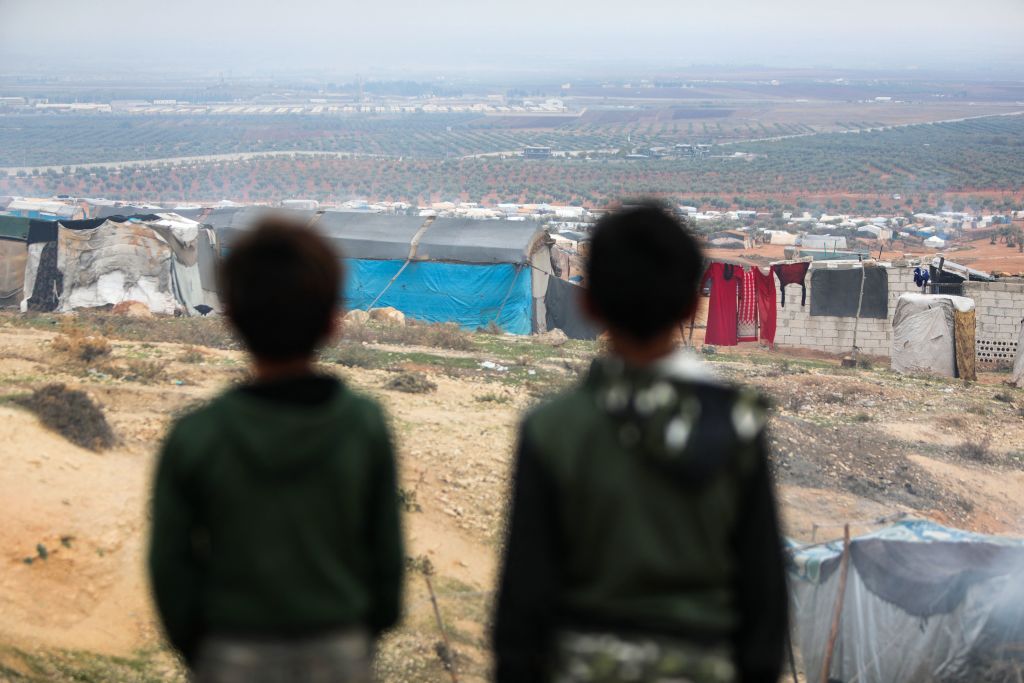
Thirteen million Syrians, over half the pre-war population, have been forcibly displaced, around 7 million of which have been cleansed from the country indefinitely, writes Sam Hamad.
[GETTY]


Over the course of a few days last week, Russia, Turkey and Israel all carried out airstrikes in different parts of Syria. The manner of such strikes, specifically their proximity to one another and the cavernous silence over them globally, speaks to the fact that Syria essentially no longer exists as a sovereign state.

Of course, there is a bitter irony to all this. When Assad first began what would become a genocidal war against the Syrians who rose up against his dynastic regime, he did so under the pretence that ‘sovereignty’ is what he was defending. Assad claimed, as did Ben Ali, Mubarak, Gaddafi, Saleh and all of the other tyrants put in jeopardy by their own people during the Arab spring, that the revolution against him was a foreign conspiracy.

The narrative went that the revolutionaries, long before they were forced to pick up a gun, were foreign conspirators, agents of America, Zionists, etc.

''Syrians are living in a prison – domestically, they are policed ruthlessly by Assad, Iran and Russia, or are trapped in Idlib, surrounded by hostility and living under the dark cloud of Assad’s will to conquer them or, if you’re a Kurd in the northeast, invasion by Turkey. All of this within the context of the richest nations on earth, namely those in the Western world, turning their backs on refugees from Syria.''

By such a logic, if the revolution has been defeated, and it effectively has, it stands to reason that Assad’s Syria ought to be enjoying a golden era of renewed sovereignty? The opposite is true however. The Syria that exists today, the one cited without contradiction or nuance by most of the global media, is not the Syria that existed antebellum.

This is not a case of monomaniacal pedantry, but rather a vital point of understanding.

Much of Syria’s ancient and beautiful cities have been reduced to rubble, particularly civilian neighbourhoods. The Idlib province remains under the tenuous control of the last remaining rebel forces, formally protected by Turkey and the mostly Kurdish-majority areas of the Northeast remain under the control of the Syrian Kurdish Democratic Union Party (PYD), protected by the US.

Even in the allegedly ‘triumphant’ part of Syria, the reality is one of a kleptocratic rump state formally ruled over by Assad but under the control of Iran and Russia. Contrary to Assad’s propagandistic invective, the rump Syria that has emerged from his war is one where the interests of the Syrian people are entirely non-existent.

Syrians are living in a prison – domestically, they are policed ruthlessly by Assad, Iran and Russia, or are trapped in Idlib, surrounded by hostility and living under the dark cloud of Assad’s will to conquer them or, if you’re a Kurd in the northeast, invasion by Turkey.

All of this within the context of the richest nations on earth, namely those in the Western world, turning their backs on refugees from Syria.

RELATED 
Perspectives 
Joseph Daher

Syria might have slipped out of the news agenda, but the situation there is still of global importance; hence why these powers still invest resources in keeping Syria under this invisible noose.

The first of the strikes last week came as Israel struck the Assad regime’s so-called heartland, hitting Latakia, Hama and Homs – at least four regime-allied soldiers were killed, while the target was the moving of advanced weaponry by the Iranian occupation forces to its proxies in Hezbollah. This is what Syria has been reduced to – Israel, which couldn’t care less about the interests of Syrians and acts to maintain its own oppression of Palestinians, bombing Iran, which is an oppressor in Syria, all within Syrian territory.

The next airstrikes came a day later. The target this time was PYD positions in the northeast and the perpetrator was Turkey, with the PYD retaliating and killing two Turkish civilians in border towns. Whatever one thinks of the PYD, Turkey’s stated intent and increasingly belligerent rhetoric indicate that it plans an invasion of northeast Syria, to seize Kurdish areas and resettle at least 1 million Syrian refugees there.

Though Turkey would argue otherwise, this plan is entirely conditioned by self-interest amidst growing racist hostility towards its Syrian refugees and the hope that Turkey can look towards normalisation with Assad. There is nothing progressive here. Resettling one set of Syrian victims at the expense of another set of Syrian victims, namely the Kurds of the northeast, is an act worthy of the worst of the old empires.

RELATED
In Brief
Adele Walton

Later that day and in the early hours of the morning, in what is the most common of occurrences in Syria, Russian warplanes, as well as rockets loaded with illegal cluster munitions fired from areas of Assad’s rump state, bombed Idlib, targeting refugee camps near the border with Turkey. At least 2 civilians were killed.

Russian policy in bombing Syria seems to serve the interrelated purposes of preparing Idlib for a potential conquest by Assad and Iran’s ground forces, as well as keeping the province in a state of near constant terror and chaos. Much like Israel’s policy of ‘mowing the grass’ in Gaza, whenever Idlib settles into a sense of normalcy, Russia must remind its millions of residents that none of them are safe and their lives are disposable.

In none of these situations do Syrian voices, experiences or lives even feature. The country has, effectively, ceased to exist – what remains now, is simply the competing interests of big powers and their will to treat Syrians as pawns or cannon fodder in the fulfilment of such interests.

What has occurred in Syria is a neo-imperialist carve up of the country. Beneath its steel skies and fortified borders, under the patronage of foreign and domestic tyrants serving foreign powers, Syrians might as well not exist. This is what Bashar al-Assad and an indifferent world have brought them.
 

Sam Hamad is a writer and History PhD candidate at the University of Glasgow focusing on totalitarian ideologies.
The_NewArab.
More than 80 injured as Indian police clash with Adani port protesters

Published: 28 Nov 2022


Police officers examine a vehicle that was damaged during a clash with protesters at a police station near the proposed Vizhinjam Port in the southern state of Kerala, India, November 28, 2022. REUTERS/Stringer

Kochi: More than 80 people were wounded in southern India as villagers halting the construction of a $900m port clashed with police, the latest escalation of a months-old protest waged by a mostly Christian fishing community against Asia's richest man.

The protests are a major headache for Gautam Adani's $23bn ports-and-logistics company which has been forced to stop work on the Vizhinjam seaport that is seen winning business from rivals in Dubai, Singapore and Sri Lanka.

Construction, however, has been halted for more than three months after villagers blocked the entrance of the site, blaming the port of causing coastal erosion and depriving them of their livelihoods.

Over the weekend, police arrested several protesters after they blocked Adani's construction vehicles from entering the port, despite a court order for work to resume.

The arrests prompted hundreds of protesters, led by Roman Catholic priests, to march on the police station, clash with personnel and damage vehicles there, according to police documents and footage on local television.

Senior local police official M R Ajith Kumar told Reuters 36 officers were wounded in the clashes. Joseph Johnson, one of the protest leaders, said at least 46 protesters were also hurt.

Located on the southern tip of India, the port seeks to plug into lucrative East-West trade routes, adding to the global reach of the business led by billionaire Adani, estimated by Forbes to be the world's third richest man.

Asked about the latest protest, the Adani Group did not immediately comment. The company has said that the port complies with all laws and cited studies that show it is not linked to shoreline erosion. The state government has also said that any erosion was due to natural causes.

The protests have continued despite repeated orders by the Kerala state's top court to allow construction to start. Police have largely been unwilling to take any action, fearful that doing so will set off social and religious tensions.

In the latest clashes, police documents said the protesters "came with lethal weapons and barged into the station and held the police hostage, threatening that if people in custody were not released they would set the station on fire." Eugine H. Pereira, the vicar general of the archdiocese and a protest leader, said the police pelted the protesters with stones.

The port protests recall the backlash Adani faced in Australia over his Carmichael coal mine. There, activists concerned about carbon emissions and damage to the Great Barrier Reef forced Adani to downsize production targets and delayed the mine's first coal shipment by six years.
WHO renames monkeypox as mpox, cites racism concerns


This image shows a colorized transmission electron micrograph of monkeypox particles (red) found within an infected cell (blue), cultured in the laboratory that was captured and color-enhanced at the National Institute of Allergy and Infectious Diseases 
(Niaid) Integrated Research Facility in Fort Detrick, Maryland. NIAID FILE IMAGE VIA AP

LONDON: The World Health Organization (WHO) has renamed monkeypox as mpox, citing concerns the original name of the decades-old animal disease could be construed as discriminatory and racist.

The United Nations health agency said in a statement on Monday that mpox was its new preferred name for monkeypox, saying that both monkeypox and mpox would be used for the next year while the old name is phased out.

The WHO said it was concerned by the "racist and stigmatizing language" that arose after monkeypox spread to more than 100 countries. It said numerous individuals and countries asked the organization "to propose a way forward to change the name."


In August, the agency began consulting experts about renaming the disease, shortly after it declared monkeypox's spread to be a global emergency.

To date, there have been more than 80,000 cases identified in dozens of countries that had not previously reported the smallpox-related disease. Until May, monkeypox, a disease that is thought to originate in animals, was not known to trigger large outbreaks beyond central and west Africa.

Outside of Africa, nearly all cases have been in gay, bisexual or other men who have sex with men. Scientists believe monkeypox triggered outbreaks in Western countries after spreading via sex at two raves in Belgium and Spain. Vaccination efforts in rich countries, along with targeted control interventions, have mostly brought the disease under control after it peaked in the summer.

In Africa, the disease mainly affects people in contact with infected animals, such as rodents and squirrels. The majority of monkeypox-related deaths have been in Africa, where there have been almost no vaccines available.

US health officials have warned it may be impossible to eliminate the disease there, warning it could be a continuing threat mainly for gay and bisexual men for years to come.

Mpox was first named monkeypox in 1958 when research monkeys in Denmark were observed to have a "pox-like" disease, although they are not thought to be the disease's animal reservoir.

Although the WHO has named numerous new diseases shortly after they emerged, including Severe Acute Respiratory Syndrome, or SARS, and Covid-19, this appears to be the first time the agency has attempted to rechristen a disease decades after it was first named.

Numerous other diseases, including Japanese encephalitis, German measles, Marburg virus and Middle Eastern Respiratory Syndrome have been named after geographic regions, which could now be considered prejudicial. The WHO has not suggested changing any of those names.
San Francisco considers allowing law enforcement robots to use lethal force

November 28, 2022
Heard on All Things Considered

ARI SHAPIRO

BRIANNA SCOTT


Law enforcement has used robots to investigate suspicious packages. Now, the San Francisco Board of Supervisors is considering a policy proposal that would allow SFPD's robots to use deadly force against a suspect.
Joe Raedle/Getty Images

Should robots working alongside law enforcement be used to deploy deadly force?

The San Francisco Board of Supervisors is weighing that question this week as they consider a policy proposal that would allow the San Francisco Police Department (SFPD) to use robots as a deadly force against a suspect.

A new California law became effective this year that requires every municipality in the state to list and define the authorized uses of all military-grade equipment in their local law enforcement agencies.

The original draft of SFPD's policy was silent on the matter of robots.

Aaron Peskin, a member of the city's Board of Supervisors, added a line to SFPD's original draft policy that stated, "Robots shall not be used as a Use of Force against any person."

The SFPD crossed out that sentence with a red line and returned the draft.

Their altered proposal outlines that "robots will only be used as a deadly force option when risk of loss of life to members of the public or officers are imminent and outweigh any other force option available to the SFPD."

The SFPD currently has 12 functioning robots. They are remote controlled and typically used to gain situational awareness and survey specific areas officers may not be able to reach. They are also used to investigate and defuse potential bombs, or aide in hostage negotiations.

Peskin says much of the military-grade equipment sold to cities for police departments to use was issued by the federal government, but there's not a lot of regulation surrounding how robots are to be used. "It would be lovely if the federal government had instructions or guidance. Meanwhile, we are doing our best to get up to speed."


Some leading robot makers are pledging not to weaponize them


The idea of robots being legally allowed to kill has garnered some controversy. In October, a number of robotics companies – including Hyundai's Boston Dynamics – signed an open letter, saying that general purpose robots should not be weaponized.

Ryan Calo is a law and information science professor at the University of Washington and also studies robotics. He says he's long been concerned about the increasing militarization of police forces, but that police units across the country might be attracted to utilizing robots because "it permits officers to incapacitate a dangerous individual without putting themselves in harm's way."

Robots could also keep suspects safe too, Calo points out. When officers use lethal force at their own discretion, often the justification is that the officer felt unsafe and perceived a threat. But he notes, "you send robots into a situation and there just isn't any reason to use lethal force because no one is actually endangered."
Sponsor Message


The first time a robot was reported being used by law enforcement as a deadly force in the United States was in 2016 when the Dallas Police Department used a bomb-disposal robot armed with an explosive device to kill a suspect who had shot and killed five police officers.


THE TWO-WAY
Bomb Robots: What Makes Killing In Dallas Different And What Happens Next?


In a statement to technology news site The Verge, SFPD Officer Eve Laokwansathitaya said "SFPD does not have any sort of specific plan in place as the unusually dangerous or spontaneous operations where SFPD's need to deliver deadly force via robot would be a rare and exceptional circumstance."

Paul Scharre is author of the book Army Of None: Autonomous Weapons And The Future Of War. He helped create the U.S. policy for autonomous weapons used in war.

Scharre notes there is an important distinction between how robots are used in the military versus law enforcement. For one, robots used by law enforcement are not autonomous, meaning they are still controlled by a human.

"For the military, they're used in combat against an enemy and the purpose of that is to kill the enemy. That is not and should not be the purpose for police forces," Scharre says. "They're there to protect citizens, and there may be situations where they need to use deadly force, but those should be absolutely a last resort."


ALL TECH CONSIDERED
Autonomous Weapons Would Take Warfare To A New Domain, Without Humans


What is concerning about SFPD's proposal, Scharre says, is that it doesn't seem to be well thought out.

"Once you've authorized this kind of use, it can be very hard to walk that back." He says that this proposal sets up a false choice between using a robot for deadly force or putting law enforcement officers at risk. Scharre suggests that robots could instead be sent in with a non-lethal weapon to incapacitate a person without endangering officers.

As someone who studies robotics, Ryan Calo says that the idea of 'killer robots' is a launchpad for a bigger discussion about our relationship to technology and AI.

When it comes to robots being out in the field, Calo thinks about what happens if the technology fails and a robot accidentally kills or injures a person.

"It becomes very difficult to disentangle who is responsible. Is it the people using the technology? Is it the people that design the technology?" Calo asks.

With people, we can unpack the social and cultural dynamics of a situation, something you can't do with a robot.

"They feel like entities to us in a way that other technology doesn't," Calo says. "And so when you have a robot in the mix, all of a sudden not only do you have this question about who is responsible, which humans, you also have this strong sense that the robot is a participant."

Even if robots could be used to keep humans safe, Calo raises one more question: "We have to ask ourselves do we want to be in a society where police kill people with robots? It feels so deeply dehumanizing and militaristic."

The San Francisco Board of Supervisors meets Tuesday to discuss how robots could be used by the SFPD.
Why technology does not make easy wars

Stephanie Carvin explains why technology does not overcome the challenges of war.


30 NOVEMBER 2022


INTERVIEW
Isabel Muttreja
Marketing Manager, International Affairs, Communications and Publishing

Stephanie Carvin

Associate Professor, Carleton University, Ottawa


The invasion of Ukraine has demonstrated that many of the assumptions held about the role of technology in contemporary warfare are flawed. The lesson that technology cannot overcome the challenges of warfare is one that the West has also yet to learn, despite a series of failed interventions since the end of the Cold War.

In a wide-ranging conversation, Isabel Muttreja sat down with Stephanie Carvin to talk about her contribution to the September 2022 issue of International Affairs on ‘how not to war’. They discuss the US’ over-reliance on technology and why ‘easy wars’ become ‘forever wars.’

You argue in your article that the US overly relies on technology in war. When did this start?

I don’t necessarily think the US is exceptional. I think all states have tried in some ways to use technologies. One of the key arguments in the article is that the US is an enlightenment country, and part of the enlightenment is a belief in rationality and science and that you can better things through the application of science.

The idea is that if you have perfect information, you are going to be able to dominate the battlefield, and that’s proven itself to be false.

I think that there is this particular scientific approach or embracing of technology, in the American and in fact larger Western tradition on technology as a way to save lives. There is a strange humanitarian impulse that often underlies this use of technology.

We are seeing a quest to try and get perfect information. The idea is that if you have perfect information, you are going to be able to dominate the battlefield, and that’s proven itself to be false. I’m not even sure you can ever get perfect information.

But it underlines this modern approach, that if you can have all the information that’s out there, crunch it into some kind of algorithm, that you can then target discriminately, proportionately, reduce the level of casualties, and reduce the level of unnecessary damage. And that’s a kind of liberal tradition. You are trying to have your cake and eat it too.

You talk about the US being an ultimately liberal state, but they have been involved in a lot of wars over the last 10–20 years. Is that a contradiction?

I hope it is. But I think it goes back to the enlightenment nature of the United States, which is that the US sees itself as a shining city on a hill that has to protect itself at all costs. Liberals abhor tyranny, and they abhor unnecessary deaths. But I think that the idea is that if you threaten us, we see ourselves as embodying these values, therefore, we have to protect ourselves.

There’s a tendency to not really recognize the kind of insurgencies that we’ve seen in Iraq and Afghanistan, or even Vietnam, as war. We don’t really see that as a kind of armed conflict, even though, arguably, that has been the dominant mode of conflict for some time. They even used to call it ‘military operations other than warfare’. We tend to still think of war as great power competition or as the Second World War.

The West has struggled to culturally understand the way other people fight. And that’s when the laws of war conventions have broken down.

My first book was on prisoners of war in the American tradition. What often determined the treatment of people as prisoners of war was if the United States recognized their form of warfare. There’s a racial element here too that I don’t want to dismiss.

So, for example, the US war in the Philippines at the start of the 20th century: They went in, won a very quick victory over the Spanish and effectively took over the Philippines. And then they had a long insurgency for two years with the native Filipinos who didn’t want US domination. While they gave the Spanish all the prisoner of war rights, they didn’t give them to the Filipinos.

This is because they recognized the form of conflict that the Spanish engaged in, but the Indigenous way of warfare was not recognized. The West has struggled to culturally understand the way other people fight. And that’s when the laws of war conventions have broken down between, say, the United States, the West, and other states.

You talk in your article about the US entering ‘easy wars’ and ending up with ‘forever wars’ – what does this mean?

There’s an allure to this high-tech version of warfare, that it can solve a lot of problems, but it’s an illusion. It is ultimately a bit of a false promise.

The idea that machines are going to replace humans is fundamentally untrue. We are seeing this to a certain extent right now, even in the Russia/Ukraine war. This is very much a battle of machines and soldiers. One of the themes of this issue of International Affairs is hubris. The idea that things that appear to be quick wins often tend to be long-term losses. And that’s exactly what this article is talking about.

‘Forever wars’ is not my favourite term, but it’s this concept that what was promised to be an easy war, a high technology-driven conflict, where you can go in, use some surgically precise weapons, take care of the problem, eliminate your opponent and then extract yourself from a situation, has actually turned into a quagmire.

There’s an allure to this high-tech version of warfare, that it can solve a lot of problems, but it’s an illusion.

The limits of technology become apparent within a few months as well as the fact of the messy business of state-building, or the fact that insurgencies and political movements don’t just disintegrate at the show of some high-tech, sophisticated weaponry. It just tends to mean that these wars do go on for a long time, and you have to eventually extricate yourself, but there’s no clean way to do this. We saw this of course with Afghanistan, and to a large extent Iraq.

We get distracted by the shiny object. We see this promise, we see this vision of a kind of warfare that for some may have great appeal. There are new super weapons, whether it be cyber information warfare or artificial intelligence. Everyone wants to be ahead of the curve, right?

Are these lessons on technology and ‘easy wars’ applicable to other countries?

I think what we’ve learned about the Russian military is that there’s a lot more at the heart of it. Part of the problem Russia is experiencing is that its capabilities were not what it thought they were. It’s clear that Vladimir Putin was enamoured with a lot of the ideas, like that the Russian military was increasingly high-tech and that they had these hypersonic missiles.

They also had very powerful cyber weapons amongst other things. Putin, too, seems to have been caught up in this idea that he could have had a 72-hour special military operation, which would have taken Kyiv. Clearly, that hasn’t happened. Once again, we see the underestimation of the human factor.

Trying to culturally understand your adversary is something that he clearly skipped out on. And what’s going to be interesting is to see with China, if there are future conflicts, say, between China and Taiwan, will there be the same kind of mistakes?

So in an ideal world, everyone reads your paper­­­­ – all the policymakers, all the academics – and the ten lessons are taken on board. What is war going to look like?

Well, I would hope there will be less of it, and more emphasis on diplomacy. I think that would be the first thing. One of the problems here is this idea that you can simply solve problems by targeting them with cruise missiles, which is simply not the case. I think we need more thinking about other kinds of tools. In this issue of International Affairs we talk a lot about sanctions and the limits of sanctions, for example.

We need to understand our adversaries, and we don’t have to agree with them to be empathetic towards them and understand their interests, their needs, and their views. Clearly, this is something that was very much missing in the lead-up to a lot of the post-9/11 wars and in the lead-up to the Russia/Ukraine conflict. Also, if you think about the cost of an advanced military missile system, versus training a bunch of people on history, culture and languages, it’s much cheaper.

We need to understand our adversaries, and we don’t have to agree with them to be empathetic towards them and understand their interests, their needs, and their views.

One thing I do want to say is I don’t think we are ever going to get rid of war. And I talked in the piece about how conventional weapons will continue to be important. We are seeing that now in Ukraine. But there are other ways of thinking about this that need to be embraced.

Stephanie Carvin’s article ‘How not to war’ is in the September 2022 issue of International Affairs. It is free to access until 11 December.

International Affairs was started at Chatham House in 1922 to communicate research to members who could not attend in person. Over the last 100 years it has transformed into a journal that publishes academically rigorous and policy relevant research. It is published for Chatham House by Oxford University Press. Read the latest issue. 
LEGALIZING HETEROSEXISM
SINGAPORE

S377A repeal: Constitutional amendment will protect policies that promote heterosexual marriage: Masagos

Chin Soo Fang
Senior Correspondent

SINGAPORE - There is strong consensus in society that marriage should be between a man and a woman, with children born and raised within such families, and amendments to the Constitution to protect this definition from legal challenge will help uphold policies that reflect this consensus, Minister for Social and Family Development Masagos Zulkifli told Parliament on Monday.

This includes public housing policies that give preference to married couples, policies on adopting children, and guidelines on what media content is acceptable, and what children are taught, he said. For instance, the pre-school and primary school curriculum will not feature same-sex parents, and at older ages, the focus will be on treating everyone with respect and empathy, but not promoting same-sex relationships.

The amendments introduce a new Article 156 of the Constitution, which makes clear that Parliament can act to define, regulate, and protect the institution of marriage. It also allows the Government and public agencies to safeguard, support, foster and promote marriage, which the law currently defines as between a man and a woman.

Speaking at the start of the debate on the changes, which are being debated together with the repeal of Section 377A of the Penal Code which criminalises gay sex, Mr Masagos noted that the PAP Government has been consistent in its strong support for the institution of marriage and the family, through its policies and legislation dating back to the Women’s Charter in 1961.

Various policies also reflect and reinforce this support for marriage and family, he said. These include encouraging parenthood within marriage, not supporting same-sex family formation, and maintaining Singapore’s policy against planned and deliberate single parenthood, including through assisted reproduction techniques (ART) or surrogacy.

Likewise, what is taught in pre-schools and schools is based on marriage as between a man and a woman, and family as the basic unit of society. Higher age ratings apply for media content depicting non-traditional family units, such as same-sex families, and public libraries do not carry books that depict such family units for very young children, he added.

“Singapore’s public policy is and has always been to uphold heterosexual marriage and promote the formation of families within such marriages,” he said. “Consistent with this policy, an overseas same-sex marriage will, generally, not be accorded legal recognition in Singapore.”

However, just as there have been challenges on the constitutionality of Section 377A, there can also be challenges to laws and policies related to marriage, said Mr Masagos, citing examples from jurisdisctions such as India to show how changes led by the courts could polarise society.

“This Bill is what a responsible government, carrying out its duty to the people of Singapore, would introduce. It allows the political process to balance different interests and perspectives and does not pass the buck to the Court to rule on political questions, which it is not set up to do,” he said.

The minister acknowledged that many Singaporeans had written to the Government about the subject, and some had wanted to go further - by enshrining the definition of marriage in the Constitution.

“We understand that these calls come from a sincere belief in the sanctity of marriage and reflect a genuine worry that the institution of marriage might be changed in the future to include same-sex marriages,” he said. But, he added: “Elevating marriage to the same level as fundamental rights in the Constitution would not be appropriate.”

Mr Masagos said while marriage and family is the bedrock of society, to elevate it to the same level as fundamental rights would change the whole complexion of the Constitution. The definition of marriage is and will remain in the Women’s Charter, Interpretation Act and Administration of Muslim Law Act, he added.

“Importantly, this Government will not use our current super-majority in Parliament to tie the hands of the future generations,” he said. “Hence, the Constitutional amendment will not prevent future Governments, elected by the people, from amending the legal definition of marriage by a simple majority in Parliament, should they choose to do so.”

What is clear is that the definition of marriage and related policies should not be determined by the Courts, he said.

“In fact, this Constitutional amendment provides greater protection than today, not just for the definition of marriage, but also related policies,” he added.

Mr Masagos also reiterated Prime Minister Lee Hsien Loong’s assurance that the Government has no intention of changing the definition of marriage, and Deputy Prime Minister Lawrence Wong’s assurance that it will not change them under his watch.

Singapore must also continue to protect all individuals from scorn or harm, he said. “This includes homosexuals who are members of our society, our kith and kin,” he added. “Homosexuals have a place in our society, and space to live their lives in Singapore.”

At the same time, religious groups can continue to preach about homosexuality according to their religious beliefs, but not instigate violence or intimidation towards others or a particular group, he said.

The minister also made clear that Singapore’s pro-family values and position are not a result of a majoritarian or a religious approach.

“It is one that we share in common as Singaporeans, and what this Government believes in and stands for,” he said. “It is how we have come so far and will enable our society to perpetuate and flourish in the future.”
Four in five of the children’s homes in England are run for profit – here’s why that is a problem
Outsourcing care provision is not working and the nation’s most vulnerable children are paying the price. 

THE CONVERSATION
Published: November 28, 2022 

The John Lewis Christmas ad has been an annual, headline-grabbing event in the UK since the retailer first launched a seasonal TV campaign in 2007. To date it has variously featured a pet penguin, a talking dragon and a trampolining dog. Its 2022 iteration, however, has garnered serious attention for the spotlight it shines on children in care.

The Beginner, as it is entitled, follows a middle-aged man who takes up skateboarding so that he can bond with the young girl he and his partner are about to foster. It has rightly been hailed as deeply moving. But, as journalist Danny Lavelle has pointed out: “It’s demoralising that one of the nation’s largest retailers is doing the government’s job for it.”

The challenges facing children’s social care in England are well documented. The number of looked-after children has, in fact, never been higher. The government’s own statistics reported 80,850 children in care in 2021 – an increase of 25% since 2010.

In addition, many councils are increasingly unable to cater to that need. They simply do not have the capacity to sort out local residential accommodation in line with the standards of care they are obliged to meet. The children’s care sector is experiencing what the government’s Office for Standards in Education, Children’s Services and Skills (Ofsted) has termed a “sufficiency crisis”.

Perhaps the most galling statistic, however, is the fact that around 80% – four in five – of all children’s homes in England are now being delivered by for-profit companies. These providers are often free to select which children to accommodate, where to set up services and at what cost. This, in turn, significantly limits local authorities’ capacity to shape the care that children receive.

This issue has been fiercely debated , but there has been surprisingly little empirical investigation. To resolve this knowledge gap, we have examined how outsourcing care homes to private companies has affected service quality across England. We have found that – on average – for-profit children’s homes receive worse Ofsted ratings and violate more statutory requirements than those run by charities and local councils.

Significant differences in quality

Our study is the first longitudinal analysis of the impact of outsourced children’s homes and Ofsted inspections in England. We created and analysed a comprehensive dataset of more than 13,000 Ofsted inspections of children’s homes in England over a seven-year period (2014–2021). We found three things.

First, for-profit children’s homes, on average, receive worse Ofsted ratings than local authority homes across all inspection domains. These include the overall experiences and progress of children and young people, the effectiveness of leadership, and the support and protection afforded to young people and children.

Second, for-profit children’s homes violate more statutory requirements and receive more recommendations to improve their services than their local authority counterparts.

Third, local authority children’s services which place a greater amount of their looked-after children with private companies receive worse Ofsted assessments than the local authorities who do not.

These findings beg the question as to why, when housing some of the most vulnerable children in society, the government would allow and even promote the for-profit provision of children’s homes. Proponents of this model claim that outsourcing to the private sector cultivates competition and enables diverse providers to “innovate” in how they deliver services. They claim this addresses the “inefficiency” of public sector services. It reduces costs and improves service quality.

Recent research from the What Works for Children’s Social Care and the Institute for Government thinktanks disproves these claims. It shows that local authorities (who commission these services) lack the internal capacity and expertise needed to monitor and shape how social care is provided by private companies. Work by the Competition and Markets Authority (the UK’s competition regulator) corroborates their assessment.

Further, it is unclear why the UK government allows for-profit provision in some sectors but not in others. State-funded schools, for example, are not allowed to be operated as profit-making entities. Why then is it desirable for children in care to be accommodated by for-profit companies?

Care work cannot easily be quantified as a commercial service

Research in adult social care shows that it is inherently difficult to align the incentives that underpin commercial enterprises with the needs of social care users. The very nature of social care work makes it challenging to define “outcomes” in the way you might for other commercial services and, as a business, to organise your operations accordingly.

This holds true too for children’s care. “Child-centred outcomes” in this context relate to the stability, wellbeing and long-term improvement of vulnerable children’s lives. However, there is no nationwide framework to shape how local authorities should achieve these outcomes. Instead, commissioning decisions tend be driven by costs – often with little room for negotiation due to the sufficiency crisis.

And because of this, outsourced social care provision is also hard to regulate. Local authorities – and even Ofsted – are severely limited in their ability to monitor the services these companies provide. As a result, the latter are free to let other priorities, such as maximising their profits, determine the quality of the care they provide.

Proponents of outsourcing care routinely dismiss these concerns. The Children’s Home Association (previously known as the Independent Children’s Home Association) recently claimed that “there is no significant degree of variance” in Ofsted ratings according to provider ownership.

Similarly, even though the 2022 Competition and Markets Authority report identified a series of market failures, it nonetheless concluded that “the evidence from regulatory inspections gives us no reason to believe that private provision is of lower quality, on average, than local authority provision”.

Our findings clearly show that Ofsted routinely criticises the care children receive in homes run for profit. This, of course, will come as no surprise to many commissioners, practitioners, social workers and other stakeholders who have long expressed their concerns.

The rise of children in need of support in England is known to have been exacerbated by austerity measures. Although the chancellor of the exchequer, Jeremy Hunt, announced some investment in social care in his autumn statement, experts have been quick to point out that he also avoided any real reform. The worry is that the sufficiency crisis the care sector faces will only be intensified.

The current operating model for children’s social care is not delivering what its advocates promised. And the nation’s most vulnerable children are paying the price.


Authors 
Anders Bach-Mortensen
Postdoctoral Research Fellow in Social Policy, University of Oxford
Anders Bach-Mortensen receives funding from the Carlsberg Foundation.
Benjamin Goodair
Doctoral Scholar in Social Policy, University of Oxford
Jane Barlow
Professor of Evidence Based Intervention and Policy Evaluation, University of Oxford

Football Capitulates at Qatar

 
 NOVEMBER 28, 2022
Facebook


Image by Vienna Reyes.

It did not take much. The initial promises of protest from a number of footballers and their teams at the Qatar FIFA World Cup were always suspect and hollow. There was Denmark’s less than impressive form of camouflaged protest via merchandise, supposedly defiant with its logo free monochrome colours. There was the barely threatening promise that armbands about love would be worn.

Then came Australia’s own uniquely celluloid performance: videos from the players claiming sympathy with the various efforts made by Qatar in improving the record on human rights in various areas yet frowning about the fact that more could be done.

From the moment the first ball was kicked, even these feeble efforts were bound to be found wanting. FIFA President Gianni Infantino made his position clear from the outset, playing the role of defender of the Qatari state and mocking detractors for obsessing with such niggling things as human rights.

In a letter sent to all 32 participating teams at the start of this month, Infantino and secretary general Fatma Samoura wrote that football, despite acknowledging that it did “not live in a vacuum” should not be “dragged into every ideological or political battle that exists.” The organisation tried “to respect all opinions and beliefs, without handing out moral lessons to the rest of the world. No one people or culture or nation is ‘better’ than any other.”

Having pretended to relativise all such positions, thereby making protest essentially meaningless, Infantino and his apparatchiks were keen to press home the point that footballers needed to focus on the ball. Gestures of protest on the pitch would not be tolerated – except through officially sanctioned FIFA channels.

Of particular interest were hardly earth-shattering threats that the captains of a number of sides would be wearing “One Love” armbands. Various national football federations baulked, noting that FIFA had “been very clear that it will impose sporting sanctions if our captains wear the armbands on the field of play.”

The national federations could not put their “players in a position where they could face sporting sanctions including bookings, so we have asked the captains not to attempt to wear the armbands in the FIFA World Cup games.” The bureaucrats behind the joint statement, in a weak effort to save face, insisted that they would have paid the fines normally applicable “to breaches of kit regulations and had a strong commitment to wearing the armband. However, we cannot put our players in a position where they might be booked or even forced to leave the field of play.”

The teams of England, Wales, Belgium, Switzerland, Germany, Denmark and The Netherlands, duly complied, falling nine pins. It really was just about the football. Prior to their opening match against Iran, it had been reported that England’s captain Harry Kane would be braving the unsanctioned arm band. He barely managed that. Former Manchester United player Roy Keane offered his two bits worth by suggesting that Kane and his team should have done it for the first game and accepted the punishment. “Take your medicine and in the next game move on. You don’t wear it because you don’t want to get suspended but, I think it was a big mistake because both players – Wales and England – should have stuck to their guns and done it.”

What FIFA got was exactly what it wanted: cowed teams and captains who would wear only approved protesting apparel. In a statement dated November 21, the organisation confirmed that “its No Discrimination campaign has been brought forward from the planned quarter-finals stage in order that all 32 captains will have the opportunity to wear this armband during the FIFA World Cup Qatar 2022.”

While this was a victory chalked up to the grey suits in Zürich, other forms of protest had more serious implications. In the case of the Iranian team, the stakes were far more serious. Not singing the Iranian anthem in the first match in solidarity for protestors back in Iran was not a gesture appreciated by the clerical authorities. But then again, some Iranian spectators have been less than impressed by a perception that the team is not supportive enough for the cause back home. As a result, the side known as Team Melli has been given another name: Team Mullah.

Iran’s footballers have come fair game and are being subjected to something a bit more serious than yellow cards and on field scolding. A number of arrests have been made against figures supposedly sympathetic to the protests. The footballer Voria Ghafouri was recently arrested for allegedly “insulting and sabotaging” the country’s team and spreading “propaganda against the regime”.

Besieged and beleaguered, the plight of the players has left the coach, Carlos Queiroz, incensed. “To those who come to disturb the team with the issues that are not only about the football opinions,” he told a news conference, “they’re not welcome because our boys, they’re just simple football boys.”

While sounding a tad condescending, Queiroz revealed an understanding paternalism that sees the tie between ball and player as the only relationship that really matters. “Let the kids play the game. Because this is what they’re looking for. The wanted to represent the country, to represent the people, as any other national team that [is] here. And all the national teams, there are issues at home.”

The perennial issue: let footballers be footballers and leave the politics and moralising to those off the pitch. To FIFA and the Qatari authorities, this must sound like the sweetest of music.
Binoy Kampmark was a Commonwealth Scholar at Selwyn College, Cambridge. He lectures at RMIT University, Melbourne. Email: bkampmark@gmail.com

March against Uganda oil pipeline in Paris


The protesters were opposing the East African Crude Oil Pipeline (EACOP) and Tilenga oil field project in Uganda and Tanzania, initiated by TotalEnergies -
Copyright © africanewscleared


By Africanews
with AFP Last updated: 10 hours ago

FRANCE

Environmental activists, religious figures and believers protested Tuesday in Paris against the mega oil projects of the French group TotalEnergies in Uganda and Tanzania, a first action led by the movements Extinction Rebellion Spiritualities and GreenFaith.

"Deliver us from Total", "Warm hearts, not pipelines": they were about thirty gathered in front of a TotalEnergies gas station in the south of Paris, according to a journalist of the AFP.

Extinction Rebellion Spiritualities is a branch of the Extinction Rebellion movement, well known for its civil disobedience actions. GreenFaith is an inter-religious NGO born in the United States which fights "for climate justice", supported by religious volunteers.


The protesters were opposing the East African Crude Oil Pipeline (EACOP) and Tilenga oil field project in Uganda and Tanzania, initiated by TotalEnergies. The NGOs accuse the multinational of taking over land through expropriation and are concerned about the environmental impact of these projects.

"Our traditions and our religions urge us not to remain silent," said Rabbi Yeshaya Dalsace, one of the religious figures present, along with Pastor Caroline Ingrand-Hoffet, President of the Rassemblement des musulmans de France Anouar Kbibech, Buddhist Master Olivier Reigen Wang-Genh and Bishop Marc Stenger.

These religious figures arrived carrying an empty coffin with African landscapes painted on it.

"I'm Catholic and I think it's great to see religious figures taking a stand on the divisive issue of ecology," said Isabelle, 43, who like all the members of Extinction Rebellion refuses to give her last name.

TotalEnergies has been sued by several environmental NGOs over its activities in Uganda and Tanzania. The company will appear before the Paris Court of Justice on December 7 to discuss the matter.

The associations are targeting two colossal projects that are intrinsically linked: the Tilenga project, a 419-well drilling project in Uganda, one third of which is in the Murchison Falls natural park; and the EACOP (East African Crude Oil Pipeline) project, the world's longest heated oil pipeline, which crosses Tanzania over nearly 1,500 km, crossing several protected natural areas.

TotalEnergies reacted in a press release, stressing that "all the partners in the Tilenga and EACOP projects are committed to implementing them in a way that places environmental and biodiversity issues and the rights of the communities concerned at the heart of the project, in accordance with the highest international standards.

These projects, the press release adds, "represent a major development challenge for Uganda and Tanzania and we are doing everything possible to make them exemplary in terms of transparency, shared prosperity, economic and social progress, sustainable development, environmental awareness and respect for human rights.