Thursday, April 27, 2023


PSAC: Remote work demands helping drag out Canada civil-service strike

The right to work from home is one of the key outstanding issues at the center of negotiations to end one of Canada’s largest strikes. 

More than 155,000 civil servants have been on strike since Wednesday to demand higher wages from Prime Minister Justin Trudeau’s government, the country’s largest employer. In addition to better pay and a right to work remotely, they’re also pushing for a ban on contracting out jobs and a requirement that seniority be respected during layoffs.

Entrenching the right to work-from-home could set an important precedent in Canada, for both public and private sectors, as workers call for more flexible arrangements while employers try to push back or impose hybrid requirements. Any return to something resembling the full-remote-work model seen during the early months of the Covid-19 pandemic would have major ramifications on real estate in major cities, as well as downtown businesses. 

 “We have proposed to review, jointly with unions, the current telework directive,” Mona Fortier, president of the Treasury Board, said in an open letter on Monday. “The directive has not been re-assessed for a post-pandemic world, so a formal review would help ensure that our approach is modern, fair, and supportive” for our employees.

Last October, business groups warned that government departments were lagging “significantly” behind the private sector in bringing employees back to offices — particularly in the Ottawa-Gatineau area that is home tens of thousands of federal workers. 

The government said the Public Service Alliance of Canada, the country’s largest federal-worker union representing the Treasury Board and Canada Revenue Agency workers who are staging a nationwide strike, came to the table with more than 570 demands, and that it has managed agree “on most of them” during negotiations. 

Still, the union said despite some headway on remote work and wage increases, it’s “not there yet.” It threatened to escalate its demonstrations, particularly at ports, as a result.

The strike has resulted in a delay or pause in several government services. Impacts at key agencies include: 

  • Some Agriculture and Agri-Food Canada programs and services may be affected, including research centers, poultry and wine sector programs, as well as a youth employment program
  • There will be delays in processing some income tax and benefit returns at Canada Revenue Agency, particularly those filed by paper
  • At Employment and Social Development Canada and Service Canada, services will be partially or fully disrupted including the temporary foreign worker program, job banks and biometrics collection
  • Delays are expected for Immigration, Refugees and Citizenship Canada citizenship events, passport services, grants and contributions services, as well as immigration-related appointments and applications processing
  • Transport Canada’s regulatory work, aircraft services, issuance of licenses, certificates or registrations, and the complaints and recalls hotline are expected to be partially or fully disrupted
  • The public may also have trouble accessing some Government of Canada buildings where services are delivered 


Civil servants’ push for remote work has Canadian employers watching anxiously

Canada’s government is grappling with what comes after the “forced experiment” of remote work brought on by the pandemic as it negotiates with striking civil servants, the country’s labour minister said. 

More than 155,000 federal employees launched one of the country’s largest strikes a week ago in a dispute that primarily focuses on wages and enshrining the right to work from home. 

With talks at a standstill, the union has escalated its demonstrations, targeting major ports for exports of grain and other commodities. While that’s prompted calls from industry for the government to step in, Labour Minister Seamus O’Regan declined to comment on the status of negotiations. 

Though O’Regan said the government doesn’t dictate what works for other employers or sectors, a deal that cements a right to remote work may set a precedent. If the civil servants are successful, it may strengthen the negotiating leverage of workers in other sectors to push back against employers who favour a return to office.

“The government as an employer is trying to figure it out. We as a society are trying to work this out,” O’Regan said in an interview at his Ottawa office. “We had a crazy forced experiment of remote work imposed on us. There are some workers who had no choice but to go to work. There were a lot of people who didn’t have to go anymore, and yet we functioned and our economy got through it.”

When most COVID-19 restrictions were lifted, employers started mandating a return to office or hybrid work, saying that it would foster collaboration and boost productivity. But some workers are eager to keep the autonomy and flexibility they enjoyed during the pandemic lockdowns.

LIKELY PRECEDENT

The Public Service Alliance of Canada is demanding that the arrangement be included in a new collective agreement. If that happens, it has the potential to influence the outcome of future talks between unions and provincial governments, municipalities, and even private-sector businesses. 

About a dozen clients who are currently negotiating collective agreements have already asked to delay the process to see the eventual deal from Prime Minister Justin Trudeau’s government, according to Patrick Groom, a labor lawyer at McMillan LLP in Toronto. 

“This is going to set the standard for collective-bargaining negotiations and employee expectations, even in non-union environments across the country,” Groom said. “If the federal government agrees to working from home arrangements, that’s going to be a serious and difficult challenge to overcome for employers who want to have their workforces return.” 

Employee resistance has left many business districts from Toronto to New York and San Francisco much emptier than in pre-COVID times. That’s been particularly acute in Ottawa, where more than 45% of workers were still working from home last year, compared with a national average of about 25%, according to Statistics Canada.   

In an open letter earlier this week, Treasury Board President Mona Fortier — the cabinet minister who’s leading the talks for Trudeau — said the government has proposed to review the current telework directive jointly with unions to “help ensure that our approach is modern, fair, and supportive” for employees.

“We value our workers. We’re like any other firms out there. We want make sure that we retain them,” O’Regan said. “The government has a vested interest in making sure that it gets the best employees at the best value for the taxpayer. I’m very hopeful that we’ll land in a good place.”


Farmers grow concerned as striking PSAC workers block grain exports

Some Canadian farmer groups are becoming increasingly concerned about the economic impact on the country’s agricultural sector after striking federal workers blocked grain exports across several Canadian ports earlier this week.

Union workers from the Public Service Alliance of Canada (PSAC) picketed the Cascadia Terminal in Vancouver on Monday, preventing grain exports from receiving their final inspection before being shipped overseas. Federal workers also picketed outside Thunder Bay, Ont. and Montreal ports, according to Milton Dyck, president of the Agricultural Union within the PSAC.

More than 100,000 federal workers walked off the job last week after failing to negotiate a new contract with the Treasury Board amid a dispute over wages and remote work. Economists estimated that the strike could see between a 0.2 per cent to 1 per cent hit to Canada’s gross domestic product in April, depending on how long the job action lasts.

The Wheat Growers Association, an industry trade group that represents Western Canadian farmers, said in a statement on Tuesday that it was “stunned” to learn that PSAC workers intentionally targeted the Cascadia Terminal and disrupted grain exports. 

“A strike is one thing, but to intentionally target a port that is critical to the lives of grain farmers and to the entire Canadian economy is the height of reckless irresponsibility,” said Wheat Growers president Gunter Jochum in a statement. “It’s time for the federal government to intervene.”

The Wheat Growers added that the Canada Grain Act needs to be amended to allow more third-party grain inspectors to handle grading and weighing services to avoid “double inspections.” It noted that Canadian farmers pay over $60 million per year to have staff from the Canadian Grain Commission inspect grain exports.

The Agricultural Producers Association of Saskatchewan (APAS) also issued a statement on Tuesday urging the Minister of Agriculture and Agri-Food Canada Marie-Claude Bibeau to come to an agreement with the federal workers to avoid prolonging any additional impact the strike would have on farmers.

“Delayed inspections will cause backlogs at ports. Every day a ship must wait means demurrage charges to grain companies, and these costs always make their way to the farmer,” said Ian Boxall, president of the APAS, in a statement.

In an interview with BNN Bloomberg, Dyck said that Canadian Grain Commission inspectors should be considered essential workers and are key to ensuring that Canada’s grain exports meet the high-quality standards sought after by importing nations. While he acknowledged that some farmers will likely see additional costs from demurrage charges being passed to them, those are not as significant as what the trade groups are suggesting.

“I can’t see why the costs would be onerous from one day of blocking the port,” he said.

The grain export dispute comes as Statistics Canada issued its latest outlook on farmer crop planting for this year’s harvest with 27 million acres of wheat expected to be planted, an increase of six per cent from 2022 and the biggest amount since 2001. Wheat prices have fallen by nearly 50 per cent since reaching all-time highs in 2022, while they’re up about 16 per cent from pre-pandemic levels.


The space economy is 'a huge area of opportunity': Venture capitalist

Space as a category of investment is still in the early development stages but weakness in technology and venture capital is weighing on the emerging industry, according to a partner at a space-themed venture capital firm. 

Chad Anderson, a managing partner at Space Capital, said in an interview with BNN Bloomberg Wednesday that successful efforts by SpaceX in the previous decade to bring down launch costs have opened the possibility of “space as an investment category.” 

He said that the lower barriers to entering the market have allowed companies to innovate while trying out new strategies and business models. 

“We've gone from essentially zero to $270 billion of private equity capital going into 1,700 unique space companies over the last 10 years. So things are really ramping up,” Anderson said. 

Despite new possibilities in the space economy, Anderson said development is being impeded by market conditions. 

“The broader tech sector and the venture market more generally, is in a bit of a slowdown right now. And that's definitely affecting space companies as well,” he said. 

Anderson said that venture capital accounts for the majority of investments in the emerging industry, making up around two-thirds of available funds. 

“So the broader tech sector slowdown is really affecting space companies as well,” he said. 

Despite recent high-profile failures in the space economy, Anderson said it’s “unreasonable” to expect success on initial attempts and that companies are making progress. 

On Wednesday, Tokyo-based ispace announced in a press release that there is a “high probability” its spacecraft crashed into the moon. 

Last week a SpaceX rocket exploded minutes after it launched during its test flight, crashing into the Gulf of Mexico. 

“It's important to remember where we are in the development of this category,” Anderson said. 

SPACE AND TELECOMMUNICATIONS

Integration between the space economy and telecommunications can also have a near-term impact, according to Anderson.

On Wednesday, SpaceX and Rogers Communications Inc. announced a deal to bring satellite phone services to Canada. 

“There are many of these direct from satellites [or] direct to cell phone partnerships that have been announced between satellite communications and telcos,” Anderson said referring to deals between SpaceX and T-Mobile US Inc., also between Apple Inc. and Globalstar, Inc. 

“This is a huge area of opportunity.” 

What's behind the cost of milk, eggs and chicken in Canada

Earlier this year, a since-removed TikTok video of a Canadian farmer dumping milk while decrying supply-management rules received national media attention. It's not the first time the image a scene, of thousands of litres of fresh milk running down a drain, has come under scrutiny.

“Milk ... is a very emotional product for us,” said Michael von Massow, a food economy professor at the University of Guelph in Ontario. “We feed it to our kids, it's a staple, one of the biggest sellers in grocery stores."

In fact, von Massow thinks that’s one of the reasons that dairy in Canada is supply managed, alongside eggs and poultry — to protect a Canadian product for Canadian consumers. 

After all, you can't talk about competition in Canadian industries without mentioning the sectors where competition has been purposefully restrained. 

First introduced in the dairy industry in the 1960s before expanding into eggs and poultry, supply management is a system that regulates the production levels, wholesale prices and trade of dairy, poultry and eggs in Canada. 

It's intended to address issues such as fluctuating supply and price volatility, yet supply management is also one of the reasons that farmers sometimes dump milk. 

The kind of milk-dumping in the TikTok video — where farmers dispose of milk they can’t sell because they produced more than their quota allows — is rare in Canada, von Massow said, noting that milk also occasionally gets dumped in the U.S., where dairy farmers aren’t supply-managed. 

"No farmer ever wants to dispose of milk," said Dairy Farmers of Canada president Pierre Lampron in a statement. He said supply management is actually intended to prevent overproduction, among other things, and in exceptional circumstances milk disposal happens as a result of factors beyond farmers' control, such as road closures or processing disruptions. 

But the drama of milk being discarded, however rare, brings up questions for shoppers who otherwise might not think much about the system that regulates Canada’s dairy, poultry and eggs sectors. And as food inflation persists, some have seen an opportunity to advocate for an end to supply management. 

Critics say supply management leads to higher prices for Canadians while stifling innovation and export opportunities. Meanwhile, industry advocates argue that supply management protects Canadians and farmers from the volatility of inflation and supply chain fluctuations. Recently, the House of Commons agriculture committee suggested that Canada's supply management systems could serve as models for developing countries to use. 

Despite the important role supply management plays in the price of many key grocery items, “There are strong opinions, but not strong understanding of supply management,” said von Massow. 

There are three pillars to the system: farm-level production controls, or quota; farmgate or wholesale prices set based on a variety of input costs; and import barriers such as tariffs. 

The idea is to protect the domestic market and ensure Canadians have enough to eat by stabilizing prices while ensuring a fair return for farmers, said Lauren Kennedy, a spokesperson for Chicken Farmers of Canada, in a statement. 

“It's a departure from the typical free market system,” said Simon Somogyi, the Arrell Chair in the Business of Food at the University of Guelph. 

“It's part of our political system to not want competition, and to not allow direct competition,” said Somogyi.

Supply management seeks to stifle competition, said Ryan Cardwell, a professor at the University of Manitoba who specializes in food and agricultural policy. It’s used in industries that mostly feed Canadians and where Canadian producers aren’t or haven’t been competitive on the world market, he said (though whether that’s a product of or an argument for supply management is a classic question of the chicken and the egg)

Somogyi, Cardwell and von Massow all say producers have more to gain from supply management than consumers do. However, while farmers benefit greatly from predictable pricing and the diffusion of market power, they also face drawbacks like limits on production and the difficulty of getting into the business, said von Massow. 

But the system brings certainty to an uncertain industry, said Bruce Muirhead, a professor at the University of Waterloo and the Egg Farmers of Canada chair in public policy.

Proponents like Muirhead say consumers benefit by getting good and consistent products at a good and consistent price. 

Roger Pelissero, chair of Egg Farmers of Canada, said in a statement that the scale and distribution of egg farms across Canada means the industry can avoid “bust periods” caused by outbreaks like the avian flu, or other such disruptions, like the recent spike in egg prices in the U.S. and some other countries that was more limited in Canada. 

But supply management doesn’t mean that prices can’t see significant changes. In 2022 the Canadian Dairy Commission raised farmgate milk prices twice as farmers struggled with rising costs, the first time by 8.4 per cent and the second by 2.5 per cent. 

While the variation in price of supply-managed products has historically been lower than other products, von Massow thinks the safety and predictability for consumers touted by pro-supply management folks is overstated. But the degree to which consumers pay more for supply managed products is also likely overstated by opponents, he said.  

“Does supply management cost us a bit more? Probably. Is it as much as the critics say? Definitively not.” 

For his part, Somogyi has noticed lower prices on dairy in other countries, such as Australia and New Zealand. Not only that, but there are more product options available for consumers, he said. Australia and New Zealand both previously had supply-managed dairy sectors. 

Not having supply management might therefore be better for consumers, but it would be tougher on producers with more pressure to keep costs down, said Somogyi.

The Dairy Farmers' Lampron argued that if supply management were abolished, retail prices would be unlikely to fall, since retail prices are set by retailers. He also argued that Canada already benefits from a variety of dairy products including imported cheeses and an "overwhelming" choice of yogurt. 

Muirhead says that with more competition for the dairy, egg and poultry sectors, prices would become more volatile and farmers would be under pressure to lower prices and compete with international products. 

"I'm not saying that all Canadian farmers would go out of business, but it would fundamentally change the nature of the business that they're in," he said. 

"If you have competition, it's a race to the bottom."

While Cardwell agrees some producers wouldn’t survive if supply management went away, he said others would become more efficient and productive, and would get more export opportunities. 

Regardless, there’s no strong political move to abolish or overhaul supply management, von Massow said.

“We have these polarized debates without really having a good foundation of research or understanding to say, 'Should we have it? Should we not have it? Should it stay the same?'” 

Supply management isn’t immune to change, either. Over the years, tweaks have been made to the system, such as changing how quotas are measured and adding programs to support new entrants, said von Massow. 

In a 2020 report, Somogyi and fellow researchers Sylvain Charlebois and Jean-Luc Lemieux argued for a middle ground between fully dismantling supply management and keeping the status quo. 

Among their main recommendations: a voluntary quota buyback program that would allow some farmers to exit the market; a change in the CDC’s pricing strategy; a removal of interprovincial trade barriers; and a slow reduction in trade tariffs. 

The proposed changes would give farmers more opportunities and flexibility, including options for dealing with extra milk, said Somogyi, and there would be more variety in product for consumers, as well as lower prices.

It’s not easy to answer whether more competition would be good for the dairy, egg and poultry industries in Canada, or for consumers, said von Massow. 

“We need to look at it holistically and dispassionately. And I think that we haven't done that effectively.”

This report by The Canadian Press was first published April 26, 2023.

PROTECTIONIST STATIST NATIONALISTS
Canadian Conservatives want Glencore takeover of Teck blocked

Bloomberg News | April 27, 2023 |

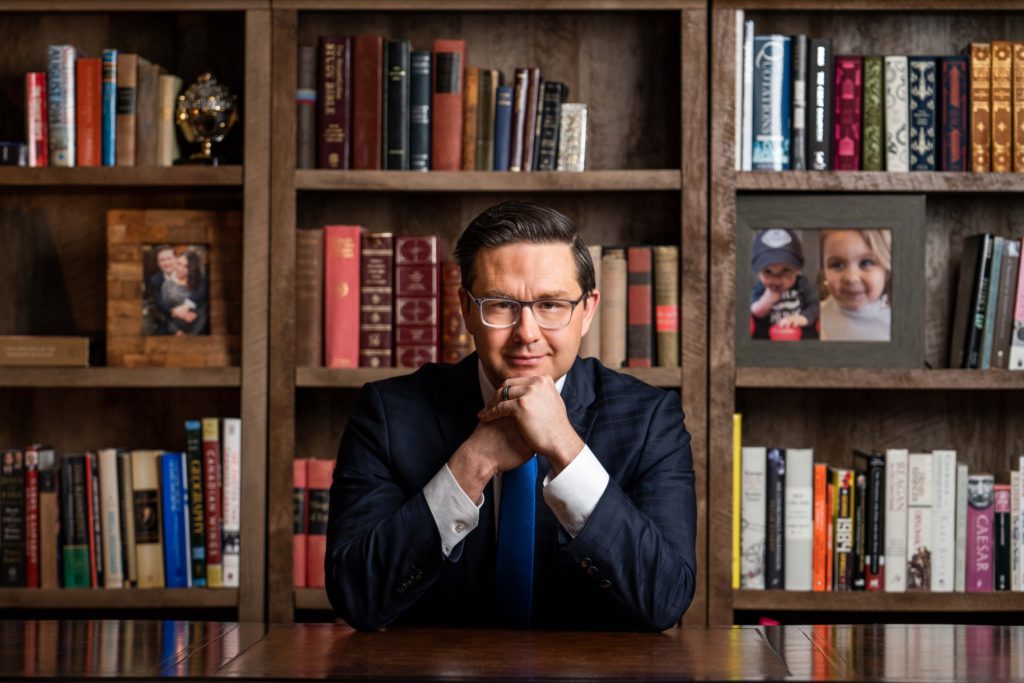
Image credit: Pierre Poilievre’s Facebook page

Canada’s main opposition party called for the government to block Glencore Plc’s proposed takeover of Teck Resources Ltd.


Thousands of jobs would be at risk if the Swiss commodities firm were to succeed in its unsolicited $23 billion bid for the Vancouver-based miner, Conservative Leader Pierre Poilievre said in a statement Thursday. He warned it would also mark the loss of Canada’s last remaining major diversified base-metals miner owned and headquartered in the country.

“Canada needs a government that is committed to creating and supporting Canadian jobs,” Poilievre said. “Glencore’s attempted hostile takeover will ship thousands of jobs out-of-country and threaten thousands more Canadians who work for Teck.”

The opposition leader’s announcement ups the pressure on Prime Minister Justin Trudeau to take a stand on the issue. His finance and natural resources ministers have said in recent weeks that the government is watching the deal closely.

Teck is trying to fend off Glencore’s approach. But its plan to spin off its coal business suffered a major blow Wednesday when it withdrew the proposal for lack of support, hours before it was to be put to a shareholder vote.

Shares of Teck rose 1.3% on Thursday to C$62.13 at 2:25 p.m. in Toronto, extending its gain this year to more than 22%. Glencore closed the day down 1.7% in London.

The deal is quickly becoming a broader political issue.

British Columbia Premier David Eby opposes it. And in a letter Monday to Vancouver’s board of trade, Deputy Prime Minister Chrystia Freeland said the nation needs companies like Teck in Canada as it prepares for the future of mining critical minerals key to the energy transition.

Any takeover of Teck would require the approval of the government. After a review, which could be lengthy, the final decision would mostly likely fall to Industry Minister Francois-Philippe Champagne, who signed Freeland’s letter alongside Natural Resources Minister Jonathan Wilkinson.

Canada blocked BHP Group’s proposed takeover of Potash Corp. of Saskatchewan in 2010, when Stephen Harper was prime minister. Poilievre was a member of that government.

(By Randy Thanthong-Knight, with assistance from Joe Deaux)

Glencore-led revolt kills Teck plan, keeping takeover goal alive

Bloomberg News | April 26, 2023 | 

Teck has urged investors to support its plan for splitting into two businesses (Image courtesy of Teck Resources.)

Glencore Plc’s efforts to spark an investor rebellion at Teck Resources Ltd. have succeeded, after the Canadian miner withdrew a plan to split itself in half just hours before a high-stakes vote. Now the focus shifts to whether Glencore will press its advantage with an increased takeover offer.


Teck’s rejection of Glencore’s unsolicited bid, followed by three weeks of intensive lobbying, has dramatically upset what was supposed to be a simple vote on Teck’s plan to divide its business between metals and coal. Teck chief executive officer Jonathan Price admitted the company likely didn’t have the votes it needed, sending it back to the drawing board. He’s still determined to pursue a split though, and insists the Glencore offer remains a “non starter.”


That puts the ball back in Glencore’s court. The Swiss company, which declined to comment on Wednesday, said last week it was willing to raise its bid if shareholders rejected Teck’s plan. Glencore would prefer to engage with the board first, but it also threatened to go directly to shareholders with an improved offer.

Teck and controlling shareholder Norman Keevil have repeatedly rejected Glencore’s $23 billion proposal to buy the company and then spin off the combined coal businesses, creating one of the world’s biggest metals miners in the process.

Any attempt by Glencore to circumvent Teck’s board would face significant hurdles without support from the Keevils, who have a blocking vote because they dominate the company’s “supervoting” Class A shares.

Teck investors will have an opportunity to hear from the company again today, as its shareholder meeting is still scheduled for noon Vancouver time — just without the vote on splitting the business.

The failure, for now, of that plan is a setback after the Canadian company spent four years mulling options for its steelmaking coal business before announcing a spinoff proposal in February. Teck had also raised the prospect of a sale or bidding war for its metals business after the split.

Glencore CEO Gary Nagle said previously that the company would keep pushing for a deal if the Teck spinoff plan failed. However, there was little sign on Wednesday that the Canadian miner is open to discussion. Speaking with analysts and investors after its announcement, Price said that the company is focused on working on a new plan to separate its coal business in simpler way and that it is still not interested in Glencore’s “flawed” offer.

“We will not engage on something that is a distraction from our mandate to create the greatest value with the greatest certainty for our shareholders,” he said.

Glencore had framed the vote as a referendum on its proposal, and suggested that any rejection of the Teck spinoff would demonstrate that shareholders support its approach. That was rejected by Price who said a “significant majority” supported the split between coal and metals, but just not in its current form.

The company will consider a range of alternatives to accomplish the split, the CEO said, but did not provide a time frame or further details about its options.

(By Thomas Biesheuvel and Joe Deaux)


Battle for Teck's assets just beginning as company backtracks on split: Analysts

Teck Resources Ltd. may have backtracked on its plan to split its coal and metals businesses into separate companies, but analysts predict the battle for the future of its assets is just beginning.

The B.C.-based miner pulled the plug on the spinoff hours before shareholders were set to vote on the proposal – a move that indicates the company did not have the support it needed, said Laura Lau, chief investment officer at Brompton Group.

However, Lau said “investors have spoken that they would like the metals and coal assets to be split,” and questions remain about if, how and when that will happen.

“I don’t think this is done. This is just the first, second innings,” she said in a television interview with BNN Bloomberg on Wednesday.

Teck was ramping up for the vote in recent weeks while fending off an unsolicited takeover offer from Glencore Plc., a Swiss miner that wanted to buy the company as a single united entity and blend Teck’s steelmaking coal assets with its own thermal coal operations.


At the heart of the battle were tensions around environmental, social and governance (ESG) investment priorities, which place a premium on Teck’s metal assets like copper, which are used to build clean  technologies like electric vehicles, and reject coal as a major source of climate change-inducing greenhouse gas emissions.

Lau, who owns shares in both Teck and Glencore, said she expects Glencore will also ultimately spin off its own coal assets to appeal to investors who want to avoid coal exposure.

She said Glencore will have a “front row seat” to purchase Teck, though the Canadian company could go to another buyer – and she said she thinks Teck is worth a higher price than the US$23 billion Glencore initially offered.

Cole Smead, president and portfolio manager at Smead Capital Management, meanwhile, said he anticipates Glencore will acquire Teck.

“I think Glencore’s going to take this sucker down,” he told BNN Bloomberg in a television interview.

Smead said he thinks the latest development in the Teck saga points to how ESG investing pressure is “not proving to be very economic.” If Glencore completes its desired acquisition, Smead said he thinks the company will be building “the most liquid coal business in the world,” because the coal has become valuable as the world tries to produce less of it.

“No one's saying how good the coal business is and nobody wants to be in the coal business, which is a way I think I can get fabulously wealthy and so can our investors and therefore we press on,” he said.

Teck CEO Jonathan Price said in a statement Wednesday that the company still considers Glencore’s proposal “a non-starter,” and the plan going forward will be “to pursue a simpler and more direct separation, which is the best path to unlock the full value of Teck for our shareholders.”

Christine Tan, portfolio manager at SLGI Asset Management, said the question about what to do with coal is a major consideration for investors in an ESG-focused environment.

She noted that Teck’s scuttled proposal would have seen profits from the coal side funnelling into the metals business for years to come, which complicated the matter for investors.

“Is it really as clean of a split as investors would like,” she said in a Wednesday interview. “Perhaps that's what management's referring to when they talk about coming back or potentially thinking about cleaner way to split the assets.”


Tan also highlighted concerns that have been raised about a foreign company buying Teck, which is considered a valuable asset for Canada’s as the country tries to position itself as a provider of critical minerals in the global energy transition.

“What does that do to the future of Teck, would be the key question for me,” she said.

Teck pulls vote on coal split, handing 

momentum to Glencore

Teck Resources Ltd. canceled a vote to spin off its coal assets hours ahead of its shareholder meeting, handing the initiative to Glencore Plc in its attempt to buy the company.

The move caps a tense three weeks of lobbying investors by both Teck and Glencore, and suggests Teck may not have mustered the support it needed. The Canadian miner rejected a US$23 billion takeover proposal from Glencore earlier this month, and said it would instead press on with the plan to spin off its coal mines, to focus on mining copper and zinc.

The focus will now turn to Glencore — which has dangled the prospect of a higher offer — and whether Teck’s own investors will pressure the company to enter discussions. While the canceled vote is an embarrassing reversal, any takeover would still require the support of controlling shareholder Norman Keevil, who holds an effective veto through Teck’s “supervoting” A Class shares.

Teck said in a statement it still intends to pursue the company split, and hasn’t changed its view on Glencore’s offer. It will consider shareholder feedback and present a new proposal. Teck shares jumped as much as 11 per cent in Toronto and traded 4 per cent higher at 12:54 p.m.

The vote on Wednesday had turned into a showdown over the future of Teck — Glencore said its proposal would be dead if the spinoff were approved, as it tried to persuade shareholders to vote “no” and pressure the company to engage. A Glencore spokesman declined to comment on Teck’s announcement.

The Swiss commodities giant wants to buy Teck and then create two new companies from their combined metals and coal businesses. The deal would offer control of Teck’s lucrative copper mines at a time when the world is worrying about a shortage, and also allow Glencore to get out of the profitable yet polluting thermal coal business. But the takeover fight also has wider significance in the global mining industry, marking a public return to large-scale mergers and acquisitions by the world’s biggest producers after years on the sidelines.

“Glencore’s rejected proposals remain a non-starter, with the same flawed structure and material execution risks identified by our board,” said Teck Chief Executive Officer Jonathan Price. “Our plan going forward is to pursue a simpler and more direct separation, which is the best path to unlock the full value of Teck for our shareholders.”

Teck had proposed creating a new steelmaking coal company, called Elk Valley Resources, that would continue to pay a royalty to its remaining metals business for several years. The ongoing link between the two companies would have muddied its appeal for investors who no longer wanted exposure to coal.

Glencore, by contrast, had offered to pay cash to buy Teck investors out of their exposure to the companies’ combined coal businesses.

OPENS POSSIBILITIES

The canceled vote “opens up several new possibilities, such as an improved proposal from Glencore, a separate sales process for the coal assets, or an immediate spin of the coal business,” B. Riley Securities analysts Lucas Pipes and Nick Giles wrote in a note.

Teck, which has repeatedly rejected Glencore, had said it would be prepared to discuss takeover offers for its metals business after the spinoff, and even raised the prospect of a bidding war. However, the board’s position suffered a blow when two influential shareholder advisory firms, Glass Lewis and Institutional Shareholder Services, both recommended votes against the Teck plan.

Teck will consider a range of alternatives for how best to split off its coal assets, Price said on a call with analysts, but declined to provide a timeframe.

“We will not engage on something that is a distraction from our mandate to create the greatest value with the greatest certainty for our shareholders,” Price said.

The shareholder meeting is still scheduled for noon in Vancouver today. The resolution on the split required two-thirds approval from both classes of shareholders separately — the A Class “supervoting” stock dominated by Teck’s founding Keevil family, as well as regular B class shares. While several smaller investors had come out for or against Teck’s plan, the company’s largest shareholders have not made their position public.

China’s sovereign wealth fund, China Investment Corp., is the biggest holder, with about 10 per cent, followed by BlackRock Inc. and Dodge & Cox.


“The late withdrawal by Teck of its separation plan from today’s AGM appears to reflect significant shareholder concerns that the plan is too complicated,” said Bloomberg Intelligence analysts.  “Glencore will view this climbdown as an opportunity to reassert its merger proposal, which will need to be improved to win over broad shareholder support.”


WORKERS CAPITAL
Teck spinoff backed by Canada pension after website error fixed
Bloomberg News | April 25, 2023 

Greenhills is one of the five steelmaking coal operations Teck Resources has in the Elk Valley, British Columbia. (Image courtesy of Teck Resources.)

Canada’s largest pension fund says it will vote for Teck Resources Ltd.’s plan to split the mining company after a “technical error” last week caused it to state the opposite.


Canada Pension Plan Investment Board, which managed C$536 billion ($394 billion) at the end of December, will endorse a plan to spin off Teck’s steelmaking coal business at an April 26 shareholder meeting, it confirmed on Tuesday.


Last week, the pension fund’s website stated it would vote against the proposal. A CPPIB spokesperson said incorrect information was posted due to a technical error.

The vote has been framed by Glencore Plc., which is seeking to buy Teck, as a referendum on whether the board of the Canadian company should abandon the split and engage in talks. The companies have spent the past few weeks in a bruising fight to win over Teck investors, after its board and controlling shareholder publicly rejected Glencore’s proposal. The Swiss commodities giant offered to buy Teck for $23 billion and then create two new companies by combining their respective metals and coal businesses.

Teck’s controlling shareholder, Norman Keevil, has signaled that he’d support a transaction with the “right partner, on the right terms” after the firm separates its metals business from its coal operations.

CPPIB owned 1.15 million of Teck’s Class B shares, or 0.23%, as of Dec. 31, according to data compiled by Bloomberg.

(By Paula Sambo)

Teck Resources should remain in Canada, says Finance Minister Freeland
Reuters | April 24, 2023 | 

Canada’s Foreign Minister Chrystia Freeland. Photo by Freeland’s press office

Teck Resources, which is trying to fend off an unsolicited $22.5 billion takeover offer from Glencore Plc, should remain headquartered in Canada and help the country expand its critical minerals industry, Finance Minister Chrystia Freeland said on Monday.


Freeland’s comments were the clearest indication to date that Ottawa is closely watching the takeover battle between Vancouver-based Teck and Switzerland’s Glencore because of Teck’s interests in copper and other metals critical to a green energy transition.

“We need companies like Teck here in Canada, companies with a strong commitment to Canada,” Freeland wrote in a letter seen by Reuters to the Greater Vancouver Board of Trade, which has concerns about Teck’s future in Canada.

After Freeland’s comment, Glencore pointed out to its April 3 letter where it has said its deal “would not materially change the day-to-day operations at Teck’s assets in Canada. It will honour all of Teck’s commitments to local Canadian communities as well as to Indigenous communities to ensure their interests are acknowledged and protected”.

Teck did not respond to an email request for comment.

Separately, Teck’s institutional shareholders were due to vote by 3 p.m. ET on Monday on a Teck proposal to split its coal and metals businesses, with results released on Wednesday.


Glencore has said that there is no deal if shareholders vote in favor of Teck’s split. Canada’s largest pension fund CPPI voted against the split over the weekend then changed its vote to favor the move, according to its website.

China Investment Corporation (CIC), the largest holder of Teck’s common stock, has not disclosed how it voted.


Large investors such as the Norwegian government pension fund, asset managers Janus Henderson and Letko Brosseau and Teck mining partner Sumitomo Metals have said they will vote in favor of the split.


Proxy advisory firms Glass Lewis and ISS have recommended shareholders oppose dividing Teck, and Toronto-based Waratah Capital Advisors has said it voted against the move.

(Reporting by Divya Rajagopal and Steve Scherer; Editing by Ernest Scheyder, Marguerita Choy and Cynthia Osterman)

Read More: Glencore CEO’s first big move: chasing mining’s toughest prize

ICYMI

The "Impossible" Fish That Broke Two Deep Sea Records

snailfish
Image of the snailfish seen at the Izu-Ogasawara Trench (University of Western Australia)

PUBLISHED APR 23, 2023 5:19 PM BY PARIS STEFANOUDIS


When thinking of animals that live in the most extreme environments on Earth most of us probably don’t think of the snailfish. Its name may not hint at extraordinary physical capabilities but the snailfish has broken the record for living at the deepest ocean depths known to humanity.

In fact scientists believed it was physiologically impossible for fish to survive conditions below 8,200 meters. Until recently, when Australian and Japanese researchers found one at a record-shattering 8,336 meters in the Izu-Ogasawara Trench, south of Japan. That’s 158 meters deeper than the previous record, also set by a snailfish during an encounter in 2017 in the Marianas Trench, about 2,000 kilometers east of the Philippines.

The deep ocean has yet again shown us there is still much to be discovered if we only have the willingness to look.

Defined as waters below 200 meters, this environment makes up 50 percent of Earth’s surface. Researchers estimate that only 10-28 percent of marine life is currently known, and most knowledge stems from researchers based in Europe, the US and Japan.

Scientists believe a lack of understanding of ocean life and its distribution is one of the biggest barriers to restoring marine biodiversity damaged by overfishing, pollution and climate change.

But when we do explore the deep ocean, we are often rewarded with new discoveries.

My current research focuses on the relatively shallow parts of the ocean from 0-500 meters. Even in relatively well-researched areas such as Bermuda, discoveries can still be made. In one oceanographic expedition, the international team I was part of discovered vast expanses of black wire coral gardens, the deepest record of the invasive lionfish, and several new species of red algae.

Black coral gardens in Bermuda. Nekton Foundation, Author provided

It’s common for up to 50 percent of all species (and sometimes almost 95 percent) sampled on a single deep-ocean expedition to be new to science. New habitat discoveries are also common. In March 2023 scientists on an expedition to the Mid-Atlantic ridge for the Schmidt Ocean Institute discovered numerous new hydrothermal vents also known as black smokers (like geysers, or hot springs, on the ocean floor).

Why deep ocean discoveries matter

Research suggests hydrothermal vents may have played a key role in the origin of life on our planet. So any new information about these unique ecosystems and their inhabitants has implications for humanity as well as extraterrestrial life.

Hydrothermal vents also show the astonishing adaptability of life. In 2012, scientists discovered new species of crabs in the Southern Ocean, the hairy-chested Hoff crabs. Named after their resemblance to the Baywatch actor David Hasselhoff, they construct crab cities around black smokers. There can be more than 700 crabs per square metre. The fur on their chest incubates microbes that can convert toxic chemicals that come out of scorching black smokers into energy. The crabs use special comb-like mouthparts to remove the energy-rich bacteria from their fur to eat. It is their main source of nourishment.

Apart from the excitement and wonder that comes with it, these discoveries provide new information that benefits society. Studies have found this habitat could harbour treatments for human diseases. Recently, researchers studied fungi found in cold-water animals called sea pens in the northeast Atlantic and discovered they produce compounds that show promise as potential drug treatments for chronic musculoskeletal diseases such as osteoarthritis.

Similarly, studies show bacteria living in deep-water sponges may have both antibiotic and antitumour properties.

The potential of bioprospecting – studying wildlife and plantlife for valuable new resources – has barely been explored in the case of deep ocean. But the industry is rapidly growing and already worth billions of dollars. Countries agreed to share the benefits as part of the UN high seas treaty in March 2023. But the new international law has not yet been ratified and it is too soon to tell whether developed nations will stick to their pledge to share the ocean’s resources with all member states.

Where do we go next?

Very little of the deep ocean has been systematically explored so far due to financial and logistical constraints. Remotely-operated vehicles cost from US$15,000 (£12,100) to millions of dollars, while a submarine built for deep ocean exploration can cost almost US$50 million. In addition, offshore exploration requires large research vessels to be deployed for weeks at sea which involves months of planning and logistics.

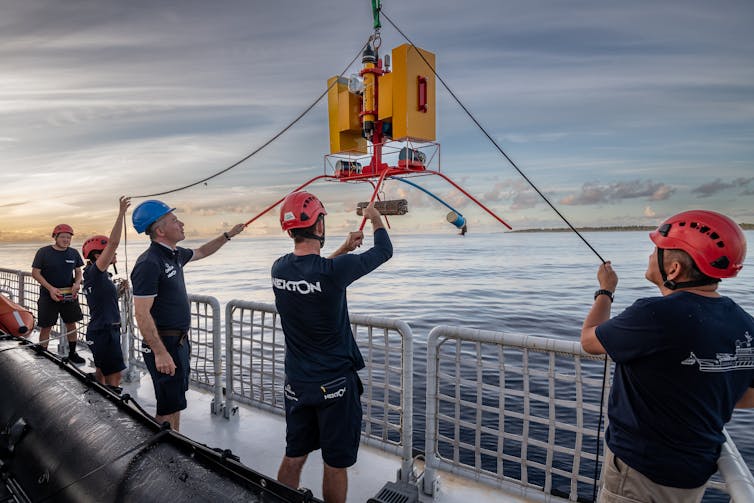
Landers being deployed on a deep ocean survey in the Maldives. Nekton Foundation, Author provided

The recent snailfish discovery was made during an international expedition involving Australian and Japanese researchers who set out to explore life in the trenches off Japan. For that study, the team used landers, metal cages that land on the seafloor using ballast weights. Landers are equipped with cameras, lights and bait for attracting predators. While it is possible to explore even the greatest ocean depths with submarines, landers are easier to operate, and can stay underwater for longer.

We are losing deep sea life before we can even discover it. Overfishing, noise pollution and global warming are already destroying deep ocean ecosystems and their inhabitants. Commercial deep seabed mining for minerals has not yet been carried out but it is a looming threat.

Governments allocate on average only 1.7 percent of their annual research budgets to explore beneath the ocean surface. If scientists make new discoveries with almost every study of the deep ocean, imagine what we could achieve if governments, charities and marine scientists worked more closely together and had better funding.

Paris Stefanoudis is a senior postdoctoral researcher at University of Oxford. 

This article appears courtesy of The Conversation and may be found in its original form here

The Conversation

The opinions expressed herein are the author's and not necessarily those of The Maritime Executive.


Wintershall Dea Announces Major Oil Discovery off Mexico

Wintershall Dea drilling rig off Mexico
Courtesy Wintershall Dea

PUBLISHED APR 26, 2023 4:03 PM BY THE MARITIME EXECUTIVE


German oil company Wintershall Dea has announced a "major" oil and gas discovery in the shallow waters of the Bay of Campeche. 

Wintershall Dea and its partners have struck oil at the Kan prospect in Block 30 in the Sureste basin, northwest of Villahermosa. Based on early estimates the discovery may contain 200 to 300 million barrels oil equivalent - not quite a giant oil field of 500 million barrels or more, but still a significant find. 

"This important discovery at Wintershall Dea’s first own-operated exploration well offshore Mexico is a great success," said Hugo Dijkgraaf, Wintershall Dea’s head of exploration. "It was one of the most contested blocks of Mexico’s bid round 3.1 back in 2018. The successful Kan discovery confirms the attractiveness of Block 30."

Kan lies within the same area as several major discoveries, including the world class Zama oil field. Wintershall Dea holds an operating interest of 40 percent in Block 30, with Harbour Energy and Sapura OMV holding 30 percent each. The consortium plans for one additional exploration well in the block during this campaign. 

Wintershall Dea has operated in Mexico since 2017 and has a substantial footprint in the country's state-dominated offshore sector. It holds a 37 percent interest in Block Hokchi, and it is the second-largest shareholder in Zama. It also has interests in ten other offshore E&P blocks, including an operating interest in three.  

The experience of foreign investors at Zama shows both the potential and the hazards of offshore E&P in Mexico. 

Wintershall's American partner at Zama, Talos Energy, found oil in the lease block in 2017. Talos was the first E&P firm back in Mexico after a long period of Pemex-only operatorship. In 2021, after a change in political leadership, Mexico's energy secretariat (SENER) stripped Talos of its operatorship and handed control to Pemex, which owned the adjacent lease block and an overlapping share of the resource. The decision effectively nationalized control of the asset and left Talos with a 17 percent non-operating share.


Swedish and Singaporean Researchers Launch Virtual Watch Tower Network

Virtual watchtowers
Illustration courtesy Sandra Haraldson

PUBLISHED APR 26, 2023 8:42 PM BY THE MARITIME EXECUTIVE


During the Singapore Maritime Week in April 2023, a new digital initiative for supply chain performance was announced. Last year the Research Institutes of Sweden (RISE) and Singapore Maritime Institute (SMI) formed a collaboration and subsequently engaged some of the world’s largest players in the supply chain industry to pilot a networked virtual watch tower (VWT).

The VWT solution for supply chain performance and risk management adopts the principles of collaborative decision making in the end-to-end supply chain augmented by artificial intelligence (AI) technologies. These technologies are areas that RISE and the A*STAR’s Institute of High Performance Computing (IHPC), which are leading the project, have been focusing on for years.

The project has received external funding from Singapore Maritime Institute (SMI) and the Swedish innovation agency Vinnova with a total grant of 12 MSEK (1,54 MSGD).  

Participating members of the pioneering community in the project are Alleima Tube, BridgeNet Solutions - part of PSA BDP, Kalmar, Bromma, Einride, Ericsson, Green Cargo, HERE Technologies, Marine Benchmark, PSA International, Scania, Stora Enso, Wallenius Sol, and Yilport Nordic; the ports of Gävle, Helsingborg, and Kvarken ports Umeå, and the Swedish Ports Association join as advisory partners. Chalmers, Gothenburg University, Stockholm Environmental Institute (SEI), and Umeå University participate as research and innovation partners.

“IHPC has been involved in many maritime research projects to develop AI-based solutions. More recently, IHPC is leading the Maritime AI Programme working with partners across the eco-system to develop and translate AI technologies in maritime sector. The Networked Virtual Watch Tower project is a natural extension to our maritime research as AI and analytical functions play a key role to enable supply chain operators to make informed and better decisions. IHPC is excited to contribute our R&D capabilities in AI and big data related research to co-develop innovative and sustainable solutions for the trade and supply chain stakeholders locally and globally. The AI tools and solutions that will be developed aim to optimise resources for supply chain stakeholders to better coordinate operations, streamline processes, achieve cost efficiency and improve productivity,” says Dr Su Yi, Executive Director, IHPC.

Innovation manager Mikael Lind, adjunct Professor in Maritime Informatics, RISE and Chalmers adds “Over a decade we have developed and refined the concept of Collaborative Decision Making (CDM). A-CDM enables coordinated airports, PortCDM does the same for ports, YardCDM and StationCDM for railways, and RRTCDM for inland terminals. In this project, we will bring all these pieces together into a CDM approach that tackles the challenges of multimodal end-to-end supply chains (e2eCDM)”.

The common goal of the participants is to collaboratively improve transport and supply chain management through augmented intelligence brought about by the project, by leveraging data sharing, transparency, and AI-driven analysis and recommendations.

“The global supply chain disruptions in the last few years have underscored the need for the industry to push harder and faster for more robust and “smarter” solutions in the immediate future. At PSA, we believe that efficient and sustainable end-to-end supply chains can only be achieved through close collaboration, digitalisation and data sharing amongst industry stakeholders and we look forward to being an active partner in the Networked Virtual Watch Tower project,” said Eddy Ng, Head of Group Commercial and Supply Chain Sustainability Solutions, PSA International.

‘’We see a strong value of the Networked approach in the Virtual Watch Tower project. Close collaboration between parties and a joint approach for improved transport visibility is the only way forward to reach supply chain visibility and resilience’’ said Niklas Fahlen, SVP Logistics, Stora Enso.

The project will run over two years with the objective of piloting a network of a virtual watch tower prototype tested in a real-life environment. The community will then deploy the final product as tech and analytics powered platform, which provides comprehensive and resilient optionality to the global trade and supply chain stakeholders not only in Singapore and Sweden but worldwide.

“SMI is pleased to award funding to IHPC for this international joint research effort with RISE. With PSA International as one of the industry collaborators, this project could provide a holistic view for both cargo owners and transport buyers of the multimodal supply chain operations, and create an ecosystem for services around the supply chain network visibility for higher operational performance and risk management. The project outcome with a piloted solution will also be the first step to further establish Singapore as a highly digitalised and smart port in the global supply chain,” said Tan Cheng Peng, Executive Director, SMI.

Vinnova, as the Swedish Governmental Agency for Innovation, has approved funding of the Virtual Watch Tower project on the Swedish side. “The project has the potential to develop solutions that will make global value chains more sustainable, resilient, and secure. The importance of the project is underlined by the participation of a diverse set of leading Swedish and foreign actors.”, said Andreas Netz, Head of Department at Vinnova

Additional information on the virtual watch tower concept can be found at www.virtualwatchtower.org.

The products and services herein described in this press release are not endorsed by The Maritime Executive.