Saturday, September 21, 2024


NTSB: Slack Lines Allowed River Current to Pull Bulker Off the Dock
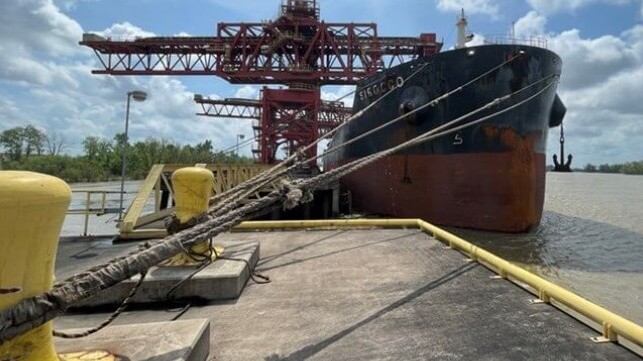
Sirocco's mooring arrangements on the day before the casualty (Oldendorff / NTSB)

Published Sep 19, 2024 6:18 PM by The Maritime Executive


The National Trasportation Safety Board has completed its review of a breakaway incident involving a bulker at a terminal on the Lower Mississippi last year. The bulker's winch brakes slipped under heavy tension from the river current, NTSB concluded, and the ship drifted off to hit a moored barge, causing about $5 million in total damages. 

On March 24, 2023, the bulker Sirocco arrived at an anchorage at river mile 114 on the Lower Mississippi, and she prepared to call at the Convent Marine Terminal (CMT) at mile 160. The water level was running higher than 12 feet at the Army Corps' Carrolton gage, the level that activates a high water loading plan at CMT. That plan requires a vessel the size of Sirocco to have one hold-in tug and both anchors freed and ready to work. It also requires doubled breast lines on the bow and two head lines forward, fixed to upriver mooring dolphins. These arrangements are intended to keep the current from pulling the ship off the dock. 

In the early hours of March 26, Sirocco arrived at CMT and moored with the bow pointed upriver, starboard side to the pier. The master had the crew tie up with 16 lines - including four head lines and two breast lines, per the high-water loading plan - and called for two hold-in tugs on the outboard side. Cargo operations began at about 0300, and Sirocco began to take on a load of 73,000 tonnes of coal. 

At about 1230, the port captain for the vessel's operator came aboard Sirocco. He noticed a slack line and informed the master, who had the crew take up slack on all mooring lines. The port captain also noted that the river gage had fallen just below 12 feet that day, so the hold-in tugs were no longer strictly required. This meant that the cost of the tugs would be borne by the shipowner, not the charterer, if the master insisted on keeping them on station - a point that the port captain relayed to the master. 

By 1500, after the port captain's repeated prompting, the master released the aft tug and the forward tug. He later told investigators that he was surprised that this was allowed, since the river current was still strong. As measured by the ship's speed log, the river was running 3-4 knots at this point in the day, according to the master and second officer. 

As the day went on, the port captain continued to observe slack lines. The deck crew told NTSB that they were continuously working to keep the lines tight, but were also tasked with cargo duties, like opening and closing hatches, cleaning hatch tracks and taking tank soundings. 

At 0000 on March 27, the second officer, an AB and an OS came on watch as cargo operations continued. The offgoing watch had been taking slack out of the lines frequently, and the oncoming watchstanders made a round to check all the lines.

Just before 0100, cargo loading operations shifted forward to the No. 2 hold, and the draft at the bow began to increase quickly. When the AB and the second officer went forward to check the lines at 0145, they found that they were "really tight" and the bow had pulled away from the dock. 

When they discovered that the mooring winches were not able to pull the breast lines back in, they called the master, who realized that the river current - at that point running at 4.5 knots - was endangering the ship. At 0201 he made an immediate call for tug assistance, and he mustered all crew on deck.  

At 0210, the second mate and AB saw that the forward mooring lines were all paying out, and that the port side winches were smoking and sparking. The bow was swinging further out into the river, and as the ship peeled away from the dock, the stern lines began to pay out as well. 

The master called the engine room for immediate propulsion, and he had engine control transferred to the bridge by 0216. At this point, the ship was drifting sideways downriver, trailing parted lines. He ordered the crew to drop anchor, and after a delay to ensure their personal safety, the second officer and AB managed to go forward and deploy the starboard anchor and one shot of chain. 

The master made a call for tug assistance, and two tractor tugs - Savannah and South Carolina - responded rapidly. They were moored about 700 yards from the drifting ship and were on scene within minutes. However, the trailing lines in the water limited their ability to approach, and they were restricted to the port side for fear of entangling their propellers. 

With the help of the two tugs, and after deploying her port anchor with five shots on deck, Sirocco reoriented her bow upstream and briefly slowed her drift to 0.2 knots.

However, the current was strong, and by 0248 the bulker was moving again at four knots astern, headed for a group of moored barges at the Mosaic Uncle Sam terminal. Loading work was under way at the terminal, and the tug Savannah sounded her whistle continuously to warn workers to get off the barges. They evacuated before Sirocco's starboard quarter struck the barge MEM 5087 at 0249, damaging the ship, the barge and the dock. The MEM 5087 was crushed badly enough that it was declared a constructive total loss. 

With the assistance of a third tug and with both her anchors, Sirocco held position midriver and awaited a pilot. The ship was safely secured at the Grandview anchorage by 0715.  

NTSB determined that the probable cause of the casualty was the bow drifting off the dock during loading of the forward hold, exposing more of the submerged hull to strong river currents. Once this began, the line tension exceeded the brake holding capacity of the mooring winches, which were designed to slip before the tension reached the point where the lines would part under strain. As the brakes slipped, the lines paid out until the ship drifted away from the terminal. 

"Crews should ensure that slack is taken out of lines as the vessel loads, especially as the forward draft increases and the bow begins to sit lower in the water, exposing more of the hull to the current," concluded NTSB. 

The agency also noted that if the starboard anchor had been let out to an appropriate length for the depth of the water - rather than just one shot - both anchors may have held the Sirocco in position and prevented the allision. 


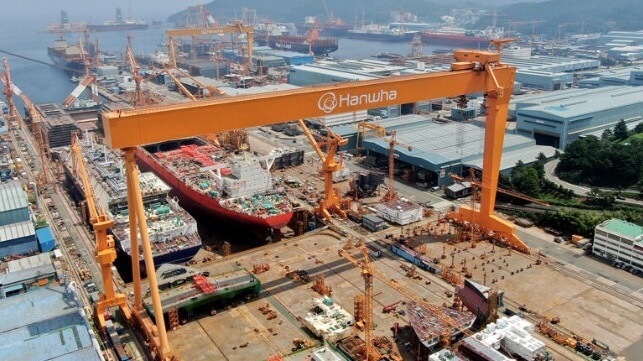
Hanwha Ocean Plans $1.3B Investment to Improve Safety for Shipbuilding

Hanwha Ocean
Hanwha Ocean announced investments to improve safety in its shipbuilding operations (file photo)

Published Sep 18, 2024 5:56 PM by The Maritime Executive


South Korea’s shipbuilder Hanwha Ocean announced that it will invest a total of $1.3 billion over the next three years to improve the safety of its shipyard operations. It comes as the company was facing mounting pressure from the government which has a very strict safety program and unions which accused the company of being lax on safety protocols.

The Hanwha Group acquired management and control of the shipbuilding operations of Daewoo Shipbuilding & Marine Engineering (DSME) completing the deal with the state-run banks in May 2023. The operation reported its first fatal accident in January 2024 under the new management and since then it has been under increasing scrutiny. Korean media reports the government was considering summoning management to report before the National Assembly after a series of incidents at the yard.

The first incident in January involved a 27-year-old subcontractor who died during grinding work at the rudder shop. A little over a week ago, a contractor worker fell from a containership under construction at the yard in Geoje. The individual who was reported in his 40s died from the injuries. A month earlier, a subcontractor in his 60s passed out at the shipyard. His death was attributed to a heat-related illness.

The Ministry of Employment and Labor inspected the shipyard in February and March of this year. They imposed a $75,000 fine for safety violations found during the inspections.

"After a thorough review of safety feedback from both internal and external experts, as well as the overall safety conditions at our shipyards, we have determined that a comprehensive overhaul of our current safety management system is needed," said Kim Hee-cheul, CEO of Hanwha Ocean, in a statement released today, September 18.

The total value of the program will be $1.3 billion with the largest piece, $853 million specifically for safety initiatives over the next three years. Over $640 million will be spent by 2026 to improve safety, including $50 million for a smart system using artificial intelligence to detect hazards such as fires, explosions, and leaks. They also plan to provide workers with body cameras, tablets, and smartwatches.

Hanwha Ocea said will also invest $528 million to replace outdated equipment that could be creating safety risks.

South Korea implemented new safety regulations in January 2022 for the shipbuilding industry. According to the labor unions, there were five fatal incidents at the Geoje shipyard after the new regulations before Hanwha took over from DSME. One particular incident, a subcontractor in his 50s drew wide attention when the man was killed in March 2022. He reportedly hit his head while nearly 200 feet in the air repairing a tower crane. The man fell and was killed by the tower crane lift wire.

South Korea indicted the former CEO of DSME in April 204 for the individual’s death. Under South Korean regulations, senior management of a company can and will be held accountable for fatal accidents in their operations. Similar charges had previously been brought against management at other shipyards.


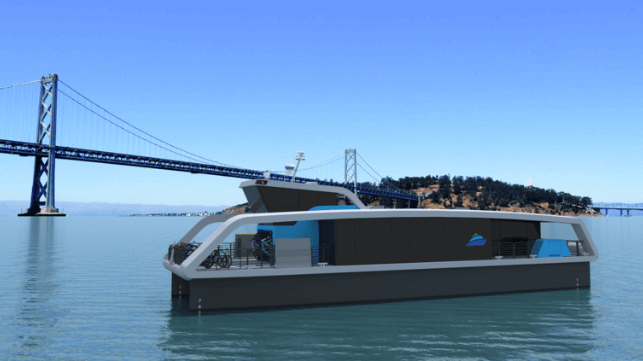
Washington State Awards Grant to Test Hydrofoiling Electric Ferry

Hydrofoiling ferry for Kitsap Transit
Courtesy Glosten / Bieker

Published Sep 18, 2024 8:28 PM by The Maritime Executive


A county transit agency in Washington State has accumulated more than $5 million in grant funding to design a demonstration-scale electric fast ferry and its shoreside charging infrastructure. The project draws on a 150-passenger vessel design by Glosten and Bieker Boats, and the trial model is designed to prove the technology concept at smaller scale. 

If built, the full-scale carbon fiber vessel for Kitsap Transit would be the first hydrofoil electric fast ferry in the region. The agency believes that the hydrofoiling ferry would reduce CO2 by 75 percent and operating cost by 35 percent when compared to diesel-powered fast ferries on the Bremerton-Seattle route. 

"This is a reliable, ultra-efficient, low-wake vessel designed to be better for passengers and the environment," said Paul Bieker, partner at Bieker Boats. "This technology represents a giant step forward in efficiency for high-speed transportation over water."

The grant funding pool comes from two state sources. Last week, the Washington State Department of Commerce allocated $1.2 million in R&D funds for the demonstration-scale project. Kitsap Transit previously secured a $4 million grant from the state legislature under Washington's Climate Commitment Act, which allocated $3 billion for public transit projects over the next decade and a half. However, a statewide initiative on the November ballot will ask Washington State's voters to choose whether they want to repeal the Climate Commitment Act, and the results of the vote will determine whether Kitsap Transit's $4 million funding tranche will be available.

If the prototype is successful, Kitsap Transit says that it will seek federal funding to build the full-size vessel. It previously applied for a grant of $18.5 million from the Federal Transit Administration in 2022 to complete the full project, but the application was turned down. 

Kitsap Transit's ferry project has backing from the state's maritime innovation accelerator, Washington Maritime Blue, along with three local seaports. 

San Francisco Gets $11 Million Grant for High-Speed Electric Ferries

Aurora
Courtesy Aurora Marine Design

Published Sep 16, 2024 8:33 PM by The Maritime Executive


The San Francisco Bay Ferry has secured an $11 million grant from the Federal Transit Administration (FTA) to help purchase the first high-speed electric ferries ever built in the United States.  

The San Francisco Bay Area Water Emergency Transportation Authority (WETA), the operator of the ferry service, wants to buy two classes of high-speed electric ferries for new and existing routes. The first phase of the plan calls for three 150-passenger battery electric ferries serving downtown and two up-and-coming waterfront neighborhoods, Mission Bay and Treasure Island. 

Together with other contributions from state and local partners, WETA now has more than $130 million set aside to build out its battery-electric fleet and the associated shoreside infrastructure. The construction program calls for a charging float at the downtown terminal, a new charging station at the Treasure Island terminal, and a brand new electric-ready terminal for Mission Bay. 

WETA has a design in hand for the 150-passenger vessel model and is soliciting quotes from shipyards; all going to plan, it expects to take delivery of its first battery-electric model in 2026. 

In phase two, WETA wants to buy two larger electric ferries capable of moving 400 passengers at a time, and will then convert four of its existing 400-passenger ferries to battery-electric operation. 

San Francisco's $11 million award is one of 18 newly-announced federal grants that will underwrite ferry newbuilds and shore infrastructure in 14 states, including eight projects for low-emissions propulsion. The largest single federal grant went to the Alaska Marine Highway System, which received $106 million. The funding will be used to buy a much-needed diesel-electric newbuild vessel to serve Southeast Alaska. 


WWIII

U.S. Navy's Top Officer Plans for Confrontation With China by 2027

WAIT, WHAT?!

PLA Navy warship
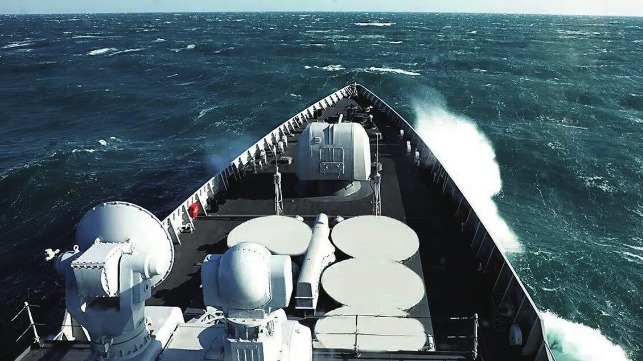
A PLA Navy warship under way near Taiwan (PLA file image)

Published Sep 18, 2024 9:20 PM by The Maritime Executive


 The U.S. Navy's top officer is urging the force to get ready for a fight in the Pacific by 2027, and to prepare with what it has on hand.  

"We cannot manifest a bigger traditional Navy in a few short years," wrote Chief of Naval Operations Lisa Franchetti in her newly-released Navigation Plan, the CNO's strategic guidance for the fleet. "We will continue to prioritize readiness, capability, and capacity— in that order. We must recognize that the Navy faces real financial and industrial constraints."

Her front and center focus is on preparing for conflict with China, centered on a much-debated timeline for a potential invasion of Taiwan. "The Chairman of the People’s Republic of China (PRC) has told his forces to be ready for war by 2027 — we will be more ready," she wrote.

The challenge is substantial. China's naval fleet is the largest in the world by fleet size, and it is rapidly modernizing. The world's largest shipbuilder, CSSC, is at the disposal of the PLA Navy, and the Chinese defense industrial base "is on a wartime footing," Franchetti said. The PLA has also worked hard to integrate its Navy, Rocket Force, Aerospace Force, Air Force and Cyberspace Force into a joint "warfighting ecosystem specifically designed to defeat ours." 

To confront this growing challenge, Franchetti wants the Navy to focus on seven areas where it can make gains "in the fastest possible time with the resources we influence." There are no new initiatives or organizational structures, just a focus on making the most of what is available within three years' time. The top line item is eliminating maintenance delays across the board, freeing up more ship-days for possible deployment. The ambitious target is to achieve a minimum "combat surge ready" status for 80 percent of all ships, subs and aircraft by 2027. 

"We will only accomplish this by getting platforms in and out of maintenance on time," wrote Franchetti. 

The next objective is to roll out robotic and autonomous systems at meaningful scale. The Navy leadership has absorbed the lessons of recent conflicts in the Black Sea and the Red Sea, where unmanned drones and bomb boats have played a prominent role in combat. Franchetti's goal is to have robotic and autonomous systems available "for routine use by the commanders who will employ them" by 2027, with "mature capabilities" integrated into all deploying carrier strike groups. 

Manning and servicemember quality of life also stand out as key priorities. The Navy was short by about 22,000 enlisted personnel at the start of the year, even after reducing minimum recruiting qualifications and introducing retention incentives. Franchetti wants to eliminate the manning gap by 2027 and achieve 95 percent fill for billets in deploying units. That initiative includes substantial changes in the way that the Navy provides for enlisted sailors: Franchetti wants to eliminate involuntary shipboard berthing when in homeport, improve housing options, and limit how long new sailors can be assigned to shipyard periods. 


PHILIPPINES

U.S. Navy Underwrites Renewed Expansion at Subic Bay Naval Base

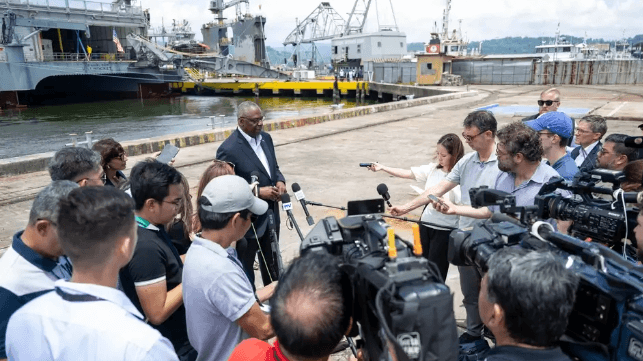
U.S. Defense Secretary Lloyd Austin meets with reporters at Subic Bay, with a U.S. Navy transport in the background, July 2024 (Pentagon)

Published Sep 17, 2024 6:39 PM by The Maritime Executive


In the early 1900s, the U.S. Navy began construction on a sprawling base at Subic Bay on the Philippine island of Luzon, a U.S. colony at the time. That facility turned into a  semipermanent launch pad for American power projection in Southeast Asia. Expanded to fill an essential role during the Vietnam War, Naval Base Subic Bay became the second-largest American overseas military base in the world, second only to nearby Clark Air Base. That ended in 1992, when the Navy's lease expired and negotiations to extend it failed - but recent activity suggests that American involvement at Subic Bay could soon resume. 

Naval Sea Systems Command has a new contract with the Armed Forces of the Philippines to finance the construction of a new finger pier at Naval Operating Base Subic, the renamed home port for the Philippine Navy's surface combatants, according to USNI. In a reversal of fate, the Philippine Navy leases its 100 acres of space from an American hedge fund, which purchased the shipyard site out of bankruptcy several years ago. The docks in the leased area will not be enough to accommodate all of the newly-built tonnage that the Philippine Navy will be getting from Korean shipbuilders in the next few years, so the new finger pier will provide room for growth.  

The construction on the new U.S. Navy-financed finger pier will be carried out by the local Subic Drydock Corporation, and will be administered by NAVSEA's International Fleet Support Program Office - the Navy's aftersales service and technical support bureau for foreign military sales. Among other clients, the office supports the Philippine Navy, which operates several former U.S. Coast Guard cutters. 

American warships periodically call at Subic Bay while operating in the South China Sea, and the extra wharfage could help preserve pierside access for U.S. Navy port calls. Subic is located just 300 nautical miles from the Spratly Islands, less than a day's sailing away from this strategic flash point. The base has also provided a safe harbor when needed for critical repairs: when the damaged destroyer USS John S. McCain needed a port of refuge during transport to a shipyard in 2017, the vessel was taken to Subic Bay for inspection and stabilization. 


After Russian Naval Drills Off Alaska, U.S. Army Sends Troops to Aleutians

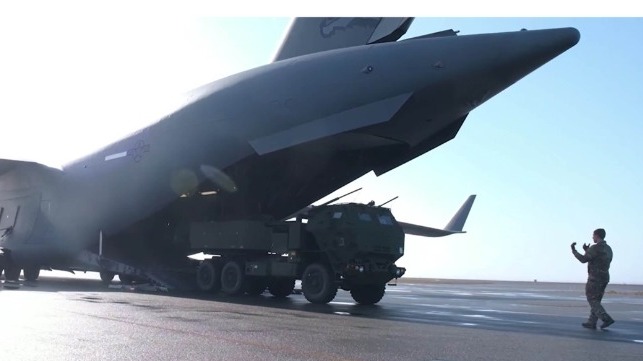
A U.S. Air Force transport plane delivers a HIMARS rocket launcher to Shemya Island, Sept. 12 (U.S. Army)

Published Sep 18, 2024 10:10 PM by The Maritime Executive


After an uptick in Russian military activity in the North Pacific and Bering Sea, the U.S. Army has dispatched mobile rocket launchers and about 130 troops to the Aleutian Islands in order to display its ability to mobilize forces to far-flung sites. The deployment is a rare increase in presence in one of America's most remote regions. 

The U.S. military has been closely watching Russian movements near the Aleutians. Over the course of the past week, one Russian tug, one frigate, two subs and eight Russian military planes came close to Alaska, according to the Pentagon. These joint deployments are part of the Russian-Chinese naval exercise "Ocean-24," one of Russia's largest naval drills in recent memory. 

According to the Coast Guard, the Russian naval vessels crossed over into the U.S. exclusive economic zone in an apparent effort to avoid drifting sea ice. The cutter USCGC Stratton monitored their progress and reported that the small flotilla "operated in accordance with international rules and customs." 

In July, the cutter USCGC Alex Haley encountered another Russian naval vessel about 30 miles southeast of Amukta Pass. The same month, four Chinese warships were spotted north of the Aleutians. 

After the uptick in foreign activity, the U.S. Army dispatched a small task force with airborne troops and two HIMARS rocket launchers to Shemya Island, home of Eareckson Air Station. The last HIMARS deployment to Shemya occurred in 2020, and the Army described the exercise as a test of its ability to rapidly move forces to remote areas. 

“As the number of adversarial exercises increases around Alaska and throughout the region, including June’s joint Russian-Chinese bomber patrol, the operation to Shemya Island demonstrates the division’s ability to respond to events in the Indo-Pacific or across the globe, with a ready, lethal force within hours,” said Maj. Gen. Joseph Hilbert in a statement. "Our ability to deploy combat-credible forces quickly and effectively to any location, no matter how remote, is critical to supporting the nation and our strong relationships with allies and partner nations."

Shemya Island is best known as the home base for the Cobra Dane radar, a giant tracking system built during the Cold War to monitor Soviet ballistic missile tests. Today, Cobra Dane is a tracking and targeting component of the Ballistic Missile Defense System, America's primary shield against nuclear-armed missiles. 

MONOPOLY CAPITALI$M

Multipurpose Cargo Sector Consolidation Deal for Spliethoff and ForestWave

multipurpose cargo ship
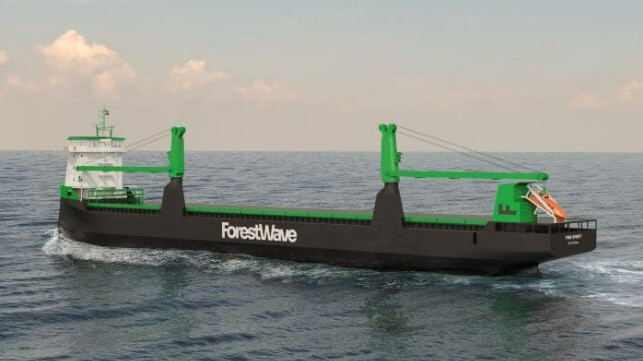
ForestWave becomes a brand in the Spliethoff Group and the multipurpose sector continues to consolidate (ForestWave)

Published Sep 20, 2024 3:00 PM by The Maritime Executive


Consolidation continues in the multipurpose cargo sector. The Dutch Spliethoff Group is acquiring a majority interest in ForestWave, another Dutch operator of multipurpose vessels. Terms of the deal were not reported but effective September 30 ForestWave becomes a brand in the Spliethoff Group.

ForestWave which had been launched in 2003 was a fast-growing provider in the sector. The company has developed a fleet of 30 vessels with loading capacities from 5,000 to 12,500 tons. Its focus is mostly on European waters and the Atlantic region providing services to bulk, forest products, and offshore equipment.

The two companies noted that they have been working together providing bulk cargo and yacht transport. They said the new cooperation in which ForestWave retains its brand and management will intensify the cooperation and create a broader global market for customers.

“After so many years of constructive and pleasant cooperation with ForestWave, formalizing this cooperation is a logical step. The takeover of ForestWave will provide synergy and enable us to offer our clients an even broader scope of logistic solutions,” said Spliethoff.

ForestWave had been one of the companies driving the consolidation in the sector. Last year, it acquired Symphony Shipping. The deal added eight vessels to the fleet which when three newbuilds were delivered they said would number 24 vessels. 

The company will become the seventh brand in the Spliethoff Group alongside Sevenstar Yacht Transport which had already been working with Forest Wave. Other brands include Biglift, Transfennica, Wijnne Barends, and Bore.

Spliethoff highlights that its fleet will grow to 147 vessels with this consolidation. The company currently operates 117 vessels with a range between 2,100 and 23,000 tons. 


Light is the Next Ocean Pollutant of Concern

Light
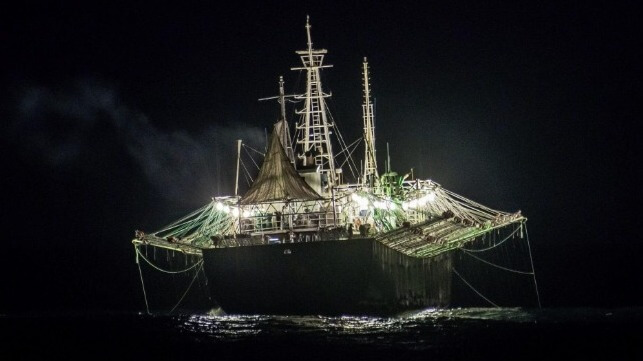
A brightly-lit squid jigger working at night (Greenpeace file image)

Published Sep 19, 2024 9:44 PM by Dialogue Earth


For years the world has largely ignored an insidious pollutant humanity has been carelessly throwing into the ocean: light.

Newly hatched turtles can be sent off course by the glow of nearby beachfront restaurants, taking them away from the sea and to their deaths. Scientists have shown that marine birds can become so confused by artificial light that they drop from the sky in “fallout events”.

But the issue of just how pervasive and damaging artificial light is at sea has struggled to garner the attention it deserves, lagging behind greenhouse gases, plastics and noise in the pantheon of pollutions plaguing the oceans, says Thomas Davies.

Davies, a marine conservation researcher at the University of Plymouth in the United Kingdom, is one of the leaders of the Global Ocean Artificial Light at Night Network. This group of leading experts on marine light pollution launched earlier this year to try and remedy the situation. Davies spoke to Dialogue Earth about how light impacts everything from breeding to feeding to movement in the sea, how the problem is likely to get worse before it gets better, and what should be done about it now.

The interview has been edited for length and clarity. 

Dialogue Earth: How did you start working on ocean light pollution?

Thomas Davies: It wasn’t really around as a subject at all until about 2014. For years, nobody was really thinking about this beyond sea birds and sea turtles. Nobody was thinking about the broader impacts of light pollution on marine ecosystems.

I think biologists assumed that there just wasn’t sufficient artificial light reaching into the marine environment to cause biological impacts. As soon as you realize as a marine ecologist how fundamental light is in shaping the marine environment, suddenly it becomes really obvious how light pollution might be doing the same thing down to 100 meters plus.

100 metres seems a long way down…

The 100 meters case is taken from a situation with Calanus copepods [tiny crustaceans] that live in the Northeast Atlantic and subpolar regions, which are really important for carbon budgets and the food web in those regions.

They normally migrate up to the surface at nighttime to feed and then migrate down during the daytime, presumably to avoid predation.

But if you turn your ship lights on [at night], then they basically scatter sideways and downwards to get away from the light sources. It’s an instantaneous response. You can see these deep holes where the zooplankton should be, where the light is penetrating down into the water. Vertical migration can be suppressed down to 100 meters in depth.

What is the largest current concern about ocean light pollution?

I think the biggest emerging concern is probably with the corals.

There is an increasing body of knowledge now, which is showing us the huge variety of ways in which light pollution can shape coral physiology, shape broadcast spawning, and shape their daily activity cycles in terms of when they feed.

What is broadcast spawning?

That presents a really big issue because obviously, corals are under threat from multiple different things at the moment, but also corals by their ecology tend to inhabit waters that are very clear. So exposure of coral reefs to light pollution which is biologically relevant to them is quite widespread.

Do you think light pollution is likely to increase in future?

Yes, I think it is, especially in the developing world.

Coastal populations are projected to increase quite significantly by 2050. And a lot of that is going to occur in developing economies. It will develop along coasts, where the trade comes, where the rivers emerge, and where the ports and harbors are. That’s where the cash tends to be.

There is going to be a lot of urban development along coastlines. If you look at stretches of the Iberian Peninsula from the nighttime satellites, you can’t actually see any breaks in the lights moving across the whole of the south coast of Spain from the Rock of Gibraltar. That kind of development is on par for some parts of Southeast Asia. It will be quite severe.

What should change about how we light the ocean?

First of all, people need to consider whether they need light in the first place. Then, how much light they need, where they need it, and when. At that point, they need to consider whether or not the colour of that light can be altered to avoid ecological impacts. The decision-making process should go in that order.

If we can get some lighting regulations to reduce light pollution from offshore infrastructure, that would be good. If we could get some regulations to manage lighting on vessels at sea, that would be useful as well. Currently, there is almost no regulation.

It’s a case of making sure that we get light pollution integrated into the international and national policy frameworks in the same way that noise pollution has been over the last 10 years. I think we’ve got a 10-year journey ahead of us to achieve that.

Where do you – and the Global Ocean Artificial Light at Night Network – go from here?

A key objective for GOALANN is moving the science into the policy agenda and to try to reach out to big international organisations, in the hope of being able to make some meaningful change in terms of the impacts of light pollution.

We’re just in that phase now where the science has moved to a point where we can start to really have that influence, and I think we need to start that kind of impact agenda now. To try and see if we can start to make a difference. You start doing the science and then you need to try to make the science make a difference.

Daniel Cressey is ocean editor at Dialogue Earth. Based in London, he worked as a journalist for two decades at publications including Nature and Research Professional News before joining Dialogue Earth in 2024. He has degrees in chemistry, history of science and journalism.

This article appears courtesy of Dialogue Earth and may be found in its original form here

The opinions expressed herein are the author's and not necessarily those of The Maritime Executive.


Russian Missile Damages Odesa Port and Docked Bulker

Odesa
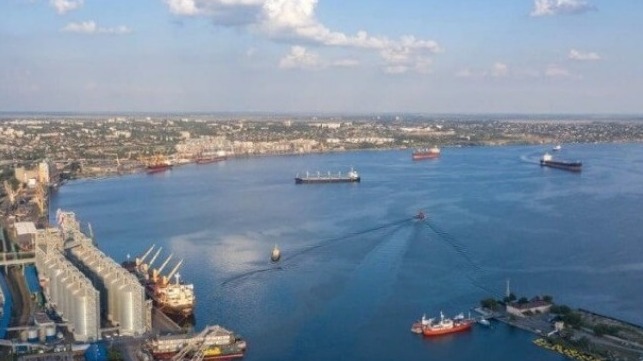
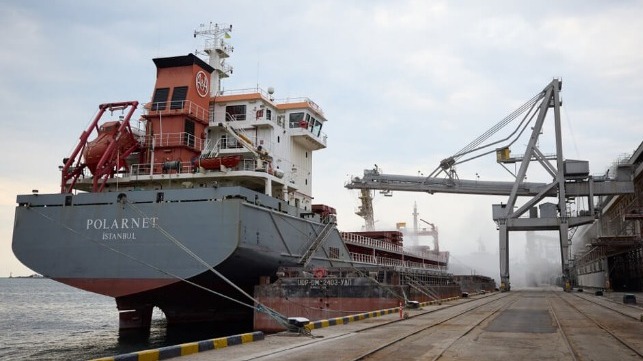
A bulker docked in Odesa was damaged during a missile attack by Russia on the city and port (Odesa file photo)

Published Sep 20, 2024 12:38 PM by The Maritime Executive


Reports are coming from Ukraine of a Russian missile strike on the city of Odesa that damaged port infrastructure and a vessel alongside loading. There are no reports of causalities in the port but four civilians were injured in the city.

The governor for the region, Oleh Kiper, posted a message on Telegram after earlier warning the citizens of a possible air assault. Russia has increased its attacks on Ukrainian cities but some reports said it was a month since the port infrastructure had been hit. Without providing details on the damage, Kiper reported they had found debris from an Iskander-M missile along with the damage in the port and civilian buildings. He warned citizens to heed the air raid alerts.

Cargo ships continue to use the ports in the Greater Odesa region as part of Ukraine’s corridor for shipping. Kiper only identified the damaged vessel as being registered in Antigua. Reuters is citing sources saying the vessel is the Golden Lion which it says was loading metal products.

Tracking data shows the vessel which is 6,315 dwt arrived this morning in Odesa coming from Varna, Bulgaria. Databases show the ship is owned and managed from Lithuania. 

Ukraine’s Agrarian Policy Ministry last month said in the first year of operation of the shipping corridor, Odesa had been systematically targeted by Russia. They asserted that the Russian attacks have caused losses of $1.5 billion in destroyed equipment and products stored in Odesa for shipment. They reported that in addition to grain storage, the attacks have also hit the tanks for sunflower oil.

Shipping continues despite the damage today and a missile strike on another bulker last week after it departed a Ukrainian port. The shipping corridor is marking its first anniversary and officials said more than 2,500 vessels have departed Ukraine’s ports in the past year.  They carried more than 46 million tons of agricultural exports and an additional 23 million tons of metal and mining exports.

President Volodymyr Zelenskyy yesterday, September 19, vowed to further expand Ukraine’s export capabilities. He said Ukraine was meeting the critical food needs for many countries and would continue its exports.


Ukraine Vows to Expand Black Sea Shipments on First Anniversary of Corridor

bulker loading grain in Ukraine
Bulkers loaded with grain are traveling to Africa and Asia from Ukraine (file photo)

Published Sep 19, 2024 3:57 PM by The Maritime Executive


Ukrainian President Volodymyr Zelenskyy highlighted the success of the corridor established by Ukraine in the Black Sea while vowing to increase shipments. The exports continue to play a critical role in the Ukrainian economy while the president seeks to also highlight the humanitarian nature of the shipments.

“Despite the war and Russian terror, Ukraine continues to be a contributor to global food security for dozens of countries, and we are increasing our capabilities,” wrote Zelenskyy on Telegram in his latest update.

Ukraine recently marked the first year of operations of its corridor established after the collapse of the UN-brokered deal with Russia. Ships began sailing from the greater Odesa area in September 2023 following the route to the west along the coast of Ukraine and Romania to reach Turkey. Largely they have proceeded without interference from Russia.

Government officials reported that 2,577 vessels left Ukrainian ports using the corridor. They transported 46 million tons of grains and foodstuffs being exported from Ukraine. According to the report, the cargoes were going to countries including Egypt, Indonesia, Tunisia, Libya, Algeria, India, and China.

In addition, the corridor permitted Ukraine to restore shipments of other goods including mining and metals exports. This amounted to 23 million tons in the past year and included steel and iron ore.

Increasing shipments through the sea corridor are also helping Ukraine to offset other losses. Polish farmers blockaded the border to stop the flow of Ukrainian grain which they said was flooding their markets.

The 2024/2025 export season is underway and so far, Ukraine says 8.94 million tons of grain shipped as of September 18. This includes almost 5 million tons of wheat. This comes as Ukraine reported a strong season with farmers completing a harvest of nearly 22 million tons. It was a similar volume to 2023.

Ukraine’s agricultural ministry reports it entered into agreements with traders and agricultural associations to ship approximately 16.2 million tons of grain this season.

Zelenskyy highlights that the military is making the shipments possible through its hard work. Ukrainian seaports especially in the greater Odesa area which account for most of the shipments have come under repeated attack from Russia. Infrastructure including storage has been damaged. 

Last week, Ukraine accused Russia of attacking a bulker registered in St. Kitts and Nevis. Zelenskyy published photos showing the damage to the vessel from a Russian missile. The ship reportedly put in to Romania, but there were no reports of casualties. Zelenskyy says with the support of its partners Ukraine has been able to continue the exports despite these attacks.


Violence, Fiscal Issues Hit China's Belt and Road Program in Pakistan

Gwadar
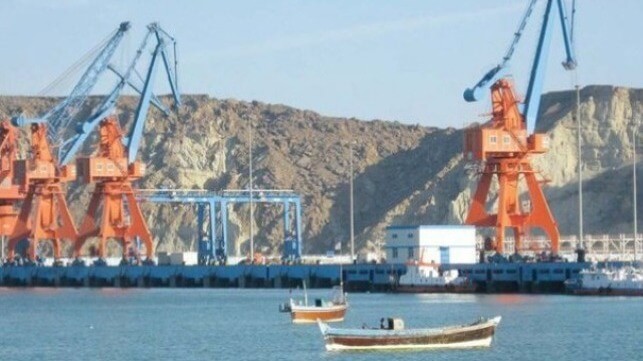
Chinese-funded infrastructure at the port of Gwadar, Pakistan

Published Sep 15, 2024 9:45 PM by Dialogue Earth


[By Atika Rehman]

More than 50 people were killed in late August during multiple attacks in Pakistan’s impoverished southwestern province of Balochistan. Despite extensive infrastructure investments made in the region, mostly through the China-Pakistan Economic Corridor (CPEC), a decades-long insurgency has only intensified, raising concerns about the sustainability of ongoing and future investments.

What is CPEC?

The attacks in Balochistan follow a similar pattern. Separatist militant groups, such as the banned Balochistan Liberation Army (BLA) and Balochistan Liberation Front (BLF), have long targeted Pakistani security forces and Chinese nationals, accusing them of exploiting the province’s resources. In Gwadar, home to the port often hailed as the crown jewel of the Belt and Road Initiative (BRI), resentment is growing among local communities, particularly fishermen, who have protested against the construction and the lack of basic amenities like water and electricity in their city.

Despite these challenges; there is little evidence that either Pakistan or China will abandon CPEC, with policymakers from both countries continuing to tout it as a “game-changer.” However, the reality on the ground is one that falls short of the lofty claims promoted by officials. Although some energy and infrastructure projects have been completed, CPEC is hardly the vibrant trade route it was billed to be.

Energy projects hit roadblocks

A key issue remains energy. Last year, Pakistan experienced an enormous blackout, a symptom of its creaky infrastructure and decades of underinvestment. Many of the CPEC energy projects, such as the Suki Kinari hydropower project and a coal power plant in Thar, were designed to address chronic energy shortages. Yet, according to Haneea Issad, an energy finance specialist at the Institute for Energy Economics and Financial Analysis (IEEFA), the issues run far deeper than simply building more plants.

“The government currently owes Chinese IPPs capacity payments to the tune of a billion dollars,” Issad told Dialgoue Earth. “Any investor owed such a huge sum would be wary of further investments after this.” She added: “There is also the issue of surplus capacity on the national grid and a shrinking consumer demand amidst slow economic and industrial growth. With the grid’s inability to absorb any new power projects, there aren’t many avenues for new investment opportunities opening up. From the Pakistan government’s end, it doesn’t have any more fiscal space to bring on any imported fuel-based new capacity, at least not on the traditional ‘take or pay’, fixed-price contractual model.”

Given these constraints, Issad argues that “any new contracts on the same model will not be feasible for both sides.”

CPEC: A multi-billion project in a struggling province

Perhaps more importantly, CPEC projects have yet to deliver meaningful benefits to the people of Balochistan, a province that makes up 44% of Pakistan’s land mass. According to the UNDP, Balochistan has the second highest headcount for multi-dimensional poverty out of all the provinces at 71.2%. It also has the lowest literacy rate in the country, especially among women.

Two energy projects under CPEC are located in Balochistan; both are troubled. The first, a 300 MW imported coal power project in Gwadar has yet to be built and there is speculation the project will be shelved due to financing challenges. Meanwhile, the China Power Hub Generation Company’s 1,320MW coal-fired plant at Hub has faced frequent liquidity problems, shattering investor confidence and leading to appeals for intervention from the Chinese ambassador to the prime minister.

Of the two road projects in Balochistan, the Khuzdar-Basima road has been built, but the second road from DI Khan to Zhob is not yet complete.

The BRI’s flagship project, the Gwadar port, is operational but has, thus far, failed to attract significant economic activity. It remains far from the bustling transshipment hub officials envisioned would “connect South Asia to the world.” Gwadar Airport, though reportedly complete, has yet to be inaugurated due to persistent security threats.

‘We don’t let saboteurs sabotage it ’

Over the years, militant groups have frequently threatened China against pursuing its development objects in the region via video messages. These groups have carried out numerous attacks, including assaults on Chinese engineers, an attack on the Chinese consulate in Karachi and the killing of three Chinese teachers.

In response, both Pakistan and China have reaffirmed their commitment to counter-terrorism and continued development. Pakistan’s defence minister, Khawaja Muhammad Asif, told Dialogue Earth: “The Chinese are invested and will not desert us. Of course, they have security concerns — it’s not just financial for them, it also involves Chinese workers on the ground. From Khunjerab to Gwadar, Chinese workers are present, making it a serious matter.”

Ahsan Iqbal, Pakistan’s minister for planning and development, expressed a similar sentiment, adding: “The Chinese understand that these incidents are isolated and they know that the forces behind them are trying to disrupt CPEC. We won’t let saboteurs succeed.”

Nonetheless, the persistent militant attacks have added pressure on CPEC projects, according to security expert Amir Rana. He pointed out that a recent high-level meeting between Pakistan’s army chief, the prime minister and Chinese president Xi Jinping featured security as “the foremost topic”.

He said: “They returned [from China] and announced ‘Azm-e-Istehkam’ [a military operation] ostensibly in response to Afghanistan, but it also reflects Chinese interest in making Balochistan safe — where the threat is highest and attacks are frequent.”

Rana added that resolving the insurgency in Balochistan and the ensuing militant attacks is far from straightforward: “It’s complicated because it’s not just a terrorist threat [and has] political elements.” On Pakistan’s response, he said “the political part of the resolution is missing.”

A pivot towards ‘Smart CPEC’

China, meanwhile, has adjusted its approach to investment in Pakistan in light of these challenges. Shahid Khaqan Abbasi, former secretary general of the Pakistan Democratic Movement coalition that governed the country from April 2022 to August 2023, noted that China had shifted away from large-scale infrastructure projects with long-term payoffs.

“Earlier in the CPEC process there was joint identification, feasibility and due diligence of potential projects and investments. But then the Chinese focus shifted to smaller and sharper interventions with quick returns; which was sometimes referred to as ‘smart CPEC’, i.e. not large infrastructure projects with long gestation periods, but smaller ones with faster results,” he explained.

At the third Belt and Road Forum in October 2023, president Xi placed great emphasis on “small yet smart” projects as part of BRI. These investments, focusing on a thousand small-scale livelihood programmes, aim to address local needs through targeted, manageable projects.

An Islamabad-based politician, speaking on condition of anonymity, said that Chinese business leaders had revealed unofficial instructions from their government to avoid investing in long-term projects. “They’ve been told to continue investing in Pakistan but to select projects that are near-ready or already operational with revenue streams. The direction changed after the slow pace and poor returns on existing projects,” he said.

This pivot reflects a broader reset in China’s overseas investment strategy, according to Isabel Hilton, founder of China Dialogue (which became Dialogue Earth in 2024) and visiting professor at King’s College London.

“Large-scale BRI investments peaked around 2017, as many of the projects became problematic for a number of reasons,” she told Dialogue Earth. “Last year, the 10th anniversary of BRI was a relatively subdued affair and today Beijing stresses a different development model — the Global Development Initiative. Chinese banks and government entities have become much more cautious in their lending and finance policies, and there is a much greater realization that due diligence matters in a world of low growth and mounting levels of debt.”

Atika Rehman is a deputy editor at Source Material, which carries out investigations around climate change, corruption and democracies. Prior to that, Atika was Dialogue Earth’s South Asia deputy editor. She is a journalist with over a decade of experience working in Pakistan.

This article appears courtesy of Dialogue Earth and may be found in its original form here

The opinions expressed herein are the author's and not necessarily those of The Maritime Executive.