Friday, February 21, 2025

'We’re gonna do it': Commerce Secretary gives away Trump’s game plan on cutting Medicaid


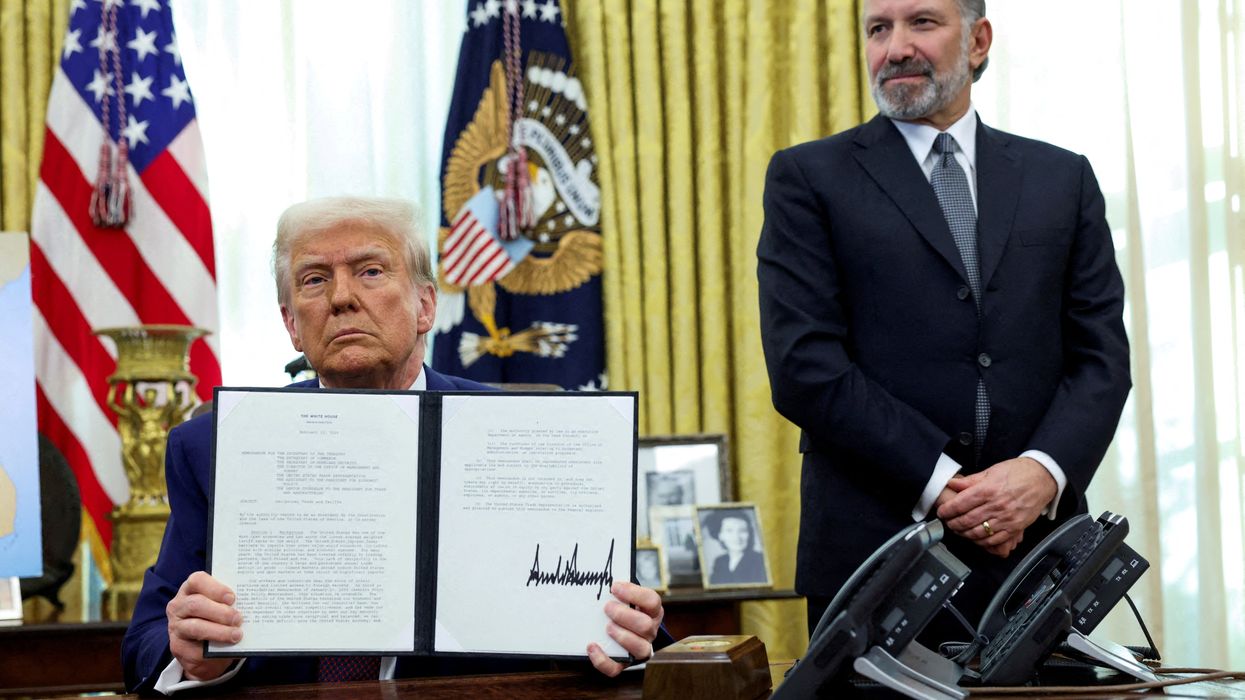
U.S. President Donald Trump holds an executive order about tariffs increase, flanked by U.S. Commerce Secretary Howard Lutnick, in the Oval Office of the White House in Washington, D.C., U.S., February 13, 2025. REUTERS/Kevin Lamarque//File Photo


Although Trump promised not to touch Medicare, Medicaid, and Social Security last week, his new billionaire Commerce Secretary, Howard Lutnick, has now said otherwise.

“Social Security won’t be touched, other than if there’s fraud or something. It’s going to be strengthened. Medicare, Medicaid — none of that stuff is going to be touched,” Trump said last week.

Trump has also said he would "love and cherish" the programs. “We’re not going to do anything with that, unless we can find some abuse or waste,” he added. “The people won’t be affected. It will only be more effective and better.”

READ MORE: 'Inaccuracies' on DOGE website suggest Trump admin is taking credit for cuts they did not make

Lutnick, who was co-chair of Trump’s transition team, said otherwise

“When I set up DOGE with Elon, so back in October … I flew down to Texas, got Elon Musk to do it [set up DOGE], and here was our agreement: that Elon was gonna cut a trillion dollars of waste fraud and abuse,” Lutnick told Fox News’ Jesse Waters Wednesday.

“Think about it. We have almost $4 trillion of entitlements, and no one’s ever looked at it before. You know Social Security is wrong, you know Medicaid and Medicare are wrong. So he’s gonna cut a trillion and we’re gonna get rid of all these tax scams that hammer against America and we’re gonna raise a trillion dollars of revenue,” he continued.

“And our objective under Donald Trump is to balance this budget and I’m telling you, you watch and we’re gonna do it,” he said.

READ MORE: Busted: DOGE took credit for canceling $8 billion contract — but it was really $8 million

House Republicans’ budget plan, which Trump has endorsed, includes billions of cuts to Medicaid in order to finance Trump’s tax plan.

“Maybe he was lying during his Fox interview. Maybe he doesn’t know what’s in the House GOP plan he endorsed. Maybe he assumes the public won’t notice the contradiction,” writes Steve Benen at MSNBC. "Whatever the explanation, Trump’s incoherence both complicates his own party’s legislative strategy and imperils the future of a health care program that helps protect tens of millions of Americans," he added.

About 79 million people are enrolled in Medicaid, according to NPR.

"The level of cuts being discussed would be incredibly damaging and catastrophic for our hospitals," said Beth Feldpush, senior vice president of policy and advocacy at America's Essential Hospitals, a trade group, told NPR.


Musk hints at cutting $500 billion from 'entitlements' like Social Security and Medicare

REUTERS/Nathan Howard
Elon Musk gestures onstage as he attends the Conservative Political Action Conference (CPAC) in National Harbor, Maryland, U.S., February 20, 2025.

February 21, 2025
ALTERNET

Editor's note: This article has been updated to include a statement from Social Security Works.

Tesla and SpaceX CEO Elon Musk — whose net worth is just shy of $400 billion — just dropped a hint that he may be eyeing significant cuts to earned benefits programs like Social Security and Medicare in the future.

During his Thursday appearance at the Conservative Political Action Conference (CPAC), Musk was asked about his "Department of Government Efficiency," or DOGE (which is not yet an official federal agency authorized by Congress) project, and about the scope of spending cuts he aimed to implement. The South African centibillionaire asserted to NewsMax anchor Rob Schmitt — who interviewed him on stage — that "waste" was "pretty much everywhere."

"People ask how can you find waste in D.C., it's like being in a room and the wall, the roof and the floors are all targets," he said. "You can shoot in any direction. You can't miss."

READ MORE: 'Time to think of Plan B': Musk ripped after forcing out Social Security chief

Schmitt then asked Musk specifically about his plans for the Social Security Administration, which DOGE representatives have already reportedly accessed. Schmitt referenced "$72 billion in waste in seven years," while Musk seemingly alluded to hundreds of billions of dollars in supposedly wasteful spending.

"I think that the rough estimate from the Government Accountability Office is over $500 billion a year. $500 billion. With a B. Per year," Musk said.

"On Social Security?" Schmitt asked.

"On all entitlements. All entitlements, yeah," Musk responded, using a catch-all term to describe mandatory spending like Medicare and veterans' benefits.

READ MORE: Top Treasury official quits as Musk allies seek to control Social Security, Medicare payments

Musk insisted during the interview that millions of dead Americans are still getting Social Security payments, including Americans who are allegedly hundreds of years old. ABC 7 New York debunked that claim, and pointed out that Musk was misreading Social Security Administration data. One of the agency's databases includes every American who has ever been issued a Social Security number, and no date of death has been listed for many of those Americans as they died before electronic records were established.

ABC 7 reported that of the roughly 67 million Americans currently receiving Social Security benefits, only 0.1% of them are over 100 years old. And while there are occasional fraudulent payments, that accounts for less than 1% of total spending and is usually in the form of overpayments to living beneficiaries.

"When Donald Trump ran for president, he blanketed swing states in flyers pledging to protect Social Security, Medicare, and Medicaid. Now, Trump has empowered Elon Musk to slash $500 billion a year from these vital benefits," Social Security Works communications director Linda Benesch told AlterNet. "But Congress has the power to stop him. We urge everyone to call their members of Congress and demand that they pledge one penny in cuts to Social Security, Medicare or Medicaid."

According to figures from the Congressional Budget Office (CBO), the federal government had approximately $3.8 trillion in mandatory spending obligations in Fiscal Year 2023, which included $1.3 trillion for Social Security and $839 billion for Medicare. Beneficiaries of those programs have their eligibility and benefit formulas set by federal statute, meaning it would take an act of Congress to change it.

READ MORE: 'Allow some of this to be privatized': GOP gov admits goal of DOGE is to gut Social Security


Watch the segment of Musk's comments below, or by clicking this link.

'No one is calling me back': Trump USDA funding freeze causing farmers major hardship


Mondovi, WI USA September 28, 2020 Farmer John with his John Deere 3020 Tractor holding out a Trump Banner and also an American Flag on the tractor.


Alex Henderson
February 21, 2025
ALTERNET

Donald Trump generally performed well among farmers in the 2024 election, winning Iowa, Nebraska, Kansas, Indiana and other farming states. But now that President Trump is back in the White House, Democrats are warning that his policies will hurt farmers badly — including aggressive tariffs and mass deportations.

Another problem that farmers are facing during Trump's second presidency, according to the Washington Post, is a U.S. Department of Agriculture (USDA) funding freeze.


Post reporters Daniel Wu and Gaya Gupta, in an article published on February 20, explain, "The Post spoke with farmers and farm organizations in 10 states who had contacted their congressional delegations about the USDA funding freeze. Some farmers from conservative-leaning districts said they have received no reply. Others said they were told that their representatives supported the (Trump) Administration's decision — and some representatives appeared to suggest that Trump's funding freeze was not affecting farmers at all. A federal judge, last week, ordered the Agriculture Department to release all withheld funds, but the farmers The Post spoke to said they had not yet received any of that money."

READ MORE:'Helpless' GOP lawmakers dislike Trumps 'indiscriminate firing' — but fear the White House won't listen

One of the farmers the Post interviewed was Iowa-based Shanon Jamison, who specializes in corn and soybeans. In late January, according to Wu and Gupta, Jamison found out "that her $69,000 federal reimbursement for a cover crop to boost soil health and slow erosion was frozen due to an executive order from President Donald Trump."


Wu and Gupta report, "Some of those farmers have been stymied by members of Congress backing Trump. In Maryland, Laura Beth Resnick contacted Rep. Andy Harris (R) to make sure the USDA would fulfill a contract to help fund the installation of solar panels on her flower farm in Harford County…. Hoppy Henton, who farms corn, soybeans, wheat and cattle in Woodford County, Kentucky, said he had several USDA-funded projects underway on his farm, including erecting new fencing and managing a pasture rotation. He said he is owed more than $20,000, which he has yet to receive."

According to Wu and Gupta, Henton "made several attempts to contact Rep. Andy Barr (R) and his staff about the issue."

Henton told the Post, "No one is calling me back….. The silence is deafening."


US Public Service Unions and State Democracy Defenders Fund Challenge Unlawful, Mass Federal Firings


AFSCME  PRESS RELEASE
FEBRUARY 20, 2025


Some of the nation’s largest public service unions have filed a lawsuit seeking to block the unlawful mass terminations of probationary federal employees, which was directed by the Office of Personnel Management (OPM) and its Acting Director, Charles Ezell. They allege that the firings “represent one of the most massive employment frauds in the history of this country.” In federal service, new employees and employees who change positions (including through promotions) have probationary status. The unions claim that OPM is exploiting and misusing the probationary period to eliminate staff across federal agencies and are asking for an injunction to stop further terminations – and to rescind those that have already been executed.

The plaintiffs in this case consist of the American Federation of Government Employees, AFL-CIO; the American Federation of State, County and Municipal Employees, AFL-CIO; AFGE Local 1216; and United Nurses Associations of California/Union of Health Care Professionals, AFSCME, AFL-CIO. They are represented byState Democracy Defenders Fund (SDDF)and the law firm Altshuler Berzon LLP.

The complaint says that OPM’s egregious firings were made on false pretenses and violate federal law, including the Administrative Procedure Act and other statutes defining federal employment and OPM's role. These firings were executed across federal agencies, based on directives from OPM. OPM, the complaint asserts, acted unlawfully by directing federal agencies to use a standardized termination notice falsely claiming performance issues. Congress, not OPM, controls and authorizes federal employment and related spending by the federal administrative agencies, and Congress has determined that each agency is responsible for managing its own employees.

“This administration has abused the probationary period to conduct a chaotic, ill-informed, and politically-driven firing spree. The result has been the indiscriminate firing of thousands of patriotic public servants across the country who help veterans in crisis, ensure the safety of our nuclear weapons, keep power flowing to American homes, combat the bird flu, and provide other essential services,” said AFGE National President Everett Kelley. “These actions aren’t just illegal. They are hurting everyday Americans and making us all less safe. It’s a stark reminder of the price we all pay when you stack the government with political loyalists instead of professionals.”

“Overnight, tens of thousands of federal employees received the same termination letter citing ‘performance issues’ without any explanation or reasoning,” said AFSCME President Lee Saunders. “These mass firings are yet another unlawful attempt by this billionaire-run administration to gut public services without regard for the health and safety of our communities. Federal workers are qualified professionals who make our nation stronger – supporting our schools, parks, hospitals and vital infrastructure. We will keep fighting these attacks on their freedoms that threaten everything from food safety to national security to health care.”

“New hires are crucial as our country continues to face nurse staffing challenges. Indiscriminately firing these nurses, who are essential to the care their units provide, could truly cost lives,” said Charmaine S. Morales, RN and UNAC/UHCP President.

Norm Eisen, representing the plaintiffs and executive chair of State Democracy Defenders Fund, said, “SDDF is proud to stand with leading public service unions in this critical fight to protect their members, who dedicate their lives to serving our nation. The mass firings ordered by OPM are illegal and betray the trust of countless federal employees. We are committed to restoring justice for these workers.”


The complaint is available here.
'Blatant Conflict': Fired FDA Workers Were Reviewing Musk's Neuralink

"DOGE operatives should stop interfering with the FDA's public health mission of assuring the safety and effectiveness of drugs and medical devices," said a doctor at one watchdog group.


The Neuralink logo is with a brain chip visible in the background in this photo illustration on January 30, 2024.
(Photo: Jonathan Raa/NurPhoto via Getty Images)

Jessica Corbett
Feb 19, 2025
COMMON DREAMS

A U.S. watchdog group and other critics are responding with alarm to reporting that federal employees reviewing applications related to a brain implant developed by Elon Musk's company Neuralink are among those fired as part of the billionaire and President Donald Trump's sweeping mission to gut the government workforce.

Despite business conflicts and a recent White House court declaration that generated some confusion, Musk is the head of Trump's so-called Department of Government Efficiency (DOGE), which has infiltrated and is working to purge employees from several agencies—including the U.S. Food and Drug Administration (FDA), according toReuters.


Citing two unnamed sources, the news agency reported Monday that "the cuts included about 20 people in the FDA's Office of Neurological and Physical Medicine Devices, several of whom worked on Neuralink... That division includes reviewers overseeing clinical trial applications by Neuralink and other companies making so-called brain-computer interface devices."

While the sources "said they did not believe the employees were specifically targeted because of their work on Neuralink's applications," they and other experts warned the firings "will hamper the agency's ability to quickly and safely process medical device applications of all sorts," Reuters noted.


Dr. Robert Steinbrook, director of Public Citizen's Health Research Group, said in Wednesday statement that "regardless of the reasons the FDA medical device center employees were fired, Elon Musk and the so-called Department of Government Efficiency have a blatant conflict of interest because the agency's Center for Devices and Radiological Health is regulating the implantable brain-computer interface made by one of Musk's companies."

"Moreover, by eviscerating the FDA's device staff, DOGE operatives are impeding the vital work of protecting the participants in the Neuralink trial and protecting the public from medical devices that are harmful or don't work," he continued. "Paradoxically, with fewer staff, the FDA's review of the Neuralink device may be impeded, which makes no sense."

"DOGE operatives should stop interfering with the FDA's public health mission of assuring the safety and effectiveness of drugs and medical devices," Steinbrook added. "This is yet the latest example of how Musk's involvement with DOGE undermines federal regulators, from the Consumer Financial Protection Bureau to the FDA."

  
Various reports from the past month have highlighted how Trump's return to power has benefited Musk and his businesses, including SpaceX and the publicly traded electric vehicle maker Tesla.

As Gizmododetailed Tuesday:
Neuralink in particular seems to have benefited from efforts to squash watchdogs. Last month, the inspector general at the U.S. Department of Agriculture had to be removed from her office by security after refusing to comply with her termination, which she believed was illegal. She happened to be heading up an investigation into Neuralink looking into whether the company was violating animal welfare rules related to its tests on animal subjects.

The FDA, too, has been looking into similar issues. Last year, the agency found that Neuralink's animal labs engaged in "objectionable conditions or practices" and urged the company to address the issues—but did not issue any punitive actions related to the investigation.

Neuralink and the FDA also had a standoff over allowing the company to move forward with human trials, a request that the FDA rejected over safety risks in 2022 before finally allowing limited trials to move forward a year later. In 2024, the FDA even gave Neuralink its "breakthrough device" designation, which allows for a speedier review process. The only thing faster might be no review at all.


A Quinnipiac University national poll released Wednesday shows that 50% of registered voters across the political spectrum have an unfavorable opinion of Musk, 54% disapprove of the richest person on Earth "playing a prominent role in the Trump administration," and 55% think he "has too much power in making decisions affecting the United States."
The Trump Admin Is Engaging in Corruption on a Massive Scale to Benefit Big Oil

By censoring and defunding climate science, Trump and his cronies are trying to erase the link between extreme weather impacts and fossil fuel pollution.


Protesters gather outside of the Lincoln Memorial during the "People's March" in Washington, D.C., on January 18, 2025, two days ahead of the inauguration of US President-elect Donald Trump.
(Photo: Kia Rastar/Middle East Images/AFP via Getty Images)


Basav Sen
Feb 21, 2025
OtherWords


Among the flurry of actions by the Trump administration, it could be easy to miss one that poses a grave danger to public health and our planet: a no-holds-barred attack on science.

In a series of disturbing moves, the administration has censored scientific research, slashed resources for public health and the environment, and advanced fossil fuel industry propaganda. These moves only serve corporate interests—at the expense of ordinary people and the planet.

Already, the administration has scrubbed government websites providing information on climate change and environmental justice. And it’s attempted to slash funding for research on climate and medical science (though a federal judge has temporarily blocked the defunding of medical research).

An administration claiming to crack down on “fraud, waste, and abuse” in government is doing the opposite.

Meanwhile, in a pair of astonishingly irresponsible moves, the administration has fired a large number of staff of the Epidemic Intelligence Service, which identifies and tracks emerging epidemics, and pulled the U.S. out of the World Health Organization— even as we face the serious risk of a worldwide bird flu pandemic.

On the climate front, President Donald Trump has launched an ideological attack against the very idea of environmental justice. That’s the idea that marginalized communities—including people of color and poor people of all races—suffer the worst from pollution. There’s a large body of peer-reviewed scientific literature confirming this pattern, but Trump and his ideologues don’t care.

Elsewhere, Trump’s Energy Secretary—former fossil fuel executive Chris Wright—has made the outlandish claim that electricity in the U.S. is more expensive today, and the electric grid is less reliable, because of closure of coal-fired power plants.

Every part of this industry propaganda is verifiably false. The U.S. electricity grid is highly reliable. While electricity rates are rising, the increase over the 10-year period from 2013 to 2023 was only about 1% in inflation-adjusted terms.

If anything, coal plant retirements were a factor in keeping rates lower, since the plants being retired are older plants with higher operating costs. And this year, solar energy is expected to be a major contributor to keeping rates almost unchanged.

Significantly, every one of these facts comes from the Energy Department’s own research and data. That’s why we shouldn’t let them scrub it.

The administration’s erasure of data has profound human consequences.

According to the Intergovernmental Panel on Climate Change (IPCC), the foremost international climate science institution, “Human-induced climate change, including more frequent and intense extreme events, has caused widespread adverse impacts and related losses and damages to nature and people,” including “reduced food and water security.”

These statements are in the present tense. Severe climate change impacts are already occurring, and will get much worse if we don’t slash our greenhouse gas emissions rapidly. Disasters like this year’s Los Angeles wildfires and last year’s floods in Appalachia and the Southeast will become more frequent and damaging.

By censoring and defunding climate science, Trump and his cronies are trying to erase the link between these impacts and fossil fuel pollution. Trump has been effectively bribed by fossil fuel oligarchs—and he’s returning the favor by making it official U.S. government policy to remove all restraints on the growth of their industry.

Under Biden, fossil fuel companies reported record profits as drilling reached record highs in the United States. Yet consumers still battled high gas prices and other costs. Under Trump, doing favors for this polluting industry is no likelier to benefit regular people.

An administration claiming to crack down on “fraud, waste, and abuse” in government is doing the opposite. It’s engaging in corruption on a massive scale to benefit wealthy, politically connected oligarchs—at the expense of the rest of us.


Basav Sen is the climate justice project director at the Institute for Policy Studies (IPS) and writes on the intersections of climate change and social and economic justice. Prior to joining IPS, Basav worked for 11 years as a campaign researcher for the United Food and Commercial Workers.
Full Bio >


Trump Moves to Fast-Track 100+ Dirty Fossil Fuel Permits Under 'Fake' Energy Emergency

"Trump's promise to cut Americans' energy bills is a lie," said one campaigner.


Climate activists and Indigenous community members gather on the river for a traditional water ceremony during a rally and march to protest the construction of Enbridge Line 3 pipeline in Solvay, Minnesota on June 7, 2021.
(Photo: Kerem Yucel/AFP via Getty Images)


Common Dreams Staff
Feb 19, 2025

With more than 100 permits for oil pipeline projects and gas-fired power plants likely to be fast-tracked under U.S. President Donald Trump's so-called "energy emergency" declaration, consumer advocates on Wednesday called on lawmakers and state officials to stand up to the president's "bullying" and block his efforts to build pollution-causing fossil fuel projects—and slow clean energy progress.

"Trump's declaration of a sham energy emergency attempts to set into motion the weaponization of national security law to dismantle generations of public health and safety protections," said Tyler Slocum, director of Public Citizen's energy program. "The ultrawealthy fossil fuel executives who donated huge sums to Trump's campaign see this fraudulent emergency declaration as an opportunity to destroy the remarkable progress of wind and solar development, while maximizing fossil fuel exports and domestic consumption."

Trump signed a day-one executive order claiming that the U.S. faces an "energy emergency" and must "unleash" fossil fuel production—which has already been on the rise in recent years despite clear warnings from scientists that oil, gas, and coal extraction must end in order to avoid catastrophic planetary hearing.

"Trump's national energy emergency is a sham."

The U.S. Army Corps of Engineers cited that order in recent days when it created a new "emergency" designation for infrastructure project permits, paving the way for officials to push forward nearly 700 pending applications, including more than 100 for fossil fuel projects.

Clean Water Action toldThe New York Times that one major project it has fought against, Canadian firm Enbridge's Line 5 pipeline, which the company wants to build under the Mackinac Straits, could threaten the Great Lakes and tens of millions of people who rely on them for drinking water.

"If this is pushed through on an emergency permit, the implications of an oil spill if there's an explosion or something during tunnel construction is that over 700 miles of Great Lakes shoreline could be at risk," Sean McBrearty, Michigan policy director for Clean Water Action, told the Times.

"If approved, this project will risk our fresh water and the millions of people who rely on it for drinking, jobs, and tourism in exchange for a foreign oil company's profits," added McBrearty.

On Wednesday, U.S. Sens. Tim Kaine (D-Va.) and Martin Heinrich (D-N.M.)—who earlier this month introduced a resolution challenging Trump's emergency declaration—held a Capitol Hill press conference with environmental leaders.


"We are producing more energy now than at any other point in our history, and the U.S. is the envy of the world when it comes to energy innovation and production," Kaine said at the event. "The passage of the Bipartisan Infrastructure Law and Inflation Reduction Act have accelerated clean energy projects and created jobs, and we are on an amazing trajectory."

"Trump's sham emergency threatens to screw all of that up," Kaine added. "Why? Because he'd rather benefit Big Oil and suspend environmental protections than lower costs and create jobs for the American people. I hope my colleagues will join me in voting to terminate President Trump's emergency."

Heinrich said: "Trump's fake emergency declaration is causing enormous uncertainty. If you're thinking about opening a new factory, you don't know what your tax structure will be in the next 12 months. If you're trying to site and build a new transmission line, the federal agencies you work with just had a ton of their expert staff sacked, making it more difficult to get a permit."

"This is going to kill skilled trades jobs and drive up the cost of your electricity bills by as much at $480 a year by 2030," the senator added. "Trump's war on affordable, American-made energy is killing jobs and raising costs on working families."

Slocum urged senators to back Kaine and Heinrich's resolution.

"Trump's promise to cut Americans' energy bills is a lie, as every action under the fraudulent energy emergency would subject Americans to higher energy burdens," he said on Wednesday. "Having senators support Senate Joint Resolution 10 is a first step, but every governor of states in the Northeast and West Coast targeted by Trump's phony emergency order needs to stand up to his bullying."

Note: The headline of this article has been changed to reflect that President Donald Trump's executive order moved to expedite the permit approval process rather than fast-tracking projects.


Study Shows Glaciers Have Lost '3 Olympic Swimming Pools Per Second' Since 2000

One researcher said the findings support calls "for urgent and concrete actions to reduce greenhouse gas emissions and associated warming."


This photo, taken on June 22, 2024, shows a melting glacier in Svalbard, Norway.
(Photo: Zhao Dingzhe/Xinhua via Getty Images)

Jessica Corbett
Feb 20, 2025
COMMON DREAMS

An international science project on Wednesday published a study in the journal Nature showing that glaciers have lost an average of 273 billion metric tons of ice annually since 2000—depleting freshwater resources, driving sea-level rise, and underscoring the need for sweeping global action to significantly reduce planet-heating pollution.

The Glacier Mass Balance Intercomparison Exercise (GlaMBIE) team compiled major studies to estimate global mass change from 2000, when glaciers—excluding Antarctica and Greenland's ice sheets—held about 121,728 billion metric tons of ice, to 2023.

The researchers found that during that period, the world lost 5% of all glacier ice, with regional losses for the full two decades ranging from 2% on the Antarctic and Subantarctic islands, to 39% in Central Europe.


That's a loss of 6,542 billion metric tons total or 273 billion metric tons per year, "the equivalent of three Olympic swimming pools per second," noted France's National Center for Scientific Research (CNRS).

Glaciologist Michael Zemp, who co-led the study, said in a statement that the annual figure "amounts to what the entire global population consumes in 30 years, assuming three liters per person and day."

"Every tenth of a degree warming that we avoid saves us money, saves us lives, saves us problems."

Although the researchers highlighted the annual average, they also emphasized that the rate of glacier ice loss "increased significantly" from 231 billion metric tons annually during the first half of the study period to 314 billion metric tons per year in the second half. In other words, the amount of ice being lost surged by 36% between the two ranges.

Zemp, a professor at Switzerland's University of Zurich and director of the World Glacier Monitoring Service, toldAgence France-Presse that the findings are "shocking" and warned that many smaller glaciers "will not survive the present century."

Stephen Plummer, an Earth observation applications scientist at the European Space Agency, said that "these findings are not only crucial for advancing our scientific understanding of global glacier changes, but also provide a valuable baseline to help regions address the challenges of managing scarce freshwater resources and contribute to developing effective mitigation strategies to combat rising sea level."

The ice loss over the GlaMBIE study's full timeline led to about 18 mm or 0.7 inches of sea-level rise. The researchers projected future losses that lead to 32-67 mm, or 1.26-2.6 inches, of sea-level rise by 2040.

"We are facing higher sea-level rise until the end of this century than expected before," Zemp told AFP, referring to the latest projection from the United Nations Intergovernmental Panel on Climate Change (IPCC).

"You have to reduce the greenhouse gas emissions, it is as simple and as complicated as that," Zemp said. "Every tenth of a degree warming that we avoid saves us money, saves us lives, saves us problems."

The GlaMBIE project manager, Samuel Nussbaumer, similarly toldOceanographic, that "our observations and recent modeling studies indicate that glacier mass loss will continue and possibly accelerate until the end of this century," which underpins the IPCC's "call for urgent and concrete actions to reduce greenhouse gas emissions and associated warming to limit the impact of glacier wastage on local geohazards, regional freshwater availability, and global sea-level rise."


The team's findings were released during the U.N.'s International Year of Glaciers' Preservation and the Decade of Action for Cryospheric Sciences—and they "will feed into the next IPCC report, due in 2029," according to CNRS.

Scientists from around the world who were not involved with the study were alarmed by its revelations—which come after the hottest year in human history and amid humanity's failure to curb planet-heating emissions, largely from fossil fuels.

Martin Siegert, a professor at the United Kingdom's University of Exeter, said in a statement that "this research is concerning to us, because it predicts further glacier loss, which can be considered like a 'canary in the coal mine' for ice sheet reaction to global warming and far more sea-level rise this century and beyond. The IPCC indicates 0.5-1 meters this century—but that is with a 66% certainty—hence 1/3 chance it could be higher under 'strong' warming, which unfortunately is the pathway we are on presently."

Andrew Shepherd, a professor at Northumbria University, another U.K. institution, explained that "glacier melting has two main impacts; it causes sea-level rise and it disrupts the water supply in rivers that are fed by meltwater."

"Around 2 billion people depend on meltwater from glaciers and so their retreat is a big problem for society—it's not just that we are losing them from our landscape, they are an important part of our daily lives," he said. "Even small amounts of sea-level rise matter because it leads to more frequent coastal flooding. Every centimeter of sea-level rise exposes another 2 million people to annual flooding somewhere on our planet."

Michigan appeals court upholds permits for Great Lakes pipeline tunnel project

By The Associated Press
February 20, 2025 

fresh nuts, bolts and fittings are ready to be added to the east leg of the pipeline near St. Ignace, Mich., as Enbridge Inc., prepares to test the east and west sides of the Line 5 pipeline under the Straits of Mackinac in Mackinaw City, Mich. (Dale G Young/Detroit News via AP, File)


Enbridge Energy’s plans to build a protective tunnel around an aging pipeline that runs beneath a channel connecting two Great Lakes can continue, a Michigan appeals court ruled.

The state Public Service Commission properly issued permits for the $500 million project, the Michigan Court of Appeals ruled Wednesday in rejecting arguments from environmental groups and Native American tribes that commissioners failed to consider the overall need for the pipeline.

Tunnel would encase pipeline in the Straits of Mackinac

Enbridge wants to build a protective tunnel around a 4-mile (6-kilometer) section of its Line 5 pipeline that runs along the bottom of the Straits of Mackinac, which link Lake Michigan and Lake Huron.

Enbridge has been using the pipeline since 1953 to transport crude oil and natural gas liquids between Superior, Wisconsin, and Sarnia, Ontario.

Concerns about a potentially catastrophic spill in the straits have been building since 2017, when Enbridge officials revealed that engineers had known about gaps in the pipeline’s coating in the straits since 2014. Fears of a spill escalated in 2018 when a boat anchor damaged the line.

Enbridge officials maintain that the line is structurally sound, but they still reached an agreement with then-Michigan Gov. Rick Snyder’s administration in 2018 that calls for the company to build the protective tunnel.
Environmental groups, tribes challenge state permits

The Michigan Public Service Commission issued state permits for the project in December 2023.

Environmental groups including the Michigan Environmental Council and the National Wildlife Federation, along with the Little Traverse Bay Bands of Odawa Indians, Bay Mills Indian Community, Grand Traverse Band of Ottawa and Chippewa Indians, and the Nottawseppi Huron band of the Potawatomi asked the appellate court last year to reverse the commission’s decision.

The groups and the tribes alleged that the commission improperly considered only the public need for the tunnel rather than whether the entire pipeline as a whole is still necessary.

They also argued the commission failed to adequately consider petroleum products' greenhouse gas impacts.
Court: Commission acted reasonably

The appellate court found that the commission issued a “comprehensive” opinion and acted reasonably. It said there was no basis for a reversal or to order the commission to revisit its decision.

David Scott, a senior attorney for the Environmental Law & Policy Center and the Michigan Climate Action Network, which are also plaintiffs in the case, said in an email that he was disappointed with the ruling and considering further moves. He didn’t elaborate.

Environmental law firm Earthjustice represented the tribes in the case. Adam Ratchenski, an attorney with the firm, said that regardless of the appellate ruling, it was “backwards and dangerous” for the commission to approve the tunnel without truly considering whether Michigan residents need it.

“Nobody wants their water poisoned or their property values torpedoed in order to keep Canadian oil and gas flowing through the Great Lakes,” he said.


Enbridge spokesperson Ryan Duffy praised the appellate ruling, saying the tunnel will make a safe pipeline even safer.
The legal fight isn’t over

The ruling Wednesday doesn’t end the legal battle over the tunnel. Current Michigan Gov. Gretchen Whitmer, a Democrat, opposes the continued operation of Line 5 even if it’s encased in a tunnel.

Democratic Attorney General Dana Nessel filed a lawsuit in 2019 seeking to void the easement that allows the line to run beneath the straits. That case is pending in state court in Ingham County. A ruling could come any day.

Enbridge would still need a permit from the Michigan Department of Environment, Great Lakes and Energy as well as federal construction permits from the U.S. Army Corps of Engineers before construction could begin.

Environmentalists fear that President Donald Trump’s administration will fast-track that process after Trump declared a national energy emergency on his first day in office.

Todd Richmond, The Associated Press
Case That Could Inflict 'Financial Ruin' on Greenpeace Heads to Trial

"This fight is bigger than Greenpeace. This lawsuit is a blatant attempt to silence critics and hide destructive practices," said the campaign director of Greenpeace USA.


A Greenpeace USA projection on a building in Washington, D.C. on February 14, 2025.
(Photo: Tim Aubry/Greenpeace)


Eloise Goldsmith
Feb 20, 2025
COMMON DREAMS

With a high-stakes court trial between the environmental organization Greenpeace and the developer of the Dakota Access Pipeline, Energy Transfer, set to begin Monday, the green group earlier this month lit up multiple locations in both Dallas and Washington, D.C. with giant projections that displayed messages such as, "You Can't Put a Movement on Trial" and, "Big Oil Is Suing Greenpeace."

The Dallas-based oil and gas company Energy Transfer—whose executive chairman Warren Kelcy is a donor to U.S President Donald Trump, according to the The Guardian—has accused Greenpeace and other activists of inciting protests that took place against the Dakota Access Pipeline in 2016 and 2017, as well as spreading misinformation about and vandalizing the project.

The lawsuit names Greenpeace International and two U.S. Greenpeace entities. Greenpeace maintains that the protests were directed by Indigenous leaders, not Greenpeace.

The Standing Rock Sioux tribe and its allies said the pipeline, which has been in operation since 2017 and carries crude oil from the Brakken oil fields in North Dakota to Illinois, would endanger the water supply for the reservation and violate the tribe's right to its land.

If successful, the $300 million lawsuit could inflict "financial ruin" on the group, according to Greenpeace. This would have a chilling effect on the organization's work, but leaders within the group have also cast it as an attack on the environmental movement and free speech more broadly.

"This fight is bigger than Greenpeace. This lawsuit is a blatant attempt to silence critics and hide destructive practices," said Rolf Skar, the campaign director of Greenpeace USA, in a Tuesday statement.

Of the projections in D.C. and Dallas, Skar said they "are a testament to that resilience, shining a light on the truth and reminding everyone fighting for a just and livable future that we will not back down."

In a similar vein, Deepa Padmanabha, Greenpeace's deputy general counsel, toldThe Guardian that "Energy Transfer and the fossil fuel industry do not understand the difference between entities and movements. You can't bankrupt the movement. You can't silence the movement. There will be a backlash and a price to pay when you pursue these kinds of tactics."

"People power is more powerful," she added.

The case has also been decried as an example of what are known as "Strategic Lawsuits Against Public Participation"—or "SLAPP" lawsuits, meritless cases whose goal it to bankrupt civil society groups and nonprofits with years of litigation and legal fees.

Greenpeace International, which is based in Amsterdam, has been the first group to initiate a lawsuit under the European Union's new anti-SLAPP directive. The group has sued in a Dutch court to recoup losses it has incurred as a result of its legal fight with Energy Transfer.

Of its bid under the anti-SLAPP directive, Daniel Simons, senior legal counsel at Greenpeace International, said in early February that "if we prevail, it will send a message to corporate bullies that the age of impunity is ending. That would be a boost for civil society in the E.U., and point to solutions for those battling the SLAPP phenomenon elsewhere."

There is no federal anti-SLAPP law on the books in the United States.

There has also been intrigue surrounding the circumstances of the upcoming trial in North Dakota. Greenpeace unsuccessfully sought to have the case moved to a different court over concerns of potential jury bias. The Guardian and the local outlet the North Dakota Monitor have reported on mysterious mailers that were sent to local residents that contain written material slanted against Dakota Access Pipeline protestors and in favor of Energy Transfer.

Energy Transfer Is Putting Free Speech and Climate Activism on Trial

A lawsuit against Greenpeace in North Dakota threatens the existence of all nonprofits.


Defiant Dakota Access Pipeline water protectors faced-off with various law enforcement agencies on the day the camp was slated to be raided.
(Photo: Michael Nigro/Pacific Press/LightRocket via Getty Images)

Davin Faris
Feb 21, 2025
Common Dreams

Imagine a world without effective nonprofit advocacy. When a corporation exploits a local community, no one speaks up or resists. Everyone is too afraid of the weaponized legal system, too vulnerable to liability. The ultra-wealthy take whatever they want and leave others to pick up the pieces. Opposition and resistance have been extinguished.

Those are the risks of a lawsuit against Greenpeace, now going to trial in North Dakota after a seven-year legal battle. Energy Transfer, the company behind the Dakota Access Pipeline, is seeking $300 million for tort damages, including defamation. Energy Transfer’s previous attempt to sue Greenpeace under federal anti-racketeering laws was blocked by the courts. But the state charges have been upheld, with a trial beginning on February 24, and free-speech advocates are raising alarms about the dangerous precedent that would follow a loss for Greenpeace, or even from the trial proceeding at all.

I recently spoke with Scott W. Badenoch, Jr., an attorney at the Environmental Law Institute. He’s part of a team of distinguished international legal scholars, including Steven Donziger and Jeanne Mirer, who have launched a Trial Monitoring Committee to ensure the case against Greenpeace proceeds fairly and transparently.

While the Trial Monitors and some activists will be on the ground in North Dakota, we need to make noise online and in the media, ensuring that as many people as possible know what’s at stake.

As Badenoch described it, the court is trying to maintain “as much of a black box as you could possibly create in the U.S. court system.” Judge James Gion recently denied a motion to allow live streaming of the trial proceedings.

Instead, Badenoch said the case should be dismissed immediately. The allegations attempt to hold Greenpeace responsible for the actions of activists and volunteers unaffiliated with the group. Legal advocates and climate organizers have called it an unconstitutional SLAPP suit, intended to burden Greenpeace with costly legal fees, shut them down, and restrict the free speech of nonprofits more broadly. “There is absolutely no justification for this trial happening in this court, at this time, with this judge,” Badenoch said. “Just none.”

In a press release from the Trial Monitoring Committee, Steven Donziger pointed to recent trends, writing that “this appears to be part of a broader strategy by the fossil fuel industry to weaponize the courts against activists and weaken organizations like Greenpeace in retaliation for their advocacy.”

While the trial itself presents dangers, the recent actions of Energy Transfer have also brought accusations of jury-tampering. In October, residents of rural Morton County, North Dakota, where the trial will be set, received what appeared to be a legitimate newspaper. However, it contained almost exclusively critical attacks on Greenpeace and the pipeline protests, while praising Energy Transfer. The “newspaper” was actually a political mailer from a company called Metric Media, with links to electioneering and fossil fuel companies, as reported in the North Dakota News Cooperative. Even more concerning, financial records link the CEO of Energy Transfer, Texas billionaire Kelcy Warren, to the creation of the fake newspaper. It looks a like blatant attempt to taint the jury pool. Despite this, Judge Gion refused to allow Greenpeace to investigate the origins of the biased mailer.

The crucial role of the Trial Monitoring Committee is to bring attention to these abuses of due process. “We are going to monitor this case one way or the other,” Badenoch told me. “But the more that [Judge Gion] withholds transparency and access from us, the more obvious it is that something is going on that they don’t want people to see.”

Meanwhile, the stakes of the case extend far beyond Greenpeace. If Energy Transfer is successful, Badenoch said, the precedent would be cataclysmic for nonprofit advocacy. An organization could be held liable for any actions by any activists, however tenuously affiliated. “Literally every social justice, climate justice, civil rights, human rights organization across the country—and maybe the planet—is at risk of legal murder in a courtroom, where an organization is put to death by a SLAPP suit.”

As members of the public, that means we all have a responsibility to advocate for transparency, fairness, and ideally dismissal of Energy Transfer’s lawsuit. While the Trial Monitors and some activists will be on the ground in North Dakota, we need to make noise online and in the media, ensuring that as many people as possible know what’s at stake. Badenoch was emphatic about this: “The number one thing is to bring attention to the case. Don’t let Greenpeace die with a whimper.”

In a time of chaos and distraction, it’s all too easy to let cases like this one go unnoticed. But the risks are simply too dire to ignore. “It’s absolutely terrifying for advocacy in this country and beyond. The risks are really hard to overstate,” Badenoch told me. “If Greenpeace is allowed to die in this field in North Dakota, then every single nonprofit is next in line.”
What We Can Learn From Leonard Peltier:
 ‘I Rise Only When I Help You Rise’

The release of Leonard Peltier after nearly half a century in prison offers a chance for a reflection on the nature of justice and how we treat each other.


Leonard Peltier was released from a federal prison in Florida on Tuesday, February 18, 2025.
(Photo: Angel White Eyes / NDN Collective)

Robert C. Koehler
Feb 20, 2025
Common Dreams

“...I write today from a position rare for a former prosecutor: to beseech you to commute the sentence of a man I helped put behind bars.”

Thus begins one of the most stunning letters I have ever read, written almost four years ago by former U.S. Attorney James H. Reynolds to then-President Joe Biden, pleading with him to exonerate former American Indian Movement (AIM) leader Leonard Peltier, who had been convicted of murdering two FBI agents at South Dakota’s Pine Ridge Reservation in 1975.

In one of his last acts before leaving office, Biden did so: freeing Peltier, now 80 years old and beset with health problems, after nearly half a century in federal prison, allowing him to serve the rest of his sentence—lifetime imprisonment—from the Chippewa reservation in North Dakota that is his home. Peltier was released from prison on February 18.

Hey, big news—kind of. Much of the mainstream coverage has been careful to present it as simply a kind-hearted act by the U.S. Department of Justice, allowing an elderly, convicted murderer to spend his final years under home incarceration. It has downplayed not only the serious flaws in the case against Peltier and the worldwide demands for his release—from Amnesty International, from Pope Francis, from Nelson Mandela, and so many others—it has avoided any mention of the larger context: that white America has long been at war with the continent’s Native population, taking their land and attempting to obliterate their culture, essentially declaring them to be subhuman.

For that reason, the fact that Reynolds’ letter is now poking itself into the present news cycle is utterly mind-boggling.

The Pine Ridge shootings occurred on June 26, 1975, when two FBI agents entered the reservation to arrest a resident for stealing a pair of cowboy boots. According to Peltier-supporters’ account, the agents entered private property without identifying themselves. Many AIM members happened to be present at the time. A shootout took place—the reason uncertain—and the two agents, along with a Pine Ridge resident, were killed. The reservation was soon surrounded by about 150 police and FBI officers. Peltier, a Native rights activist, was among those arrested and eventually became the focal point of the government’s case.

Reynolds’ letter to Biden continues: “Leonard Peltier’s conviction and continued incarceration is a testament to a time and a system of justice that no longer has a place in our society. I have been fortunate enough to see this country and its prevailing attitudes about Native Americans, progress dramatically over the last 46 years.”

He then goes into detail about the case itself, explaining: “We were not able to prove that Mr. Peltier personally committed any offense on the Pine Ridge Reservation. As a result, we shifted our stance on the theories of guilt throughout the prosecution and appeal.”

Ultimately, the entirety of the case against Peltier, he writes, was that he was present at the reservation and was in possession of a weapon. There was no evidence that he shot the agents—or evidence against anyone else at the reservation. Indeed, The Guardian, writing about the case, notes that a witness who testified that she saw Peltier shoot the agents “later said she had been coerced into testifying and recanted her testimony.”

All of which sets the context for the largest point Reynolds makes to Biden, transcending the case itself and looking directly at the country’s evolving social consciousness:

“I believe,” he writes, “that a grant of executive clemency would serve the best interests of justice and the best interests of our country. In my opinion, to continue to imprison Mr. Peltier any longer, knowing what we know now, would serve to continue the broken relationship between Native Americans and the government.”

“I urge you to chart a different path in the history of the government’s relationship with its Native people through a show of mercy rather than continued indifference. I urge you to take a step toward healing a wound that I had a part in making. I urge you to commute Leonard Peltier’s sentence and grant him executive clemency.”

All I can do is let these words sit there for a moment. My God, this is a larger look at the nature of justice than I would expect from at actual member of the Department of Justice. Mr. President, let us take action now to begin healing our broken relationship with Native Americans. Let us look at ourselves!

It took Biden several years to take action on Peltier’s incarceration, and it’s not as though Biden’s commutation was also an exoneration—a declaration of his innocence... nor was it an apology for the nation’s, or for Europe’s, five centuries of land theft and cultural dehumanization of Indigenous people of the Americas.

But let me dig for a moment into the words of Peltier himself, who has written an account of how, as a nine-year-old boy, he (along with his sister and a cousin) were taken from their homes and sent off to... uh, boarding school, perhaps more accurately called dehumanization school, the point of which was to take away their language, their culture, their humanity. Upon arrival, the children were stripped naked, forced into hot showers, then “they put DDT all over us. The poison even got in our eyes and mouths.”

The children were told it was to kill lice and other insects—but in reality it was no doubt to eliminate the “Indian” in them. “They made it clear we were hated,” he wrote. “With every look, with every cruel word, they continued a war our ancestors had fought since their ancestors landed here back in 1492.” Some of the kids wound up committing suicide; they were buried in unmarked graves on the school grounds.

Peltier also noted: “We spoke our language. We sang our songs. And we prayed in our languages, all in secret.”

Proof of his guilt—he broke the rules!

He concluded his boarding school memories by writing: “You don’t treat people badly like that. I rise only when I help you rise. Despite all those beatings, I still believe it. It’s a law, like physics, and it’s true. You get nowhere being mean and disrespecting the feelings of others, especially the most vulnerable. I have seen both kinds of people and more than my share of evil ones, and I know I’m right. I rise only when I help you rise.”

This isn’t what the boarding school taught, but apparently this is what he learned. And now, his intention is to teach it to the world.
'He's Selling Out': Teamsters President Faces Backlash for Cozying Up to GOP

HE SOLD OUT WHEN HE SPOKE AT THE GOP CONVENTION

One labor journalist called his comments regarding right-to-work "shameful" and "embarrassing."


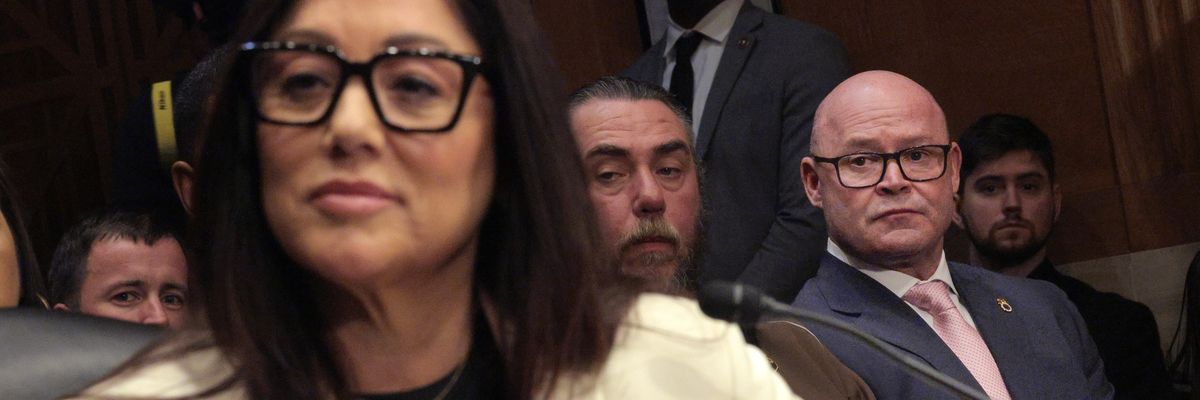
President of the International Brotherhood of Teamsters Sean O'Brien (right) attends the confirmation hearing for Lori Chavez-DeRemer, President Donald Trump’s pick to lead the Labor Department
(Photo: Chip Somodevilla/Getty Images)


Eloise Goldsmith
Feb 20, 2025
COMMON DREAMS

International Brotherhood of Teamsters President Sean O'Brien faced backlash from labor movement voices on Wednesday for expressing his support for U.S. President Donald Trump's pick to lead the Department of Labor and for appearing to take a softer stance on so-called "right-to-work" laws—policies generally decried by organized labor because they allow employees to opt out of union expenses while working at a unionized establishment.

Labor journalist Alex Press called his comments regarding right-to-work "shameful" and "embarrassing."

Over the summer, Press spoke with rank-and-file Teamsters members about recent actions from O'Brien that signal a rightward shift, such as his decision to headline the first night of the 2024 Republican National Convention. "Some are undoubtedly thrilled," wrote Press, though "a growing number of members believe their president is offering a straightforward, if not always explicit, endorsement of a political party that wants to destroy them."

On Wednesday, O'Brien attended the Senate confirmation hearing of Oregon Republican Lori Chavez-DeRemer, Trump's labor pick, during which Chavez-DeRemer said she would support Trump's agenda, according to The New York Times. Chavez-DeRemer also told senators that she no longer supports a section of the Protecting the Right to Organize (PRO) Act—sweeping Democratic labor legislation that was introduced in Congress but never passed—which would have weakened state right-to-work laws.

Speaking later Wednesday on Fox News, O'Brien said of Chavez-DeRemer, "Not only do we support her appointment, we are going to the mat to make sure that she gets confirmed."

When asked about Chavez-DeRemer's stance on the right-to-work section of the PRO Act, O'Brien said that he is working with senators such as Sen. Josh Hawley (R-Mo.) to come up with a version of the PRO Act that "may not include that."

"That's the beauty of having conversations with people from the other side, where you can collaborate and actually find out what works for that state, what doesn't work for it—but more importantly, what's going to work for the American worker," O'Brien said.

A clip of these comments was reposted by the National Right to Work Committee, a group dedicated to "combating the evils of compulsory unionism," according to its website.

"The Teamsters union is as decentralized as the country. Like the median voter, most Teamsters aren't closely following what Sean O'Brien is saying," wrote labor journalist Luis Feliz Leon in response. "The press should ensure they know how he's selling out members to cozy up to anti-worker politicos and bolstering the power of bosses."

In the same Fox News interview, O'Brien also said the Teamsters do not want to see anyone losing their job, but that "[Trump] thinks he's within his right," when asked about the personnel-slashing Department of Government Efficiency and the Trump administration's widely decried deferred resignation program for nearly all federal employees. Multiple federal employees unions are currently battling the Trump administration in court over its actions targeting federal workers and federal agencies.

"What a shame. Teamsters deserve better than this," wrote Rep. Alexandria Ocasio-Cortez (D-N.Y.) in response on Bluesky.

Another labor journalist, Kim Kelly, denounced a video posted Wednesday by Sen. Markwayne Mullin (R-Okla.)—whom O'Brien nearly physically fought during a Senate hearing last year—in which Mullin and O'Brien chum it up and both express support for Chavez-DeRemer.

Also in response to the video, an observer on X with username katy, who indicates they are a part UFCW Local 371, wrote, "class traitor."

"I was raised in a Teamsters household, survived because of union benefits, and still do. I'd rather starve than lick a boot," katy wrote. "We're the union."


Trump Labor Secretary Pick Vows to Defend Anti-Union 'Right-to-Work' Laws

"How very not pro-worker of you," the Philadelphia Council AFL-CIO said in response to Lori Chavez-DeRemer's remarks.


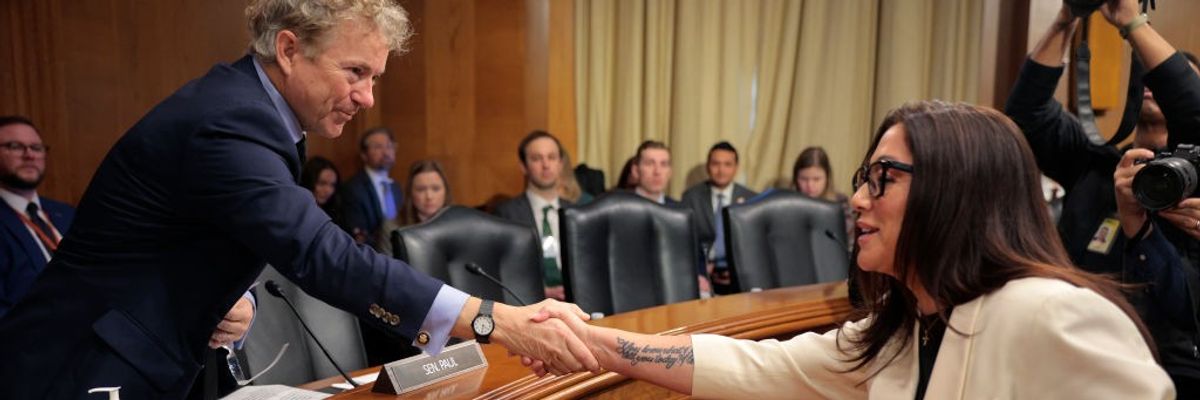
Lori Chavez-DeRemer, President Donald Trump’s pick to lead the Labor Department, greets Sen. Rand Paul (R-Ky.) as she arrives for her confirmation hearing on February 19, 2025.
(Photo: Chip Somodevilla/Getty Images)

Jake Johnson
Feb 19, 2025
COMMON DREAMS


U.S. President Donald Trump's pick to lead the Department of Labor made clear during her Senate confirmation hearing on Wednesday that she no longer supports legislation known as the PRO Act, which would bolster worker organizing and dramatically weaken anti-union "right-to-work" laws currently in place in over two dozen states.


Asked by Sen. Rand Paul (R-Ky.) whether she still supports the Protecting the Right to Organize Act—a bill she co-sponsored while in Congress—former Rep. Lori Chavez-DeRemer (R-Ore.) said she signed onto the bill because she "wanted to be at that table," not because she was fully supportive of its provisions.

Chavez-DeRemer answered "yes" when Paul—the lead sponsor of the National Right to Work Act—specifically asked her to confirm that she no longer supports "the aspect of the PRO Act that would have overturned state right-to-work laws."

"The right to work is a fundamental tenet of labor laws, where states have a right to choose if they want to be a right-to-work states," said Chavez-DeRemer.

"How very not pro-worker of you, Lori," the Philadelphia Council AFL-CIO wrote in response.

Watch the exchange:


In so-called right-to-work (RTW) states, employees in unionized workplaces can opt out of paying union dues while still benefiting from the union's collective bargaining efforts.

An Economic Policy Institute study published last year found that RTW states "have lower unionization rates, wages, and benefits compared with non-RTW states."

"RTW laws are designed to diminish workers' collective power by prohibiting unions and employers from negotiating union security agreements into collective bargaining agreements, making it harder for workers to form, join, and sustain unions," the study noted. "Consequently, workers in states with RTW laws have lower wages, reduced access to health and retirement benefits, and higher workplace fatality rates. On average, workers in RTW states are paid 3.2% less than workers with similar characteristics in non-RTW states, which translates to $1,670 less per year for a full-time worker."

In her opening remarks to the Senate Health, Education, Labor, and Pensions Committee on Wednesday, Chavez-DeRemer said her job if confirmed "will be to implement President Trump's policy vision"—which has thus far been glaringly anti-worker.

"In his first few weeks back in office, Trump fired the [National Labor Relations Board's] acting chairperson, leaving the board without a quorum to enforce laws that protect workers' right to unionize," Steven Greenhouse, a senior fellow at The Century Foundation, wrote Tuesday. "Trump has designated [Elon] Musk, a vehemently anti-union billionaire, to launch an all-out war against the federal bureaucracy and workforce, and Trump and Musk have essentially treated the nation's 2 million-plus federal employees as if they were disposable, low-quality widgets."

Trump also removed former NLRB General Counsel Jennifer Abruzzo, who was strongly pro-labor. The president's acting replacement has moved quickly to roll back NLRB guidance issued during Abruzzo's tenure, including a memo declaring that anti-union "captive audience meetings" amount to an "unlawful threat" aimed at deterring union organizing.

During Wednesday's hearing, Sen. Bernie Sanders (I-Vt.) raised Trump's termination of former NLRB member Gwynne Wilcox, who argues her dismissal was illegal and is suing Trump in federal court.

Sanders said he also views Wilcox's firing as unlawful and asked Chavez-DeRemer if she agrees.

In response, Chavez-DeRemer said that Trump "has a right to exercise his executive power."