Friday, February 21, 2025

Author details link between 'Christian nationalism' and MAGA’s 'smashing of the administrative state'


President Donald Trump on June 20, 2020 (Wikimedia Commons)

Alex Henderson
February 18, 2025
ALTERNET

Journalist/author Katherine Stewart has a long history of in-depth reporting on the Religious Right — and not in a favorable way.

2012's "The Good News Club: The Christian Right's Stealth Assault on America's Children" and 2022's "The Power Worshippers: Inside the Dangerous Rise of Religious Nationalism," both characterized the Religious Right movement as antithetical to religious freedom in the United States. And in her new book, "Money, Lies, and God: Inside the Movement to Destroy American Democracy," Stewart emphasizes that Christian nationalists and billionaire oligarchs have formed a deeply authoritarian alliance.

Stewart discussed that alliance during an interview with Salon's Amanda Marcotte, published in Q&A form on February 18.

READ MORE:'Time to think of Plan B': Musk ripped after forcing out Social Security chief

When Marcotte asked Stewart how "MAGA tech bros like Elon Musk" and the Christian Right "fit together," the journalist/author responded, "The New Right and Christian nationalists are a power couple of American authoritarianism. Both want to smash the institutions that safeguard our democracy. They've said it in different ways. The smashing of the 'administrative state' is more of a New Right concept. The Christian nationalist movement is more focused on rejecting pluralism and equality. But both are committed to this anti-democratic project."

Stewart continued, "On the Christian Right, they would say our democratic system is not godly. On the New Right, they would say it simply doesn't work, that it's outlived its purpose. They want to smash it up and create something new, and that's an autocracy."

In 2025, the term "New Right" has a very different meaning than it did during Ronald Reagan's presidency.

Back in the early 1980s, "New Right" was used to describe the conservative movement being championed by President Reagan and his allies. But these days, the term "New Right" is used to describe President Donald Trump and the MAGA movement — which, in many respects, is a major departure from traditional old-school Reagan/Barry Goldwater/John McCain conservatism. And many Never Trumpers who were considered "The New Right" back in the 1980s are now scathing critics of Trump and MAGA.

When Stewart speaks of the New Right, she is referring to MAGA — not the conservatives of 40 or 45 years ago.

Stewart told Marcotte, "The Christian nationalist side has been an authoritarian movement for quite some time. They refer to Donald Trump like a biblical ruler. They compare him (to) King Cyrus or King David, an imperfect ruler God chose to enact his will. Here's the thing about kings: they're not part of a democracy. They're the law onto themselves. Christian nationalists have persuaded themselves they're facing a demonic other, defined as anyone who doesn't believe as they do. They also believe God's hand is on Trump's shoulder. If anybody opposes him, they're going against God."

Amanda Marcotte's interview with Katherine Stewart for Salon is available at this link.


'Not just blood that they’re after': Expert says Christian Nationalists 'want a show'


Photo by David Todd McCarty on Unsplash

February 20, 2025
ALTERNET


President Donald Trump was able to be elected president a second time partly by mobilizing his base of Christian nationalists. This anti-Democratic group has an “us vs. them” mentality, believing that America is on the verge of an apocalypse and that they are being persecuted. In her new book, "Money, Lies, and God: Inside the Movement to Destroy American Democracy," journalist Katherine Stewart investigates this voter base. Salon published an interview with her Tuesday.

This subculture, Stewart argues, believes America should move past democracy. “They believe the U.S. is not founded on principles, but on a specific religious and cultural heritage,” she said. “They argue America is on the brink of an apocalypse, owing to the rise of equality and what they call ‘wokeness.’ They argue democracy, as a system, isn't sufficient to meet the ‘challenges’ of feminism and equality. They believe the democratic rules no longer apply, because we're facing this absolute apocalypse of equality. They want an authoritarian leader who puts himself above the law, who's going to seize the reins of power and scrap the rule of law in favor of the iron fist.”

One of the three major tenants of this mindset is the belief that the country is nearing an apocalypse.

“This is what authoritarian leaders do,” she explained. “Christian nationalism is not just an ideology. It's also not just a political movement. It's a mindset… First is ‘us versus them’ or ‘pure versus the impure,’ or those who properly ‘belong’ in the country, and those who do not. Second, there's a sense of persecution. They claim white conservative Christians are being persecuted more than any other group in society. Third is the sense that we're facing an apocalypse. They share this view with the new right. It's always, ‘If we don't win this election, we're gonna go under the control of the Illuminati and the devil's gonna be controlling us for hundreds of years. So it's any means necessary to ‘save’ us from this terrible fate.”

“Those three ideas,” she continued, “clear the way for the acceptance of an authoritarian leader, someone who doesn't respect the rules, who will punish their enemies, and who will suspend the rule of law. If you look at what's happening in our politics today, you can see it playing out before our eyes. In the first weeks of the Trump presidency, we're seeing a version of Project 2025. They've been telling us for a long time they're going to smash the institutions that safeguard our democracy. That's what they're doing.”

But the members of this group have been “colossally misinformed.”

“Many of these supporters don't recognize that American democracy might be destroyed. Some don't care. They think it's more important to put a strong man in power to demolish the supposedly dangerous radical left. But whether they don't care or don't know, it's because they've been colossally misinformed. That's how they rationalize their choices at the ballot box. And I would have to say this is not just about Trump. Authoritarianism loves a misinformed public. The anti-democratic movement has funded this massive propaganda campaign that has led us to where we are today,” she said.

Here is an excerpt from the book, published by Rolling Stone:

“Power has not softened the base of this movement. It’s not just blood that they’re after; they want a show. This is the thing that Trump surely understands best. Policy simply doesn’t matter. You can kill off grandma through vaccine denial, take away health insurance, bust unions, drive up inflation, and reward your billionaire friends with policies that benefit their bloated bottom lines. None of that matters as long as you give the people the pleasure of a good performance, where they can project their frustrations and resentments on the targets they have been trained to hate.”
‘It’s about control’: Why Trump renamed Denali to Mount McKinley


Photo by John Feng on Unsplash
February 19, 2025

There is a game children play called “King of the Mountain.” The rules vary, but generally, kids race to the top of a mound and push or wrestle until only one child stands and is declared the king. Displacing other children on the mound is the only way to win, and the game often rewards particularly vicious players — those who will bite, punch, and scratch to get to the top of the hill and win the title.

It’s a game the Trump administration is also keen on playing. But in this version, physical violence is replaced by aggressive tariffs, hostile dealings with foreign officials, and fraudulent business practices. It’s also involved petty actions, changing the name of the Gulf of Mexico and punishing those who refuse to adhere to the order, and renaming Mount Denali, in Alaska, to Mount McKinley; a change nobody — not even Republicans in Alaska — wanted.

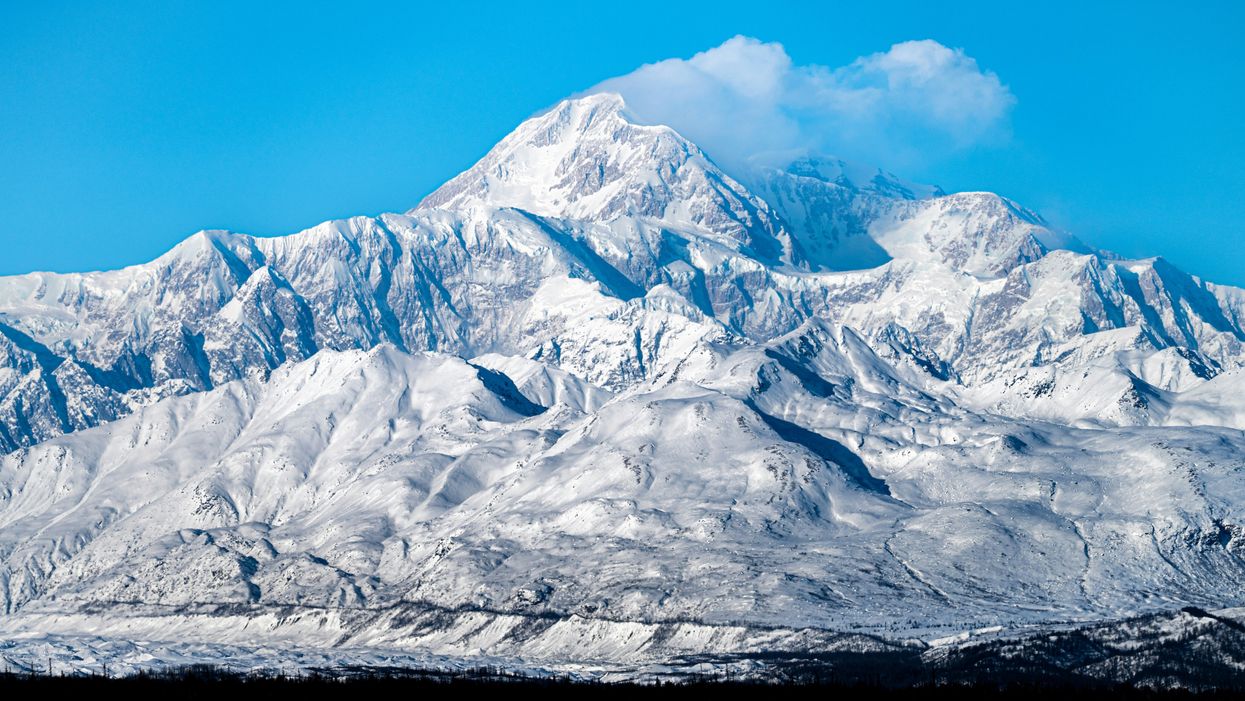
Denali is a Koyukon Athabaskan word that means “the high one” — the tallest mountain in North America — and has been referred to as Denali until 1896, when it was rechristened Mount McKinley by gold prospectors in honor of then-Republican presidential candidate William McKinley: a man who never visited the region. In 1975, Alaska legislators began petitioning the federal government to change the name back to Denali, and in 2015, the Obama administration did just that.

“All of our land places had Koyukuk and Athabaskan names and identification markers before settler contact,” said Sonia Vent, a Koyukuk Athabascan elder in southeast Alaska.

Settler naming conventions, especially for mountains, often celebrate the accomplishments of a single president, explorer, or mountaineer, reinforcing the idea that the country was built by great individual men.

Settlers rarely name mountains after women, but they often name them after breasts. The Teton Mountain range in Wyoming, for example, is French for “breasts.” There are also multiple hills named “Molly’s Nipple” in Utah and a Nippletop Mountain in New York. Many geographic sites still bear derogatory terms for Indigenous women despite federal initiatives aimed at removing them.

This feminization of the landscape reflects a history of gender-based violence, an idea captured by author Susan Schrepfer in her book Nature’s Altars. “Nature was assumed to be feminine, but control over it was masculine,” wrote Schrepfer. “Rather than identifying a site embedded in time and place these designations celebrated taking possession as a manly act.”

In the early 1900s, domination of women and the environment was reflected in the acquisition of Native land and our erasure from the landscape. State and federal governments created a system of parks and reserves that professed to protect wildlife and landscapes, but also kicked tribes off the land with the assumption that settlers knew of better ways to steward the land.

“Mountains came to emulate in vertical space the social values of hierarchy and authority,” Schrepfer wrote.

President Donald Trump has been graphic in his characterization of this dominance, saying “drill, baby drill” on the campaign trail and when he took office asserting that the United States needs to enter an era of “energy dominance.” Even the term “natural resource,” equates mountains, plains, and bodies of water as resources for settler consumption.

“The idea is that Indigenous peoples are supposed to just go away,” said Niiokamigaabaw Deondre Smiles, an Ojibwe geographer at the University of Victoria. “Renaming is saying, ‘Now that we’ve conquered you, we can remake this space into something that’s more beneficial to us.’”

Stripping an Indigenous place name and imposing a new one on maps, atlases, and our phones’ navigational systems is an act of colonial dominance. “It’s about control,” Smiles said.

It’s also about justice. Last year, the Eastern Band of Cherokee Indians achieved their goal of restoring the original name of Clingman’s Dome, on the Tennessee-North Carolina border. The name is now Kuwahi meaning “mulberry place” in Tsalagi, the Cherokee language. And two years ago, in Colorado, Mt. Evans, a 14,000 ft peak overlooking Denver, was renamed Mt. Blue Sky after my tribe, the Arapaho, who are known as the Blue Sky People. The mountain was previously named for John Evans, Colorado’s territorial governor in the mid-1800’s. However, recent reappraisals of the man’s legacy — including his responsibility for the 1864 Sand Creek Massacre which led to the deaths of 230 Cheyenne and Arapaho people — hastened the change.

Many places have multiple Indigenous names, depending on whom you ask, but that complexity is difficult to capture on a map, where nuance is lost. The nation’s first national monument, Devil’s Tower, in northwest Wyoming, has as many as 20 different names such as “Bear’s Tipi,” “Tree Rock,” and “Bear Lodge.”

“Our officialdom doesn’t really tolerate that,” said Tom Thompson, a professor at the University of Alaska who studies Tlingit and anthropology. “It depends on the capacity of the language to incorporate things like direction, action, relationality. A lot of other Native American languages are very good at that or have that capacity.”

In southeast Alaska alone, there are more than 3,500 documented Alaskan Native place names. Mt St. Elias is near Icy Bay, and the Tlingit name for the mountain is just that, Was’eitushaa ”meaning mountain at the head of Icy Bay.”

Elder Sonia Vent said care of the earth is baked into Indigenous languages instead of elements of domination she sees in settler’s names. “To live a substance lifestyle you need that deep, deep love for the land. For all the animals and the plants and minerals around you,” she said.

When the United States bought Alaska from Russia in 1867, Native language speakers outnumbered those who spoke English. But English-only policies in boarding schools forbid the speaking of Native languages, so even though there are 20 Alaskan Native languages, nearly all are either endangered or extinct. Sea levels are rising, typhoons rip through communities, and increased erosion are driving people away from the coasts and changing traditional relationships with land.


In Glacier Bay National Park, also in southeastern Alaska, “Sitakaday Narrows” is an incorrect interpretation of the Tlingit word Sít’ Eeti Geeyí, which means ‘bay taking the place of the glacier.’

“That’s one of those names that doesn’t work well in English, said Thompson. But due to climate change the glacier is slowly receding. The bay is now, literally, taking the place of the glacier. “Agglutinative and polysynthetic describe most Alaskan Native languages, which just means they can accommodate lots of informational bits and terms as prefixes and suffixes,” he said.

To understand a place, one must understand language and vice versa: to understand language, one must get to know the landscape in the same way one would get acquainted with another person. “It’s about connection,” said Angela Gonzalez, an Athabaskan writer in southeast Alaska. “It’s not just the name. Go out on the land and have tea as a way to connect with the land.” She adds that spending time with rivers, mountains, and plains and learning their original names brings you closer to them, like any other friend.

Last month Mt. Egmont, in Aotearoa New Zealand, regained its original name: Mount Taranaki from the Māori word for “mountain peak.” The name Egmont, applied by Captain James Cook in honor of his friend John Perceval Earl of Egmont, has been an intense subject of debate since the 1980s. Perceval was a leader in the British Royal Navy, but died before he learned the mountain was named after him. With the name change came something else: Mount Taranaki was also granted personhood, ensuring legal protections for the mountain, its ecosystem, and its traditional relationship with Māori tribes.

Mount Taranaki, and its legal protections are in stark contrast with how the United States regards Indigenous lands and peoples. “Today Taranaki, our maunga [mountain], our maunga tupuna [ancestral mountain], is released from the shackles,” said Debbie garewa-Packer, leader of the Māori Party, last month. “The shackles of injustice, of ignorance.”

This article originally appeared in Grist at https://grist.org/indigenous/its-about-control-why-trump-renamed-denali-to-mount-mckinley/.

Grist is a nonprofit, independent media organization dedicated to telling stories of climate solutions and a just future. Learn more at Grist.org
An unexpected anomaly was found in the Pacific Ocean – and it could be a global time marker


Photo by Dylan Sauerwein on Unsplash

February 19, 2025

Earth must have experienced something exceptional 10 million years ago. Our study of rock samples from the floor of the Pacific Ocean has found a strange increase in the radioactive isotope beryllium-10 during that time.

This finding, now published in Nature Communications, opens new pathways for geologists to date past events gleaned from deep within the oceans.

But the cause of the beryllium-10 anomaly remains unknown. Could it have been major shifts in global ocean currents, a dying star, or an interstellar collision?
Extremely slow rocks deep in the ocean

I am on a hunt for stardust on Earth. Previously, I’ve sifted through snow in Antarctica. This time, it was the depths of the ocean.

At a depth of about 5,000 metres, the abyssal zone of the Pacific Ocean has never seen light, yet something does still grow there.

Ferromanganese crusts – metallic underwater rocks – grow from minerals dissolved in the water slowly coming together and solidifying over extremely long time scales, as little as a few millimetres in a million years. (Stalactites and stalagmites in caves grow in a similar way, but thousands of times faster.)

This makes ferromanganese crusts ideal archives for capturing stardust over millions of years.

The age of these crusts can be determined by radiometric dating using the radioactive isotope beryllium-10. This isotope is continuously produced in the upper atmosphere when highly energetic cosmic rays strike air molecules. The strikes break apart the main components of our air – nitrogen and oxygen – into smaller fragments.

Both stardust and beryllium-10 eventually find their way into Earth’s oceans where they become incorporated into the growing ferromanganese crust.

Ferromanganese crust sample VA13/2-237KD analysed in this work. The anomaly was discovered in this crust at a depth of about 30mm – representing 10 million years.
Dominik Koll

One of the largest ferromanganese crusts was recovered in 1976 from the Central Pacific. Stored for decades at the Federal Institute for Geosciences and Natural Resources in Hanover, Germany, a 3.7kg section of it became the subject of my analysis.

Much like tree rings reveal a tree’s age, ferromanganese crusts record their growth in layers over millions of years. Beryllium-10 undergoes radioactive decay really slowly, meaning it gradually breaks down over millions of years as it sits in the rocks.

As beryllium-10 decays over time, its concentration decreases in deeper, older sediment layers. Because the rate of decay is steady, we can use radioactive isotopes as natural stopwatches to discern the age and history of rocks – this is called radioactive dating.
A puzzling anomaly

After extensive chemical processing, my colleagues and I used accelerator mass spectrometry – an ultra-sensitive analytical technique for longer-lived radioactive isotopes – to measure beryllium-10 concentrations in the crust.

This time, my research took me from Canberra, Australia to Dresden, Germany, where the setup at the Helmholtz-Zentrum Dresden-Rossendorf was optimised for beryllium-10 measurements.

The results showed that the crust had grown only 3.5 centimetres over the past 10 million years and was more than 20 million years old.

However, before I could return to my search for stardust, I encountered an anomaly.

Initially, as I searched back in time, the beryllium-10 concentration declined as expected, following its natural decay pattern – until about 10 million years ago. At that point, the expected decrease halted before resuming its normal pattern around 12 million years ago.

This was puzzling: radioactive decay follows strict laws, meaning something must have introduced extra beryllium-10 into the crust at that time.

Scepticism is crucial in science. To rule out errors, I repeated the chemical preparation and measurements multiple times – yet the anomaly persisted. The analysis of different crusts from locations nearly 3,000km away gave the same result, a beryllium-10 anomaly around 10 million years ago. This confirmed that the anomaly was a real event rather than a local irregularity.

Ocean currents or exploding stars?

What could have happened on Earth to cause this anomaly 10 million years ago? We’re not sure, but there are a few options.

Last year, an international study revealed that the Antarctic Circumpolar Current – the main driver of global ocean circulation – intensified around 12 million years ago, influencing Antarctic ocean current patterns.

Could this beryllium-10 anomaly in the Pacific mark the beginning of the modern global ocean circulation? If ocean currents were responsible, beryllium-10 would be distributed unevenly on Earth with some samples even showing a lack of beryllium-10. New samples from all major oceans and both hemispheres would allow us to answer this question.

Another possibility emerged early last year. Astrophysicists demonstrated that a collision with a dense interstellar cloud could compress the heliosphere – the Sun’s protective shield against cosmic radiation – back to the orbit of Mercury. Without this barrier, Earth would be exposed to an increased cosmic ray flux, leading to an elevated global beryllium-10 production rate.

A near-Earth supernova explosion could also cause an increased cosmic ray flux leading to a beryllium-10 anomaly. Future research will explore these possibilities.

The discovery of such an anomaly is a windfall for geological dating. Various archives are used to investigate Earth’s climate, habitability and environmental conditions over different timescales.

To compare ice cores with sediments, ferromanganese crusts, speleothems (stalagmites and stalactites) and others, their timescales need to be synchronous. Independent time markers, such as Miyake events or the Laschamp excursion, are invaluable for aligning records thousands of years old. Now, we may have a corresponding time marker for millions of years.

Meanwhile, my search for stardust continues, but now keeping an eye out for new 10-million-year-old samples to further pin down the beryllium-10 anomaly. Stay tuned.

Dominik Koll, Honorary Lecturer, Australian National University

This article is republished from The Conversation under a Creative Commons license. Read the original article.
'We’re gonna do it': Commerce Secretary gives away Trump’s game plan on cutting Medicaid


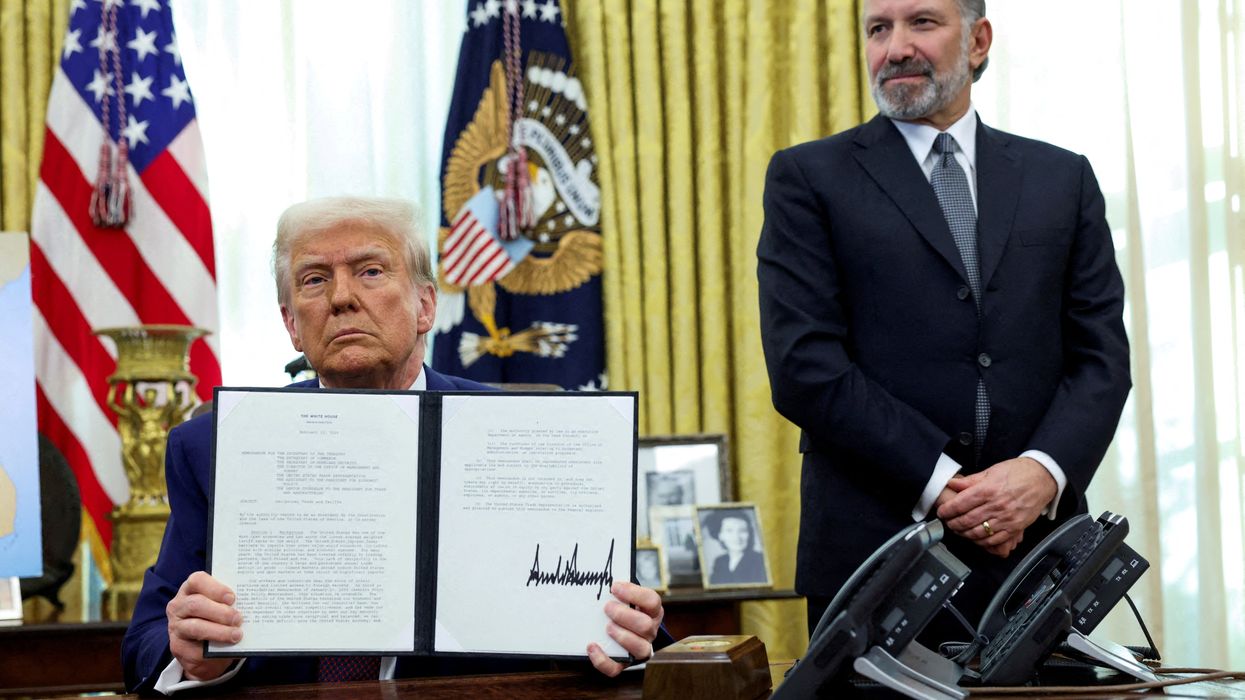
U.S. President Donald Trump holds an executive order about tariffs increase, flanked by U.S. Commerce Secretary Howard Lutnick, in the Oval Office of the White House in Washington, D.C., U.S., February 13, 2025. REUTERS/Kevin Lamarque//File Photo


Although Trump promised not to touch Medicare, Medicaid, and Social Security last week, his new billionaire Commerce Secretary, Howard Lutnick, has now said otherwise.

“Social Security won’t be touched, other than if there’s fraud or something. It’s going to be strengthened. Medicare, Medicaid — none of that stuff is going to be touched,” Trump said last week.

Trump has also said he would "love and cherish" the programs. “We’re not going to do anything with that, unless we can find some abuse or waste,” he added. “The people won’t be affected. It will only be more effective and better.”

READ MORE: 'Inaccuracies' on DOGE website suggest Trump admin is taking credit for cuts they did not make

Lutnick, who was co-chair of Trump’s transition team, said otherwise

“When I set up DOGE with Elon, so back in October … I flew down to Texas, got Elon Musk to do it [set up DOGE], and here was our agreement: that Elon was gonna cut a trillion dollars of waste fraud and abuse,” Lutnick told Fox News’ Jesse Waters Wednesday.

“Think about it. We have almost $4 trillion of entitlements, and no one’s ever looked at it before. You know Social Security is wrong, you know Medicaid and Medicare are wrong. So he’s gonna cut a trillion and we’re gonna get rid of all these tax scams that hammer against America and we’re gonna raise a trillion dollars of revenue,” he continued.

“And our objective under Donald Trump is to balance this budget and I’m telling you, you watch and we’re gonna do it,” he said.

READ MORE: Busted: DOGE took credit for canceling $8 billion contract — but it was really $8 million

House Republicans’ budget plan, which Trump has endorsed, includes billions of cuts to Medicaid in order to finance Trump’s tax plan.

“Maybe he was lying during his Fox interview. Maybe he doesn’t know what’s in the House GOP plan he endorsed. Maybe he assumes the public won’t notice the contradiction,” writes Steve Benen at MSNBC. "Whatever the explanation, Trump’s incoherence both complicates his own party’s legislative strategy and imperils the future of a health care program that helps protect tens of millions of Americans," he added.

About 79 million people are enrolled in Medicaid, according to NPR.

"The level of cuts being discussed would be incredibly damaging and catastrophic for our hospitals," said Beth Feldpush, senior vice president of policy and advocacy at America's Essential Hospitals, a trade group, told NPR.


Musk hints at cutting $500 billion from 'entitlements' like Social Security and Medicare

REUTERS/Nathan Howard
Elon Musk gestures onstage as he attends the Conservative Political Action Conference (CPAC) in National Harbor, Maryland, U.S., February 20, 2025.

February 21, 2025
ALTERNET

Editor's note: This article has been updated to include a statement from Social Security Works.

Tesla and SpaceX CEO Elon Musk — whose net worth is just shy of $400 billion — just dropped a hint that he may be eyeing significant cuts to earned benefits programs like Social Security and Medicare in the future.

During his Thursday appearance at the Conservative Political Action Conference (CPAC), Musk was asked about his "Department of Government Efficiency," or DOGE (which is not yet an official federal agency authorized by Congress) project, and about the scope of spending cuts he aimed to implement. The South African centibillionaire asserted to NewsMax anchor Rob Schmitt — who interviewed him on stage — that "waste" was "pretty much everywhere."

"People ask how can you find waste in D.C., it's like being in a room and the wall, the roof and the floors are all targets," he said. "You can shoot in any direction. You can't miss."

READ MORE: 'Time to think of Plan B': Musk ripped after forcing out Social Security chief

Schmitt then asked Musk specifically about his plans for the Social Security Administration, which DOGE representatives have already reportedly accessed. Schmitt referenced "$72 billion in waste in seven years," while Musk seemingly alluded to hundreds of billions of dollars in supposedly wasteful spending.

"I think that the rough estimate from the Government Accountability Office is over $500 billion a year. $500 billion. With a B. Per year," Musk said.

"On Social Security?" Schmitt asked.

"On all entitlements. All entitlements, yeah," Musk responded, using a catch-all term to describe mandatory spending like Medicare and veterans' benefits.

READ MORE: Top Treasury official quits as Musk allies seek to control Social Security, Medicare payments

Musk insisted during the interview that millions of dead Americans are still getting Social Security payments, including Americans who are allegedly hundreds of years old. ABC 7 New York debunked that claim, and pointed out that Musk was misreading Social Security Administration data. One of the agency's databases includes every American who has ever been issued a Social Security number, and no date of death has been listed for many of those Americans as they died before electronic records were established.

ABC 7 reported that of the roughly 67 million Americans currently receiving Social Security benefits, only 0.1% of them are over 100 years old. And while there are occasional fraudulent payments, that accounts for less than 1% of total spending and is usually in the form of overpayments to living beneficiaries.

"When Donald Trump ran for president, he blanketed swing states in flyers pledging to protect Social Security, Medicare, and Medicaid. Now, Trump has empowered Elon Musk to slash $500 billion a year from these vital benefits," Social Security Works communications director Linda Benesch told AlterNet. "But Congress has the power to stop him. We urge everyone to call their members of Congress and demand that they pledge one penny in cuts to Social Security, Medicare or Medicaid."

According to figures from the Congressional Budget Office (CBO), the federal government had approximately $3.8 trillion in mandatory spending obligations in Fiscal Year 2023, which included $1.3 trillion for Social Security and $839 billion for Medicare. Beneficiaries of those programs have their eligibility and benefit formulas set by federal statute, meaning it would take an act of Congress to change it.

READ MORE: 'Allow some of this to be privatized': GOP gov admits goal of DOGE is to gut Social Security


Watch the segment of Musk's comments below, or by clicking this link.

'No one is calling me back': Trump USDA funding freeze causing farmers major hardship


Mondovi, WI USA September 28, 2020 Farmer John with his John Deere 3020 Tractor holding out a Trump Banner and also an American Flag on the tractor.


Alex Henderson
February 21, 2025
ALTERNET

Donald Trump generally performed well among farmers in the 2024 election, winning Iowa, Nebraska, Kansas, Indiana and other farming states. But now that President Trump is back in the White House, Democrats are warning that his policies will hurt farmers badly — including aggressive tariffs and mass deportations.

Another problem that farmers are facing during Trump's second presidency, according to the Washington Post, is a U.S. Department of Agriculture (USDA) funding freeze.


Post reporters Daniel Wu and Gaya Gupta, in an article published on February 20, explain, "The Post spoke with farmers and farm organizations in 10 states who had contacted their congressional delegations about the USDA funding freeze. Some farmers from conservative-leaning districts said they have received no reply. Others said they were told that their representatives supported the (Trump) Administration's decision — and some representatives appeared to suggest that Trump's funding freeze was not affecting farmers at all. A federal judge, last week, ordered the Agriculture Department to release all withheld funds, but the farmers The Post spoke to said they had not yet received any of that money."

READ MORE:'Helpless' GOP lawmakers dislike Trumps 'indiscriminate firing' — but fear the White House won't listen

One of the farmers the Post interviewed was Iowa-based Shanon Jamison, who specializes in corn and soybeans. In late January, according to Wu and Gupta, Jamison found out "that her $69,000 federal reimbursement for a cover crop to boost soil health and slow erosion was frozen due to an executive order from President Donald Trump."


Wu and Gupta report, "Some of those farmers have been stymied by members of Congress backing Trump. In Maryland, Laura Beth Resnick contacted Rep. Andy Harris (R) to make sure the USDA would fulfill a contract to help fund the installation of solar panels on her flower farm in Harford County…. Hoppy Henton, who farms corn, soybeans, wheat and cattle in Woodford County, Kentucky, said he had several USDA-funded projects underway on his farm, including erecting new fencing and managing a pasture rotation. He said he is owed more than $20,000, which he has yet to receive."

According to Wu and Gupta, Henton "made several attempts to contact Rep. Andy Barr (R) and his staff about the issue."

Henton told the Post, "No one is calling me back….. The silence is deafening."


US Public Service Unions and State Democracy Defenders Fund Challenge Unlawful, Mass Federal Firings


AFSCME  PRESS RELEASE
FEBRUARY 20, 2025


Some of the nation’s largest public service unions have filed a lawsuit seeking to block the unlawful mass terminations of probationary federal employees, which was directed by the Office of Personnel Management (OPM) and its Acting Director, Charles Ezell. They allege that the firings “represent one of the most massive employment frauds in the history of this country.” In federal service, new employees and employees who change positions (including through promotions) have probationary status. The unions claim that OPM is exploiting and misusing the probationary period to eliminate staff across federal agencies and are asking for an injunction to stop further terminations – and to rescind those that have already been executed.

The plaintiffs in this case consist of the American Federation of Government Employees, AFL-CIO; the American Federation of State, County and Municipal Employees, AFL-CIO; AFGE Local 1216; and United Nurses Associations of California/Union of Health Care Professionals, AFSCME, AFL-CIO. They are represented byState Democracy Defenders Fund (SDDF)and the law firm Altshuler Berzon LLP.

The complaint says that OPM’s egregious firings were made on false pretenses and violate federal law, including the Administrative Procedure Act and other statutes defining federal employment and OPM's role. These firings were executed across federal agencies, based on directives from OPM. OPM, the complaint asserts, acted unlawfully by directing federal agencies to use a standardized termination notice falsely claiming performance issues. Congress, not OPM, controls and authorizes federal employment and related spending by the federal administrative agencies, and Congress has determined that each agency is responsible for managing its own employees.

“This administration has abused the probationary period to conduct a chaotic, ill-informed, and politically-driven firing spree. The result has been the indiscriminate firing of thousands of patriotic public servants across the country who help veterans in crisis, ensure the safety of our nuclear weapons, keep power flowing to American homes, combat the bird flu, and provide other essential services,” said AFGE National President Everett Kelley. “These actions aren’t just illegal. They are hurting everyday Americans and making us all less safe. It’s a stark reminder of the price we all pay when you stack the government with political loyalists instead of professionals.”

“Overnight, tens of thousands of federal employees received the same termination letter citing ‘performance issues’ without any explanation or reasoning,” said AFSCME President Lee Saunders. “These mass firings are yet another unlawful attempt by this billionaire-run administration to gut public services without regard for the health and safety of our communities. Federal workers are qualified professionals who make our nation stronger – supporting our schools, parks, hospitals and vital infrastructure. We will keep fighting these attacks on their freedoms that threaten everything from food safety to national security to health care.”

“New hires are crucial as our country continues to face nurse staffing challenges. Indiscriminately firing these nurses, who are essential to the care their units provide, could truly cost lives,” said Charmaine S. Morales, RN and UNAC/UHCP President.

Norm Eisen, representing the plaintiffs and executive chair of State Democracy Defenders Fund, said, “SDDF is proud to stand with leading public service unions in this critical fight to protect their members, who dedicate their lives to serving our nation. The mass firings ordered by OPM are illegal and betray the trust of countless federal employees. We are committed to restoring justice for these workers.”


The complaint is available here.
'Blatant Conflict': Fired FDA Workers Were Reviewing Musk's Neuralink

"DOGE operatives should stop interfering with the FDA's public health mission of assuring the safety and effectiveness of drugs and medical devices," said a doctor at one watchdog group.


The Neuralink logo is with a brain chip visible in the background in this photo illustration on January 30, 2024.
(Photo: Jonathan Raa/NurPhoto via Getty Images)

Jessica Corbett
Feb 19, 2025
COMMON DREAMS

A U.S. watchdog group and other critics are responding with alarm to reporting that federal employees reviewing applications related to a brain implant developed by Elon Musk's company Neuralink are among those fired as part of the billionaire and President Donald Trump's sweeping mission to gut the government workforce.

Despite business conflicts and a recent White House court declaration that generated some confusion, Musk is the head of Trump's so-called Department of Government Efficiency (DOGE), which has infiltrated and is working to purge employees from several agencies—including the U.S. Food and Drug Administration (FDA), according toReuters.


Citing two unnamed sources, the news agency reported Monday that "the cuts included about 20 people in the FDA's Office of Neurological and Physical Medicine Devices, several of whom worked on Neuralink... That division includes reviewers overseeing clinical trial applications by Neuralink and other companies making so-called brain-computer interface devices."

While the sources "said they did not believe the employees were specifically targeted because of their work on Neuralink's applications," they and other experts warned the firings "will hamper the agency's ability to quickly and safely process medical device applications of all sorts," Reuters noted.


Dr. Robert Steinbrook, director of Public Citizen's Health Research Group, said in Wednesday statement that "regardless of the reasons the FDA medical device center employees were fired, Elon Musk and the so-called Department of Government Efficiency have a blatant conflict of interest because the agency's Center for Devices and Radiological Health is regulating the implantable brain-computer interface made by one of Musk's companies."

"Moreover, by eviscerating the FDA's device staff, DOGE operatives are impeding the vital work of protecting the participants in the Neuralink trial and protecting the public from medical devices that are harmful or don't work," he continued. "Paradoxically, with fewer staff, the FDA's review of the Neuralink device may be impeded, which makes no sense."

"DOGE operatives should stop interfering with the FDA's public health mission of assuring the safety and effectiveness of drugs and medical devices," Steinbrook added. "This is yet the latest example of how Musk's involvement with DOGE undermines federal regulators, from the Consumer Financial Protection Bureau to the FDA."

  
Various reports from the past month have highlighted how Trump's return to power has benefited Musk and his businesses, including SpaceX and the publicly traded electric vehicle maker Tesla.

As Gizmododetailed Tuesday:
Neuralink in particular seems to have benefited from efforts to squash watchdogs. Last month, the inspector general at the U.S. Department of Agriculture had to be removed from her office by security after refusing to comply with her termination, which she believed was illegal. She happened to be heading up an investigation into Neuralink looking into whether the company was violating animal welfare rules related to its tests on animal subjects.

The FDA, too, has been looking into similar issues. Last year, the agency found that Neuralink's animal labs engaged in "objectionable conditions or practices" and urged the company to address the issues—but did not issue any punitive actions related to the investigation.

Neuralink and the FDA also had a standoff over allowing the company to move forward with human trials, a request that the FDA rejected over safety risks in 2022 before finally allowing limited trials to move forward a year later. In 2024, the FDA even gave Neuralink its "breakthrough device" designation, which allows for a speedier review process. The only thing faster might be no review at all.


A Quinnipiac University national poll released Wednesday shows that 50% of registered voters across the political spectrum have an unfavorable opinion of Musk, 54% disapprove of the richest person on Earth "playing a prominent role in the Trump administration," and 55% think he "has too much power in making decisions affecting the United States."
The Trump Admin Is Engaging in Corruption on a Massive Scale to Benefit Big Oil

By censoring and defunding climate science, Trump and his cronies are trying to erase the link between extreme weather impacts and fossil fuel pollution.


Protesters gather outside of the Lincoln Memorial during the "People's March" in Washington, D.C., on January 18, 2025, two days ahead of the inauguration of US President-elect Donald Trump.
(Photo: Kia Rastar/Middle East Images/AFP via Getty Images)


Basav Sen
Feb 21, 2025
OtherWords


Among the flurry of actions by the Trump administration, it could be easy to miss one that poses a grave danger to public health and our planet: a no-holds-barred attack on science.

In a series of disturbing moves, the administration has censored scientific research, slashed resources for public health and the environment, and advanced fossil fuel industry propaganda. These moves only serve corporate interests—at the expense of ordinary people and the planet.

Already, the administration has scrubbed government websites providing information on climate change and environmental justice. And it’s attempted to slash funding for research on climate and medical science (though a federal judge has temporarily blocked the defunding of medical research).

An administration claiming to crack down on “fraud, waste, and abuse” in government is doing the opposite.

Meanwhile, in a pair of astonishingly irresponsible moves, the administration has fired a large number of staff of the Epidemic Intelligence Service, which identifies and tracks emerging epidemics, and pulled the U.S. out of the World Health Organization— even as we face the serious risk of a worldwide bird flu pandemic.

On the climate front, President Donald Trump has launched an ideological attack against the very idea of environmental justice. That’s the idea that marginalized communities—including people of color and poor people of all races—suffer the worst from pollution. There’s a large body of peer-reviewed scientific literature confirming this pattern, but Trump and his ideologues don’t care.

Elsewhere, Trump’s Energy Secretary—former fossil fuel executive Chris Wright—has made the outlandish claim that electricity in the U.S. is more expensive today, and the electric grid is less reliable, because of closure of coal-fired power plants.

Every part of this industry propaganda is verifiably false. The U.S. electricity grid is highly reliable. While electricity rates are rising, the increase over the 10-year period from 2013 to 2023 was only about 1% in inflation-adjusted terms.

If anything, coal plant retirements were a factor in keeping rates lower, since the plants being retired are older plants with higher operating costs. And this year, solar energy is expected to be a major contributor to keeping rates almost unchanged.

Significantly, every one of these facts comes from the Energy Department’s own research and data. That’s why we shouldn’t let them scrub it.

The administration’s erasure of data has profound human consequences.

According to the Intergovernmental Panel on Climate Change (IPCC), the foremost international climate science institution, “Human-induced climate change, including more frequent and intense extreme events, has caused widespread adverse impacts and related losses and damages to nature and people,” including “reduced food and water security.”

These statements are in the present tense. Severe climate change impacts are already occurring, and will get much worse if we don’t slash our greenhouse gas emissions rapidly. Disasters like this year’s Los Angeles wildfires and last year’s floods in Appalachia and the Southeast will become more frequent and damaging.

By censoring and defunding climate science, Trump and his cronies are trying to erase the link between these impacts and fossil fuel pollution. Trump has been effectively bribed by fossil fuel oligarchs—and he’s returning the favor by making it official U.S. government policy to remove all restraints on the growth of their industry.

Under Biden, fossil fuel companies reported record profits as drilling reached record highs in the United States. Yet consumers still battled high gas prices and other costs. Under Trump, doing favors for this polluting industry is no likelier to benefit regular people.

An administration claiming to crack down on “fraud, waste, and abuse” in government is doing the opposite. It’s engaging in corruption on a massive scale to benefit wealthy, politically connected oligarchs—at the expense of the rest of us.


Basav Sen is the climate justice project director at the Institute for Policy Studies (IPS) and writes on the intersections of climate change and social and economic justice. Prior to joining IPS, Basav worked for 11 years as a campaign researcher for the United Food and Commercial Workers.
Full Bio >


Trump Moves to Fast-Track 100+ Dirty Fossil Fuel Permits Under 'Fake' Energy Emergency

"Trump's promise to cut Americans' energy bills is a lie," said one campaigner.


Climate activists and Indigenous community members gather on the river for a traditional water ceremony during a rally and march to protest the construction of Enbridge Line 3 pipeline in Solvay, Minnesota on June 7, 2021.
(Photo: Kerem Yucel/AFP via Getty Images)


Common Dreams Staff
Feb 19, 2025

With more than 100 permits for oil pipeline projects and gas-fired power plants likely to be fast-tracked under U.S. President Donald Trump's so-called "energy emergency" declaration, consumer advocates on Wednesday called on lawmakers and state officials to stand up to the president's "bullying" and block his efforts to build pollution-causing fossil fuel projects—and slow clean energy progress.

"Trump's declaration of a sham energy emergency attempts to set into motion the weaponization of national security law to dismantle generations of public health and safety protections," said Tyler Slocum, director of Public Citizen's energy program. "The ultrawealthy fossil fuel executives who donated huge sums to Trump's campaign see this fraudulent emergency declaration as an opportunity to destroy the remarkable progress of wind and solar development, while maximizing fossil fuel exports and domestic consumption."

Trump signed a day-one executive order claiming that the U.S. faces an "energy emergency" and must "unleash" fossil fuel production—which has already been on the rise in recent years despite clear warnings from scientists that oil, gas, and coal extraction must end in order to avoid catastrophic planetary hearing.

"Trump's national energy emergency is a sham."

The U.S. Army Corps of Engineers cited that order in recent days when it created a new "emergency" designation for infrastructure project permits, paving the way for officials to push forward nearly 700 pending applications, including more than 100 for fossil fuel projects.

Clean Water Action toldThe New York Times that one major project it has fought against, Canadian firm Enbridge's Line 5 pipeline, which the company wants to build under the Mackinac Straits, could threaten the Great Lakes and tens of millions of people who rely on them for drinking water.

"If this is pushed through on an emergency permit, the implications of an oil spill if there's an explosion or something during tunnel construction is that over 700 miles of Great Lakes shoreline could be at risk," Sean McBrearty, Michigan policy director for Clean Water Action, told the Times.

"If approved, this project will risk our fresh water and the millions of people who rely on it for drinking, jobs, and tourism in exchange for a foreign oil company's profits," added McBrearty.

On Wednesday, U.S. Sens. Tim Kaine (D-Va.) and Martin Heinrich (D-N.M.)—who earlier this month introduced a resolution challenging Trump's emergency declaration—held a Capitol Hill press conference with environmental leaders.


"We are producing more energy now than at any other point in our history, and the U.S. is the envy of the world when it comes to energy innovation and production," Kaine said at the event. "The passage of the Bipartisan Infrastructure Law and Inflation Reduction Act have accelerated clean energy projects and created jobs, and we are on an amazing trajectory."

"Trump's sham emergency threatens to screw all of that up," Kaine added. "Why? Because he'd rather benefit Big Oil and suspend environmental protections than lower costs and create jobs for the American people. I hope my colleagues will join me in voting to terminate President Trump's emergency."

Heinrich said: "Trump's fake emergency declaration is causing enormous uncertainty. If you're thinking about opening a new factory, you don't know what your tax structure will be in the next 12 months. If you're trying to site and build a new transmission line, the federal agencies you work with just had a ton of their expert staff sacked, making it more difficult to get a permit."

"This is going to kill skilled trades jobs and drive up the cost of your electricity bills by as much at $480 a year by 2030," the senator added. "Trump's war on affordable, American-made energy is killing jobs and raising costs on working families."

Slocum urged senators to back Kaine and Heinrich's resolution.

"Trump's promise to cut Americans' energy bills is a lie, as every action under the fraudulent energy emergency would subject Americans to higher energy burdens," he said on Wednesday. "Having senators support Senate Joint Resolution 10 is a first step, but every governor of states in the Northeast and West Coast targeted by Trump's phony emergency order needs to stand up to his bullying."

Note: The headline of this article has been changed to reflect that President Donald Trump's executive order moved to expedite the permit approval process rather than fast-tracking projects.


Study Shows Glaciers Have Lost '3 Olympic Swimming Pools Per Second' Since 2000

One researcher said the findings support calls "for urgent and concrete actions to reduce greenhouse gas emissions and associated warming."


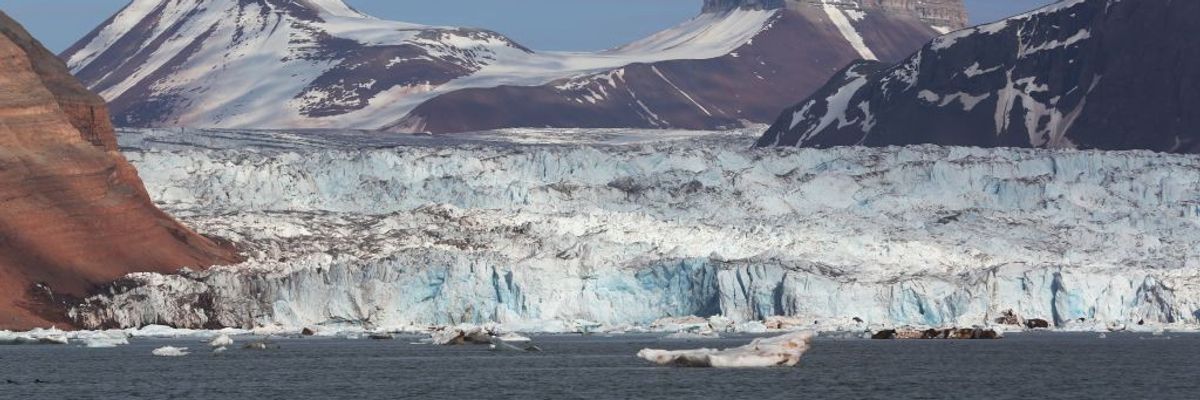
This photo, taken on June 22, 2024, shows a melting glacier in Svalbard, Norway.
(Photo: Zhao Dingzhe/Xinhua via Getty Images)

Jessica Corbett
Feb 20, 2025
COMMON DREAMS

An international science project on Wednesday published a study in the journal Nature showing that glaciers have lost an average of 273 billion metric tons of ice annually since 2000—depleting freshwater resources, driving sea-level rise, and underscoring the need for sweeping global action to significantly reduce planet-heating pollution.

The Glacier Mass Balance Intercomparison Exercise (GlaMBIE) team compiled major studies to estimate global mass change from 2000, when glaciers—excluding Antarctica and Greenland's ice sheets—held about 121,728 billion metric tons of ice, to 2023.

The researchers found that during that period, the world lost 5% of all glacier ice, with regional losses for the full two decades ranging from 2% on the Antarctic and Subantarctic islands, to 39% in Central Europe.


That's a loss of 6,542 billion metric tons total or 273 billion metric tons per year, "the equivalent of three Olympic swimming pools per second," noted France's National Center for Scientific Research (CNRS).

Glaciologist Michael Zemp, who co-led the study, said in a statement that the annual figure "amounts to what the entire global population consumes in 30 years, assuming three liters per person and day."

"Every tenth of a degree warming that we avoid saves us money, saves us lives, saves us problems."

Although the researchers highlighted the annual average, they also emphasized that the rate of glacier ice loss "increased significantly" from 231 billion metric tons annually during the first half of the study period to 314 billion metric tons per year in the second half. In other words, the amount of ice being lost surged by 36% between the two ranges.

Zemp, a professor at Switzerland's University of Zurich and director of the World Glacier Monitoring Service, toldAgence France-Presse that the findings are "shocking" and warned that many smaller glaciers "will not survive the present century."

Stephen Plummer, an Earth observation applications scientist at the European Space Agency, said that "these findings are not only crucial for advancing our scientific understanding of global glacier changes, but also provide a valuable baseline to help regions address the challenges of managing scarce freshwater resources and contribute to developing effective mitigation strategies to combat rising sea level."

The ice loss over the GlaMBIE study's full timeline led to about 18 mm or 0.7 inches of sea-level rise. The researchers projected future losses that lead to 32-67 mm, or 1.26-2.6 inches, of sea-level rise by 2040.

"We are facing higher sea-level rise until the end of this century than expected before," Zemp told AFP, referring to the latest projection from the United Nations Intergovernmental Panel on Climate Change (IPCC).

"You have to reduce the greenhouse gas emissions, it is as simple and as complicated as that," Zemp said. "Every tenth of a degree warming that we avoid saves us money, saves us lives, saves us problems."

The GlaMBIE project manager, Samuel Nussbaumer, similarly toldOceanographic, that "our observations and recent modeling studies indicate that glacier mass loss will continue and possibly accelerate until the end of this century," which underpins the IPCC's "call for urgent and concrete actions to reduce greenhouse gas emissions and associated warming to limit the impact of glacier wastage on local geohazards, regional freshwater availability, and global sea-level rise."


The team's findings were released during the U.N.'s International Year of Glaciers' Preservation and the Decade of Action for Cryospheric Sciences—and they "will feed into the next IPCC report, due in 2029," according to CNRS.

Scientists from around the world who were not involved with the study were alarmed by its revelations—which come after the hottest year in human history and amid humanity's failure to curb planet-heating emissions, largely from fossil fuels.

Martin Siegert, a professor at the United Kingdom's University of Exeter, said in a statement that "this research is concerning to us, because it predicts further glacier loss, which can be considered like a 'canary in the coal mine' for ice sheet reaction to global warming and far more sea-level rise this century and beyond. The IPCC indicates 0.5-1 meters this century—but that is with a 66% certainty—hence 1/3 chance it could be higher under 'strong' warming, which unfortunately is the pathway we are on presently."

Andrew Shepherd, a professor at Northumbria University, another U.K. institution, explained that "glacier melting has two main impacts; it causes sea-level rise and it disrupts the water supply in rivers that are fed by meltwater."

"Around 2 billion people depend on meltwater from glaciers and so their retreat is a big problem for society—it's not just that we are losing them from our landscape, they are an important part of our daily lives," he said. "Even small amounts of sea-level rise matter because it leads to more frequent coastal flooding. Every centimeter of sea-level rise exposes another 2 million people to annual flooding somewhere on our planet."

Michigan appeals court upholds permits for Great Lakes pipeline tunnel project

By The Associated Press
February 20, 2025 

fresh nuts, bolts and fittings are ready to be added to the east leg of the pipeline near St. Ignace, Mich., as Enbridge Inc., prepares to test the east and west sides of the Line 5 pipeline under the Straits of Mackinac in Mackinaw City, Mich. (Dale G Young/Detroit News via AP, File)


Enbridge Energy’s plans to build a protective tunnel around an aging pipeline that runs beneath a channel connecting two Great Lakes can continue, a Michigan appeals court ruled.

The state Public Service Commission properly issued permits for the $500 million project, the Michigan Court of Appeals ruled Wednesday in rejecting arguments from environmental groups and Native American tribes that commissioners failed to consider the overall need for the pipeline.

Tunnel would encase pipeline in the Straits of Mackinac

Enbridge wants to build a protective tunnel around a 4-mile (6-kilometer) section of its Line 5 pipeline that runs along the bottom of the Straits of Mackinac, which link Lake Michigan and Lake Huron.

Enbridge has been using the pipeline since 1953 to transport crude oil and natural gas liquids between Superior, Wisconsin, and Sarnia, Ontario.

Concerns about a potentially catastrophic spill in the straits have been building since 2017, when Enbridge officials revealed that engineers had known about gaps in the pipeline’s coating in the straits since 2014. Fears of a spill escalated in 2018 when a boat anchor damaged the line.

Enbridge officials maintain that the line is structurally sound, but they still reached an agreement with then-Michigan Gov. Rick Snyder’s administration in 2018 that calls for the company to build the protective tunnel.
Environmental groups, tribes challenge state permits

The Michigan Public Service Commission issued state permits for the project in December 2023.

Environmental groups including the Michigan Environmental Council and the National Wildlife Federation, along with the Little Traverse Bay Bands of Odawa Indians, Bay Mills Indian Community, Grand Traverse Band of Ottawa and Chippewa Indians, and the Nottawseppi Huron band of the Potawatomi asked the appellate court last year to reverse the commission’s decision.

The groups and the tribes alleged that the commission improperly considered only the public need for the tunnel rather than whether the entire pipeline as a whole is still necessary.

They also argued the commission failed to adequately consider petroleum products' greenhouse gas impacts.
Court: Commission acted reasonably

The appellate court found that the commission issued a “comprehensive” opinion and acted reasonably. It said there was no basis for a reversal or to order the commission to revisit its decision.

David Scott, a senior attorney for the Environmental Law & Policy Center and the Michigan Climate Action Network, which are also plaintiffs in the case, said in an email that he was disappointed with the ruling and considering further moves. He didn’t elaborate.

Environmental law firm Earthjustice represented the tribes in the case. Adam Ratchenski, an attorney with the firm, said that regardless of the appellate ruling, it was “backwards and dangerous” for the commission to approve the tunnel without truly considering whether Michigan residents need it.

“Nobody wants their water poisoned or their property values torpedoed in order to keep Canadian oil and gas flowing through the Great Lakes,” he said.


Enbridge spokesperson Ryan Duffy praised the appellate ruling, saying the tunnel will make a safe pipeline even safer.
The legal fight isn’t over

The ruling Wednesday doesn’t end the legal battle over the tunnel. Current Michigan Gov. Gretchen Whitmer, a Democrat, opposes the continued operation of Line 5 even if it’s encased in a tunnel.

Democratic Attorney General Dana Nessel filed a lawsuit in 2019 seeking to void the easement that allows the line to run beneath the straits. That case is pending in state court in Ingham County. A ruling could come any day.

Enbridge would still need a permit from the Michigan Department of Environment, Great Lakes and Energy as well as federal construction permits from the U.S. Army Corps of Engineers before construction could begin.

Environmentalists fear that President Donald Trump’s administration will fast-track that process after Trump declared a national energy emergency on his first day in office.

Todd Richmond, The Associated Press