Friday, February 21, 2025

Genocide Drove the Yazidi From Their Homeland. A Decade Later, Some Are Returning.

ISIS wrecked 80 percent of public infrastructure and 70 percent of civilian homes in Sinjar City and surrounding areas.
February 17, 2025
Hussein Findi and his wife Ghassal Sado return to their half-destroyed home in Sinjar in January 2025.Jaclynn Ashly


Fadil Murat Shamo, 22, is still struggling to rebuild his life after ISIS (Islamic State of Iraq and Syria, also known as Daesh) militants killed most of his family when they took over the predominantly Yazidi district of Sinjar in northern Iraq more than a decade ago. As a child, he spent five years in ISIS captivity and was indoctrinated to become a soldier.

It was a fate that befell thousands of Yazidi, a long-persecuted group whose faith is rooted in Zoroastrianism and who were declared infidels by ISIS. About a decade after the United States invaded Iraq, sparking a sectarian civil war and creating conditions for what was then al-Qaeda in Iraq to flourish, ISIS invaded Sinjar on August 3, 2014, prompting most Yazidi to flee their homes.

The Yazidi who became trapped in Sinjar endured ineffable horrors. Within days, nearly 10,000 people were killed, with almost half of them executed — either shot, beheaded or burned alive — while the rest died from starvation, dehydration or injuries during the ISIS siege of Mount Sinjar, to where scores of Yazidi fled during the onslaught. Nearly 7,000 Yazidi were kidnapped. Young women and girls taken captive were sold as sex slaves, while boys like Shamo were forced to fight as child soldiers.

Never miss another story

Get the news you want, delivered to your inbox every day.

Email*


Nearly 2,800 of these women and children are still missing today. Some are known to be in ISIS captivity, while the whereabouts of others are uncertain. Some villages in Sinjar are mass graveyards — yet to be exhumed.

More than a decade after what the United Nations declared a genocide, traumatized Yazidi continue to trickle back to their ancestral lands in Sinjar — finding both hope and sorrow waiting for them there.

Related Story
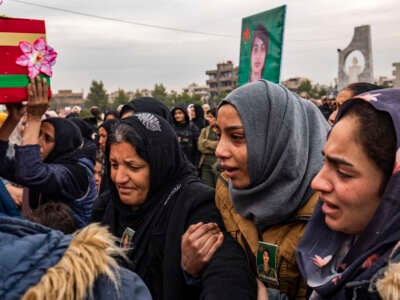
News |
War & Peace
Solidarity Activists Are Raising Alarm Over Impending Turkish Attacks on Rojava
The Kurdish movement in North and East Syria is facing existential threats from Turkey following the fall of Assad.
By Ella Fassler , TruthoutDecember 24, 2024

According to the International Organization for Migration (IOM), more than 100,000 Yazidi have so far returned to Sinjar, but the majority remain displaced. Those returning are battling serious physical and mental trauma — exacerbated by perpetual feelings of insecurity — while infrastructure and job opportunities are still severely lacking. Across the district, buildings and homes remain damaged or destroyed.

“Returning for those of us who lost loved ones is very hard,” Shamo tells Truthout, sitting on the floor of the home he constructed in the northern part of Sinjar after he returned in 2020. “We will never be the same again after ISIS.”

“But it brings me some happiness when I see Yazidi families coming back home. Returning will not heal us, but it is a nice feeling to see Sinjar coming back to life.”
“Wanted to Die”

Shamo was 12 years old when he was abducted by ISIS, along with his parents and siblings, including his sisters. First, the militants separated Shamo and his sisters from their parents and elder brother. Then, Shamo says, his small sisters were collected and sold into slavery, while he was transported to Mosul with 33 other boys.Fadil Murat Shamo sits with his wife and small child.Jaclynn Ashly
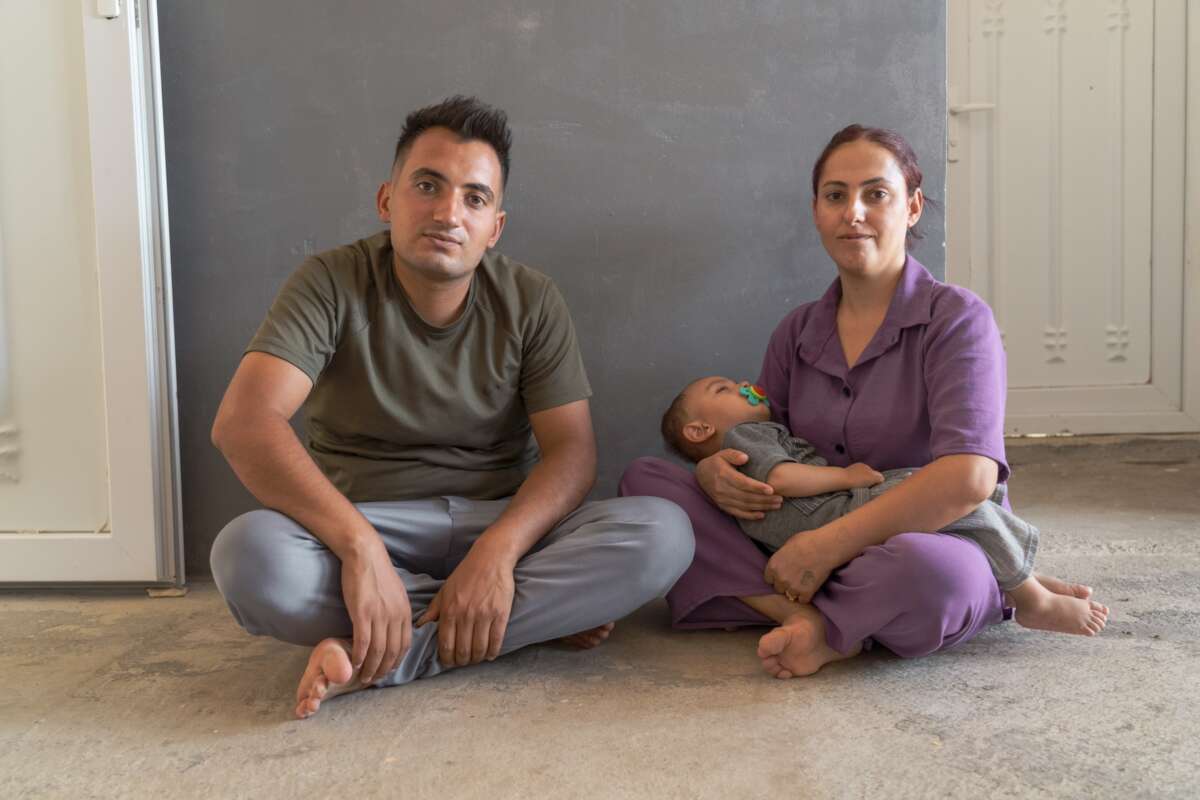
“They kept us at a private house in Mosul where we were forced to learn the Quran, their ideologies and how to fight,” Shamo remembers. “We stayed there for one year. It was like a prison. We weren’t allowed outside and we never saw the sunlight. There was just one small window in the building.”


The old city remains in complete ruins — with bullet-riddled buildings and collapsed roofs and walls.

Once the militants thought the boys were ready, they transported them to Raqqa, the capital of the Islamic State in Syria, to join their ranks as ISIS fighters. Only 10 of these boys survived, Shamo says.

“They killed our whole families so all of us just wanted to die,” Shamo recounts, fiddling with his thumbs. “The most unimaginable things became everyday life. We witnessed beheadings so often that they became normal. But we never actually believed that when we died, we would become martyrs and go to heaven. Everyone blew themselves up or died in battle because they hated this life — not because they wanted heaven in the next life.”

After three years of fighting as a soldier, Shamo was able to get smuggled out of ISIS territory, ending up in al-Hol camp (Kempa Holê) in Kurdish-controlled northern Syria, which continues to hold tens of thousands of women and children from former ISIS territory

.
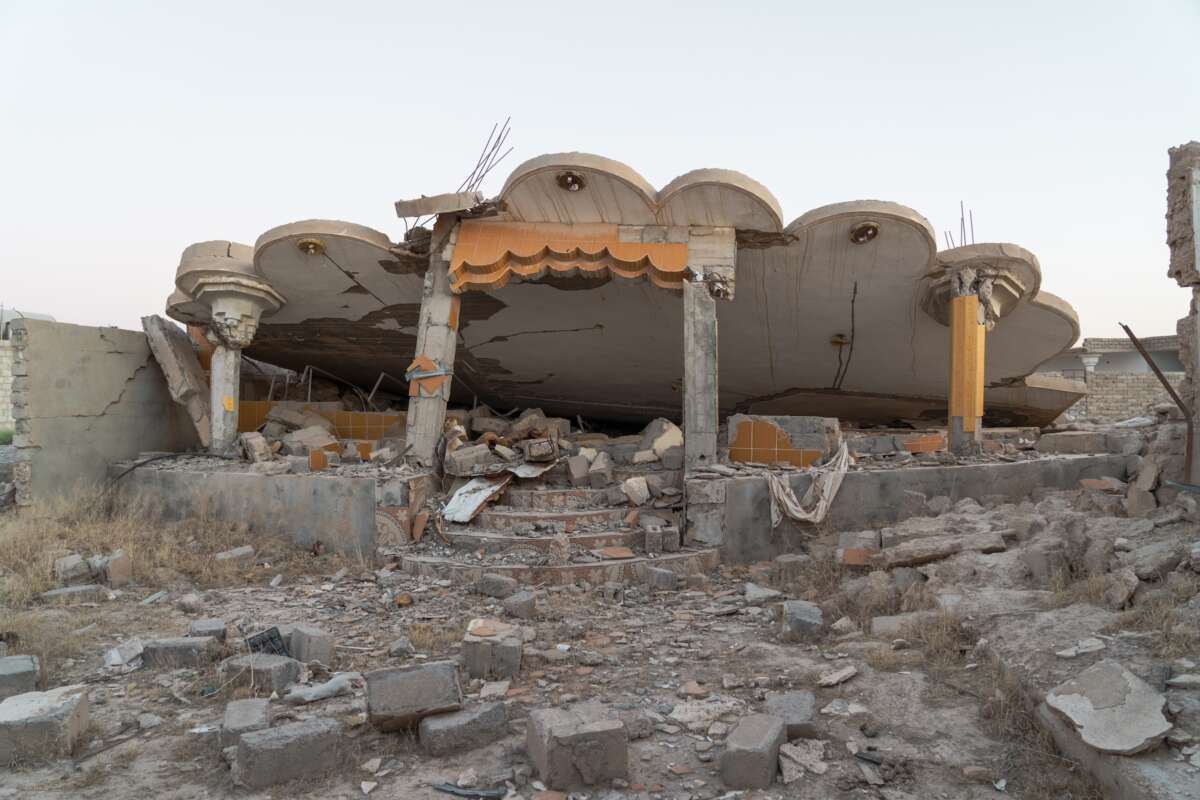
Ruined buildings are shown of a village in northern Sinjar, where Yazidi have recently begun to return. Jaclynn Ashly

He was eventually repatriated to Iraq, where he stayed at one of numerous internally displaced people (IDP) camps in Iraqi Kurdistan. His sisters were also smuggled out of ISIS territory two years prior and are now living in the camps. His parents and brother, however, are still missing — assumed to have been killed.

In 2020, Shamo decided he would return to Sinjar. According to the IOM, which assists Yazidis to voluntarily return to Sinjar, 2020 saw the highest number of returns out of any year since the group began collecting data in 2018.

Despite finding his childhood home destroyed, Shamo saw a glimmer of hope in his return. “After I returned, I focused all my energies on rebuilding my life,” Shamo says. “I got married and had children. Now I have my own family. This has helped me to recover from what happened to me.”
“Sick of the Camps”

But not everyone returning to Sinjar is as hopeful. Others see no future there — only unresolved wounds and crumbling buildings. Sinjar’s main town still bears the scars of the fighting that raged there in 2014 until a fightback driven by Kurdish forces dislodged ISIS militants from the town the following year. The old city remains in complete ruins — with bullet-riddled buildings and collapsed roofs and walls. In some areas, there are still warning signs of the lethal threat of land mines and war munitions.

Many Yazidi do not have the money to rebuild; some are sleeping on the floors of half-standing houses. Infrastructure is still wrecked, while the federal Iraqi government and the autonomous Kurdistan Region of Iraq tussle for control over the area.People sit among the partly destroyed buildings of a village in northern Sinjar, where Yazidi have recently begun to return.Jaclynn Ashly
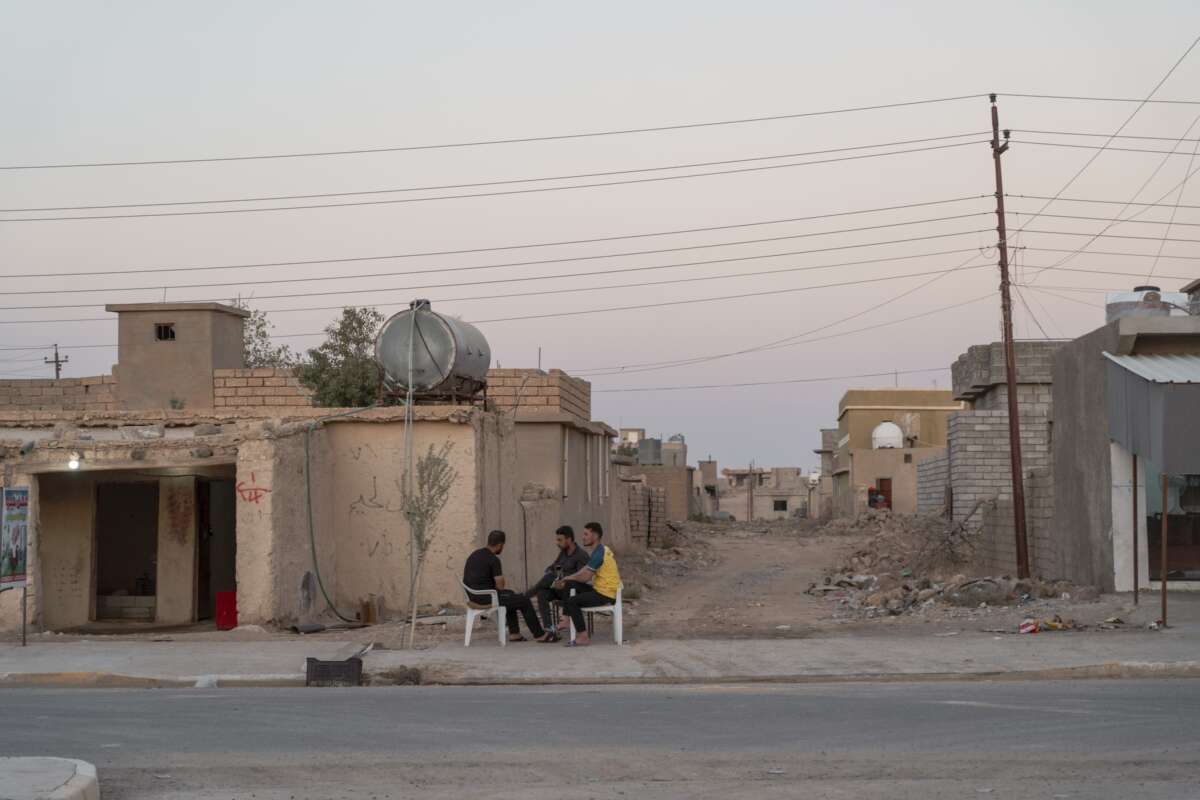
When Amy Hussein, 48, returned to Sinjar last year with his six children, ages 9 to 22, he found his home was reduced to rubble. He is now living in his brother’s home, which he was in the process of constructing before ISIS militants overran the area. His brother is living abroad in Germany, where many Yazidi were granted asylum.

“You see over there,” Hussein says, pointing to one of many abandoned homes in his small village in the northern part of Sinjar. “At this home, about 25 members of the family were taken captive by ISIS. All of them are now either killed, missing or living as refugees in Europe.” He shakes his head and digs his shoe into the dried dirt. “I came back here only because I was so sick of living in the IDP camps,” he adds.
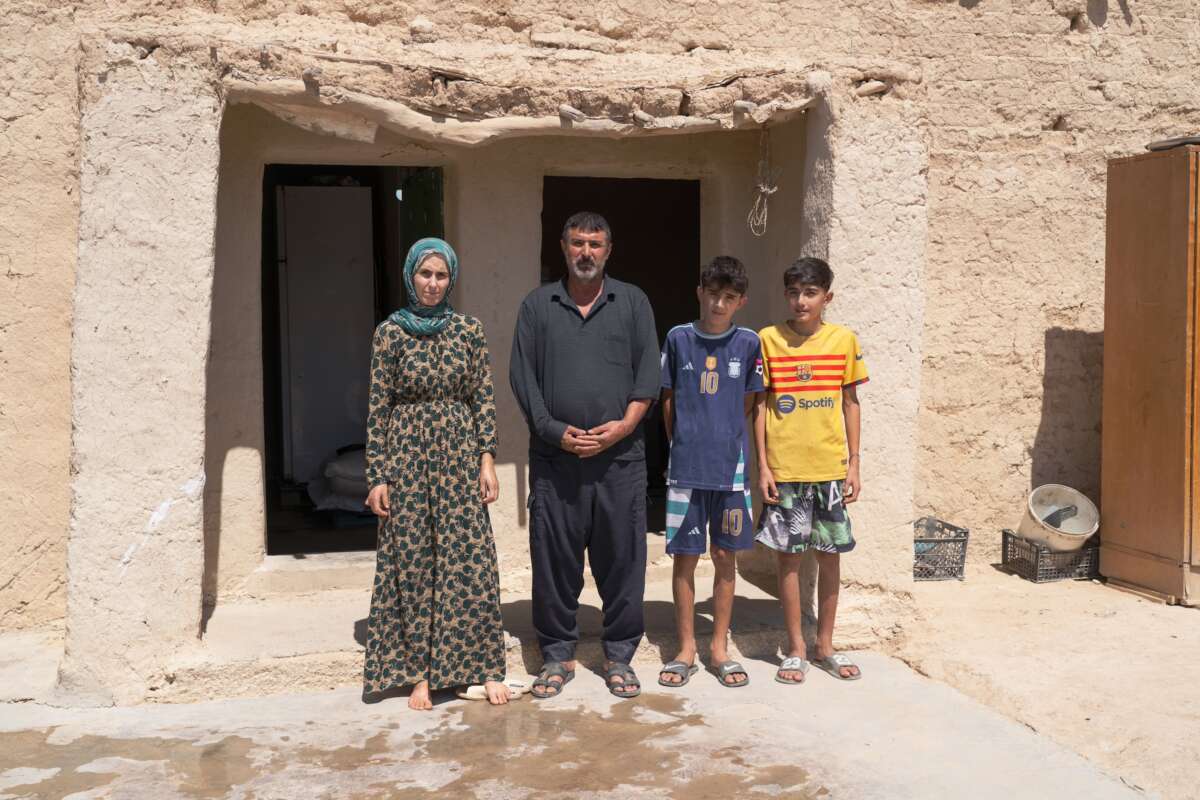
Amy Hussein stands with his wife and two sons. Jaclynn Ashly

“But it’s still hard. For those of us who survived the genocide, we don’t know anything about our fate or our future.”

With ISIS’s destruction of around 80 percent of public infrastructure and 70 percent of civilian homes in Sinjar City and surrounding areas, a lack of basic services and adequate shelter means those returning are in an uphill battle to rebuild their lives. According to the IOM, there are still challenges in accessing running water, electricity, health care and education for families in Sinjar.

Public education is sometimes not readily available, in part due to damage or destruction of schools. Where it is accessible, the quality of education is undermined by overcrowding, with some schools accommodating students from multiple villages, and staffing shortages, as thousands of teachers remain displaced.

Many families here have received financial support from IOM to return and to rebuild their homes, but they say that it is not enough. Hussein, who received about 700,000 Iraqi dinar ($534) from IOM, says it helped him put up some windows and doors in his brother’s half-constructed home, but the funds quickly dried up.

About 2,200 Yazidi are receiving monthly stipends — about $650 — through the Yazidi Survivors Law, which the Iraqi parliament passed in 2021 and which provides a reparations framework for many survivors of ISIS crimes, particularly women and girls subjected to sexual violence, as well as child survivors who were abducted before the age of 18. The law focuses on the Yazidi community, but also includes reparations for survivors from the Christian, Turkmen and Shabak minority groups.

Many Yazidi do not have the money to rebuild; some are sleeping on the floors of half-standing houses.

Shamo, who was abducted by ISIS when he was 12, is a recipient of this monthly stipend, which has helped him rebuild and sustain himself in Sinjar despite widespread unemployment.

The Iraqi government, through the Ministry of Migration and Displaced (MoMD), also provides a return grant of 4 million Iraqi dinar ($3,052) for Yazidi families residing inside the IDP camps and 1.5 million Iraqi dinar ($763) for those outside the camps. Those whose homes and properties were destroyed or damaged can also apply for compensation from the government.
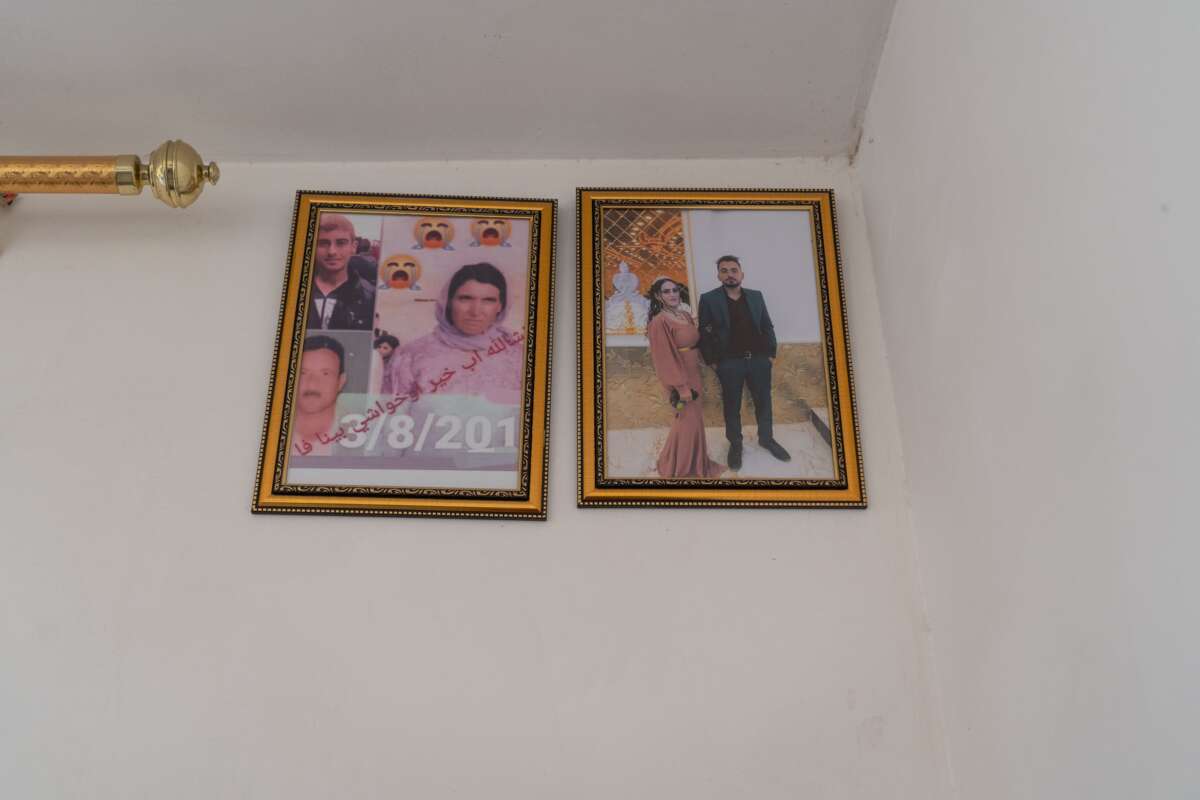
Photos hang on the wall of Shamo’s parents and brothers, who are still missing and believed to have been killed by the Islamic State. Jaclynn Ashly

Yet of all the recently returning Yazidi Truthout spoke to, none had received this government assistance. Jamal Saido, the documentation and protection officer at Nadia’s Initiative, founded by Nobel Peace Prize Laureate and Yazidi survivor Nadia Murad, says this is likely due to the extremely slow pace of the application process, which can often drag on for many months.
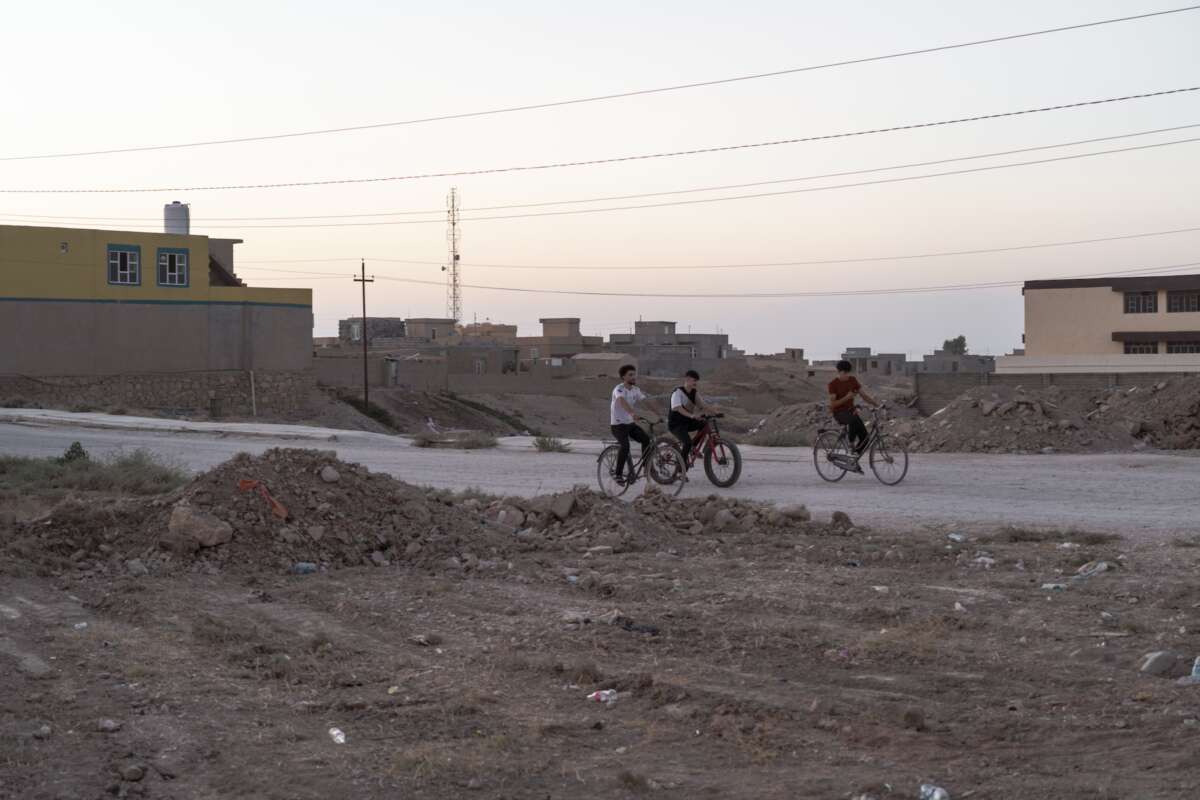
Young people ride bikes through a village in northern Sinjar, where Yazidi have recently begun to return.Jaclynn Ashly

Tired of waiting, many Yazidi families have returned on their own without government or organizational support.


“Because of Fear”

Sahar Hajimalo, 30, just returned to Sinjar a few days ago — after spending more than a decade in Chamishku camp in Zakho. The mother of three children, from ages 10 years to 2 months, returned to the home her family had started constructing before the ISIS invasion.

“Living in the camps, nothing ever belonged to us,” Hajimalo tells Truthout, balancing her 2-month-old on her hip. “We wanted to return to the only things that still belong to us — our home and land.”
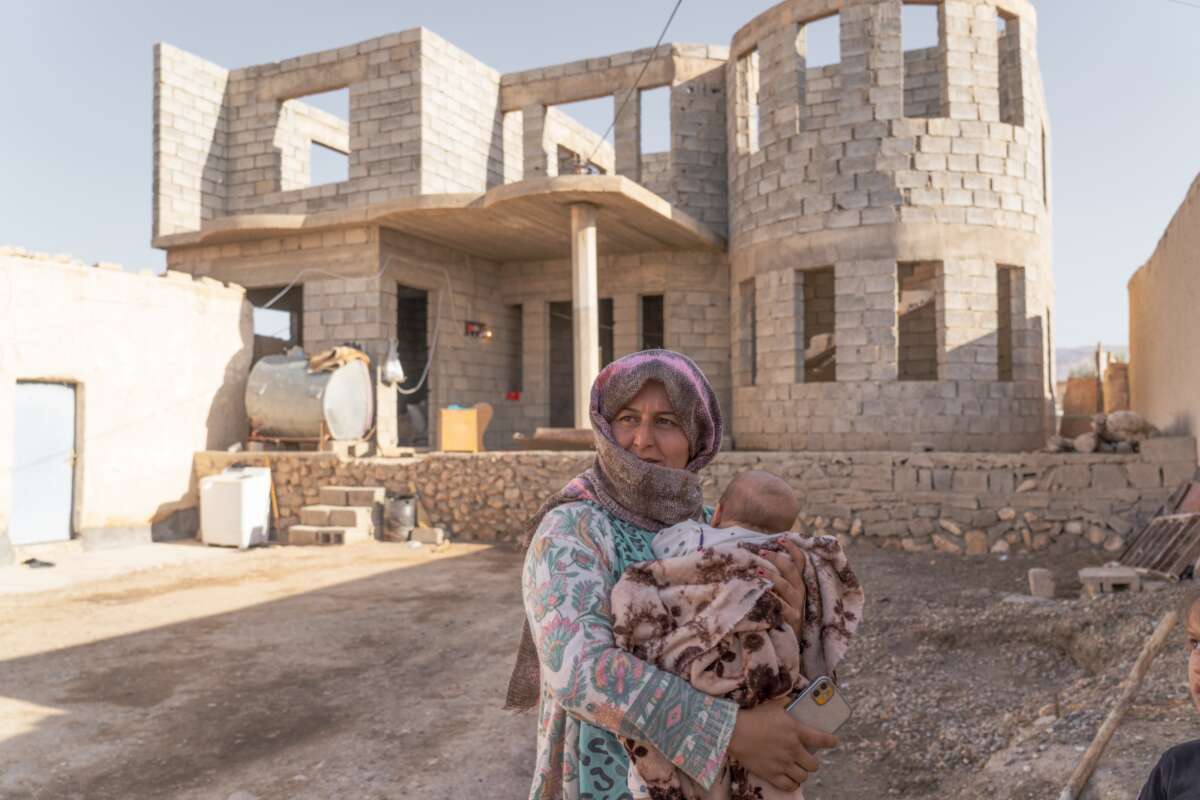
Sahar Hajimalo, 30, just returned to Sinjar a few days ago and is sleeping on the floor of a half-constructed home. Jaclynn Ashly

Hajimalo says she has not received any financial assistance, but decided to return on her own. Her husband is also unemployed. With much of the infrastructure and buildings still damaged or destroyed in Sinjar, along with the majority of the Yazidi population still displaced, there is a major lack of employment and business opportunities for those returning.

Hajimalo and her family now sleep on the floor of a small room in her half-constructed home, bundled up in blankets during the nights. “The conditions here are not great,” she says. “But the situation in the camp was becoming unbearable. We didn’t want to be displaced for the rest of our lives.” Some returning Yazidi have erected tents to live in, while others have moved into the homes of those who were killed or displaced because their own homes were destroyed, according to residents.

An IOM survey conducted last year revealed that 85 percent of displaced Yazidi said they were not returning to Sinjar due to issues around accessing housing, employment, making a livelihood or starting a business, along with inadequate access to basic services. According to the IOM, 80 percent of Yazidi households, whether returnees or internally displaced people, do not have a stable income.
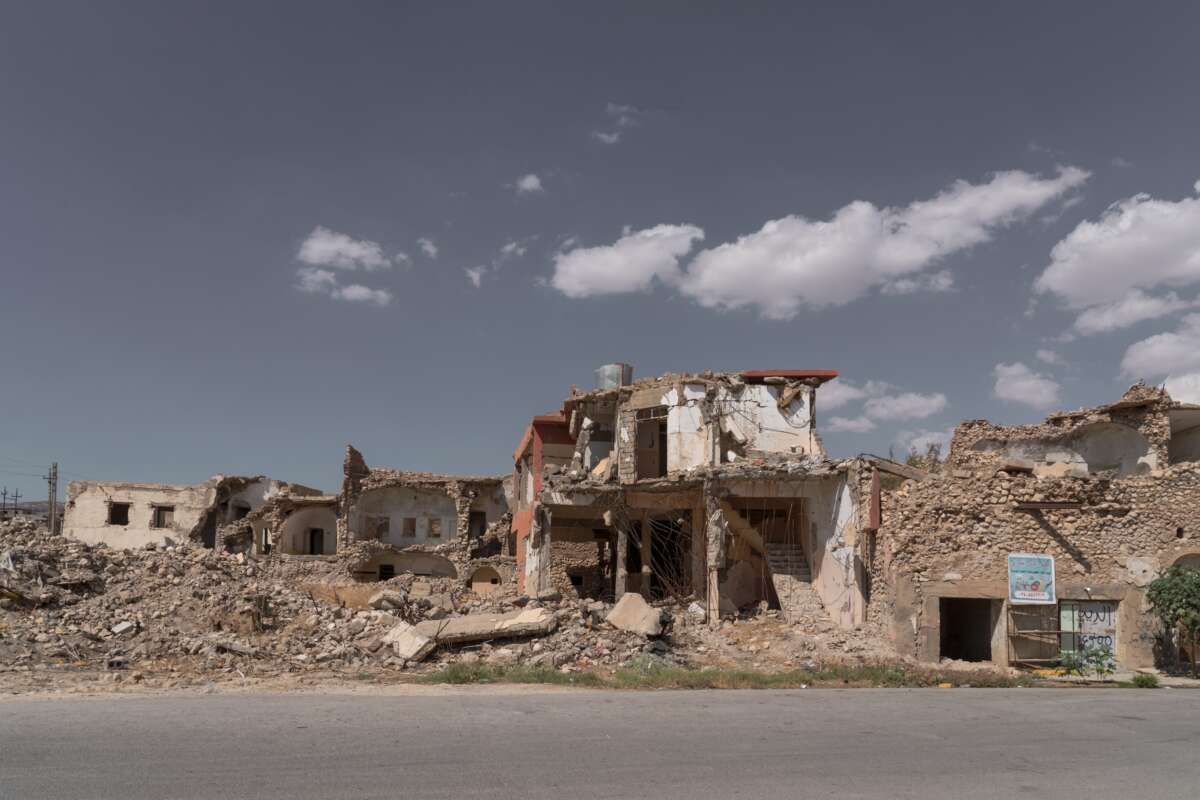
Sinjar’s old city is still in ruins. Jaclynn Ashly

About 85 percent of Sinjar’s population was dependent on agriculture for their livelihoods before 2014. But the ISIS militants wiped out Sinjar’s natural resources, sabotaged its irrigation canals and wells, stole or destroyed farming equipment and razed the farmland. Many families also lost their documentation that proves land ownership during the chaos of fleeing their homes, leaving them without access to their properties on which to farm.

Omar Uso, 74, sits beside his two sons on a mat laid out in front of his home, which he began constructing about a year ago with help from local organizations. The family finally returned a month ago after construction was completed.

“Before ISIS, we had vehicles and a lot of livestock — over 300 sheep, but we left everything behind,” Uso tells Truthout. “ISIS burned down our homes and looted our vehicles, tractors, generators, animals, everything.” According to Uso, 70 people from his village were captured by ISIS and out of them only two elderly women survived.

“It would take a huge investment to get back all that was stolen from us and build up our farm again, and it’s just not possible right now,” Uso explains.
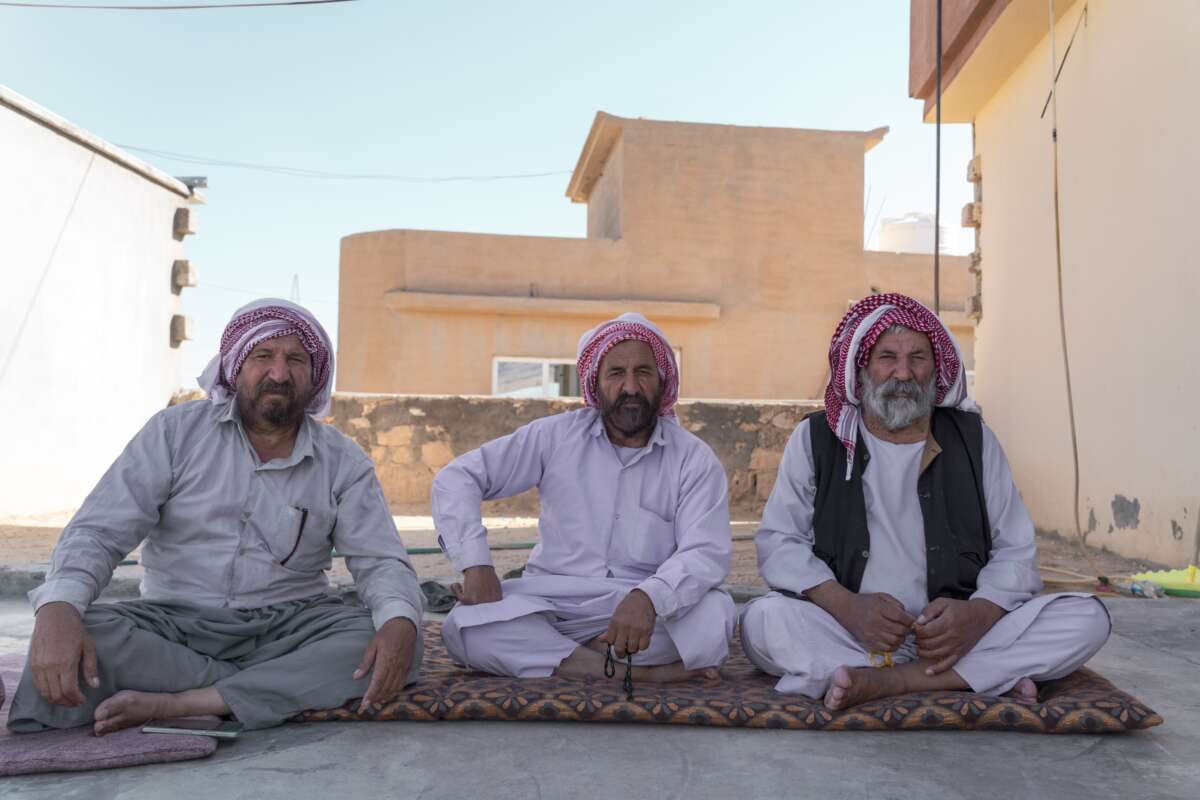
Omar Uso (right) sits beside his two sons at his home in Sinjar. Jaclynn Ashly

Uso says there is also rising hate speech against the Yazidi in Iraqi Kurdistan and this is driving many to return to Sinjar, despite not having proper homes or livelihoods. These tensions followed statements made last year by Qasim Shasho, a Yazidi politician and commander of the Yazidi Peshmerga unit in Sinjar, who declared that the Yazidi would always be under threat as long as “Mohammed and his religion exist”; however, Shasho claimed his words were misinterpreted and were meant only for extremist groups.

Nevertheless, this public comment elicited uproar, with some Sunni clerics making direct threats of violence against the Yazidi living in camps around Duhok in public speeches and social media. At least dozens of Yazidi families, reminded of the terror they endured in 2014, fled their homes in fear of potential attacks.

Uso’s son Barjis tells Truthout that the primary reason for him returning to Sinjar two weeks ago was due to continued feelings of insecurity in the IDP camps. “The camps don’t feel safe anymore,” Barjis says. “I had work and more opportunities in Kurdistan, but I came back here because of fear.”
“Kill Us Again”

This fear is felt throughout the entire Yazidi community in Iraq — among those returning to Sinjar and those still displaced. “Yazidi are living in total uncertainty in different environments,” explains Saido from Nadia’s Initiative. “Some are living in IDP camps and they are scared to return to their lands where they were subjected to genocide with little support to assist them in rebuilding their lives. Others are also scared of staying in the camps.”

“Wherever the Yazidi are in Iraq, they have been living in total uncertainty and insecurity for more than a decade now,” he adds. “They are still living in complete fear that something will happen to them again at any moment. It’s difficult for them to feel safe, regardless of where they are.”
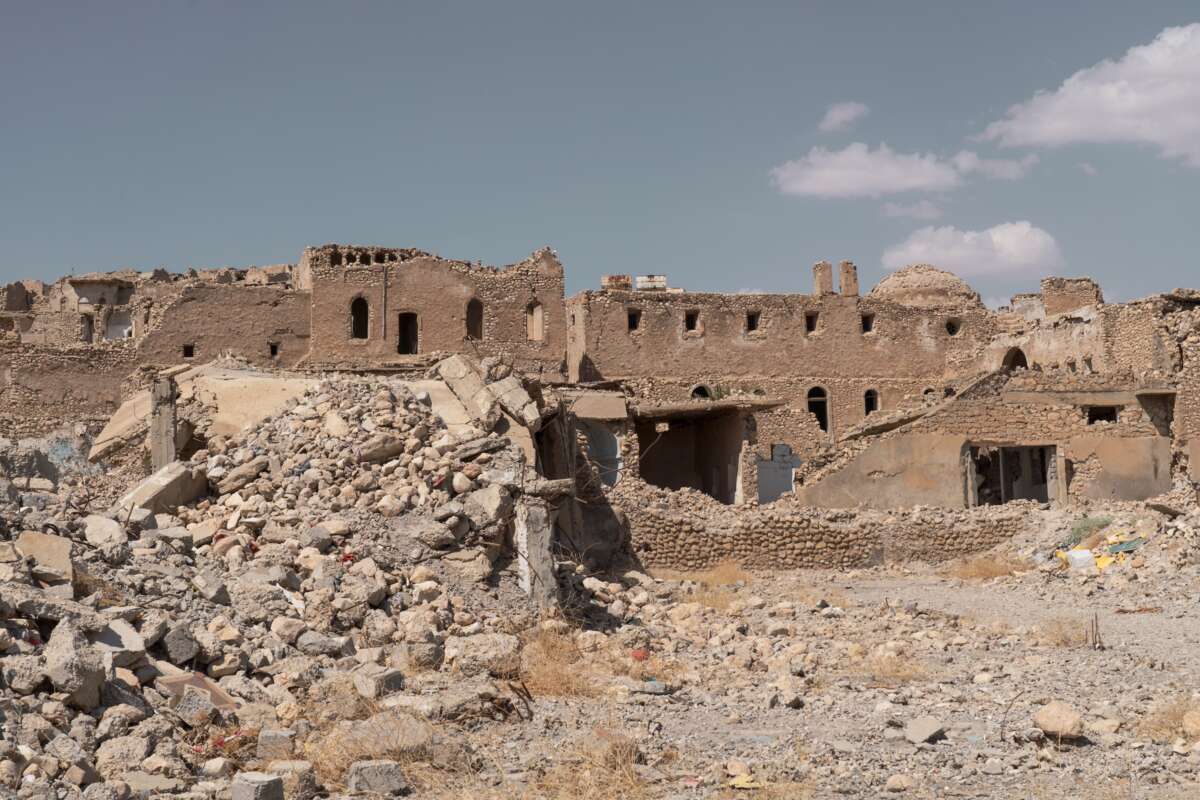
Sinjar’s old city is still in ruins. Jaclynn Ashly

According to Saido, those returning to Sinjar are suffering from PTSD and have experienced flashbacks upon returning to their destroyed villages and homes. Shamo, who was indoctrinated to fight as a child soldier for ISIS, concedes that he is often unable to sleep. “Psychologically, I’m still not normal,” Shamo tells Truthout. “I have hope in my future here in Sinjar. But I can’t help my mind from remembering and thinking too much. It has been more than 10 years that I haven’t heard anything about my parents and brother. Even to just calm my mind down to sleep for one night is very difficult for me.”

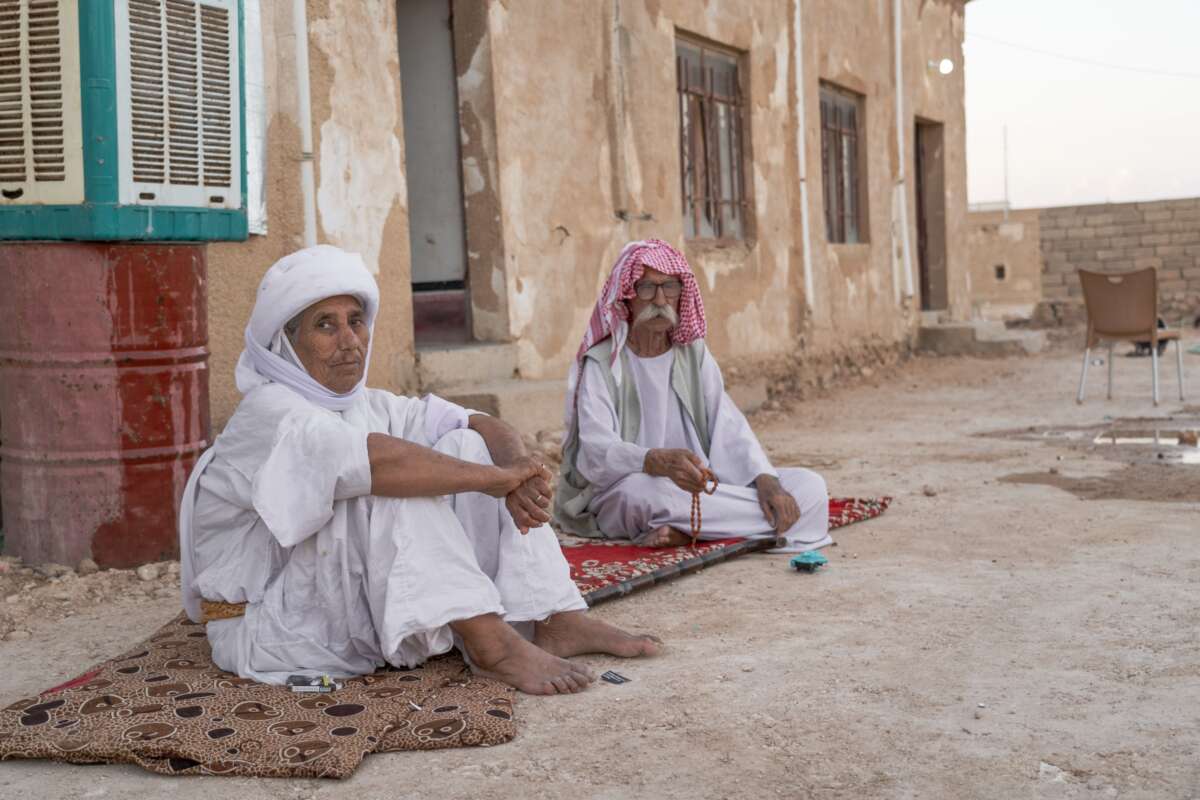
Hussein Findi, 107, and his wife, 85-year-old Ghassal Sado, returned to their half-destroyed home in Sinjar about a month ago. They also say it was increased hate speech targeting the Yazidi in Iraqi Kurdistan that prompted them to leave the Kabarto IDP camp and return to Sinjar. “Nowhere in Iraq is safe for the Yazidi, so we might as well return to our homeland,” Findi says, seated cross-legged on the concrete floor of one of the only rooms of his home that was not destroyed by ISIS.

“But this violence is not new to the Yazidi,” Findi tells Truthout, gliding a string of prayer beads between his fingers. “What ISIS did to us is not the first genocide against the Yazidi; they have killed us before and they will kill us again.”

Historians believe that there were at least 74 different genocidal acts that were committed against the Yazidi by various actors through the centuries. The Yazidi refer to these massacres as the 74 Firmans, literally meaning an official decree or order. This word has become synonymous with genocide within the Yazidi community, because most of the episodes were committed in furtherance of Islamic Fatwas calling for violence against the Yazidi.

“The Yazidi will never be safe in this country,” Findi laments. “But if they come for us again, I would much rather be killed in my homeland than in an IDP camp.”

This article is licensed under Creative Commons (CC BY-NC-ND 4.0), and you are free to share and republish under the terms of the license.

Jaclynn Ashly is a multimedia freelance journalist who has worked in more than a dozen countries. She specializes in telling in-depth stories that relate to human rights, migration, culture, climate change and politics.
Intentional Journalism Owes a Debt to the Dead in a Swedish Mass Shooting

The majority of those who died were immigrants to Sweden, and the debt is simple: telling their stories in a way that counters common stereotypes about immigrants and refugees in Sweden, and across Europe.


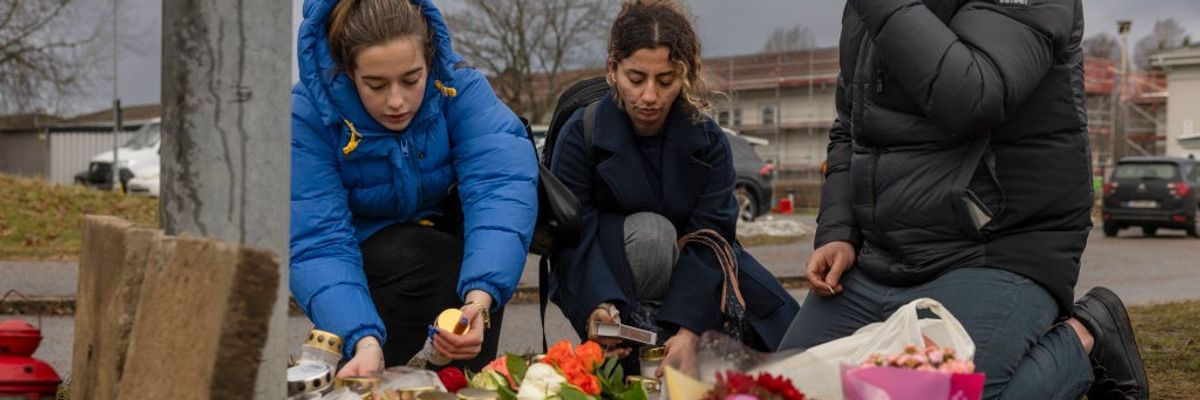
Mourners gather at the site to pay tribute to the victims in a shooting on February 5, 2025 in Orebro, Sweden.
(Photo: Jonas Gratzer/Getty Images)
Common Dreams

As the mass murder that took the lives of 10 innocent people in Sweden disappears from the international news map, there remains a debt to the dead that will likely go unpaid.

The majority of those who died were immigrants to Sweden, and the debt is simple: telling their stories and placing their lives in a context that pushes back against the common stereotypes about immigrants and refugees in Sweden, and across Europe.

Details are now beginning to emerge about the victims in Örebro. Of the 10 who died in Örebro, seven were women and three were men. Eight were born outside the country. But there is so much more. There are details that speak to the mundane, everyday lives of immigrants and refugees—stories that are largely ignored by the media in favor of more sensational topics such as crime, terrorism, and failed integration. Topics that do not reflect the overwhelming majority of people who have immigrated to Sweden and Europe. People who have often fled violence and persecution in search of a quiet, ordinary, and anonymous life.

To not recognize their everyday lives or to refuse to acknowledge their efforts to integrate into their new societies is to subject them to a second form of violence: the symbolic murder of their humanity.

Let’s be honest. The decision to present immigrants and refugees in one way rather than another is both deliberate and conscious. And let’s not deny the cruel irony that immigrants, routinely smeared as “lazy,” “violent,” and “incapable of integrating,” were murdered by an "ethnic Swede" who himself lived an unintegrated life as a “loner.”

Immigrants like Bassam, a father of two who came to Sweden from Syria. He worked making bread and preparing food, and on days when he had Swedish language classes, he would start work at 4:00 or 5:00 am, attend his language class, then return to work and stay late.

Immigrants like Salim, a refugee from Syria who had become a Swedish citizen and was studying to become a healthcare worker. He was engaged and had just bought a house. His last act, as he lay dying after being shot, was to call his mother and ask her to take care of his fiancée.

Immigrants like Elsa, who arrived in Sweden in 2015 from Eritrea and was also studying to become an assistant nurse. She was already employed at a nursing home and worked as a contact person for disabled residents in the municipality. She wanted to have two jobs to earn enough money for her husband to get a residence permit. They had four children.

These were victims of an act of violence that ended their physical presence in this world. To not recognize their everyday lives or to refuse to acknowledge their efforts to integrate into their new societies is to subject them to a second form of violence: the symbolic murder of their humanity. We are regularly told that immigrants to Europe from “other” parts of the world do not share our “values.” Yet, in the case of the mass murder in Sweden, we see victims who worked—often with multiple jobs—to integrate and create a better life. In short, they shattered the stereotype of the isolated, lazy immigrant unwilling to engage with Swedish society.

In the days (and now weeks) after the mass murder in Örebro, media in Sweden have been telling the stories of some of these immigrants and their families. About their lives and their losses. This is important progress in Sweden… while media outside of the country have overwhelmingly ignored the dead. But it also raises the question: Should it really take being killed in a mass murder to have your story told?

There are parts of the world that receive media coverage in Europe and the U.S. almost exclusively when there is war, famine, or natural disasters. This links these regions with crisis in the minds of news consumers, and it is a connection that is hard to break. The very idea that people in these regions have everyday concerns, worries, and joys like we do at home is very rarely addressed. Similarly, in domestic media, there are segments of society that are covered primarily when something negative or terrible happens. This creates a similar mental map for news consumers, overshadowing all other perspectives.

In journalism and media research, the concept of “framing” suggests that how an issue or group is presented (rhetorically or visually) in news affects how that issue or group is perceived and understood. But what is not shown is also part of “framing.” What is omitted in the presentation and analysis of society is also an editorial decision.

This should also be seen as part of the debt owed to many of those killed in Örebro. To recognize the power of media to shape not only what people think about but also how they think about it, and to present the everyday lives of those who come to Sweden and Europe not only when linked to tragedy and violence.


Christian Christensen, American in Sweden, is Professor of Journalism at Stockholm University. Follow him on Twitter: @ChrChristensen
Full Bio >
Why Trump Is Detaining Migrants Out of Sight and Out of Mind in Guantánamo Bay

Whatever the treatment of the “worst of the worst” at or near that infamous prison, now a recyclable holder for whoever is the enemy of the day, it will be hidden from public view.


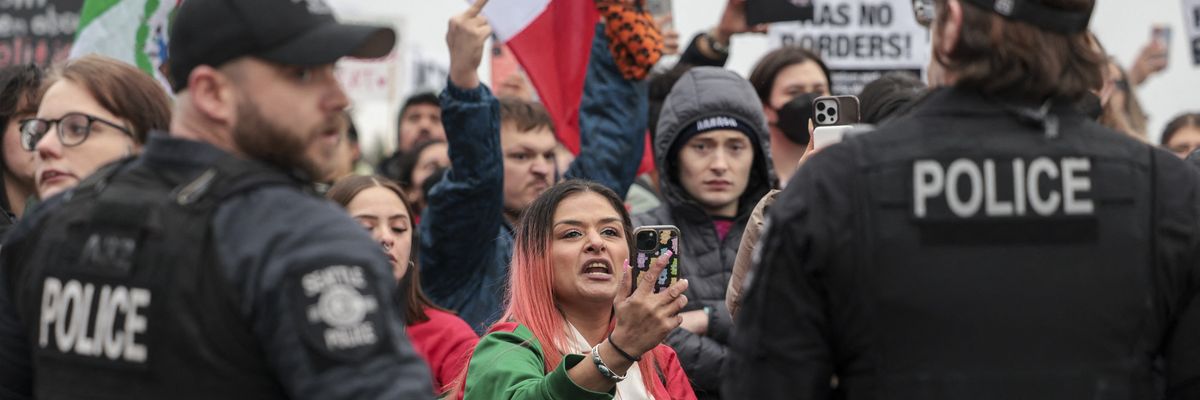
A demonstrator records Seattle Police officers on their phone after officers made one of two arrests during a march against Immigration and Customs Enforcement (ICE) entitled "Get our Gente Out of Guantánamo Bay!" in Seattle, Washington on February 8, 2025.
(Photo: Jason RedmondA/AFP via Getty Images)

Andrea Mazzarino
Feb 21, 2025
TomDispatch

President Donald Trump has made no secret of his disdain for immigrants, particularly the non-white variety from south of our border. His statements that immigrants are “poisoning the blood” of our country,” coupled with Fox Newsreports on Hispanic-appearing migrants who commit crimes, leave little doubt about what he and his allies think of (non-white) immigrants and their contributions to this country.

So it didn’t surprise me that he recently began to follow through on his own and his Department of Homeland Security (DHS) leadership’s earlier intentions (as far back as 2018) to detain immigrants—including unaccompanied children—at military posts. Earlier this month, the first deportation flight carried a few men from the American mainland to our naval base and Global War on Terror offshore prison site in Guantánamo Bay, Cuba. Trump’s spokesperson Karoline Leavitt referred to those migrants as “the worst criminal illegal aliens” and “the worst of the worst.” The flight apparently included members of a gang from Venezuela. Yet troops had already been ordered to ready the base in Cuba to house some 30,000 immigrants—a dramatic increase in its capacity—in military tent encampments meant to supplement existing detention facilities there.

The move is part of President Trump’s signature public policy initiative: to deport millions of immigrants living in the U.S. without clear legal status. Some 40% of those Trump deems “illegal” and has targeted for deportation actually have some sort of official permission to be here, whether because they already have temporary protected status, a scheduled date in immigration court, or refugee or asylum status.

The Trump administration isn’t planning to give the public the opportunity to critique the mistreatment of migrants deported to Guantánamo or any other military post or new detention center in an up-close-and-personal fashion.

Since none of them wear their immigration status on their shirts (thankfully!), it might prove unnerving indeed how officers from DHS will be selecting people for interrogation and detention. (It’s probably not the guy in front of you at Starbucks with a Scandinavian accent who just ordered a fancy drink.)

Everything from Ku Klux Klan flyers left in towns across the Midwest after the election to Trump’s order removing the protected status of schools, healthcare facilities, and places of worship when it comes to U.S. Immigration and Customs Enforcement (ICE) raids paints a dire picture. We haven’t seen profiling on this scale since the days after the 9/11 attacks in 2001, when the federal government ordered tens of thousands of men of Arab, Middle Eastern, and South Asian descent to register and be fingerprinted, subjecting them to increased surveillance and vigilante violence.

Since then, globally, the U.S. has detained hundreds of thousands of men (and, in some cases, boys) domestically and at that infamous prison in Guantánamo Bay, many without the ability to challenge their detentions and without the Red Cross surveillance that international law grants them.

Given the way legal standards for the treatment of people detained at federal facilities have eroded over the last two and a half decades, what may happen to tens of thousands of migrants at incarceration centers like Guantánamo in the years to come can only be a matter of grim speculation. However, one thing is clear: Whatever the treatment of the “worst of the worst” at or near that infamous prison, now a recyclable holder for whoever is the enemy of the day, it will be hidden from public view.
My Backyard

Such developments seem ever more real to me because my family lives about 40 miles from downtown Washington, D.C., where the Trump administration is churning out executive orders at breakneck speed. We live in a beautiful rural community in a county where about one-third of all residents are foreign-born. Those immigrant families bring cultural and linguistic richness to our schools, fuel the day-to-day operations of our many nearby military posts, run some of the most affordable supermarkets and tastiest restaurants around, and do the physically and emotionally demanding work of growing our local food. It’s hard for me to imagine how such immigrants are the worst of the worst.

Sure, some of them—like some of any other population you choose, including, of course, that convicted felon Donald Trump and crew—commit crimes. Yet rates of criminal activity among immigrants are much lower than among U.S. citizens. According to a 2020 study by the Bureau of Economic Research, immigrants are 60% less likely to be incarcerated than people born in this country.

I’m also a military spouse of more than 10 years and, in my family and community, it’s taken for granted that you’re going to be spending a lot of time with people who were born elsewhere, since immigrants of various stripes make up about 5% of our service members and are a significant part of military spouse communities as well. And believe me, many of the folks I know in those foreign-born subcategories of military communities are truly scared right now, even if for wealthier white families like mine, the suburbs and rural rolling hills around our nation’s capital offer opportunities to learn and a peacefulness that make them great places to raise kids.
A Changing Landscape

That said, in the wake of President Trump’s recent orders, the landscape around me is already changing. Some children whose family members are immigrants or who themselves are foreign-born have been absent from local schools. One of my children came home upset earlier this week and has been complaining of an unsettled stomach since learning that a good friend will have to leave the country due to fear of harassment under Trump’s new policies. Nearby, a Maryland high school teacher has been placed on leave after boasting on social media that he would help ICE identify “illegals” among his students. School administrators are bracing for armed federal agents to show up, demanding access to kids.

This is the kind of mundane horror and sadness I see blooming around me these days, as the news starts to report similar developments elsewhere: the Syracuse restaurant workers who were called into an ICE office and left with ankle monitors; the Guatemalan-American father of four in Ohio who was told by an ICE agent during his annual check-in that he needs to book a flight back to the country he only remembers from his teenage years or be deported. And these are the “lucky” ones who at least have some forewarning. Others won’t and will simply be subjected to the whims of federal immigration agents like those in New York City, where a memo issued by Mayor Eric Adams informed city workers that they can allow ICE agents into municipal facilities if they “reasonably feel threatened or fear for your safety or the safety of others around you.”

I wish I could say that history has taught Americans about the human costs of war and the dangers of indifference to it.

At least, the Trump administration’s immigration policies and actions are still subject to criticism by plucky journalists and activists prepared to call out instances of abuse of executive power, racial profiling, and violations of the right to education and other human rights. Count on this, though: The Trump administration isn’t planning to give the public the opportunity to critique the mistreatment of migrants deported to Guantánamo or any other military post or new detention center in an up-close-and-personal fashion. Such areas will be closed to all but servicemembers and assigned workers.

Sometimes even military family members won’t have the special authorization to enter them. In order to get in, you’ll need to present an official ID, have a reason to enter, possibly have a military service member directly authorize your access, and abide by specific restrictions on movement and rules about whether you can photograph anything on the base. At that base in Guantánamo, restrictions are even tighter and there are no guarantees that journalists will ever have access to migrants and their living conditions there.
Isolation as Death

President Trump has undoubtedly chosen the U.S. military base at Guantánamo, Cuba not just because it has so much detention space or, in past times, was used to detain Haitian and other immigrants, but at least in part because the prison there that held so many tortured prisoners from this country’s war on terror is well known to rights groups and the general public as a nightmarish facility. A 2014 Senate report, along with numerous investigations by human rights groups, found that terror suspects, including in some cases boys, at that base had often been denied due process, detained indefinitely without charge, and subjected to inhumane or degrading treatment.

It’s a fact that people do poorly living in conditions of isolation from the rest of society. Our own military is a case in point. In the decades since fewer of us began to serve, thanks to the absence of a draft (even as the military budget ballooned), Americans generally know far less about what our military is like and what it does. In these same years, suicide rates among servicemembers and veterans have surpassed civilian rates, while violent crime and accidents have grown more common following post-9/11 deployments. Such problems are due, at least in part, to a culture of silence and isolation among military families, as well as a lack of access to military bases by journalists and the public. What we can’t know about or see, we naturally care so much less about.

Other examples of isolated populations, ranging from those in nursing homes during the Covid-19 pandemic (where there were staggering death rates) to closed mental institutions, remind us that isolation begets a lack of public accountability, indifference, and greater human pain.

Of course, the federal government has also had a deadly history of isolating people for national security reasons—from Indian reservations to the internment of Japanese- and German-Americans on military installations during World War II. Things have never ended well for such groups.
The Sound of Silence

As our country’s next wave of abuse toward supposedly dangerous “others” begins, it’s possible to pay attention. Yet when I go out into my community and speak with neighbors, other parents, friends, and acquaintances, I’m reminded of how easy it is to do nothing in the face of what’s happening around us. When I urge people to write their representatives about the treatment of immigrants, they all too often look away and don’t respond, or say they’re afraid of violent retribution if they post a yard sign on their lawns about how “everyone is welcome here.” And I can’t blame them. After all, you bring kids into this world and your first loyalty is to their safety. By the same token, ignoring signals of growing authoritarianism in the interest of peace and continuity has its obvious problems.

In my area, populated by many federal employees recently ordered to return to full-time in-person work, daily life will soon be overflowing (with little room for anything else). Residents will commute two-plus hours each way to crowded office buildings in D.C. so that voters in red states can be happy. Possibly the only ones among us who will have no choice but to pay attention to what happens in their own backyards are those who have already lost their jobs; activists at local NGOs serving immigrants and other vulnerable groups; and schoolchildren who, by necessity, see the horrors of this administration through the eyes of their vulnerable friends and parents.

For us adults, especially parents occupied with the care of our children, I’m reminded of how easy it is to ignore or forget what happens right in our own backyards. Recently, I read a New York Times article about a house in Poland on the edge of what used to be the Nazi death camp of Auschwitz, where its wartime commandant once lived. It overlooks a former gallows and the gas chambers where more than a million civilians were murdered, even as many Poles then carried on with their daily lives. A widow who brought up two kids there in the post-war years called the house “a great place to raise children.”

I wish I could say that history has taught Americans about the human costs of war and the dangers of indifference to it. Yet, around here at least, as Donald Trump and his administration scapegoat immigrants to distract from the impunity of their own actions (particularly those of Elon Musk, perhaps the most prominent immigrant ever to work here “without a legal basis to remain in the United States”), the silence is deafening. It seems to matter not at all that the infamous all-American prison in Cuba from this country’s grim war on terror has now become the “homeland” for a new nightmare (and a half).


© 2023 TomDispatch.com


Andrea Mazzarino co-founded Brown University's Costs of War Project. She is an activist and social worker interested in the health impacts of war. She has held various clinical, research, and advocacy positions, including at a Veterans Affairs PTSD Outpatient Clinic, with Human Rights Watch, and at a community mental health agency. She is the co-editor of "War and Health: The Medical Consequences of the Wars in Iraq and Afghanistan" (2019).
Full Bio >
TRUMP KILLS

'Jocelynn Deserves Justice!': 11-Year-Old Texan Kills Herself After Bullies' Deportation Threats

"This is what violent nationalism does," said one observer. "It seeps into the minds of children and turns playgrounds into nightmares."


Jocelynn Rojo Carranza, age 11, took her own life after severe bullying and anti-migrant taunts from her Texas classmates.
(Photo: family photo/@ndelriego/X)

Brett Wilkins
Feb 19, 2025
COMMON DREAMS

An 11-year-old Texas girl took her own life following relentless bullying from classmates, some of whom threatened to call U.S. immigration authorities to deport her mother—who says she was never notified by school officials who knew of the abuse.

Jocelynn Rojo Carranza, a sixth-grader at Gainesville Intermediate School in Gainesville, located about 70 miles north of Dallas, died on February 8 in a Dallas hospital after spending five days in its intensive care unit, The Latin Timesreported Tuesday.

"I waited a whole week for a miracle that my daughter would be well, but unfortunately nothing could be done," the girl's mother, Marbella Carranza, toldUnivision in an interview in which she asked authorities to investigate the incident.

"She was a happy girl. My daughter will always live for me, and I will always love her," Carranza added.

According to The Latin Times, classmates bullied Carranza over her family's immigration status and threatened to call U.S. Immigration and Customst Enforcement. Newsweekreported that some of Carranza's tormentors taunted her about being abandoned if her parents were deported.

"This is what happens when you support and vote for a clown that blames immigrants for everything."

School officials knew Carranza was being severely bullied and sent her for multiple weekly counseling sessions. However, the officials reportedly never notified the child's mother, who says she only found out about the abuse after her daughter's hospitalization.

Carranza's death came amid increased anti-immigrant bigotry fueled by the return of Republican U.S. President Donald Trump to the White House. Trump—whose winning campaign strategy included falsely smearing migrants as pet-eating invaders and disease-spreading terrorists—quickly began his promised mass deportation drive.

This includes sending some deportees to the notorious Guantánamo Bay naval base and prison in Cuba, while some are being detained in a Panamanian jungle camp described as "primitive."

On Monday, U.S. Homeland Security Secretary Kristi Noem introduced a video warning people who are in the United States without authorization to "self-deport and stay out." The ad—which is part of a campaign reportedly costing taxpayers $200 million—tells undocumented migrants to "leave now" or "we will hunt you down."

Ruth Delgado, the digital media manager at the immigration reform group America's Voice, called Carranza's death a "heartbreaking story" in a Tuesday post on the Bluesky social media site.

"Her story is one of the many real human consequences of Trump's anti-immigrant rhetoric," Delgado added.


Another Bluesky user said that "the cruelty and terror is the goal of this horrible regime."

"Jocelynn did nothing wrong," he added. "We failed her. I'm so sorry."

One immigrant from Mexico wrote on social media that "this is what happens when you support and vote for a clown that blames immigrants for everything. The way in which the MAGA cult is poisoning the mind of this kids is outrageous. Jocelynn deserves justice!"

A Italian study of fifth grade students published in 2022 found a correlation between campaigning by the xenophobic right-wing Lega Nord party and school bullying.

"Our main result is that during electoral campaigns in places where Lega Nord is active there are large increases in bullying victimization within schools that is concentrated solely on children from immigrant backgrounds," the study's authors concluded. "These effects are absent for municipalities in which Lega Nord has little support, where no elections occurred, and for native children."

The 988 Suicide & Crisis Lifeline—which offers 24/7, free, and confidential support—can be reached by calling or texting 988, or through chat at 988lifeline.org


'Outrageous, Unlawful Attack': Trump Plots Takeover of US Postal Service

"Any attack on the Postal Service would be part of the billionaire oligarch coup," said the president of the American Postal Workers Union.


A U.S. Postal Service Post Office is pictured near Los Angeles International Airport in Los Angeles, California on February 5, 2025.

(Photo: Patrick T. Fallon/AFP via Getty Images)


Jake Johnson
Feb 21, 2025
COMMON DREAMS

President Donald Trump's reported plan to terminate every member of the U.S. Postal Service Board of Governors and bring the independent and highly popular USPS under his administration's control drew immediate outrage from the world's largest postal union, which said the floated takeover would be illegal and destructive to public mail operations.

"Any attack on the Postal Service would be part of the billionaire oligarch coup, directed not just at the postal workers our union represents, but the millions of Americans who rely on the critical public service our members provide every single day," said Mark Dimondstein, president of the American Postal Workers Union (APWU), which represents hundreds of thousands of current and retired postal workers.

The union leader's statement came after The Washington Postreported Thursday that Trump is preparing to "dissolve the leadership of the U.S. Postal Service and absorb the independent mail agency into his administration, potentially throwing the 250-year-old mail provider and trillions of dollars of e-commerce transactions into turmoil."

"Trump is expected to issue an executive order as soon as this week to fire the members of the Postal Service's governing board and place the agency under the control of the Commerce Department and Secretary Howard Lutnick," the Post reported, citing unnamed sources.

Lutnick, who was confirmed by the U.S. Senate earlier this week, is a billionaire with glaring conflicts of interest.

The Post noted that Trump has spoken publicly about the possibility of privatizing the USPS, which is currently led by Louis DeJoy. On Tuesday, DeJoy—who was initially nominated for the post by Trump and has worked to gut the Postal Service from within during his tenure—asked the USPS board to begin the process of finding his successor.

The new reporting prompted warnings that Trump, who lied relentlessly about mail-in voting in the run-up to and aftermath of the 2020 election, wants to disrupt ballot deliveries by bringing the USPS under his control.

"Trump's reported outrage that the Postal Service was able to successfully deliver Americans' mail-in ballots in 2020 is exceptionally alarming when considering the same man who helped incite an insurrection based on evidence-free election denialism now wants to be in control of millions of absentee ballots," said Tony Carrk, executive director of the watchdog group Accountable.US.

"President Trump wants to consolidate power further and control access to your mail, all while making his wealthy donors richer in the process," Carrk added. "All eyes should be on conservative senators who represent rural communities who will bear the brunt of postal privatization."


Rep. Gerry Connolly (D-Va.), the top Democrat on the House Oversight Committee, said in a statement Thursday that privatizing the USPS would be "an attack on Americans' access to critical information, benefits, and lifesaving medical care."

"It is clear that Trump and his cronies value lining their own pockets more than the lives and connection of the American public," said Connolly.

According to the Post, the USPS board was "planning to fight Trump's order" and held an "emergency meeting" Thursday at which the board "retained outside counsel and gave instructions to sue the White House if the president were to remove members of the board or attempt to alter the agency's independent status."

"Two of the group's GOP members—Derek Kan, a former Trump administration official, and Mike Duncan, a former chair of the Republican National Committee—were not in attendance," the Post reported.

Dimondstein voiced support for the postal board's plan to fight any Trump takeover attempt, saying the union backs all "efforts to defend our national treasure."

"If this reporting is true, it would be an outrageous, unlawful attack on a storied national treasure, enshrined in the Constitution and created by Congress to serve every American home and business equally," said Dimondstein. "The law created the postal board of Governors, and empowers it and it alone to hire and fire the postmaster general. Any effort by the administration to remove the board or fire postal executives is clearly illegal."

"The Postal Service is owned by the people, for the benefit of the people. Postal workers are dedicated to our mission to serve, no matter who sits in the White House or in Congress," the union leader added. "Postal workers and our unions will join with the public to fight for the vibrant, independent, and public Postal Service we all deserve."
Behind Trump Tariffs Is Capital’s Warfare Against the Working Class

Trump’s tariffs will escalate exploitation and desperation of US workers. That’s the point.
February 17, 2025

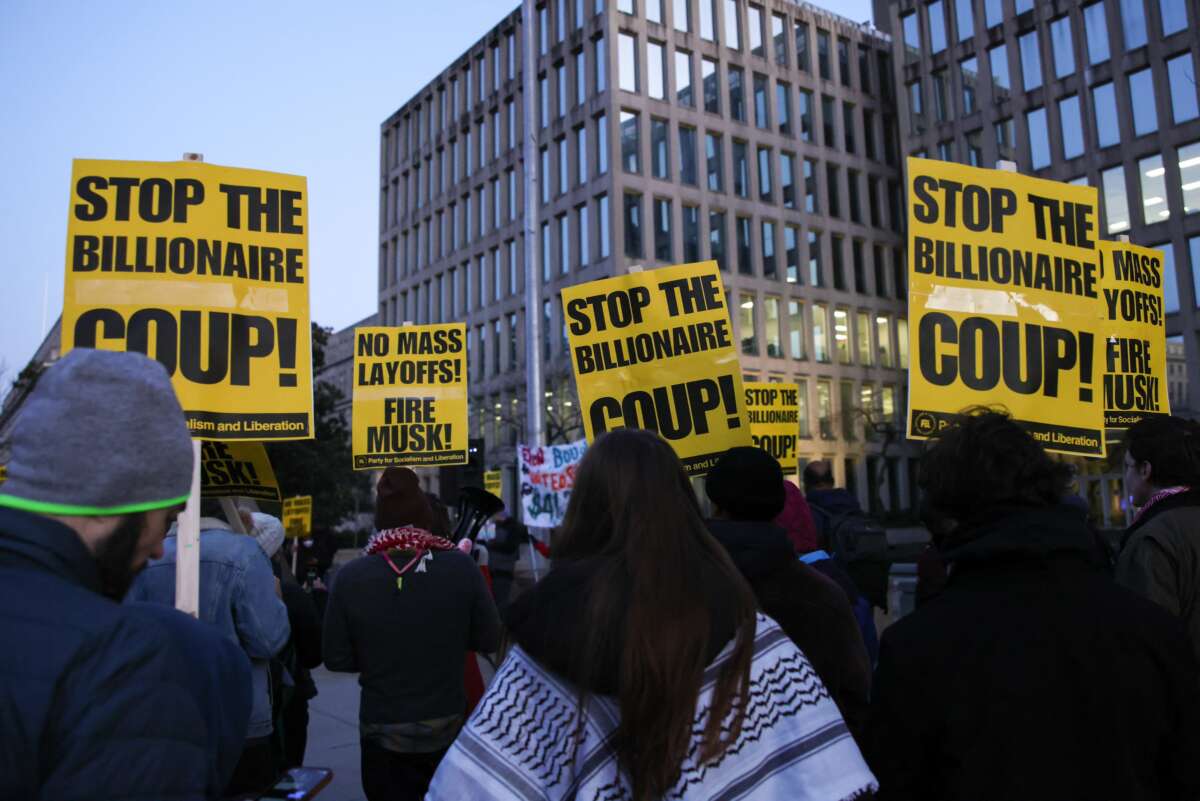
Demonstrators gather outside of the Office of Personnel Management to protest federal layoffs and demand the termination of Elon Musk from the "Department of Government Efficiency" (DOGE) in Washington, D.C., on February 7, 2025.Bryan Dozier / Middle East Images / Middle East Images via AFP

What is behind the tariff war that Donald Trump has launched against Mexico, Canada and China, with a promise to extend the war to the world as a whole? Moving beyond the smoke and mirrors, we must step back and focus on three things. First, the tariff war is a response to the rapidly deepening crisis of global capitalism. Second, it is one component of a radical escalation of class warfare from above against the U.S. and the global working class. And third, the tariff policy is riddled with so many contradictions that it will end up aggravating the crisis and contributing to the unraveling of the Trump coalition.

The crisis of global capitalism is both economic and political. Economically, the system faces a structural crisis of overaccumulation and chronic stagnation that generates turbulence in global financial markets as it heightens international and geopolitical conflict. Over the past half-century, every country has become integrated into a global system of production, finance and services. Nationalist and populist movements of both the left and the right may wish to extricate their countries from this global economy, but withdrawal is impossible — or at least not possible without massive disruption that would generate chaos and collapse. The 2020 COVID-19 shutdown that interrupted global supply chains, for instance, triggered an economic meltdown and social catastrophe unmatched since the Great Depression of the 1930s.

Trump’s tariff war will aggravate the economic turbulence, but the system also faces a spiraling political crisis of state legitimacy, capitalist hegemony and mass social discontent. These political dimensions of the crisis reflect a fundamental contradiction in the organization of global capitalism: the disjuncture between a globally integrated economy and a nation-state-based system of political authority. Despite our economic interdependence, political authority is divided up among over 200 individual nation-states. These capitalist states have a contradictory mandate. On the one hand, each individual state needs to achieve political legitimacy among its respective population and stabilize its own national social order. On the other hand, it must promote transnational capital accumulation in its territory in competition with other states and secure the inflow of resources and raw materials that this capital needs.

The transnational capitalist class (TCC) is not tethered to particular nation-states. Its members will welcome any incentive offered by a state if it enhances profit-making opportunities and will invest wherever they find the best conditions to accumulate. As the crisis has deepened, each state seeks to reduce risks to its internal economy in the face of global financial turmoil and political instability by doubling down on policies that incentivize or oblige transnational corporations to invest in its domestic economy.

These two functions of the capitalist state — the accumulation function and the legitimation function — are incompatible with one another and are played out in protectionist wars and other forms of interstate competition. Attracting transnational investment requires providing capital with incentives such as low wages and labor discipline, a lax regulatory environment, tax concessions, investment subsidies, privatization, deregulation, and so on — precisely the neoliberal policies that have been pursued worldwide since the onset of globalization. The result is rising inequality, impoverishment and insecurity for working and popular classes — precisely the conditions that throw states into crises of legitimacy, destabilize national political systems, jeopardize elite control and give impetus to the rise of a neofascist right.

This is the larger context for the rise of Trumpism, which must be seen as a far right, neofascist response to the social and economic crisis of the U.S. working class and to the crisis of state legitimacy that it has produced. The working class has experienced an ongoing destabilization of its living conditions over this past half-century, with a particularly sharp deterioration since the financial collapse of 2008 and in the wake of the COVID-19 pandemic. It faces increasing precarity, job instability, widespread and rising un- and underemployment, poverty wages, marginalization and social decomposition, food insecurity, and crises of health care, substandard housing and homelessness.

Trump managed to get elected for a second term through a populist, nationalist, racist and neofascist discourse that spoke to this rising socioeconomic insecurity and mass social anxiety. He manipulated mass discontent with the Democratic Party and with the status quo, above all with a false promise to solve the socioeconomic problems of the masses. Hypernationalism has always been a key ideological weapon of the ruling classes to channel mass disaffection away from its source in the system, especially during times of crisis and rising class struggle, and toward scapegoated groups such as immigrants and “foreign enemies.”

Far from stabilizing global capitalism, the Trump project will aggravate the contradictions that are tearing it apart.

Trump has now escalated his “America first” rhetoric by slapping 25 percent tariffs — temporarily suspended — on Mexico and Canada, 10 percent tariffs on China, and promising to impose tariffs on the European Union (EU) and on all U.S. imports. In fact, well before Trump took office, successive U.S. administrations in the 21st century have pursued subsidies, tax credits and tariffs to entice transnational investors, triggering ongoing subsidy and protectionist conflicts among the United States, the EU and China. State protectionist measures offer the TCC incentives to invest inside rather than outside the borders of a particular country. Beyond the United States, state subsidies, tariffs, and other nationalist economic policies have been on the rise around the world with the aim of attracting transnational capital in search of investment opportunities in the face of chronic stagnation. Governments worldwide adopted over 1,500 policies in the early 2020s to promote specific industries in their territories compared to almost none in the 2010s.

Unlike the protectionism that countries imposed in the early part of the 20th century, which was intended to keep out foreign capitalists and cultivate domestic industry, this new protectionism has not been directed at keeping out “foreign capital” but at attracting transnational corporate and financial investors. “America is open for business,” Trump declared to these investors during his first term, at the 2018 meeting of the global elite for the World Economic Forum (WEF) in Davos, Switzerland, shortly before imposing tariffs on China, the EU, and other countries. “Now is the perfect time to bring your business, your jobs and your investments to the United States.”

Fast forward to 2025. Just two days after his inauguration, Trump told this year’s WEF gathering: “If you don’t make your product in America, which is your prerogative, then very simply you will have to pay a tariff.”

Trumpism 2.0, hence, represents not a break from but a radical escalation of recent trends. If one part of the equation involves tariffs and other protectionist measures to attract TCC investment, the other part is an all-out escalation of class warfare against the U.S. and global working class as the dictatorship of the TCC consolidates and ruling groups around the world turn to more openly authoritarian and fascist political dispensations.

The Trump program is following the script laid out in the notorious Project 2025 drafted by the Heritage Foundation, which was founded in 1973, at the start of capitalist globalization and the neoliberal counterrevolution. That script calls for smashing what remains of the regulatory state; privatizing the final remnants of the public sphere; massively cutting social spending, including the threat to cut and to privatize Social Security; reducing taxes on capital and the rich; expanding the state apparatus of repression and surveillance; and forcing all this through by overriding the few remaining mechanisms of democratic accountability.

Trumpism’s goal is to radically degrade U.S.-based labor, already facing a severe crisis. Transnational corporate investors are to be punished with tariffs if they are located outside of the United States, but enticed to relocate inside U.S. borders by the incentive of a mass of labor thrown onto the defensive and available for exploitation. Trumpism proposes to offer the TCC a desperate and readily exploitable working class, making this class’s exploitability competitive with the exploitability of the working classes in other countries. As many have noted, tariffs will hurt not capital but workers. Corporations will pass off the cost of tariffs through higher prices. This rise in prices will contract working-class consumption. It is a calculated strategy to weaken labor by dividing and immiserating workers at a time of mass discontent and rising class struggle.

Beyond the deceptive rhetoric, the war on immigrants and the threat of mass deportation is an attack on the entire multiethnic, multinational working class, intended to generate fear and chaos in labor markets and social institutions at a time when strike activity, protests and organizing drives have spread among workers in both old and new sectors of the economy. Historically, hypernationalism such as that now wielded by Trumpism serves to undermine working-class unity and to pit workers of different countries against each other. Racism must also be inflamed, whether by scapegoating immigrants or doing away with diversity, equity and inclusion, in order to divide and disorganize the working class.
The Dictatorship of Transnational Capital

Trumpism seeks to profoundly restructure state power into a more direct instrument of capitalist domination under fascist leadership, involving a vast expansion and concentration of presidential power. The goal is to expunge the remaining elements of the “great class compromise” that emerged during the Great Depression of the 1930s and resulted in the New Deal, or the social democratic welfare state. Under Trump, U.S. members of the TCC have seized even more direct control of the state. Trump has tapped an unprecedented 13 billionaires for his administration and appointed the richest man in the world, Elon Musk, as unelected co-president. Corporations and billionaires — especially from the tech, financial and energy sectors — funneled unprecedented millions into the Trump Inaugural Committee in order to ensure that their interests would be represented.

The stock market soared after Trump was elected, and then spiked even further in the days leading up to his inauguration, reflecting the giddy confidence that transnational capital has placed in his government’s ability to represent its interests and to further discipline and control the working class. Just days before Trump took office, banks reported near-record profits. JPMorgan Chase posted a stunning record annual profit of $54 billion for 2024. Fossil fuel billionaires increased their wealth by $3 billion following Trump’s inauguration. The stock value of GEO Group, one of two corporations that run private, for-profit immigrant prisons, soared by 32 percent immediately after Trump was elected in November, while that of the other, CoreCivic, rose by over 30 percent.

Nonetheless, Trumpism 2.0 is a fundamentally contradictory program. Trump is a Frankenstein, a monster conjured up by transnational capital’s reliance on the state to keep mass discontent under control and to resolve the problem of chronic stagnation. The TCC wants to have its cake and eat it too. It may embrace Trumpism for its plans to compress wages and control workers, to deregulate and cut taxes on capital and the rich. But it is doubtful that Trump’s trade wars will actually succeed in convincing transnational capitalists to relocate production to U.S. territory. The TCC has consistently opposed protectionism and state interference in accumulation strategies. Capital’s rationale for going global was to escape any national constraints on its worldwide freedoms and it has no intention of returning to the confines of the nation-state.

The U.S. Chamber of Commerce, the National Association of Manufacturers, the National Retail Federation, and other corporate bodies have opposed U.S. tariffs and other measures against China. Almost immediately after Trump announced his tariffs on Mexico and Canada, major business groups came out in opposition. The case of Elon Musk’s Tesla corporation is instructive. Musk may serve as a shadow co-president, but he has been quietly fighting against any state interference in his global business empire. In January, for instance, Tesla sued the European Union over tariffs it had placed on Chinese-made electric vehicles. Tesla was joined in the suit by the Germany-based BMW and several China-based firms. Tesla, BMW and the Chinese firms may have a home base in a particular country, but they operate through vast intertwined global production and distribution chains that are impeded by tariffs or any other obstacles imposed by nation-states.

Trump’s hardcore base lies in the far right, organized into racist and neofascist organizations and militias, such as those that stormed the capital on January 6, 2021. But he has also managed to construct a mass base in a significant sector of the working class, especially but not exclusively white workers. These workers are expecting that Trump will improve their economic situation, but this will not happen. His government cannot represent the interests of workers and of capital, and he has no intention whatsoever of abandoning capital. To the contrary, if Trump’s agenda is successful, the lot of workers will deteriorate further. Moreover, even if some corporations were to reshore manufacturing to the United States, this would not result in any significant increase in manufacturing jobs or higher wages, as artificial intelligence and other digital technologies are already leading to the rapid automation of manufacturing sequences and to the deskilling of many tech and professional jobs.

The Trump coalition will unravel as disillusion sets in, and eventually his mass base will break up. There will be escalating social and political conflict. Trump will take advantage of the chaos generated by his program to unleash the full fury of the police state against popular resistance. These are the conditions for a popular left alternative to develop, but they are also conditions under which the fascist tendency could consolidate into more open 21st-century fascism.

Far from stabilizing global capitalism, the Trump project will aggravate the contradictions that are tearing it apart. Global elites are divided and increasingly fragmented as the post-WWII international order cracks up and geopolitical confrontation escalates. The WEF released its annual Global Risks Report on the eve of Trump’s inauguration. “As we enter 2025, the global outlook is increasingly fractured across geopolitical, environmental, societal, economic and technological domains,” it warned. The world faces “a bleak outlook across all three time horizons — current, short-term and long-term.”

Trump’s tariff war, his threat to annex Canada and Greenland to seize their resources, his attacks on U.S. allies and his withdrawal from multilateral organizations will rapidly undermine longstanding international alliances and fragment the global economy, driving the world closer to World War III. The breakdown of global order and the threat of world war spring from the underlying contradictions of a global capitalism in intractable crisis, just as fascism and the world wars of the 20th century were outcomes of world capitalist crises. We cannot turn to the ruling classes to avoid catastrophe; our salvation lies in the mass resistance of the working and popular classes.

This article is licensed under Creative Commons (CC BY-NC-ND 4.0), and you are free to share and republish under the terms of the license.


William I. Robinson is a distinguished professor of sociology, global studies and Latin American studies at the University of California at Santa Barbara. His most recent book is Can Global Capitalism Endure? (Clarity Press). He is also the author of Global Civil War: Capitalism Post-Pandemic (PM Press).
BLACK HISTORY MONTH/CRT

Frederick Douglass’s Words Ring True: “Power Concedes Nothing Without a Demand”

Let’s draw on the defiant wisdom of Frederick Douglass as Trump carries out a blitzkrieg against democracy in the US.
February 15, 2025

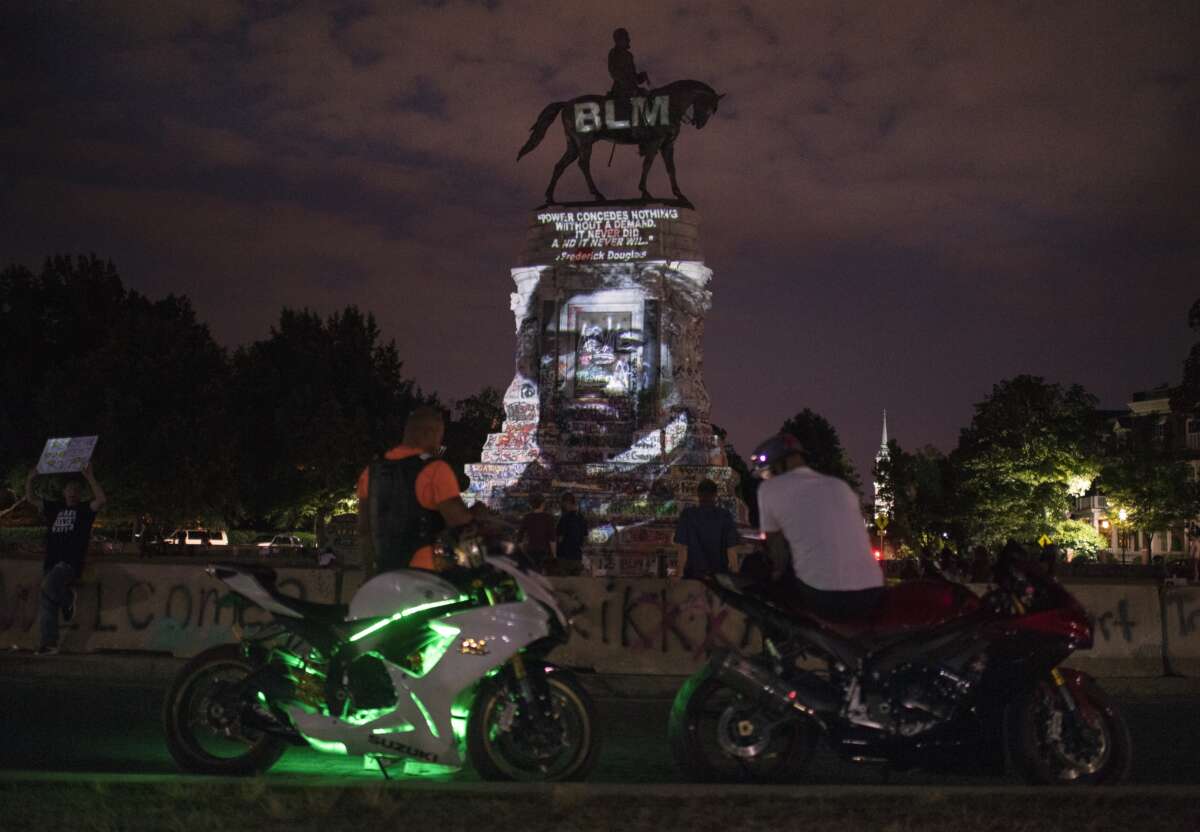
An image of Frederick Douglass is projected onto the Robert E. Lee Statue on Monument Avenue in Richmond, Virginia, on June 18, 2020.John McDonnell / The Washington Post via Getty Images

As I was reflecting on Frederick Douglass this Black History Month, I thought about the blitz of executive orders coming from Donald Trump. The term “blitz” is apropos as it comes from the German Blitzkrieg, meaning “rapid attack” or “lightning war.” Hence, as Trump targets and attacks this fragile experiment called democracy, it is important that we heed Douglass’s defiant wisdom: “Power concedes nothing without a demand. It never did and it never will,” Douglass said in an 1857 speech. Moreover, the abolitionist stated, “The limits of tyrants are prescribed by the endurance of those whom they oppress.”

Douglass’s words are just as true and applicable today as they were when he initially articulated them. It is always important, though, as we observe Black History Month and engage in critical reflection regarding thinkers of the past that we don’t read them through an ahistorical lens. After all, they are complex figures responding to the material historical contexts in which they lived. Failure to do so opens us to misinterpretations, distortions and even hagiographic forms of idealization.

To avoid these, I turned to African American philosopher John H. McClendon to address a number of important questions regarding aspects of Douglass’s philosophy, his political praxis, his Christian sensibilities and the importance of his work for us today. McClendon is a professor of philosophy at Michigan State University and is the author of several books, including African American Philosophers and Philosophy: An Introduction to the History, Concepts, and Contemporary Issues (with Stephen Ferguson) and Black Christology and the Quest for Authenticity: A Philosophical Appraisal. The interview that follows has been lightly edited for clarity and length.

George Yancy: I’ve been thinking about how Frederick Douglass described U.S. slavery as “the blood-stained gate.” He is a thinker who powerfully engaged questions of philosophical anthropology (the meaning of the “human”), Black freedom and resistance, dignity, natural rights, social justice, emigration and integration, the use of violence, the problem of theodicy, and so on. How do you see, in broad terms, Frederick Douglass fitting within the African American philosophical tradition?

John H. McClendon: In our coauthored text, African American Philosophers and Philosophy: An Introduction to the History, Concepts, and Contemporary Issues, Stephen Ferguson and I locate Douglass within the dialectical idealist tradition, which was dominant among the various African American philosophical schools of thought during the 19th and 20th centuries. In its association with African American thought, dialectical idealism emphasizes that the catalyst for all motion, change and development (laws of motion) rested in immaterial entities such as ideas, consciousness or the human soul.

Related Story

Remember What Audre Lorde Told Us: The Oppressor Doesn’t Determine What’s True
To navigate these terrible times, we need Audre’s Lorde’s audacity: Protect the public sphere. Refuse to be silenced. By George Yancy , Truthout February 8, 2025

In his 1854 address, “The Claims of the Negro Ethnologically Considered,” we discover Douglass is astonished that white people with high levels of education and even scientific training participate in espousing racist ideas. Therein, he maintains an idealist perspective, first in thinking that formal education is removed from the ruling ideology — where white supremacy has a significant function — and also that such formal and even scientific education can be corrected by infusing the element of human love as a crucial shield against racist ideology. Nevertheless, he also argues that scientific ideas have the capacity to promote higher ethical standards that correspondingly can influence better race relations between Black and white people.

The notion that ideas (albeit scientific ones) can possibly evoke ethical changes in race relations, without material (institutional changes) is patently an idealist perspective on social transformation. This is why we view Douglass, in many respects, as a dialectical idealist. I offer the caveat “in many respects” because on other occasions, he is quite in sync with the priority of institutional (material) transformation. In his debate concerning the 15th Amendment — with white women in the suffrage movement — he elaborates on why Black men having the right to vote was vital to the very survival of the entire African American community.

Douglass is famous for saying: “If there is no struggle, there is no progress.” He goes on to say, “This struggle may be a moral one, or it may be a physical one, and it may be both moral and physical, but it must be a struggle.” In our contemporary moment, what might Douglass say about not only the importance and necessity of struggle vis-à-vis Black people, but the kind of struggle that is requisite for substantial Black progress? After all, anti-Black racism continues to exist systemically. And Black people still find it necessary to shout “Black Lives Matter!”

As Trump targets and attacks this fragile experiment called democracy, it is important that we heed Douglass’s defiant wisdom: “Power concedes nothing without a demand. It never did and it never will.”

In many of my public lectures and speeches, over the years, I utilize this statement from Douglass. It has both substantive lessons and magnetic appeal for audiences across the spectrum. When we conceive of struggle in a protracted manner and not confined to given acts of resistance, rebellion, demonstrations/marches or even specified movements such as the movement for Black lives, then the cardinal principle of his declaration emerges in bold relief. The key point of departure is the notion of “protracted” struggle, because this could entail the incorporation of struggles over the course of several historical periods. Yet different historical periods also engender qualitative changes that provide new and different subject matter and content for our assessment and ultimately more concrete interpretations of the past.

Accordingly, this is the reason why historians must engage in the process of periodization. Periodization is a procedure that conceptually frames the chronological ordering of facts and events. For illustration, the categories such as antebellum and postbellum denote the periods before and after the Civil War. In turn, these two conceptual moments in time have markedly different content. This conceptual content substantially impacts how we interpret events in regard to the respective time period under review. Therefore, when it comes to how Douglass might have a viewpoint on what kind of struggle is requisite for substantial Black progress at this given juncture, we must remain cognizant of how different historical contexts and circumstances give rise to acts of rebellion and movements such as abolitionism, civil rights, Black Power, the resistance to the Vietnam War, Pan-Africanism, the movement for Black lives, and so on.

When we carefully examine Douglass’s legacy, then it becomes apparent that during the antebellum period and the struggle to end slavery, Douglass consistently remained in the vanguard for the Black struggle. Notably, the propensity toward gradualism — found among certain white abolitionists, such as William Lloyd Garrison — was effectively attached to paternalist notions about Black people, expressly centered on Black leadership capacity within the movement.

Consequently, Douglass published his own abolitionist newspapers, encouraged and supported others to do likewise. Douglass’s The North Star (1847-1851) and Frederick Douglass’ Paper (1851-1860) were organs that effectively propagated the independent viewpoints of Black abolitionists. He also strongly supported James McCune Smith’s newspaper, The Colored American. Smith — a physician who was the first Black person to earn a medical degree in the U.S. — mentored Douglass, and their organizational alliances included the Radical Abolitionist Party. Douglass remarked, “No man in this country more thoroughly understands the whole struggle between freedom and slavery than does Dr. Smith, and his heart is as broad as his understanding.” The antebellum Douglass’s viewpoint on struggle was steadfast, militant and uncompromising.

The postbellum period ushered in considerably different social, political and economic realities that Douglass did not fully comprehend. Given all of its complexity, it demanded a different kind of struggle than the antebellum abolitionist movement. Douglass became a stalwart defender of the party of Lincoln, namely the Republicans. Although the Republicans played a crucial role in establishing what W. E. B. Du Bois termed as Black Reconstruction, this party was willing to compromise with the Southern racists and reactionary politicians. Before the Compromise of 1877, which overturned Reconstruction, in 1873 a severe economic crisis of depression level completely destroyed the Freedman’s Bank. Previously, Douglass willingly directed this bank and defended it on the grounds it would be a good investment opportunity for the Black community. Needless to say, many Black people trusting in Douglass’s leadership sadly lost their life savings.

As you know, Martin Luther King Jr. said, “The arc of the moral universe is long, but it bends toward justice.” King believed that human beings are “co-workers with God” in the work of transforming the world. King certainly believed in struggle but believed progress cannot be attained without God. Is this also true for Douglass? In your book, Black Christology and the Quest for Authenticity: A Philosophical Appraisal, you write, “Arguably, Douglass’s standpoint is one of religious humanism, if not completely secular in character.” Could you explain what you mean?

The draconian measures of the Trump administration must be challenged by way of the mass movements that extend beyond the pale of electoral politics.

The esteemed philosopher and theologian William R. Jones was one of the pioneers who located Douglass within the camp of religious humanism. My remarks simply build on Jones’s profound interpretation of Douglass. Jones’s penetrating text, Is God a White Racist, remains a must-read if we are to compare King’s theism — God must intervene in the Black struggle — contra Douglass’s position. Throughout his writings, Douglass makes reference to God, therefore he is not in any fashion an atheist, which is to say one who does not believe in God. Instead, situating him as a religious humanist allows for granting a belief in God without the need for God’s active participation in the Black struggle. This is what theologians designate as deism.

A little-known fact about Douglass is that he engaged in the social scientific study on race via ethnology. Here the influence of James McCune Smith plays a vital part. Not only was Smith a physician, he was also a pioneer in employing statistical methodology and social scientific investigation to affirm the humanity of Black people. In his 1854 address, “The Claims of the Negro Ethnologically Considered,” Douglass asserts:


I propose to submit to you a few thoughts on the subject of the Claims of the Negro, suggested by ethnological science…. The relation subsisting between the white and black people of this country is the vital question of the age. In the solution of this question, the scholars of America will have to take an important and controling [sic] part. This [is] the moral battlefield to which their country and their God now call them.

However, though Douglass invokes the name of God in this passage, he does not make God a necessary condition for the progression of the Black struggle. It follows that my judgment about Douglass as religious humanist is based on his appeal to scientific evidence, which is a secular concern.

Keeping with religion, I see white Christian nationalism as a form of idolatry that centers and glorifies white racial hegemony and xenophobic violence. Within this context, I hear the voice of Douglass where he powerfully critiqued what he called “the Christianity of this land.” He goes on to state: “Indeed, I can see no reason, but the most deceitful one, for calling the religion of this land Christianity. I look upon it as the climax of all misnomers, the boldest of all frauds, and the grossest of all libels.” The idea that Trump is the “chosen one” or should be treated as such is as idolatrous and vacuously sanctimonious as it gets. In what ways do you think Douglass would find manifestations of white Christian nationalism within this country today to be theologically problematic?

Douglass openly rejects any form of cultism, religious or otherwise. At the same time, he understands that the principles of human dignity are established on the grounds of all humans sharing universal rights. The effort to destroy this bond of humanity, whether sanctioned by religion or political allegiance, should be entirely rejected. Douglass makes abundantly clear, “A contest had in fact been going on in my mind for a long time, between the clear consciousness of right and the possible make-shifts of theology and superstition. The one held me an abject slave – a prisoner for life, punished for some transgressions in which I had no lot nor part; and the other counseled me to manly endeavor to secure my freedom. This contest was now ended; my chains were broken, and the victory brought me unspeakable joy.”

For you, what is most crucial with regard to Douglass’s work and how does it speak to our current moment?

The recent discussions on the presidential election in the Black community, along with the debates among African American intellectuals, academics and even activists, were often confined to the narrow constraints of the ruling two-party system. Postbellum, Douglass’s position in debate with Richard T. Greener (the first Black graduate of Harvard) focused on if Black people should migrate out of the South. We find the once-progressive Douglass now anticipates the conservative trope of Booker T. Washington’s calling for casting our buckets in the South. Douglass repeatedly made conservative political decisions in concert with Republican policies. The backdrop of all of the above is why we must diligently study how history at a given historical moment drastically alters how we should interpret leading individuals in view of our present circumstances in relation to the past events. What we do know is that Douglass did not comprehend what kind of struggle was requisite for substantial Black progress circa the postbellum period. While some Black thinkers and activists like Peter Clark, Lucy Parsons and T. Thomas Fortune held a critical stance vis-à-vis industrial capitalism and its political party, Douglass remained loyal to the Republicans and advised Black people that the Republican Party was the solitary vehicle that they should fasten their political future to. Douglass’s failure to understand the emerging industrial capitalist order, along with the nature of the political role and rule of Republicans, led to his decline from the apex of progressive Black leader. We can learn from Douglass how a myopic (bourgeois) political outlook is detrimental to Black progress.

I would like to return to Douglass’s famous quote: “Power concedes nothing without a demand. It never did and it never will.” As a way of concluding, how do you understand the importance of Douglass’s words in the current moment under the second Trump presidency?

Douglass provides a valuable lesson inasmuch as he asserts the need for resistance rather than resignation, protracted struggle instead of defeatism. The draconian measures of the Trump administration must be challenged by way of the mass movements that extend beyond the pale of electoral politics. The power embodied in the concerted fight against reaction is the key weapon requisite for fundamentally progressive social, political and economic transformation. We cannot forget that during the antebellum period that the fight against slavery, which included the Underground Railroad and Slave Rebellions, was in fact a federal crime. Hence, Douglass, in gaining his freedom, became a “criminal” under the provisions of U.S. law. Douglass’s choice was clear: namely, to fight for freedom whatever the cost. Today the fight for freedom continues with our ongoing struggle.

This article is licensed under Creative Commons (CC BY-NC-ND 4.0), and you are free to share and republish under the terms of the license.


George Yancy is the Samuel Candler Dobbs professor of philosophy at Emory University and a Montgomery fellow at Dartmouth College. He is also the University of Pennsylvania’s inaugural fellow in the Provost’s Distinguished Faculty Fellowship Program (2019-2020 academic year). He is the author, editor and co-editor of over 25 books, including Black Bodies, White Gazes; Look, A White; Backlash: What Happens When We Talk Honestly about Racism in America; and Across Black Spaces: Essays and Interviews from an American Philosopher published by Rowman & Littlefield in 2020. His most recent books include a collection of critical interviews entitled, Until Our Lungs Give Out: Conversations on Race, Justice, and the Future (Rowman & Littlefield, 2023), and a coedited book (with philosopher Bill Bywater) entitled, In Sheep’s Clothing: The Idolatry of White Christian Nationalism (Roman & Littlefield, 2024).