Saturday, February 22, 2025

U$A THE WORLDS GUNRUNNER

What is the F-35 fighter jet that Trump has promised Modi?

The F-35 is billed as the most advanced fighter jet ever made.


Dawn.com Published February 21, 2025


In a significant boost to defence cooperation between the United States and India, President Donald Trump announced his administration’s willingness to sell F-35 fighter jets to India, America’s most advanced military aircraft.

The offer came during Indian Prime Minister Narendra Modi’s visit to Washington on February 13, as part of broader discussions on trade and security cooperation.

But what exactly is the F-35, and why is this offer significant?
A ‘next-generation’ fighter

The F-35 Lightning II is, according to manufacturer Lockheed Martin, the world’s most advanced fighter jet, combining stealth technology with supersonic speed and highly sophisticated combat capabilities.

According to product documentation, the “Joint Strike Fighter” represents the pinnacle of American military aviation technology and is described as the “quarterback of the fighting force”.

Lockheed adds that the jet has logged over 983,000 flight hours, with over 1,110 deliveries made to 20 operating nations.

What makes the F-35 special is its “5th Generation” capability: a combination of radar-evading stealth technology, advanced sensors, information fusion, and network connectivity.

The aircraft can operate without being detected at supersonic speeds, making it particularly valuable in modern warfare scenarios.


An F-35 jet lands on the flight deck of the USS Carl Vinson aircraft carrier south of Oahu, Hawaii in this file photo from July 2024. — Reuters/File


Why India wants it


India currently relies on an ageing fleet of Russian fighter jets and a small number of French-made Rafale aircraft. Access to F-35s would represent a significant upgrade to India’s air force capabilities, which has traditionally relied heavily on Russian equipment.

On February 27, 2019, a day after Indian aircraft violated the Line of Control and performed strikes from Pakistani airspace, two Indian Air Force planes were shot down by Pakistan, with an Indian pilot captured.

Then-director general of the Inter-Services Public Relations Major General Asif Ghafoor confirmed the development on Twitter (now X), writing: “[The] PAF shot down two Indian aircraft inside Pakistani airspace. One of the aircraft fell inside AJ&K (Azad Jammu and Kashmir) while [the] other fell inside IoK (Indian-occupied Kashmir). One Indian pilot [was] arrested by troops on [the] ground while two in the area.”


US President Donald Trump and Indian Prime Minister Narendra Modi are pictured in a mirror as they attend a joint press conference at the White House in Washington on February 13. — Reuters

According to the Institute of Strategic Studies Islamabad think tank, one of the Indian aircraft shot down was a MiG-21 Bison, the most common jet-powered military aircraft, as certified by the Guinness Book of World Records.

India is the largest operator of the MiG-21, with Rahul Bedi writing for The Wire in 2023 that since 1963, India inducted around 870 variants of the plane. As of 2023, only 40 aircraft remain in active service, with the last two squadrons to be phased out this year.

Aside from the plane’s ageing design, it has been plagued by crashes and a poor safety record. Bedi wrote that over 500 MiG-21s have crashed killing over 170 pilots. The incidents “led to the fighters being ignominiously dubbed by the media as ‘flying coffins’ and ‘widowmakers’”, he wrote.

The potential acquisition would also strengthen India’s position in the Indo-Pacific region, where it faces an increasingly assertive China. By 2025, there will be more than 300 F-35s operating in the Indo-Pacific region, according to Lockheed Martin data.

The US has expressed interest in selling the jets to India since as far back as 2011. The US Defence Department, in a report to Congress on US-India security cooperation, said if New Delhi indicated an interest in Lockheed Martin’s F-35 Joint Strike Fighter, the Pentagon would be willing to provide information on the aircraft’s security and infrastructure requirements.

Technical specifications

The F-35A, the variant that is sold the most, boasts:Maximum speed: Mach 1.6
Combat radius: More than 590 nautical miles
Weapons payload: 18,000 pounds
Advanced stealth technology
Sophisticated sensor suite and combat systems
The exclusive club

If the deal moves forward, India will join an elite group of nations authorised to purchase the F-35. Current operators include US military services, Nato allies, close partners like Israel and Japan and select nations like Australia and South Korea.


According to Lockheed Martin, the first F-35 was delivered to the US in July 2011, with the first international delivery of the aircraft being to the United Kingdom the next year.

The jet first saw combat in 2018 in Israel, which used modified versions of the plane with the moniker ‘Adir’. According to Defense News, which cited Haaretz, the Israeli military tweeted that it was the first nation to use the F-35 in an operational capacity.

“The Adir planes are already operational and flying in operational missions,” the tweet said, quoting Israel Air Force head Major General Amikam Norkin. “We are the first in the world to use the F-35 in operational activity.”

Most recently, on February 4, Norwegian F-35s intercepted a flight of Russian aircraft near northern Norway.

Nato reported that the F-35s “quickly located and identified the Russian aircraft”, adding that the Joint Strike Fighter’s “advanced capabilities allowed them to gather important information and ensure that the Russian aircraft did not violate Nato airspace”.

Regional implications

Pakistan has expressed deep concern about the potential F-35 sale to India. The Foreign Office spokesperson, Shafqat Ali Khan, warned that such transfers could “accentuate military imbalances in the region and undermine strategic stability”.

He urged “international partners” to adopt “a holistic and objective view of the issues of peace and security in South Asia” and avoid taking “one-sided positions divorced from ground realities”.

Challenges ahead

Despite the bonhomie on display at the White House, the path to India acquiring F-35s is complex, as was evident by the measured tones that Indian officials demonstrated when commenting on the potential purchases.

Should India pursue acquiring the aircraft, it will need to consider the costs of owning and operating the F-35.

According to the Centre for Arms Control and Non-Proliferation, the cost-per-unit of an F-35 Lightning II exceeds $100 million. In 2021, The F-35A variant, with conventional takeoff and landing, cost $110.3m; the F-35B, with STOVL (Short Takeoff and Vertical Landing) capabilities, cost $135.8m; the F-35C, designed for use with aircraft carriers, cost $117.3m.

These costs included depot maintenance, ground support and spare parts, the Centre said.

A file photo from 2020 shows the vertical takeoff capabilities of the F-35 in action at an airshow in Singapore. — Reuters/File


Additionally, John A Tirpak wrote for Air and Space Forces Magazine in 2020 that the F-35 costs $35,000 per flight hour to operate, though he noted that the F-35 Joint Programme Office aims to lower these costs to $25,000 per hour by this year.

Over its lifetime, the aircraft has cost the US Defence Department over $1 trillion to operate, according to an April 2024 report from the US Government Accountability Office.

Additionally, the Centre for Arms Control warned in a 2021 datasheet that there is a significant risk of injury to pilots who eject from the aircraft.

“Tests in July and August of 2015 demonstrated a 23 per cent probability of death and a 100pc probability of neck injury upon ejection for pilots weighing between 136 and 165 pounds, and a 98pc probability of death for pilots under 136 pounds,” the data read.

The Centre added that modifications to the ejection seat “allegedly” lowered the risks, but cited a 2017 internal report by the US Air Force warning that a dozen pilots could be killed by flaws in the ejector seats.

Despite its advanced avionics, the F-35 has a documented history of crashes, with one crashing in Alaska as recently as January 29, the latest of 11 reported crashes, according to Anadolu.

According to a report released last year by the US Director of Operational Test and Evaluation, the F-35 faced ongoing challenges with reliability, maintainability, and availability, with aircraft being ready for missions just 51pc of the time, falling short of the targeted 65pc goal.

“The operational suitability of the F-35 fleet remains below service expectations and requirements,” the report, released in January 2024, said.

Indian Foreign Secretary Vikram Misri has noted that no formal process has yet begun, characterising the F-35 deal as merely “a proposal at this point”. This caution reflects the considerable groundwork still needed before any potential sale could move forward.

Header image: An F-35 fighter jet taxis after landing during the “Aero India 2025” air show at the Yelahanka air base in Bengaluru on February 11.

 — Reuters/File


INDIA/U$A

Bromance on the brink?

Rafia Zakaria 
February 22, 2025
DAWN

The writer is an attorney teaching constitutional law and political philosophy.


THE week before Indian Prime Minister Narendra Modi was to arrive in the United States, he received an unwelcome gift. A military plane from the US carrying around 100 undocumented Indian migrants was sent to Indian Punjab.

The men had endured the 40-hour journey from detention centres in the US to India in shackles. More such flights followed, with the total number of Indian deportees from the US crossing 330 in under two weeks. Heartrending ordeals have been described by the deportees who have been subjected to such treatment by President Donald Trump’s administration that is intent on getting them out of the US.

It must, therefore, have been a humiliating time for Modi, who has long been a fan of Trump with whom he shares the same authoritarian inclinations. Ever since Modi’s 2019 visit to the US and Trump’s return trip the next year, with both men speaking to packed audiences during their respective visits, Indians in general and Modi in particular had imagined that the bromance between the two leaders set them apart from the rest. Considering the punishments that the Trump administration has been raining down on so many other countries, they thought that they would be spared.

But the first plane full of deportees undoubtedly rattled nerves. In the run-up to the actual meeting, India television anchors continued to praise the two men’s cosy relationship plastering screens with images from the rallies in Houston and Ahmedabad. The nerves were not just because of the planeload of deportees. In the new era of trade that the Trump administration seems eager to pioneer, tariffs reign supreme and trade deficits are determinative. By these metrics, India would be hit hard.

This became obvious hours before the meeting when President Trump announced that the US would be slapping reciprocal tariffs on every country who charged America tariffs. The Trump administration was also peeved about the enormous trade deficit between the two countries — $45.6 billion in favour of India.

In the Trumpian worldview, such deficits are the direct result of the high tariffs that a particular economy — in this case India — is charging the US for access to their consumer market. During his election campaign, Trump had actually referred to India as a “big abuser” of trade ties. He said that India would need to step up its purchases of gas, oil, and defence equipment from America.

Despite the support for Trump, the right-wing Hindutva establishment that props up Modi was essentially given a scolding.

During his recent visit, when Modi embraced Trump, the latter did not seem to be as effusive. While Indian media streaming the event live tried to put a positive spin on the two men’s meeting; highlighting what Trump said about Modi’s negotiating skills — “he’s a much tougher negotiator than me, and he’s a much better negotiator than me” — the meeting, by any objective standard, was not a success, central to which was the fact that Modi came back without any waivers on the reciprocal tariffs issue.

According to Reuters, in 2023, India imposed an aggregates weighted tariff of 11pc on American goods, which is higher than what the US charges India. In certain sectors, tariffs were even higher.

For instance, the White House said in a fact sheet: “The US average applied Most Favoured Nation … tariff on agricultural goods is 5pc. But India’s average applied MFN tariff is 39pc. India also charges a 100pc tariff on US motorcycles, while we only charge a 2.4pc tariff on Indian motorcycles.” The last example virtually ensures that no American manufacturer can sell motorbikes to the Indian consumer market.

With such announcements coming out of the White House even before Modi’s arrival in Washington, the outcome of the meeting was more or less expected. Trump announced no waivers just because India was ‘special’ or because he and Modi were ‘good buddies’. “Prime Minister Modi and I have agreed that we will be in negotiations to address the long-running disparities,” Trump said, instead, referring to the US-India trade relationship. But really, we want a certain level of playing field, which we really think we’re entitled to.“

Modi walked away having been told that his country which now buys oil and gas from other countries would now have to buy it from the US and then ship it all the way from the US to India. This purchase will be a lot more expensive than the ones India has been used to.

Trump also offered the possibility for India purchasing F-35s — something that may sound good but that camouflages the fact that India would now likely have to buy whatever expensive defence goods the US chooses to produce or sell to it so that the trade deficit narrows.

All this is not good news for Modi. Despite the support for Trump, the right-wing Hindutva establishment that props up Modi was essentially given a scolding. The reciprocal tariffs are likely to slow down India’s growth rate even further as it has to buy expensive things it does not need to bring down the trade deficit. All this may even cause Indian manufacturers to have decreased access to the American consumer market if Modi does not bring down tariffs.

The US is in the process of instituting a new foreign policy; one which is harsh and unapologetically self-serving. India — where Islamophobia has been made a part of national culture — felt that the also Islamophobic Trump may make exceptions for them. The new America under Trump, however, is simply not interested.

At the press conference during his visit, Modi mouthed an overwrought comparison and combination of ‘Make America Great Again’ and ‘Make India Great Again’ — “mega partnership for prosperity”. To nobody, except the Modi supporters in the room, did this statement make sense.

rafia.zakaria@gmail.com


Published in Dawn, February 22nd, 2025

 UK

New energy price hikes forecast, despite billions in industry profits

Campaigners have claimed that the latest energy price forecasts show customers are being gaslighted by an industry that has made £483 billion in profits since 2020.

At the heart of the scandal is the system that sees electricity prices being set by the cost of gas up to 40% of the time under the marginal pricing rules.

Now, with the cost of gas rising to a two-year high in recent weeks, the over-reliance on fossil fuels in the country’s energy system is once again causing distress in households.

Warm This Winter spokesperson Caroline Simpson said: “It’s soul-destroying that there will be another price cap rise. What billpayers don’t know is that even their electricity bills are chained to gas prices. This over-reliance on gas – both for our heating and in setting the electricity price – is why we saw huge hikes in bills four years ago and now we are seeing prices  set to rise again.

“Instead, the public are being told by some politicians that net zero and green policies are to blame. This couldn’t be further from the truth and we need to stop gaslighting people.

“Our bills are high and the ones who benefit are greedy gas and oil companies who are making billions. That is why we desperately need to develop our own renewable energy sources as the only way to achieve lower prices and energy security for good.”

Analysts predict the price cap is set to rise yet again in April when Ofgem makes their announcement a week today. That is because it is linked to the current gas price surge driven by the conflict in Ukraine, a colder than expected European winter and city market traders who buy and sell gas to desperate countries. 

Simon Francis, coordinator of  the End Fuel Poverty Coalition, said: “As volatile energy bills continue to be set by our reliance on global wholesale markets and driven by the cost of gas, it is even more vital that we see moves toward sustainable, cheaper, renewable energy.

“This of course needs to be combined with investment in helping people make their homes more energy efficient – especially those living in low quality private rented homes. But until then, consumers need to navigate a confusing array of energy tariffs. The key point to remember is to use your own energy usage when comparing prices and do not rely on industry averages which may hide the true cost you will pay.

“Customers must also look out for exit fees which may trap you into uncompetitive tariffs in the future. And, if a household is interested in moving to a ‘tracker’ style tariff, it is even more important to make sure you look at your own usage, the unit costs and the standing charges and check that they will offer you real value for money.”

The advice comes as the warnings in the media suggest that a typical bill could rise by more than £100 a year. Ed Miliband has urged the energy watchdog Ofgem to take action to protect consumers.  Nine million homes on variable tariffs are likely to be particularly hard hit by the price hike.

The number of people in England and Wales who sought help with energy bills jumped by 20% last year, according to Citizens Advice. With Labour’s axing of winter fuel payments to pensioners, that figure is likely to raise.

Image: https://pix4free.org/photo/2475/energy.html Credit: Pix4Free.org Energy by Nick Youngson CC BY-SA 3.0 Pix4free Attribution-ShareAlike 3.0 Unported CC BY-SA 3.0 Deed


How the Tories crashed – but could recover

FEBRUARY 20, 2025

Mike Phipps reviews Collapse of the Conservatives: Volatile Voters, Broken Britain and a Punishment Election, by Steve Rayson, published by Bavant.

In March 2020, support for the Conservative government was running at 54%, 26 points ahead of the Labour Party. It was the highest Conservative poll share ever in government and its biggest lead over Labour since the Falklands War in 1982. And in the first few weeks of the Covid pandemic, Boris Johnson’s popularity would increase even further.

In May 2021, the Conservatives capitalised on their ‘vaccine bounce’ by winning 235 new seats in the local elections, as well as the Hartlepool by-election, taking it from Labour on a remarkable 23% swing, the biggest for an incumbent governing party in a by-election in the post-war period. The talk was of a decade-long Johnson premiership.

Three years and two Prime Ministers later, almost half of the Conservative Party’s 2019 voters deserted them. In the 2024 general election, they lost 251 seats, more than any party had ever lost at a general election, and their vote share slumped to just 23.7%, their lowest ever. For the first time in over 100 years, they did not win a majority of southern seats.

Things get volatile

How did it happen? Beyond the specific ‘incidents’ in the Johnson, Truss and Sunak premierships that led to this collapse, Steve Rayson’s book looks at more fundamental trends. The first is increased distrust in politicians – now at a forty-year low – which has fuelled voter volatility.

This has been developing for a while. In 2015, an estimated 43% of people voted for a different party than they had voted for in 2010. Party and class dealignment among voters have been taking place for decades, so that by 2019 Professor John Curtice could say there was no longer much of a link between party support and social class.

When people are less attached to political parties, they are more likely to vote on a short-term transactional, rather than an ideological, basis. In retrospect, t’s now clear – in fact, it has been for nearly three years – that Johnson’s big win in ‘red wall’ seats in 2019 was down to such factors, such as Brexit and distrust of Jeremy Corbyn, rather than any long-term conversion. The coalition of support this victory rested on was also inherently unstable.

“When Jeremy Corbyn was replaced by Keir Starmer and the Brexit deal was finally signed, two of the core motivations for the 2019 first-time Conservative voters supporting the party were removed,” notes Rayson. To retain their backing, the government would have to tread carefully and deliver on its ‘levelling up’ agenda. It did neither.

The money allocated to levelling up was swallowed up in the Covid crisis, But this, the public felt, was being increasingly poorly handled as it wore on – the double standard for top ministers, such as Matt Hancock,  and advisors, like Dominic Cummings, who appeared to break the rules with impunity; the ‘cancellation of Christmas’ in December 2020 at four days’ notice, blamed on Johnson’s dithering; Cummings’ departure from the government and his declaration that Johnson was unfit to be Prime Minister.

Then came the Owen Paterson affair, where Johnosn imposed a three-line whip to prevent the House of Commons from punishing a minister who broke lobbying rules; ‘Partygate’; the fraud that flowed from the government’s Bounce Back Loan Scheme and its chummy and partly unlawful allocation of contracts for Covid equipment; a rising cost of living crisis; and the final straw, Johnson’s appointment to government of a man he knew had been accused of sexual assault.

By the time Johnson resigned in July 2022, public trust in government was in freefall: just   21% of people thought the Conservative Party was fit to govern. In the ensuing leadership contest, rival candidates tore lumps out of each other – Truss dubbed Sunak the “socialist” chancellor – and Labour opened up a fifteen-point lead.

The rapid demise of Truss, arguably the worst Prime Minister ever, has been explored in detail elsewhere. By the time she left office, fewer than fifty days later, more than twice as many people thought that Labour would be better at handling the economy than the Tories. Only 8% thought the Conservatives trustworthy.

The big books have yet to be written about Rishi Sunak’s premiership. Could he have rescued the Tories’ reputation? It seems unlikely, and appointing so many Cabinet members from the Johnson-Truss era did not help his cause. Nor did bringing back Suella Braverman as Home Secretary, just six days after she had been sacked for leaking restricted material – part of a grubby deal to head off a challenge from her for the leadership.

A year later, as Britian tipped into recession, three-quarters of the public thought the Tory government was handling the economy badly. But politicians of all stripes were on notice: “Almost half of people said they would ‘almost never’ trust British governments of any party to place the needs of the country above the interests of their own political party, more than ever before.”

The incompetent Conservatives broke Britain and must be punished

Another underlying trend that sealed the Conservatives’ fate was the convergence of three narrative strands about the party. The first was that ‘nothing works anymore’ – a view shared by 62% of people in June 2024 and further illustrated by polling which showed that 84% felt public services had deteriorated under the Tories. Rayson drills down into the multiple crises engulfing local authority services, health, housing, the criminal justice system, the water industry, education and even defence.

The second thread was that the Tories were incompetent – constantly changing leaders, unable to control immigration (which matters to Tory voters), economically reckless under Truss.

The central, perhaps the only, reason why the Conservatives have been re-elected to govern so often over the years is their reputation, merited or not, for competence. Once that goes – as in the 1990s under John Major – they are kicked out. By June 2024, only 8% of 2019 Tory voters, said they were satisfied with the current Conservative government.

The third strand was ‘the Conservatives should be punished’. “It was the result of growing public anger at the collapse of public services, rising levels of poverty, and the behaviour of the Conservative government, which had been marked by allegations of impropriety, misconduct, corruption, fraud, and lying,” suggests Rayson.  

Partygate in particular created a powerful sense of grievance about government dishonesty and hypocrisy at a time when ordinary people were banned even from attending the funerals of close relatives. By 2024, public anger was palpable. The Economist called the summer general election “an episode of mob justice.”

2024: maximising the Tory wipeout                 

The final cause of the Tory wipeout can be located in the general election campaign itself. Opposition parties leveraged the public’s willingness to engage in intense tactical voting to eject the Tories, while Reform UK’s decision to run over 600 candidates split the right wing vote.

Keir Starmer is often credited with implementing a winning strategy. He turned his back on the ten pledges he had made when running to be Labour’s leader in 2020, suspended his predecessor, Jeremy Corbyn, from the parliamentary Party and bureaucratically blocked a host of left wing candidates from standing, in order to emphasise his rejection of what Labou had once stood for. Supporters of the Starmer leadership have talked up the success of Labour’s electoral strategy, which focused on winning Conservative votes in marginal seats, while offering little to the Party’s traditional urban voters.

However, a price was paid for this approach, in two ways. Firstly, the scale of the defection of Labour voters to the Party’s left – including in Starmer’s own constituency, where a socialist Independent was runner-up – took Party strategists by surprise. Four Greens and five Independents, including Jeremy Corbyn, were elected, while others came impressively close, for instance in Wes Streeting’s Ilford North constituency, which the now Secretary of State for Heath won by just 528 votes. Secondly, Starmer’s “ruthless” U-turn towards the centre ground resulted in a big leap in levels of public distrust towards him.

Opinion polls shifted little in the final weeks: voters had already made up their minds. Nonetheless, Rishi Sunak’s apparent snub to D-Day veterans – he left the commemoration early to go electioneering – did nothing to help his cause. Nor did reports of his aides using their insider knowledge to place lucrative bets on a July election.

The Labour leadership too made all the wrong headlines due to its factional attempts – ultimately unsuccessful – to stop Diane Abbott from running as its Hackney North candidate. Still, the Party captured the public mood by emphasising “change”, but as Rayson notes, it “explicitly ruled out changes to income tax, National Insurance, corporation tax, and VAT, which constituted 71% of all tax income in 2022/23.” This would make change much harder to deliver when in office.

When the results came in, it was a disaster for the Conservatives – some of the seats they lost they had held for over a century. They were the preferred party only of people over age 65, while securing a mere 5% of the votes of 18 to 24-year-olds and only 10% of the votes of 25 to 34-year-olds. On competence, fitness to govern, empathy and integrity, the party’s ratings collapsed.

But Labour only marginally improved on their 2019 vote share, thanks largely to gains in Scotland from the SNP. The Party won back the ‘red wall’, but its landslide was based on just 34% of the vote. The polls had massively overestimated Labour’s support, which ended up at just ten points ahead of the Tories. Labour had fewer votes than they had achieved in both 2017 and 2019 – and it was the second lowest turnout since 1885. It’s further estimated that Labour lost a third of its support from Black and Asian communities in this election.

No honeymoon for Labour

The satisfaction rating for the new Labour government when it was elected, was -21, better than Sunak’s, but a long way from Tony Blair’s +37 in 1997. It underlined the high level of political distrust in UK politics and the erosion of traditional voting blocs in favour of more transactional voting.

In short, people voted for change. If Labour fail to deliver it, their electoral support will evaporate.

Which is precisely what is happening. Two months in, Keir Starmer’s government had a 23% approval rating, which fell precipitously after it announced a decision to means-test the winter fuel allowance. By October 2024, Starmer’s personal favourability rating had fallen to -36, the lowest since he became Labour leader.

 As for the Tories, they are profoundly damaged. In November 2024, Kemi Badenoch was elected as the new leader with 53,000 votes, fewer than Rishi Sunak managed when he lost to Liz Truss. That itself is a sign of falling membership. Rayson identifies four challenges facing the party: the threat from Reform, its lost reputation for competence, its lack of narrative vision going forward and the demographic challenge that it is utterly unappealing to younger voters.

These are enormous challenges, but not insurmountable. Rayson’s book went to the publishers just as the utterly unexpected began to happen: the Tories gained twenty seats in local council by-elections in the last quarter of 2024. One analyst commented: “No party has won such a huge parliamentary victory and seen their fortunes reverse as quickly. No party that has suffered an historic defeat has rebounded as rapidly.”

Reform UK are also making gains. There is a lot of chatter in the media about whether the party might replace the Tories as the main right wing force, whether a merger of the two parties is feasible, what role Nigel Farage might play in a future right wing government and so on – but the most important point is that, on current poll ratings, all that is needed for Labour to lose office is an electoral non-aggression pact between Reform and the Conservatives.

Current poll numbers are a stark warning to Keir Starmer’s government. Its huge parliamentary majority could be a one-term wonder. As the government abandon the WASPI women, scrap hospital building programmes, allow huge water bill rises and commit to a third runway at Heathrow airport, voters who wanted change are already looking elsewhere. There was even talk earlier this year of Keir Starmer being replaced as Labour leader ahead of the next general election.

These are volatile times. Trump’s re-election in the US, the entry of billionaire oligarchs into frontline politics and the rise of the far right in Europe throw more uncertainty into the mix. This book is about the collapse of the Conservatives, but right now Labour have just as much to worry about.

Mike Phipps’ book Don’t Stop Thinking About Tomorrow: The Labour Party after Jeremy Corbyn (OR Books, 2022) can be ordered here.

TODAY

“Legitimizing this aggression by accepting the occupation would embolden dictators around the world”


Thousands are set to march to the Russian Embassy on Saturday 22nd February to mark the third anniversary of Russia’s full-scale invasion of Ukraine.

They will carry placards saying Occupation is not Peace! and Don’t Betray Ukraine! behind a banner calling for Russian Troops Out.

The demonstration is called by a coalition of Ukrainian community organisations, trade unions and civil society organisations.

Ukrainians sponsors include Vsesvit, the Campaign for Ukraine, KHARPP humanitarian charity, Rozviyyouth movement and Ukrainian student societies.

The march will be led by the Ukrainian singers from the Hromada choir.

The Trade Unions Congress is supporting the demonstration along with national unions GMB, ASLEF, PCS, UCU, UNISON and the NUM.

The march aims to show Ukrainians we still stand with them in their battle against Russian aggression, for as long as it takes for them to liberate their country.

The organisers issued a joint statement  declaring that Ukraine has been made vulnerable by not being provided enough aid to defeat Russia, and is being expected to consign its own citizens to occupation under a deal imposed by Trump.

We are calling for renewed solidarity, that peace must come with the full withdrawal of Russian forces, for a surge in military aid to strengthen Ukraine in any negotiations and be able to finally end the occupation if no just agreement is secured.

Saturday 22nd February

Assemble St Volodymyr Statue, Holland Park, 12:00 noon

March to Russian Embassy for rally at 13:00.

Olena IvashchenkoDirector of the Campaign for Ukraine said: “Right now, Ukraine’s future is being decided by politicians behind closed doors. But one thing is clear – true and sustainable peace cannot be achieved without justice.  We call for Russia to withdraw its troops from all of Ukraine, for Trump to end his backroom power games, and for the UK to strengthen its leadership in safeguarding Ukraine’s sovereignty and Europe’s security.”

Barbara Plant, President of the GMB union said: “GMB remains firmly in solidarity with the Ukrainian people in their fight for freedom from Russian military aggression. Only the ability for the Ukrainian people to truly determine their own future free from Putin’s occupation will bring about a just or lasting peace, and certainly not an alliance of oligarchs. 

“We will be marching on Saturday for the immediate withdrawal of Russian troops and for a peace that has Ukraine’s sovereignty, social justice and support of the Ukrainian people at its heart.”

Christopher Ford, Secretary of Ukraine Solidarity Campaign said: “The millions who have stood by Ukraine are appalled at the conduct of Trump and the threat of betrayal. Promises made to do whatever it takes to help Ukraine win have collapsed without any explanation. We must show that this is not inevitable and raise our voices that a partition and occupation is not a sustainable peace. The UK and Europe must not repeat the errors of 1930s appeasement.”

Mariia Pastukh of Vsesvit, Ukraine solidarity collective said: “We are calling this rally near the Russian Embassy to draw attention to the root cause of this war: Russia’s imperialist ambitions, which fuelled its brutal and unprovoked invasion of Ukraine. We demand that Russia’s crimes in Ukraine not be forgotten. Legitimizing this aggression by accepting the occupation would embolden dictators around the world.”

John McDonnell MP, a founder of the Ukraine Solidarity Campaign said: “We’ll be calling for peace, but a just peace determined by the Ukrainian people and not imposed upon them by either Trump or Putin. Join us in solidarity with Ukraine.”

El Salvador declares state of emergency – again

FEBRUARY 19, 2025

The State of Exception, the brainchild of President Nayib Bukele, suspending basic rights and leading to the arrest of thousands of alleged gang members, has been renewed again.  This report is edited from the blogs of Tim Muth, who lives in the country.

On January 29th 2025, El Salvador’s Legislative Assembly passed a resolution extending for the 35th time the State of Exception under which the country’s residents have lived since March 27th 2022. 

There was no debate. There was no evidence presented of the emergency circumstances required by the Salvadoran constitution to justify the suspension of rights to due process in the criminal justice system and warrantless interception of communications.   Where would such evidence come from today in the country that Nayib Bukele proclaims the safest in the western hemisphere?   

In the almost three years of the State of Exception, the government says it has arrested more than 85,000 persons and put them in the country’s prison system, imprisoning 1.8% of the country’s population. As of the fall 2024, 12,900 of the country’s prison population are women.

The online periodical Focos notes that the high level of incarceration does not bother Bukele:

“For Nayib Bukele, these figures are a source of pride. When asked whether more than 1% of the population is behind bars, he responds: ‘We did not imprison 1% of the population, we freed 99%,’ said Bukele in a speech he gave when visiting a prison in Costa Rica in November 2024….

“’Obviously, the operations are not perfect and, without any intention of harming an innocent person, some were captured in the same way as they are in France, in Germany, in Japan and in all the countries of the world. We are freeing them. We have already freed 8,000 people and we are going to free 100% of the innocent people,’ added Bukele.”

As a side note, the suggestion that people are being ‘freed’ is misleading.  I have spoken to several persons wrongly detained and subsequently released, and have read many other reports. The vast majority are still being charged with somehow being criminals and have the possibility of prison hanging over their heads. The government does not acknowledge in any individual case that it arrested an innocent person, it just stops imprisoning them before some unscheduled future trial date.

The Washington Office on Latin America (WOLA) commented on the president’s number of 8,000 freed:

“The release of these people is difficult to corroborate because the lack of transparency, reliable data and access to information is a serious problem. The state security forces, the prosecutor’s office, and the judiciary, act without any control or counterweight, with confidentiality being the rule. On the one hand, the recognition made by President Bukele should be subject to international scrutiny, including crimes under international criminal law, since there is an explicit acceptance of violations to human rights, access to justice, and due process. On the other hand, the documentation work of human rights organizations and complaints from many relatives of those detained indicate that there are probably many other innocent people who have been detained under the state of emergency.”

Although Bukele seems to be admitting that up to 10% of the persons jailed, often for month or years, were wrongly detained, human rights investigators believe the number may be closer to 40%.

The group Socorro Juridico says that it has identified 366 prisoners who have died during the State of Exception.  According to their investigations, 40% died as a result of acts of violence and 30% through medical neglect.  The group worries the actual number of deaths could be much higher.

In December 2024, Amnesty International wrote about the conditions in prisons under the State of Exception:

“[There is] a crisis of extreme overcrowding in most penitentiary centres, some of which, according to civil society organisations, have been running at over 300% capacity since the state of emergency was instituted. Victims have described conditions as ‘hellish’, characterised by a lack of medical care, substandard basic services such as food and water, and the cruel, degrading and inhumane treatment frequently meted out, including torture. According to local organisations, more than 300 deaths under state custody have been recorded. Amnesty International has documented cases of deaths due to beatings, torture and a lack of proper medical care.”

A new investigative report by Focos and RevistaFactum describes the conditions under which women detained during the State of Exception are incarcerated, unable to access basic feminine hygiene needs and lacking insufficient access to potable water in their cells.

Children of the thousands incarcerated unjustly suffer as innocent victims.  Veronica Reyes of Passionist Social Services conducted a study of the damage caused:

“The impacts recorded in this study showed psychological effects such as anxiety, sleep problems, sadness and depression, unfocused grief, as well as avoiding places that generate fear due to the presence of the police or military. This study also identified abandoned children, who do not have adult relatives to care for them, and who, due to the social stigma of the arrest of someone in their family, receive very little or no support for their subsistence, with the community itself seeking to accompany and provide food or money, even out of fear of being unjustly arrested just for helping them. In certain cases, children have been identified as victims of sexual exploitation, particularly girls and adolescents.”

The United Nations heard in January from human rights groupsmember nations, and UN bodies about the State of Exception and other human rights issues as part of its Universal Periodic Review for El Salvador.  The Universal Periodic Review is a mechanism of the Human Rights Council that calls for each UN Member State to undergo a peer review of its human rights records every 4.5 years.  The entire  submission of the government of El Salvador has only a one sentence mention of the State of Exception, attributing a reduction in homicides to its adoption.

A United Nations body has also agreed to look at four exemplar cases of arbitrary detentions during the State of Exception.  

While the US government has been silent about human rights abuses under the State of Exception, and nothing should be expected from the Trump administration, Democratic members of the US Senate Foreign Relations Committee, Ben Cardin and Tim Kaine, issued a statement in November 2024 which reads in part:

“For 32 months, tens of thousands of Salvadorans have been arbitrarily arrested without due process – presumed guilty, crammed into overpopulated prisons, and unaware of the charges against them….The Bukele administration must restore constitutional order for the Salvadoran people, immediately end its practice of mass trials, grant detainees access to family and legal counsel, and provide reintegration support for those innocent Salvadorans unjustly swept up in this crackdown.”

Bukele welcomes deportations

Meanwhile Nayib Bukele has offered to receive not just citizens of El Salvador, but persons from other nations expelled from the US by the Donald Trump deportation machine. Salvadorans are wondering what this offer, coupled with Trump’s promise of “massive” removals, portends for their country.  

During a visit of Secretary of State Marco Rubio to El Salvador this month, Bukele offered to sign an agreement not only to take back Salvadorans from the US, but also to accept deportees from other nations, and even to imprison US citizen criminals for a fee.

Bukele very much wants MS-13 leaders like “Crook” held in the US on terrorism charges to be returned to El Salvador. Bukele wants them back in El Salvador before they can testify in US courts about his negotiations with MS-13 to lower homicide levels in the country.  

The deportation flights that currently arrive two or three times per week, may increase to daily, or multiple flights per day if Trump succeeds in his vision for mass deportation.  There are today 127,000 open cases in US immigration courts against Salvadorans who lack the protection of TPS (temporary protected status). They are part of the estimated 741,000 undocumented Salvadorans living in the US. Trump’s massive deportation promise puts all of them at risk.  The recent census conducted by the government in 2024 revealed that 159,415 Salvadoran households, representing 8.3% of the total, had at least one family member emigrate to another country in the last five years, during the Bukele presidency.

Tim Muth is a US-trained lawyer who works on matters involving civil liberties and human rights. He blogs at El Salvador Perspectives, and you can follow him on Twitter as @TimMuth.

Image: https://pix4free.org/photo/995/el-salvador.html El salvador by Nick Youngson CC BY-SA 3.0 Pix4free Licence: Attribution-ShareAlike 3.0 Unported CC BY-SA 3.0 Deed


This Land is still Your Land

FEBRUARY 21, 2025

Mark Perryman celebrates the 85th anniversary of Woody Guthrie’s anthem.

On Sunday, 23rd February 2025, it will be the 85th anniversary of Woody Guthrie writing his anthemic This Land is Your Land, This Land is My Land. Ever since, it has been sung out loud and proud as an American, global, song of resistance quite like almost none other.   

February 1940: the United States hadn’t yet entered World War Two; that wouldn’t come for almost another two years following Imperial Japan’s deadly air attack on the US naval base, Pearl Harbor. Nazi Germany was in the process of taking all of Europe by Blitzkrieg. The Soviet Union was quelled by the shameful, and to prove treacherous, Ribbentrop-Molotov pact.

While US President Roosevelt’s sympathies were with Churchill and the British armed forces leading the resistance both in Europe and South-East Asia, American support was purely economic, transactional lend-lease and of entirely financial benefit to US business. American public opinion was for non-intervention, appeasement. But for a section of the American right it went further. Just like the Daily Mail’s notorious front page “Hurrah for the Blackshirts”, this is a moment where there are many in America who resent being reminded that a year before Woody penned his song, 20,000 American Nazis filled the famous Madison Square Garden, sieg-heiling their American support for Hitler to a huge backdrop of George Washington squeezed between two equally large Swastika flags. 

Such was the context of This Land Is Your Land. In Mike Marqusee’s brilliant book Chimes of Freedom: The Politics of Bob Dylan’s Art (updated and expanded as Wicked Messenger: Bob Dylan and The 1960s) Mike provides the details of Woody’s authorship including the missing lines ‘purged’ from the more sanitised version that has become popular ever after.

 A big high wall there that tried to stop me

 A sign was painted said: Private Property”

And

One bright sunny morning in the shadow of the steeple

By the Relief Office I saw my people –

As they stood hungry, I stood there wondering if

This land was made for you and me.

One can scarcely imagine Vance, adding such lines to his Hillbilly Elegy soundtrack. And there lies, in Woody’s and our time, the falsehoods, but dangerously successful populist right appeal of Trumpian and Faragist versions.

Mike Marqusee is much missed by many, including myself. He was that very rare kind, a public intellectual, a hugely creative political organiser – at the height of opposition to the Iraq War, only Mike would have the idea and the ability to organise an Iraq v USA football match; Philosophy Football (of course) provided the kits. He was a gloriously gifted writer who was as at ease writing about Dylan, his Jewish identity, Muhammad Ali and most of all his quixotically American love of cricket, as about Labour Party politics.

It is his take on the latter that helps explains Mike’s disavowal of one particular accolade This Land is often accorded: “The song combines a sense of longing and belonging, and has been cursed with the soubriquet of the ‘alternative national anthem’.”

By political inclination I’m a pluralist. I have simply no interest in a political culture founded on the pressing need for all of us hankering after a label, ‘left’ or Labour, for want of any other, to entirely agree with one another and exclude those with whom we don’t. In my experience, I learn just as much engaging with those I don’t share wholehearted agreement with as those with whom I do. I would often debate with Mike his rejection of the national popular, in particular Englishness, a position he waggishly entitled “Anyone but England”. His position was  far more illuminating and instructive than Sir Keir’s entirely performative ‘progressive patriotism’, never to be articulated without a Union Jack draped somewhere or other in the camera shot.

However, this rejection of the national popular, if you like, This Land as an ‘alternative national anthem’, reflects a broader rebuttal of a Gramscian (yes, yes, Philosophy Football do a Gramsci T-shirt too) politics that focuses on popular culture as an absolutely central site where ideas are contested and changed. It’s a focus that recognises and doesn’t downgrade the meaning given to our nation for many which is key to this. In this sense the very special power of This Land is that it is both, and at the same time, universal and very distinctly American.  

And it is this mix, the national, the popular and the radical that framed future generations who sang in the different ways of who their land belonged to: Simone, Dylan and Baez via Patti Smith, the Clash, the Specials. Billy Bragg, to new-generation minstrels of change, Grace Petrie, Joe Solo and Calum Baird, with plenty more where that rebel-rousing lot came from. Now that’s what I call a soundtrack of however many revolutions per minute takes your fancy. 

Mark Perryman is the co-founder of Philosophy Football.                    

The 85th anniversary This Land T-shirt is available exclusively from the self-styled ‘sporting outfitters of intellectual distinction’ aka Philosophy Football here  


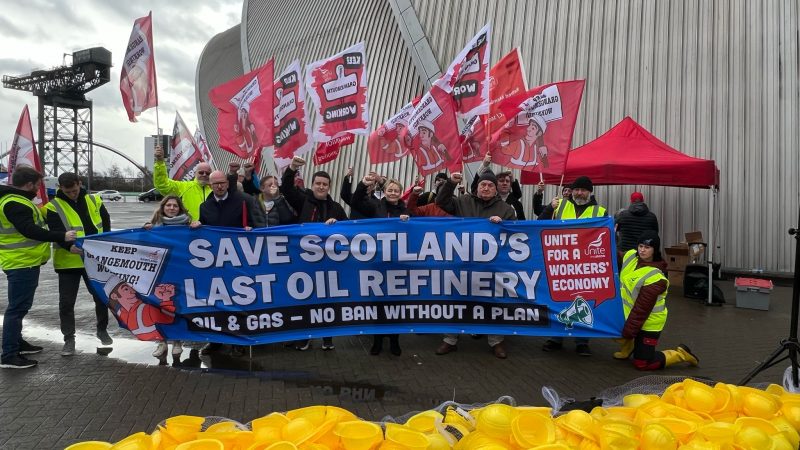
Unite lays hard hats outside Scottish Labour conference in Grangemouth protest


Photo: Luke O’Reilly

Labour’s green transition plans cannot be fuelled by “transitioning our jobs abroad”, Sharon Graham has warned at a Scottish Labour conference protest over saving the Grangemouth oil refinery.

Speaking to LabourList at the protest outside the Scottish Labour conference in Glasgow on Friday, Graham argued that Grangemouth was ideally placed to provide green aviation fuel for the expansion of Heathrow Airport.

It was announced last year that the oil refinery, the only one in Scotland, would be closed, with the loss of 400 jobs.

Unite workers battled the elements as they laid 400 helmets, one for every job lost, outside the Scottish Event Campus venue.

At one point a particularly powerful gust of wind blew several helmets across the parking lot, though nearby Waspi campaigners were on hand to help the trade unionists gather them back up.

‘Labour can’t put their fingers in their ears’

The protesters chanted: “You said our refinery was your top priority” and “keep Grangemouth working”.

Graham echoed their sentiments.

“We’re here to say to the Labour government in the UK, and obviously the politicians in Scotland, that they need to save the Grangemouth site.

“It’s not acceptable for them to put their fingers in their ears, and not save this site, and that’s what we are demanding today.”

Grangemouth’s closure is a terrible thing for the UK

She said Grangemouth’s closure wasn’t just a terrible thing for the people of Grangemouth but also the UK.

“I think it’s a terrible thing for the UK. Rachel Reeves went on the telly a couple of weeks ago to say that for our Heathrow expansion we’re going to need green aviation fuel.

“And the question I keep asking is: Where are you going to get it from?

“We don’t make green aviation fuel at the moment. So if you’re not going to get it from sites like Grangemouth, which is sitting there read to make it, where are we getting it from?

“Are they seriously telling me that this transition is about transitioning our jobs abroad? Because if they do that, that will never be forgotten, and we will not allow that to happen.”

‘This is a highly skilled workforce’

Graham said the hard hats represent the skills of Grangemouth’s workforce.

“This represents 400 workers, a hard hat for every worker, and the skills these workers have.

“This is a highly skilled and trained workforce. We need those skills in Britain.

“It is a matter of national security that Grangemouth stays open and transitions into an aviation fuel site. We need to make sure that they do that.”