It’s possible that I shall make an ass of myself. But in that case one can always get out of it with a little dialectic. I have, of course, so worded my proposition as to be right either way (K.Marx, Letter to F.Engels on the Indian Mutiny)
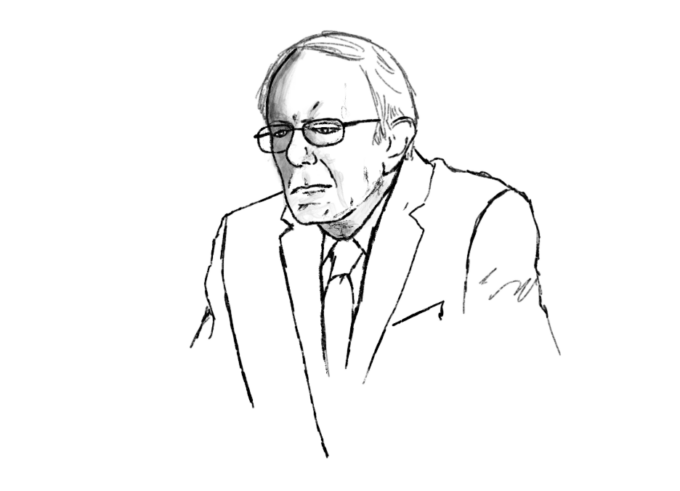
How strange that due to the disastrous policies of “their president,” Montana’s all-Republican Congressional delegation and governor are now too scared to even face Montanans in town halls. And yet Bernie Sanders flies into Missoula on his national “Fighting Oligarchy” tour and draws “thunderous applause and standing ovations” from an over-capacity crowd of 9,000 Montanans on an afternoon in the middle of the week.
Why? Because people know Bernie is telling the truth about what’s going on in this nation, not fabricating excuses and downplaying the very real damages taking place while they hide under their MAGA hats.
He’s also correctly calling out the fact that both Republicans and Democrats are responsible for the on-going tragedy that sees American democracy, once the envy of the world, turning into an oligarchy of billionaires whose greed knows no bounds or even a scintilla of concern for “the little people.”
Nor was Bernie speaking from a bullet-proof cage surrounded by nasty looking thugs with sunglasses and earbuds to ensure no one gets close to him. Quite the opposite — top Republicans nowadays don’t dare do what Bernie did — walk out into the overflow crowd of thousands to shake hands and talk directly to the people who couldn’t get in.
The few Republican politicians who dare venture into the realm of “we the people” are being met by angry crowdswhose interests and hope for a better future they have so grievously betrayed. Just ask 91-year old GOP Senator Chuck Grassley, who was bluntly told “his” people in supposedly “red state” Iowa are now really “pissed” because he won’t stand up to “dictator” Trump.
In an astounding contrast, there’s no denying that Bernie’s huge crowds are showering this 83-year old dynamo with love and hope, many with tears in their eyes because his words go straight to the challenges they are experiencing and they want to believe that somehow we can overcome the insulated and isolated billionaires and return our government to the people, not the 1 percenters who want ever more, no matter the cost to the rest of us.
That’s part of the reason Bernie Sanders is the most popular Senator in the nation. In his own words from his Missoula speech: “We can either have extreme wealth inequality, with the toxic division and corruption that it requires to survive, or we can have a fair economy for working people along with the democracy and freedoms that uphold it. But we cannot have both.”
Speaking truth to power, Bernie laid it out: ““We don’t accept this blue state–red state nonsense. We are the United States of America, not red states, not blue states. I believe honestly that I speak for conservatives, moderates and progressives, for the overwhelming majority of the American people, who understand that there is something fundamentally wrong in our campaign finance system where billionaires can buy elections.”
Apparently that rankled Montana’s millionaire governor, Greg Gianforte, who posted: “Bernie Sanders and AOC are in Montana pushing their far–left agenda — but Montanans rejected them and their puppet Joe Biden after four years of failed policies. The people have spoken. They aren’t feeling the Bern.”
I got news for the gov — who has never drawn anything close to Bernie’s crowds or approval ratings. Bernie won the Montana Democratic primary election in 2016 because he, not Hillary Clinton, spoke to Montanans’ concerns. They “felt the Bern” then and obviously are “feeling the Bern” again. Why? Because they’re feeling burned — by Gianforte, our do-nothing congressional delegation, and by the eternally lying fool in the Oval Office.
George Ochenski is a columnist for the Daily Montanan, where this essay originally appeared.
Corporal Punishment in America: Most Adults in US Support Spanking Children and 19 States Allow It in Schools
Nearly a half-century after the Supreme Court ruled that school spankings are permissible and not “cruel and unusual punishment,” many U.S. states allow physical punishment for students who have misbehaved.
Around the world, 68 countries have banned the hitting of children in any form, including spanking. This movement began in 1979 with Sweden’s ban on all forms of physical punishment, including spanking in any setting, and including in the family home.
Each state in the U.S. has its own child abuse laws, and all states, tribes and territories aim to protect children from abuse. But all state laws also allow parents to hit their children if it does not leave an injury or a mark.
A typical example is Oklahoma’s definition of child abuse and neglect. It includes an exception that permits parents to use ordinary force as a means of discipline, including spanking, using an implement like a switch or a paddle. However, leaving evidence of hitting, such as welts, bruises, swelling or lacerations, is illegal and considered child abuse in all states.
Parental spanking of children is considered unique from other physical violence because of the relational context and the purpose. Laws entitle parents to hit their children for the purpose of teaching a lesson or punishing them to improve behavior. Children are the only individuals in society who can be hit by another person and the law does not regard it as assault.
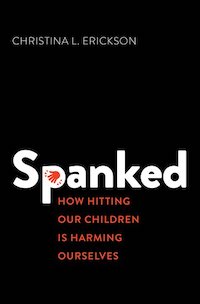
Spanking’s impact on a child is unfortunately similar to abusive hitting. Spanking has been labeled as an “Adverse Childhood Experience,” or ACE. These are events that cause poor health outcomes over the span of one’s life.
Some school districts require permission from parents to allow disciplinary paddling in school, while others do not require any communication. State law does not assure agreement between parents and school districts on what offenses warrant a paddling. Parents may feel they have no alternative but to keep their child in school, or fear reprisal from school administrators. Some students are old enough to denounce the punishment themselves.
In this school district, physical punishment is used only when parents give written permission.
Is spanking considered the same as hitting?
The term spank conceals the concept of hitting and is so commonplace it goes unquestioned, despite the fact that it is a grown adult hitting a person much smaller than them. The concept is further concealed because hitting a child’s bottom hides any injuries that may occur.
Types of hitting that are categorized as spanking have narrowed over the years but still persist. Some parents still use implements such as tree switches, wooden spoons, shoes or paddles to “spank” children, raising the chances for abuse.
Most spanking ends by the age of 12, partly because children this age are able to fight back. When a child turns 18, parental hitting becomes the same as hitting any other adult, a form of domestic violence or assault throughout the U.S.
There is a lack of a consistent understanding of what constitutes a spanking. The definition of spanking is unique to each family. The number of hits, clothed or not, or using an implement, all reflect geographical or familial differences in understanding what a spanking is.
How do US adults view spanking?
People in the United States generally accept spanking as part of raising children: 56% of U.S. adults strongly agree or agree that “… it is sometimes necessary to discipline a child with a good, hard spanking.” This view has been slowly changing since 1986, when 83% of adults agreed with that statement.
The laws worldwide that protect children from being hit usually begin by disallowing nonparental adults to hit children. This is happening in the U.S. too, where 31 states have banned paddling in schools.
With the slow but steady drop of parents who believe that sometimes children need a good hard spanking, as well as the ban of paddling in schools in 31 states, one could argue that the U.S. is moving toward a reduction in spanking.
What does research say about spanking?
Spanking’s negative influence on children’s behavior has been documented for decades. Spanking seems to work in the moment when it comes to changing or stopping the immediate behavior, but the negative effects are hidden in the short term and occur later in the child’s life. Yet because the spanking seemed to work at the time, the parent doesn’t connect the continued bad behavior of the child to the spanking.
No studies have shown positive long-term benefits from spanking. Because of the long-standing and expansive research findings showing a range of harm from spanking and the increased association with child abuse, the American Psychological Association recommends that parents should never spank their children
What are some resources for parents?
Consider these questions when choosing a discipline method for your child:
Is the expectation of your child developmentally accurate? One of the most common reasons parents spank is because they are expecting a behavior the child is not developmentally able to execute.
Can the discipline you choose grow with your child? Nearly all spanking ends by age 12, when kids are big enough to fight back. Choose discipline methods you can use over the long term, such as additional chores, apologies, difficult conversations and others that can grow with your child.
Might there be another explanation for your child’s behavior? Difficulty of understanding, fear or miscommunication? Think of your child as a learner and use a growth mindset to help your child learn from their life experiences.
Parents are the leaders of their families. Good leaders show strength in nonthreatening ways, listen to others and explain their decisions. Don’t spoil your kids. But being firm does not have to include hitting.
Practicing calm when with your children will help you be calmer at work and in your other relationships. Listening to and speaking with a child about challenges, even from a very early age, is the best way to make it part of your relationship for the rest of your life.
Choose a method that allows you to grow. Parents matter too.