Sunday, July 20, 2025

“Youth Unity to Hold Back the Right:” Young Members of Unity for Chile Pave the Way in Support of Jeannette Jara

“We must speak to all young people, even those who don’t believe in this system. And that means a project that stays true to its convictions but opens itself to representing the broader majority.”

Chilean newspaper El Siglo report on a recent youth event held to rally support and develop policies for the Presidential campaign of Jeannette Jara, the candidate selected by the Unity for Chile electoral alliance, in November’s elections.

The voices of representatives from the JJCC (Young Communist League), JS (Socialist Youth), JR (Radical Youth), JL (Liberal Youth), the Broad Front, and Party for Democracy (PPD). Agreement reached to promote a series of self-organised meetings across the country, open to social organisations and youth movements, with the aim of developing proposals to enrich Jeannette Jara’s presidential programme.

Santiago, July 2025: At a political breakfast held this morning at the headquarters of the Central Unitaria de Trabajadores (Chile’s Trade Union Congress), the youth wings of the Unity for Chile coalition kicked off joint efforts ahead of November’s presidential elections, agreeing on a territorial and policy-based action plan in support of Jeannette Jara’s candidacy.

The meeting brought together representatives from the Young Communist League, the Student Front of the Broad Front, the Socialist Youth, the PPD Youth, the Radical Youth, and the Liberal Youth—demonstrating political convergence following the results of the 29th June primaries, in which Jara won by a wide margin as the ruling coalition’s candidate.

The key agreement from the meeting was to launch a series of self-organised gatherings across the country, open to social organisations and youth movements, with the goal of drafting proposals to shape Jara’s presidential agenda.

“We believe Chilean youth can be a decisive force in this election. We have the chance to push for a transformative alternative, but that requires our voices to be heard in the programme,” said Catalina Lufín, President of the Young Communist League.

The role of young activists during the primaries—though with varied levels of support—was crucial in digital and grassroots mobilisation, as well as in universities. Social media, mass student gatherings, and cultural and sporting events were key in shaping the debate and winning over younger sectors, often absent from traditional campaigns.

With these lessons in mind, youth leaders agreed that the challenge now is to move beyond mere formal endorsement of the candidacy and into a phase of collective development, incorporating the different visions expressed during the primaries.

“We want Jeannette Jara’s programme to include the most important points from all the progressive candidates. There are elements from Gonzalo Winter, Carolina Tohá, and Jaime Mulet (all candidates at the primary won by Jeannete Jara) that should be part of a shared synthesis,” said José Miguel Gallo, President of the Liberal Youth, who also stressed the importance of broadening the campaign’s appeal to independent and moderate sectors.

Collective Building, Beyond Party Lines

A recurring theme at the meeting was that the campaign must go beyond institutional and party activism. The call was to work from grassroots connections, engagement with social organisations, and digital outreach with messages that resonate with those who do not yet feel part of this movement.

“We must speak to all young people, even those who don’t believe in this system. And that means a project that stays true to its convictions but opens itself to representing the broader majority,” said Javier Hormazábal, President of the Radical Youth.

To achieve this, the main agreement reached was to organise a series of local and sector-based meetings across the country, aiming to gather demands and concrete proposals to feed into Jara’s programme from the youth’s perspective. These will be self-organised spaces, open to social organisations, youth collectives, student unions, feminist and environmental groups, and dissident movements, with the goal of shaping a future vision that connects with new majorities.

“Today, we’re not flying party flags. We’re convinced that unity is the only way to secure the majority we need in November,” said Claudio Calabrán, President of the Broad Front’s Student Front, who noted that this youth alliance builds on existing collaboration in student movements and local activism.

Over the coming weeks, a formal launch of this youth policy agenda is expected, with a calendar of activities including open assemblies, thematic forums, and digital meetings.

With four months to go until the first round of voting, progressive youth aim to establish themselves as a political force with their own voice—and the ability to reach unorganised sectors of Chilean youth—in an effort to expand support for the social transformation embodied by Jeannette Jara’s candidacy.


  • This article was originally published in El Siglo on 10 July 2025, and was translated to English by Francisco Dominguez.


Chile: A Major Victory for the People and the Left, with Strategic Impact


With Jeannette Jara’s victory, a concrete proposal for social and developmental measures has won. A healthy and fresh style of politics has won. An option born from the left and social movements has won.

Chilean newspaper El Siglo published the following editorial in response to the victory of Jeannette Jara in the primary vote to select the Presidential candidate of the Unity for Chile electoral alliance, ahead of this November’s general election.

The victory of Jeannette Jara in the ruling coalition’s primary is a major triumph for the people and the left.

The surprise does not lie so much in the result itself, as all polls and analyses in the past week pointed to a win for the Communist Party candidate, backed by Humanist Action, the Christian Left, and independents. What may have been surprising, perhaps, was her winning 60% of the vote: a resounding success.

Another unexpected factor is that a Communist Party member won the primary, despite many predicting it was nearly impossible and that her party affiliation would work against her. Overwhelmingly, those opinions have been dismissed by the force of facts and the strength of democracy.

With Jeannette Jara’s victory, a concrete proposal for social and developmental measures has won. A healthy and fresh style of politics has won. An option born from the left and social movements has won.

Stigmatizing, anti-Communist, sectarian, obscurantist, and retrograde theses and perceptions were defeated. 

The people triumphed through a candidacy that has proven to be connected to their needs and demands—one that, when given governmental responsibility, successfully advanced concrete measures that improved working conditions and quality of life for millions of Chileans.

There is a well-placed trust in Jeannette Jara and the forces supporting her—a belief in a revitalized approach and a steadfast commitment to expanding democracy and social rights.

As stated, now more than ever, we can dream with our feet on the ground, with hope and realism, with confidence and commitment.

This victory has a strategic impact. With the clear support received by the Communist candidate, the path is now open to continue fighting for more rights for the majority of Chileans—with stability and security.

At this moment, we must not forget the loyalty, effective governance, seriousness, and commitment that Communists have always demonstrated in various government roles throughout Chile’s history.

The coming days must bring clarity of objectives, deeper alignment with the people, and better solutions to the country’s pressing issues. At the same time, they must be days of dialogue, openness, intelligence, and collective construction—because today, an alternative has emerged from a coalition of political and social sectors that must remain coordinated and unified.

This has been a pivotal moment for the country’s future, for the realisation of transformative ideas, for the improvement of democracy and its institutions, and for the defence of the rights of Chilean men and women.


  • This article was originally published in El Siglo on 30 June 2025, and was translated to English by Francisco Dominguez.

Hiroshima to Today: Confronting the Nuclear Threat


“Governments across Europe are making these problems worse. They are leading a massive programme of rearmament, including talk of European nuclear proliferation; but they are in denial about the dangers it is unleashing.”

By Kate Hudson, Campaign for Nuclear Disarmament

As we commemorate the eightieth anniversary of the criminal attacks on Hiroshima and Nagasaki by US atomic bombs, we must recognise that we are closer than ever to nuclear war. The war on Ukraine has greatly increased the risk. So too has Nato’s location of upgraded nuclear weapons across Europe — including Britain — and Russia’s resultant siting of similar weapons in Belarus. Irresponsible talk suggesting that “tactical” nuclear weapons could be deployed on the battlefield — as if radiation can be constrained in a small area — has made nuclear use more likely. And last year, after decades of reductions since the end of the Cold War, the global nuclear stockpile increased.

Governments across Europe are making these problems worse. They are leading a massive programme of rearmament, including talk of European nuclear proliferation; but they are in denial about the dangers it is unleashing. This is a bad time for humanity — and for all forms of life on Earth. It’s time for us to stand up and say No: we refuse to be taken into nuclear Armageddon.

It is also right that we should take the opportunity of this tragic anniversary to clarify the facts of the atomic bombing.

Conventional wisdom, especially in the US, says it was necessary to drop the bomb to bring about a speedy conclusion to the war and save lives. Even today many people believe that the bomb was necessary to bring about a Japanese surrender and to avoid the need for an invasion of Japan by the US, which might have cost hundreds of thousands of lives. But extensive scholarly research in the US shows that this just wasn’t true. By the time the bomb was ready for use, Japan was ready to surrender. As US General Dwight Eisenhower said, Japan was at that very moment seeking some way to surrender with minimum loss of face, and “it wasn’t necessary to hit them with that awful thing.” And British wartime leader, Winston Churchill, said, “It would be a mistake to suppose that the fate of Japan was settled by the atomic bomb. Her defeat was certain before the first bomb fell and was brought about by overwhelming maritime power.”

So if Japan was ready to surrender, why were atomic bombs dropped on Hiroshima and Nagasaki? A significant factor in the decision to bomb was the US’s desire to establish its dominance in the region after the war. Those planning for the post-war situation believed that this required US occupation of Japan, enabling it to establish a permanent military presence, shape its political and economic system and dominate the Pacific region. But the US’s key strategic concern, above all, was the position of the Soviet Union in the post-war world.

Evidence suggests that the US wanted to demonstrate its unique military power — its possession of the atomic bomb — in order to gain political and diplomatic advantage over the Soviet Union in the post-war settlement in both Asia and Europe. So nothing to do with ending the war with Japan.

Many European scientists worked on the US Manhattan Project because they saw the development of the atomic bomb as a necessary evil in the arms race to defeat Hitler. At the end of 1944, it was clear that Germany was not going to succeed in making an atom bomb. In these circumstances, the eminent Polish scientist Joseph Rotblat left the Project. Others tried to alert politicians to the dangers ahead and prevent the use of the bomb. But top politicians pressed ahead.

As Rotblat himself later pointed out: “There is good reason to believe that the destruction of Hiroshima and Nagasaki was not so much the end of the second world war as the beginning of the cold war, the first step in a fateful chain of events, the start of an insane arms race that brought us very close to a nuclear holocaust and the destruction of civilisation.”

In memory of all those who died at Hiroshima and Nagasaki, and those who have suffered the consequences since, we must do our utmost to prevent the same catastrophe happening again; let us take action to prevent our politicians catapulting us into nuclear war — and the destruction of all life on this planet.


Revolutionary Thinker Franz Fanon at 100


“In an era of new global brutality, his reflections against colonialism and racism, and in defence of the universal, remain intellectually vital in a world ravaged by imperialist logics.”

By Hélène Bidard, Party of the European Left

The Party of the European Left pays tribute to Frantz Fanon, psychiatrist, revolutionary thinker, and freedom fighter. The theorist of human liberation was born one hundred years ago, on July 20, 1925, in Fort-de-France. He embraced the cause of Algerian independence and global emancipation. In an era of new global brutality, his reflections against colonialism and racism, and in defence of the universal, remain intellectually vital in a world ravaged by imperialist logics.

Across the vast expanse of a transatlantic geography, his journey was a “call to live,” as Aimé Césaire said of him. At the twilight of colonisation, Fanon’s thought—rooted in struggle—grasped a historical rupture. It remains a call to fight for the creation of a world free from domination, liberated from colonialism, and rid of the discourses and acts meant to reify human beings.

An anti-Nazi fighter at 18, then a medical student in Lyon, Fanon became a psychiatrist in Blida, Algeria. There, he practiced a form of clinical work inspired by institutional psychiatry. For him, colonization generates mental disorders in both the colonized and the colonizers. It alienates bodies and corrodes minds. His work charts lines of escape from that “zone of non-being” to which the colonized are consigned; these routes pass through a resolute will to be human—only human. This desire to rise into humanity underpins both his political project and his clinical practice. How can one not still feel the grip of this today, when in Gaza, war criminals call Palestinians “human animals” to justify genocidal machinery?

In Black Skin, White Masks, Fanon rejects all fixed identities: “The Negro is not. No more than the White.” He denounces the racial categories imposed by colonialism to divide humanity and defends a decolonial, radical, embodied humanism: “I am a man, and it is the whole past of the world that I must reclaim.”

In Algeria Unveiled, he shows how the colonial regime manipulates women’s bodies to fracture colonized society under the guise of emancipation. But unveiling can also become a revolutionary tactic. To those who dream of a return to religion, he replies: “My path stands in opposition to yours.” Emancipation cannot be nostalgia; it is invention.

In The Wretched of the Earth, Fanon opposes a strictly economistic reading of oppression. He writes: “In the colonies, the economic infrastructure is also a superstructure. Cause and consequence are one: one is rich because one is white, and one is white because one is rich.” Rejecting dogmatic frameworks, he weaves together Marxism, existentialism, and lived experience to think through liberation.

He had already denounced what we now call a permanent state of war: military domination, terror, censorship, exile, sanctions, and all the brutalities of the world.

Fanon said it clearly: “No peace without liberation.”

Frantz Fanon died at 36, but his humanist and combative body of work endures. It compels us. It continues to call us—to the decolonisation of thought and structures, to self-reflection and reflection on the world, and to the struggle.


l\9QQ, are part of the ceremony of a polite, English refusal. There has been no substantial work on Fanon in the his- ... Frantz Fanon. I 33 dementia, to feeble- ...

OTHER WORKS BY FRANTZ FANON. PUBLISHED BY GROVE PRESS: Black Skin, White ... had harvested were eager to understand how it worked. They very quickly ...

his major works and many are viewed as peripheral to Fanon's three books and the collection of his political writings that has been available to English.

To find out more about our authors and books visit www.bloomsbury.com and sign up for our newsletters. Page 6. Plates ix. Illustrations xi. Frantz Fanon: Works ...

In this way, and not through books, business deals, or international assemblies is the present unity of humanity being forged and constructed. Frantz Fanon ...

Jun 4, 2019 ... Fanon, Frantz, 1925-1961, Colonies. Publisher: New York : Monthly Review Press. Collection: trent_university; internetarchivebooks; inlibrary ...


Activists read names of 20,000 Palestinian children killed in Gaza outside Welsh government

Yesterday
Left Foot Forward

“Each was precious. Each was innocent. Many died horrific, painful deaths. There were so many of them. They must not be forgotten.”


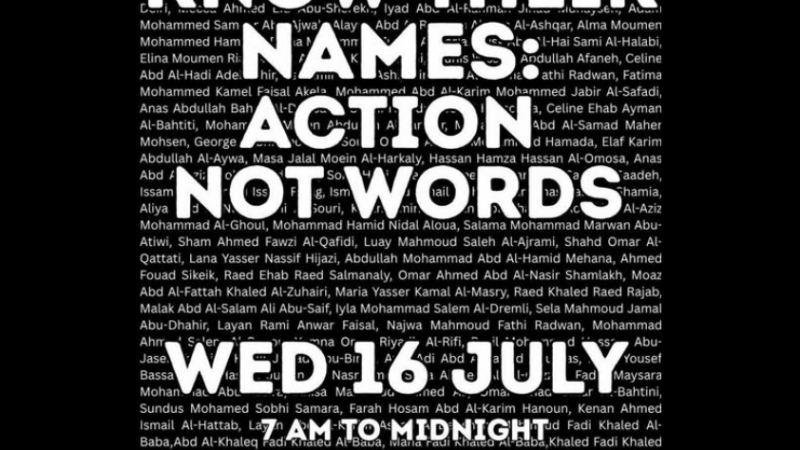
On July 16, activists gathered outside the Welsh government building to read aloud the names of 20,000 Palestinian children killed in Gaza since October 7, 2023. The remembrance act, titled “Know Their Names: Action Not Words,” was a solemn tribute to young lives cut short by the violence.

The event was organised by Palestine Solidarity Campaign (PSC) Cymru and Parents and Teachers for Palestine, who aim to draw public and political attention to the human cost of the war in Gaza.

Campaigners are urging the Welsh Government and members of the Senedd to support an immediate arms embargo on Israel, to press for targeted sanctions, and to take steps to uphold international law.

Clive Haswell, from PSC Cymru, said: “If the death of over 20,000 children is not enough for our First Minister and MSs to demand decisive action and end our complicity, I’m truly lost for words.

“UNRWA [United Nations Relief and Works Agency for Palestine Refugees in the Near East] staff recently visited the Senedd and pleaded with our elected leaders to speak out and use their influence.

“Their continued silence and inaction kills.”

Ahead of the event, Frankie Finn of Parents and Teachers for Palestine said:

“On 16 July, we’ll stand outside our national parliament to honour these children – by saying their names.

“Each was precious. Each was innocent. Many died horrific, painful deaths. There were so many of them. They must not be forgotten.”

The call for political action appears to reflect growing public concern in the UK. A recent Opinium poll, commissioned by PSC, found that 57% of the British public support ending arms sales to Israel, compared with just 13% opposed. Among Labour voters in the 2024 general election, that support rose to 71%.

The same poll showed majority support for several related measures, including 53% who said they would back government sanctions against Israel’s finance minister, who has called for Gaza to be “cleansed” and the destruction of “what’s left”.

Additionally, a majority of 54% are in favour of Israel being expelled from the United Nations, while just 16% oppose the expulsion.

On boycotting Israeli goods, twice as many respondents supported supermarkets removing such products as those who opposed the idea

Last September, the UK government suspended around 30 arms export licences after it assessed that the items might be used to facilitate serious violations of International Humanitarian Law.

However, 90% of the arms export licenses to Israel have still not been suspended.

Image credit: Gaza Action in Wales

Astonishing clip shows protester being threatened with arrest for Palestine flag and placard


17 July, 2025 
Left Foot Forward


A video clip has shown an astonishing interaction between a protester and two police officers in Kent. In the clip, the protester – Laura Murton – was threatened with arrest while they held a Palestine flag and displayed a placard reading ‘Israel is committing genocide’.

In the clip, Murton is seen being approached by two police officers who asked them what their intention was. The police went on to ask whether Murton supported any proscribed group. She confirmed that she did not, going on to say “I support a free Palestine and the end of genocide.”

Following this, one of the officers asked for her details saying that she may be ‘committing an offence’ and that he needed to make sure that she was ‘legit’.

Murton then asked the officer what offence she may be committing, and was told that it related to support for proscribed groups. She responded to this by saying she didn’t “have anything on me which says that”. The officer then said “the way you are behaving at the moment” would “give me suspicion to believe you could be”.

A second officer can then be seen saying “My colleague’s explained that the support of this – mentioning freedom of Gaza, Israel genocide, all of that – all would come under proscribed groups which are terror groups that have been dictated by the government which we have suspicions to suggest that you’re supporting based on your actions here in a city with the flags and the posters you’ve got.”

Later in the clip, the same officer went on to say “I’ll tell you the offences that we’ve been asked to deal with things like this. So you’ve got to belong or profess to a proscribed organisation – so Palestine Action”. After Murton said “which I have not”. The officer then said “and you haven’t”, but continued: “Invite support for a proscribed organisation – you haven’t. Express an opinion or belief that is supportive of a proscribed organisation. Now, that you have done.”

Murton responded to this by saying “That’s ridiculous, you’re going to end up arresting half the country.” The officer then said “I didn’t make the legislation. That is the legislation.” He later added that if Murton continued their protest in a different location “you’ll probably find yourself arrestable for that offence”.

The incident follows the controversial decision by the government to proscribe Palestine Action as a terrorist group.

Speaking to the Guardian, Murton said: “I don’t see how anything I was wearing, how anything I was displaying, anything I was saying, could be deemed as supportive of the proscribed group.”

“It’s terrifying, I was standing there thinking, this is the most authority, authoritarian, dystopian experience I’ve had in this country, being told that I’m committing terrorist offences by two guys with firearms.”

“I ended up giving my details, and I really resent the fact I had to do that because I don’t think that was lawful at all.”

According to the Guardian, a Kent police spokesperson said: “Under the Terrorism Act it is a criminal offence to carry or display items that may arouse reasonable suspicion that an individual is a member or supporter of a proscribed organisation such as Palestine Action.”

Chris Jarvis is head of strategy and development at Left Foot Forward


Image credit: Scotgunn – Creative Commons


“Atlanticist liberalism can never recover from its present agony”


Last month Saqi Books published Gilbert Achcar‘s new book The Gaza Catastrophe: The Genocide in World-Historical PerspectiveLabour Hub interviewed the author about the book and the political events that gave rise to it.

JULY 17,2025 


Labour Hub: Fifteen years ago, you wrote: “No national strategy in confronting the Zionist state is possible without relying on the combination of the Palestinian and Arab struggle with the effort to split Israeli Jewish society from within. This last goal requires Palestinian and Arab liberation forces to be able to address the Israeli Jews and detach a significant portion of them from the Zionist mindset.” Is this still a viable strategy, are we any nearer that goal and what concretely needs to happen to get closer to it?

Gilbert Achcar: Whether it is viable or not, allow me to first emphasise that this is the only possible strategy for bringing this long tragedy and the ordeal endured by the Palestinian people to an end that could usher in a true and lasting peaceful coexistence between Palestinians and Israelis. There is no alternative to that end: all other scenarios entail the continuation of occupation and violence or else an apocalyptic mayhem.

Now, to address more directly what is implied by your question, we are certainly not nearer such a goal, alas, but actually farther than at any previous time since 1948. That is due to the culmination of the long-term drift to the right of Israel’s society and polity, embodied in the present Netanyahu government – a coalition between the neofascist Likud party and the neo-Nazi gangs of Ben Gvir and Smotrich – and boosted by the disastrous effect of the 7th October attack on the Israeli public. The Jewish Israelis’ hostility to the Palestinian people has reached an all-time peak as attested by polls indicating that most of them support the expulsion from Gaza of its Palestinian inhabitants.

But Israel’s rightward drift has not been constant. In the wake of the 1988 Palestinian Intifada – a popular uprising organised by grassroots committees in Gaza and the West Bank – the Israeli society was positively impacted to the point that it brought back the Zionist Labourites to power and welcomed the Oslo agreements that they concluded with the Palestine Liberation Organization. Among Israeli intellectuals, we saw the development of a “post-Zionist” trend, advocating a shift from “Jewish state” to “state of all its citizens”.

This tendency was soon to be reversed by the dialectics of violence initiated by the Zionist far right (the murderous suicide attack of Palestinian worshippers by Baruch Goldstein in 1994), inaugurating a new cycle that would reach a first peak with Ariel Sharon’s most violent reinvasion of the Palestinian enclaves in 2002. Sharon surfed to power in 2001 on the wave that he himself had triggered by setting off in September 2000 the Second Intifada, which, unlike the first, took the form of armed clashes.

Nowadays, the prospect of a new pro-peace turn of the Israelis seems quite remote indeed, but it is no reason to abandon “optimism of the will” and the hope that an internationalist dialectics between Arabs/Palestinians and Israeli Jews might eventually prevail, rebounding from the present abysmal condition and facilitated by non-Israeli Jews, an increasingly important proportion of whom are being “detached from the Zionist mindset”.

Labour Hub: The militarization and rising authoritarianism of the Israeli state, while maintaining minimal democratic norms, albeit on a racialized basis – is this something that Western elites recognise in the trajectory of their own states, and perhaps therefore constitutes a significant factor in their support for Israel, despite the contempt in which Israel’s actions are held by so many of their own citizens?

Gilbert Achcar: It depends on which Western elites you mean. For the neofascists who are on the rise almost everywhere in Western countries, yesteryear’s “cradle of liberalism”, the present Israeli state is certainly a beacon. Netanyahu has been a model for them for many years as well as an enabler, whitewashing their antisemitism and coopting them as allies of Israel on the common ground of anti-Muslim racism.

To say the same of the so-called liberal elites would be exaggerated: the likes of Keir Starmer, despite their apparently unstoppable drift to the right, have not yet reached a point where they would see in Netanyahu a model. They’d rather wish for the Israeli opposition to manage to defeat the present Israeli prime minister and get back to a semblance of liberalism – as fake as theirs. Note that the Israeli opposition is hardly better than Netanyahu’s coalition when it comes to war goals against the Palestinians (identified with Hamas) and Iran.

Labour Hub: For the last year and a half, some activists have participated in anti-war demonstrations, against Israel’s war on Palestine and against Russia’s war on Ukraine, with a banner saying “From Ukraine to Palestine, Occupation is a crime”. Would you agree that Russia’s unprovoked bombardment of Ukraine has encouraged and normalised Israel’s bombardment of Gaza – as Russia’s aggression is reciprocally normalised by Israel’s onslaught in turn?

Gilbert Achcar: I don’t think that Israel needed any encouragement from Russia, or any other state for that matter. It has been claiming a colonial right over the land of Palestine long before Putin claimed a colonial right over Ukraine. From its inception, Israel is built on forceful occupation and annexation: it has waged war after war against the Palestinians and all its Arab neighbours.

The Israeli armed forces’ violence against civilians has steadily increased over time, with peaks reached with the 1982 invasion of Lebanon, the repression of the Palestinian Intifada in 1988-1993, the 2002 onslaught on the West Bank and Gaza, the bombing of Lebanon in 2006, and the repeated onslaughts on Gaza since 2007.

So, if either of Israel or Russia normalised the other’s violence, it is the former rather than the latter. However, what has been much more important in encouraging and normalising Russia’s aggression on Ukraine is the US-UK 2003 invasion of Iraq, blatantly violating the so-called rules-based international order, as I showed in my book The New Cold War.

Labour Hub: Could a return of some semblance of a rules-based international order possibly emerge from a change of leadership in Washington? But is there any way that Atlanticist liberalism, which you argue is “now definitively discredited”, can possibly recover?

Gilbert Achcar: I don’t think that Atlanticist liberalism can ever recover from its present agony. Reverting towards the rebuilding of a genuine rules-based international order – a semblance would no longer work – would take such a radical change of leadership in Washington that it wouldn’t usher in a renewal of Atlanticism, but the inauguration of a completely new chapter in world history, quite more progressive than what followed World War Two.

For now, the only genuine upholders of a rules-based international order are to be found in the Global South, with countries such as South Africa or China. Of the latter, let me emphasise that, despite its constant bashing in Western countries, it has been a constant upholder of the UN Charter in international relations – much more consistently so than any Western government. That applies to its original stance on Ukraine as well, as I pointed up some time ago.

Labour Hub: Israel’s genocide against the Palestinians in Gaza is often characterised as the first live-streamed genocide in real time, which reinforces its undeniability. This month has seen commemorations of the Srebrenica genocide – also still not fully recognised by Western states as a genocide against the entire Bosnian people, and one in which these same states were arguably complicit. How useful do you think it is for campaigners in solidarity with Gaza to emphasise these parallels as part of a wider war on human rights, or is this a distraction from focusing on the specifics of Israel’s crimes?

Gilbert Achcar: What campaigners have been principally emphasising is the double standard that makes Western governments acknowledge the massacre of some 3% of the population of Bosnia-Herzegovina as a genocide and refuse to acknowledge the qualification as genocide of the comparable proportion of Gazans killed since October 2023. In the same way, the double standard that led Western governments to severely condemn Russia’s invasion of Ukraine in February 2022 while they endorsed Israel’s invasion of Gaza in October 2023 has been very much commented on and was a key factor in the final discrediting of Atlanticist liberalism and its pretence of conforming to principles.

Labour Hub: As you say at the end, it’s hard to be optimistic about the situation, although as public pressure continues, Western elites are beginning to voice their concerns about Israel’s policy. Are there grounds to be more optimistic now than when you finished the book?

Gilbert Achcar: I finished writing the book in February of this year. It ended on a deeply pessimistic prognosis about the outcome of the ongoing genocidal war on Gaza – not least because of the ‘second coming’ of Donal Trump to the White House. Nothing did happen since then, unfortunately, that would make me revise my pessimism regarding the foreseeable future.

The only source of hope that I can see – hope and not optimism, which is a distinction that is dear to me – is in the effect on the new generations of the ongoing catastrophes of the present world, from the climate’s increasingly catastrophic change to the Gaza catastrophe. Indeed, an increasing proportion of the young is revulsed at what is going on and bitter against those who enabled it, either as perpetrators or as bystanders.

I very much hope that out of this radicalisation, a new progressive movement will arise and develop, one that would assimilate the lessons of the failure of the 20th century’s left and lead the way towards the rollback of the present neofascist surge and a new drive towards another world than the increasingly ugly one in which we live.

Gilbert Achcar is Emeritus Professor of Development Studies and International Relations at SOAS, University of London. His new book The Gaza Catastrophe: The Genocide in World-Historical Perspective is published by Saqi.


Britain’s quiet billion-pound subsidy to banks and ‘shadow’ banks

JULY 20, 2025

By Costas Lapavitsas

Rachel Reeves seeks cuts in public spending and considers tax increases because, apparently, the cupboard is bare. No fiscal space, we are told, to reverse years of social erosion. Yet in the background, one of the largest transfers of public wealth in recent British history continues apace—almost entirely out of sight.

The Bank of England’s Asset Purchase Facility (APF), a holdover from the era of Quantitative Easing, is quietly funnelling tens of billions of pounds from the Treasury to commercial banks and ‘shadow’ financial institutions. These payouts are not tied to productive investment or economic risk-taking. They are, in essence, payments for doing nothing—for holding central bank reserves created by the Bank itself. And now, for buying government bonds at a discount while the state swallows the losses.

The scale is staggering. In the 2023–24 fiscal year, the Bank received £44.5bn from the Treasury to cover losses from the APF. In Reeves’s 2024–25 budget, the figure rises to £54bn. This is not loose change. It far exceeds the so-called “fiscal headroom” Labour has inherited and is money that could be used to tackle poverty, fund housing, or invest in public services. Instead, it’s being quietly redirected to the financial sector.

Originally created in response to the 2007-9 crisis—and later expanded during the pandemic—the APF enabled the Bank of England to buy up hundreds of billions of pounds in government bonds. To finance these purchases, the Bank created central bank reserves, which now sit idly on the balance sheets of private banks, earning interest at the Bank’s policy rate. That rate currently stands at 4.25%. The bonds purchased, by contrast, yield closer to 1.5%.

The result is a sustained and predictable loss, borne by the Treasury, and a windfall for banks. As if that weren’t enough, once Quantitative Tightening began in full earnest in 2022, the Bank opted not to let these bonds mature naturally, but actively to sell them. Since prices have fallen due to interest rate hikes, the Bank is making losses. The winners are ‘shadow’ banks and commercial banks buying the securities at knock-down prices. Once again, the public picks up the tab.

The rationale for these moves according to the Bank of England is that they are part of responsible monetary policy to control inflation. But this is groundless. Other central banks have managed Quantitative Tightening differently. The European Central Bank, for instance, “tiers” the rate of interest paid on reserves. The US Federal Reserve is allowing its bond portfolio to shrink passively as assets mature. The Bank of England’s has opted for a far more aggressive strategy, which is enormously expensive for the taxpayer and subsidises the financial system.

There are two immediate reforms that could stem the tide.

First, the government should end full-rate interest payments on QE-created reserves. These reserves were supplied by the central bank as a monetary intervention—not as a permanent source of risk-free income for commercial lenders. There is no good reason why the public should continue to pay 4.25% on them.

Second, the Bank should stop the active sale of bonds at a loss. Allowing them to mature would avoid unnecessary losses for the Bank of England and reduce pressure on an already overstretched government budget.

Neither of these reforms would compromise the independence of the Bank of England, if the government still insisted on abiding by this shibboleth of the worst years of financial excess. They are about adjusting the terms of monetary policy to reflect the economic and political realities of 2024, not 2009.

And yet, Reeves, bound by her pledge of fiscal discipline, has turned her gaze inward—towards benefit claimants, public services, and tax increases. MPs and the public have every right to ask: why is it unaffordable to lift children out of poverty, but perfectly affordable to subsidise the banking sector?

What the Treasury and the Bank of England are doing is neither an oversight nor merely a technocratic detail. It is a political and social choice that reveals where power lies—and whom our economic system truly serves.

Labour must decide: will it be the Party of working people or the Party of financial appeasement? The billions bleeding out through the APF could transform lives instead of subsidising banks and ‘shadow banks’. It’s time to end the silence.

Costas Lapavitsas is a Professor of Economics at the School of Oriental and African Studies, University of London. He was elected as a member of the Greek Parliament for Syriza in January 2015, subsequently joining Popular Unity later that year.

Image: Bank of England. Source: https://www.flickr.com/photos/alexguibord/9378760126. Author: Alex Guibord from Toronto, Canada, licensed under the Creative Commons Attribution 2.0 Generic license.