Sunday, July 20, 2025

 VIET-NAM

Tourist Vessel Capsizes in Ha Long Bay, Killing at Least 37 People

Vietnam People's Navy
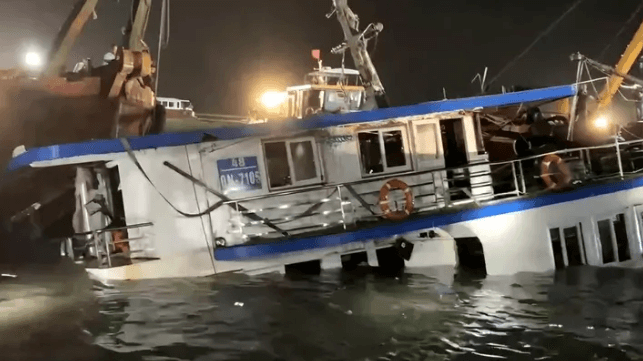
Salvors right the Wonder Seas with crane barges (Courtesy Vietnam People's Navy)

Published Jul 20, 2025 4:34 PM by The Maritime Executive


Dozens of passengers have died in the capsizing of a passenger vessel in Ha Long Bay, an area east of Haiphong which is world-famous for its towering islands.

Ha Long Bay has a thriving tourism industry, and millions of visitors come to the area every year. On Saturday, one of the many tourist boats that operate in the region - the Wonder Seas - was under way on a routine sightseeing excursion. The majority of the ticket-holders were local families from Hanoi, and about 20 passengers were children. At about 1530 hours, a sudden thunderstorm swept in with high winds and heavy rain, capsizing the vessel, according to local police. 

Foul weather complicated the initial response, but nearly 30 vessels responded to the scene, along with a team of rescue divers. The official numbers for victims and survivors have fluctuated over the course of the ongoing response effort, a reality of a rapidly-unfolding emergency situation. As of Sunday, local Vietnamese sources reported that 37 people were confirmed dead, including at least eight children; five more individuals were still missing, and 10 people have been rescued alive. At least two survivors had to swim out of the submerged vessel to reach the surface, indicating a rapid capsizing with limited time for passenger evacuation. One other survivor was found by divers inside an air pocket within the upturned hull. 

The vessel has been righted, dewatered and towed back to shore for examination. Search operations continue, with backing from Vietnam's military and on-scene oversight from Deputy Prime Minister Tran Hong Ha. National authorities have promised a thorough investigation of the circumstances of the casualty. 

"[Prime Minister Pham Minh Chinh] extended his heartfelt sympathies to those affected and expressed deep condolences to the families of those who lost their lives," state media outlet Vietnam News Agency said in an urgent bulletin. 


Ferry Fire Kills At Least Three off Sulawesi

Barcelona V
Via Indonesian social media

Published Jul 20, 2025 2:10 PM by The Maritime Executive


On Sunday, a major fire broke out aboard a ferry off the coast of Sulawesi, forcing the passengers and crew to abandon ship into the water. 

At about 1200-1300 hours, a blaze broke out in the upper decks of the ferry Barcelona V as it transited off the coast of Talisei Island, en route to Manado City on the far northeastern tip of Sulawesi. The passengers evacuated onto the weather decks as the fire spread through the interior, then - as the flames approached - abandoned ship over the side. Video from the scene shows the vessel's liferafts still in their cradles and hundreds of people in the water. 

The Indonesian Navy, Maritime Security Agency (Baklama), good Samaritan vessels and local SAR assets responded to the scene. 280 passengers were rescued by first responders, the commander of a nearby naval station told Antara. Three of those individuals died during the abandon-ship process. One of the deceased was a pregnant woman, according to the Manado Search and Rescue office. 

The fire burned through the vessel's topsides and was extinguished later that day. Rescuers are searching the wreckage of the ship to see if there are any remains of further personnel.


Ferry casualties are not uncommon in Indonesia, where the population relies heavily on passenger vessels for transportation among the archipelagic nation's countless islands. A large domestic fleet and less stringent safety standards combine to create elevated numbers of incidents. Earlier this month, a local ferry went down off Bali in rough weather, claiming 16 lives. 


Strikes Grow as Wage Talks Drag on for Korean Shipbuilders

Korean metal workers strike
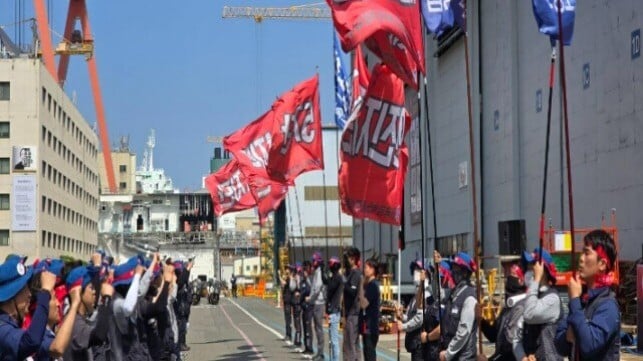
Strikes over wages are growing at South Korea's shipbuilders (Korean Metal Workers)

Published Jul 18, 2025 1:53 PM by The Maritime Executive


The Korean Metal Workers’ Union reports it is expanding its strike actions against the shipbuilding sector during this year’s round of wage talks. The union says that HD Hyundai management had promised to quickly conclude the negotiations and advance the company to the next level with a future-oriented labor-management culture, but after 12 rounds, the time left is now running out.

Partial strikes began this week at HD Hyundai Heavy Industries with a four-hour stoppage on July 16 and seven hours on July 17. Today, on the third consecutive day, the union was planning a full stoppage, and the strike was also spreading to the HD Hyundai Samho yard and Hanwha Ocean, where they planned a four-hour stoppage.

Union members have now authorized strikes at three of Hyundai’s yards, HD Hyundai Heavy Industries, Mipo, and Samho, and the leadership reports it will also expand the strike to the R&D Center in Seongnam. Members at Hanwha Ocean and K Shipbuilding have also voted to support strikes.

Adding to the drama, one of the union branch managers is staging a hunger strike in front of the R&D Center. Baek Ho-seon has been on a hunger strike for 10 days, taking only water and salt.

The union says HD Hyundai presented its proposal on July 9, but it was rejected with the union saying it was far lower than expected. The company proposed a smaller increase in base wages and what it says is the largest ever increase in the incentive and performance pay packages. The union is demanding an increase in basic pay instead of variable pay, as well as an extension of the retirement age and a change in how the performance pay is calculated. Media reports are that they are also demanding more hiring of employees versus contractors.

According to the union leaders, the shipyards are citing the increased competition from the Chinese shipbuilders. They said the shipyards are emphasizing a "sense of crisis due to the situation in which China, which has closely followed Korea in the shipbuilding industry orders and technology, is sweeping away sales and the consolidation of Chinese shipyards equipped with technological development and the latest facilities."

South Korea’s shipbuilders have built large backlogs in the past few years, but also note that China has grown its market share. The Koreans have been focusing on high-value ships and new technologies such as automation and navigation, as well as new sectors such as ammonia-fueled vessels.

The Metal Workers Union has scheduled additional strikes for next week. They are calling for seven-hour stoppages for the day shifts between 9 and 5 on July 22, 23, and 26. They are also calling for a resolution of the contract for the annual summer leave begins.

From Minerals To Microchips: What Taiwan Can Learn From Ukraine – Analysis


By 

By Yen-ting Lin


In May 2025, Ukraine signed a $60 billion critical minerals agreement with the United States—an investment framework celebrated as a landmark in bilateral cooperation. Yet, this deal was forged only after two years of war, a 29% GDP contraction, and the loss of industrial territories holding over 30% of the world’s titanium and rare earths. Long recognized for their importance in aerospace, defense, and clean energy, these resources became bargaining assets only after immense national sacrifice and the failure of deterrence.

Taiwan, meanwhile, occupies a pivotal role in the global semiconductor supply chain, producing over 90% of the world’s advanced chips under 10 nanometers and contributing more than $70 billion annually through firms like TSMC, MediaTek, and UMC. These semiconductors power artificial intelligence, precision weapons, and cutting-edge computing. Yet Taiwan faces mounting pressure from the People’s Republic of China, whose military doctrineincreasingly signals 2027 as a potential flashpoint for unification by force.

Despite over $50 billion in Taiwanese-led investments in the United States, Japan, and Germany—spanning fabs from Arizona to Dresden—Taiwan remains outside formal military alliances like NATO and without a bilateral defense treaty. The Taiwan Relations Act provides strategic ambiguity but no explicit defense guarantee, leaving the island vulnerable to coercion.

This juxtaposition raises urgent questions: How can Taiwan ensure its semiconductor dominance translates into binding security guarantees? What lessons can it draw from Ukraine’s reactive resource diplomacy to avoid similar costs? And how can Taiwan’s strategic interdependence with the United States and its allies be leveraged to deter aggression without eroding its “silicon shield”?

Comparative Strategic Leverage: Taiwan and Ukraine

Taiwan and Ukraine, despite their geographic and cultural differences, share a critical similarity: control over globally indispensable resources. Taiwan dominates the production of advanced semiconductors. Ukraine, by contrast, holds approximately 30% of the world’s titanium reserves and 20% of rare earth deposits—essential for clean energy, aerospace, and military applications. However, the geopolitical contexts in which these nations operate diverge sharply.


Ukraine leverages its status as a UN member and European Union candidate to secure support through frameworks like the IMF and NATO’s Partnership for Peace. Taiwan, by contrast, is diplomatically recognized by only 11 nations and excluded from multilateral institutions, operating in near-total isolation. Its security rests on economic indispensability and strategic partnerships, particularly with the United States.

Ukraine’s experience underscores Taiwan’s vulnerabilities. Only after a 29% GDP contraction and the loss of key industrial territories did Ukraine secure a $60 billion minerals deal with the U.S. and sustained military aid from NATO-aligned countries. Taiwan, however, faces the immediate threat of a 2,000-missile barrage from the PLA, capable of disabling critical semiconductor fabs in under 21 minutes and severing global chip supply chains. Unlike Ukraine’s extractive resources, which can be relocated or exploited over time, Taiwan’s semiconductor production relies on irreplaceable Dutch ASML lithography machines and a highly specialized workforce, making it uniquely vulnerable to disruption.

Adding complexity is Taiwan’s economic interdependence with China. In 2024, 35% of Taiwan’s semiconductor revenue came from Chinese clients, creating a precarious duality of strength and vulnerability. In contrast, Ukraine’s integration with European markets aligns seamlessly with its Western geopolitical trajectory. Taiwan’s exclusion from institutional frameworks such as the IMF and NATO deepens its isolation and limits its ability to secure international support in a crisis.

While Ukraine benefits from symbolic gestures, such as the Pope’s prayers and alignment with Western narratives, Taiwan must rely on its economic contributions and technological indispensability. Its $165 billion in overseas semiconductor investments, aimed at embedding the island in allied economies, risks becoming sunk costs without binding security guarantees. The lessons from Ukraine are clear: reliance on reactive diplomacy risks devastation. Taiwan must act preemptively to translate its semiconductor dominance into binding alliances, institutional guarantees, and strengthened readiness.

US-Taiwan Relations: Semiconductor Leverage and the Risk of Strategic Overexpectation

Taiwan’s relationship with the United States is central to its security and survival but rests on fragile verbal assurances rather than binding commitments. The Taiwan Relations Act offers strategic ambiguity, not explicit guarantees, leaving Taiwan dependent on promises that lack enforceable clarity. This dependence has fostered what scholars term “overexpectation”—the belief that economic interdependence and arms sales ensure US intervention in a crisis. In reality, without formal treaties or security compacts, Taiwan’s defense relies more on hope than certainty.

The U.S. supplies nearly all of Taiwan’s advanced weaponry, but this dependency exposes systemic vulnerabilities. Delayed deliveries and maintenance backlogs of critical systems, including Stinger missiles and F-16 fighters, limitTaiwan’s ability to deter or withstand a major assault. Unlike US allies with diversified procurement options, Taiwan’s exclusion from international alliances exacerbates this reliance, leaving it unable to access alternative defense suppliers.

Taiwan’s mutual-billion in semiconductor investments in Arizona, Kumamoto, and Dresden aim to strengthen economic ties, but they also present a strategic dilemma. Offshoring production risks weakening Taiwan’s “silicon shield” — the strategic indispensability that ties its survival to global supply chains. At the same time, retaining most production on the island frustrates allies seeking risk diversification. This paradox underscores Taiwan’s precarious balance: its indispensability sustains its relevance, but over-dependence on US support threatens its leverage.

The semiconductor industry also highlights Taiwan’s central role in a fragile global ecosystem. Advanced chip production depends on irreplaceable Dutch ASML lithography machines, Japanese photoresists, and Taiwan’s highly specialized workforce—none of which can be quickly replicated elsewhere. A PLA blockade could cost the global economy $1.6 trillion within six months, yet US commitments remain cautious, falling short of the formal guarantees Taiwan needs.

Taiwan’s experience with the United States reveals a painful reality: verbal assurances and economic interdependence are no substitute for formalized security. To avoid the pitfalls of overexpectation, Taiwan must demand stronger alignment between its economic investments and defense commitments while safeguarding its semiconductor leverage. Binding bilateral agreements, enhanced military resilience, and recalibrated expectations are essential to navigating the harsh realities of strategic ambiguity.

From Delay to Deterrence: Strategic Imperatives for Taiwan’s Survival

Taiwan’s semiconductor industry is its greatest strategic asset, but this indispensability has not yet translated into tangible security guarantees. Chinese military doctrine points to 2027 as a critical decision point for potential unification by force, underscoring the urgency for Taiwan to act decisively and transform its semiconductor dominance into a durable strategic advantage.

First, Taiwan must reframe its mutual-billion in TSMC-led overseas investments in Arizona, Kumamoto, and Dresden as geopolitical collateral. These fabs should be formalized as “chip embassies” embedded in allied territories, triggering automatic responses under threat scenarios. Such institutionalization strengthens alliances and aligns Taiwan’s survival with the interests of its partners, ensuring that its contributions are more than economic.

Second, Taiwan must amplify its global stakes by highlighting the catastrophic consequences of a disruption in chip production. Outreach to governments and corporations should emphasize that a blockade could cost the global economy $1.6 trillion within six months, underscoring Taiwan’s irreplaceable role. This approach can drive international commitment to Taiwan’s security through economic interdependence.

Third, Taiwan should leverage its semiconductor expertise to engage with non-state actors like global corporations and research institutions. Collaborations with entities in Japan, the Netherlands, and the United States—particularly in areas like advanced lithography and production diversification—enhance Taiwan’s technological edge while reinforcing its position as a critical player in the semiconductor ecosystem.

Finally, Taiwan must maximize its participation in international coalitions where statehood is not a requirement. As a leader in semiconductor innovation, Taiwan can position itself as an essential actor in technical standard-setting bodies and industry-specific alliances. This strategy enhances Taiwan’s visibility and influence while sidestepping its exclusion from formal international organizations.

Taiwan’s assumption that its indispensability will automatically trigger allied intervention is a dangerous overestimation. By constructing a strategic architecture of non-state engagement, geopolitical investments, and chip diplomacy, Taiwan can secure its survival without overreliance on verbal assurances. Waiting for a crisis to act risks negotiating from weakness, not strength.

Is Taiwan Ready?

Taiwan’s dominance in semiconductors secures its role as an economic powerhouse, but strategic assets alone will not guarantee survival. Overreliance on the United States and the misplaced belief that indispensability ensures intervention remain Taiwan’s most dangerous vulnerabilities. This is not a time for complacency.

Taiwan cannot afford to wait for a crisis to reveal the fragility of its assumptions. Unlike Ukraine, which leveraged international frameworks and deep territorial resilience, Taiwan stands as an isolated, self-governed island. It lacks the depth, alliances, and multilateral protections necessary to mobilize or endure prolonged conflict.

The reality is stark: Taiwan has time to act, but not to hesitate. It must build treaty-bound guarantees, fortify its domestic resilience, and leverage its indispensability into binding commitments from allies. Without these actions, Taiwan risks facing its defining crisis alone.

The world depends on Taiwan’s semiconductors, but Taiwan’s survival must depend on more than faith in external intervention. The real challenge is not proving Taiwan’s importance to the world—it is ensuring that importance translates into security before the window closes.

  • The views expressed in this article belong to the author(s) alone and do not necessarily reflect those of Geopoliticalmonitor.com.
Geopolitical Monitor

Geopoliticalmonitor.com is an open-source intelligence collection and forecasting service, providing research, analysis and up to date coverage on situations and events that have a substantive impact on political, military and economic affairs.

SYRIA

Al-Sharaa: True Or False? – OpEd


By 

Ahmed al-Sharaa, the interim President of Syria, has the world guessing.  Is he the Sunni jihadist leader of an Islamic militia with historic ties to al-Qaeda, planning to covert Syria into a autocratic Islamist state governed by strict Sharia law?  Or has he reinvented himself as a democratic leader in the making, determined to transform Syria into a unified, inclusive, prosperous nation pledged to maintain freedom of opinion and expression, at peace with itself and the region?


With US President Donald Trump’s recent description of him as a “young, attractive guy,” his optimism about Sharaa having “a real shot at holding it together,” and his decision to lift US sanctions on Syria, the balance would seem to be shifting in Sharaa’s favor.  Even so, for the moment Sharaa remains an enigma.  The transformation from what he was, to what he seems to aspire to become, has been too sudden to convince many of its authenticity. 

Ten years ago Sharaa was leading a fighting militia closely tied to al-Qaeda.  In March 2015, under his nom de guerre of Abu Mohammad al-Jolani, he participated in the onslaught on the governorate of Idlib in north-western Syria.  After a week or so of fighting, the Islamist coalition captured Idlib city from Syrian government forces, and took control of the region.

By early 2019 Jolani’s militia, Hay’at Tahrir al-Sham (HTS), had became the de facto ruler of the entire Idlib governorate and surrounding areas, in defiance of the regime of Bashar al-Assad, Syria’s then-president.

There Sharaa ruled for nearly six years.  Compared to other parts of war-torn Syria, Idlib under HTS was seen by some as relatively stable and orderly, especially in areas like traffic control, civil policing, and municipal services. They ran courts, managed utilities, and collected taxes. NGOs reported that basic services were functional, even amid war and airstrikes.

The downside was that HTS was widely criticized for cracking down on rival factions, activists, journalists, and protesters.  Arrests, disappearances, and suppression of free expression were common.  The legal system was based on Islamic law, and critics noted it lacked transparency, with harsh sentences and little recourse for appeal.


In the first days of December 2024 a convergence of strategic, political, and military factors created a unique opportunity for Sharaa to take action. The previous month his HTS had captured Aleppo, the large governorate to the east of Idlib.  Its fall had exposed the Assad regime’s weakening grip on power.  Assad’s unsuccessful appeal for Russian military assistance further underscored the regime’s growing isolation and vulnerability.

So Sharaa seized the day.  Leading his highly trained HTS, he swept down from the north, easily trounced Syrian government forces, and in a matter of days captured Damascus and overthrew the regime of Bashir al-Assad.

On December 8, 2024 then-prime minister, Mohammad Ghazi al-Jalali, announced a transitional arrangement for the governance of Syria. Sharaa would assume the leadership as head of the New Syrian Administration.  Subsequently, on January 29, during the Syrian Revolution Victory Conference in Damascus, the Syrian General Command formally appointed Sharaa as president of Syria for the transitional period. 

On Sunday, July 13 members of a Bedouin tribe attacked and robbed a Druze man on the main highway in Syria’s Suwayda province. Suwayda was a tinder-box ready to be ignited. The memory was still raw of the deadly confrontations between Druze residents and Sunni Bedouin armed groups that occurred between April 28 and May 2 – all due to a fake audio clip – and the heavy-handed intervention by Syrian government forces which carried out so-called extrajudicial “field executions” of 19 Druze civilians.  More than 100 Druze were killed in the subsequent fighting. 

During the outbreak of sectarian violence in Suwayda on July 13 more than two hundred people were killed.  Over the next few days militias affiliated with the new regime in Damascus attacked members of the Druze community.  As the violence spread, Syrian military forces entered the region.  In Israel members of the Druze minority organized demonstrations, demanding that the government act immediately to protect their co-religionists across the border.

Israel lived up to its promise.  It mounted air strikes, targeting Syrian tanks moving south from Damascus, as well as other Syrian Army vehicles and an airfield in southwestern Syria. 

The same day, Syria’s defense minister, Murhaf Abu Qasra, secured an agreement between the combatants – the Syrian army, Druze armed factions and Bedouin tribes – and a ceasefire was declared.  Unfortunately it soon broke down, and Israel continued its campaign by targeting key Syrian government structures in Damascus, including the Defense Ministry headquarters and areas in the vicinity of the Presidential Palace.
Efforts to reach a ceasefire in Suwayda continued and, backed by US mediation, an agreement was reached between the Syrian army and Druze factions.  Government forces began withdrawing. 

Meanwhile, on the evening of July 16, Sharaa gave a televised address to the nation.  What he said was entirely in line with what he has been asserting as his intentions from the moment he was appointed Syria’s interim president on January 29, 2025.

His first major decision had been to suspend the Assad-era constitution.  In his six months as interim president he has overseen the drafting of an interim constitution for a five-year transition period.  This document commits the nation’s governance to unity and inclusivity, explicitly pledges to maintain freedom of opinion and expression, and establishes a People’s Committee to function as an interim parliament.   

He seems to have made every effort to distance himself from his al-Qaeda roots, and to present a moderate and pragmatic image.  In public statements he has emphasized his intention to protect minorities and transform Syria into a pluralist state.  

In speaking to the Syrian people on July 16, Sharaa asserted the nation’s sovereignty, but nevertheless praised mediation from foreign sources.  In line with his declared aim of national unity and the protection of minorities, he said: “We are keen on holding accountable those who transgressed and abused our Druze people, as they are under the protection and responsibility of the state.”  

In a statement virtually seeking conciliation with Israel, he said that the nation did not fear war, “but we have put the interests of the Syrians before chaos and destruction.”

Before the recent upsurge of violence, several pointers had suggested possible Israel-Syria reconciliation.    

For example, on April 18 Congressman Cory Mills held a 90minute meeting with Sharaa in Damascus during which, Mills reported, Sharaa expressed openness to normalizing relations with Israel, stating Syria could consider joining the Abraham Accords under the right conditions.

Then, during Sharaa’s visit to French President Emmanuel Macron on May 7, both leaders confirmed that Syria has held indirect talks with Israel through mediators.  Sharaa expressed openness to “technical discussions” with Israel.

There is no doubt that the tenor of remarks by Sharaa from the start of his governance seem to favor conciliation toward Israel. They suggest a potential openness to the principles of regional normalization and cooperation embodied in the Abraham Accords.  If he eventually delivers the inclusive, unified, well-governed state that he promises, he will have disproved those who currently regard him with suspicion and believe that he can never rid himself of his Al-Qaeda past.


Neville Teller

Neville Teller's latest book is ""Trump and the Holy Land: 2016-2020". He has written about the Middle East for more than 30 years, has published five books on the subject, and blogs at "A Mid-East Journal". Born in London and a graduate of Oxford University, he is also a long-time dramatist, writer and abridger for BBC radio and for the UK audiobook industry. He was made an MBE in the Queen's Birthday Honours, 2006 "for services to broadcasting and to drama."