Monday, July 21, 2025

WHITE RACISM IS ANTI DEI, ANTI WOKE

Trump threatens to hold up stadium deal if Washington Commanders don't switch back to Redskins


Published : July 21, 2025 
Korea Herald

US President Donald Trump (center right), alongside Washington Commanders owner Josh Harris (left), National Football League Commissioner Roger Goodell (center left), and Secretary of the Interior Doug Burgum, announces that Washington will host the 2027 NFL draft in the Oval Office of the White House, in Washington, May 5. EPA-Yonhap

CLEVELAND (AP) — President Donald Trump is threatening to hold up a new stadium deal for Washington's NFL team if it does not restore its old name of the Redskins, which was considered offensive to Native Americans.

Trump also said Sunday that he wants Cleveland's baseball team to revert to its former name, the Indians, saying there was a "big clamoring for this" as well.

The Washington Commanders and Cleveland Guardians have had their current names since the 2022 seasons and both have said they have no plans to change them back.

Trump said the Washington football team would be "much more valuable" if it restored its old name.

"I may put a restriction on them that if they don't change the name back to the original 'Washington Redskins,' and get rid of the ridiculous moniker, 'Washington Commanders,' I won't make a deal for them to build a Stadium in Washington," Trump said on his social media site.

His latest interest in changing the name reflects his broader effort to roll back changes that followed a national debate on cultural sensitivity and racial justice. The team announced it would drop the Redskins name and the Indian head logo in 2020 during a broader reckoning with systemic racism and police brutality.

The Commanders and the District of Columbia government announced a deal earlier this year to build a new home for the football team at the site the old RFK Stadium, the place the franchise called home for more than three decades.

Trump's ability to hold up the deal remains to be seen. President Joe Biden signed a bill in January that transferred the land from the federal government to the District of Columbia.

The provision was part of a short-term spending bill passed by Congress in December. While Washington residents elect a mayor, a city council and commissioners to run day-to-day operations, Congress maintains control of the city's budget.

Josh Harris, whose group bought the Commanders from former owner Dan Snyder in 2023, said earlier this year the name was here to stay. Not long after taking over, Harris quieted speculation about going back to Redskins, saying that would not happen. The team did not immediately respond to a request for comment following Trump's statement.

The Washington team started in Boston as the Redskins in 1933 before moving to the nation's capital four years later.

The Cleveland Guardians' president of baseball operations, Chris Antonetti, indicated before Sunday's game against the Athletics that there weren't any plans to revisit the name change.

"We understand there are different perspectives on the decision we made a few years ago, but obviously it's a decision we made. We've got the opportunity to build a brand as the Guardians over the last four years and are excited about the future that's in front of us," he said.

Cleveland announced in December 2020 it would drop Indians. It announced the switch to Guardians in July 2021. In 2018, the team phased out "Chief Wahoo" as its primary logo.

The name changes had their share of supporters and critics as part of the national discussions about logos and names considered racist.

Trump posted Sunday afternoon that "The Owner of the Cleveland Baseball Team, Matt Dolan, who is very political, has lost three Elections in a row because of that ridiculous name change. What he doesn't understand is that if he changed the name back to the Cleveland Indians, he might actually win an Election. Indians are being treated very unfairly. MAKE INDIANS GREAT AGAIN (MIGA)!"

Matt Dolan, the son of the late Larry Dolan, no longer has a role with the Guardians. He ran the team's charity endeavors until 2016.

Matt Dolan was a candidate in the Ohio US Senate elections in 2022 and '24, but lost.

Washington and Cleveland share another thing in common. David Blitzer is a member of Harris' ownership group with the Commanders and holds a minority stake in the Guardians.


khnews@heraldcorp.com
'BANZI'

'Japanese First' party emerges as election force with tough immigration talk
]

Sanseito party supporters raise their fists during the Sanseito's election campaign tour, on the last day of campaigning for the July 20 upper house election, at Shiba Park in Tokyo, Japan, on July 19, 2025.
PHOTO: Reuters file


July 20, 2025 

TOKYO - The fringe far-right Sanseito party emerged as one of the biggest winners in Japan's upper house election on Sunday (July 20), gaining support with warnings of a "silent invasion" of immigrants, and pledges for tax cuts and welfare spending.

Birthed on YouTube during the Covid-19 pandemic spreading conspiracy theories about vaccinations and a cabal of global elites, the party broke into mainstream politics with its "Japanese First" campaign.

The party won 14 seats adding to the single lawmaker it secured in the 248-seat chamber three years ago. It has only three seats in the more powerful lower house.

"The phrase Japanese First was meant to express rebuilding Japanese people's livelihoods by resisting globalism. I am not saying that we should completely ban foreigners or that every foreigner should get out of Japan," Sohei Kamiya, the party's 47-year-old leader, said in an interview with local broadcaster Nippon Television after the election.

Prime Minister Shigeru Ishiba's Liberal Democratic Party and its coalition partner Komeito lost their majority in the upper house, leaving them further beholden to opposition support following a lower house defeat in October.

"Sanseito has become the talk of the town, and particularly here in America, because of the whole populist and anti-foreign sentiment. It's more of a weakness of the LDP and Ishiba than anything else," said Joshua Walker, head of the US non-profit Japan Society.

In polling ahead of Sunday's election, 29 per cent of voters told NHK that social security and a declining birthrate were their biggest concern. A total of 28 per cent said they worried about rising rice prices, which have doubled in the past year. Immigration was in joint fifth place with seven per cent of respondents pointing to it.

"We were criticised as being xenophobic and discriminatory. The public came to understand that the media was wrong and Sanseito was right," Kamiya said.

Kamiya's message grabbed voters frustrated with a weak economy and currency that has lured tourists in record numbers in recent years, further driving up prices that Japanese can ill afford, political analysts say.

Japan's fast-ageing society has also seen foreign-born residents hit a record of about 3.8 million last year, though that is just three per cent of the total population, a fraction of the corresponding proportion in the United States and Europe.
Japan's Sanseito party leader Sohei Kamiya speaks to the members of the media on the day of upper house election, at the party's headquarters in Tokyo, Japan, on July 20, 2025. PHOTO: Reuters
Inspired by Trump

Kamiya, a former supermarket manager and English teacher, told Reuters before the election that he had drawn inspiration from US President Donald Trump's "bold political style".

He has also drawn comparisons with Germany's AfD and Reform UK although right-wing populist policies have yet to take root in Japan as they have in Europe and the United States.

Post-election, Kamiya said he plans to follow the example of Europe's emerging populist parties by building alliances with other small parties rather than work with an LDP administration, which has ruled for most of Japan's postwar history.

Sanseito's focus on immigration has already shifted Japan's politics to the right. Just days before the vote, Ishiba's administration announced a new government taskforce to fight "crimes and disorderly conduct" by foreign nationals and his party has promised a target of "zero illegal foreigners".

Kamiya, who won the party's first seat in 2022 after gaining notoriety for appearing to call for Japan's emperor to take concubines, has tried to tone down some controversial ideas formerly embraced by the party.

During the campaign, Kamiya, however, faced a backlash for branding gender equality policies a mistake that encourage women to work and keep them from having children.

To soften what he said was his "hot-blooded" image and to broaden support beyond the men in their twenties and thirties that form the core of Sanseito's support, Kamiya fielded a raft of female candidates on Sunday.

Those included the single-named singer Saya, who clinched a seat in Tokyo.

Like other opposition parties, Sanseito called for tax cuts and an increase in child benefits, policies that led investors to fret about Japan's fiscal health and massive debt pile, but unlike them it has a far bigger online presence from where it can attack Japan's political establishment.

Its YouTube channel has 400,000 followers, more than any other party on the platform and three times that of the LDP, according to socialcounts.org.

Sanseito's upper house breakthrough, Kamiya said, is just the beginning.

"We are gradually increasing our numbers and living up to people's expectations. By building a solid organisation and securing 50 or 60 seats, I believe our policies will finally become reality," he said.

Ishiba's coalition loses majority in Japan's upper house election


Published : July 21, 2025 -

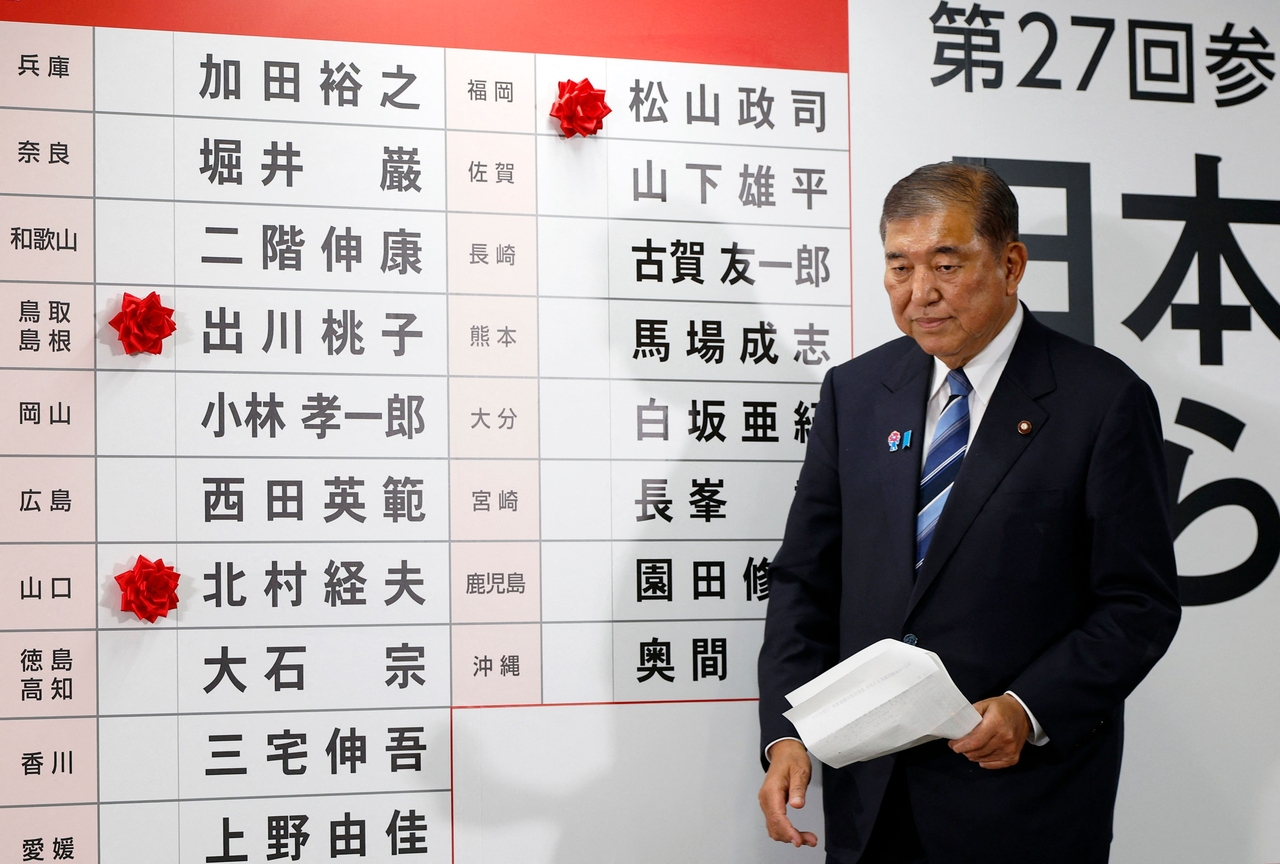
Japan's Prime Minister Shigeru Ishiba walks after addressing the media at the vote counting center in the Liberal Democratic Party headquarters in Tokyo on Sunday. AFP-Yonhap

TOKYO (AP) — Japanese Prime Minister Shigeru Ishiba’s ruling coalition failed Monday to secure a majority in the 248-seat upper house in a crucial parliamentary election, NHK public television said.

Ishiba’s Liberal Democratic Party and its junior coalition partner Komeito needed to win 50 seats on top of the 75 seats they already have to retain their majority. With just one more seat to be decided, the coalition had 47 seats.

The loss is another blow to Ishiba’s coalition, making it a minority in both houses following its October defeat in the lower house election, and worsening Japan’s political instability. It was the first time the LDP has lost a majority in both houses of parliament since the party’s foundation in 1955.

Despite the loss, Ishiba expressed determination to stay on and not create a political vacuum to tackle challenges such as US tariff threats, but he could face calls from within his party to step down or find another coalition partner.

“I will fulfill my responsibility as head of the No. 1 party and work for the country,” he said.

Ishiba had set the bar low, wanting a simple majority of 125 seats, which means his LDP and its Buddhist-backed junior coalition partner Komeito needed to win 50 seats. Exit poll results released seconds after the ballots closed Sunday night mostly showed a major setback for Ishiba’s coalition.

The LDP alone won 39 seats, better than most exit poll projections of 32, and still the No. 1 party in the parliament, known as the Diet. But Ishiba said the coalition’s poor showing was because his government’s measures to combat price increases had yet to reach many people.

“It’s a tough situation. I take it humbly and sincerely,” Ishiba told a live interview with NHK.

The poor performance in the election will not immediately trigger a change of government because the upper house lacks the power to file a no-confidence motion against a leader, but it will certainly deepen uncertainty over his fate and Japan’s political stability. Ishiba could face calls from within the LDP party to step down or find another coalition partner.

Soaring prices, lagging incomes and burdensome social security payments are the top issues for frustrated, cash-strapped voters. Stricter measures targeting foreign residents and visitors also emerged as a key issue, with a surging right-wing populist party leading the campaign.

Sunday’s vote comes after Ishiba’s coalition lost a majority in the October lower house election, stung by past corruption scandals, and his unpopular government has since been forced into making concessions to the opposition to get legislation through parliament. It has been unable to quickly deliver effective measures to mitigate rising prices, including Japan’s traditional staple of rice, and dwindling wages.

US President Donald Trump has added to the pressure, complaining about a lack of progress in trade negotiations and the lack of sales of US autos and American-grown rice to Japan despite a shortfall in domestic stocks of the grain. A 25 percent tariff due to take effect Aug. 1 has been another blow for Ishiba.

Ishiba resisted any compromise before the election, but the prospect of a breakthrough after the election is just as unclear because the minority government would have difficulty forming a consensus with the opposition.

Frustrated voters were rapidly turning to emerging populist parties. The eight main opposition groups, however, were too fractured to forge a common platform as a united front and gain voter support as a viable alternative.

The emerging populist party Sanseito stands out with the toughest anti-foreigner stance, with its “Japanese First” platform that proposes a new agency to handle policies related to foreigners. The party’s populist platform also includes anti-vaccine, anti-globalism and favors traditional gender roles.

Conservative opposition groups, especially the DPP and Sanseito, gained significant ground at the Liberal Democrats’ expense, while the centrist top opposition CDPJ was sluggish. The DPP quadrupled to 17 seats from four, according to interim results reported by Japanese media. Sanseito surged to 14 from just one.

DPP leader Yuichiro Tamaki said his party made saw a big gain because voters chose it "as a new alternative.” None of the opposition parties said that they were open to cooperating with the governing coalition. CDPJ leader Yoshihiko Noda told NHK that his priority is to form an alliance among the opposition. “Public opinion clearly said ‘no’ to the Ishiba government,” Noda said.

The spread of xenophobic rhetoric in the election campaign and on social media triggered protests by human rights activists and alarmed foreign residents.

The LDP has almost continuously dominated Japan’s postwar politics, contributing to its political stability and social conformity. But voters are divided between stability and change, with some voicing concern about escalating xenophobia.

Yuko Tsuji, a 43-year-old consultant who came to a polling station inside a downtown Tokyo gymnasium with her husband, said they both support LDP for stability and unity. They voted “for candidates who won’t fuel division." “If the ruling party doesn’t govern properly, the conservative base will drift toward extremes. So I voted with the hope that the ruling party would tighten things up,” she said.

Self-employed Daiichi Nasu, 57, who came to vote with his dog, said he hopes for a change toward a more inclusive and diverse society, with more open immigration and gender policies such as allowing married couples to keep separate surnames.

“That’s why I voted for the CDPJ,” he said. “I want to see progress on those fronts.”
What the West misunderstands about Iran

After decades of diplomatic whiplash, even moderates in Tehran have stopped trusting Western promises


Emad Khatami
Jul 21, 2025

When Iranian officials were preparing for the sixth round of negotiations with their U.S. counterparts over the country’s nuclear program, Israel launched a surprise military strike. Rather than condemning the attack, the United States and Europe stood by — or even applauded. The German Chancellor framed it as “the dirty work Israel is doing for all of us.” This moment only reinforced what Iranian leaders have long believed: that the world demands their surrender — and leaves them alone, at constant risk of betrayal and invasion.

Unless the West begins to understand Iranian history — and the mindset it has created among Iranian leaders — it will continue to misread Tehran’s actions. What often looks like aggression or stubbornness from the outside is, in the minds of Iranian decision-makers, an act of defense grounded in deep national memory.

For centuries, Iran has lived under the shadow of invasion, betrayal, and isolation. And every chapter of its modern history has only reinforced the same conclusion for its leaders: no matter who sits at Iran’s end of the negotiating table — be it a reformist, a moderate, or a hardliner — Iran must rely only on itself. It’s not a question of paranoia. It's a survival instinct.

This sense of siege didn’t begin in 2025 with the Israeli attacks, or even in 1980 with Saddam’s invasion. Iran has been shaped by trauma stretching back over a thousand years: Alexander the Great’s conquest of Persia in the 4th century BC, the Arab conquest in the 7th century, the Mongol invasions in the 13th century, and repeated Turkic and Central Asian assaults. In more recent centuries, it lost territory in the Russo-Persian wars and was occupied by Allied forces in both world wars, even though it had declared neutrality in both. Again and again, Iran has faced foreign troops on its soil. And each time, no one came to help.

That deep historical scar tissue explains the decisions of Iranian leaders more than any speech ever could. It’s why they see military self-reliance not as aggression, but as insurance. It’s why they view diplomacy with suspicion, and why even moderates in Tehran are hesitant to trust Western intentions.

In the contemporary era, there have been at least four major betrayals by the United States that continue to underscore Iran’s fear of foreign duplicity.

First, the 1953 coup against Prime Minister Mohammad Mossadegh, backed by the CIA and MI6. Mossadegh was democratically elected and sought to engage with the United States as a counterbalance to British colonial influence. The U.S. responded by orchestrating his overthrow, primarily to protect British oil interests.

Second, after the 9/11 attacks, Iran secretly assisted the United States in its campaign against the Taliban — providing intelligence, cooperating with anti-Taliban forces, and supporting the post-war settlement in Afghanistan. Just weeks later, it was branded part of President George W. Bush’s “Axis of Evil.

The third betrayal involves the 2015 nuclear deal, the Joint Comprehensive Plan of Action (JCPOA). Iran agreed to the strictest nuclear inspections regime in history. The International Atomic Energy Agency (IAEA) confirmed its compliance 15 times between 2016 and 2018. Yet in 2018, President Donald Trump unilaterally withdrew from the deal and reimposed crippling sanctions, more severe than those that existed before the agreement.

Fourth, the most recent and perhaps most consequential betrayal came in June 2025. After five rounds of talks between Iran’s Foreign Minister Abbas Araghchi and U.S. Special Envoy Steve Witkoff — mediated by Oman — a sixth round was scheduled. Both sides held firm positions but remained at the table. Iran sought recognition of its right to enrich uranium for peaceful purposes. The U.S. ultimately demanded zero enrichment on Iranian soil. Despite the impasse, cautious progress was being made, based on comments from both sides after each round of talks.

Then, on the morning of June 13, 2025 — just two days before the next round — Israeli forces launched an unprecedented assault on Iran, striking nuclear sites and killing civilians. Senior scientists and military commanders were among the casualties. These weren’t symbolic warning shots. They were hard, coordinated blows, timed to derail diplomacy.

But Israel didn’t act alone.

While the initial Israeli attack was unilateral, American strikes soon followed. U.S. stealth bombers dropped 30,000-pound bunker-buster bombs on Fordow and Natanz. Days earlier, President Trump called for Iran’s “unconditional surrender.” After the strikes, he publicly praised the operation, declared it a success, and warned that Iran “should make peace or face more attacks,” adding that “there are many targets left” if Iran refused to relinquish key parts of its nuclear program.

In Tehran, it’s not irrational to believe that U.S. diplomatic engagement was never intended to succeed. The negotiations had been real, but the intentions behind them now look suspect. For Iranian leaders, the lesson seemed unmistakable: the West may speak the language of dialogue, but it acts in the language of force and violence.

So, what should the West expect now?

It doesn’t matter who rules Iran. The leadership — regardless of name or face, whether wearing a crown, a turban, or a tie — shares a foundational belief: the West cannot be trusted to keep its word, honor its deals, or respect Iranian sovereignty.

This mindset long predates the Islamic Republic. Both Reza Shah and his son Mohammad Reza Shah — who came to power with at least the tacit support of Western powers — remained deeply skeptical of foreign governments and consistently questioned their intentions. That posture didn’t end with the 1979 revolution; it was only reinforced and has gained broader consensus across the political spectrum.

This doesn’t mean Iran is inflexible or incapable of negotiation. But its starting point is not trust, it’s caution. That caution has only deepened over time, especially as the West repeatedly turns to what it calls “alternatives” to diplomacy. Each time that happens, those inside Iran who oppose negotiations gain the upper hand.

This mindset may frustrate Western diplomats. But ignoring it leads to policies doomed to fail. If the West wants a different outcome with Iran, it must stop pretending it’s engaging with a blank slate. History walks into every room before a single word is spoken. And for Iran, history keeps saying the same thing: you are alone, so act accordingly.

Until that narrative is disrupted — not with airstrikes, but with sustained, credible commitments — Iran’s leaders will continue to do exactly what history taught them to do: resist.

Emad Khatami is a member of the National Committee of Etehad-e Mellat, a leading reformist party in Iran, where he chairs its Foreign Policy Committee. He holds an M.A. in Middle Eastern Studies from the University of Tehran and focuses on U.S.–Iran relations. He has written in Persian and co-authored three books on regional politics.
The views expressed by authors on Responsible Statecraft do not necessarily reflect those of the Quincy Institute or its associates.


AMERIKAN GESTAPO

ICE to target all undocumented immigrants, their employers in sweeping crackdown


Acting ICE chief Todd Lyons says agents will arrest anyone who is in US unlawfully and prosecute companies that hire them


Gizem Nisa Demir |21.07.2025 - TRT/AA


US Immigration and Customs Enforcement (ICE) will arrest anyone found living in the country unlawfully, regardless of their criminal history or lack thereof, and is ramping up enforcement against employers hiring unauthorized workers, the agency’s acting director, Todd Lyons, said Sunday.

Under orders from the Trump administration, ICE has reinstated wide-ranging immigration enforcement policies, including so-called collateral arrests — detaining non-criminal undocumented immigrants found during broader operations — which had been curtailed during the Biden era.

“What’s, again, frustrating for me is the fact that we would love to focus on these criminal aliens that are inside a jail facility,” Lyons said in an exclusive interview with CBS News.

“A local law enforcement agency, state agency already deemed that person a public safety threat and arrested them and they’re in detention.”

Lyons said the current rise in community arrests is a consequence of states and cities with sanctuary policies refusing to hand over noncitizen inmates, forcing ICE agents to go into neighborhoods.

“I’d much rather focus all of our limited resources on that...but we do have to go out into the community,” he said.

In the first half of 2025, ICE deported nearly 150,000 people, including around 70,000 with criminal convictions, many of which were minor, according to internal government data obtained by CBS News.

Lyons did not rule out reaching the administration’s target of 1 million deportations this year, citing a recent multi-billion-dollar boost in congressional funding.

“ICE is always focused on the worst of the worst,” Lyons said. “One difference you’ll see now is under this administration, we have opened up the whole aperture of the immigration portfolio.”

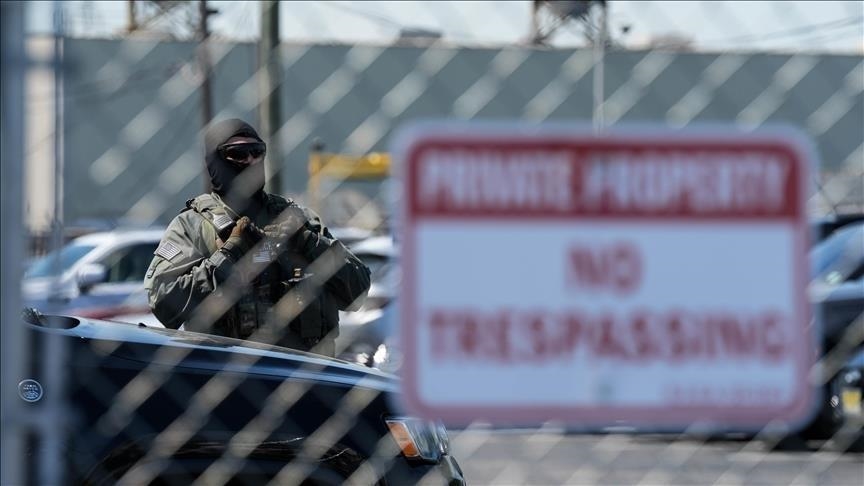
He also confirmed the agency has resumed large-scale worksite raids, including recent operations at a Nebraska meat plant, a Louisiana racetrack and California cannabis farms, where over 300 unauthorized workers were arrested, including minors.

ICE will now prioritize not only the arrest of undocumented workers but also prosecution of the companies hiring them.

“Not only are we focused on those individuals...we’re focused on these American companies that are actually exploiting these laborers,” Lyons said. When asked if employers will be held accountable, he responded: “One hundred percent.”


US citizen and veteran says immigration officials detained him for days without explanation

US citizen and Army veteran George Retes on Wednesday spoke out after being arrested during an immigration raid at his workplace on a California cannabis farm, stating that he was arrested and detained for three days without explanation.

Retes shared in a video press conference organized by the United Farm Workers (UFW) labor union that he works as a security guard at Glass House Farms in Camarillo, California. He stated that he was on his way to work when he was met by federal agents. The officers then broke his window, sprayed him with pepper spray, and dragged him out of the car. He said that two officers kneeled on his back and another one on his neck to arrest him, even though his hands were already behind his back and he was covered in pepper spray.

Retes later explained that he showed up to work when federal agents had already conducted the raid and was met with a wall of protestors in addition to federal agents. He exited his car and told the officers that he was a US citizen and that he was only there to work and not to protest. He then reentered, and the officers surrounded his car and gave conflicting orders to get out of the car, pull the car over to the side, and reverse before arresting him.

According to AP News, “Retes was taken to the Metropolitan Detention Center in downtown Los Angeles, where he said he was put in a special cell on suicide watch and checked on each day after he became emotionally distraught over his ordeal and missing his 3-year-old daughter’s birthday party Saturday.”

Retes said that federal agents did not allow him to contact a lawyer or his family or to shower or change clothes during his three-day detention, despite being covered in pepper spray and tear gas.

The Department of Homeland Security’s Assistant Secretary for Public Affairs Tricia McLaughlin issued a statement explaining his release. She said: “He has not been charged. The US Attorney’s Office is reviewing his case, along with dozens of others, for potential federal charges related to the execution of the federal search warrant in Camarillo.”

On July 10, 2025, US Immigration and Customs Enforcement (ICE) and US Customs and Border Protection (CBP) officers executed criminal warrant operations at two marijuana grow sites in Carpinteria and Camarillo. The US Department of Homeland Security stated that “at least 14 migrant children have been rescued from potential exploitation, forced labor and human trafficking. ICE has transferred 10 of the children who are unaccompanied to the US Department of Health and Human Services… Federal officers also arrested at least 361 illegal aliens from both sites.” The department stated, “During the operation, more than 500 rioters attempted to disrupt operations.”

Retes provided the following statement to UFW: 

What happened to me wasn’t just a mistake — it was a violation of my civil rights. It was excessive force… I’m speaking out…for every citizen who could’ve ended up in my place that day. I’m calling for a full investigation into the actions of ICE and other agencies involved in this operation… [T]his raid didn’t just target immigrants. It hurt Americans too. I will not stay silent. I served this country, and now I’m demanding it do right by me.

568 people survived after an Indonesian passenger ferry caught fire at sea, killing 3

Indonesian rescuers evacuating people from a passenger ferry that caught fire at sea say more than 560 were rescued and three died


ByGRACEY WAKARI
 Associated Press
July 20, 2025, 


MANADO, Indonesia -- Indonesian rescuers evacuating people from a passenger ferry that caught fire at sea said Monday more than 560 were rescued and three died.

The KM Barcelona 5 caught fire around midday Sunday while heading to Manado, the capital of North Sulawesi province, on its regular half-day journey from Melonguane port in Talaud Islands district in the same province, according to First Adm. Franky Pasuna Sihombing, chief of the Manado navy base.

A coast guard ship, six rescue vessels and several inflatable boats were deployed in the rescue operation, Sihombing said. The crews pulled many people from the sea and took them to nearby islands, and local fishermen also saved some survivors wearing life jackets as they were drifting in the choppy waters.

Photos and videos circulated on social media showed terrified passengers, mostly wearing life jackets, jumping into the sea as orange flames and black smoke billowed from the burning vessel.

The search and rescue operation was continuing, though there were no immediate reports of people still missing. Authorities previously said five people had died, but the National Search and Rescue Agency revised it to three early Monday after two passengers initially reported as dead were saved in a hospital, including a 2-month-old baby whose lungs were filled with seawater.

The fire that began in the ferry's stern was extinguished within an hour, Sihombing said. The ferry's manifest initially registered only 280 passengers and 15 crew members but the national rescue agency confirmed 568 survivors had been rescued and three bodies recovered, including a pregnant woman.

It is common for the number of passengers on a boat or ferry to differ from the manifest in Indonesia. This discrepancy can contribute to accidents and can complicate search and rescue efforts, Sihombing said.

The capacity of the ferry is 600 people.

Indonesia is an archipelago of more than 17,000 islands where ferries are a common method of travel. Disasters occur regularly, with weak safety enforcement often blamed.

A speedboat carrying 18 people capsized during a storm July 14, and all its occupants were found rescued by the next day. Earlier in the month, a ferry sank near Indonesia’s resort island of Bali, leaving at least 19 dead and 16 others missing. A two-week search operation involved more than 600 rescuers, three navy ships, 15 boats, a helicopter and divers.


___

Associated Press writer Niniek Karmini in Jakarta, Indonesia, contributed to this report.

IRAQ

Reuters reported Friday that a restart of Kurdish oil exports is not imminent


Barzani during the inauguration of the emergency water supply project in Erbil (KRG Prime Minister’s Office)

Baghdad: Fadhel al-Nashmi
21 July 2025
 AD Ù€ 26 Muharram 1447 AH

Despite weeks of intensive negotiations and multiple official visits between Baghdad and the Kurdistan Region, a final resolution to the long-standing oil and budget disputes remains elusive.

As a result, hundreds of thousands of public sector workers in Kurdistan have gone unpaid for over 75 days, deepening an already severe economic crisis.

While the Iraqi federal government announced last week that an agreement to resume oil exports through the Turkish port of Ceyhan was near, and both sides reportedly reached a “near-final” deal, tangible progress has stalled.

Reuters reported Friday that a restart of Kurdish oil exports is not imminent, citing both ongoing disputes and drone attacks on oilfields in the region that have slashed production by half.

Nevertheless, Kurdistan Regional Government (KRG) Prime Minister Masrour Barzani reiterated Sunday his administration’s readiness to hand over oil to Baghdad on one condition: that the federal government guarantees the region’s share of the national budget and secures public salaries.

Speaking at the inauguration of a new emergency water project in Erbil, Barzani demanded an end to what he described as “collective punishment” of the Kurdish people.

Addressing public criticism over local revenue use, Barzani said: “We don’t respond to irresponsible claims meant to mislead public opinion. Our projects are the real answer.”

Barzani also pushed back against Kurdish voices advocating for Baghdad to directly distribute salaries, asserting the region’s constitutional right to manage its own budget.

“We are a federal entity. Kurdistan must have its own budget, and how it is spent should be decided by its institutions and people,” he said.

Tensions have grown in recent months as some Kurdish civil servants traveled to Baghdad, demanding the federal government bypass the KRG and pay salaries directly, a move Erbil firmly rejects.

Barzani expressed frustration with Baghdad’s withdrawal from earlier agreements, despite Erbil agreeing to hand over 230,000 barrels of oil per day to the federal SOMO company, as well as 120 billion dinars in monthly revenue. He warned that recent drone strikes on oil infrastructure could impact output but should not be used as an excuse to delay payments.

The federal government counters that the KRG has failed to meet its oil transfer obligations and exceeded its allocated share of the national budget. In May, Iraq’s Finance Ministry formally warned that funding would cease, citing overpayments that exceeded Kurdistan’s legal 12.67% share.

Sunday, July 20, 2025

UK move to lower voting age sparks renewed calls from Israeli youth

'This generation matured with the country through national crises': Inspired by Britain’s decision to extend voting rights to 16-year-olds, Israeli student leaders urge similar reform ahead of national elections

Tamar Trabelsi-Hadad|07.19.25 | YNET

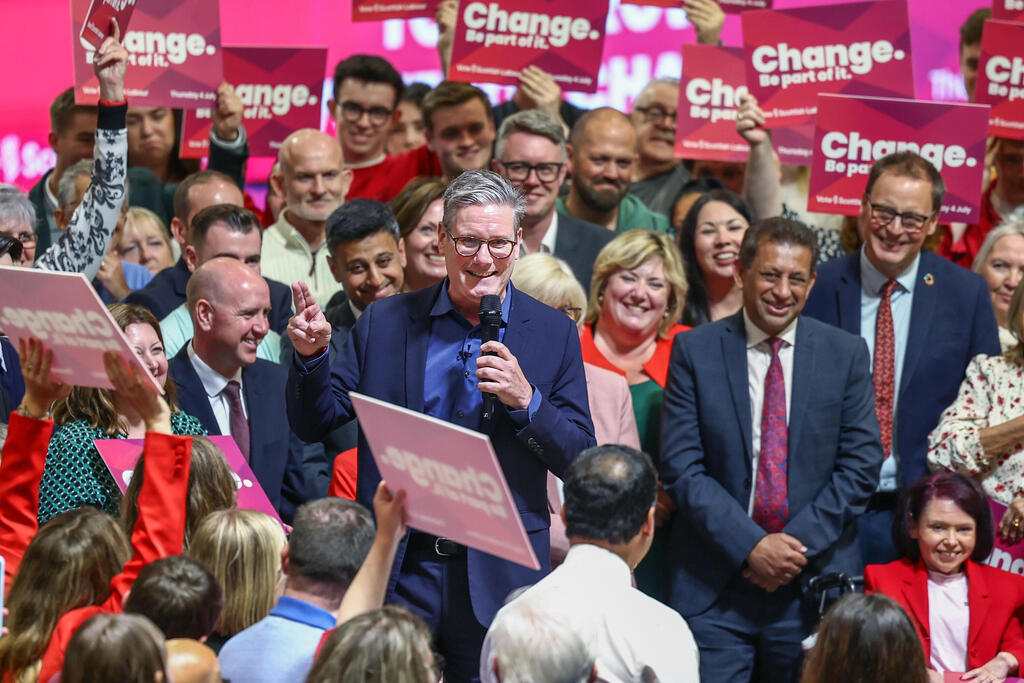
British Prime Minister Keir Starmer’s announcement this week that the voting age will be lowered to 16 has reignited calls among Israeli youth leaders for a similar move ahead of future national elections.

Starmer, citing low voter turnout in recent elections, said it was time to allow 16- and 17-year-olds to help shape their government. “I think it’s really important that 16- and 17-year-olds have the vote, because they are old enough to go out to work, they are old enough to pay taxes, so pay in," Starmer said. "And I think if you pay in, you should have the opportunity to say what you want your money spent on, which way the government should go.

 
British Prime Minister Keir Starmer
(Photo: Jeff J Mitchell / Getty Images)

The change, which still requires parliamentary approval, would expand rights already granted in Scotland and Wales, where 16- and 17-year-olds can vote in local and regional elections.

In Israel, the National Student and Youth Council has lobbied for over a decade to lower the voting age, at least in local elections, but without success. The announcement from Britain has fueled renewed optimism.

“We are citizens of this country at 16, we have duties and rights,” said outgoing Council Chair Roni Kamai, echoing Starmer’s argument. “It’s important that we are seen as an integral part of Israeli society, in elections and in public life.”

Kamai added that years of student lobbying to lower the voting age in municipal elections had already led to “significant changes” in how mayors engage with youth, especially around education policy and local needs.

“This generation matured with the country through national crises,” she said. “It’s time we are treated accordingly.”


From left to right: Yuval Dgani, Dror Cohen and Roni Kamai
(Photo: Moti Kimchi)

Dror Cohen, a high school senior from Petah Tikva and incoming chair of the national student council, said the British decision shows how political inclusion can empower youth. “It puts young people at the center of the public conversation,” he said, adding that it would help advance issues important to teens by making them visible to elected officials. “It’s a way for them to see us as the future and act for us.”
Cohen pledged that the council would continue pushing for change in the coming year. “We want to make sure that whenever people talk about youth, they talk with youth.”

Yuval Dgani, a high school senior from Haifa and incoming vice chair of the council, said political discussions already take place in schools, “but they are unstructured.” Lowering the voting age, she said, would encourage informed engagement. “It’s a way to teach teens how to conduct political dialogue and choose responsibly.”

Dgani echoed her colleagues’ hopes that a change would force politicians to take younger voices seriously. “It would help them see us, our daily concerns, our future, as a legitimate part of the decision-making process.”

Most countries set the voting age at 18. If Britain’s Parliament approves the change, the UK will join a small group of nations—including Austria, Brazil, Argentina, Cuba and Ecuador—that allow voting at 16. Some EU countries, such as Belgium, Germany and Malta, permit 16-year-olds to vote in European Parliament elections.
Jerusalem Post 
Investigation exposes X, WhatsApp as hotbeds for arms trade involving Houthis, US weapons

TTP identified 130 Yemen-based X accounts that were advertising a range of weapons, including high-powered rifles, grenade launchers, and other military-grade arms.

Protesters, mainly Houthi supporters, mark the annual al-Quds Day on the last Friday of Ramadan, in Sana'a, Yemen, March 28, 2025
(photo credit: REUTERS/KHALED ABDULLAH)

JULY 19, 2025

A recent investigation by the Tech Transparency Project (TTP) has revealed that Elon Musk’s platform X and Meta-owned WhatsApp are hosting a thriving arms trade linked to Houthi terrorists in Yemen. The investigation exposes how these tech giants are failing to enforce their own policies against weapons trafficking and undermining US national security interests.

TTP identified 130 Yemen-based X accounts that were advertising a range of weapons, including high-powered rifles, grenade launchers, and other military-grade arms. A significant portion of these accounts, over half, were based in Sana'a, Yemen’s capital, which has been under the control of the Houthi movement for over a decade. Many of the accounts displayed allegiance to the Houthis, with some even prominently featuring the Houthi emblem in their posts.
US-branded weapons found for saleAmong the weapons offered by these accounts were items clearly marked as “Property of US Govt.,” raising serious concerns about the origins of the firearms. While the accounts did not specify how they came into possession of US-branded weapons, such items have been a known source of concern, particularly following the US withdrawal from Afghanistan.

During the chaotic exit, a large amount of US-manufactured weapons were left behind, some of which have made their way into the global black market. The arms were likely being sold to fund the activities of the Houthi terrorists, who continue to pose a threat to regional stability.

The arms trade extended beyond X. TTP found that several accounts used WhatsApp or Telegram, encrypted messaging platforms, to facilitate direct communication between buyers and sellers. WhatsApp, a business communication tool owned by Meta, was actively used for arms sales, despite the platform’s stated policy prohibiting such transactions

.
A 3D-printed miniature model of Elon Musk and the X logo are seen in this illustration taken January 23, 2025 (credit: REUTERS/DADO RUVIC/ILLUSTRATION/FILE PHOTO)

Clear violation of platform policiesBoth X and WhatsApp have policies that prohibit weapons sales. However, these platforms seem to have either overlooked or failed to enforce their own guidelines. The arms trade continued openly on X, with accounts explicitly offering military-grade rifles and rocket launchers for sale.

In addition to the weapon listings, X also ran ads beneath some of the posts featuring firearms, raising further concerns. Ads from unrelated companies, such as the Conservative Political Action Conference (CPAC) and even Tesla, appeared in the comment sections of posts offering weapons for sale. This indicates that X might be generating revenue from these policy-violating posts, even though the company has publicly stated that it does not run ads alongside such content.
The role of X's business accountsMany of the arms trader accounts found on X were listed as business accounts, a feature designed to allow businesses to engage with customers. These accounts, which often had professional categories such as "Gun Store" or "Shopping & Retail," were used to promote weapons and military equipment. In total, TTP identified over 50 such accounts that had been given business classifications, some of which were apparently paying for premium services on X.

Several accounts were seen using the extended video features available to X Premium subscribers, with one showing an individual unboxing a “M249 SAW,” a light machine gun used by the US military. These accounts had access to enhanced features, such as longer video uploads and access to analytics dashboards, further blurring the line between legitimate business activity and illegal arms dealing.
Houthi-linked X accounts and their operationsAmong the X accounts involved in this trade was @yeusaf_mm, which identified itself in Arabic as a platform for buying and selling weapons. With over 2,700 followers, the account frequently posted about various weapons, including AK-47-style rifles and a Polish-made AK-47. The account shared pro-Houthi content, including videos from Houthi media and posts celebrating the movement’s military activities.

Another account, @mslslnsln1, also based in Sana'a, advertised a variety of weapons, including Soviet-made RPGs and Turkish-made M4 carbines. The profile image was a logo of a rifle, and posts frequently featured military equipment for sale, with prices and details listed. One of these posts offered AK-47s for about $1,500, indicating the type of weapons on sale and the organized nature of these illegal transactions.

The presence of US military weapons, particularly the M4 carbine, was noted by TTP. Some of the rifles were still marked with “PROPERTY OF US GOVT,” raising further questions about how these items made their way to Yemen. The M4 carbine, used by US forces, was sold alongside grenades, ballistic helmets, and night-vision goggles, with some items being offered at prices upwards of $10,000.

TTP’s findings point to a serious security risk, as these weapons could be used not only by the Houthis but also by other terrorist groups in the region, further exacerbating tensions and undermining international stability.
WhatsApp’s role in the tradeWhatsApp, owned by Meta, also played a key role in this arms trade. More than half of the Yemen-based X accounts investigated by TTP had links to WhatsApp business accounts. These WhatsApp business profiles were used to facilitate the sale of weapons, with several accounts listing their wares in product catalogs. One such account, linked to the X account @AlqhylyM, offered a range of military equipment, including rifles and accessories, and clearly indicated its location in Sana'a.

WhatsApp’s business accounts are intended to facilitate customer service and promote products, yet in this case, they were used to market weapons. Despite WhatsApp’s policy against the sale of firearms, these business accounts were able to advertise and transact openly without apparent intervention from Meta’s monitoring systems.
Meta’s failure to enforce its own policiesWhile Meta claims it cannot monitor the encrypted content of WhatsApp messages, the company does review business account profiles and images posted to catalogs. However, TTP found that several of the business accounts violated both WhatsApp’s and Meta’s broader policies on firearms sales. The failure to detect and remove these profiles and catalogs raises serious concerns about Meta’s commitment to enforcing its own rules and preventing the misuse of its platforms.

The investigation also uncovered that many of the arms traders linked their WhatsApp business accounts to Instagram or Facebook profiles, which further violated Meta’s commerce policies. Despite the platform’s prohibitions on firearm sales, these accounts were able to operate openly for months, if not longer.
X's ongoing responsibilityThe investigation into X’s role in facilitating the sale of weapons linked to the Houthis is a reminder of the challenges faced by tech companies in regulating content on their platforms. Despite having clear policies against weapons trafficking, X appears to have failed in both enforcement and detection of policy violations.

Paris unveils mural of Josephine Baker to honor her legacy

Published : July 20, 2025 -
Korea Herald

The mural of Josephine Baker in Paris, Saturday (AP-Yonhap)

PARIS (AP) — Paris is reviving the spirit of US-French entertainer and civil rights activist Josephine Baker with a new mural.

Fifty years after her death, Baker now gazes out over a diverse neighborhood of northeast Paris, thanks to urban artist FKDL and a street art festival aimed at promoting community spirit.

Born in St. Louis, Missouri, Baker became a megastar in the 1930s, especially in France, where she moved in 1925 as she sought to flee racism and segregation in the United States.

In addition to her stage fame, Baker also spied on the Nazis for the French Resistance and marched alongside Martin Luther King Jr. in Washington. She died in Paris in 1975.

"I feel moved and I feel happy, because this is part of a memory of my mother," her son Brian Baker told the Associated Press at the unveiling of the mural Saturday. He was one of 12 children Josephine Baker adopted from around the world that she called her "rainbow tribe" and what her son called "a little United Nations."

The mural of Baker, meant to symbolize freedom and resistance, is among several painted in recent days in the neighborhood and organized by the association Paris Colors Ourq.

The artist FKDL said he focuses on "bringing women back into the urban landscape."

"Josephine Baker has always been, for me, a somewhat iconic figure of that era. Both wild and free-spirited, but also deeply connected to music, musicals, and dance," he said. "She was an extraordinary character, an incredible woman."

Baker was the first Black woman inducted into France's Pantheon, joining such luminaries as philosopher Voltaire, scientist Marie Curie and writer Victor Hugo.

"My mother wouldn't have liked words like iconic, star, or celebrity. She would have said, no, no let's keep it simple," her son said.

khnews@heraldcorp.com
Azerbaijan leader says he wants Russia to admit it accidentally shot down passenger plane killing 38


People mourn at the grave of flight attendant Hokuma Aliyeva during the funeral of the crew members of Azerbaijan Airlines Flight J2-8243 that crashed near the Kazakh city of Aktau, in Baku, Azerbaijan, on Dec 29, 2024.
PHOTO: Reuters file

July 19, 2025 

KHANKENDI, Azerbaijan - Ilham Aliyev, the president of Azerbaijan, on Saturday (July 19) said he wanted Russia to publicly acknowledge that it had accidentally shot down an Azerbaijani passenger plane in December last year, killing 38 people on board, and to punish those responsible.

President Vladimir Putin apologised at the time to Aliyev for what the Kremlin called a "tragic incident" over Russia in which an Azerbaijan Airlines plane crashed after Russian air defences opened fire against Ukrainian drones.

But he stopped short of saying Russia had shot down the aircraft.

Aliyev, speaking at a news conference in the city of Khankendi during an event called The Global Media Forum, made clear that he wanted much more from Moscow whom he accused of inaction following the downing of the airliner.

"We know exactly what happened - and we can prove it. Moreover, we are confident that Russian officials also know what happened," Aliyev said.

"The real question is: Why didn't they do what any responsible neighbour should do?"

He said Azerbaijan expected the incident to be formally acknowledged, for those responsible to be held accountable, for compensation to be paid to victims' families and those injured, and for Moscow to reimburse the cost of the destroyed aircraft.

"These are standard expectations within the framework of international law and good-neighbourly relations," he said.

Flight J2-8243, en route from Baku to the Chechen capital Grozny, crash-landed near Aktau in Kazakhstan after diverting from southern Russia, where Ukrainian drones were reported to be attacking several cities. Thirty-eight people were killed and 29 survived.

Ties between Moscow and Baku have seriously deteriorated in recent months after Russian police detained a group of ethnic Azerbaijanis living in Russia and accused them of various historic crimes.

Speaking at the same event, Aliyev said he wanted a transit corridor to be opened between Azerbaijan and its exclave of Nakhchivan that would run via Armenia.

Aliyev said: "We are talking about unimpeded state access from Azerbaijan to Azerbaijan. And we understand this literally - we are talking about a connection between parts of one country."

He said that, if and when it is set up, that Azerbaijani train passengers should not be exposed to physical danger from Armenian civilians whom he accused of throwing stones at such trains in the Soviet era and called for "reliable and verifiable" security guarantees.

"This is an absolutely legal and fair demand," Aliyev said.

Armenian Prime Minister Nikol Pashinyan said on July 16 that the US had offered to manage the potential transport corridor.

The potential corridor, which Baku is keen to secure, would run roughly 32km through Armenia's southern Syunik province, linking the majority of Azerbaijan to Nakhchivan, an Azerbaijani exclave that borders Baku's ally Turkey.

The transit link is one of several stumbling blocks to a peace deal between Azerbaijan and Armenia, neighbours in the South Caucasus region who have fought a series of wars since the late 1980s and remain arch rivals.

The countries said in March they had finalised a draft peace deal, but the timeline for signing it remains uncertain.