Showing posts sorted by relevance for query RULING CLASS. Sort by date Show all posts

Sunday, October 06, 2024

Class analysis and Russian imperialism: A response to Ilya Matveev
In his interview, “Political imperialism, Putin’s Russia, and the need for a global left alternative,” Ilya Matveev suggests that Russia’s invasion of Ukraine was motivated almost entirely by Vladimir Putin’s ideological fears and concerns for his regime’s preservation. Matveev contends these actions lacked economic rationale and were driven by ideology alone. While this interpretation has some merit, it oversimplifies the structural forces at play. By focusing primarily on ideology and Putin’s personal motivations, Matveev overlooks broader class dynamics and the material interests of Russia’s capitalist class, which are crucial to understanding Russia’s post-2014 foreign policy.

Karl Marx argued that to fully grasp the actions of a state, one must first examine the economic base — specifically the interests of the ruling class. A class analysis reveals that the war is not simply the result of geopolitical fears but reflects the economic interests of Russia’s capitalist class. The invasion of Ukraine is part of a broader interplay between the capitalist logic of profit maximisation and the power logic of geopolitical control, both of which shape Russia’s imperialist ambitions.

The limitations of the individual-centric explanation

Matveev claims Russia’s post-2014 actions, including the annexation of Crimea, can be understood through Putin’s ideological fear of Western regime change. He argues: “There was no economic logic to annexing Crimea.” However, as Marx pointed out, the state functions as a tool of the ruling class, and its actions must be understood within the context of the economic system that underpins it. By focusing solely on ideology, Matveev overlooks the material interests of Russia’s political capitalists, who have profited from the annexation and the war.

Boris Kagarlitsky notes in his analysis of Russia’s peripheral imperialism that the ruling class is not simply motivated by nationalistic or ideological concerns. Crimea’s annexation is not an isolated case but part of a broader economic strategy. This strategy reflects the interests of Russia’s political capitalist class, which has exploited the war for profit opportunities, particularly in state-led projects and infrastructure development. State contracts for energy, construction, and defence activities have proliferated in the newly annexed territories, providing lucrative avenues for capital accumulation.

Economic rationale for the invasion of Ukraine

While Matveev emphasises the ideological motives behind Russia’s actions, the economic rationale is equally critical. Samir Amin has argued that imperialism is often driven by the need for capital to find new outlets for investment to counter the effects of over-accumulation in the imperialist centre. The invasion of Ukraine provided precisely these opportunities for Russia’s political capitalist class, a common ruling elite in the post-Soviet space as argued, for example, by Volodymyr Ishchenko. Being in essence “political capitalists,” the ruling class is heavily dependent on state contracts and public resources for their wealth, and additional expenditures on territorial expansion are seen as investments that open new channels for profit-making.

Military Keynesianismcharacteristic of the Russian economy in the past two years, far from depriving capitalists from their profits, has created new profitable investment opportunities. The invasion has spurred significant investments in infrastructure projects, particularly in transportation, energy, and public construction, with Russian firms benefiting from state contracts. This highlights the capitalist logic behind the war: the Russian state, controlled by the political capitalists, redirects public funds into sectors dominated by the ruling class, ensuring continued capital accumulation while at the same time counteracting the key feature of capitalism identified by Marx — the falling rate of profit. Long-term government contracts guaranteeing stable demand and profits stabilise the capitalist system.

This is even more true in the case of the military-industrial complex. The conflict has generated significant profit opportunities for Russia’s military-industrial complex, as defence spending and state contracts for military production have surged. The sheer number of recent corruption cases opened against Russian defence officials (including in the top echelons) and military suppliers gives an idea of just how much money has flooded into the military-industrial complex, overwhelming its capacity to absorb it efficiently. As vast sums of capital are funnelled into defence contracts, the opportunities for graft, kickbacks, and embezzlement multiply, revealing the system’s inability to manage such huge inflows without leakages.

These corruption scandals are not merely incidental but symptomatic of a larger problem: the saturation of the military sector with surplus capital that far exceeds its productive or strategic needs. In many ways, this mirrors Paul A Baran and Paul Sweezy’s concept of “ waste spending,” where the state directs resources into unproductive sectors as a way to stabilise the economy. Inflated prices and military spending inefficiencies become avenues for the ruling class to extract profits, even as corruption erodes the intended military objectives. This overflow of capital, rather than strengthening Russia’s military capabilities, often serves the interests of political capitalists who benefit from the bloated system.

(Of course, this is also true for the Western military-industrial complex, which is thriving on a surge of new military orders. US Senate Republican Leader Mitch McConnell publicly stated that military aid to Ukraine has allowed the US to develop cutting-edge technology that will be crucial in future global competition, especially against rivals such as Russia and China, while boosting US job creation through increased production for defence contracts.)

These factors show that, as Marx argued, the economic base — capital accumulation — is driving the superstructure, including the state’s imperialist actions. Indicators of financial returns in Russia reached their highest level in a decade in 2021 and have remained there since. Return on sales jumped from about 9% to almost 15%. Far from acting on ideological whims, the Russian ruling class is pursuing material interests through territorial expansion.
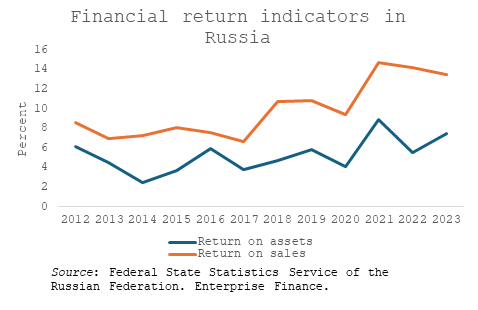
Financial return indicators in Russia

Class interests in Russia and Ukraine: A divergence in capital accumulation

To better understand Russia’s actions, it is also necessary to examine the differing patterns of capital accumulation in Russia and Ukraine, as highlighted by Ishchenko. He points to the conflict being rooted in contradictions within the Ukrainian national bourgeoisie, who are divided by their attitudes toward transnational capital: the accommodationist faction and the faction of political capitalists. I argue, however, that this division is grounded in material conditions, specifically the types of assets owned by these groups. The accommodationist faction relies on more mobile financial capital, whereas the other faction is tied to less mobile industrial capital, which is more vulnerable to competition from Western capital. Although both factions are ultimately political capitalists, given the origins of their wealth, the second group is less dependent on state patronage. This class struggle reflects broader trends in capital mobility and varying degrees of state dependency.

In Russia, rapid growth in the 2000s and early 2010s (averaging 5.2% annually between 1999 and 2014), particularly in the energy sector, generated substantial capital surpluses that needed reinvestment. But profitable investment opportunities were in short supply (save for a few extractive industries and real estate development). This explains, among other things, the huge capital flight from Russia. Russian capitalists looked to former Soviet republics, including Ukraine, as investment outlets. However, the growing presence of Western capital in these regions threatened Russian interests. Amin argued that the global expansion of imperialist powers often provokes resistance from local capitalist classes, who seek to protect their spheres of influence. The annexation of Crimea and invasion of Ukraine, therefore, reflect the Russian capitalist class’s need to protect its interests in these regions.

In contrast, Ukraine’s lower growth rates meant its financial bourgeoisie had accumulated less capital. Ukrainian capitalists, particularly those with ties to mobile financial capital, were more inclined to cooperate with Western capital, as a way to safeguard their investments. This divergence in capital accumulation patterns explains why Russia chose confrontation while Ukrainian elites sought Western integration.
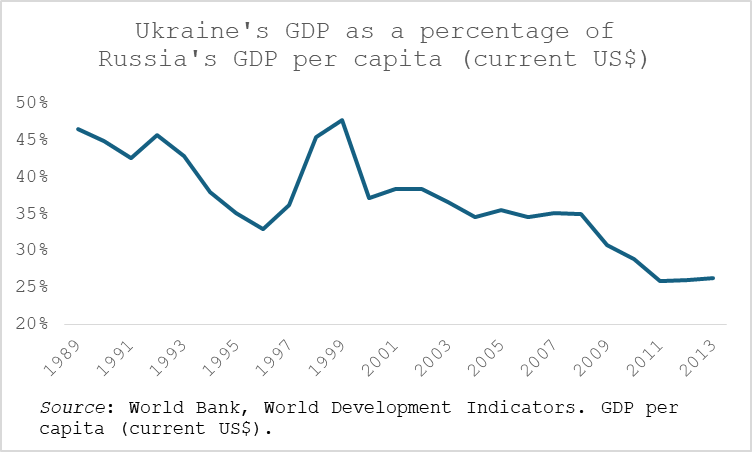
Ukraine's GDP as a percentage of Russia's GDP per capita

Russia’s rupture with the West: A class-driven decision

Matveev suggests that the rupture between Russia and the West in 2014 was driven by Putin’s ideological concerns. However, as Claudio Katz points out in his analysis of global imperialism, different forms of imperialism emerge based on the specific class configurations of each country. In Russia’s case, the rupture was not solely the result of Putin’s ideological preferences but reflected deeper class dynamics.

Before 2014, Russian and Western capitalists cooperated profitably, as Matveev acknowledges. However, Western capital’s growing influence in Ukraine and other post-Soviet states increasingly threatened Russian capital’s long-term interests. Crimea’s annexation and the full-scale invasion of Ukraine were strategic moves by the Russian ruling class to protect its dominance in the region, particularly in sectors such as energy and infrastructure, which were vulnerable to Western encroachment.

Katz argues that peripheral imperialism often arises when the local ruling class, facing competition from stronger powers, adopts more aggressive postures to defend its economic interests. Russia’s actions reflect this dynamic, as its ruling class sought to delink from the West in response to the perceived threat posed by Western capital’s expansion.

Why Russia did not continue cooperation with Western capital

Unlike the Ukrainian financial bourgeoisie, which welcomed cooperation with Western capital due to its reliance on mobile financial investments, Russian capitalists were tied to less mobile, strategic industries, such as energy and defence. Marx explained that industries dependent on immobile capital require greater state protection to secure long-term profitability. For Russian capitalists, cooperation with Western capital would have undermined their strategic industries, particularly as Western firms began to dominate sectors crucial to Russia’s economy.

Kagarlitsky has noted that Russia’s ruling class faced growing pressure to maintain state control over its key industries, especially in the face of NATO expansion and Western encroachment. Crimea’s annexation and the broader rupture with the West were therefore driven by economic concerns, not simply ideological ones. Russian capitalists, particularly those tied to energy and defence, viewed confrontation with the West as necessary to protect their economic dominance.

The dialectical interplay of capitalist and power logics

While the economic motives behind Russia’s actions in Ukraine are clear, it is essential to consider the dialectical relationship between the capitalist logic of profit maximisation and the geopolitical (or territorial) logic of state control. Giovanni Arrighi pointed out in The Long Twentieth Century that, historically, these logics have not operated in isolation but rather in relation to one another. While Matveev introduces the idea of “political imperialism” driven by territorial logic (the logic of power), it is crucial to emphasise that for Arrighi, the territorial logic is often in service to, and subordinate to, the capitalist logic. Even when geopolitical strategies seem to contradict short-term economic interests, they typically create conditions that safeguard long-term capital accumulation.

Arrighi’s analysis aligns with Lenin’s argument in Imperialism, the Highest Stage of Capitalism, where imperialist expansion is presented as a necessary outcome of capitalist development. Lenin emphasised that imperialism is driven by economic needs — particularly the search for new markets and investment opportunities as capital over-accumulates in core capitalist countries. In this sense, imperialist territorial expansion, whether by trade or conquest, is fundamentally tied to the financial logic of the ruling class. Lenin argued that the export of capital and expansion of financial control through imperialism are ways for capital to overcome domestic limitations, further illustrating how economic imperatives drive geopolitical ambitions.

In Russia’s case, the war in Ukraine exemplifies this dialectical interplay. The capitalist logic is evident in the pursuit of profit through energy control, infrastructure projects, and defence contracts. Simultaneously, the power logic manifests in Russia’s effort to maintain its geopolitical influence in the post-Soviet space. However, as Arrighi and Lenin both argue, territorial expansion is rarely an end in itself. The ultimate goal is to secure the material interests of the ruling class, ensuring access to resources and markets that are vital for continued capital accumulation. Arrighi pointed out that the main reason for European expansionist imperialism in the 18-19th century was the desire to retrieve the purchasing power that was relentlessly draining from West to East and to restore economic balance. While it may be analytically useful to speak of “political imperialism,” it should not obscure the fact that geopolitical strategies are usually subordinate to the more universal logic of capital.

The class dynamics behind Russian imperialism

Matveev’s argument that the invasion of Ukraine is primarily ideologically driven fails to account for the economic rationale driving the actions of the Russian ruling class. Marx, Amin, and Kagarlitsky have all argued that imperialism is always rooted in the material interests of the capitalist class — and the war in Ukraine is no exception. The conflict is shaped by both the capitalist logic of profit maximisation and the power logic of geopolitical control, which are dialectically interconnected.

By understanding the invasion through a class analysis, it becomes clear that the war is not simply the result of ideological fears — let alone the poorly thought-through decision of one individual, however powerful — but that it is driven by the economic interests of Russia’s political capitalists. The rupture with the West was not a spontaneous decision based on Putin’s personal ideology, but a strategic move by the ruling class to protect its long-term capital accumulation. These dynamics suggest that the conflict is unlikely to end with Putin’s departure, as the structural forces shaping Russian imperialism will continue to guide the state’s actions.

But this does not mean that ruling classes never make mistakes while pursuing what they deem is their best interests. History has proven the opposite on numerous occasions. Had the ruling class always chosen the optimal survival decision, there would have been no place for revolutions and other social upheavals. This is what Marxism is essentially about: understanding that the capitalist system is riddled with contradictions, driven by the conflict between the ruling class’s pursuit of profit and the inherent instability of capital accumulation. But we should always keep in mind what Friedrich Engels said about the complex interplay of material and ideological factors in paving the way for history:

According to the Materialist Conception of History, the factor which is in the last instance decisive in history is the production and reproduction of actual life. More than this neither Marx nor myself ever claimed. If now someone has distorted the meaning in such a way that the economic factor is the only decisive one, this man has changed the above proposition into an abstract, absurd phrase which says nothing.

In Russia’s case, while the political capitalists have strategically pursued their interests through imperialist actions, including the invasion of Ukraine, this does not guarantee long-term success or stability. The war, driven by a fusion of economic and ideological motives, could exacerbate internal tensions, fuel popular discontent, and strain Russia’s economy in unforeseen ways. As Marx pointed out, the very actions taken by the ruling class to preserve its dominance can sow the seeds of future crises — and ultimately destabilise the system they aim to uphold.

Wednesday, May 24, 2006

Bilderburger


Over 200 Billion controlled. That would be the motto of the Bilderberg Conference if this secret society of the ruling class was branded like MacDonalds, the other burger baron.

Apparently one of our favorite 'secret' ruling class conclaves will be meeting in Canada, north of Ottawa, in June.


The secretive group known as Bilderberg will hold its annual secret meeting at the posh Brook Street Resort a few miles from Ottawa, Canada, June 8-11.

The location and part of the agenda was disclosed to American Free Press by a source inside Bilderberg’s inner circle.

High on the Bilderberg’s secret agenda this year are oil prices and the political upheaval in Latin America. When meeting last year in Rottach-Egern, Germany, Bilderberg called for dramatic increases in the price of oil. Oil prices started climbing immediately from $40 a barrel to $70.

Whether Bilderberg will call for still higher prices is unclear, but Henry Kissinger and others had gleefully anticipated ultimate prices at $150 a barrel a year ago. Bilderberg is certainly concerned about supply, which is related to the “Latin American problem,” as one insider said.

Approximately 120 international leaders in politics and finance will also discuss the wars in Iraq and Afghanistan, which has caused a rare breach between American Bilderbergers and their European counterparts since the United States Iraq invasion in 2003. Whether the United States should invade Iran is also high on the agenda.
Media coverage of the Bilderberg conference is extermely limited as many of the ruling class media barons and their syncophants attend. See Aaron Bratens Open Letter to the Bilderberg Steering Committee

For more on ruling class conspiracies see: Conspiracy Theory or Ruling Class Studies

For more on the Bildgerberg Conferences

We all know of the Davos meeting of the Ruling Classes but before that there was the Bilderberg Conference. Davos too was a secret meeting till after it was exposed during the Seattle Protests, and the creation of the mass democratic
alternative World Social Forum.

When the ruling class gathers to hold its secret meetings to plan our futures we should all be worried. It proves that the Executive branch of capitalism, view democracy as only convinient if it is representative of their interests, which is why they dominate all of the political parties that vie for parlimentary power.

the bourgeoisie has at last, since the establishment of Modern Industry and of the world market, conquered for itself, in the modern representative state, exclusive political sway. The executive of the modern state is but a committee for managing the common affairs of the whole bourgeoisie. THE COMMUNIST MANIFESTO
Now those that see conspiracies everywhere might be forgiven for thinking that this meeting is coincidental with Canada's economic dominace with the petro-dollar and the election of the Conservatives, since Harper has attended previous Bilderberg Conferences.

Steven Harper and the Bilderbergers Secret Meeting : Thunderbay IMC


Your Exeutive Committee of the Canadian Ruling Class:

The ruling class has many coordinating committees, and like most corporations they share interlocking boards of directors.

Ralph Klein attended the 1995 Bilderberg meeting while floods ravished the south of the province and forest fires decimated the North. It was a good time for a trip abroad. He was invited by long standing Bilderberg Steering Committee member and international corporate criminal; Conrad Black.

Alberta is also home to members of the Trilateral Commission, another executive committee of the ruling class; Ron Southern of ATCO-Frontenac. Meetings are held at Southern's Spruce Meadows equistrian ranch in Calgary.
Bill Graham is also a member as is Allan Gotlieb The international importance of Ron Southern cannot be underestimated last year the Summit of the Americas held a closed confernce at Spruce Meadows.

The Head of the Carlyle Group is a member of the Trilateral Commission. It is well known that ex-Premier Frank Mcekenna is a member of the Carlyle Group, but so is another Ex Premier. Peter Lougheed is a member of the Carlyle Group along with the political king maker Paul Desmarais of Power Corporation.

And of course we would be remiss if we did not mention the Canadian Council of Chief Executives, the ultimate executive committee of the ruling class in Canada of which David Emerson is a prominant member as is Derek Burney.

The fact that Burney was Harpers advisor and a corporate colleague of Emerson's may have helped when Harper got Emerson tocross the floor.

Ladies and Gentlemen these are your Board of Directors of the Canadian Ruling Class.

Also See:

Bilderberg

Conspiracy Theory or Ruling Class Studies

Conspiracy Theories


Find blog posts, photos, events and more off-site about:
, , , , , , , , , , , , , , , , , , , ,

Friday, June 26, 2020

FROM THE BOOKSHELF

Theodore W. Allen’s The Invention of the White Race
By Jeffrey b. Perry


May 3, 2013


The Invention of the White Race, Vol. I: Racial Oppression and Social Control (New Expanded Edition, Verso Books, November 2012)

Theodore W. Allen’s two-volume The Invention of the White Race, republished by Verso Books in a New Expanded Edition, presents a full-scale challenge to what Allen refers to as “The Great White Assumption” – “the unquestioning, indeed unthinking acceptance of the ‘white’ identity of European-Americans of all classes as a natural attribute rather than a social construct.” Its thesis on the origin and nature of the “white race” contains the root of a new and radical approach to United States history, one that challenges master narratives taught in the media and in schools, colleges, and universities. With its equalitarian motif and emphasis on class struggle it speaks to people today who strive for change worldwide.

Allen’s original 700-pages magnum opus, already recognized as a “classic” by scholars such as Audrey Smedley, Wilson J. Moses, Nell Painter, and Gerald Horne, included extensive notes and appendices based on his twenty-plus years of primary source research. The November 2012 Verso edition adds new front and back matter, expanded indexes, and internal study guides for use by individuals, classes, and study groups. Invention is a major contribution to our historical understanding, it is meant to stand the test of time, and it can be 
expected to grow in importance in the 21st century. 

“When the first Africans arrived in Virginia in 1619, there were no ‘white’ people there; nor, according to the colonial records, would there be for another sixty years.” 

That arresting statement, printed on the back cover of the first (1994) volume, reflected the fact that, after pouring through 885 county-years of Virginia’s colonial records, Allen found “no instance of the official use of the word ‘white’ as a token of social status” prior to its appearance in a 1691 law. As he explained, “Others living in the colony at that time were English; they had been English when they left England, and naturally they and their Virginia-born children were English, they were not ‘white.’” “White identity had to be carefully taught, and it would be only after the passage of some six crucial decades” that the word “would appear as a synonym for European-American.”

Allen was not merely speaking of word usage, however. His probing research led him to conclude – based on the commonality of experience and demonstrated solidarity between African-American and European-American laboring people, the lack of a substantial intermediate buffer social control stratum, and the “indeterminate” status of African-Americans – that the “white race” was not, and could not have been, functioning in early Virginia.

It is in the context of such findings that he offers his major thesis — the “white race” was invented as a ruling class social control formation in response to labor solidarity as manifested in the later, civil war stages of Bacon's Rebellion (1676-77). To this he adds two important corollaries: 1) the ruling elite, in its own class interest, deliberately instituted a system of racial privileges to define and maintain the “white race” and 2) the consequences were not only ruinous to the interests of African-Americans, they were also “disastrous” for European-American workers, whose class interests differed fundamentally from those of the ruling elite.

In Volume I Allen offers a critical examination of the two main lines of historiography on the slavery and racism debate: the psycho-cultural approach, which he strongly criticizes; and the socio-economic approach, which he seeks to free from certain apparent weaknesses. He then proceeds to develop a definition of racial oppression in terms of social control, a definition not based on “phenotype,” or classification by complexion. In the process, he offers compelling analogies between the oppression of the Irish in Ireland (under Anglo-Norman rule and under “Protestant Ascendancy”) and white supremacist oppression of African Americans and Indians.

Allen emphasizes that maximizing profit and maintaining social control are two priority tasks of the ruling class. He describes how racial oppression is one form of ruling class response to the problem of social control and national oppression is another. The difference centers on whether the key component of the intermediate social control stratum are members of the oppressor group (racial oppression) or the oppressed group (national oppression).

With stunning international and domestic examples he shows how racial oppression (particularly in the form of religio-racial oppression) was developed and maintained by the phenotypically-similar British against the Irish Catholics in Ireland; how a phenotypically-similar Anglo bourgeoisie established national oppression in the Anglo-Caribbean and racial oppression in the continental Anglo-American plantation colonies; how racial oppression was transformed into national oppression due to ruling class social control needs in Ireland (while racial oppression was maintained in Ulster); how the same people who were victims of racial oppression in Ireland became “white American” defenders of racial oppression in the United States; and how in America racial oppression took the form of racial slavery, yet when racial slavery ended racial oppression remained and was re-constituted in new form.

In Volume II, on The Origin of Racial Oppression in Anglo-America, Allen tells the story of the invention of the “white race” in the late seventeenth- and early eighteenth-century Anglo-American plantation colonies. His primary focus is on the pattern-setting Virginia colony, and he pays special attention to the fact that England alone, of all the European colonizing powers, exported so many of its own surplus poor laboring population. He also pays particular attention to the process by which tenants and wage-laborers in the majority English labor force in Virginia were reduced to chattel bond-servants in the 1620s. In so doing, he emphasizes that this reduction was a qualitative break from the condition of laborers in England and from long established English labor law, that it was not a feudal carryover, that it was imposed under capitalism, and that it was an essential precondition of the emergence of the lifetime hereditary chattel bond-servitude imposed upon African-American laborers under the system of racial slavery.

Allen describes how, throughout much of the seventeenth century, the status of African-Americans was being fought out and he documents significant instances of labor solidarity and unrest, especially during the 1660s and 1670s. Most important is his analysis of the civil war stage of Bacon’s Rebellion when, in the final stages, "foure hundred English and Negroes in Arms" fought together demanding freedom from bondage.

It was in the period after Bacon's Rebellion, in response to class struggle, that the “white race” was invented as a ruling-class social control formation. Allen describes systematic ruling-class policies, which conferred “white race” privileges on European-Americans while imposing harsher disabilities on African-Americans resulting in a system of racial slavery, a form of racial oppression that also imposed severe racial proscriptions on free African-Americans. He emphasizes that when African-Americans were deprived of their long-held right to vote in Virginia and Governor William Gooch explained in 1735 that the Virginia Assembly had decided upon this curtailment of the franchise in order "to fix a perpetual Brand upon Free Negros & Mulattos," it was not an "unthinking decision." Rather, it was a deliberate act by the plantation bourgeoisie and was a conscious decision in the process of establishing a system of racial oppression, even though it entailed repealing an electoral principle that had existed in Virginia for more than a century.

The key to understanding racial oppression, Allen argues, is in the formation of the intermediate social control buffer stratum, which serves the interests of the ruling class. In the case of racial oppression in Virginia, any persons of discernible non-European ancestry after Bacon's Rebellion were denied a role in the social control buffer group, the bulk of which was made up of laboring-class "whites." In the Anglo-Caribbean, by contrast, under a similar Anglo- ruling elite, "mulattos" were included in the social control stratum and were promoted into middle-class status. For Allen, this was the key to understanding the difference between Virginia’s ruling-class policy of “fixing a perpetual brand” on African-Americans, and the policy of the West Indian planters of formally recognizing the middle-class status “colored” descendant and other Afro-Caribbeans who earned special merit by their service to the regime. This difference, between racial oppression and national oppression, was rooted in a number of social control-related factors, one of the most important of which was that in the West Indies there were “too few” poor and laboring-class Europeans to embody an adequate petit bourgeoisie, while in the continental colonies there were '’too many’' to be accommodated in the ranks of that class.

The references to an “unthinking decision” and “too few” poor and laboring class Europeans are consistent with Allen's repeated efforts to challenge what he considered to be the two main arguments that undermine and disarm the struggle against white supremacy in the working class: (1) the argument that white supremacism is innate, and (2) the argument that European-American workers “benefit” from “white race” privileges and that it is in their interest not to oppose them and not to oppose white supremacy. These two arguments, opposed by Allen, are related to two master historical narratives rooted in writings on the colonial period. The first argument is associated with the “unthinking decision” explanation for the development of racial slavery offered by historian Winthrop D. Jordan in his influential, White Over Black. The second argument is associated with historian Edmund S. Morgan’s similarly influential, American Slavery, American Freedom, which maintains that, as racial slavery developed, “there were too few free poor [European-Americans] on hand to matter.” Allen’s work directly challenges both the “unthinking decision” contention of Jordan and the “too few free poor” contention of Morgan. Allen convincingly argues that the “white race” privileges conferred by the ruling class on European-Americans were not only ruinous to the interests of African-Americans; they were also against the class interest of European-American workers.

The Invention of the White Race is a compelling work that re-examines centuries of history. It also offers Allen’s glimpse of “the future in the distance.” When he completed Volume II sixteen years ago, the 78-years-old Allen, in words that resonate today, ended by describing “unmistakable signs of maturing social conflict” between “the common people” and “the Titans.” He suggested that “Perhaps, in the impending . . . struggle,” influenced by the “indelible stamp of the African-American civil rights struggle of the 1960s,” the “white-skin privileges may finally come to be seen and rejected by laboring-class European-Americans as the incubus that for three centuries has paralyzed their will in defense of their class interests vis-à-vis those of the ruling class.” It was with that prospect in mind, with its profound implications for radical social change, that the independent, working class intellectual/activist  
Theodore W. Allen (1919-2005) concluded The Invention of the White Race.
https://zcomm.org/znetarticle/theodore-w-allen-s-the-invention-of-the-white-race-by-jeffrey-b-perry/


Theodore W. Allen and The Invention of the White Race - Jeffrey B. Perry

Jun 28, 2016


This slide presentation/talk on “Theodore W. Allen and ‘The Invention of the White Race’" by Jeffrey B. Perry was presented on Sat., June 18, 2016, at a "Multiracial Organizing Conference" on "Organizing Poor and Working Class Whites: The Challenge of Building a Multiracial Movement," at the Beloved Community Center, Greensboro, NC. The conference pulled together a “multiracial” group of organizers from the South, who are doing work among poor and working people, and who oppose class exploitation and oppression and emphasize the centrality of struggle against white supremacy to social change efforts. Organizer Ben Wilkins coordinated the two-day conference and other speakers included long-time activists Joyce Johnson, Rosalyn Pelles, Bob Zellner, and Al McSurely. Special thanks to Eric Preston (and Fusion Films) for his work on this video. Please share this video with others! The struggle against white supremacy is central to efforts at social change! For a 2012 video on this topic see https://www.youtube.com/watch?v=2Gq77... "When the first Africans arrived in Virginia in 1619, there were no 'white' people there; nor, according to the colonial records, would there be for another sixty years." Theodore W. Allen (Written after searching through 885 county-years of Virginia's colonial records) Allen's "The Invention of the White Race," with its focus on racial oppression and social control, is one of the twentieth-century's major contributions to historical understanding. This two-volume classic (Vol. 1: "Racial Oppression and Social Control" and Vol. 2: "The Origin of Racial Oppression in Anglo-America") details how the "white race" was invented as a ruling-class social control formation and a system of racial oppression was imposed in response to labor solidarity in the wake of Bacon's Rebellion (1676-77), how the "white race" was created and maintained through "white race" privileges conferred on laboring class European-Americans relative to African-Americans, how these privileges were not in the interest of African-Americans or laboring class European-Americans, and how the "white race" has been the principal historic guarantor of ruling-class domination in America. (See http://www.jeffreybperry.net/_center_... ) "The Invention of the White Race" presents a full-scale challenge to what Allen refers to as "The Great White Assumption" -- "the unquestioning, indeed unthinking acceptance of the 'white' identity of European-Americans of all classes as a natural attribute rather than a social construct." Its thesis on the origin and nature of the "white race" contains the root of a new and radical approach to United States history, one that challenges master narratives taught in the media and in schools, colleges, and universities. With its equalitarian motif and emphasis on class struggle it speaks to people today who strive for change worldwide. Jeffrey B. Perry contributed new introductions, back matter, internal study guides, and expanded indexes to Verso Books' new expanded edition of "The Invention of the White Race." See http://www.jeffreybperry.net/_center_... For information on Dr. Perry and his work on Hubert Harrison "the father of Harlem radicalism" (1883-1927) and Theodore W. Allen (1919-2005) see http://www.jeffreybperry.net 1) For comments by scholars and activists About “Hubert Harrison: The Voice of Harlem Radicalism, 1883-1918” http://www.jeffreybperry.net/disc.htm 2) For information by and about Hubert Harrison http://www.jeffreybperry.net/_center_... 3) For information by and about Theodore W. Allen http://www.jeffreybperry.net/_center_... 4) For information on Hubert Harrison’s “When Africa Awakes: The ‘Inside Story’ of the Stirrings and Strivings of the New Negro in the Western World” see http://www.jeffreybperry.net/_center_... For the video “Hubert Harrison, Theodore W. Allen, and the Centrality of the Struggle Against White Supremacy” see https://www.youtube.com/watch?v=rcuvU... For a video on Hubert Harrison the “Father Harlem Radicalism” and Founder of the “New Negro Movement” -- in 2016 see https://youtu.be/5V9UEEqB5aM For a 2014 video on Hubert Harrison see https://www.youtube.com/watch?v=heBKm... For a 2016 video on “Hubert Harrison” see https://www.youtube.com/watch?v=szp7e... For videos of an interview with Theodore W. Allen by Stella Winston see http://youtu.be/EtS7yUyCsvU and at http://youtu.be/7JYYnNzjJrU For the article “The Developing Conjuncture and Some Insights from Hubert Harrison and Theodore W. Allen on the Centrality of the Fight Against White Supremacy” by Jeffrey B. Perry, which offers the fullest treatment of the development of Allen’s thought, see http://www.jeffreybperry.net (Top Left) or see http://clogic.eserver.org/2010/2010.html


Saturday, February 04, 2006

Bureaucratic Collectivist Capitalism

Al Ahram has another brilliant essay in this weeks issue; Egypt and the ghost of Marx

It reminds me of
Max Schactman's critique of State Capitalism in the USSR as being Bureaucratic Collectivism. In this case the Egyptian economy went from being a State Capitalist economy under Nassar to becoming a bureaucratic Collectivist capitalism under neo-liberalism.

The similarities are striking. Complete down to the New Class criticism of the Soviet Union and by the fact that social upheaval that had occurred in the Seventies and Eighties by the professionals, technocrats, artists, writers, workers and poor that led to Glasnost is now occurring in Egypt.

It was natural for this kind of situation to lead to the predominance of suppressed "social" grumbling among various sectors of the populace, particularly traditional professionals such as teachers, lawyers, doctors and engineers, in addition to the armies of the unemployed. It was possible for any organized power opposed to the ruling party to exploit this situation in its interest and reap its fruits without regard to its political or religious nature. This is what the second class -- the Muslim Brotherhood -- did. Over seven decades it has succeeded in securing its bases among large groups including the small bourgeois in the cities as well as low- ranking civil servants and a wide section of professional syndicate members and other marginalised groups that have suffered from the mistakes of development policies over the last three decades.


Except instead of occurring because of Bureaucratic Collectivism it is because of Collectivist Bureaucratic Capitalism. The political analysis in this article about why the ruling class lost the election, though they won the government, to the Muslim Brotherhood is because the State and its capitalist class have become disengaged from the needs of the people. Neo-Liberalism in the Non-G8 world has become bureaucratic Collectivist Capitalism with a New Class in charge of what the Economist would call crony capitalism.


From a capitalism led by the state in the Nasser era to a capitalism "practiced" by individuals in the Sadat era, the door was opened wide to monopolistic practices marred by financial and institutional corruption. In the end this resulted in a "catholic alliance" between capitalism and government bureaucracy, followed by the appearance of a new, uncontrolled class -- "bureaucratic capitalists" -- that does not embrace real capitalism as much as its slogans, and which is not led by any ethical or social framework in the practice of its economic activity. In its presence, the state appears to have become incapable of providing the most basic services to its citizens.

With the arrival of the third millennium it appeared as though a new class was being formed in the womb of the Egyptian regime. Its form resembled that of the "comprador bourgeoisie," so named by theorists of the dependency school. This elite relied on external support more than connections on the domestic front, the price of its incorporation into the global market paid by overlooking society's basic demands. Many of the economic laws that have been passed recently can be read in this context.

Since then, it has appeared as though the process of "disengagement" between the state and society that began in the mid-1970s has reached its fullest extent. It has become clear that the state is attempting to replace its social legitimacy with another that is class-based and which relies on wealth that has swelled over the last decade. This development resembles a deal in which the regime benefits from the extraordinary economic capabilities of the new class while shoring up foreign legitimacy through compliance with economic transformation programmes. The new rich, in turn, benefit from the inheritance of a centralized state by moving from the world of a shadow economy to the world of politics and legitimacy through the doors of parliament.

Now compare that with Djilas theory of the New Class in the old Soviet Union and the similarities are stunning.

Djilas' New Class

A theory of the new class was developed by Milovan Djilas, who participated with Tito in the Yugoslavian Revolution, but was later purged by him as Djilas began to advocate democraticegalitarian ideals (which he believed were more in line with the way socialism and communism should look like). The theory of the new class is in contradiction to the claims of certain ruling communists, such as Stalin, who argued that their revolutions and/or social reforms had resulted in the extinction of any ruling class as such. It was Djilas' observation as a member of a communist government that party members stepped into the role of ruling class - a problem which he believed should be corrected through revolution. Djilas' completed his primary work on his new class theory in the mid 1950s. and

Djilas claimed that the new class' specific relationship to the means of production was one of collective political control, and that the new class' property form was political control. Thus for Djilas the new class not only seeks expanded material reproduction to politically justify its existence to the working class, but it also seeks expanded reproduction of political control as a form of property in itself. This can be compared to the capitalist who seeks expanded value through increased sharemarket values, even though the sharemarket itself does not necessarily reflect an increase in the value of commodities produced. Djilas uses this argument about property forms to indicate why the new class sought parades, marches and spectacles despite this activity lowering the levels of material productivity.

Djilas proposed that the new class only slowly came to self-consciousness of itself as a class. On arriving at a full self-consciousness the initial project undertaken would be massive industrialisation in order to cement the external security of the new class' rule against foreign or alternative ruling classes. In Djilas' schema this approximated the 1930s and 1940s in the Soviet Union. As the new class suborns all other interests to its own security during this period, it freely executes and purges its own members in order to achieve its major goal of security as a ruling class.

After security has been achieved, the new class pursues a policy of moderation towards its own members, effectively granting material rewards and freedom of thought and action within the new class -- so long as this freedom is not used to undermine the rule of the new class. Djilas identified this period as the period of Khrushchev's government in the Soviet Union. Due to the emergence of conflicts of policy within the new class, the potential for palace coups, or populist revolutions is possible (as experienced in Poland and Hungary respectively).

Finally Djilas predicted a period of economic decline, as the political future of the new class was consolidated around a staid programme of corruption and self-interest at the expense of other social classes. This can be interpreted as a prediction of the Brezhnev era stagnation by Djilas.

How can capitalism be Bureaucratic Collectivist you ask. Well it is simple the IMF and World Bank as much as they are agencies of U.S. Imperialism, are in effect left overs of the post WWII Keynesian social welfare state. They fueled that dependency model of economics until the eighties when they shifted to a neo-liberal model of economic adjustment.

The World Bank in particular promoted the privatization of State Enterprises and attached funding strings that enforced the restructuring of national economies. The IMF used its clout to demand open markets, reductions in social spending and the further privatization of the economy.

The capitalist models they were using were not the existing sustainable local market economies, see my article on Africa, but rather they were opening up the existing state enterprises to investment by the local ruling classes and their bureaucracy, and allowing for international investment into these existing enterprises.

In the former Soviet Union this led to what we call Mafia Capitalism, where the old apparatchiks became the new bosses. The same thing occurred in Egypt. The bureaucracy became the new capitalist class. And since the WB and the IMF themselves are giant bureaucratic monopolies, they only understand dealing with large scale enterprises that are modeled on themselves.

The agenda of the WB and IMF was not to see the development of local sustainable economies but rather to open up closed economies to international investors and commodities.

As the article from Al Ahram shows this resulted in exactly the same collective bureaucratization that occurs under any form of State Capitalist model of development. It doesn't matter what the ideology is. In this case neo-liberal models of economics embraced by the U.S. and Britain impacted in these countries not as opening up the market place but actually closing the markets to the local communities and opening them up to the international capitalist corporations.

At the same time the IMF demanded that states reduce their obligations towards their citizens, claiming that privatization of water, utilities, public transit, and other services would allow for competition. The competition did not occur, rather state services become private monopolies. And reduced their social subsidization while searching for investment markets and investors to shore up their bottom line. Why build infrastructure in rural Egypt when you build housing and hotel developments in Israel or Saudi Arabia.

Egypt is not alone in suffering from this failed model of political economy. Bolivia, Argentina, Brazil, Venezuela, and all the newly developed capitalist economies of the South have suffered exactly from this same form of bureaucratic Collectivist Capitalism. It is apparent in the democratic uprisings in these Latin American countries. Venezuela is an excellent example of the same crony ruling class dominant class being out of touch with the people as Egypt now experiences.

Chavez mobilized those out of power to gain power. The ruling class he faced down and still faces as an opposition includes the wealthy and powerful, the union bosses and their members who benefited from the bureaucratic Collectivist capitalism of the monopoly gas and oil industry, and from the middle classes whose wealth comes from their privilege.

Ironically it is the Left in Latin America that now calls for an end to the power of the bureaucratic Collectivist classes, and is trying new models of social and economic development that is sustainable, locally based and based on worker and consumer collectives and cooperatives.

It is this model that can challenge the globalization model of the WB and the IMF and their crony capitalist class in Egypt.

Also see:

The Need for Arab Anarchism


Tags