EPA Sued for Backtracking on Greenhouse Gas Regulation
Two lawsuits filed Wednesday in the D.C. Circuit Court of Appeals mark the beginning of a rocky legal road for the Environmental Protection Agency following its reversal of a 2009 rule underpinning federal regulation of greenhouse gas emissions.
The challenges include a lawsuit brought against both the EPA and its administrator, Lee Zeldin, by a coalition of 17 health and environmental groups, as well as a suit filed on behalf of 18 youths across the United States.
Created in the wake of a 2007 Supreme Court decision, Massachusetts v. EPA, which unambiguously held that greenhouse gases are pollutants under the Clean Air Act, the 2009 endangerment finding states that current or projected concentrations of greenhouse gases “threaten the public health and welfare of current and future generations.”
Reversing the 17-year-old scientific finding effectively undermines the EPA’s authority to regulate greenhouse gas emissions from sectors such as motor vehicles and power plants.
“This repeal has no basis in law, science or reality, and human health is at extreme risk,” Georges Benjamin, the executive director of the American Public Health Association, said in a Wednesday press conference. “The Trump administration is making climate denialism the official government policy and undercutting the EPA’s ability to act.”
In a White House press conference last week, President Donald Trump hailed the endangerment finding reversal as “the single largest deregulatory action in American history.”
The EPA is attempting “an end run” around the 2007 Supreme Court decision, said the Sierra Club’s Andres Restrepo, senior attorney for the organization’s environmental law program. “They’re relying on what is clearly a mischaracterization of that decision,” Restrepo said.
“EPA is bound by the laws established by Congress, including under the CAA [Clean Air Act]. Congress never intended to give EPA authority to impose GHG [greenhouse gas regulations] for cars and trucks,” the agency wrote in a statement to Inside Climate News, following the lawsuits’ filing on Wednesday.
The lawsuit brought by environmental and health groups, including the Sierra Club, will challenge the EPA’s attempt to bypass the Supreme Court’s Massachusetts v. EPA decision and abandon responsibility for protecting citizens from greenhouse gas emissions, Restrepo said.
The EPA has said its decision is based on legal doctrine, not climate science, and has had to distance itself from the “Climate Working Group” of prominent climate skeptics cited in the original proposal to reverse the endangerment finding. The scientific community widely criticized the findings of the working group, and a federal judge ruled that Energy Secretary Chris Wright violated the Federal Advisory Committee Act by establishing the group.
“EPA carefully considered and reevaluated the legal foundation of the 2009 Endangerment Finding, the text of the CAA [Clean Air Act], and the Endangerment Finding’s legality in light of subsequent legal developments and court decisions,” the agency’s press office told Inside Climate News. “Unlike our predecessors, the Trump EPA is committed to following the law exactly as it is written and as Congress intended—not as others might wish it to be.”
Though the agency is no longer making a scientific argument for the repeal of the endangerment finding, science and health experts say the decision amounts to climate denialism.
“Simply put, there is no way to make the agency’s statutory claims without fundamentally misreading the science,” said Carlos Javier Martinez, a senior climate scientist with the Union of Concerned Scientists. “Scientifically, this decision by the Environmental Protection Agency is reckless, illogical and ignores the vast majority of public comments.”
The Alliance of Nurses for a Healthy Environment is among several health organizations joining the suit, along with the American Public Health Association, the American Lung Association and Physicians for Social Responsibility.
“We need to call the Trump Administration’s repeal of the Engagement Finding what it is—climate denialism and the EPA abandoning its responsibility to protect us from climate change,” said Katie Huffling, a doctor of nursing practice and executive director of the Alliance of Nurses for a Healthy Environment, in a statement issued Wednesday.
The Erosion of EPA Enforcement Under Trump Creates a Public Health Risk
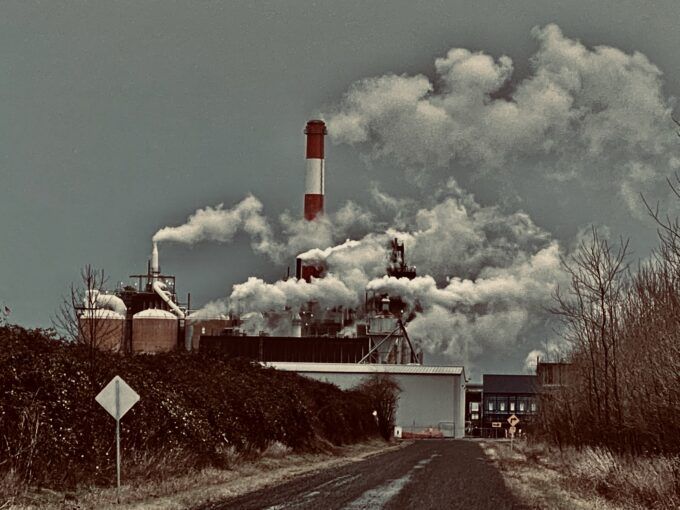
Weyerhaeuser plant, Halsey, Oregon. Photo: Jeffrey St. Clair.
It’s been a tumultuous couple of weeks for the Environmental Protection Agency (EPA). The agency followed through on its plan to rescind the 2009 Endangerment Finding and all the rules and decisions based on it. This action means the federal government no longer considers carbon dioxide and other greenhouse gases — which result from burning fossil fuels like coal, oil, and gas — a threat to public health and welfare, which goes against the government’s own thorough review of existing scientific research and all the evidence that has been added since 2009.
On top of that, legal actions initiated by the Department of Justice on behalf of the EPA against alleged polluters have sharply decreased, according to a new reportfrom the Environmental Integrity Project. The report found only 16 such legal actions, a 76 percent drop from the number taken during the Biden administration’s first year. But that’s not the only metric by which the EPA’s work has declined under Trump. EPA’s Enforcement Compliance and History Online (ECHO) database shows how little the EPA enforces its own regulations.
In particular, data for compliance and enforcement activities conducted under the 1976 Resource Conservation and Recovery Act (RCRA) for hazardous waste handlers show a large gap in the number of formal actions taken between Biden and Trump (see figure below).
Unlike the Clean Air Act and Clean Water Act, in which EPA delegates a lot of authority to state agencies, RCRA gave EPA the authority to control hazardous waste “from cradle to grave.” This is why in the figure below, states are consistent in the number and percentage of actions they take across administrations. That is because EPA is supposed to lead the way on enforcement. If you look at the states as the control group and the administration as the experimental group, this starts to make sense.
So what is considered hazardous waste? Title 40 of the US Code of Federal Regulations lists everything from petroleum refinery wastewater treatment sludges and the output of pesticide manufacturing to discarded commercial chemical products. These wastes share common traits: they are flammable, corrosive, unstable (meaning they react with other chemicals or water to produce gases or potentially explode), and toxic. Mixed waste contains all those components and radioactive materials. Hazardous waste that is improperly disposed of poses a serious risk to public health and the environment. Contamination of water sources can lead to severe outcomes, including elevated cancer rates, lethal effects on both humans and wildlife, and toxicity to vegetation.
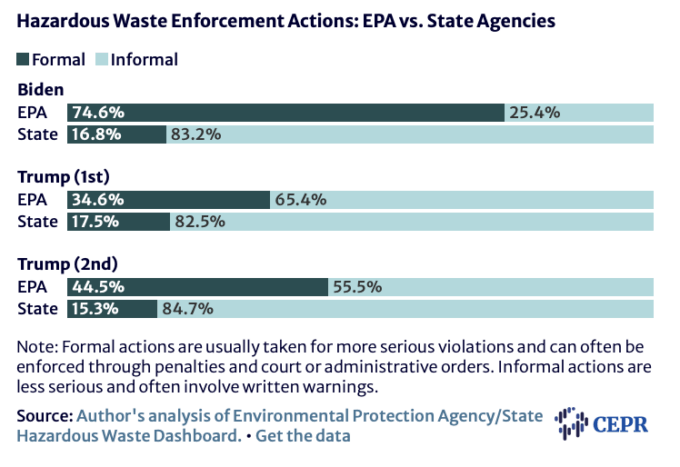
The EPA or state EPA offices can take informal and formal actions against facilities to enforce compliance. Informal actions are less serious and often involve a written warning, while formal actions are usually reserved for more serious violations and may include penalties. Examples of formal actions include court orders or administrative orders with a compliance schedule. The figure above shows that the Biden administration issued far more formal actions than the Trump administration in its first term and the first year of the second term. Not only that, the data show that the Biden administration took more than 3,200 formal and informal actions against alleged polluters, almost double the number Trump took in his first term (1,823).
While the Trump administration claims that taking these recent actions — reversing the endangerment finding, reducing regulations for companies, etc.—will save consumers money, the truth is that these moves will have a very real cost in terms of public health and environmental degradation. Findings in just the last five years have linked fossil fuel emissions to respiratory illnesses such as asthma and premature birth rates. There is also plenty of research showing that facilities that generate hazardous waste are often located in or near marginalized neighborhoods. Communities of color are disproportionately affected by environmental hazards, according to the EPA’s own data. Black Americans, for example, are 75 percent more likely to reside in “fenceline communities” — areas situated near hazardous waste sites and polluting facilities.
Regulations are not created arbitrarily by politicians and policymakers. They are based on scientific evidence and real examples of companies putting profits over public safety. When the evidence is ignored, the true price of “savings” is measured in public health crises and disproportionate harm to the nation’s most vulnerable communities. Instead of “Make America Healthy Again,” these actions are more likely to “Make America Sick Again,” and the public shouldn’t stand for it.

No comments:
Post a Comment