The polling was released alongside a letter urging attendees of the World Economic Forum's Davos summit to "tax the superrich."

Austrian-German Marlene Engelhorn, who gave much of her inheritance to groups that seek to improve environmental protection, education, integration, health, and social issues, poses with British millionaire Phil White with signs that say "Tax the rich" ahead of the World Economic Forum meeting in Davos, Switzerland on January 19, 2025.
(Photo: Fabrice Coffrini/AFP via Getty Images)
Jessica Corbett
Jan 22, 2025
COMMON DREAMS
As the World Economic Forum held its annual summit in Davos, Switzerland, polling released Wednesday showed that even millionaires are concerned about the wealthy's influence over Republican U.S. President Donald Trump, who started his second term earlier this week surrounded by Big Tech billionaires.
The poll, conducted in November and December by Survation on behalf of the U.S.-based group Patriotic Millionaires, is based on the responses of 2,902 people from G20 countries with investable assets over $1 million, excluding their homes.
Around two-thirds of them strongly or somewhat agreed that "superrich individuals interfered inappropriately in media, public, and political opinion in the 2024 U.S. election" (67%) and "the role the superrich will play in Donald Trump's presidency is a threat to global stability" (63%).
"When a superrich elite is determining the outcome of elections purely to protect their vested interests and accelerate profits, it's clear that we are in a terrifying age of wealth extremism."
Pollsters also found that over half of those surveyed believe that extreme wealth threatens democracy and the democratic stability of their country, and that political leaders lack the will to tackle extreme wealth. Nearly 70% of respondents said that the influence of the superrich is leading to a decline in trust in democracy.
Over 70% think that the ultrawealthy buy political influence and disproportionately sway public opinion through control of the media and social media platforms—and that their influence is leading to a decline in trust of the media and the justice system, according to the poll. Additionally, 72% favor raising taxes on the superrich to help reduce inequality and invest in public services.
The poll results were released alongside a letter to global leaders attending the Davos meeting, signed by more than 370 millionaires and billionaires from 22 countries, who argued that "oligarchy cannot be born from the political fear of upsetting the superrich," so "you must tax us, the superrich."
Signatories include American filmmaker and Patriotic Millionaires member Abigail Disney, who said in a statement that "it's easy to see the election of a figure like Donald Trump as an aberration, but that's not the case. Donald Trump—along with his so-called 'first buddy,' Elon Musk—is the final and inevitable conclusion of decades of inaction on the part of world leaders to put a check on extreme inequality."
Musk, a tech CEO and the richest person on the planet, poured over a quarter-billion dollars into reelecting Trump, has often been seen at the president's side since his November win, and is leading the Republican's Department of Government Efficiency, a controversial presidential advisory commission created to pursue GOP dreams of slashing federal regulations and spending.
"It's hard to be optimistic about what lies ahead over the next four years—and maybe more—but if officials want to do something to ensure the stability of our democracies, they need only find the political resolve to once and for all tax wealthy people like me," said Disney.
Other signatories also shared that call, including Marlene Engelhorn, an Austrian-German who co-founded taxmenow and said Wednesday that "the superrich are buying themselves more wealth and more power while the rest of the world is living in economic fear."
"We no longer have access to free and fair media; our political and legal systems can be bought; and our democracies are on very shaky ground," added Engelhorn, one of the representatives sharing the letter in Davos. "For all our sake, in every country, we have to tackle this now. Politicians need to show their mettle; they need to tax the superrich."
Scottish award-winning actor Brian Cox, who portrayed a billionaire named Logan Roy on the show Succession, also signed on and said that "recent events have shown that the political influence of billionaires and those with extreme wealth is an extreme risk to society."
"The superrich now manage so much more than money: They manage what we read, what we watch, the information we're given, and ultimately, how we vote," he continued. "When a superrich elite is determining the outcome of elections purely to protect their vested interests and accelerate profits, it's clear that we are in a terrifying age of wealth extremism. Our leaders have lacked the backbone needed to rein in political capture and put ordinary people first. It's time we draw the line and tax the superrich."
Watchdogs Argue 'Narrow Profit Interests' Drive Corporate Tax Debate in US
"It is the American people who lose when corporations succeed in keeping their taxes low," according to the report's authors.
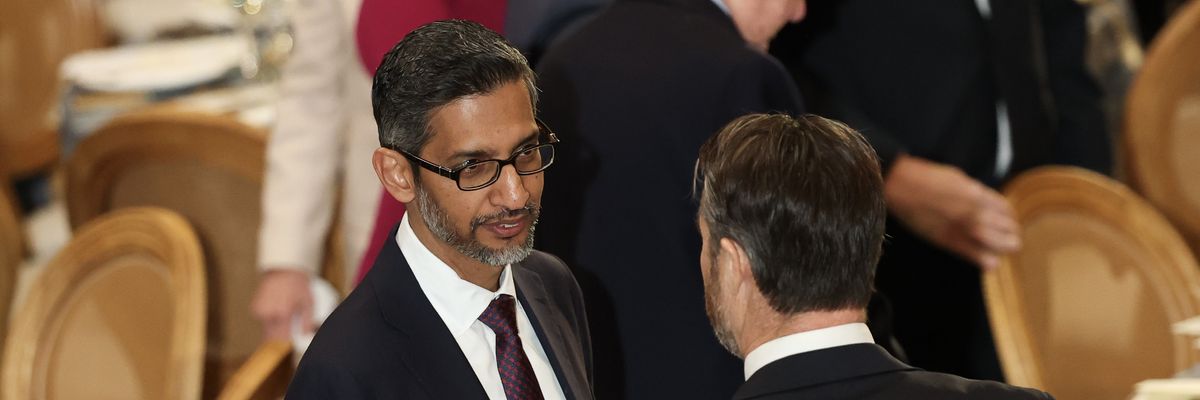
CEO of Google and Alphabet Sundar Pichai attends the inauguration of U.S. President-elect Donald Trump in the Rotunda of the U.S. Capitol on January 20, 2025 in Washington, DC.
(Photo by Kevin Dietsch/Getty Images)
Eloise Goldsmith
Jan 23, 2025
COMMON DREAMS
With portions of President Donald Trump's 2017 Tax Cuts and Jobs Act that favored high income households and corporations set to expire in 2025, the watchdog group Accountable.US and the coalition Americans for Tax Fairness released a report Wednesday detailing how top corporations benefited from corporate tax law in the five years following the 2017 reform.
These corporations, which include household names such as Apple, Bank of America, Microsoft, Meta, and General Motors, make a disproportionate share of national profits and pay a big chunk of total corporate taxes, though at low rates, according to the report—as in, the "corporate tax ten" identified by the report have a lot at stake when it comes to corporate tax policy.
Ahead of the coming debate around taxes in 2025, "the American public should be aware that the debate over corporate tax policy is less about national economic impact—as corporate lobbyists tend to insist—and more about the narrow profit interests of a few mammoth corporations," according to the report's authors.
While Trump's 2017 tax law permanently lowered the corporate tax rate from 35% to 21%—and this provision is not among those set to expire this year—Trump and House Republicans have expressed interest in dropping the corporate tax rate further, to 15%. Researchers at the Institute on Taxation and Economic Policy found that even after Trump dropped the corporate tax rate to 21%, most profitable corporations paid considerably less than that, "mainly due to loopholes and special breaks that the 2017 tax law left in place and, in some cases, introduced."
"We've seen how Trump's tax scam played out before—after promising to deliver for Main Street, he turned around and gave trillions in tax cuts to the ultra-wealthy and mega-corporations," said David Kass, ATF's executive director in a statement Wednesday. Regular American families "will be hurt by Republicans' plans to give trillions in additional tax cuts to make the rich richer and pay for it by cutting essential programs," he added.
Citing the Institute on Taxation and Economic Policy, the report notes that of the hundreds of billions in total subsidies received by corporations from 2018 through 2022—defined as "the difference between what they would owe over that period without special breaks in the tax code and what they actually paid with them in place"—over $150 billion of those total tax breaks were claimed by just 25 corporations, with Bank of America topping the list at nearly $24 billion in subsidies over those five years
Those breaks help explain how Bank of America paid a federal income-tax rate of just 3.8% on almost $139 billion in profits over that time period, according to the report.
Trump's 2017 legislation also lowered the tax rate for corporate income that comes from intangible assets that are held in the U.S. but generate sales overseas, so-called Foreign Derived Intangible Income (FDII) earnings, according to the report. The authors report that "of the over $50 billion the top 15 corporate beneficiaries of the FDII loophole have received over the first six years of the Trump law, almost one-quarter was reaped by Alphabet"—the parent company of Google.
The authors also note that if the 15% corporate tax rate was already in effect, Apple alone would have saved $3.5 billion on its taxes in the most recent annual reporting period.
The report gives other examples of how these top ten corporations benefit from subsidies already in place and how much they stand to gain from a potentially lowered corporate tax rate.
The report's argument that corporations approach tax policy first and foremost with their own profit margins in mind "is an important realization because it is the American people who lose when corporations succeed in keeping their taxes low: through cuts to public services because of the lost revenue; widening income and wealth gaps from increased corporate profits and stock prices; and in the growth of concentrated corporate power," the authors write.
"It is the American people who lose when corporations succeed in keeping their taxes low," according to the report's authors.
CEO of Google and Alphabet Sundar Pichai attends the inauguration of U.S. President-elect Donald Trump in the Rotunda of the U.S. Capitol on January 20, 2025 in Washington, DC.
(Photo by Kevin Dietsch/Getty Images)
Eloise Goldsmith
Jan 23, 2025
COMMON DREAMS
With portions of President Donald Trump's 2017 Tax Cuts and Jobs Act that favored high income households and corporations set to expire in 2025, the watchdog group Accountable.US and the coalition Americans for Tax Fairness released a report Wednesday detailing how top corporations benefited from corporate tax law in the five years following the 2017 reform.
These corporations, which include household names such as Apple, Bank of America, Microsoft, Meta, and General Motors, make a disproportionate share of national profits and pay a big chunk of total corporate taxes, though at low rates, according to the report—as in, the "corporate tax ten" identified by the report have a lot at stake when it comes to corporate tax policy.
Ahead of the coming debate around taxes in 2025, "the American public should be aware that the debate over corporate tax policy is less about national economic impact—as corporate lobbyists tend to insist—and more about the narrow profit interests of a few mammoth corporations," according to the report's authors.
While Trump's 2017 tax law permanently lowered the corporate tax rate from 35% to 21%—and this provision is not among those set to expire this year—Trump and House Republicans have expressed interest in dropping the corporate tax rate further, to 15%. Researchers at the Institute on Taxation and Economic Policy found that even after Trump dropped the corporate tax rate to 21%, most profitable corporations paid considerably less than that, "mainly due to loopholes and special breaks that the 2017 tax law left in place and, in some cases, introduced."
"We've seen how Trump's tax scam played out before—after promising to deliver for Main Street, he turned around and gave trillions in tax cuts to the ultra-wealthy and mega-corporations," said David Kass, ATF's executive director in a statement Wednesday. Regular American families "will be hurt by Republicans' plans to give trillions in additional tax cuts to make the rich richer and pay for it by cutting essential programs," he added.
Citing the Institute on Taxation and Economic Policy, the report notes that of the hundreds of billions in total subsidies received by corporations from 2018 through 2022—defined as "the difference between what they would owe over that period without special breaks in the tax code and what they actually paid with them in place"—over $150 billion of those total tax breaks were claimed by just 25 corporations, with Bank of America topping the list at nearly $24 billion in subsidies over those five years
Those breaks help explain how Bank of America paid a federal income-tax rate of just 3.8% on almost $139 billion in profits over that time period, according to the report.
Trump's 2017 legislation also lowered the tax rate for corporate income that comes from intangible assets that are held in the U.S. but generate sales overseas, so-called Foreign Derived Intangible Income (FDII) earnings, according to the report. The authors report that "of the over $50 billion the top 15 corporate beneficiaries of the FDII loophole have received over the first six years of the Trump law, almost one-quarter was reaped by Alphabet"—the parent company of Google.
The authors also note that if the 15% corporate tax rate was already in effect, Apple alone would have saved $3.5 billion on its taxes in the most recent annual reporting period.
The report gives other examples of how these top ten corporations benefit from subsidies already in place and how much they stand to gain from a potentially lowered corporate tax rate.
The report's argument that corporations approach tax policy first and foremost with their own profit margins in mind "is an important realization because it is the American people who lose when corporations succeed in keeping their taxes low: through cuts to public services because of the lost revenue; widening income and wealth gaps from increased corporate profits and stock prices; and in the growth of concentrated corporate power," the authors write.


No comments:
Post a Comment