Tuesday, March 10, 2026


'Don’t Steal This Book': Authors protest AI at London Book Fair with ‘empty’ book

'Don’t Steal This Book': Authors protest AI at London Book Fair with ‘empty’ book
Copyright Canva

By David Mouriquand
Published on 

Thousands of authors feature in a new "empty" book titled “Don’t Steal This Book” - a protest over AI firms using creative professionals’ work without their permission.

“The UK government must not legalise book theft to benefit AI companies,” reads the back cover of a new book being distributed at this year’s London Book Fair.

A treatise on the existential threat that artificial intelligence represents for writers? A compendium of artists’ experiences as they face an uncertain future?

In many ways, yes: it’s an “empty” book in which the only content is a list of the names of thousands of authors, who have published “Don’t Steal This Book” as a way to protest against AI firms using their work without their permission.

Among the illustrious names are Kazuo Ishiguro, Richard Osman, Alan Moore, Marian Keyes, Malorie Blackman, Philippa Gregory and Mick Herron. You can read the full list of authors involved on dontstealthisbook.com.

The website states: “AI companies are building their products by copying millions of books without permission or payment. The UK government is considering legalising this large-scale theft. We urge them to rule this out. AI companies should pay for books, like everyone else.”

The statement adds: “If they don’t, this is what we’ll be left with: empty pages, writers without pay, and readers deprived of the next book they’ll love.”

"Don't Steal This Book - A Plea From Authors" dontstealthisbook.com

The organiser of the book, Ed Newton-Rex, a composer and campaigner for protecting artists’ copyright, told the Guardian that the AI industry was “built on stolen work … taken without permission or payment”

“This is not a victimless crime – generative AI competes with the people whose work it is trained on, robbing them of their livelihoods,” said Newton-Rex. “The government must protect the UK’s creatives, and refuse to legalise the theft of creative work by AI companies.”

The distribution of “Don’t Steal This Book” comes just one week before the UK government is due to issue an assessment on the economic cost of proposed changes in copyright law.

The Guardian notes that British artists have responded with outrage at the main government proposal in the consultation, which proposes letting AI firms use copyright-protected work without the owner’s permission – unless the owner has signalled that they want to opt out.

UK ministers must deliver an economic impact assessment by 18 March, as well as a progress update on a consultation about the legal overhaul.

This year's London Book Fair takes place from 10 - 12 March.


French AI startup AMI raises $1B to develop 'universal intelligent systems'


French artificial intelligence startup AMI on Tuesday said it has raised $1 billion to develop AI systems designed to understand the physical world "in the way animals and humans do", unlike the language-based models behind chatbots such as ChatGPT. The company said it expected to produce "fairly universal intelligent systems" within five years.

Issued on: 10/03/2026 - 
By: FRANCE 24

Co-founder of French artificial intelligence startup AMI Yann LeCun attends the World Economic Forum annual meeting in Davos on January 23, 2025. © Fabrice Coffrini, AFP

French artificial intelligence startup AMI, co-founded by Meta's former chief AI scientist Yann LeCun, announced Tuesday it has raised $1 billion to develop models able to understand the physical world.

This first funding round for AMI (Advanced Machine Intelligence) was carried out by five investment funds and attracted investment from several big groups, including Toyota, Nvidia and Samsung.

Notable names in tech, including former Google CEO Eric Schmidt and Amazon founder Jeff Bezos, also bought in.

LeCun told AFP that, with the funding round complete, AMI would bring aboard 20-30 people "in the very short term".

He and five co-founders plan to "shift into a higher gear" on developing "world models", or AI systems designed to understand the physical world.

Unlike the text-based large language models (LLMs) behind chatbots like ChatGPT and Gemini, such AIs should understand the world "in the way animals and humans do," he added.

"Yann LeCun is turning a new page in artificial intelligence. This is the France of researchers, builders and the bold. Bravo!" President Emmanuel Macron posted on X.

Based in Paris with offices in New York, Singapore and Montreal, AMI was valued at around $3.5 billion before this funding round.
'Paradigm shift'

LeCun announced his departure from Meta in November, after 12 years with the owner of Facebook, Instagram and WhatsApp.

He now serves as AMI's non-executive chairman, while Alexandre Lebrun is the Paris-based startup's CEO.

Within three to five years, AMI plans to produce "fairly universal intelligent systems" that could be used for almost any task requiring intelligent machines, such as autonomous driving and robotics, LeCun said.

"I am very clearly in the camp that believes we need a paradigm shift" from the AI reliance on LLMs, he told AFP.

LeCun has been a vocal critic of major AI developers' laser focus on LLMs, which was one reason for why he left Meta – although he insists he still has "a good relationship with Mark Zuckerberg".

AMI's work will take up where LeCun left off with research at Meta on a new AI architecture dubbed JEPA.

"It's a direct continuation of that project," he said.

Researchers hope world models will allow AI systems to analyse and predict the behaviour of complex systems, such as a jet engine, a power plant or the organs of a human patient.

LeCun, a dual French-American citizen who remains a computer science professor at New York University, said AMI would focus on research and development in its first year.

Discussions with corporate partners could be held within six to 12 months, he added.

(FRANCE 24 with AFP)


Volkswagen slashes 50,000 jobs after profits collapse by nearly half
VW also recorded a decline in sales.
Copyright AP Photo/Rick Bowmer

By Verena Schad
Published on 

Volkswagen Group profits slumped by almost half in 2025. Trade conflicts, difficulties in China and the change in strategy at Porsche are putting Europe's largest car manufacturer under pressure.

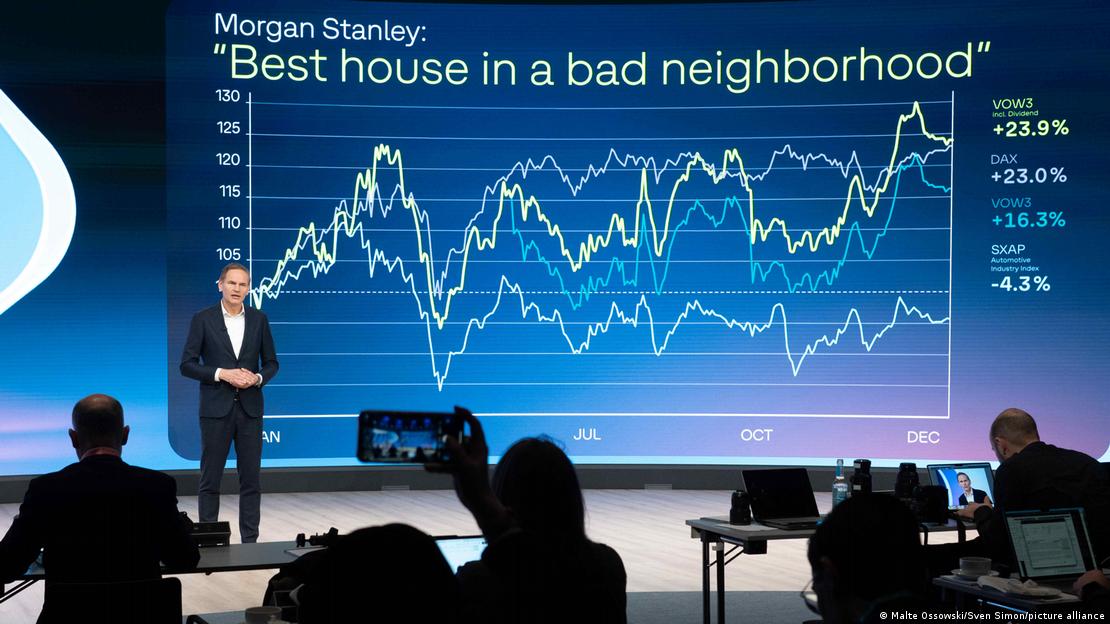
The Volkswagen group had a bruising year in profits and plans to cut 50,000 jobs in Germany by 2030 — a dramatic escalation of its cost-cutting programme after net profit slumped 44% to €6.9bn in 2025, the carmaker's worst result since the diesel emissions scandal nearly a decade ago.

The announcement, made by chief executive Oliver Blume in Wolfsburg on Tuesday, goes well beyond the 35,000 job reduction the group had already agreed with trade unions at the end of 2024.

Revenue stagnated at around €322bn, while operating profit almost halved to around €8.9bn, according to Europe's largest carmaker.

Chief financial officer Arno Antlitz cited a "challenging environment" of geopolitical tensions, new trade barriers and intensifying competition, particularly from China.

Volkswagen shares rose nearly 3.7% in Frankfurt on Tuesday morning, lifted by the broader market rally that followed Donald Trump's comments on Iran sanctions and a potential end to the conflict.

In 2015, Volkswagen was found to have installed software in millions of diesel vehicles designed to cheat emissions tests, making cars appear far cleaner than they were during testing — a scandal that wiped billions from the company's market value, triggered criminal prosecutions and cost the group upwards of €30bn in fines, settlements and recalls worldwide.

The current predicament is considered to be more damaging than the 2015 scandal.

Problems in China and the US

Although Volkswagen grew in Europe, this was not enough to compensate for declines in China and North America. The Group delivered around 8.98 million vehicles worldwide in 2025 — a decrease of 0.5%.

Trump's tariffs hit the US market for Volkswagen cars particularly hard, while changes to environmental regulations and the withdrawal of government subsidies have cooled demand for electric vehicles — putting pressure on planned projects including a new plant for electric pick-up trucks under the group's Scout brand.

The squeeze is equally acute in China, long Volkswagen's most important growth market, where local manufacturers including BYD, Geely and Nio are closing the technological gap and gaining market share.

In response, Volkswagen is doubling down on an "in China for China" strategy with local development and local supply chains, which analysts consider crucial to the group's long-term prospects.

The pain has been felt most acutely at Porsche.

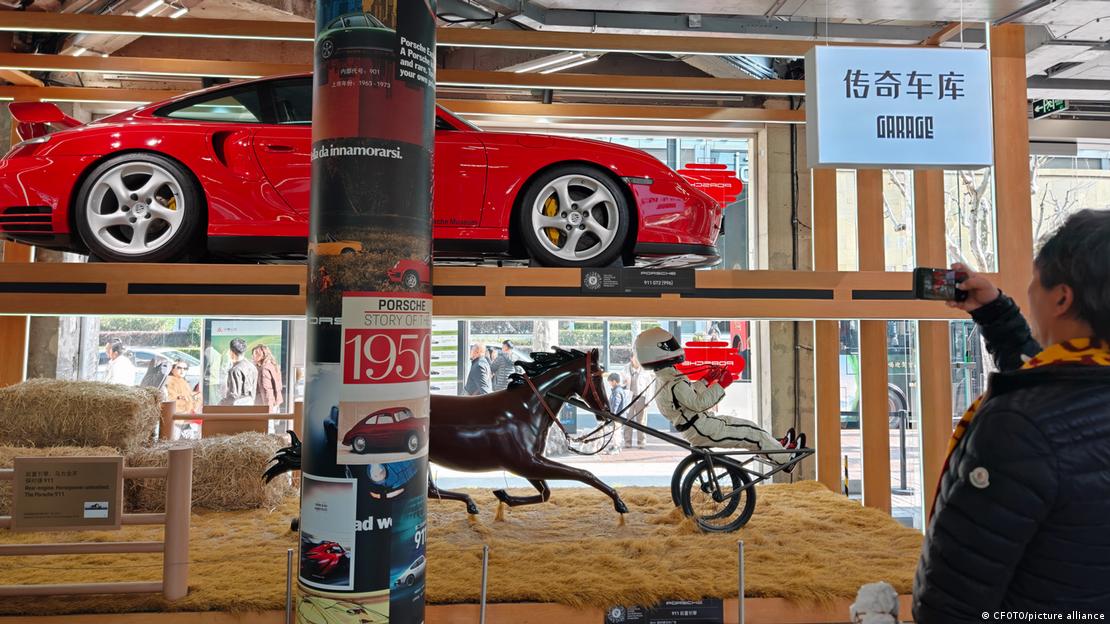
The sports car brand suffered a sharp drop in Chinese sales while absorbing the costs of a strategic reversal.

Having long prioritised electric vehicles, Porsche is now pivoting back toward combustion engine models.

Inflated pay bonuses?

Operating profit collapsed from around €5.3bn in 2024 to just €90m last year.

The earnings collapse has not, however, dented executive pay and that is causing anger.

Despite the group's worst results in nearly a decade, members of the Volkswagen executive board are again receiving bonuses totalling millions, driven largely by net cash flow — the cash remaining after investments and running costs — which hit €6.4bn, the highest target level in the remuneration system.

According to media reports, total bonus payments to the management board came to around €13.6m.

Chief executive Oliver Blume received total remuneration of around €7.4m — slightly less than the previous year, partly due to a voluntary pay waiver.

Employee representatives are now demanding that the workforce share in the strong cash flow, with talks over possible special payments under way.

Hope for recovery in 2026

Despite the weak annual results, the Group has recently been somewhat more stable.

In the final quarter, business developed better than before. Volkswagen had previously reported a loss of more than €1bn in the third quarter due to special charges at Porsche.

The Group now expects profitability to improve again in 2026. The operating margin is expected to rise to between 4.0 and 5.5%, after falling to 2.8% in 2025.

Forging A Robust Middle Class: Lessons Learned From Comparisons Between Indonesia And China – Analysis


March 10, 2026 
 ISEAS - Yusof Ishak Institute
By Sherry Tao Kong and Maria Monica Wihardja


The expansion of the middle-class has long been viewed as an indicator of successful development.[1] In China, large-scale poverty reduction under an industrialisation-led growth model beginning in the late 1970s was accompanied by sustained wage growth and the gradual expansion of social insurance. This allowed income gains to translate into greater economic security and the emergence of a large middle-class that has since consolidated.[2] Indonesia’s experience, however, presents a more fragile trajectory. Despite significant progress in lifting people out of poverty, middle-class expansion has slowed and even reversed in recent times.

Indonesia’s secure middle-class share has declined since 2018, while nearly half of the population remains economically insecure despite being no longer poor or near poor. Many households that have moved beyond poverty and near poverty remain exposed to income volatility, informal employment, and limited social protection. Stagnant real wages, weak manufacturing and high-end service sector growth, and rising informality have constrained upward mobility, while recent episodes of social unrest point to growing anxiety among those who are not poor or near poor but who remain economically insecure.

This Perspective argues that the central challenge facing Indonesia—and many middle-income economies in Southeast Asia—is not only how to expand the middle-class, but how to ensure that its expansion is resilient and durable. It advances a conceptual framework for middle-class resilience, defined as the capacity of households to sustain their economic position over time, absorb shocks, and convert income gains into lasting welfare and political stability. By comparing Indonesia with the case of China, the analysis shows how labour market conditions, social protection systems, structural transformation, and the fiscal capacity–governance nexus shape middle-class outcomes.

DEFINING THE MIDDLE-CLASS


Globally, there is no consensus when it comes to identifying the middle-class. Commonly adopted approaches include absolute (fixed) income (or expenditure) cutoffs, relative positions within the income distribution, and subjective self-identification. In Indonesia, the National Statistics Agency uses an absolute measure to define the middle-class where the cutoff values are based on economic vulnerability, following the approach used in the World Bank’s middle-class report for Latin America.[3]


It groups individuals into five economic classes:[4]

Poor: Those who live below the poverty line.

Vulnerable (near poor): Those who live above the poverty line but face more than a ten-percent probability of becoming poor in the following year.

Aspiring middle-class: Those who are neither poor nor vulnerable but face more than a ten-percent probability of becoming vulnerable in the following year.

Middle-class: Those who face less than a ten-percent probability of falling into poverty or vulnerability but face greater than a ten-percent probability of falling into the aspiring middle-class during the following year.

Upper-class: Those who face less than a ten-percent probability of falling into aspiring middle class or below in the following year.


With this definition, the middle-class are those who are relatively free from economic insecurity. Using the calculation described in Appendix 1 to set the expenditure threshold for each class category, the middle-class threshold is set at 3.5 to 17 times the poverty line. In 2024, this translates into those who consume IDR2.04 million-IDR9.91 million per capita expenditure per month (approximately USD136-USD661 per capita expenditure per month or USD6.5K-32K per household per year).

Figure 1: Indonesia’s household expenditure distribution (2010-2024)


Source: Susenas, 2010-2024; authors’ calculations. Note: Horizontal lines are indicated in the graph as higher and lower bounds for identifying middle class in Indonesia: 3.5-17 x national poverty line per capita expenditure per month.

Figure 1 shows that Indonesia’s middle-class consolidation has proven fragile. Although the middle-class was the fastest-growing expenditure group during the 2010s, its share has declined since 2018, with many households slipping back into the aspiring middle-class and the vulnerable class. This reversal reflects income volatility and limited access to social protection, particularly among wage earners without stable contracts or adequate employment protections. More fundamentally, the types and quality of jobs created over the past two decades have not generated sufficient upward mobility to absorb a substantial share of the aspiring middle-class into secure middle-class status.

Using Indonesia’s national definition of the middle-class, in 2024, Indonesia’s middle-class was estimated to have reached 47.9 million or only 17.1 percent of total population. It peaked at 22.5 percent in 2018 before declining to a share similar to that of a decade ago (2014). The middle-class lies between the 82nd and 99th percentiles of the consumption distribution.[5] Note that when an absolute measure is used, the middle-class does not necessarily comprise those in the ‘middle’ of the income or expenditure distribution as seen in the case of Indonesia.

Figure 2: China’s household income distribution (2010-2024)


Source: CFPS data and authors’ calculation. Note: Horizontal lines are indicated in the graph as higher and lower bounds for identifying the middle class in China: 80K-400K in 2010, 2012; 90K-450K in 2014, 2016; 100K-500K in 2018 and after, per household per year. The 2024 data is still preliminary.


China’s middle-class consolidation contrasts sharply with that of Indonesia. Like Indonesia, China adopts the absolute measure approach for its national definition of the middle-class albeit using income instead of expenditure. China’s National Bureau of Statistics categorises households into three income groups: low-income, middle-income and high-income. It defines the middle-income-group, a loosely comparable notion to the middle-class, using an absolute measure, namely those who earn RMB100K-500K (approximately USD14K-71K) per household per year in 2018 and after.

Figure 2 shows that over the past decade, China’s income distribution has shifted from a steep pyramid toward a more ‘elongated vase’, reflecting a broad-based expansion of middle-income households.[6] While income dispersion remains and mobility across income groups is substantial, the middle of the distribution has thickened over time, reflecting a net expansion of middle-income households. This structural shift has been supported in part by sustained wage growth and rising formal employment; these have helped reduce the risk of large-scale backsliding even as income mobility remains high. In 2022, China’s middle-class is estimated to have reached 591 million people or close to 40 percent of total households​​, up from 14.4 percent in 2012, to lie neatly between the 53rd and 97th percentiles of the income distribution.

WHY THE MIDDLE-CLASS MATTERS

In Indonesia, the middle-class contributes significantly to national consumption. Indonesia’s middle-class accounted for 38 percent of total household consumption in 2024, which was disproportionately larger than the 17 percent share of the middle-class in the population.[7] Indonesia’s economy is largely driven by household consumption, which contributes a robust 53 percent of GDP. Robust domestic consumption, fueled by the middle-class, is therefore not just desirable; it is a strategic necessity for economic resilience and sustained growth. Moreover, a 2024 study in Indonesia shows that the middle-class contributed 51 percent of total tax revenues despite only receiving 9 percent of total government subsidies.[8]


Aside from its economic significance, a resilient middle-class is often correlated with greater political stability. Global experiences including Thailand,[9] Brazil,[10] and Indonesia[11] show that a fragile middle-class easily generates political instability. A recent study by Basri (2026) shows a strong correlation between social unrest intensity and middle-class shrinkage among emerging markets between 2019 and 2024.[12] This segment of the population is distinctly more educated than those in poorer sections of the population and typically make demands for better governance, transparency, and public services.[13] In Indonesia, more than one in four individuals aged 15 or older in the middle-class have a bachelor’s or equivalent degree, compared to only 9 percent or lower of those in the less economically secure class groups (Figure 3). Their political participation – whether through formal politics, civil society, or consumer activism – shapes national agendas and fosters more responsive institutions.

The middle-class is also distinct from other class groups in their consumption patterns and in quality of jobs. The middle-class spends more on non-food items than food items, unlike the more vulnerable class groups (Figure 4). They drive demand in key sectors such as automobiles, education, healthcare, entertainment, travel, and e-commerce, and they invest more in their children’s education and help break intergenerational poverty.[14] Moreover, Indonesia’s middle-class mostly work as wage employees in formal employment unlike those in lower-class groups who mostly work in the informal employment (Figure 5).


Figure 3: Highest Educational Attainment for Population Aged 15 and Above in 2024
 (Indonesia)

Figure 4: Average Share of Food and Non-Food Items by Income Class in 2022 (Indonesia)

Figure 5: Employment Status in 2024 (Indonesia)


Like Indonesia, China’s middle-class carries significant economic weight and exhibits stronger educational and occupational advantages compared to the low-income group. In 2022, it accounted for nearly half of total household consumption, exceeding its share of the population. Middle-income households in China have substantially higher educational attainment and spend more on non-food items compared to low-income households (Appendix Figure 1-2). They are more closely linked to formal employment in public and private enterprises compared to low-income households (Appendix Figure 3).


THE PILLARS OF MIDDLE-CLASS RESILIENCE: A COMPARATIVE ANALAYSIS


This section develops a framework organised around four pillars—quality jobs, structural transformation, social protection, and the fiscal capacity-governance nexus—to explain why poverty reduction has been more likely to translate into middle-class consolidation in China, while that class has remained more fragile in Indonesia. These pillars are inter-related. Structural transformation shapes the availability of productive jobs, which in turn determines labour market formality and wage dynamics, while social protection, fiscal capacity and governance provide the conditions in which income risks are managed over the life cycle. By using China as a benchmark for middle-class consolidation, the analysis of Indonesia’s case yields lessons for other middle-income economies across Southeast Asia.

Structural Transformation and Productivity

Structural transformation forms the foundation of middle-class resilience and shapes the economy’s capacity to generate productive, well-paying jobs. Middle-class expansion is more likely to be durable when labour moves into higher-productivity sectors and occupations that support sustained wage growth, rather than into low-productivity activities that limit earnings and job upgrading, and reinforce informality.

Indonesia’s structural transformation has been limited. Investment has increasingly been oriented towards resource-based activities and capital-intensive sectors, while labour-intensive manufacturing has failed to expand.[15] The high-end services sector has also been constrained by a limited supply of high-skill workers. While labour has transitioned away from the low-productivity agricultural sector, it has primarily been absorbed by the low-end services sector.[16] As a result, job creation has been concentrated in low-productivity services and informal activities, limiting wage growth and reinforcing employment precarity. This pattern helps explain why employment expansion has not translated into more substantial middle-class consolidation, despite rising consumption.


In contrast to Indonesia’s limited structural transformation, partly attributed to ‘premature deindustrialisation’ starting in the early 2000s, China’s middle-class expansion was underpinned by a sustained shift of labour into manufacturing and, more recently, to technology- and knowledge-intensive activities.[17] This transformation raised productivity and created large numbers of wage-paying jobs in the formal sector capable of supporting income growth over time. While not all employment has been high-quality, and regional disparities persist, the overall structure of growth has generated the productive jobs needed to sustain a broad middle-income group.

The contrast highlights a core vulnerability. In Indonesia, household consumption accounts for a large share of GDP—around 53 per cent—yet this consumption-led growth has not been matched by a productivity-driven employment base. Without deeper structural transformation into sectors that generate ‘good jobs’, middle-class expansion is likely to remain fragile.

Quality Jobs

Labour market conditions are central to middle-class resilience in Indonesia, since wages (labour incomes) are the primary income source for its middle-income households. Stable real-wage growth and access to formal employment reduce income volatility and help households sustain middle-class living standards, while stagnant wages and informality increase the risk of backsliding.

Indonesia’s trajectory is concerning in this regard. Real wages have stagnated since around 2017, a reversal of the pre-2017 trend when real wages grew by 4.2 percent annually between 2010 and 2017.[18] Job creation has increasingly occurred in the informal sector rather than in the formal sector, reversing the long-term trend of formalisation.[19] It is notable that the issue here is not in job creation but in job quality. Recent shifts have weakened earnings stability and reduced access to employment-linked protections; this contributes directly to the decline since 2018 of the secure middle-class. The pattern reflects a structural change in labour market dynamics rather than a temporary cyclical slowdown.

In contrast to Indonesia’s recent labour-market trajectory, middle-income households in China have a mix of relatively secure formal employment in the public sector and private enterprises, alongside owning private businesses and self-employment. Wages in China account for around 70 per cent of middle-class income. While income mobility remains high and some downward movement persists, sustained wage growth has ensured that upward mobility has, on balance, exceeded downward mobility.


Social Protection


While labour market conditions and structural transformation establish the foundation for middle-class incomes, access to essential services and social protection determines whether those gains can be sustained in the face of economic shocks. Social protection is however not a substitute for decent jobs.[20] The extent and effectiveness of the safety nets thus constitute a third pillar of middle-class resilience.


Due to lack of access to social protection programmes, Indonesia’s middle-class has been described by some as ‘consuming like the middle-class but living with the anxiety of the poor’, reflecting limited insurance coverage and high exposure to health and economic shocks. Indonesia’s situation is characterised by a heavy reliance on private services (for those who can afford them) that have emerged in lieu of public alternatives that remain underdeveloped. For example, while 49 percent of government employees have a pension fund, this is true only for 12 percent of private-sector employees.[21] The share of workers in household enterprises with a pension fund is only 0.18 per cent. Moreover, while 75 percent of government employees have health insurance, only 69 percent of private-sector employees and less than 3 percent of workers in household enterprises do.[22] This qualitative dimension of fragility is evident in expenditure patterns, where middle-class households allocate a significant share of their spending to private health and education—a defensive strategy that drains resources which could otherwise be saved or invested for upward mobility.[23] The under-provision of public social protection also shifts risk management onto households, leaving them financially exposed. Without a functional safety net, the economic security of the middle-class remains provisional.

In contrast, the expansion of social insurance in China has proceeded in tandem with middle-class growth, providing a measurable degree of security. Coverage for medical insurance and old-age pensions exceeds 57 per cent of the relevant population, reflecting a systematic effort to build a broad-based safety net.[24] Although the social protection system, while extensive, remains incomplete, institutional backing has helped to cushion middle-income households against health emergencies and retirement insecurity, reducing the risk that a single shock could push them back into poverty.

The contrast between China’s institutionalised, albeit incomplete, system, and Indonesia’s fragmented, individually financed model, underscores the fact that the durability of the middle- class depends not only on the ability to earn a stable income but also on the collective capacity to pool risks and ensure general access to essential services.

Fiscal Capacity and Governance


The state’s capacity to mobilise resources, deliver services, and maintain public trust plays an important role in determining whether the economic foundations of middle-class resilience can be fully realised. Labour markets, structural transformation, and social protection do not operate in an institutional vacuum; their effectiveness is mediated by fiscal capacity and the governance pact between the state and its citizens.

Revenue mobilisation​ is the bedrock of state capacity, enabling investments in public goods that support middle-class stability. However, Indonesia struggles with low tax revenues relative to its economy, constraining the government’s ability to fund essential services.[25] This fiscal gap undermines the very public investments needed to consolidate the gains made from poverty reduction, leaving the middle-class exposed to underfunded systems.

State capacity and service delivery​ determine whether revenue translates into tangible benefits for households. When the state provides quality education, healthcare and infrastructure efficiently, it reinforces middle-class trust and reduces the need for costly private alternatives. In Indonesia, however, perceived inefficiency or corruption in public service delivery erodes confidence; this prompts households to opt for private services as a rational choice that, in turn, weakens the tax base and perpetuates underinvestment in public services. This vicious cycle highlights the fact that effective governance is not merely about collecting taxes but about demonstrating credible delivery to secure citizen buy-in.


In contrast, in China, rapid economic growth has expanded the tax base, allowing for substantial public spending on infrastructure, education and healthcare. These are key drivers of productivity and household security. Access to quality education, healthcare and infrastructure has also reduced the need for costly private services.

The dynamics of the above four pillars produce a critical political economy feedback loop. A resilient middle-class tends to support long-term investment and fiscal capacity, and thus becomes a stabilising force, while a large, fragile ‘aspirational’ class—no longer poor or near poor but lacking economic security—can fuel grievances and populism, undermining the very policies that can foster long-term resilience.[26] While a state that delivers on its promises nurtures a resilient, tax-compliant middle-class, a mismatch between rising expectations for public services and limited fiscal capacity fuels political anxiety. Thus, in Indonesia, rebuilding the governance pact—where credible service delivery meets tax morale—is essential to prevent middle-class fragility from undermining long-term resilience.

Furthermore, the large share of Indonesian households clustered near the threshold of middle-class status (the aspiring middle-class) has translated into rising expectations for public services and protection, without a commensurate expansion of the stable tax base or fiscal space. By contrast, where income growth and employment are closely anchored in productivity gains, as in the case of China, governments have been better able to mobilise resources and expand social protection alongside middle-class growth. More broadly, the experience of Indonesia suggests that middle-class fragility can generate political pressures that, if not managed, risk reinforcing economic vulnerability and making reforms more difficult to implement.[27] This is an issue that holds growing relevance for middle-income countries across Southeast Asia.

POLICY IMPLICATIONS

For Indonesia, the transition from poverty reduction to a resilient middle-class is not an automatic process. By using China as a benchmark case, the analysis in this paper shows that middle-class consolidation requires a deliberate and integrated policy approach that addresses the interconnected pillars of labour markets, social protection, and structural transformation, which are at the same time underpinned by sound fiscal capacity and governance and adapted to the country’s developmental context.[28] For Indonesia, there is an urgent need for middle-class consolidation​ in order to prevent backsliding.

Indonesia’s policy agenda needs to aim at stabilising its vast aspirational class and halting the erosion of its secure middle-class. This requires a coordinated strategy across the following three areas. First, policies must reverse the trend of de-formalisation. This involves labour market deregulation to incentivise formal hiring, coupled with targeted skills training aligned with the needs of higher-value sectors.

Second, to address the profound vulnerability highlighted by the social protection​ pillar, the government must prioritise expanding the social safety net. Enhancing the coverage and adequacy of health insurance and pension fund, and introducing a credible unemployment benefits system, are critical to reducing households’ exposure to shocks and building trust in state institutions.


Third, these efforts will be futile without a shift in structural transformation. Policy must consciously steer away from capital-intensive, resource-extractive FDI towards job-creating, competitive manufacturing and knowledge-intensive modern services, supported by improved regulatory certainty. Ultimately, these economic measures must be framed within a broader new social contract that demonstrates tangible improvements in public service delivery through the broadening of the tax base; this will break the vicious cycle of low tax morale and underfunded public goods.

REFERENCES

Basri, Chatib. 2025. ‘Indonesia’s Fragile Middle Class’. Carnegie Endowment for International Peace. 

Basri, Chatib. 2026. ‘Why Development Becomes Harder: The Policy Economy of the Possible’. CID Speakers Series. Harvard Kennedy School. https://youtu.be/vZvAEvTw7gg?si=P98eNoizjw0Mltnf

Channel News Asia (CNA). 2026. Insight 2025/2026 – Inequality in Indonesia. https://www.channelnewsasia.com/watch/insight-20252026/inequality-in-indonesia-5878896

Dalen, K. 2020. ‘Welfare and Social Policy in China: Building a New Welfare State’. In A. Hansen et al. (eds.), The Socialist Market Economy in Asia https://doi.org/10.1007/978-981-15-6248-8_10

Jäger, K. 2012. ‘Why did Thailand’s middle class turn against a democratically elected government? The information-gap hypothesis’. Democratization, 19(6), 1138–1165. https://doi.org/10.1080/13510347.2011.623353

Kong, Sherry Tao, and Shaobo Chen. 2025. Expanding the Middle-Income Group: Measurements, Characteristics and Policy implications (扩大中等收入群体研究). Social Sciences Academic Press (社会科学文献出版社). (In Chinese)
Li, S. 2023. ‘Understanding China’s road to common prosperity: background, definition and path’. China Economic Journal, 16(1), 1–13. https://doi.org/10.1080/17538963.2023.2164950

LPEM FEB UI. 2025. ‘Indonesia Economic Outlook Q3 2024’. 

Nagara, Khaerul Budhy, & Rusma Rizal. 2025. ‘The Burden of Education Costs for the Middle Class in Indonesia: An Analysis of Challenges and Implications’. Jurnal Serambi Ilmu, 26(2), 153–164. https://doi.org/10.32672/jsi.v26i2.3766

Negara, Siwage Dharma and Maria Monica Wihardja. 2025. ‘Post-Sri Mulyani, Indonesia’s Unrestrained Growth Ambitions Carry Serious Risks.’ Fulcrum. ISEAS-Yusof Ishak Institute.

Qin G. 2021. ‘Liberal or Conservative? The Differentiated Political Values of the Middle Class in Contemporary China’. The China Quarterly. Vol. 245:1-22. https://doi:10.1017/S0305741020000296

Su, Hainan, Hong Wang, Fenglin Chang. 2022. The Rise of the Middle Class in Contemporary China. Palgrave Macmillan Singapore. DOI: https://doi.org/10.1007/978-981-19-5099-5

Yang, Xiuna, Terry Sicular, Björn Gustafsson. 2024. ‘China’s Prosperous Middle Class and Consumption-led Economic Growth: Lessons from Household Survey Data’. The China Quarterly. 258:479-494.

Wihardja, Maria Monica and Putu Sanjiwacika Wibisana. 2024.
Fulcrum. ISEAS-Yusof Ishak Institute.

Wihardja, Maria Monica and Chatib Basri. 2025. ‘Growing or Shrinking? How Indonesia’s Middle Class is Really Doing’. Fulcrum. ISEAS-Yusof Ishak Institute.

Wihardja, Maria Monica, Mohamad Ikhsan and Vivi Alatas. 2025. ‘Times Are Changing: Can Indonesia Stay the Course?’ Bulletin of Indonesian Economic Studies, Vol.61, No.2, 1-36. https://www.tandfonline.com/doi/full/10.1080/00074918.2025.2526824

Wijaya, Ria Fortuna. 2026. ‘AEI Economists: Middle Class Holds Key to Indonesia’s 2026 Growth’. Jakarta Globe.ID. https://jakartaglobe.id/business/aei-economists-middle-class-holds-key-to-indonesias-2026-growth#goog_rewarded

World Bank. 2013. Economic Mobility and the Rise of the Latin American Middle Class. Washington, DC: World Bank. https://documents.worldbank.org/en/publication/documents-reports/documentdetail/647651468053711367

World Bank. 2019. Aspiring Indonesia–Expanding the Middle Class. Washington, DC: World Bank. https://www.worldbank.org/en/country/indonesia/publication/aspiring-indonesia-expanding-the-middle-class

World Bank. 2021. Pathways to Middle-Class Jobs in Indonesia. Washington, DC: World Bank. https://www.worldbank.org/en/country/indonesia/publication/pathways-to-middle-class-jobs-in-indonesia

World Bank. 2025. ‘China Economic Update’. Washington, DC: World Bank. https://www.worldbank.org/en/news/press-release/2025/12/11/advancing-reforms-can-enhance-prospects-china-economic-update


For appendices and endnotes, please refer to the original pdf document.


About the authors:
 Sherry Tao Kong is Head of Research at the Institute of Social Science Survey, and Senior Research Fellow at the Institute of Digital Finance, Peking University. She also teaches at the Institute of Area Studies, Peking University. 

Maria Monica Wihardja is Visiting Fellow and Co-coordinator of the Media, Technology and Society Programme at ISEAS – Yusof Ishak Institute, and also Adjunct Assistant Professor at the National University of Singapore.

Source: This article was published by ISEAS – Yusof Ishak Institute

ISEAS - Yusof Ishak Institute

The Institute of Southeast Asian Studies (ISEAS), an autonomous organization established by an Act of Parliament in 1968, was renamed ISEAS - Yusof Ishak Institute in August 2015. Its aims are: To be a leading research centre and think tank dedicated to the study of socio-political, security, and economic trends and developments in Southeast Asia and its wider geostrategic and economic environment. To stimulate research and debate within scholarly circles, enhance public awareness of the region, and facilitate the search for viable solutions to the varied problems confronting the region. To serve as a centre for international, regional and local scholars and other researchers to do research on the region and publish and publicize their findings. To achieve these aims, the Institute conducts a range of research programmes; holds conferences, workshops, lectures and seminars; publishes briefs, research journals and books; and generally provides a range of research support facilities, including a large library collection.

LET THIS BE THE LAST OF 'LASER FOCUSED'


FUBAR TOO?!

Arnold Schwarzenegger staging a comeback with ‘King Conan’, new ‘Predator’ and ‘Commando’ movies

Arnold Schwarzenegger staging comeback with ‘Conan 3’, new ‘Predator’ and ‘Commando’ movies
Copyright AP Photo - 20th Century-Fox

By David Mouriquand
Published on 

Arnold Schwarzenegger is in talks to return to not one but three of his iconic film franchises. The first seems to be ‘King Conan’ - a return to the world of the 1982 film that propelled him to stardom.

One of Hollywood’s biggest action stars hasn’t been seen on the big screen since 2019’s poorly received Terminator: Dark Fate... But now, "The Austrian Oak" is staging a comeback.

Arnold Schwarzenegger has revealed that he is currently in talks to return to his first franchise, Conan the Barbarian.

The 1982 action-adventure film was the former body builder's breakout role, before James Cameron’s The Terminator propelled him to international fame two years later.

The 78-year-old former Governor of California is not just limiting his return to one franchise though... He’s in talks to return to the worlds of Commando (1985) and Predator (1987).

“They did an additional Predator and the director [Dan Trachtenberg] has been doing a great job of that. Now, he wants me to be in the next Predator. We’ve talked about it,” Schwarzenegger revealed at this year’s Arnold Sports Festival in Columbus, Ohio, according to Variety.

“As a matter of fact, Fox Studios has kind of rediscovered Arnold,” he added. “They’ve come to me and said, ‘We want you to do Predator, we just got a script for you to do Commando 2.’”

Arnold Schwarzenegger at the premiere of "Fubar" - 11 June 2025 AP Photo

Schwarzenegger said that for the Conan sequel, the studio “just hired a fantastic writer/director who did Tom Cruise’s last four movies to write and direct King Conan.”

He seems to be referring to Christopher McQuarrie – who directed Cruise in Mission: Impossible – Fallout (2018), Mission: Impossible - Dead Reckoning (2023) and Mission: Impossible – The Final Reckoning (2025) – as well as write and produce 2022’s Top Gun: Maverick.

He clarified that all three roles will be “different” and written to better reflect his current age.

“They don’t write them like I’m 40 years old. You write it to be age-appropriate,” he explained. “I’ll still go in there and kick some ass but it will be different.”

Addressing plans for King Conan, Schwarzenegger added: “It’s a great old story that Conan was 40 years as king and now he gets forced out of the kingdom and there’s conflict, of course, but somehow he comes back and there’s all kinds of madness, violence, magic and creatures and stuff like that.”

“And now, of course, there’s all kinds of special effects. The studio has plenty of money to make those movies really big so I’m looking forward to all of those projects.”

Conan The Barbarian (1982) 20th Century-Fox

Hollywood previously attempted to reboot Conan in 2011 with Jason Momoa in the title role. However, the film was a box office letdown, with $63 million worldwide on a reported $90 million production budget.

Fake Euronews reports used to spread disinformation about Middle East, Ukraine war

Fake Euronews videos posted on social media
Copyright Social media

By Tamsin Paternoster & Estelle Nilsson-Julien
Published on 

A disinformation campaign which has been linked to pro-Russian actors is imitating reputable media outlets to push fake reports about the Middle East war, as part of a campaign to discredit the West and Ukraine.

Doctored videos impersonating Euronews and other major media outlets have been used to spread false claims about the war in the Middle East, shared across social media and relayed by the pro-Kremlin Pravda network.

According to researchers from the Antibot4Navalny collective, the campaign is tied to the Russia-linked "Matryoshka" operation, which carries out mass, coordinated disinformation campaigns across social media and online, targeting Ukraine and the West.

Researchers say the campaign is not directly focused on the Middle East war, but that the crisis has been used to push unrelated narratives to tarnish the West. This includes presenting Ukrainians as criminals, taking aim at Western governments and seeking to undermine the Armenian government ahead of Parliamentary elections in June.

Fake claims about Ukrainians

One fake Euronews video manipulated the voice of a journalist reporting on a drone strike which hit the luxury Fairmont The Palm Hotel in Dubai.

The doctored clip incorporated an authentic Euronews report on the strike but manipulated a real reporter's voice halfway through, making her claim that "Ukrainian looters" used the chaos of the strikes on Dubai to attack "shops, jewellery stores and abandoned cars" — which she did not say in the real news package.

                          Doctored Euronews reports Euronews

The doctored footage also falsely claimed that authorities detained 19 Ukrainians following the looting, alleging that they coordinated their activities on WhatsApp, but there is no evidence for this.

The journalist's voice was likely altered with the help of AI-voice cloning software. Another clue that the clip is inauthentic is that her manipulated voice plays over generic stock images, a common technique used by disinformation actors to avoid generating realistic deepfakes of reporters on camera.

The same strategy was employed for another false Euronews report, which alleged that strikes on the UAE had damaged a luxury mansion belonging to a Ukrainian general worth $7 million.

Fake report targets Armenian prime minister

Euronews branding was also used in a separate doctored report which claimed that strikes targeting the UAE damaged an apartment allegedly belonging to Armenia's Prime Minister Nikol Pashinyan.

The doctored report claimed that the revelation about multiple apartments owned by Pashinyan in the UAE had triggered a "debate among both residents of Armenia and the Armenian diaspora around the world".

The video also alleged that Pashinyan's UAE property was worth $170 million (€147 million), before stating that Pashinyan's press secretary had responded by asserting that the property's value "did not exceed" $70 million dollars.

However, Pashinyan's press secretary, Nazeli Baghdasaryan, has publicly responded to the false allegations, declaring on on social media that "Prime Minister Nikol Pashinyan DOES NOT OWN any property in the UAE or any other country".

"All the figures, 'values' circulating in the videos, as well as the comments presented in my name as the Prime Minister's spokesperson, are entirely fabricated and do not correspond to reality", she said.

Baghdasaryan also accused disinformation actors of seeking to discredit the country's prime minister ahead of parliamentary elections scheduled for June 2026.

"We are dealing with a classic FIMI [Foreign Information Manipulation and Interference] mechanism, where several characteristic tools are used: false attribution to reputable international news outlets ("Al Jazeera", "Euronews") — with the aim of giving the material a false impression of credibility," she said.

False information about an apartment belonging to Pashinyan in the UAE has spread online since as early as 2021, relayed by the Telegram channel Mediaport and the "Gazeta of Armenians in Russia".

Middle East conflict a breeding ground for doctored videos

Plenty of other international media outlets and organisations have indeed been impersonated alongside Euronews, in an effort to spread disinformation about Europe within the context of the war in the Middle East.

A doctored video imitating French newspaper Le Point has spread across social media, falsely claiming that Ukrainian phone scammers have managed to con French citizens out of tens of millions of euros following an escalation of the Middle East conflict.

A further fake clip falsified a report from the Institute for the Study of War, in a bid to claim that France had covered up the death of 70 French servicemen following an Iranian strike on a base in Abu Dhabi.

In another report imitating American outlet USA Today, disinformation actors claimed that Ukrainian weapons had been used in strikes on French, German and American military bases in the Gulf States.

It's not the first time the Matryoshka network has used Euronews graphics to spread false claims. A campaign using similar methods was launched during the Milan Winter Olympics, and during Moldova's electoral campaign.