The deaths in Texas mark a devastating chapter in a growing story: the slow, preventable betrayal of American children by a government unwilling to face the truth about climate change.
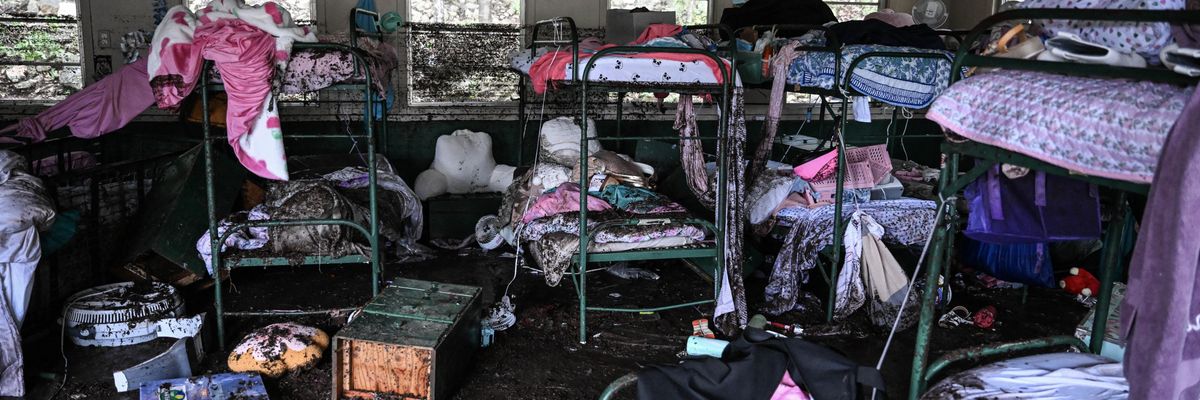
A view inside of a cabin at Camp Mystic, the site of where at least 20 girls went missing after flash flooding in Hunt, Texas, on July 5, 2025.
(Photo: Ronaldo Schemidt/AFP via Getty Images)
Nathalie Beasnael
Jul 15, 2025
The floodwaters that tore through Texas have claimed over 130 lives—and stolen the futures of at least 36 children, most of them swept away while attending a Christian summer camp that offered neither the preparation nor protection demanded by our new climate reality.
Eventually, their names will fade from the headlines. But their deaths mark a devastating chapter in a growing story: the slow, preventable betrayal of American children by a government unwilling to face the truth about climate change.
The science is not in dispute. Storms like this—once labeled “1-in-500-year” events—are becoming terrifyingly routine. A warmer atmosphere traps more water vapor, fueling more intense rainfall. According to the National Climate Assessment, the heaviest Texas storms now dump 20% more rain than they did in the 1950s, when the planet was significantly cooler.
It is U.S. President Donald Trump who poses the central danger to our children. He thinks climate change is “one of the great scams” and governs accordingly. His resulting cuts to NWS, the Environmental Protection Agency, and the National Oceanic and Atmospheric Administration—which faces a proposed 40% budget cut—and his desire to phase out the Federal Emergency Management Agency (FEMA) snub basic moral responsibility to compound the threat of a warming world.
Our children are not political pawns. They are not expendable. They are the reason we build, the reason we serve, the reason we fight for a better country. If our policies cannot protect them, then those policies must change.
Yet the White House was quick to dismiss any link between budget cuts and the catastrophe in Texas, with a spokesperson calling such criticism “shameful and disgusting.” As a trained FEMA responder, emergency nurse, and woman of faith, I’ve seen with my own eyes how shameful it is to pretend we’re prepared—and how disgusting it is to suggest these deaths were unavoidable.
There were “early and consistent warnings” from the National Weather Service (NWS), insisted Press Secretary Karoline Leavitt. It is as if it were the children’s fault for not listening to the news instead of a consequence of deliberate, manmade policy failure.
That’s not politics. That’s engineered neglect.
And children are paying the price. In 2024, over 242 million students around the world had their schooling disrupted by extreme climate events—from heatwaves and hurricanes to floods and droughts. In the U.S, 11 million people were displaced by disasters that year, many of them children.
When classrooms flood, when heatwaves overwhelm neighborhoods, when families are forced to flee… it is the youngest who suffer most.
Yet we continue to send 26 million American children to summer camps, many of which are located in rural, exposed areas with little to no emergency oversight. Most lack up-to-date evacuation plans or protections against extreme weather. In Kerr County, the system failed completely—delayed warnings, limited staffing, and no infrastructure to fall back on.
We owe these children more than thoughts and prayers. We owe them action.
We must respond with both moral urgency and practical action. Every community—not just wealthy ones—deserves climate-resilient infrastructure, schools, and camps built to withstand the new normal, and local authorities trained and funded to respond quickly and effectively. The Department of Education’s emergency management unit must be strengthened, not slashed.
We must also invest in prevention, not just response. That means restoring ecosystems that can buffer against climate extremes, building sustainable infrastructure, and, crucially, educating our children to understand and navigate the crisis they’ve inherited. We cannot continue to rely on outdated systems and hope they’ll hold. They won’t.
At the grassroots level, people are already rising to meet the moment. Organizations like Zero Hour are training youth from diverse backgrounds to lead on environmental justice. Faith-based networks are stepping in where policy has failed—not just preaching morality but practicing it.
Earlier this year, Duke University’s Divinity School formalized its partnership with Faith For Our Planet, a global nonprofit founded by the Muslim World League (MWL). Their pioneering youth fellowship program equips young people to identify local climate risks and lead resilience efforts in their communities. At the launch, MWL secretary general Sheikh Muhammad Al-Issa urged young people not to underestimate their power: “Challenge injustices. Innovate solutions. Start dialogues where others sow discord.”
Across denominations, congregations are mobilizing: The Faith Alliance for Climate Solutions works to develop solutions at the local level. The Evangelical Environmental Network is producing Sunday school curricula centered on stewardship and sustainability. These are not fringe efforts—they are real, growing movements that link moral clarity with public service.
We are past the point of debate. The climate crisis is not theoretical. It is here, and it is killing our children. Those who frame this as a culture war are only trying to distract from their own failures of responsibility.
Our children are not political pawns. They are not expendable. They are the reason we build, the reason we serve, the reason we fight for a better country. If our policies cannot protect them, then those policies must change.
It’s time to stop blaming God for disasters we refuse to prevent. The water is rising—and so must we.
Our work is licensed under Creative Commons (CC BY-NC-ND 3.0). Feel free to republish and share widely.
Nathalie Beasnael
Dr. Nathalie Beasnael is an accomplished trainee of the Federal Emergency Management Agency and the founder of Health4Peace, which provides essential medical supplies to hospitals in Chad, Senegal, Ghana, South Africa, and Nigeria. She is the diplomatic envoy for the Republic of Chad to the USA and was a delegate at the United Nations annual climate summit COP28, where she moderated a panel discussion on how climate change is impacting human health. She is one of the leading recovery nurses at the California Surgical Institute in Beverly Hills and has received several recognitions for her outstanding efforts in the health unit across the USA. Her work has recently been featured in leading publications including the Sydney Morning Herald, Newsweek, USA Today, and the Independent.
Full Bio >
DHS Head Noem Prioritized Instagram Pics Over FEMA Requests for Texas Floods
It took Noem four days to respond to requests from FEMA, delaying access to some search and rescue tools.
Officials within the Federal Emergency Management Agency (FEMA) who were tasked with responding to massive flooding in central Texas this past week say that some of their lifesaving efforts were delayed due to cost-saving rules imposed by Department of Homeland Security (DHS) Secretary Kristi Noem.
Noem, whose department oversees FEMA’s work, requiring all contracts and grants costing over $100,000 to be personally approved by her. As floodwaters were rising in Texas, Noem failed to respond to such requests over the weekend, taking four days to approve the spending that could have saved lives.
As of Wednesday evening, , with 173 people still missing.
FEMA officials were prompt to respond to the devastating natural disaster as it was happening. But according to four officials within the agency , the new rule directly impeded their efforts.
“We were operating under a clear set of guidance: lean forward, be prepared, anticipate what the state needs, and be ready to deliver it. That is not as clear of an intent for us at the moment,” one of the sources told the network.
A spokesperson for FEMA defending the policy said Noem’s changes to the agency were mostly positive.
“The old processes are being replaced because they failed Americans in real emergencies for decades,” .
But some crucial tools to assist in rescuing people were left unused for days, the anonymous FEMA officials said. For example, Urban Search and Rescue Crews, typically dispatched immediately when a disaster occurs, when floodwaters started to rise rapidly on Friday. Aerial imagery to assist in rescue efforts , the officials said.
Although these requests were made on Friday, Noem did not approve them until Monday, several days after the flooding had started and wrought most of its destruction.
Noem — who frequently shares social media posts of her dressing in the same garb as other DHS agents — did take the time to post on her Instagram account on Sunday a few potential options for her official portrait as a former governor of South Dakota, , asking her followers which image was their favorite.
On the same day Noem had asked her followers to weigh in on her portrait, President Donald Trump , including questions on whether cuts to the National Weather Service (NWS) had affected efforts to warn residents.
Trump ignored a reporter who had started to ask a question about those cuts, claiming he couldn’t hear her, despite having no difficulty hearing reporters moments before. He also attempted to place partial blame for the floodwaters on his predecessor, claiming without evidence that “the water situation” was a “Biden setup.”

No comments:
Post a Comment