
Stop Trump’s Murder Spree and We Could Also Stop a War With Venezuela
Under international law, executing people outside a genuine armed conflict is an extrajudicial killing. Nothing about these strikes meets the legal threshold for war. But if we don’t hold the president to account, a war is exactly what we may get.
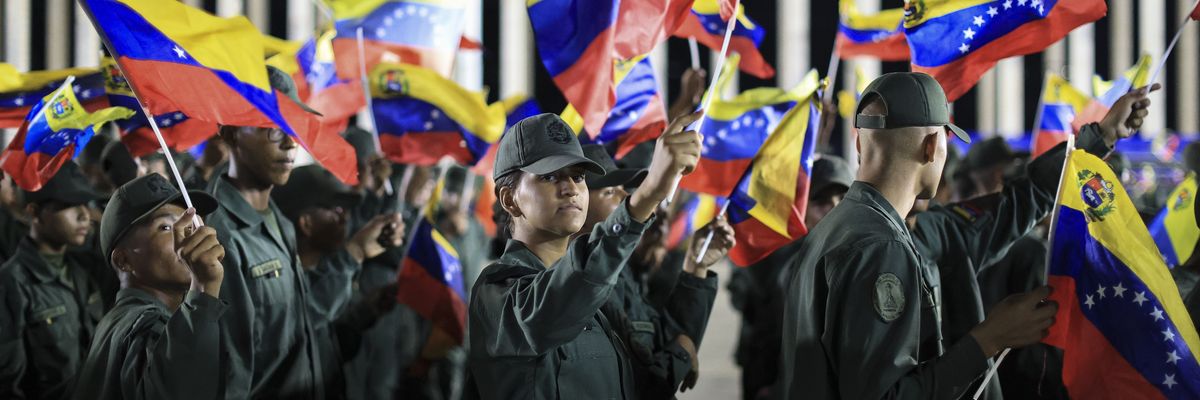
Members of the Bolivarian National Armed Forces (FANB) wave Venezuelan flags during a military ceremony commemorating the 200th anniversary of the presentation of the ‘Sword of Peru’ to Venezuelan independence hero Simón Bolívar on November 25, 2025, in Caracas, Venezuela.
(Photo by Jesus Vargas/Getty Images)
Michelle Ellner
Dec 10, 2025
Under international law, executing people outside a genuine armed conflict is an extrajudicial killing. Nothing about these strikes meets the legal threshold for war. But if we don’t hold the president to account, a war is exactly what we may get.
Members of the Bolivarian National Armed Forces (FANB) wave Venezuelan flags during a military ceremony commemorating the 200th anniversary of the presentation of the ‘Sword of Peru’ to Venezuelan independence hero Simón Bolívar on November 25, 2025, in Caracas, Venezuela.
(Photo by Jesus Vargas/Getty Images)
Michelle Ellner
Dec 10, 2025
Common Dreams
The first US missiles that struck the boats in the Caribbean in early September 2025 were described by Washington as a “counter-narcotics operation,” a sterile phrase meant to dull the violence of incinerating human beings in an instant. Then came the second strike, this time on survivors already struggling to stay afloat. Once the details emerged, however, the official story began to fall apart.
Local fishermen contradicted US claims. Relatives of those killed have said the men were not cartel operatives at all, but fishermen, divers, and small-scale couriers. Relatives in Trinidad and Venezuela told regional reporters their loved ones were unarmed and had no connection to Tren de Aragua or other cartels, describing them instead as fathers and sons who worked the sea to support their families. Some called the US narrative “impossible” and “a lie,” insisting the men were being demonized after their deaths. UN experts called the killings “extrajudicial.” Maritime workers noted what everyone in the region already knows: the route near Venezuela’s waters is not a fentanyl corridor into the United States. Yet the administration clung to its story, insisting these men were “narcoterrorists,” long after the facts had unraveled. Because in Washington’s post 9/11 playbook, fear is a tool. Fear is the architecture of modern American war.
The US did not emerge from the Iraq War into peace or reflection. It emerged into normalization. The legal theories invented and abused after 9/11—elastic self-defense, limitless definitions of terrorism, enemy combatants, global strike authority—did not fade. They became the backbone of a permanent war machine. These justifications supported drone wars in Pakistan, airstrikes in Yemen and Somalia, the destruction of Libya, special operations in Syria, and yet another military return to Iraq. And behind every expansion of this global battlefield was a US weapons industry that grew richer with each intervention, lobbying for policies that kept the country in a constant state of conflict. What we are seeing today in the Caribbean is not an isolated action; it is the extension of a militarized imperial model that treats entire regions as expendable.
There is no legitimate reason for a president to hide the legal basis for lethal force, unless the argument collapses under scrutiny. A secret opinion cannot serve as the foundation for an open-ended military campaign in the Western Hemisphere.
The next wars were always there because we never confronted the political and economic system that made endless wars a profitable cornerstone of US power.
A Post-9/11 Legal Framework Built for Endless War
The Trump administration has advanced several overlapping legal arguments to justify the strikes, and together they reveal a post-9/11 framework that stretches executive power far beyond its intended limits.
According to detailed reporting in The Washington Post, a classified Justice Department Office of Legal Counsel (OLC) memo argues that the United States is engaged in a “non-international armed conflict” with so-called narcoterrorist organizations. Under this theory, the strikes qualify as part of an ongoing armed conflict rather than a new “war” requiring congressional authorization. This framing alone is unprecedented: drug-trafficking groups are criminal networks, not organized armed groups targeting the US.
A second pillar of the memo, described by lawmakers to the Wall Street Journal, claims that once the president designates a cartel as a Foreign Terrorist Organization, it becomes a lawful military target. But terrorism designations have never created war powers. They are financial and sanctions tools, not authorizations for lethal force. As Sen. Andy Kim put it, using an FTO label as a “kinetic justification” is something “that has never been done before.”
The OLC memo also invokes Article II, claiming the president can order strikes as part of his commander-in-chief authority. Yet this argument depends on a second unsupported premise: that the boats posed a threat significant enough to justify self-defense. Even internal government lawyers questioned this. As one person familiar with the deliberations told the Washington Post, “There is no actual threat justifying self-defense—there are not organized armed groups seeking to kill Americans.”
At the same time, the administration has publicly insisted that these operations do not rise to the level of “hostilities” that would trigger the War Powers Resolution because US military personnel were never placed at risk. By the administration’s own logic, that means the people on the boats were not engaged in hostilities and therefore were not combatants under any accepted legal standard, making the claim of a wartime self-defense strike impossible to reconcile with US or international law.
Under international law, executing people outside a genuine armed conflict is an extrajudicial killing. Nothing about these strikes meets the legal threshold for war. Because the people on the boats were not lawful combatants, the operation risks violating both international law and U.S. criminal law, including statutes on murder at sea, a concern reportedly underscored by Admiral Alvin Holsey’s early resignation.
The memo goes further still, invoking “collective self-defense” on behalf of regional partners. But key regional partners, including Colombia, Brazil, and Mexico, have publicly criticized the strikes and said they were not consulted, undermining the very premise of “collective” defense.
This internal contradiction is one reason lawmakers across both parties have called the reasoning incoherent. As Sen. Chris Van Hollen put it, “This is a memo where the decision was made, and someone was told to come up with a justification for the decision.”
And beneath all of this lies the most dangerous element: the memo’s logic has no geographic limits. If the administration claims it is in an armed conflict with a designated “narcoterrorist” group, then, by its own theory, lethal force could be used wherever members of that group are found. The same framework that justifies strikes near Venezuela could, in principle, be invoked in a US city if the administration claimed a cartel “cell” existed there.
If Trump truly believes he leads “the most transparent administration in history,” then releasing the memo should be automatic. The American people have the right to know what legal theory is being used to justify killing people in their name.
For decades, OLC memos have been used not simply as legal advice but as the internal architecture that allows presidents to expand their war-making power. The Bush torture memos treated torture as lawful by redefining the word “torture” itself, calling it “enhanced interrogation,” thereby enabling years of CIA black-site operations and abusive interrogations. The Libya War Powers memo argued that bombing Libya did not constitute “hostilities,” allowing the administration to continue military action without congressional approval. Targeted-killing memos, including those related to drone strikes on US citizens abroad, constructed a legal theory that lethal force could be used outside traditional battlefields, without trial, based on executive determinations alone. In each case, the memo did not merely interpret the law; it reshaped the boundaries of presidential war powers, often without public debate or congressional authorization.
The American people have the right to know what “legal theory” is being used to justify killing people in their name. Congress needs it to conduct oversight. Service members need it to understand the legality of the orders they receive. And the international community needs clarity on the standards the US claims to follow. There is no legitimate reason for a president to hide the legal basis for lethal force, unless the argument collapses under scrutiny. A secret opinion cannot serve as the foundation for an open-ended military campaign in the Western Hemisphere.
The Older Foundation: A 200-Year-Old Doctrine of Control
If the legal foundation comes from the post-9/11 era, the geopolitical foundation is older—almost ancestral. For 200 years, the Monroe Doctrine has served as the permission slip for US domination in Latin America.
The Trump administration went even further by openly reviving and expanding it through what officials called a “Trump Corollary,” which reframed the entire Western Hemisphere as a US “defense perimeter” and justified increased military operations under the language of counter-narcotics, migration control, and regional stability. In this framework, Latin America is no longer treated as a diplomatic neighbor but as a security zone where Washington can act unilaterally.
Venezuela, with its vast oil reserves, sovereign political project, and refusal to submit to US pressure, has long been marked as a target. Sanctions softened the terrain. Disinformation hardened public opinion. And now, military strikes near its waters test how far Washington can push without triggering public revolt at home. The term “narcoterrorism” is simply the newest mask on a very old doctrine.
The strikes in the Caribbean are not isolated. They are the predictable intersection of two forces: a post-9/11 legal regime that allows war to expand without congressional approval, and a 200-year-old imperial doctrine that treats Latin America as a zone of control rather than a community of sovereign nations. Together, they form the logic that justifies today’s violence near Venezuela.
The Label that Opened the Door
After 9/11, every administration learned the same lesson: if you label something “terrorism,” the public will let you do almost anything. Now, this logic is being used everywhere. The cruel, decades-long blockade on Cuba is justified by claiming that the island is a “state sponsor of terrorism.” Mass surveillance, border militarization, endless sanctions, all wrapped in the language of “counterterrorism.” And now, to authorize military action in the Caribbean, they simply take the word “narco” and attach it to the word “terrorism.” The label does all the work. The danger is not confined to foreign policy: after Charlie Kirk’s assassination, the same elastic definition of “terrorism” is now being used domestically to justify crackdowns on NGOs the administration claims are inciting “anti-American” political violence.
The only reason Trump has not launched a full-scale attack on Venezuela is that he is still testing the ground, testing resistance inside Venezuela, testing Congress, testing the media, and testing us. He knows nearly 70% of people in the United States oppose a war with Venezuela. He knows he cannot sell another Iraq. So he is probing, pushing, looking for the line we will not let him cross.
We are that line.
If we do not challenge the lie now, if we do not demand release of the memo, if we stay silent, “narcoterrorism” becomes the new “weapons of mass destruction.” If we allow this test case to go unanswered, the next strike will be a war. We are the only ones who can stop him. And history is watching to see whether we learned anything from the last twenty years of fear, deception, and violence.
Because the next wars were always here, looming. We just need the clarity to see them and the force to stop them before they begin.
Our work is licensed under Creative Commons (CC BY-NC-ND 3.0). Feel free to republish and share widely.
Michelle Ellner
Michelle Ellner is a Latin America campaign coordinator of CODEPINK. She was born in Venezuela and holds a bachelor’s degree in languages and international affairs from the University La Sorbonne Paris IV, in Paris. After graduating, she worked for an international scholarship program out of offices in Caracas and Paris and was sent to Haiti, Cuba, The Gambia, and other countries for the purpose of evaluating and selecting applicants.
Full Bio >
The first US missiles that struck the boats in the Caribbean in early September 2025 were described by Washington as a “counter-narcotics operation,” a sterile phrase meant to dull the violence of incinerating human beings in an instant. Then came the second strike, this time on survivors already struggling to stay afloat. Once the details emerged, however, the official story began to fall apart.
Local fishermen contradicted US claims. Relatives of those killed have said the men were not cartel operatives at all, but fishermen, divers, and small-scale couriers. Relatives in Trinidad and Venezuela told regional reporters their loved ones were unarmed and had no connection to Tren de Aragua or other cartels, describing them instead as fathers and sons who worked the sea to support their families. Some called the US narrative “impossible” and “a lie,” insisting the men were being demonized after their deaths. UN experts called the killings “extrajudicial.” Maritime workers noted what everyone in the region already knows: the route near Venezuela’s waters is not a fentanyl corridor into the United States. Yet the administration clung to its story, insisting these men were “narcoterrorists,” long after the facts had unraveled. Because in Washington’s post 9/11 playbook, fear is a tool. Fear is the architecture of modern American war.
The US did not emerge from the Iraq War into peace or reflection. It emerged into normalization. The legal theories invented and abused after 9/11—elastic self-defense, limitless definitions of terrorism, enemy combatants, global strike authority—did not fade. They became the backbone of a permanent war machine. These justifications supported drone wars in Pakistan, airstrikes in Yemen and Somalia, the destruction of Libya, special operations in Syria, and yet another military return to Iraq. And behind every expansion of this global battlefield was a US weapons industry that grew richer with each intervention, lobbying for policies that kept the country in a constant state of conflict. What we are seeing today in the Caribbean is not an isolated action; it is the extension of a militarized imperial model that treats entire regions as expendable.
There is no legitimate reason for a president to hide the legal basis for lethal force, unless the argument collapses under scrutiny. A secret opinion cannot serve as the foundation for an open-ended military campaign in the Western Hemisphere.
The next wars were always there because we never confronted the political and economic system that made endless wars a profitable cornerstone of US power.
A Post-9/11 Legal Framework Built for Endless War
The Trump administration has advanced several overlapping legal arguments to justify the strikes, and together they reveal a post-9/11 framework that stretches executive power far beyond its intended limits.
According to detailed reporting in The Washington Post, a classified Justice Department Office of Legal Counsel (OLC) memo argues that the United States is engaged in a “non-international armed conflict” with so-called narcoterrorist organizations. Under this theory, the strikes qualify as part of an ongoing armed conflict rather than a new “war” requiring congressional authorization. This framing alone is unprecedented: drug-trafficking groups are criminal networks, not organized armed groups targeting the US.
A second pillar of the memo, described by lawmakers to the Wall Street Journal, claims that once the president designates a cartel as a Foreign Terrorist Organization, it becomes a lawful military target. But terrorism designations have never created war powers. They are financial and sanctions tools, not authorizations for lethal force. As Sen. Andy Kim put it, using an FTO label as a “kinetic justification” is something “that has never been done before.”
The OLC memo also invokes Article II, claiming the president can order strikes as part of his commander-in-chief authority. Yet this argument depends on a second unsupported premise: that the boats posed a threat significant enough to justify self-defense. Even internal government lawyers questioned this. As one person familiar with the deliberations told the Washington Post, “There is no actual threat justifying self-defense—there are not organized armed groups seeking to kill Americans.”
At the same time, the administration has publicly insisted that these operations do not rise to the level of “hostilities” that would trigger the War Powers Resolution because US military personnel were never placed at risk. By the administration’s own logic, that means the people on the boats were not engaged in hostilities and therefore were not combatants under any accepted legal standard, making the claim of a wartime self-defense strike impossible to reconcile with US or international law.
Under international law, executing people outside a genuine armed conflict is an extrajudicial killing. Nothing about these strikes meets the legal threshold for war. Because the people on the boats were not lawful combatants, the operation risks violating both international law and U.S. criminal law, including statutes on murder at sea, a concern reportedly underscored by Admiral Alvin Holsey’s early resignation.
The memo goes further still, invoking “collective self-defense” on behalf of regional partners. But key regional partners, including Colombia, Brazil, and Mexico, have publicly criticized the strikes and said they were not consulted, undermining the very premise of “collective” defense.
This internal contradiction is one reason lawmakers across both parties have called the reasoning incoherent. As Sen. Chris Van Hollen put it, “This is a memo where the decision was made, and someone was told to come up with a justification for the decision.”
And beneath all of this lies the most dangerous element: the memo’s logic has no geographic limits. If the administration claims it is in an armed conflict with a designated “narcoterrorist” group, then, by its own theory, lethal force could be used wherever members of that group are found. The same framework that justifies strikes near Venezuela could, in principle, be invoked in a US city if the administration claimed a cartel “cell” existed there.
If Trump truly believes he leads “the most transparent administration in history,” then releasing the memo should be automatic. The American people have the right to know what legal theory is being used to justify killing people in their name.
For decades, OLC memos have been used not simply as legal advice but as the internal architecture that allows presidents to expand their war-making power. The Bush torture memos treated torture as lawful by redefining the word “torture” itself, calling it “enhanced interrogation,” thereby enabling years of CIA black-site operations and abusive interrogations. The Libya War Powers memo argued that bombing Libya did not constitute “hostilities,” allowing the administration to continue military action without congressional approval. Targeted-killing memos, including those related to drone strikes on US citizens abroad, constructed a legal theory that lethal force could be used outside traditional battlefields, without trial, based on executive determinations alone. In each case, the memo did not merely interpret the law; it reshaped the boundaries of presidential war powers, often without public debate or congressional authorization.
The American people have the right to know what “legal theory” is being used to justify killing people in their name. Congress needs it to conduct oversight. Service members need it to understand the legality of the orders they receive. And the international community needs clarity on the standards the US claims to follow. There is no legitimate reason for a president to hide the legal basis for lethal force, unless the argument collapses under scrutiny. A secret opinion cannot serve as the foundation for an open-ended military campaign in the Western Hemisphere.
The Older Foundation: A 200-Year-Old Doctrine of Control
If the legal foundation comes from the post-9/11 era, the geopolitical foundation is older—almost ancestral. For 200 years, the Monroe Doctrine has served as the permission slip for US domination in Latin America.
The Trump administration went even further by openly reviving and expanding it through what officials called a “Trump Corollary,” which reframed the entire Western Hemisphere as a US “defense perimeter” and justified increased military operations under the language of counter-narcotics, migration control, and regional stability. In this framework, Latin America is no longer treated as a diplomatic neighbor but as a security zone where Washington can act unilaterally.
Venezuela, with its vast oil reserves, sovereign political project, and refusal to submit to US pressure, has long been marked as a target. Sanctions softened the terrain. Disinformation hardened public opinion. And now, military strikes near its waters test how far Washington can push without triggering public revolt at home. The term “narcoterrorism” is simply the newest mask on a very old doctrine.
The strikes in the Caribbean are not isolated. They are the predictable intersection of two forces: a post-9/11 legal regime that allows war to expand without congressional approval, and a 200-year-old imperial doctrine that treats Latin America as a zone of control rather than a community of sovereign nations. Together, they form the logic that justifies today’s violence near Venezuela.
The Label that Opened the Door
After 9/11, every administration learned the same lesson: if you label something “terrorism,” the public will let you do almost anything. Now, this logic is being used everywhere. The cruel, decades-long blockade on Cuba is justified by claiming that the island is a “state sponsor of terrorism.” Mass surveillance, border militarization, endless sanctions, all wrapped in the language of “counterterrorism.” And now, to authorize military action in the Caribbean, they simply take the word “narco” and attach it to the word “terrorism.” The label does all the work. The danger is not confined to foreign policy: after Charlie Kirk’s assassination, the same elastic definition of “terrorism” is now being used domestically to justify crackdowns on NGOs the administration claims are inciting “anti-American” political violence.
The only reason Trump has not launched a full-scale attack on Venezuela is that he is still testing the ground, testing resistance inside Venezuela, testing Congress, testing the media, and testing us. He knows nearly 70% of people in the United States oppose a war with Venezuela. He knows he cannot sell another Iraq. So he is probing, pushing, looking for the line we will not let him cross.
We are that line.
If we do not challenge the lie now, if we do not demand release of the memo, if we stay silent, “narcoterrorism” becomes the new “weapons of mass destruction.” If we allow this test case to go unanswered, the next strike will be a war. We are the only ones who can stop him. And history is watching to see whether we learned anything from the last twenty years of fear, deception, and violence.
Because the next wars were always here, looming. We just need the clarity to see them and the force to stop them before they begin.
Our work is licensed under Creative Commons (CC BY-NC-ND 3.0). Feel free to republish and share widely.
Michelle Ellner
Michelle Ellner is a Latin America campaign coordinator of CODEPINK. She was born in Venezuela and holds a bachelor’s degree in languages and international affairs from the University La Sorbonne Paris IV, in Paris. After graduating, she worked for an international scholarship program out of offices in Caracas and Paris and was sent to Haiti, Cuba, The Gambia, and other countries for the purpose of evaluating and selecting applicants.
Full Bio >
Princeton Experts Speak Out Against Trump Boat Strikes as ‘Illegal’ and Destabilizing ‘Murders’
“Deploying an aircraft carrier and US Southern Command assets to destroy small yolas and wooden boats is not only unlawful, it is an absurd escalation,” said one scholar.
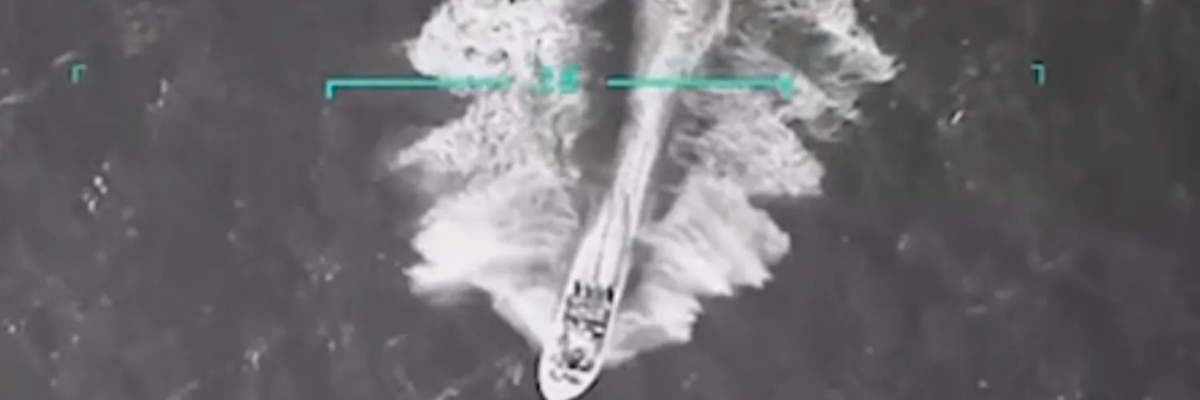
This image was posted on social media by President Donald Trump and shows a boat that was allegedly transporting cocaine off the coast of Venezuela when it was destroyed by US forces on September 2, 2025.
(Photo: President Donald Trump/Truth Social)
Brad Reed
Dec 10, 2025
C0MMON DREAMS
Multiple scholars at the Princeton School of Public and International Affairs on Wednesday spoke out against the Trump administration’s campaign of bombing suspected drug boats, with one going so far as to call them acts of murder.
Eduardo Bhatia, a visiting professor and lecturer in public and international affairs at Princeton, argued that it was “unequivocal” that the attacks on on purported drug boats are illegal.
“They violate established maritime law requiring interdiction and arrest before the use of lethal force, and they represent a grossly disproportionate response by the US,” stressed Bhatia, the former president of the Senate of Puerto Rico. “Deploying an aircraft carrier and US Southern Command assets to destroy small yolas and wooden boats is not only unlawful, it is an absurd escalation that undermines regional security and diplomatic stability.”
Deborah Pearlstein, director of the Program in Law and Public Policy at Princeton, said that she has been talking with “military operations lawyers, international law experts, national security legal scholars,” and other experts, and so far has found none who believe the administration’s boat attacks are legal.
Pearlstein added that the illegal strikes are “a symptom of the much deeper problem created by the purging of career lawyers on the front end, and the tacit promise of presidential pardons on the back end,” the result of which is that “the rule of law loses its deterrent effect.”
Visiting professor Kenneth Roth, former executive director of Human Rights Watch, argued that it was not right to describe the administration’s actions as war crimes given that a war, by definition, “requires a level of sustained hostilities between two organized forces that is not present with the drug cartels.”
Rather, Roth believes that the administration’s policy should be classified as straight-up murder.
“These killings are still murders,” he emphasized. “Drug trafficking is a serious crime, but the appropriate response is to interdict the boats and arrest the occupants for prosecution. The rules governing law enforcement prohibit lethal force except as a last resort to stop an imminent threat of death or serious bodily injury, which the boats do not present.”
International affairs professor Jacob N. Shapiro pointed to the past failures in the US “War on Drugs,” and predicted more of the same from Trump’s boat-bombing spree.
“In 1986, President Ronald Reagan announced the ‘War on Drugs,’ which included using the Coast Guard and military to essentially shut down shipment through the Caribbean,” Shapiro noted. “The goal was to reduce supply, raise prices, and thereby lower use. Cocaine prices in the US dropped precipitously from 1986 through 1989, and then dropped slowly through 2006. Traffickers moved from air and sea to land routes. That policy did not work, it’s unclear why this time will be different.”
The scholars’ denunciation of the boat strikes came on the same day that the US seized an oil tanker off the coast of Venezuela in yet another escalatory act of aggression intended to put further economic pressure on the government of Venezuelan President Nicolás Maduro.
“Deploying an aircraft carrier and US Southern Command assets to destroy small yolas and wooden boats is not only unlawful, it is an absurd escalation,” said one scholar.
This image was posted on social media by President Donald Trump and shows a boat that was allegedly transporting cocaine off the coast of Venezuela when it was destroyed by US forces on September 2, 2025.
(Photo: President Donald Trump/Truth Social)
Brad Reed
Dec 10, 2025
C0MMON DREAMS
Multiple scholars at the Princeton School of Public and International Affairs on Wednesday spoke out against the Trump administration’s campaign of bombing suspected drug boats, with one going so far as to call them acts of murder.
Eduardo Bhatia, a visiting professor and lecturer in public and international affairs at Princeton, argued that it was “unequivocal” that the attacks on on purported drug boats are illegal.
“They violate established maritime law requiring interdiction and arrest before the use of lethal force, and they represent a grossly disproportionate response by the US,” stressed Bhatia, the former president of the Senate of Puerto Rico. “Deploying an aircraft carrier and US Southern Command assets to destroy small yolas and wooden boats is not only unlawful, it is an absurd escalation that undermines regional security and diplomatic stability.”
Deborah Pearlstein, director of the Program in Law and Public Policy at Princeton, said that she has been talking with “military operations lawyers, international law experts, national security legal scholars,” and other experts, and so far has found none who believe the administration’s boat attacks are legal.
Pearlstein added that the illegal strikes are “a symptom of the much deeper problem created by the purging of career lawyers on the front end, and the tacit promise of presidential pardons on the back end,” the result of which is that “the rule of law loses its deterrent effect.”
Visiting professor Kenneth Roth, former executive director of Human Rights Watch, argued that it was not right to describe the administration’s actions as war crimes given that a war, by definition, “requires a level of sustained hostilities between two organized forces that is not present with the drug cartels.”
Rather, Roth believes that the administration’s policy should be classified as straight-up murder.
“These killings are still murders,” he emphasized. “Drug trafficking is a serious crime, but the appropriate response is to interdict the boats and arrest the occupants for prosecution. The rules governing law enforcement prohibit lethal force except as a last resort to stop an imminent threat of death or serious bodily injury, which the boats do not present.”
International affairs professor Jacob N. Shapiro pointed to the past failures in the US “War on Drugs,” and predicted more of the same from Trump’s boat-bombing spree.
“In 1986, President Ronald Reagan announced the ‘War on Drugs,’ which included using the Coast Guard and military to essentially shut down shipment through the Caribbean,” Shapiro noted. “The goal was to reduce supply, raise prices, and thereby lower use. Cocaine prices in the US dropped precipitously from 1986 through 1989, and then dropped slowly through 2006. Traffickers moved from air and sea to land routes. That policy did not work, it’s unclear why this time will be different.”
The scholars’ denunciation of the boat strikes came on the same day that the US seized an oil tanker off the coast of Venezuela in yet another escalatory act of aggression intended to put further economic pressure on the government of Venezuelan President Nicolás Maduro.
One former Navy lawyer said the Trump administration “might not want to get into the messy issues involving detention and habeas corpus lawsuits.”
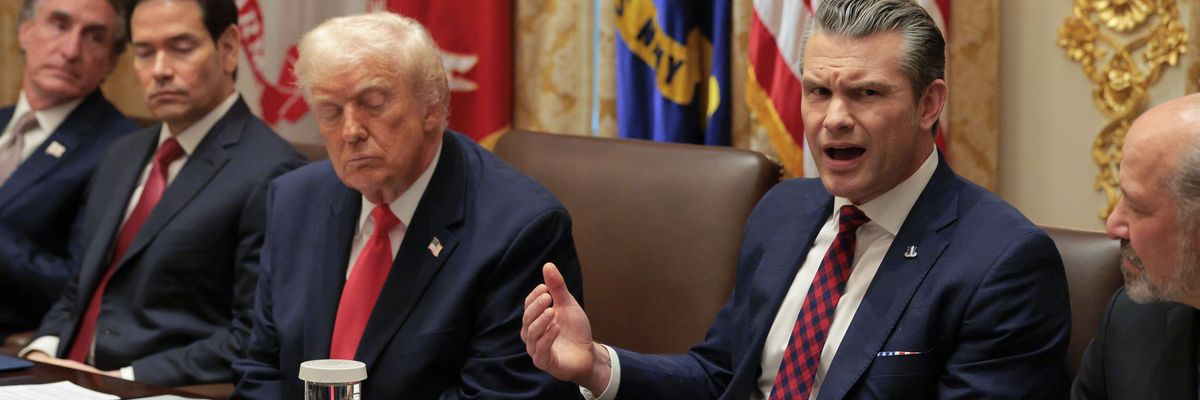
US Defense Secretary Pete Hegseth speaks alongside President Donald Trump, Secretary of State Marco Rubio, and other senior administration officials at the White House in Washington, DC on December 2, 2025.
(Photo by Chip Somodevilla/Getty Images)
Brett Wilkins
Dec 10, 2025
COMMON DREAMS
Pentagon officials asked about sending survivors of US boat strikes in the Caribbean Sea and Pacific Ocean to a notorious maximum security prison in El Salvador in a bid to keep them out of American courts—where the Trump administration’s high seas extrajudicial killing spree would be subject to legal scrutiny.
New details published Tuesday by the New York Times revealed that attorneys at the US Department of Defense inquired about whether two survivors of an October 16 strike on a boat allegedly smuggling drugs in the southern Caribbean could be sent to El Salvador’s Terrorism Confinement Center (CECOT), where the Trump administration has shipped ihundreds of mostly Venezuelan victims of its mass deportation campaign.
The prison—the centerpiece of right-wing Salvadoran President Nayib Bukele’s war on crime—has been plagued by allegations of torture and other abuse.
One Trump administration official speaking on condition of anonymity told the Times that State Department lawyers were “stunned” by the query. The two boat strike survivors were ultimately returned to Colombia and Ecuador, their home countries.
Other unnamed officials told the newspaper that repatriations—either to survivors’ home countries or to third nations—would become the administration’s default plan for dealing with anyone who lived through the US attacks.
The goal, the officials said, was to avoid trying boat strike survivors in US courts, where the discovery process would compel the Trump administration—which has offered no concrete evidence to support its claims that the targeted vessels were carrying drugs—to provide legal justification for attacks that experts say are illegal.
The Pentagon’s inquiry followed a September 2 “double-tap” strike on a vessel carrying 11 passengers. Two men survived the initial bombing but were killed in a second strike. Since then, at least 76 other people have been killed in 23 boat strikes reported by the Trump administration.
In addition to the two men who initially survived the September 2 strike and the two repatriated survivors of the October 16 attack, one other person who lived through a boat bombing was left adrift at sea and is presumed dead.
Some observers have noted similarities between the Trump administration’s goal of keeping boat strike survivors out of US courtrooms and War on Terror policies and practices—first implemented during the George W. Bush administration—such as extraordinary rendition, the use of Central Intelligence Agency “black sites,” and imprisonment of terrorism suspects at Guantánamo Bay in Cuba—designed to circumvent the law.
While the Trump administration previously sent migrants captured during its crackdown to Guantánamo, sending boat strike survivors to the lockup allow their lawyers to sue for habeas corpus, a right granted by the US Supreme Court in its 2008 Boumediene v. Bush decision.
The Trump administration has revived the term “unlawful enemy combatant”—which was used by the Bush administration to classify people caught up in the War on Terror in a way that skirts the law—to apply to boat strike survivors. The Pentagon has also called such survivors “distressed mariners,” a term that normally applies to civilians stranded at sea.
“If we’re in a war, they should be using the term ‘shipwrecked survivors,’” Mark Nevitt, a former Navy lawyer who is now a law professor at Emory University, told the Times. “My theory is they might not want to get into the messy issues involving detention and habeas corpus lawsuits.”
Relatives of men killed in the strikes, as well as officials in Venezuela and Colombia, say that at least some of the victims were fishermen who were not linked to the illicit drug trade. One expert said last month that even in cases of vessels that were involved in drug trafficking, the bombings were “the equivalent of straight-up massacring 16-year-old drug dealers on US street corners.”
Even if the men targeted in the boat strikes were running drugs, “the appropriate response is to interdict the boats and arrest the occupants for prosecution,” former Human Rights Watch executive director Kenneth Roth said Wednesday.
“The rules governing law enforcement prohibit lethal force except as a last resort to stop an imminent threat of death or serious bodily injury,” he added, “which the boats do not present.”

No comments:
Post a Comment