Pope criticizes US bid to 'break apart' US-Europe alliance, insists on Europe role in Ukraine peace
ROME (AP) — Leo was asked about the U.S. peace proposal and the seeming sidelining of European powers in the process.
Nicole Winfield
December 11, 2025
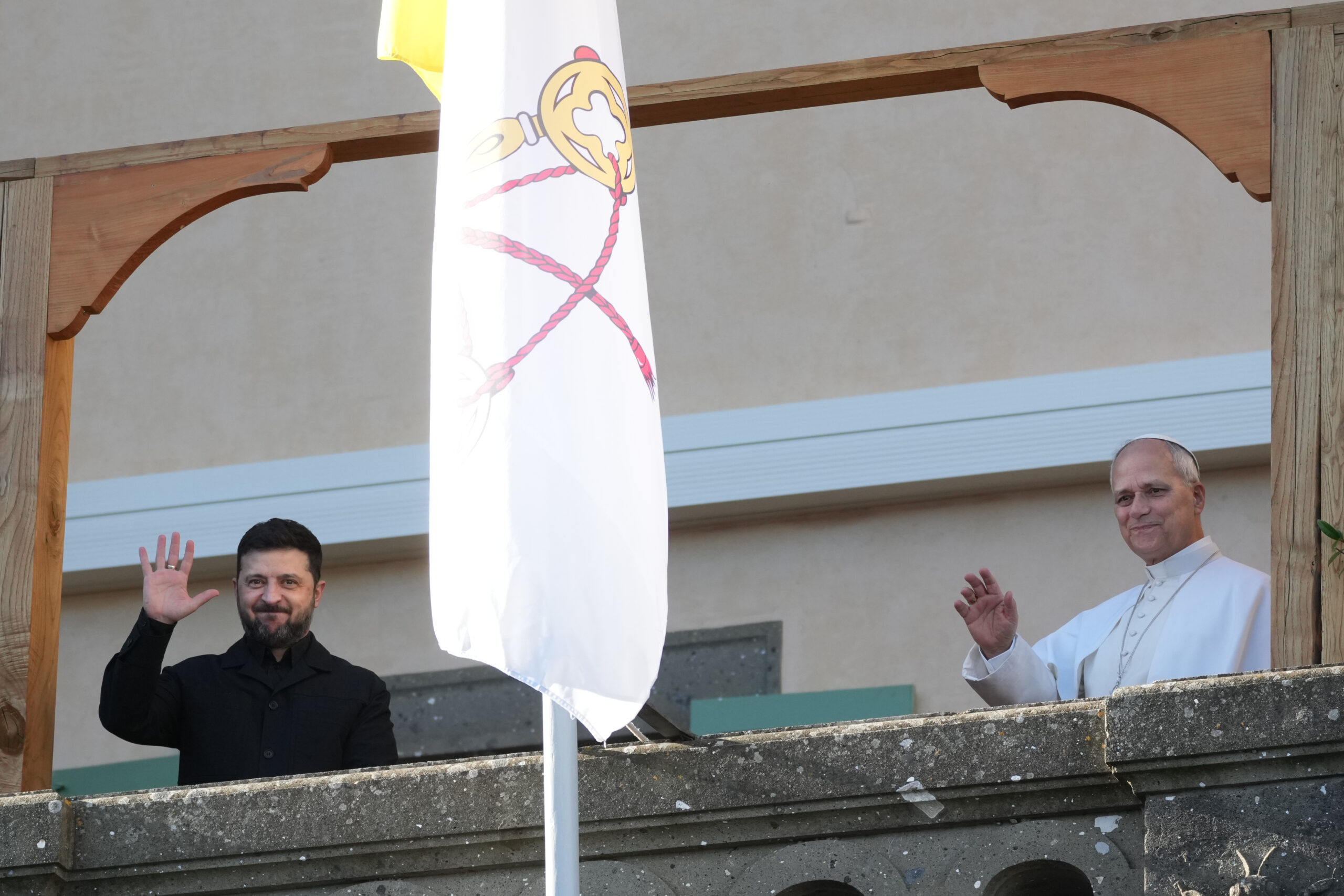
ROME (AP) — Pope Leo XIV insisted Tuesday that Europe must have a role in any Ukraine peace deal and criticized what he said was the Trump administration’s effort to “break apart” the long-standing U.S.-European alliance.
Leo spoke to reporters after meeting with Ukrainian President Volodymyr Zelenskyy, who is on another tour to rally European support for Kyiv. The American pope said they discussed the need for a ceasefire and the Vatican’s efforts to facilitate the return of Ukrainian children taken by Russian authorities.
Leo was asked about the U.S. peace proposal and the seeming sidelining of European powers in the process. Speaking as he left his vacation home in Castel Gandolfo, Leo insisted that Europe’s role was crucial to any deal.
“Seeking a peace agreement without including Europe in the talks is unrealistic, given the war is in Europe,” he said. “Guarantees are also being sought for security today and in the future. Europe must be part of this, and unfortunately not everyone understands this, but I think there is a great opportunity for European leaders to unite and seek a solution together.”
Zelenskyy has said there are three documents in the peace agreement being discussed with U.S. and European partners, a framework document of 20 points, a second document with security guarantees, and a third document about Ukraine’s recovery.
Leo was asked about the U.S. peace plan for Ukraine but appeared to respond to a broader question about the Trump administration’s views on the U.S.-Europe alliance. Just last week, the Trump administration released its U.S. national security strategy, which questions the U.S.-European alliance and stresses a desire to improve U.S.-Russia relations.
Leo said what he had read would “make a huge change in what was for many, many years a true alliance between Europe and the United States.” Additionally, some comments by U.S. President Donald Trump suggest an effort “trying to break apart what I think needs to be an alliance today and in the future.”
While some people in the United States may agree with that effort, “I think many others would see things in a different way,” Leo said.
The Holy See has tried to remain neutral in Russia’s war while offering solidarity and concrete assistance to what it calls the “martyred” people of Ukraine. Leo has met now three times with Zelenskyy and has spoken by telephone at least once with Russian President Vladimir Putin.
The American pope has called for a ceasefire and urged Russia in particular to make gestures to promote peace.
The Vatican has also tried to facilitate the return of Ukrainian children taken by Russian authorities, and last month Leo met with some returned children at the Vatican.
___
Associated Press religion coverage receives support through the AP’s collaboration with The Conversation US, with funding from Lilly Endowment Inc. The AP is solely responsible for this content.
Trump admin ignites 'intense battle' with top allies over 'profound' change to Europe
Nicole Charky-Chami
December 10, 2025 RAW STORY

President Donald Trump, Ukrainian President Volodymyr Zelenskiy, German Chancellor Friedrich Merz, French President Emmanuel Macron, British Prime Minister Keir Starmer, Italian Prime Minister Giorgia Meloni, and Finland's President Alexander Stubb, NATO Secretary General Mark Rutte and European Commission President Ursula von der Leyen pose for a photo amid negotiations to end the Russian war in Ukraine, at the White House in Washington, D.C. on Aug. 18, 2025. REUTERS/Alexander Drago
The Trump administration has given its European partners a plan on how it wants to rebuild Ukraine and bring Russia back into the world market, according to an exclusive Wall Street Journal report published Wednesday.
The appendices have not been publicly released; however, U.S. and European officials have described them to The Journal and have indicated that U.S. financial organizations and businesses will use about $200 billion in frozen Russian assets to help fund projects in Ukraine. Those efforts include a new, large-scale data center to be powered by a nuclear plant currently under occupation by Russian troops.
"The proposals have sparked an intense battle at the negotiating table between America and its traditional allies in Europe. The outcome stands to profoundly alter the economic map of the continent," according to The Journal.
One appendix apparently focuses on a vision to bring back Russian energy across Western Europe and globally, with U.S. firms investing in rare-earth extraction and oil drilling in the Arctic, the report indicated.
"Some European officials who have seen the documents said they weren’t sure whether to take some of the U.S. proposals seriously. One official compared them to President Trump’s vision of building a Riviera-style development in Gaza," The Journal reported. "Another, referring to the proposed U.S.-Russia energy deals, said it was an economic version of the 1945 conference where World War II victors divvied up Europe. 'It’s like Yalta,' he said."
ROME (AP) — Leo was asked about the U.S. peace proposal and the seeming sidelining of European powers in the process.
Nicole Winfield
December 11, 2025
ROME (AP) — Pope Leo XIV insisted Tuesday that Europe must have a role in any Ukraine peace deal and criticized what he said was the Trump administration’s effort to “break apart” the long-standing U.S.-European alliance.
Leo spoke to reporters after meeting with Ukrainian President Volodymyr Zelenskyy, who is on another tour to rally European support for Kyiv. The American pope said they discussed the need for a ceasefire and the Vatican’s efforts to facilitate the return of Ukrainian children taken by Russian authorities.
Leo was asked about the U.S. peace proposal and the seeming sidelining of European powers in the process. Speaking as he left his vacation home in Castel Gandolfo, Leo insisted that Europe’s role was crucial to any deal.
“Seeking a peace agreement without including Europe in the talks is unrealistic, given the war is in Europe,” he said. “Guarantees are also being sought for security today and in the future. Europe must be part of this, and unfortunately not everyone understands this, but I think there is a great opportunity for European leaders to unite and seek a solution together.”
Zelenskyy has said there are three documents in the peace agreement being discussed with U.S. and European partners, a framework document of 20 points, a second document with security guarantees, and a third document about Ukraine’s recovery.
Leo was asked about the U.S. peace plan for Ukraine but appeared to respond to a broader question about the Trump administration’s views on the U.S.-Europe alliance. Just last week, the Trump administration released its U.S. national security strategy, which questions the U.S.-European alliance and stresses a desire to improve U.S.-Russia relations.
Leo said what he had read would “make a huge change in what was for many, many years a true alliance between Europe and the United States.” Additionally, some comments by U.S. President Donald Trump suggest an effort “trying to break apart what I think needs to be an alliance today and in the future.”
While some people in the United States may agree with that effort, “I think many others would see things in a different way,” Leo said.
The Holy See has tried to remain neutral in Russia’s war while offering solidarity and concrete assistance to what it calls the “martyred” people of Ukraine. Leo has met now three times with Zelenskyy and has spoken by telephone at least once with Russian President Vladimir Putin.
The American pope has called for a ceasefire and urged Russia in particular to make gestures to promote peace.
The Vatican has also tried to facilitate the return of Ukrainian children taken by Russian authorities, and last month Leo met with some returned children at the Vatican.
___
Associated Press religion coverage receives support through the AP’s collaboration with The Conversation US, with funding from Lilly Endowment Inc. The AP is solely responsible for this content.
Nicole Charky-Chami
December 10, 2025
President Donald Trump, Ukrainian President Volodymyr Zelenskiy, German Chancellor Friedrich Merz, French President Emmanuel Macron, British Prime Minister Keir Starmer, Italian Prime Minister Giorgia Meloni, and Finland's President Alexander Stubb, NATO Secretary General Mark Rutte and European Commission President Ursula von der Leyen pose for a photo amid negotiations to end the Russian war in Ukraine, at the White House in Washington, D.C. on Aug. 18, 2025. REUTERS/Alexander Drago
The Trump administration has given its European partners a plan on how it wants to rebuild Ukraine and bring Russia back into the world market, according to an exclusive Wall Street Journal report published Wednesday.
The appendices have not been publicly released; however, U.S. and European officials have described them to The Journal and have indicated that U.S. financial organizations and businesses will use about $200 billion in frozen Russian assets to help fund projects in Ukraine. Those efforts include a new, large-scale data center to be powered by a nuclear plant currently under occupation by Russian troops.
"The proposals have sparked an intense battle at the negotiating table between America and its traditional allies in Europe. The outcome stands to profoundly alter the economic map of the continent," according to The Journal.
One appendix apparently focuses on a vision to bring back Russian energy across Western Europe and globally, with U.S. firms investing in rare-earth extraction and oil drilling in the Arctic, the report indicated.
"Some European officials who have seen the documents said they weren’t sure whether to take some of the U.S. proposals seriously. One official compared them to President Trump’s vision of building a Riviera-style development in Gaza," The Journal reported. "Another, referring to the proposed U.S.-Russia energy deals, said it was an economic version of the 1945 conference where World War II victors divvied up Europe. 'It’s like Yalta,' he said."
“The Days of the United States Propping Up the Entire World Order Like Atlas Are Over.”
.png)
Trump’s National Security Strategy document was released late on Thursday
On Thursday, the White House released the new National Security Strategy for the United States. Others may well give it a different read, but here is my quick take:
The document is ghoulish, abhorrent, repetitious, and sometimes incoherent, but I found its honesty refreshing. The mask is torn off sanctimonious bullshit, tall tales about spreading democracy and caring about human rights. The US is “not grounded in traditional political idealism,” but by “America First.” (P.8) A bit of the usual boilerplate is here, but for the most part, the ideological cover is gone.
Dan Caldwell, onetime advisor to Defense Secretary Pete Hegseth, applauded the new American military restraint, saying, “For too long, delusion undergirded our foreign policy, delusion about America’s role in the world, delusion about our interests, and delusion about what we can achieve through military force. This is a reality-based document in that regard.” (NY Times,12/7/2025)
In place of pretense, the document spells out what US policy has always been about: undisguised economic nationalism — whatever benefits American grifter capitalism. All this unexpected candor required the New York Times to lamentably and hypocritically describe the new doctrine as “Security Strategy Focused on Profit, Not Spreading Democracy.” Going further, General Wesley Clark, former NATO Commander, joined in by saying that “The United States has sacrificed the magic of America. For 250 years, America lived the dream that we gave to all mankind. And we acted to protect that. The rules-based international order has served us so well.” Yes, he actually said that…
Here are a few specifics from a document that, without explicitly saying so, recognizes that the US is a declining power and must accommodate that reality
Ukraine: The US must press for an “expeditious cessation of hostilities.” This is as clear a public admission that we’re going to see from Trump that the US proxy war is lost. Ukraine will not be joining NATO; the organization must cease being a “perpetually expanding alliance.” The US should also “re-establish strategic stability with Russia.” This section states that “The days of the United States propping up the entire world order like Atlas are over.” One detects Vance’s input here.
The Middle East: The US will recede from the Middle East. There will be “No more” decades of nation-building wars, even as the area remains an area of “partnership, friendship, and investment.” The document also states that “We seek good and peaceful relations with other countries without imposing on them democratic or other changes that differ widely from their traditions and histories.” This falls under a section called “Flexible Realism.”
Europe: The US evidences contempt for Europe. As recently as last Wednesday, Trump said, “The European Union was founded to screw the United States.” The document asserts that Europe faces “civilization erasure” in 20 years, in large measure because immigration will make it “non-European.” Further, Europe must learn to “stand on its own feet” and “We expect our allies to spend far more on their Gross National Product (GDP) on their own defense to start making up for the enormous imbalances over decades of much greater spending by the United States.” This refers to Washington’s demand that European allies spend 5% of their GDP on defense.
Latin America: The United States will reassert its preeminence in the region, a development referred to as “The Trump Corollary” to the 1823 Monroe Doctrine. Hemispheric competitors will be prevented from owning and controlling energy facilities, ports, and telecommunication networks. The goal is to make the Western Hemisphere an increasingly attractive market for American commerce and investment. In accordance with this objective, US diplomats in the region are to seek out “major business opportunities in their country, especially major government contracts.” And they should be “sole-source contracts for our companies.” I sense that profits from the Western Hemisphere are expected to offset a shortfall elsewhere. There is an unmistakable message here that Latin American countries will no longer retain their sovereignty.
China: As nearly as I can tell, the document cautions that war over Taiwan should be avoided because it would have “major implications for the US economy.” Further, “Our allies must step up and spend — and more importantly do — much more for collective defense.” The document refers to establishing a “mutually advantageous relationship with China.”
.png)
Militarism Without Strategy: How the 2025 National Security Document Institutionalizes Perpetual Conflict
On December 4, 2025, the Trump administration released a document claiming to herald a “Golden Age of Peace”; yet a careful reading reveals an entirely different picture: a roadmap for institutionalizing chronic militarism and perpetuating conflict in a new form. The new U.S. National Security Strategy portrays Trump as the “Peace President” who has allegedly “achieved peace in eight global conflicts,” yet the same document simultaneously authorizes the use of “lethal force” in other countries, the expansion of military deployments at borders, and the weaponization of economic tools. This apparent contradiction is not accidental; it is part of a structural logic that links claims of non-interventionism with the reality of expanding military dominance.
The 2025 National Security Strategy reveals this operational redefinition of “peace through strength”—which in practice means the continuation of militarism, though no longer through direct occupation but through more complex mechanisms of regional control and economic coercion—across three key dimensions: first, the revival of the Monroe Doctrine, declaring the Western Hemisphere America’s “natural sphere of influence” and justifying military intervention against any “foreign threat”; second, the securitization of migration, transforming borders into military frontlines and legitimizing armed force deployment; and third, the legitimization of unilateral military operations on foreign soil under the banner of counter-terrorism and anti-cartel operations – all of which, beneath the rhetoric of peace, institutionalize the continuation of American militarism in a new guise.
The document crowns the president “The Peace President” and claims he has quietly ended eight wars around the world. In the very same pages, however, it calmly authorizes American forces to cross borders and use “lethal force” inside other sovereign countries, expands military deployments along entire continents, and turns economic tools into weapons of coercion. This is not a contradiction by accident; it is the whole design. It allows the government to say “we don’t want war” while building a system that keeps everyone on the edge of one.
From the viewpoint of anyone who has spent a lifetime studying real peace – the kind that lets children walk to school without fear, the kind that keeps hospitals open and fields planted – this document does not describe peace at all. It describes what scholars sadly call “structural violence”: a quiet, everyday violence that does not always make headlines with explosions, but that shortens lives all the same through fear, hunger, and the slow grind of sanctions and threats.
At the heart of the strategy is a new version of an old idea: the United States gets to decide what happens in the entire Western Hemisphere, and no one from outside – China, Russia, Europe, anyone – is allowed to have a say. They call it the “Trump Annex” to the Monroe Doctrine, but to families in Mexico, Colombia, or Honduras it simply sounds like a new declaration that their countries are not fully their own. The document says, in plain words, that American troops may enter any neighbor’s territory to hunt drug cartels, using deadly force whenever they judge it necessary, without asking permission and without going through the United Nations or any court. Drug cartels are criminals, yes. But turning a crime problem into a shooting war across borders has been tried before in Latin America, and the only things it ever produced were widows, orphans, and deeper hatred.
We have already seen the first signs: quiet navy raids on boats far out at sea, warships gathering off the coast of Venezuela, rumors of plans that look a lot like forced regime change. None of this is announced as war. No congress votes. No Security Council resolution. It is war by another name, hidden behind the phrase “border security.”
The document keeps repeating that America is done with interventionism, that it is neither hawk nor dove, neither realist nor idealist. Those words are carefully chosen so that any action – no matter how aggressive – can be made to fit. When Washington likes an authoritarian ally in the Middle East, it says “we don’t interfere in how others govern themselves.” When it dislikes a government in Latin America, the same principle disappears and the marines are suddenly an option. Rules, in this new vision, are not principles; they are tools to be picked up or discarded depending on power and convenience.
What we are left with is a strange kind of permanent half-war: no official declarations, no clear battlefields, just an endless low hum of menace. Troops on hair-trigger alert along borders that used to be neighbors. Economies strangled until they gasp. This is not the architecture of peace. It is the architecture of exhaustion, designed to keep everyone too afraid or too poor to challenge the new order.
Real peace – the kind human beings have always longed for – looks entirely different. It looks like a Guatemalan village where the army is no longer needed because the land reforms finally happened. It looks like a hospital in Sana’a or Gaza that never runs out of electricity. It looks like two teenagers, one Palestinian and one Israeli, playing football together without soldiers watching. It looks like a planet whose leaders decided that burning the future to win today was no longer acceptable.
The 2025 National Security Strategy does not move the world one millimeter closer to any of those things. It moves us further away.
For anyone who believes peace must mean justice, dignity, and shared survival, this document is not a celebration; it is a warning bell in the night. It shows how easily the word “peace” can be emptied of meaning and filled instead with the sound of marching boots and the silence of empty clinics.
The responsibility now falls to the rest of us – ordinary people everywhere, communities, cities, smaller nations, movements of conscience – to keep alive a different voice. A voice that insists real security comes from schools that stay open, from fields that yield enough food, from air that children can still breathe in fifty years.
If we let this gilded version of “peace” become the only story told, then the golden age will belong not to humanity, but to fear.
And that is a future none of us should accept.
Peter Rodgers is an international relations graduate of Penn State University. His area of interest is the United States’ relations with Eurasia. His writings have appeared on news analysis websites like responsiblestatecraft.org and middleeastmonitor.com
The Renewed Plan for US Global Hegemony
 By Ben Norton
The Donald Trump administration revealed the US empire’s new plan for global dominance in the 2025 National Security Strategy. The goal is to impose hegemony in the Western Hemisphere, reviving the colonial Monroe Doctrine, to move supply chains out of Asia and bring manufacturing into Latin America via “nearshoring”, in order to economically decouple from China and prepare for conflict in Cold War Two. Ben Norton analyzes the important document.

No comments:
Post a Comment