Domestic Terrorism in Plain Sight: White
Supremacy, State Violence, and the Assault
on Democracy
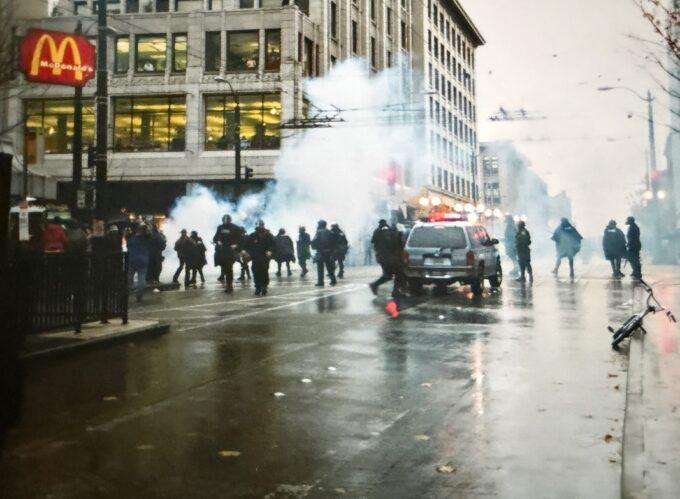
Photo: Jeffrey St. Clair.
The United States is under siege, not by a foreign enemy, but by the Trump administration, which has transformed governance itself into a form of domestic terrorism in the service of a white supremacist state. By domestic terrorism, I mean the use of state-sanctioned intimidation, disappearance, and violence against civilian populations in order to discipline dissent, enforce racial hierarchy, and normalize fear as a mode of governance. Masked agents in unmarked vehicles, dressed in battlefield gear and operating beyond any recognizable legal authority, now stalk the streets, abducting, brutalizing, and in some cases killing people. Citizens and non-citizens alike are rendered disposable. Reason and the rule of law have collapsed, replaced by the naked exercise of state violence in defense of an apartheid politics.
This is a regime that has turned against its own people. It governs through disappearance, terror, and the routinization of cruelty. Harm, misery, violence, and murder are no longer deviations from democratic norms; they are the norms. In the Minneapolis area alone, federal agents have now been involved in multiple fatal shootings in recent weeks, including the January 7th state murder of 37-year-old mother Renée Nicole Good, a U.S. citizen shot and killed by an ICE agent during federal enforcement operations. The killing has sparked widespread protests and outrage across the Twin Cities and the nation as communities demanded accountability and justice. The Trump administration attempted to justify the killing by labeling Good a ‘domestic terrorist,’ weaponizing the term to deflect accountability and invert the meaning of state violence.
Soon after Good’s death, federal agents were again captured on video in Minneapolis using lethal force that amounted to an execution in plain sight. The footage shows a man overwhelmed by a swarm of officers, pushed to the ground, and shot multiple times even as he lay motionless before them. Local officials confirm that the incident resulted in the death of 37-year-old ICU nurse Alex Jeffrey Pretti, who dedicated his life to caring for veterans. This marked the third shooting by federal immigration agents in the city in just a few weeks, deepening public outrage over what critics call unchecked violence by federal agents. Once again, despite multiple videos documenting the murder, including one showing a Border Patrol agent taking Pretti’s gun before he was killed, the Trump regime nevertheless claimed an agent shot him in self-defense, “a narrative Minnesota Gov. Tim Walz called ‘nonsense’ and ‘lies’.”
Within minutes of the killing, senior Trump administration officials moved swiftly to control the narrative. Trump’s deputy chief of staff, Stephen Miller, joined others in seizing on unverified claims to label Pretti a “domestic terrorist” and a “would-be assassin,” while accusing Democrats of “fanning the flames of insurrection” for crass political gain. These assertions were not merely reckless; they were strategic fabrications designed to invert victim and perpetrator, delegitimize dissent, and preemptively justify state violence. They also backfired on the administration, as an avalanche of videos stripped away the official lies and revealed the real assailants, federal agents who beat and killed not as rogue actors, but as executors of state-sanctioned terror. To understand these killings as anything other than isolated crimes is to confront the deeper historical system of violence from which they emerge.
State violence must be remembered and confronted not only in its most spectacular eruptions, such as the deployment of armed federal forces into America’s cities, but as a systemic condition rooted in a long history of imperial conquest, genocide, and racial domination. From the extermination wars against Indigenous peoples to slavery, lynching, and mass incarceration, violence has never been incidental to the American project; it has been one of its organizing principles. This history is embodied in the evolution of the carceral state, a political culture wedded to racist terror, and a punishing gangster form of capitalism that plunders labor, concentrates wealth, and thrives on mass inequality, impoverishment, and social misery. The machinery of death is thus both historical and existential, sustained by a culture of manufactured ignorance and permanent class and racial war. Such a system cannot be reformed without reproducing the very relations of domination on which it depends. It must be dismantled. Trump and his army of enforcers, in the streets and in the White House, are not a rupture from this history but its culmination, the moment when a long-standing regime of violence sheds its democratic disguise and rules openly through fear. The assassinations of Good and Pretti, however morally and politically repulsive, mark more than the tragic and shocking loss of two lives; they signal the death of American democracy, the unraveling of its civic culture, the collapse of its legal and cultural institutions, and the emergence of an upgraded form of fascism, a convergence that grimly fulfills the long history of violence through which America must now recognize itself.
That long history does not remain abstract; it is actively mobilized in the present through spectacle, coercion, and the strategic deployment of state power. Such claims echo across the upper reaches of the Trump administration and function as ideological weapons. They sanctify state terror, erase visual evidence of brutality, and flood the public sphere with a fascist politics of fear in which dissent is criminalized, truth rendered disposable, and violence recoded as both necessary and virtuous. Their purpose is unmistakable: to create the conditions for invoking the Insurrection Act by normalizing the spectacle of unarmed civilians being shot in cold blood.
These killings are not random excesses or rogue acts. They are calculated performances of power, intended simultaneously to shock the public into paralysis and to provoke mass resistance that can then be cited as justification for escalating repression. The regime’s logic is brutally circular: protest is met with violence, violence generates outrage, outrage is labeled insurrection, and insurrection becomes the pretext for extinguishing democracy at gunpoint. State-sanctioned violence is thus framed as the only means of restoring “order,” even as it becomes the mechanism through which democratic life is suffocated.
Here, Václav Havel’s warning in The Power of the Powerless takes on renewed urgency. Havel argued that authoritarian systems depend not only on repression but on the forced participation of citizens in a lie, a lie sustained through fear, ritualized obedience, and manufactured consent. What we are witnessing is precisely such a moment: an attempt to compel the public to accept an inverted moral universe in which state murder is called security and resistance is branded terrorism. The real danger lies not only in the violence itself but in whether society is coerced into living within its logic. Havel also insisted that dominant power must never be allowed the final word, and that the downtrodden and oppressed always carry within themselves the capacity to overcome their own powerlessness. It is precisely this insight that haunts the Trump regime and its band of executioners, for it reveals that their authority is neither total nor secure. Embedded within their displays of force are the very seeds of their undoing, taking root in the growing courage, solidarity, and resistance of those who refuse to live within the lie.
As Carole Cadwalladr has rightly observed, what taking place on the streets of Minneapolis is a test case. The city has become a political laboratory, a petri dish in which the administration is probing the limits of its power and measuring the resilience of democratic resistance. As she reported, drawing on an interview with conservative historian Robert Kagan, the strategy is deliberate: provoke street violence, manufacture chaos, and then invoke the Insurrection Act as a means of consolidating authoritarian rule. Minneapolis is not an aberration. It is a warning; it is a glimpse of a dark future.
The brutal, state-sanctioned assassinations of Good and Pretti, captured on cell phone videos, expose a cruelty that tears through history’s thin membrane and returns us to its darkest rituals. This malignant lawlessness summons an earlier terror, when the lynching of Black bodies was staged as public spectacle, when murder became entertainment and cruelty was recoded as a political theater of fear in the service of the Trump administration. These killings and the unceasing violence unleashed by ICE summon the memory of Kristallnacht, that moment in Nazi Germany when sanctioned brutality spread like a moral plague, destroying reason, annihilating decency, and choking off the very possibility of civic life. What we are witnessing is not an aberration but a warning, violence unbound from law or conscience, rehearsing the old lessons of hatred with new tools and new victims. The horror is not only unthinkable, it is historically familiar, and that familiarity should chill us to the bone. History in this case should not be a weapon of state terror, but a repository of dangerous memories, a resource for radical change.
This history of sanctioned brutality is not confined to memory or metaphor; it is institutionalized in the everyday operations of the contemporary carceral state. These deaths, and the escalation of federal deadly force within U.S. cities, are not isolated tragedies. They are part of a broader pattern, a rupture in the social contract and due process. ICE, in expanding its sprawling system of detention fortresses that critics have likened to creating its own gulags, oversaw at least 32 deaths in custody last year and additional deaths tied to recent enforcement actions, a carceral network where cruelty is built into the very architecture of state governance rather than treated as an aberration. This pattern of horror behind ICE’s prison walls should serve as a stark warning that violence, brutality, and cruelty now define the DNA of a democracy in retreat.
Trump’s delusional embrace of violence is no longer a matter of abstract rhetoric. It is evident in his racist and dehumanizing language, the expansion of the so-called war on terror, and his unapologetic support for imperial power, all of which work to make state-sanctioned violence thinkable, defensible, and increasingly legitimate. This violence is not deferred or symbolic; it is unfolding in real time, in spaces that should be protected from state power rather than violated by it. The regime of terror now operates simultaneously at home and abroad, the latter visible in the bombing of Iran and Yemen and in the invasion of Venezuela. What is unfolding domestically mirrors a violence long rehearsed beyond U.S. borders.
As Chris Hedges has observed, what we are witnessing is the return of violence long perfected abroad to our own streets, the “imperial boomerang” in action, where the tactics of occupation and repression once deployed in Fallujah or Helmand province are now repurposed against civilians here at home. Before we became the victims of such state terror, Hedges reminds us, we were often its accomplices.
In Minnesota, ICE agents have escalated targeted raids and detentions across neighborhoods and in close proximity to schools, shattering any remaining pretense that children are off limits. School officials in a Minneapolis suburb report that ICE vehicles have entered school property, followed buses, circled playgrounds, and detained students, including multiple minors swept up in the Trump administration’s immigration crackdown. As Columbia Heights Public Schools Superintendent Zena Stenvik stated publicly, ICE agents have been “roaming our neighborhoods, circling our schools, following our buses, coming into our parking lots and taking our children,” leaving a community that once regarded schools as sanctuaries with a sense of safety that has been deeply shattered.
The abduction of five-year-old Liam Conejo Ramos by ICE marks a chilling pedagogical moment in the worst sense of the term. Innocence itself is weaponized. A child’s terror becomes a warning to the nation: no one is beyond reach, not even those who should be most protected. Childhood is no longer a sanctuary; it has become a frontline. Schools, once imagined as fragile democratic spaces of care, learning, and protection, are now treated as legitimate sites of surveillance and coercion. When armed agents stalk school grounds and detain children, the message is unmistakable: fear has replaced care as the governing logic of the state. Liam Conejo Ramos’s case, one of several involving children detained near schools or on their way to class, demonstrates that the agents meant to enforce ‘immigration law’ now operate in ways that fracture communities and transform schools from sites of refuge into spaces of dread, state violence, and terminal abandonment.
ICE has mutated into an apparatus of terror bearing unmistakable resemblance to the Nazi Brownshirts (SA). It has become a toxic and ugly institution that no longer seeks legitimacy through persuasion, spectacle, or even propaganda It has blood in its mouth, feeding openly on the spectacle and normalization of violence. The work of dehumanization is complete. Repression no longer needs a narrative. Violence now speaks directly, efficiently, and publicly. The photograph of five-year-old preschooler Liam Conejo Ramos trembling in fear is not incidental; it is visual proof of a war on children that is already underway, a war that treats young lives as collateral damage in the consolidation of authoritarian power.
But this moment is not only one of terror; it is also a moment of profound pedagogical consequence. The Trump regime does not rely solely on repression, surveillance, and brute force; it depends on the continual production of fascist subjects willing to embrace its reign of terror as common sense, security, and patriotism. Fascism operates not only through the machinery of domination but through the colonization of consciousness, educating people to normalize cruelty, internalize fear, and confuse obedience with moral virtue. It educates by attacking public and higher education, stripping history of dangerous memories, ideas, and critical knowledge. It also works relentlessly to shape desires, loyalties, and perceptions, making violence appear necessary and dissent appear dangerous. Against this pedagogy of fear, resistance becomes an alternative form of education, one that awakens critical consciousness and restores the capacity to imagine justice. The assault on children, youth, independent media, organized resistance, and the future itself exposes the moral bankruptcy of the regime and clarifies the stakes of the struggle. Young people are learning, in real time, what power looks like when stripped of ethics and accountability, and they are also learning that democracy cannot survive without courage, solidarity, and collective action.
The United States is not on the brink of fascism; it is living inside it. Yet history teaches us that authoritarianism is never defeated by silence or compliance. It is challenged when people refuse to unlearn their capacity for outrage, when education becomes a practice of freedom rather than domination, and when youth transform fear into political consciousness. The mass resistance now unfolding in Minneapolis and spreading across the country is not a fleeting protest but a giant stirring, a force gathering its strength in the face of terror. What is required now is a shared awakening, a collective refusal to normalize terror or accept fear as the horizon of political life. It calls for a renewed commitment to a pedagogy of resistance, one that names injustice without hesitation, connects private suffering to public responsibility, and affirms, even in dark times, that another future not only remains possible but is already struggling to be born.
That future, however, depends on organized, nonviolent mass action led by workers, artists, intellectuals, cultural workers, youth, educators, unions, community organizers, and mass democratic organizations that understand that teaching, cultural production, and political struggle are inseparable practices. The tools required to confront authoritarianism are not new; they are part of a democratic inheritance forged through abolitionist movements, labor struggles, anti-colonial resistance, and the Black freedom struggle, this country’s most enduring and transformative force for democracy. Again and again, these traditions have shown that disciplined, mass-based collective movements can dismantle regimes of terror once deemed invincible. Under such circumstances, education should become central to politics and the struggle over identity, agency, and subjectivity, functioning as a fundamental force in social change. To reclaim democracy today is to recover this historical lineage, embrace the struggle over agency, reactivate its lessons in the present, and recognize that social hope is not an abstract retreat but a collective practice, one built through solidarity, historical memory, sustained resistance, and the refusal to surrender the future to fear.

No comments:
Post a Comment