
Governing Crisis—Sanctions, Austerity and Social Unrest in Iran
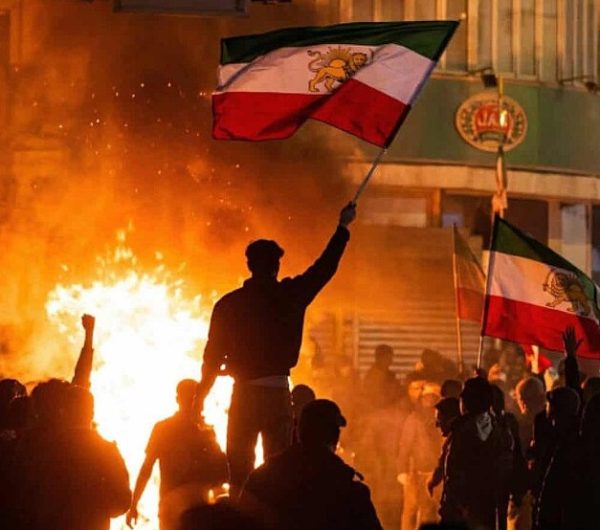 Image from Wikimediacommons, in public domain
On December 28, 2025, protests erupted across multiple cities in Iran in response to currency collapse and spiraling living costs. As the exchange rate grew more volatile, sections of Tehran’s Grand Bazaar and commercial centers shuttered. Rapidly shifting prices made imports, pricing and trade impossible.
The state moved quickly to implement an emergency measure embedded in its 2025–2026 fiscal-year budget package: It removed preferential foreign exchange rates for essential goods and key production inputs. Officials presented the move as anti-corruption reform and promised direct compensation through cash transfers and targeted support. In practice, the change accelerated an already rapid rise in prices and further eroded purchasing power, shifting the burden onto households. Official inflation in December was reported to be around 42 percent, but the cost of basic groceries rose much faster at 72 percent compared to a year earlier, pushing staples such as bread and dairy out of reach for large segments of the working class. By early January, the removal of preferential foreign exchange rates had only deepened the squeeze on everyday consumption, and protests escalated into mass demonstrations across the country that lasted for weeks.
It was not the first time Iranian officials have provoked unrest by introducing regressive measures in the name of reform. Over the past decade, successive governments have framed price liberalization and currency adjustments as necessary steps to stabilize markets and curb insider profiteering and corruption. In practice, these policies have functioned as austerity measures, transforming service-based welfare programs into cash-based handouts that quickly lose value amid chronic inflation.
The 2010, and later 2019, fuel price hikes are notable earlier examples of this shock politics, with the latter fomenting a mass uprising against deteriorating economic conditions. Both protests were put down with lethal repression. The current moment has followed the same arc at a higher intensity. This time, the masked austerity measures were implemented amid an economic protest. By mid-January the government was estimated to have killed thousands and had placed the country under an indefinite communication blackout (internet and phone) in one of the deadliest episodes in the Islamic Republic’s history since the purges of political dissent in the 1980s.
On December 28, 2025, protests erupted across multiple cities in Iran in response to currency collapse and spiraling living costs. As the exchange rate grew more volatile, sections of Tehran’s Grand Bazaar and commercial centers shuttered. Rapidly shifting prices made imports, pricing and trade impossible.
The state moved quickly to implement an emergency measure embedded in its 2025–2026 fiscal-year budget package: It removed preferential foreign exchange rates for essential goods and key production inputs. Officials presented the move as anti-corruption reform and promised direct compensation through cash transfers and targeted support. In practice, the change accelerated an already rapid rise in prices and further eroded purchasing power, shifting the burden onto households. Official inflation in December was reported to be around 42 percent, but the cost of basic groceries rose much faster at 72 percent compared to a year earlier, pushing staples such as bread and dairy out of reach for large segments of the working class. By early January, the removal of preferential foreign exchange rates had only deepened the squeeze on everyday consumption, and protests escalated into mass demonstrations across the country that lasted for weeks.
It was not the first time Iranian officials have provoked unrest by introducing regressive measures in the name of reform. Over the past decade, successive governments have framed price liberalization and currency adjustments as necessary steps to stabilize markets and curb insider profiteering and corruption. In practice, these policies have functioned as austerity measures, transforming service-based welfare programs into cash-based handouts that quickly lose value amid chronic inflation.
The 2010, and later 2019, fuel price hikes are notable earlier examples of this shock politics, with the latter fomenting a mass uprising against deteriorating economic conditions. Both protests were put down with lethal repression. The current moment has followed the same arc at a higher intensity. This time, the masked austerity measures were implemented amid an economic protest. By mid-January the government was estimated to have killed thousands and had placed the country under an indefinite communication blackout (internet and phone) in one of the deadliest episodes in the Islamic Republic’s history since the purges of political dissent in the 1980s.
The Political Economy of Sanctions
Most commentary on political crisis in Iran oscillates between two convenient, reductive narratives. The problem is either corruption and mismanagement, as if Iran’s economy operates in a vacuum untouched by global capitalism, or, echoing the state’s own narrative, sanctions and imperialist hostility are treated as the singular root of the country’s problems. Both stories flatten a complicated reality. The more useful question is how sanctions have been absorbed into Iran’s political economy in ways that serve the interests of the ruling class. Sanctions have not suspended market-oriented restructuring in Iran. They have reshaped it by widening the state’s discretionary power over who gets access to dollars, permits and contracts, and by generating new opportunities for insider profiteering under the guise of reform. Any serious account of Iran’s crisis must confront both the external sanctions regime and the internal machinery that manages crisis through austerity and repression.
Any serious account of Iran’s crisis must confront both the external sanctions regime and the internal machinery that manages crisis through austerity and repression.
Sanctions have shaped Iran’s political economy since 1979, with sharp escalations in 2012 targeting oil and finance, in 2018 after the US withdrawal from the nuclear agreement (when sanctions were reimposed) and again in late 2025 with the reinstatement of UN and EU-level “snapback” sanctions. Over the past 15 years, these punitive measures have translated into chronic inflation, collapsing real wages and a deepening crisis of social reproduction. Since late 2017, livelihood struggles have repeatedly spilled into open contention, from the 2017–2018 uprising to the 2019 fuel protests to recurring, decentralized mobilizations across workplaces and communities. A decade-long wave of organized labor protest has also persisted with teachers, pensioners and contract oil and petrochemical workers mobilizing over contracts, wages, pensions and basic living costs.
Sanctions did not contribute to the crisis simply by reducing resources. They have also reshaped who gains and how. By creating hard-currency shortages and blocking routine cross-border payments, they pushed trade into opaque channels, weakened the currency and made basic pricing increasingly unstable. One outcome is what many inside Iran call the “trustee economy,” referring to the expansion of intermediaries that keep exports moving, especially oil, by routing payments around banking and SWIFT restrictions. These brokers—often linked to state or quasi-state networks—profit through fees, exchange-rate markups and control over when payments are released, including by delaying or withholding export revenues that are supposed to be brought back into the country. Since 2018, official statements have repeatedly claimed that a significant share of export foreign currency has not been repatriated, with some estimates as high as 30 percent, amounting to tens of billions of dollars.
A related but distinct mechanism operates within the domestic economy. The state has attempted to manage volatility through multiple exchange rates, preferential foreign exchange and discretionary import permissions, turning political access into profit. When hard currency is scarce, the state’s allocation regime channels subsidized dollars and import license through institutional gatekeeping that predictively favors politically connected firms, creating lucrative opportunities for those positioned closest to these bottlenecks.
The Debsh Tea company scandal offers one glaring example. Between 2019 and 2022, Debsh Tea, a privately owned importer and producer, received billions of dollars in preferential foreign exchange earmarked for essential imports. In late 2023, Iranian oversight bodies and judiciary-linked reporting alleged that a significant portion of this subsidized currency was not used for the declared imports and was instead diverted into open-market transactions—turning access to cheap dollars into a quick profit by capturing the gap between the preferential and market exchange rates. The sums reported—upwards of $3 billion—was large enough to cover years of national tea demand or finance major public investment.
Not every case becomes a national headline, but the mechanism is familiar. Similar audit controversies have surfaced before, involving preferential access to foreign currency that did not match verified import records or any documented return of the money. One widely cited instance is the Supreme Audit Court dispute over $4.8 billion in preferential foreign exchange reportedly disbursed to importers with no corresponding imports documented.
When the resulting legitimacy crisis becomes intolerable, the state rolls out corrective packages presented as anti-corruption reforms. In practice, these policies entrench austerity and deliver sudden price shocks. Health policy offers a clear example. The Daroyar reform—a 2022 overhaul of drug subsidies—ended preferential foreign exchange for medicine and shifted the subsidy to an insurance-based reimbursement system. In theory, patients would pay less at the pharmacy while insurers and the state covered the difference. In practice, the financing chain never stabilized: Delayed reimbursements and liquidity shortages increased out-of-pocket costs and produced persistent gaps in access for patients and pharmacies alike. Meanwhile, the government captured fiscal gains from changes in the exchange rate, banks benefited as suppliers and importers relied more heavily on high-cost borrowing. Fuel policy has followed a similar pattern. Price hikes were justified as a way to fund targeted redistribution through cash transfers, but transfers quickly lagged behind high inflation, leaving households to absorb the widening gap between what they received and the real cost of fuel.
The broader state response to the sanctions driven fiscal crisis follows a familiar path. Rather than meeting its obligations through stable public funding, it has leaned on privatization, debt-for-asset swaps and “productive use” (Movaledsazi) schemes that transfer public assets into private hands. A notable example is the pension system. Instead of paying down its debt to Social Security in cash, the government has increasingly transferred shares in state-owned firms, effectively forcing the pension system to finance benefits through dividends, asset sales and investment returns. This policy shifts risk onto retirees by tying their livelihoods to market performance and inflation rather than stable entitlements.
The result is a sanctioned political economy in which austerity becomes a governing tool, and scarcity generates profit for those with privileged access. Instead of protecting households through social provision, so-called anti-corruption reforms shift the costs and risks downward through devaluation and subsidy removal while preserving the allocation systems that advantage well-connected elites. This pattern is widely noted in sanctions-era analyses of inequality and distribution. Recent official estimates put poverty at roughly a third of the population; similarly, the World Bank estimates that close to 10 million people fell into poverty over the past decade.
The result is a sanctioned political economy in which austerity becomes a governing tool, and scarcity generates profit for those with privileged access.
The downward redistribution is visible in how quickly economic shocks travel outward from the commercial core to outlying towns and provinces and in the forms of anger they produce. In western Iran’s long marginalized regions, in towns like Abdanan, the crisis has hit earlier and harder than in many central provinces, leaving deep underinvestment, high unemployment and entrenched poverty. During the recent protest wave, demonstrators stormed a supermarket and tore open bags of rice, scattering the grain across the floor and into the street rather than carrying it away. By late December, a 10kg bag of rice was selling for around several million toman, roughly equivalent to a month of minimum wage income. The gesture was not theft so much as refusal and a public rejection of a system that turns a basic staple into a luxury while demanding that people accept humiliation as everyday submission.
When crisis is managed through shock transfer rather than redistribution, policy becomes part of the problem, producing a vicious cycle. As economic instability intensifies, the state responds with new rounds of austerity framed as reform. Households do not experience these measures as repair; they experience them as a cost shift that deepens the crisis of everyday survival. The usual channels for complaint and mediation lose credibility. People can petition officials and institutions, but those same institutions are either implementing the damaging reforms or lack the power to reverse them. As that legitimacy erodes, pressure accumulates until a trigger can diffuse economic hardship into a national protest moment. Once dissent spills outside institutional channels, the state increasingly treats it as disorder. With fewer credible mechanisms of incorporation left, repression becomes routine because it is the only tool remaining to retain control.
Most commentary on political crisis in Iran oscillates between two convenient, reductive narratives. The problem is either corruption and mismanagement, as if Iran’s economy operates in a vacuum untouched by global capitalism, or, echoing the state’s own narrative, sanctions and imperialist hostility are treated as the singular root of the country’s problems. Both stories flatten a complicated reality. The more useful question is how sanctions have been absorbed into Iran’s political economy in ways that serve the interests of the ruling class. Sanctions have not suspended market-oriented restructuring in Iran. They have reshaped it by widening the state’s discretionary power over who gets access to dollars, permits and contracts, and by generating new opportunities for insider profiteering under the guise of reform. Any serious account of Iran’s crisis must confront both the external sanctions regime and the internal machinery that manages crisis through austerity and repression.
Any serious account of Iran’s crisis must confront both the external sanctions regime and the internal machinery that manages crisis through austerity and repression.
Sanctions have shaped Iran’s political economy since 1979, with sharp escalations in 2012 targeting oil and finance, in 2018 after the US withdrawal from the nuclear agreement (when sanctions were reimposed) and again in late 2025 with the reinstatement of UN and EU-level “snapback” sanctions. Over the past 15 years, these punitive measures have translated into chronic inflation, collapsing real wages and a deepening crisis of social reproduction. Since late 2017, livelihood struggles have repeatedly spilled into open contention, from the 2017–2018 uprising to the 2019 fuel protests to recurring, decentralized mobilizations across workplaces and communities. A decade-long wave of organized labor protest has also persisted with teachers, pensioners and contract oil and petrochemical workers mobilizing over contracts, wages, pensions and basic living costs.
Sanctions did not contribute to the crisis simply by reducing resources. They have also reshaped who gains and how. By creating hard-currency shortages and blocking routine cross-border payments, they pushed trade into opaque channels, weakened the currency and made basic pricing increasingly unstable. One outcome is what many inside Iran call the “trustee economy,” referring to the expansion of intermediaries that keep exports moving, especially oil, by routing payments around banking and SWIFT restrictions. These brokers—often linked to state or quasi-state networks—profit through fees, exchange-rate markups and control over when payments are released, including by delaying or withholding export revenues that are supposed to be brought back into the country. Since 2018, official statements have repeatedly claimed that a significant share of export foreign currency has not been repatriated, with some estimates as high as 30 percent, amounting to tens of billions of dollars.
A related but distinct mechanism operates within the domestic economy. The state has attempted to manage volatility through multiple exchange rates, preferential foreign exchange and discretionary import permissions, turning political access into profit. When hard currency is scarce, the state’s allocation regime channels subsidized dollars and import license through institutional gatekeeping that predictively favors politically connected firms, creating lucrative opportunities for those positioned closest to these bottlenecks.
The Debsh Tea company scandal offers one glaring example. Between 2019 and 2022, Debsh Tea, a privately owned importer and producer, received billions of dollars in preferential foreign exchange earmarked for essential imports. In late 2023, Iranian oversight bodies and judiciary-linked reporting alleged that a significant portion of this subsidized currency was not used for the declared imports and was instead diverted into open-market transactions—turning access to cheap dollars into a quick profit by capturing the gap between the preferential and market exchange rates. The sums reported—upwards of $3 billion—was large enough to cover years of national tea demand or finance major public investment.
Not every case becomes a national headline, but the mechanism is familiar. Similar audit controversies have surfaced before, involving preferential access to foreign currency that did not match verified import records or any documented return of the money. One widely cited instance is the Supreme Audit Court dispute over $4.8 billion in preferential foreign exchange reportedly disbursed to importers with no corresponding imports documented.
When the resulting legitimacy crisis becomes intolerable, the state rolls out corrective packages presented as anti-corruption reforms. In practice, these policies entrench austerity and deliver sudden price shocks. Health policy offers a clear example. The Daroyar reform—a 2022 overhaul of drug subsidies—ended preferential foreign exchange for medicine and shifted the subsidy to an insurance-based reimbursement system. In theory, patients would pay less at the pharmacy while insurers and the state covered the difference. In practice, the financing chain never stabilized: Delayed reimbursements and liquidity shortages increased out-of-pocket costs and produced persistent gaps in access for patients and pharmacies alike. Meanwhile, the government captured fiscal gains from changes in the exchange rate, banks benefited as suppliers and importers relied more heavily on high-cost borrowing. Fuel policy has followed a similar pattern. Price hikes were justified as a way to fund targeted redistribution through cash transfers, but transfers quickly lagged behind high inflation, leaving households to absorb the widening gap between what they received and the real cost of fuel.
The broader state response to the sanctions driven fiscal crisis follows a familiar path. Rather than meeting its obligations through stable public funding, it has leaned on privatization, debt-for-asset swaps and “productive use” (Movaledsazi) schemes that transfer public assets into private hands. A notable example is the pension system. Instead of paying down its debt to Social Security in cash, the government has increasingly transferred shares in state-owned firms, effectively forcing the pension system to finance benefits through dividends, asset sales and investment returns. This policy shifts risk onto retirees by tying their livelihoods to market performance and inflation rather than stable entitlements.
The result is a sanctioned political economy in which austerity becomes a governing tool, and scarcity generates profit for those with privileged access. Instead of protecting households through social provision, so-called anti-corruption reforms shift the costs and risks downward through devaluation and subsidy removal while preserving the allocation systems that advantage well-connected elites. This pattern is widely noted in sanctions-era analyses of inequality and distribution. Recent official estimates put poverty at roughly a third of the population; similarly, the World Bank estimates that close to 10 million people fell into poverty over the past decade.
The result is a sanctioned political economy in which austerity becomes a governing tool, and scarcity generates profit for those with privileged access.
The downward redistribution is visible in how quickly economic shocks travel outward from the commercial core to outlying towns and provinces and in the forms of anger they produce. In western Iran’s long marginalized regions, in towns like Abdanan, the crisis has hit earlier and harder than in many central provinces, leaving deep underinvestment, high unemployment and entrenched poverty. During the recent protest wave, demonstrators stormed a supermarket and tore open bags of rice, scattering the grain across the floor and into the street rather than carrying it away. By late December, a 10kg bag of rice was selling for around several million toman, roughly equivalent to a month of minimum wage income. The gesture was not theft so much as refusal and a public rejection of a system that turns a basic staple into a luxury while demanding that people accept humiliation as everyday submission.
When crisis is managed through shock transfer rather than redistribution, policy becomes part of the problem, producing a vicious cycle. As economic instability intensifies, the state responds with new rounds of austerity framed as reform. Households do not experience these measures as repair; they experience them as a cost shift that deepens the crisis of everyday survival. The usual channels for complaint and mediation lose credibility. People can petition officials and institutions, but those same institutions are either implementing the damaging reforms or lack the power to reverse them. As that legitimacy erodes, pressure accumulates until a trigger can diffuse economic hardship into a national protest moment. Once dissent spills outside institutional channels, the state increasingly treats it as disorder. With fewer credible mechanisms of incorporation left, repression becomes routine because it is the only tool remaining to retain control.
External Signaling, Internal Escalation
When US and Israeli officials cast the protests as a theater of war and regime change, the state can more easily reframe mass dissent as a security threat and respond with counterinsurgency-style repression.
What has made this round of uprisings deadlier is the interplay between external and internal escalation. Iranians did not need outside encouragement to come to the streets: The currency collapse, unmatched wages to inflation and erosion of everyday survival were sufficient conditions for revolt. Rather, external escalation has raised the cost of dissent in a different way—less through material support than through narrative and signaling. When US and Israeli officials cast the protests as a theater of war and regime change, the state can more easily reframe mass dissent as a security threat and respond with counterinsurgency-style repression.
Exiled opposition figures, most prominently the wannabe king, Reza Pahlavi (son of Iran’s deposed Shah in the 1979 revolution) have tried to cast the uprising as a transition movement and have urged escalation, including repeated calls for foreign intervention to facilitate Pahlavi’s return as the national leader. At the same time, US and Israeli officials have publicly gestured at their own involvement, boasting of assets on the ground, speaking casually of arming protestors and promising “help is on the way.” Their posturing only serves to strengthen the state’s claim that dissent is a foreign operation. Iranian officials have in turn framed the protests as an extension of the 12-day war with Israel in June 2025.
The result is a two-sided narrative that benefits everyone except ordinary Iranians. On one side, external signaling transforms real popular dissent into a proxy battlefield where death becomes collateral damage on the road to regime change. On the other, the Islamic Republic treats all regime change rhetoric as proof that protestors are terrorists, spies and enemy assets rather than citizens with legitimate grievances. In this sense, the response of the Iranian state and the politics of external powers share a core feature: both treat Iranian lives as expendable for the needs of power and profit.
The protests may be suppressed for now, but the conditions that generated them remain unchanged. There is little evidence that the state is able or willing to undertake the structural and welfare reforms needed to fundamentally address the crisis of everyday survival. While it cannot directly lift sanctions, it has shown little interest in reducing household exposure to inflation, curbing precarious living conditions or rebuilding the minimum credibility of welfare and representation. Currency instability and price volatility are increasingly governed as normal conditions, not emergencies to be solved. With each turn of the cycle from austerity to protest, the crisis deepens and heavier force becomes the default method of control. What comes next is uncertain, but the direction is not. As long as crisis is managed through austerity and bullets, and as long as external powers treat Iranian lives as instruments of pressure and regime change, the costs will keep rising and more will die.
Ida Nikou holds a PhD in sociology from Stony Brook University.
Editor’s note: Due to the ongoing internet shutdown in Iran, some Iran-based websites were inaccessible at the time of publication. Links are nonetheless included for reference.
The Biggest Threats the Iranian People Face Are America and Israel
January 30, 2026
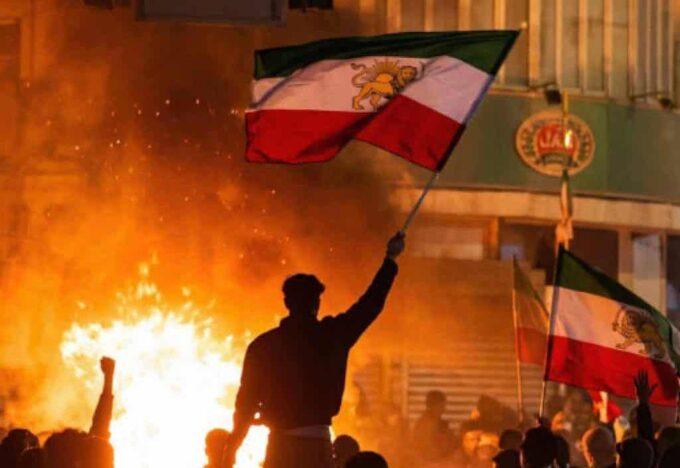
Demonstrator silhouetted against a street fire waving the Lion and Sun flag, 9 January 2026 – CC0
Israel’s longstanding campaign to lure Washington into war with Iran seems to have fizzled once again—for now, anyway. But in their attempt to invent a casus belli, their spy agencies employ tactics—disinformation, infiltration, and incitement of rioting—that help sustain the patently false impression that Tehran, not Tel Aviv, is home to the Middle East’s cruelest regime.
“We Are with You in the Field”
In late December, people in several cities across Iran took to the streets in nonviolent protest over the crushing economic conditions spawned by US attacks on Iran’s currency and the further intensification of US sanctions. Police were deployed, but the protests were peaceful, so they stayed on the sidelines.
Then, suddenly on January 8, shocking violence broke out across Iran, and most of the peaceable protesters vanished from the streets. They’d been displaced by young toughs, many of them armed.
Video (released by both government and anti-government forces) showed arsonists setting fire to businesses, mosques, a fire station (killing the firefighters inside), and other buildings, as well as public buses. Roving gangs, reportedly armed by Israeli agents, gunned down hundreds of people.
Max Blumenthal at The Grayzone reported,
“In Kermanshah, where anti-government rioters shot and killed 3 year-old Melina Asadi, groups of militants were filmed firing automatic weapons at police. In cities from Hamedan to Lorestan, rioters have filmed themselves beating unarmed security guards to death for attempting to impede their rampages.”
Suspecting foreign incitement, officials in Tehran shut off all internet connections beyond Iran’s borders. Sure enough, the violence ended as suddenly as it had started two days earlier.
There soon emerged more evidence that the riots had been orchestrated from abroad. Israel’s spy agency Mossad, which has many agents and collaborators on the ground in Iran, had put out the following message through its Farsi-language X account: “Go out together into the streets. (See especially Justin Podur’s Jan. 27 analysis, “The Iran Insurgency: A review of the available evidence”) The time has come. We are with you. Not only from a distance and verbally. We are with you in the field.” In an interview, Yoav Gallant, a former Israeli defense minister, was quite clear: “The regime in Iran must fall . . . At this moment, when what matters most is the mass action on the ground, we need to stay in the background and steer things with an invisible hand.“ Even former US Secretary of State Mike Pompeo got in on the action, posting, “Happy New Year to every Iranian in the streets … also, to every Mossad agent walking beside them.”
US sanctions had ruined Iran’s economy, bringing people into the streets in protest. Israel took it from there, using the nonviolent demonstrations over economic issues as cover for whipping up deadly riots against the government.
On January 20, speaking at the Davos World Economic Forum, US Treasury Secretary Scott Bessent pulled back the curtain a bit more, boasting that the sanctions and currency manipulation inflicted on Iran had been highly successful, because “their economy collapsed,” so “people took to the streets” and now “things are moving in a very positive way.”
(Helena Cobban, president of the non-profit Just World Educational, has pointed out that Bessent was saying, in effect, that the Iran sanctions “were intended to inflict such harsh pain and misery on entire populations of civilians that those civilians take action to change their government.” And, she added, that fits the definition of state-sponsored terrorism. Israel’s role in converting peaceful protest into armed uprising was a further terrorist act.)
As the violence in Iran was peaking, Reza Pahlavi, son the last Shah of Iran, tweeted support for the riots from his place of exile in the Washington, DC suburbs: “Our goal is no longer merely to come to the streets; the goal is to prepare for seizing the centers of cities and holding them.” Pahlavi has longed to retake the throne in Iran ever since his father, a brutal tyrant, was overthrown in the revolution of 1979.
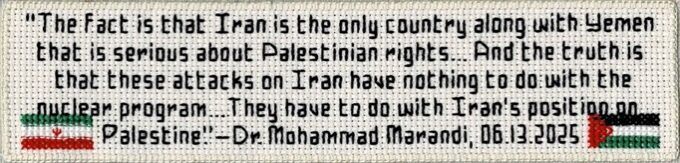
Image: Priti Gulati Cox.
Corporate media coverage of events in Iran has been abysmal—light on facts and heavy with Israeli propaganda. Social media were hijacked, too. Data analysis by the staff of Al Jazeera showed how a #FreeThePersianPeople hashtag that went viral during the riots
“…appears to be a politicized information operation constructed outside Iran and led by networks linked to Israel and its allies. The campaign successfully hijacked legitimate economic grievances, reframing them within a broader political project that links the ‘liberation of Iran’ to the return of the monarchy and foreign military intervention.”
Sina Toosi of the Center for International Policy wrote for The Nation that given Washington’s seemingly unlimited tolerance for the Israeli regime’s genocide in Gaza,
“What animates US and Israeli policy is not outrage at repression but hostility toward an adversarial state that resists their regional dominance … The claim that the United States has suddenly discovered a principled concern for Iranian lives is not merely implausible. It is an insult to the intelligence of anyone paying attention.”
Much of the American public does have sincere concern for the safety and wellbeing of the Iranian people. But the best way to help them is to demand that Washington end the sanctions on Iran, not instigate societal conflict and collapse.
Israel: The Bully’s Little Sidekick
The US and Israel have been trying and failing to topple Iran’s government for decades. But now, the Zionist regime is more tightly focused on Iran than ever. Its fraudulent “ceasefire” with the Palestinians, and its colonial “Board of Peace,” will simply be the final phase of the genocide, ending (in their fantasies, at least) with expulsion of all Palestinians from Gaza and the West Bank.
This last phase is to be quieter, more bureaucratic, than what came before—and managed by the US and some of its  other client regimes. The butchers in Tel Aviv hope they can then devote more of their own effort toward asserting dominance over the entire region. And that means taking down the government in Iran.
Afraid to launch an all-out war against such a large, militarily powerful state, Washington and Tel Aviv have long bombarded the people of Iran with sanctions, financial attacks, propaganda, and psychological warfare, hoping to impose enough misery to spur a mass uprising capable of overturning the government. As Middle East Eye put it, they have sought “regime collapse without the costs of a direct military intervention”—with just a little exchange of bombs and missiles from time to time.
As recent events have shown, that was wishful thinking. Authentic protests in Iran remained nonviolent, and no one called for installation of the much-hated, much-ridiculed Reza Pahlavi as Iran’s leader. Clearly, external stoking of violence and chaos was required to convince the world that Iran is imploding, and that’s what we’ve now seen.
Israel and the US may be feeling their oats right now, but they have made themselves pariah nations with their genocide of the Palestinian people and their aggression against any society on any continent that refuses to comply with their neocolonial ambitions.
Polls show that the numbers of people around the world who hold negative views of Israel have risen dramatically. Last year, Pew found the regime to be 33 points underwater on that question, with 62% of responses unfavorable and 29% favorable. Pew also found a dramatic increase in unfavorable views of the United States, largely related to our economic, military, diplomatic, and media sponsorship of the genocide in Gaza.
For the past two years, Israel has ranked dead last among the world’s countries in the Nation Brands Index, a national-reputation score. Furthermore, institutions around the world are divesting from billions of dollars in Israel Bonds, which are essential to sustaining its economy. The global Boycott, Divestment, and Sanctions (BDS) movement against Israel is snowballing.
And crucially, writes Mohamad Elmasry, a professor at the Doha Institute for Graduate Studies,
“Gone, at least for now, are the days when Saudi Arabia viewed Iran as its foremost enemy, when Qatar saw Saudi Arabia as its principal threat, or when Egypt treated Qatar as the chief source of regional instability. Increasingly, Arab regimes, with perhaps the exception of the UAE, now view Israel as the region’s most destabilizing force.”
The loathing that most of the world has for Israel is richly earned. For many, the genocide—not only the raw death toll but also the sadistic relish with which the Zionist regime has tortured an entire society for the past 28 months—was the last straw.
The one element of the state that once drew the most respect, its much-vaunted military, has proven once and for all to be a pathetic fraud. The Israeli Occupation Forces are cowards. Against Iran, Syria, Yemen, Lebanon, Gaza, everyone, they attack mostly or entirely from afar, with shelling and bombing and drones and cyberattacks and, yes, beepers. They rely heavily on clean, safe, white-collar warfare: espionage, propaganda, and sabotage. But they’re picking fights they can’t finish.
When they have dared to engage in battle on the ground, as in Lebanon, they’ve been routed. Their troops’ attempts to invade, capture, and hold ground in Gaza also have been totally hapless failures, except during “ceasefires”, when only the Palestinian resistance ceases and only the IOF fires.
Then, whenever Israeli forces gin up the “courage” to bomb the elephant in the region, Iran, they usually act like a bully’s little sidekick: picking fights, then running and hiding behind Washington’s skirts, crying, “Save us, please!”
We Americans must accept that our government and its client Israel are rogue states. Together, they will continue posing a threat to the rest of the world until we force our own government to stop funding and start sanctioning Israel—and to end our own attacks, both military and economic, on other nations.
When US and Israeli officials cast the protests as a theater of war and regime change, the state can more easily reframe mass dissent as a security threat and respond with counterinsurgency-style repression.
What has made this round of uprisings deadlier is the interplay between external and internal escalation. Iranians did not need outside encouragement to come to the streets: The currency collapse, unmatched wages to inflation and erosion of everyday survival were sufficient conditions for revolt. Rather, external escalation has raised the cost of dissent in a different way—less through material support than through narrative and signaling. When US and Israeli officials cast the protests as a theater of war and regime change, the state can more easily reframe mass dissent as a security threat and respond with counterinsurgency-style repression.
Exiled opposition figures, most prominently the wannabe king, Reza Pahlavi (son of Iran’s deposed Shah in the 1979 revolution) have tried to cast the uprising as a transition movement and have urged escalation, including repeated calls for foreign intervention to facilitate Pahlavi’s return as the national leader. At the same time, US and Israeli officials have publicly gestured at their own involvement, boasting of assets on the ground, speaking casually of arming protestors and promising “help is on the way.” Their posturing only serves to strengthen the state’s claim that dissent is a foreign operation. Iranian officials have in turn framed the protests as an extension of the 12-day war with Israel in June 2025.
The result is a two-sided narrative that benefits everyone except ordinary Iranians. On one side, external signaling transforms real popular dissent into a proxy battlefield where death becomes collateral damage on the road to regime change. On the other, the Islamic Republic treats all regime change rhetoric as proof that protestors are terrorists, spies and enemy assets rather than citizens with legitimate grievances. In this sense, the response of the Iranian state and the politics of external powers share a core feature: both treat Iranian lives as expendable for the needs of power and profit.
The protests may be suppressed for now, but the conditions that generated them remain unchanged. There is little evidence that the state is able or willing to undertake the structural and welfare reforms needed to fundamentally address the crisis of everyday survival. While it cannot directly lift sanctions, it has shown little interest in reducing household exposure to inflation, curbing precarious living conditions or rebuilding the minimum credibility of welfare and representation. Currency instability and price volatility are increasingly governed as normal conditions, not emergencies to be solved. With each turn of the cycle from austerity to protest, the crisis deepens and heavier force becomes the default method of control. What comes next is uncertain, but the direction is not. As long as crisis is managed through austerity and bullets, and as long as external powers treat Iranian lives as instruments of pressure and regime change, the costs will keep rising and more will die.
Ida Nikou holds a PhD in sociology from Stony Brook University.
Editor’s note: Due to the ongoing internet shutdown in Iran, some Iran-based websites were inaccessible at the time of publication. Links are nonetheless included for reference.
Demonstrator silhouetted against a street fire waving the Lion and Sun flag, 9 January 2026 – CC0
Israel’s longstanding campaign to lure Washington into war with Iran seems to have fizzled once again—for now, anyway. But in their attempt to invent a casus belli, their spy agencies employ tactics—disinformation, infiltration, and incitement of rioting—that help sustain the patently false impression that Tehran, not Tel Aviv, is home to the Middle East’s cruelest regime.
“We Are with You in the Field”
In late December, people in several cities across Iran took to the streets in nonviolent protest over the crushing economic conditions spawned by US attacks on Iran’s currency and the further intensification of US sanctions. Police were deployed, but the protests were peaceful, so they stayed on the sidelines.
Then, suddenly on January 8, shocking violence broke out across Iran, and most of the peaceable protesters vanished from the streets. They’d been displaced by young toughs, many of them armed.
Video (released by both government and anti-government forces) showed arsonists setting fire to businesses, mosques, a fire station (killing the firefighters inside), and other buildings, as well as public buses. Roving gangs, reportedly armed by Israeli agents, gunned down hundreds of people.
Max Blumenthal at The Grayzone reported,
“In Kermanshah, where anti-government rioters shot and killed 3 year-old Melina Asadi, groups of militants were filmed firing automatic weapons at police. In cities from Hamedan to Lorestan, rioters have filmed themselves beating unarmed security guards to death for attempting to impede their rampages.”
Suspecting foreign incitement, officials in Tehran shut off all internet connections beyond Iran’s borders. Sure enough, the violence ended as suddenly as it had started two days earlier.
There soon emerged more evidence that the riots had been orchestrated from abroad. Israel’s spy agency Mossad, which has many agents and collaborators on the ground in Iran, had put out the following message through its Farsi-language X account: “Go out together into the streets. (See especially Justin Podur’s Jan. 27 analysis, “The Iran Insurgency: A review of the available evidence”) The time has come. We are with you. Not only from a distance and verbally. We are with you in the field.” In an interview, Yoav Gallant, a former Israeli defense minister, was quite clear: “The regime in Iran must fall . . . At this moment, when what matters most is the mass action on the ground, we need to stay in the background and steer things with an invisible hand.“ Even former US Secretary of State Mike Pompeo got in on the action, posting, “Happy New Year to every Iranian in the streets … also, to every Mossad agent walking beside them.”
US sanctions had ruined Iran’s economy, bringing people into the streets in protest. Israel took it from there, using the nonviolent demonstrations over economic issues as cover for whipping up deadly riots against the government.
On January 20, speaking at the Davos World Economic Forum, US Treasury Secretary Scott Bessent pulled back the curtain a bit more, boasting that the sanctions and currency manipulation inflicted on Iran had been highly successful, because “their economy collapsed,” so “people took to the streets” and now “things are moving in a very positive way.”
(Helena Cobban, president of the non-profit Just World Educational, has pointed out that Bessent was saying, in effect, that the Iran sanctions “were intended to inflict such harsh pain and misery on entire populations of civilians that those civilians take action to change their government.” And, she added, that fits the definition of state-sponsored terrorism. Israel’s role in converting peaceful protest into armed uprising was a further terrorist act.)
As the violence in Iran was peaking, Reza Pahlavi, son the last Shah of Iran, tweeted support for the riots from his place of exile in the Washington, DC suburbs: “Our goal is no longer merely to come to the streets; the goal is to prepare for seizing the centers of cities and holding them.” Pahlavi has longed to retake the throne in Iran ever since his father, a brutal tyrant, was overthrown in the revolution of 1979.
Image: Priti Gulati Cox.
Corporate media coverage of events in Iran has been abysmal—light on facts and heavy with Israeli propaganda. Social media were hijacked, too. Data analysis by the staff of Al Jazeera showed how a #FreeThePersianPeople hashtag that went viral during the riots
“…appears to be a politicized information operation constructed outside Iran and led by networks linked to Israel and its allies. The campaign successfully hijacked legitimate economic grievances, reframing them within a broader political project that links the ‘liberation of Iran’ to the return of the monarchy and foreign military intervention.”
Sina Toosi of the Center for International Policy wrote for The Nation that given Washington’s seemingly unlimited tolerance for the Israeli regime’s genocide in Gaza,
“What animates US and Israeli policy is not outrage at repression but hostility toward an adversarial state that resists their regional dominance … The claim that the United States has suddenly discovered a principled concern for Iranian lives is not merely implausible. It is an insult to the intelligence of anyone paying attention.”
Much of the American public does have sincere concern for the safety and wellbeing of the Iranian people. But the best way to help them is to demand that Washington end the sanctions on Iran, not instigate societal conflict and collapse.
Israel: The Bully’s Little Sidekick
The US and Israel have been trying and failing to topple Iran’s government for decades. But now, the Zionist regime is more tightly focused on Iran than ever. Its fraudulent “ceasefire” with the Palestinians, and its colonial “Board of Peace,” will simply be the final phase of the genocide, ending (in their fantasies, at least) with expulsion of all Palestinians from Gaza and the West Bank.
This last phase is to be quieter, more bureaucratic, than what came before—and managed by the US and some of its other client regimes. The butchers in Tel Aviv hope they can then devote more of their own effort toward asserting dominance over the entire region. And that means taking down the government in Iran.
Afraid to launch an all-out war against such a large, militarily powerful state, Washington and Tel Aviv have long bombarded the people of Iran with sanctions, financial attacks, propaganda, and psychological warfare, hoping to impose enough misery to spur a mass uprising capable of overturning the government. As Middle East Eye put it, they have sought “regime collapse without the costs of a direct military intervention”—with just a little exchange of bombs and missiles from time to time.
As recent events have shown, that was wishful thinking. Authentic protests in Iran remained nonviolent, and no one called for installation of the much-hated, much-ridiculed Reza Pahlavi as Iran’s leader. Clearly, external stoking of violence and chaos was required to convince the world that Iran is imploding, and that’s what we’ve now seen.
Israel and the US may be feeling their oats right now, but they have made themselves pariah nations with their genocide of the Palestinian people and their aggression against any society on any continent that refuses to comply with their neocolonial ambitions.
Polls show that the numbers of people around the world who hold negative views of Israel have risen dramatically. Last year, Pew found the regime to be 33 points underwater on that question, with 62% of responses unfavorable and 29% favorable. Pew also found a dramatic increase in unfavorable views of the United States, largely related to our economic, military, diplomatic, and media sponsorship of the genocide in Gaza.
For the past two years, Israel has ranked dead last among the world’s countries in the Nation Brands Index, a national-reputation score. Furthermore, institutions around the world are divesting from billions of dollars in Israel Bonds, which are essential to sustaining its economy. The global Boycott, Divestment, and Sanctions (BDS) movement against Israel is snowballing.
And crucially, writes Mohamad Elmasry, a professor at the Doha Institute for Graduate Studies,
“Gone, at least for now, are the days when Saudi Arabia viewed Iran as its foremost enemy, when Qatar saw Saudi Arabia as its principal threat, or when Egypt treated Qatar as the chief source of regional instability. Increasingly, Arab regimes, with perhaps the exception of the UAE, now view Israel as the region’s most destabilizing force.”
The loathing that most of the world has for Israel is richly earned. For many, the genocide—not only the raw death toll but also the sadistic relish with which the Zionist regime has tortured an entire society for the past 28 months—was the last straw.
The one element of the state that once drew the most respect, its much-vaunted military, has proven once and for all to be a pathetic fraud. The Israeli Occupation Forces are cowards. Against Iran, Syria, Yemen, Lebanon, Gaza, everyone, they attack mostly or entirely from afar, with shelling and bombing and drones and cyberattacks and, yes, beepers. They rely heavily on clean, safe, white-collar warfare: espionage, propaganda, and sabotage. But they’re picking fights they can’t finish.
When they have dared to engage in battle on the ground, as in Lebanon, they’ve been routed. Their troops’ attempts to invade, capture, and hold ground in Gaza also have been totally hapless failures, except during “ceasefires”, when only the Palestinian resistance ceases and only the IOF fires.
Then, whenever Israeli forces gin up the “courage” to bomb the elephant in the region, Iran, they usually act like a bully’s little sidekick: picking fights, then running and hiding behind Washington’s skirts, crying, “Save us, please!”
We Americans must accept that our government and its client Israel are rogue states. Together, they will continue posing a threat to the rest of the world until we force our own government to stop funding and start sanctioning Israel—and to end our own attacks, both military and economic, on other nations.
MARINS: An American naval showdown with Iran will not go well for the US
In 2025, according to analyses from Kpler, Vortexa, and TankerTrackers, Venezuela, Iran and Russia supplied 35-40% of China's oil demand. In Russia’s case, it also met a third of China's natural gas demand.
As they are sanctioned countries, they operate with intermediaries, ship-to-ship transfers, and other opaque means to evade sanctions, which means in reality these countries probably meet 50% of China's demand.
All this oil is sold to the Chinese with discounts ranging from 10% to 20% and in special cases can reach 30%. That’s good business.
These purchases have helped boost the competitiveness of various Chinese sectors, mainly petrochemicals, producing naphtha and derivatives like ethene, propene, plastics (PE, PP), resins, solvents, and basic chemicals at highly competitive prices, with China dominating 40-50% of global petrochemical capacity, exporting plastics and chemicals at unbeatable prices, gaining market share in global markets (Asia, Africa, Latin America).
The cheap oil also directly impacts the costs of Chinese infrastructure and fuel refining, which gains billions of dollars.
In a world where the West has increasingly expensive energy, the Chinese government showed skill and made great deals, which further boosted Chinese competitiveness, something that the West now wants to end by force.
The hawks in Washington, after taking Venezuela off the board, authorized this week that Caracas sell oil to the Chinese, but they will set the price. This evidences one of the objectives until now little discussed by political and military analysts. The Maduro Operation to decapitate the Venezuela had less to do with promoting values of boosting democracy, but simply levelling the commercial playing field of competing US products in a market where China had won itself an unbeatable competitive price advantage.
With Venezuela out of the game, Washington is now turning its attention to Iran.
If the Persians have a similar end to the Venezuelans, this will impact the competitiveness of the Chinese industry, which will then depend exclusively on cheaper Russian oil and thus have greater difficulties in getting discounts. The Chinese also have a 10,400-kilometre railway creating a corridor directly linking China and Iran that became operational in mid-2025, traversing Kazakhstan, Uzbekistan, and Turkmenistan to connect Xi’an with Tehran. The advantage of the rail link is it is impervious to pressure by the US navy.
The relationship between the Chinese and Iran involves military, energy, and many mineral issues, since Persian lands house something between 7-10% of the planet's mineral reserves.
The contradictory thing is that these discounts only exist because the West imposed sanctions on these countries and only now realized that with this it was favouring its biggest rival: China. Many critics argue that the West no longer has the power of decades ago to decide the shine or ostracism of a nation through the sanctions mechanism in an increasingly multipolar world.
Although American hawks are targeting the cheap supply to the Chinese, militarily any action against Iran will be a great challenge.
Although Iran has an irrelevant air force, war at sea deeply favours them. Iranian anti-ship missiles like the Qadr-474 have a range of up to 2,000 km, which is 8x the average of European missiles and 30% greater than the maritime version of the Tomahawk. In terms of developing naval anti-ship munitions, the US has been asleep at the wheel. This without mentioning thousands of UAV drones, USVs, and UVVs for which Iran is one of the world leaders. The US has been napping on the development of drone technology too.
A direct attack on Iran could close the Strait of Hormuz, where one-third of the world’s seaborne oil trade, and almost one-fourth of its LNG passes. That would throw oil prices sky high, widely favouring the Russians.
And if Iran decides to close the strait, this will be something long thought over, done with the stock of 5,000 sea mines and 20-23 mini submarines equipped with special torpedoes and submerged-launched Jask-2 anti-ship missiles, besides long range cruise anti-ship missiles that equip other 6-7 larger submarines. Iran even has three Kilo-class Russian-made submarines with a stealth range of 300km during which they are virtually undetectable.
With a fleet that even counts the destroyer Sahand and other 25-30 frigates, corvettes, and patrol boats, all equipped with missiles, the Iranian navy can impose a combat of many months in the strait.
Another great peril posed by this navy is its mosquito fleet of catamarans and fast boats equipped with missiles and some even with anti-air defence systems. Just in 2020, Iran commissioned 100 of these vessels.
A second strike group is being sent to the region, with the intent to reinforce the American fleet, which already has about 1,000 Vertical Launch System (VLS), but still below the 1,600-2,000 launchers present in the Iranian navy. Again, I emphasize that a battle at sea favours the Iranians, while the massive use of planes greatly favours the Americans. It will be a battle mainly of two different doctrines: large ships composing a navy to project power, facing a navy focused on low cost, in the Mosquito strategy.
Iran is a nation of 90mn people and one of the top 5 in drone and missile technology. And the Americans will have a challenge ahead, which is to break through the Iranian naval defences at a time when Tehran is in survival mode and will probably fight with everything it has.
Iran ‘Unlikely To Capitulate’ To Trump’s Demands For A Deal To Avoid Military Action
January 30, 2026
RFE RL
By Kian Sharifi
Even as US President Donald Trump threatens to strike Iran, he has repeatedly called on Tehran to “make a deal.”
Trump’s demands for an agreement are clear: Iran must end its nuclear program, limit its ballistic missile capabilities, and sever ties with armed proxies in the Middle East. In return, the United States will not attack Iran and remove crippling sanctions.
If the Islamic republic does not accept those terms, Trump has warned that the country will suffer consequences “far worse” than last year, when the United States joined Israel in bombing Iran’s nuclear sites.
Experts say it is unlikely that Iran will accept Trump’s maximalist demands, which would mark a reversal of decades of policy and amount to capitulation in the eyes of Tehran.
‘Before It’s Too Late’
In written comments sent to RFE/RL, a White House official said Trump “hopes that no action will be necessary” against Iran but urged Tehran to make a deal “before it is too late.”
Trump has “demonstrated with Operation Midnight Hammer and Operation Absolute Resolve that he means what he says,” said the official, referring to the June 2025 strikes on Iran’s nuclear sites and the US operation that ousted Venezuelan leader Nicolas Maduro on January 3.
“The President has a wide array of options at his disposal to address the situation in Iran,” added the White House official.
The United States has deployed key military assets, including an air carrier and additional bombers, to the Middle East in recent days.
Trump has also ratcheted up economic pressure on Tehran by announcing a 25 percent tariff on any country doing business with Iran and imposing new sanctions.
The US president has threatened to carry out a military strike on Iran since nationwide protests erupted in late December 2025 and the authorities launched a violent crackdown that killed thousands of demonstrators.
US Military Action Is ‘Likely’
Trump on January 28 said he wanted a “fair and equitable deal” that ensured Iran will have “no nuclear weapons.” Tehran has long claimed that its nuclear program is peaceful.
But the nuclear file is only one of several US demands. Trump, according to reports, has also insisted that Iran must accept caps on its ballistic missile program and end its support for pro-Iranian armed groups in Lebanon, Iraq, Yemen, and the Palestinian territories.
Tehran possesses short-range missiles that threaten US military bases and commercial interests in the Persian Gulf and advanced medium-range missiles that can reach Israel, a key US ally.
Experts say Trump is seeking to exploit the unprecedented weakness of Iran’s clerical establishment to force Tehran into making wide-ranging concessions.
Iran’s rulers have been weakened by a worsening economic crisis and weeks of nationwide protests that posed the biggest threat to their power in years. Israel has also degraded the military capabilities of Tehran’s allies, including Lebanon’s Hezbollah, Yemen’s Huthi rebels, and US-designated Palestinian terrorist group Hamas.
“Some US officials see this moment as an opportunity to pressure Tehran into concessions on nuclear limits, regional behavior, and missile capabilities,” said Alex Vatanka, Iran program director at the Washington-based Middle East Institute.
‘Collapse Of The Islamic Republic’
Iranian officials, including Foreign Minister Abbas Araqchi and parliament speaker Mohammad Baqer Qalibaf, have said Tehran is open to talks but alleged Washington is not interested in a fair agreement.
Iran’s Supreme Leader Ayatollah Ali Khamenei would be “very skeptical and resistant to accept” Trump’s demands “as he would perceive acceding to them as paving the way for the collapse of the Islamic republic,” said Jason Brodsky, policy director at the Washington-based United Against Nuclear Iran.
In the absence of a deal, Trump is “very likely” to authorize military action against Iran, said Brodsky, pointing to the president’s rhetoric and the US military buildup in the region.
“This is a very similar pattern of statements and actions that resulted in the 12-day war in June and the US seizure of Nicolas Maduro in Venezuela,” he said. “President Trump alternates between confrontational and conciliatory statements to throw the Iranian regime off.”
Brodsky said the objectives of military action would be to hold Iran accountable for its bloody crackdown on protesters, deter its behavior in the region, and erode its military capabilities.
He added Trump could view “further military action as the prelude to an eventual deal down the line.”
Vatanka offered a more cautious assessment, arguing there are “still reasons for the United States to think twice.”
He emphasized that “the Pentagon knows any strike could trigger a regional chain reaction” involving Iran’s allied armed groups and proxies.
The US military buildup in the Middle East, he suggested, could be “mostly defensive or aimed to pressure Tehran on the diplomatic track, rather than [bring about] regime change.”
The Iranian Protests Explained – OpEd
January 30, 2026
By Daniel Falcone
In this interview, international relations scholar Stephen Zunes and Middle East historian Lawrence Davidson help to unpack the Iranian protests and explain their relevance within the context of U.S. and Israeli national interests.
Daniel Falcone: Jeffrey St. Clair of CounterPunch, recently cited filmmaker Jafar Panahi’s insistence that change in Iran must come from the will of the people, not from outside intervention. As U.S. and Israeli involvement tends to strengthen hardliners, how do you explain the balance between international solidarity and the risk of external actors undermining Iran’s sovereignty and social movement?
Lawrence Davidson: One has to ask what these terms, international solidarity, and risk from external actors, mean in today’s international environment. If international solidarity means, for instance, the solidarity of reactionary countries that have somehow made an alliance to change the internal behavior of a third nation, that is obviously problematic. In this case, international solidarity is the manifestation of just these external actors. If the United States intervenes in Iran at this time, it would not be to the benefit of the Iranian people, it would be for the suppression of anti-Zionist sentiment in the country through the introduction of the Shah’s adult son. This would probably lead to something like a civil war in Iran. If, however, international solidarity means the sentiment of people rather than governments, this has not proved very effective, as we can see in the case of Gaza.
The Arab and Muslim peoples have either chosen not to or could not in any practical way act to support the Palestinians. I’m afraid that the conclusion here is that in the present circumstances, there is no balance between international solidarity and external actors. The power of institutionalized external actors overwhelms practical terms, the power of popular solidarity.
Stephen Zunes: While the United States and Israel have tried to take advantage of the unrest, the protests this round, as well as previously, have been homegrown and not the result of imperialist machinations. Iran has had a long history of widespread civil resistance going back to the late nineteenth century with the tobacco strike against imperialist economic domination, through the Constitutional Revolution the following decade, through the revolution in the late 1970s that brought down the U.S.-backed Shah. The outspoken support for the protests by the U.S. and Israeli governments have probably been counter-productive, feeding the regime’s false narrative that they are a result of foreign backing. Israel and the United States have a lot of power in terms of blowing things up and killing people.
They do not have the power to get hundreds of thousands of angry Iranians into the streets or even to steer the direction of their protests. The people who have given their lives on the streets were fighting for their freedom, not for foreign powers. Threats of military action by the United States and Israel have also likely strengthened the regime, since people tend to rally around the flag in case of outside threats and most Iranians across the political spectrum do not trust either country.
Given the U.S. support for even more repressive regimes in the Middle East, don’t think the Trump administration cares about the Iranian people. Bombing Iran to ostensibly support the uprising would be a tragedy. People would certainly be reluctant to go out onto the streets while they are being bombed. Most of those calling for U.S. military intervention appear to have been from the Iranian diaspora, not those on the streets. Although some Iranians within the country may have been desperate enough to want to risk it as well, let’s remember that it was not the eleven weeks of NATO bombing that brought down Milosevic in Serbia. It was the massive nonviolent resistance of the Serbian people that took place more than a year later.
It is possible that the United States and Israel might prefer the current reactionary, autocratic Iranian regime to a democratic one, which would still be anti-hegemonic and anti-Zionist but have a lot more credibility. A democratic Iran would still be nationalistic and sympathetic to the Palestinian cause, but less likely to engage in the kinds of repression and provocative foreign policies that would give the United States and Israel an excuse for some of their militarism. Solidarity from global civil society, by contrast, is important and appropriate. Despite claims by some to the contrary, many prominent pro-Palestinian voices from Bernie Sanders to Peter Beinart to Greta Thunberg have been outspoken in their support for the Iranian popular struggle as well. People will certainly tend to protest more when their own governments are actively supporting repression and mass killing, as with Israeli violence in Gaza and the West Bank, than when their governments are opposing the repression and mass killing.
Same as during the Cold War—it is quite natural for Americans to be less involved in protesting Communist repression we could do little about than repressive rightwing governments backed by Washington, where we might have more impact. As a result, this line about “where are all the protests on U.S. campuses?” has been unfair (particularly since most were still on winter break). And although some sectarian leftists really have become apologists for the reactionary Iranian regime or have exaggerated the Israeli role in the uprising, they are fortunately a small minority.
Ultimately, international solidarity is important, but it must be from sources that genuinely support the principles for which a popular movement is struggling. The movement in Iran, as with similar movements against autocratic regimes elsewhere, is fighting for freedom, democracy, and social and economic justice. Since neither the U.S. nor the Israeli government supports those principles, the Iranian regime—quite accurately in this case—can observe that U.S. and Israeli backing of the resistance is about advancing U.S. and Israeli strategic objectives, since these right-wing governments support regimes with even worse human rights records and they themselves are undermining democratic principles in their own countries. Indeed, some statements of support have played right into the regime’s hands.
Daniel Falcone: It seems that the participation of bazaaris and the poor and working class makes these protests distinct from earlier movements dominated by students and the middle class. How does this class composition alter legitimacy and the political stakes for the regime?
Lawrence Davidson: Their participation reflects the economic circumstances now. Those circumstances are, in turn, the product of externally imposed economic sanctions and incompetent internal management. Certainly, the participation of the bazaar keepers and the poor and working class in the protests is significant. No matter who comes out on top here, you’re going to see some sort of reform take place. The probability that it is the government that comes out on top is a function of the remaining loyalty of various contingents of the military. And a lot of this has to do with the economic stake of the Revolutionary Guard Corps in the status quo. As long as the military components of the regime stay loyal, the addition of bazaar keepers and the lower classes in the demonstrations cannot change the government.
Stephen Zunes: I find it rather significant that the bazaaris, traditionally a backbone of support for the regime, have been in the leadership of the resistance, as is the fact that there has been significant poor and working-class participation in the protests, unlike some previous movements, which have been disproportionately students and those from the educated middle class. The Iranian military, like the military in Egypt and some other autocratic systems, has their fingers in all sorts of economic enterprises at the expense of the common people. As a result, their brutal response to the protests was not just ideological, but from a desire to protect their vested interests.
It is also striking how quickly the protests went beyond economic issues. Most Iranians want at minimum much greater democratization/accountability within the current system and an increasing number clearly want regime change, not just because of economic hardship, but because they are simply tired of the repression.
Daniel Falcone: Although U.S. led sanctions have crippled Iran, there are also problems of systemic corruption and mismanagement by the Iranian state. Protesters increasingly reject both. Do you see this moment as one in which economic grievances lead to demands for democratization?
Lawrence Davidson: The economic problems come from both factors you mention. The Iranian theologians did not understand the intricacies of modern economic institutions or the importance of international trade. Thus, they could not manage a national economy, particularly one under outside stress. At the same time, American sanctions were designed to destroy that economy and impoverish the Iranian people. The two factors, working simultaneously, opened the way for corruption. And then there is the Revolutionary Guard capturing control of important parts of the economy. It is a mess. Democracy? I think we are a long way from that. We are probably closer to a military coup with the mullahs kept as front men.
Stephen Zunes: U.S.-led sanctions are unjustifiable (since Iran was honoring the nuclear agreement when Trump reimposed them) and they are hurting the economy. But my sense is that both the regime and Washington, for different reasons, are exaggerating the importance of the sanctions in sparking the rebellion. It is the regime’s corruption, mismanagement, and lack of accountability that are the bigger problems. The sanctions have provided the government with an excuse to deflect attention from their lousy economic policies, but that justification is now wearing thin. The economic problems are systemic, so changes at the Central Bank and minor adjustments in fiscal policies will not satisfy most protesters. The regime’s crony capitalism is being seen increasingly as beyond repair under the current system.
Daniel Falcone: UBC Professor Jaleh Mansoor eloquently defended the circulation of protest images as a form of democratic solidarity, while also warning about reactionary diaspora fantasies that reduce Iran’s future to either the Islamic Republic or a restored monarchy. How do you see media circulation distorting an understanding of the protests?
Lawrence Davidson: I do believe that the images should be shown as widely as possible, just as should the ones from Gaza. However, the problem is that they are often shown with either few or misleading explanations. Western commentators do not understand much of the context of happenings in Iran, much less the history. This is the price of a corporate press. The ignorance and biases of editors, if not reporters, are shown over and over. In our lifetime the best example is during Vietnam.
Unless one is motivated to go to an alternate, more accurate source one will get a distorted picture. It is a curse that has always been with us. The wealthy Iranians in California can be as delusional as they wish but there will be no restored monarchy short of an American invasion and occupation of Iran. That is not going to happen. Thus, the Shah’s son will stay in LA.
Stephen Zunes: The greater the circulation of imagery of the people’s resistance and the regime’s repression the better. Care should be given as to how they are presented, however. Like protest coverage elsewhere, the media tends to disproportionately show dramatic photos of vandalism and arson even though overall the protests have been overwhelmingly nonviolent. Indeed, violence is used by the regime to increase its already horrific repression even more.
Similarly, the monarchists are certainly a small minority of the protesters, though both the regime and the Western media (for different reasons) like to highlight them. Although there is something of a nostalgia among better-off Iranians from the pre-revolutionary days—like there is by some Russians for the Soviet era—it is more of a sign of how bad things are now than how good things were then. The Shah was one of the most repressive dictators in the world, and the inequality and corruption under his rule was terrible. Despite some protesters with signs or chants calling for a return of the Shah, the reality is that most Iranians on the streets in recent weeks have been fighting for democracy. In addition to the small number of monarchists, there have also been communists, moderate Islamists, secular liberals, and lots of other folks. People are fed up. Based on my time in Iran a few years ago and my following the situation in that country for decades, I can say with confidence that most of the Iranian people are both anti-regime and anti-monarchist.
Daniel Falcone: Masoud Pezeshkian has taken a conciliatory tone. Are hardliners likely to prevail if the protests intensify? And do you see any viable path for change within the current system?
Lawrence Davidson: There is a story going around that some government people went to the University of Tehran. They asked the protesting students what they wanted. The answer was “we want you to leave.” This was a mistake on the part of the protesters. They gave those with more power than themselves, no way to retreat. I see no path to meaningful change. I do think that once the government retakes the streets, there will be minor positive alterations in their behavior.
Stephen Zunes: Pezeshkian is a relative moderate, but he is not nearly as powerful as the mullahs or the military. Iran’s authoritarian system is a series of complex overlapping loci of power which represent varying interests, unlike some authoritarian regimes centered around a single autocrat, whose social base is thinner. As a result, I am not surprised, though quite disappointed, that the regime appears to have successfully and violently suppressed another round of protests.
Another problem is that the Iranian regime is the first government to face a massive civil insurrection that initially came to power themselves through a massive civil insurrection. Just as regimes that have come to power through guerrilla warfare are better at engaging in counterinsurgency, the Islamic Republic has unfortunately developed better mechanisms than did the Shah (or Mubarak, Ben Ali, Milosevic, Marcos, Suharto, etc.) to suppress civil resistance. I do believe the regime’s days are numbered, however. I just can’t say when or predict what will replace it.
Daniel Falcone
Daniel Falcone is a historian, teacher and journalist. In addition to Foreign Policy in Focus, he has written for The Journal of Contemporary Iraq & the Arab World, The Nation, Jacobin, Truthout, CounterPunch, and Scalawag. He resides in New York City and is a member of The Democratic Socialists of America.
January 30, 2026
By John P. Ruehl
The plunge of Iran’s rial has resulted in nationwide protests exposing deep economic and social grievances. Exile groups and foreign powers are quietly testing Tehran’s strength amid its weakest point since the 1979 revolution.
In early January, several currency trackers briefly displayed the Iranian rial’s value as “$0.00,” unable to process the speed and scale of the depreciation, making it unexchangeable on important international trading platforms. The fallout quickly translated into a protest in Teheran’s bazaar district and eventually led to a mass unrest.
Unlike the 2019 fuel price protests or 2022 women-led demonstrations, this wave was initiated by Iran’s commercial class and is being seen as a “battle for survival.” Their dissent over the worsening economic conditions drew in other groups around the country, producing widespread instability despite little coordination. Even conservative Iranian government estimates acknowledge more than 3,000 deaths, with other sources placing the toll as high as 30,000. On January 23, 2026, the UN Human Rights Council issued an “urgent investigation” to look into the “brutal crackdown” on protests, which have been “described by UN officials as the deadliest since the 1979 revolution,” according to the Geneva Solutions. The U.S. also announced new sanctions in response to the violent measures and has threatened a military attack, which has led to “worry” in the region. “Hopefully Iran will quickly ‘Come to the Table’ and negotiate a fair and equitable deal—NO NUCLEAR WEAPONS—one that is good for all parties,” President Donald Trump said on the Truth Social platform on January 28. “Time is running out, it is truly of the essence!”
Looming over Iran’s unrest is the question of foreign involvement. Western states and their regional partners have long sought to limit Iran’s influence abroad, and exacerbating its internal turmoil creates an opportunity to apply additional pressure. Yet visible interference, whether through a military strike or admission of operatives on the ground, risks validating Tehran’s claims of outside influence, intensifying repression and provoking wider regional instability.
Economic Breakdown
Iran’s economic foundation, weakened by chronic mismanagement and decades of Western sanctions, suffered particularly severe strain in 2025. Beginning in February, energy shortages disrupted daily life and sharply reduced industrial output, compounded by Israeli targeting of Iranian energy infrastructure during the 12-day war in June 2025. Extreme drought created “water bankruptcy,” raising fears Tehran could run out of water. Additionally, France, Germany, and the United Kingdom activated the “trigger mechanism” under the Joint Comprehensive Plan of Action in Septemberof last year, resulting in the restoration of UN sanctions.
Tehran also faced increasing pressure from Washington. Executive Order 13902, issued in 2020 to weaken Iran’s oil, shipping, and financial networks, expanded through 2025, alongside tougher sanctions on Iran’s “ghost fleet” used to transport oil and evade sanctions.
American authorities have also targeted billions of dollars in Iran’s “shadow banking network” across China, Hong Kong, and the United Arab Emirates (UAE), disrupting its revenue channels. And though Iran managed to export more oil in 2025 than in prior years, the heavy reliance on intermediaries and steep discounts reduced profits. As access to hard currency narrowed, the rial fell roughly 50 percent over the first 11 months of 2025.
As the government’s ability to stabilize the rial through interest rates, public spending, and monetary policy faltered, black market exchange rates effectively became the benchmark, overtaking official pricing. The crisis mirrors patterns seen in other countries under prolonged financial pressure; the Venezuelan bolivar’s collapse in the 2010s, for example, was a result of bad economic policies and years of U.S. sanctions that began under the Obama administration and intensified under Trump, driving hyperinflation in 2017-2019 and mass protests.
After the bolivar’s redenomination in 2018 and 2021, informal dollarization took hold as the government stopped resisting the dollar’s use. The U.S. dollars became the default for major purchases, while the fast-depreciating bolivar was only used for small, everyday transactions. The bolivar continued to decline in 2025 amid renewed U.S. pressure to remove then-president Nicolás Maduro, leading to further social upheaval in Venezuela.
Similar to Venezuela, the Iranian government has attempted various fixes to prevent a slide, financing deficits by printing money, which caused inflation to surge. As Eurasia Review stated, the government also implemented “a three-tier gasoline pricing system. This caused the price of non-subsidized fuel to jump to 50,000 rials per liter. … It triggered immediate disruptions in supply chains and sent food inflation soaring past 70 percent.”
While currency collapses are commonly imagined as sudden panics, they usually begin as credit failures. Iran’s managed currency system means the government tries to guide its value rather than letting it move freely with market demand. The rial is mostly inside money; accepted for wages, taxes, and domestic transactions inside the country. But it has few users beyond Iran’s borders, where trade and savings depend on outside money, or hard currency, accepted almost everywhere, like the U.S. dollar. As sanctions tightened, Iran’s access to dollars reduced and inflation accelerated, demand for the rial declined because people and businesses began avoiding a currency that was losing purchasing power and was hard to use for imports or savings.
The critical failure came in December 2025. For years, the government sold U.S. dollars at discounted rates to certain importers and some merchants to make imported goods cheaper under sanctions, but dollars had become scarce. At the same time, the official exchange rate set by the government remained largely symbolic and was rarely used in practice. Most people trade at the open-market rate, which was much higher and reflected the real cost of dollars and imported goods.
Subsidies, price controls, and multiple exchange rates helped the Iranian government buy time, but trust in the rial continued to erode as prices, costs, and contracts became increasingly unpredictable. What began as strain in financial markets spilled into daily commerce, leaving merchants unable to set prices.
As dollar scarcity increased, the government began rolling back subsidized access. By December 2025, soaring costs and collapsing profits forced many shopkeepers to close their doors rather than continue operating at a loss, and Tehran’s Grand Bazaar erupted in protest on December 28.
Protests
Although authorities moved to formally end the preferential exchange systemon January 1, 2026, the symbolism of the merchant unrest was consequential. Historically, bazaar merchants lent legitimacy to the 1979 Iranian revolution and its aftermath while channeling economic and political support to the state. While merchants had protested currency depreciation in 2018, those actions were more localized and occurred while preferential access to foreign exchange still functioned. The breakdown of that patronage system and the withdrawal of merchant support showed that the government had lost the confidence of one of its most loyal constituencies.
Protests quickly spread beyond the commercial class to include student groups, labor groups, minority communities, and more. Yet they did not coalesce into a single unified movement, which is partly deliberate. During the 2009 Green Movement, protestors rallied around prominent political figures, which made the movement easier to crush. Years of repression have left much of Iran’s recognizable opposition imprisoned, exiled, or executed, with few others willing to risk stepping forward.
The recent protests spread through decentralized networks. Neighborhood groups and student circles produced local organizers without a central hierarchy or identifiable leadership, making the movement harder to dismantle. At the same time, many of the groups differed significantly in priorities and outlook, limiting coordination and the development of a coherent political message, as well as complicating outside efforts to shape the movement.
Foreign Involvement?
Iranian authorities have nevertheless insisted that the unrest was not purely spontaneous, with state media warning of“organized networks” and “coordinated sabotage.” Supreme Leader Ali Khamenei has explicitly accusedthe U.S. and Israel as being behind the “foreign-backed saboteurs.”
Blaming foreign actors and terrorism is a familiar strategy for delegitimizing domestic dissent anywhere. But considering that Iran operates its own influence networks in the U.S. and elsewhere, it would be naive to assume that Iran’s adversaries are not seeking to exploit the unrest without openly directing it.
During the 2019-2020 Venezuela crisis, for example, ex-U.S. special forces and private military contractors were reportedly used in Venezuela in a botched operation to oust Maduro.
Reza Pahlavi, the Shah’s son in exile, is often mentioned as a viable challenger to replace Iran’s government, but his presence divides the opposition. Younger protestors who reject the Islamic Republic are also skeptical of a return to monarchy because of the authoritarianism and lack of democratic freedoms associated with pre-revolutionary Iran. Pahlavi retains support among portions of the Iranian diaspora and is seen as a useful symbolic figure by some Western policymakers, yet faces doubts from influential figures, including Trump.
Instead, senior Iranian officials have repeatedly named the Mujahedin-e-Khalgh (MEK) exiled leftist opposition group as the major force behind arson attacks, assaults on security personnel, and general destabilization, with assistance from abroad.
The MEK has a complex history with both the Iranian and Western governments. After conducting attacks on Western targets during the Shah’s rule and initially allying with the Iranian revolutionaries in 1979, the group quickly fell out with the new theocratic government. It relocated to Iraq but continued to operate in Iran, and its 2002 exposure of Iranian nuclear facilities boosted its credibility. Following the 2003 U.S.-led invasion of Iraq, American forces disarmed MEK fighters but provided protection from Iranian operatives.
Ex-CIA operative Ray McGovern, stated in 2005, “Previously, we considered… [MEK] a terrorist organization. And they exactly are. But they are now our terrorists and we now don’t hesitate to send them into Iran. … for the usual secret service activities: attacking sensors, in order to supervise the Iranian nuclear program, mark targets for air attacks, and perhaps establishing secret camps to control the military locations in Iran. And also a little sabotage.”
The MEK was removed from the U.S. terrorism watch list in 2012, having been on it since 1997. Through U.S.-facilitated arrangements, the group also relocated to Albania in 2013, causing friction with Iran. The MEK’s political umbrella, the National Council of Resistance of Iran (NCRI), has spent the last few decades rebuilding legitimacy in Western capitals, and maintains a secretariat in France.
Public and indirect support for the MEK’s wider political motivations has continued to grow in the West. In 2024, thousands of European lawmakers signed a statement backing the NCRI as an alternative to the Islamic Republic. In the U.S., bipartisan support followed in May 2025 with House Resolution 166, endorsing the NCRI’s stated platform of being an alternative to the current regime.
While the MEK’s popularity within Iran remains questionable and its internal structure is widely criticized as authoritarian, it has demonstrated operational reach inside the country that is unmatched by most other groups, claiming almost 40,000 acts of defiance nationwide in 2025. It has long been accusedby Iranian authorities of conducting violent operations inside the country, and Israel has reportedly used MEK-linked networks for intelligence collection in recent years.
Rather than leading a unified opposition, the MEK uses Iran’s destabilization to challenge and harass the government. While external adversaries may not seek outright regime change, the protests have weakened Tehran and forced it to focus inward. Though the extent of foreign coordination remains unclear, the MEK is uniquely positioned to amplify pressure.
Western officials, including President Trump, have publicly urged Iran to halt the crackdown, threatening military action. In January 2026, Trump disclosed a private message from French President Emmanuel Macron stating “We can do great things on Iran,” offering a rare glimpse into the Western coordination and monitoring of Iran’s unrest.
Several Israeli media figures and officials have suggested that Israeli operatives were active in Iran amid the protests. Tamir Morag of Israel’s Channel 14 cited an unsourced report hinting that Israel is supplying weapons to protestors, while Heritage Minister Amichai Eliyahu claimed Israeli agents were operating inside the country.
The Mossad has previously acknowledged smuggling personnel and weapons into Iran during the 12-day war in 2025. On December 29, 2025, the Israeli Mossad’s X account meanwhile posted, “We are with you. Not only from a distance and verbally. We are with you in the field.” Amnon Sofrin, former head of the Mossad’s intelligence directorate, stated that the agency’s efforts were focused on achieving “sustained attritional pressure” to steadily weaken the Iranian government’s authority over time, instead of seeking immediate collapse.
A January 11 report by Israel’s Channel 13 alleged that this included clandestine firmware updates to Starlink terminals to bypass Iranian jamming. Estimates suggest that roughly 50,000 to 100,000 Starlink terminals have been smuggled into the country in recent years, implying some level of external support.
Tehran has also previously accused Saudi Arabia of funding separatist movements in Baluchistan and other Iranian regions., though it has not claimed any current Saudi involvement.
Nonetheless, concern that instability in Iran’s Kurdish and Baluchi regions could spill across their borders prompted Turkey and Pakistan to increase security deployments to contain unrest and discourage similar protests among their own minority populations, while publicly signaling support for Tehran. Meanwhile, Russia is suspected of providing technical assistance to Iran, including electronic jamming capabilities, helping the government disrupt protest communications.
But Iran’s government is still isolated and vulnerable. The currency collapse eroded support from a core part of its base, and efforts to suppress unrest have shut down much of the economy and only deepened the crisis. Even with Starlink terminals and other communications channels, visibility into events remains limited.
Economic frustration has clearly blended with larger social and political grievances in Tehran. Foreign powers have used the unrest to observe and test the Iranian government without openly pursuing regime change, treating the protests as both a measure of weakness and a way to distract Tehran from its nuclear program and supporting proxy forces abroad.
As the potential for an American strike approaches again, it must be noted that Iran’s political leadership is more entrenched than Venezuela’s leadership, backed by a stronger security apparatus and supported by institutions long tested against U.S. pressure.
Yet Iran’s crackdown is costly and cannot last indefinitely, especially given its fragile financial situation. Easing controls to stabilize the economy, after the rial hit a record low on January 27, carries the risk of renewed unrest among its population. Any groups hoping for regime change could trigger far greater instability, as well as may create a more hostile Iranian government.
John P. Ruehl
John P. Ruehl is an Australian-American journalist living in Washington, D.C. He is a contributing editor to Strategic Policy and a contributor to several other foreign affairs publications.
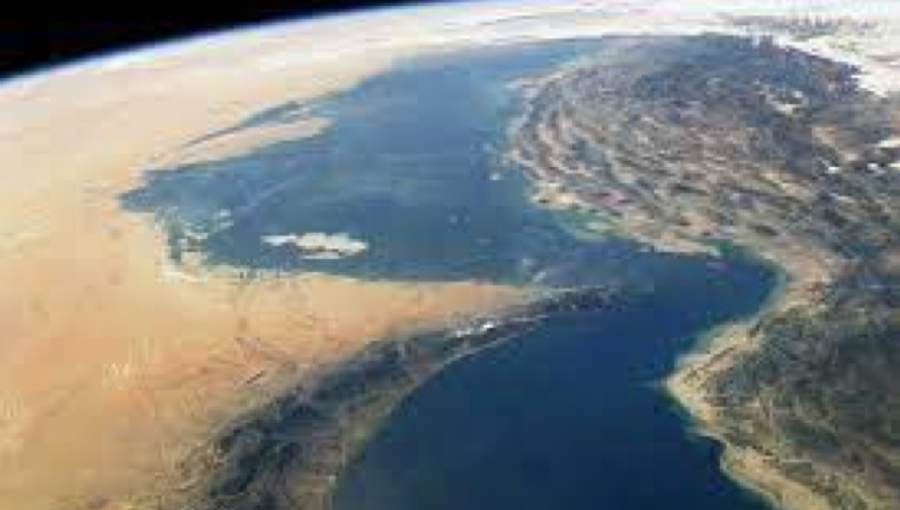
U.S. policy toward Iran is frequently sold as a reaction to urgent threats. In practice, it behaves more like a system: narrative escalation, economic coercion, covert pressure, and then the steady normalization of “military options.” The pattern repeats because it is institutionally convenient. It compresses debate, rewards maximal claims, and makes restraint look like failure.
Start with the information environment. On Iran, the line between verified reporting and advocacy often collapses. Casualty figures circulate fast, harden into “fact” faster, and then become emotional fuel for punitive policy. In the current cycle, official Iranian sources have cited a death toll around 6,000 during unrest, while Iran International has promoted numbers in the tens of thousands, including claims around 36,500. A gap that large isn’t normal uncertainty. It should trigger basic questions about method, sourcing, and incentives.
A serious media culture should demand transparent sourcing and methodological clarity from any outlet circulating extraordinary claims about Iran – because inflated or opaque reporting narrows debate and makes coercive policy feel inevitable.
Once the narrative is locked in, the next step is usually sanctions, marketed to Americans as a humane alternative to war. That framing is false. Sanctions are a form of economic warfare, and their most reliable impact is not “behavior change” among elites but predictable harm to civilians: disrupted medicine supply chains, overcompliance by banks and vendors, inflation shocks, and the slow deterioration of public health. Human Rights Watch has documented how “maximum pressure” sanctions and financial restrictions undermined access to essential medicines and threatened Iranians’ right to health, despite nominal humanitarian exemptions.
The United Nations has also been unusually explicit that sanctions’ human impact is often amplified by overcompliance – companies and financial institutions refusing lawful transactions out of fear. The Office of the U.N. High Commissioner for Human Rights warned that unilateral sanctions and overcompliance pose a serious threat to human rights in Iran, and U.N. experts later highlighted cases where overcompliance affected access to life-saving medicine.
The most damning evidence is quantitative. A peer-reviewed study in The Lancet Global Health estimated that unilateral sanctions were associated with an annual toll of 564,258 deaths (with wide confidence intervals) over its study period. Even if readers debate model assumptions, the core implication holds: economic strangulation can be war-like in its human cost. If Washington wants to claim human rights as a guiding principle, it cannot treat sanctions as morally clean simply because suffering arrives through shortages and delayed care rather than explosions.
This is also why the sudden humanitarian vocabulary that often accompanies pressure campaigns should be treated skeptically. U.S. officials can speak the language of women’s rights and freedom while advancing tools that predictably intensify hardship, increase polarization, and reduce the space for negotiated outcomes. But the incentives driving U.S. pressure campaigns are often material as well as ideological: leverage over energy, trade, and strategic geography. Venezuela is a useful reminder of how quickly “moral” narratives can sit alongside resource-centered outcomes – Washington simultaneously charged Venezuela’s leadership with “narco-terrorism” and related crimes, while U.S. policy in practice increasingly moved toward controlling Venezuelan oil flows and distribution. That is not a critique of women’s rights. It is a critique of instrumentalizing rights language as branding for coercion.
Covert pressure belongs in the analysis as well, not because it explains everything, but because it changes the incentive structure around instability. Israel’s history of clandestine activity targeting Iran’s strategic capabilities is widely reported, including sabotage and covert operations designed to weaken defenses and increase vulnerability. The Associated Press has described multi-year preparations, including smuggled systems and data-driven target selection, and ProPublica has reported on efforts to recruit Iranian dissidents for inside-Iran missions.
None of this proves that every protest or every violent incident is “foreign-made,” and it would be analytically sloppy to claim that. But it does establish a sober baseline: when unrest erupts, sophisticated actors have both capability and incentive to exploit volatility, intensify chaos, and steer events toward outcomes that make diplomacy harder and punitive policy easier to sell.
Terrorist violence is part of this landscape too. Iran has suffered mass-casualty attacks claimed by the Islamic State; Reuters has reported on ISIS’s claim after the Kerman bombing, and has also covered ISIS-linked cases and prosecutions. Recognizing violent opportunism does not negate real grievances or economic pressures. It simply prevents Washington from laundering coercion as “solidarity” while ignoring the covert and violent tools that cluster around flashpoints.
The strategic logic behind Washington’s “hardball” is not mysterious. Realist analysts like John Mearsheimer have argued that U.S. leaders understand the risks of direct confrontation with peer competitors such as China and Russia, and therefore often seek demonstrations of resolve against states they assume are more pressure-sensitive. Whether one agrees with Mearsheimer or not, the warning is relevant: when Washington needs an arena to perform strength, the Middle East is repeatedly treated as available – and Iran is framed as a permanent emergency rather than a state with which negotiation is possible.
This is where war talk becomes reckless. A conflict with Iran would not be “surgical.” It would be systemic. One reason is energy and shipping risk. Roughly 20% of the world’s oil flows through the Strait of Hormuz, and the U.S. Energy Information Administration has documented comparable figures for recent years. Even limited escalation can spike risk premiums, shipping costs, and inflation. A wider conflict would create incentives for retaliation and miscalculation that pull in multiple countries and damage infrastructure.
Americans should ask who pays – not in slogans, in invoices. War and war-footing politics expand executive power, widen surveillance, and turn “emergency” into governance. Randolph Bourne’s old warning remains intact: war is the health of the state. A foreign policy that normalizes coercion abroad reliably produces coercion at home.
The alternative is not naïve idealism. It is restraint. It means treating inflated claims with skepticism and refusing to let unverifiable extremes collapse debate into inevitability. It means acknowledging that sanctions are not a humanitarian tool but a coercive one with measurable civilian harm. And it means prioritizing de-escalation and durable diplomacy over the ritualized march from narrative panic to economic warfare to military options.
Iran is not an “emergency” that requires Americans to suspend judgment. It is a country Washington can choose to negotiate with, or choose to pressure until conflict becomes self-fulfilling. That is a political choice. The costs, if we choose wrong, will be paid by civilians first and by liberty eventually.
Sophia Gonzalez is an American activist and political analyst focusing on U.S. strategy, Middle East affairs, and global security. A peace and human rights advocate, she writes to challenge interventionism and promote diplomacy. Find her on X (@SophiaGnzlz) or contact her at Gonzalez.initial@gmail.com.
The drumbeat of escalation against Iran has grown louder in Western capitals, from fresh sanctions rhetoric to renewed strike speculation. Beyond the headlines, a dangerous shift is occurring in the strategic thinking of policymakers. The old Neoconservative framework of “regime change”, which assumed one could swap a government while keeping the nation intact, is being shadowed by a far more perilous drift toward policies that risk state collapse.
Whether driven by the momentum of broad sanctions or a lack of viable alternatives, the current trajectory suggests that Western powers are risking a repetition of the “Libya Model” in Iran. A sober analysis of data, geography, and demographics indicates that this path would not lead to democracy, but to a geopolitical catastrophe that creates a security vacuum from the Caspian Sea to the Persian Gulf.
The Libya Mirage vs. The Iranian Reality
The allure of this strategy rests on a kind of amnesia about the outcome of the 2011 NATO intervention in Libya. Sold as a humanitarian necessity, the removal of central authority did not produce a liberal democracy. Instead, it shattered the state’s monopoly on violence. Over a decade later, Libya remains a fractured territory where rival militias compete for control and human trafficking networks operate with relative impunity.
Attempting to replicate this outcome in Iran involves a profound misreading of scale. Iran is not Libya. It is a nation of nearly 90 million people, roughly thirteen times the population of Libya in 2011. Geographically, it sits atop the Strait of Hormuz, a critical artery through which a major share of globally traded oil passes each day.
In contrast to the isolated Gaddafi regime, a destabilized Iran would not implode neatly. It would likely erupt across borders. The collapse of central authority in Tehran could plausibly trigger large refugee flows toward Europe and create conditions conducive to extremism and narcotics trafficking. From a purely Realist perspective, the cost of coexisting with a difficult Iranian state is significantly lower than the cost of managing a major zone of ungoverned instability in the heart of Eurasia.
Sanctions and the Fragility Trap
Some advocates of “maximum pressure” argue that economic strangulation creates leverage for democratization. The economic data suggests a different outcome. While sanctions have undeniably devastated the Iranian economy, driving high and persistent inflation and eroding the national currency, they have failed to produce political liberalization.
In practice, these policies create what economists call a “fragility trap”. The International Monetary Fund (IMF) has warned that geoeconomic fragmentation and the weaponization of trade are fracturing the global economy. In Iran, this dynamic systematically hollows out the middle class. By destroying the economic foundation of independent civil society, Western policy eliminates the very social stratum historically required for stable democratic transitions.
As citizens are pushed into a struggle for biological survival, facing documented obstacles to accessing some critical medicines and shrinking purchasing power, their capacity for organized political activism diminishes. They rarely become builders of stable institutions; survival takes over. Thus, the current policy does not weaken the grip of the state; it weakens the resilience of the society.
The Security Dilemma and the Civilizational Turn
The West’s approach can also misread the nature of the Iranian polity. Iran increasingly acts as a civilizational state, viewing itself as the custodian of a historical continuity under siege. This shapes threat perception and makes external pressure read as existential.
Political theorist Carl Schmitt argued that when a state faces such a threat, its natural reflex is not liberalization, but the state of exception, a suspension of norms to ensure survival. This framing matters because domestic radicalization can deepen the civilizational posture.
As politics harden, Tehran has fewer incentives to hedge and more incentives to lock in with other civilizational powers, especially China and Russia. That gravitational pull can weaken emerging regional understandings with Arab neighbors and turn Iran into a persistent arena for East and West power projection, with local interests squeezed by great power rivalry.
In that climate, external threats of military action, sabotage, and policies aimed at destabilization are unlikely to empower reformers in Tehran; they tend to validate the security apparatus. Each threat reinforces the narrative that the country is facing a war for its existence, justifying the securitization of domestic politics. In this context, the West is not acting as the midwife of Iranian liberty, but as the architect of its securitization.
The human cost of this strategy is often dismissed as collateral damage. Yet treating the Iranian population as mere leverage in a geopolitical struggle is not only morally questionable but strategically counterproductive. It alienates the very population the West claims to support, fueling a nationalist rally round the flag effect that strengthens the central government against foreign interference.
A Realistic Way Forward
If the goal is regional stability and global security, the fantasy of destabilization must be abandoned. A realistic policy toward Iran requires three concrete shifts.
First, acknowledge the security dilemma and negotiate on the issues that can be verified. A workable framework should center the nuclear file on enrichment limits, monitoring, and compliance, while opening a parallel regional track that links deescalation to reciprocal steps by all parties. In practice, that means pairing verifiable Iranian restraint with clear commitments to reduce escalation by Israel in the region, especially in southern Lebanon, consistent with Security Council resolution 1701.
Second, de-weaponize the civilian economy. Broad measures that punish the general population should be rolled back in favor of targeted restrictions and credible humanitarian channels. A thriving Iranian middle class is a better long term partner for peace than an impoverished populace dependent on the state.
Third, prioritize regional integration over isolation, and insulate it from great power competition. Security in the Persian Gulf cannot be imported from Washington; it must be built through sustained regional dialogue that lowers incentives for alignment with external blocs and preserves space for pragmatic cooperation.
Washington and European capitals can lower the odds of a wider conflict by publicly ruling out any policy aimed at state collapse and by pursuing deescalation through a phased package with verifiable benchmarks. One track can focus on nuclear transparency, including expanded monitoring and step by step relief tied to compliance. A second, parallel track can move the Palestine file from a zero sum arena into a regional framework led by Palestinians themselves and backed by neighboring states.
Under such an arrangement, Iran could commit to a verifiable halt to financial support and material assistance for armed non-state actors in the region, while retaining its declared diplomatic support for Palestinian self determination through political and humanitarian channels. Israel, in turn, would be expected to implement internationally recognized commitments, with progress assessed against clear, public benchmarks.
The choice is no longer between a pro Western Iran and a hostile Iran. The actual choice is between a functioning state that can be negotiated with, and a stateless abyss that exports chaos. As the ruins of Libya testify, breaking a state is easy; living with the consequences is the hard part.
Mahdi Motlagh is a policy analyst and researcher on civilizational state theory, historical legacies, and Middle East governance. He can be reached at motlaghgrmini@gmail.com.
Iran: Currency shock, budget politics and class conflict
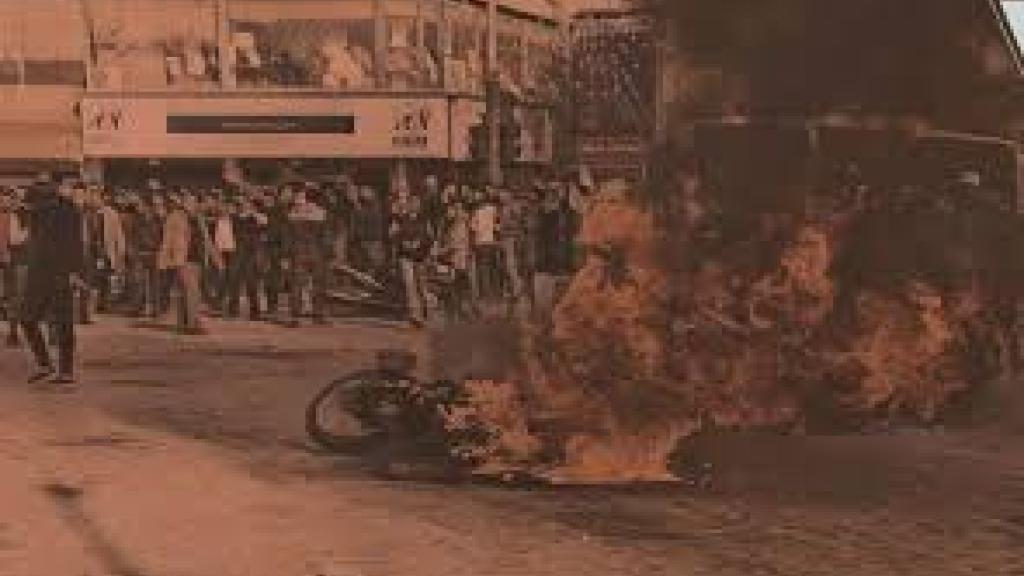
First published at Tempest.
When we speak of the “Dey uprising” — Dey in the Iranian calendar roughly corresponds to late December through mid-January — it is tempting to compress the whole episode into two images: the street and repression. That shortcut serves two audiences at once: the state, and lazy analysis. The state prefers to claim it was merely “unrest,” stirred up by foreign actors and then contained through “firmness.” A segment of the opposition, for its part, prefers to describe it as nothing more than a sudden flare of “popular anger” that eventually burned out. But if we keep the story inside this narrow frame, we miss what actually mattered.
Dey was the outcome of a process. The chain began at the start of autumn — from Mehr (roughly late September) — with a combination of economic decisions, political blockages, and an internal struggle over rentier privilege and access to resources. (A rentier is someone who lives off of unearned income — “rents” — derived from investments or a powerful social position). By Dey, this accumulation reached its point of detonation, as price shocks collided with the collapse of people’s basic capacity to live: the ability to buy necessities, to plan even a few weeks ahead, to maintain ordinary dignity under extraordinary pressure.
Most importantly, the episode did not “end” simply because repression occurred. Repression was decisive, yes. But what followed repression was equally political: a reconfiguration of the regime’s center of gravity and a blunt message delivered to society. The costs of the crisis would be paid from the pockets of ordinary people, not from the wealth, immunity, and institutional power of the ruling strata.
To understand Dey, political economy must be moved from the margins back to the center of the analysis.
Why every economic crisis in Iran becomes political
Iran’s economy can be explained very simply, without heavy jargon.
On one side there is a society whose income is paid in rials and that has almost no effective tools of collective self-defense — wage workers, teachers, nurses, junior civil servants, retirees, and a large share of the urban middle strata. These groups live under inflation, become poorer as the national currency loses value, and if they protest, they often face “securitized” repression — an “intelligence case,” charges framed as national security, and the machinery of punishment.
On the other side there is a network that lives off privilege. Privilege here is not a vague moral accusation; it is a concrete set of access points: preferential access to hard currency (dollars and other foreign exchange), import and export licenses, state contracts, oil and construction projects, monopolies in transport and customs, and — crucially — judicial and security immunity. Within this network, sanctions are not only “external pressure.” They can also function as an internal opportunity: they push trade into the shadows, concentrate it in fewer hands, kill open competition, and enlarge the rents available to those with protected channels.
The result is that crisis itself becomes a mechanism of redistribution — upward.
So when the rial collapses, it is not merely the dollar rate that rises. The prices of food, medicine, rent, transportation, and energy all surge. Ordinary people become poorer, while privileged networks either profit directly or, at minimum, survive the shock far better than everyone else. That is why an economic crisis in Iran rapidly turns into a legitimacy crisis: people do not experience the state as merely “incompetent,” but as partial — structurally aligned with the beneficiaries of privilege, and willing to make society pay to preserve that order.
What exactly does “economic surgery” mean?
In Iran’s official, technocratic vocabulary, “economic surgery” is a polite label for what is essentially shock therapy. What does that mean in concrete terms?
It means the state is trying to do several things at once, and to do them fast:
- Raise energy prices — gasoline, gas, electricity — in order to cut subsidies and lighten the budget deficit.
- Move the exchange rate toward a single-rate system, or at least redefine foreign-exchange “privileges,” because a multi-tier currency regime generates corruption and creates enormous rents for those who can access preferential rates.
- Increase tax extraction, usually through taxes that are easiest to collect — such as value-added tax — and through intensified pressure on small businesses and the urban middle strata, because taxing the truly powerful centers of wealth is politically costly and often practically blocked.
- Reduce social spending, or achieve the same outcome indirectly by keeping nominal wage increases below the inflation rate — which effectively lowers real wages.
Even in a “normal” state, this package is painful for lower-income groups. In Iran, it runs into a structural problem that turns pain into political combustion: the main beneficiaries of rent and privilege are not outside the state — they sit inside the architecture of power.
So “surgery,” in rhetoric, sounds like cutting away rent-seeking and restoring economic health. But in practice it tends to become something else: austerity for society, continuity for the rentier order. The blade is supposed to cut rent; instead it usually cuts into the social body.
That contradiction — reform spoken as rent-removal, executed as downward sacrifice — is the core of Dey.
From autumn to Dey: The chain that produced an explosion
From the start of autumn — from Mehr (roughly late September) — a serious debate began to consolidate among segments of the technocratic bloc, market-oriented economists, and even parts of Iran’s decision-making circles. The core claim was blunt: A shock was necessary. Energy prices had to rise. The exchange rate had to be pushed toward a single-rate regime. The economy had to be “stabilized” through a painful, concentrated intervention. Some even sold the fantasy — borrowing from cases like Argentina — that Iran could “fix” its economic disorder without any serious change in foreign policy and without opening political space, simply by administering a hard economic shock.
But the project carried a ruthless question from the very beginning: Who would pay the price?
If the goal were genuinely to reduce rent-seeking, then the privileged networks would have to be cut back. The budgets and contracts of powerful institutions would have to come under the knife. Oil, customs, and contractor monopolies would have to be subjected to transparency and real oversight. In other words, it would require a direct confrontation with the ruling strata.
What advanced in practice, however, moved in the opposite direction: The system prepared to ensure that the shock would land on society — not on the rentiers.
It is in this context that the suppression of voices capable of explaining the crisis in class terms becomes politically legible. If the public is prevented from understanding that the issue is not simply gasoline but the distribution of power and wealth, then responding to the crisis as a national security issue becomes far easier. Arrests, the closure of critical outlets, and the targeting of social and women’s activists in the months leading into Dey can be read within precisely this logic: clearing the terrain of interpretation and organization before the storm breaks.
Then the first stage of energy price increases was implemented. The state congratulated itself for “avoiding a repeat of Aban 1398” (November 2019). But it quickly became clear that Iran’s sick economy could not be “fixed” by a single round of shock, because the problem was never only the price of gasoline. The deeper drivers were structural: chronic budget deficits, sanctions, networked corruption, and a privilege-based rentier economy. So the talk of a second, deeper shock returned — and this was the point at which a technocratic project became a political crisis.
Why? Because two things were happening at once.
On the one hand, officials pushed the idea of creating at least the horizon of negotiations with the United States as a way to calm the foreign-exchange market. Even the mere possibility of talks can reduce psychological pressure on the rial, for a time. On the other hand, the state’s confrontational foreign policy posture and its domestic political closures remained intact. In other words, the system wanted to intensify austerity without accepting even minimal institutional reform. “Surgery” had to be performed, but the blade was permitted to cut only into society — never into the body of power.
The 1405 (2026-2027) budget, in detail: A document that said, “You will pay the price”
On 23 December 2025 (2 Dey 1404 in the Iranian calendar), the government submitted the draft budget for 1405 — and many things that had previously circulated as “speculation” suddenly hardened into an official document.
To make sure the reader understands exactly what is being discussed, several key pillars — and the logic behind them — have to be spelled out plainly.
(a) Wages versus inflation: A built-in pay cut
The budget assumed a nominal rise in wages and salaries at a level that does not match Iran’s existing inflation. If inflation is above 40 percent while wages rise by 20 percent, the implication is straightforward: real purchasing power falls.
Put simply: if this year your salary allowed you to buy 10 kilos of meat or 20 kilos of rice, next year — despite the “raise” — you will be able to buy less. The state is effectively closing its fiscal gap by shrinking the real wage of employees and wage earners. (In technical terms, a 20 percent nominal increase against 40 percent inflation is roughly a 14 percent drop in real terms: 1.20 ÷ 1.40 ≈ 0.86.)
(b) Minimum pay and the living basket: Working poverty as a policy outcome
The budget’s projected minimum wage level was far below the real cost of living. When the estimated cost of a working-class household’s basic living basket runs into tens of millions of tomans, but the minimum wage remains well below that threshold, the result is not mysterious: wage poverty. (Figures in Iran are typically discussed in tomans — with the “Iranian type” of everyday usage — though any conversion to U.S. dollars depends on the volatile free-market rate.)
That means poverty is no longer merely a condition of unemployment. It becomes something you can experience while fully employed — a structural feature of the system, not a personal failure.
(c) Taxes: Raising revenue where it’s easiest, not where it’s fairest
The draft budget projected a sharp increase in tax revenues. In practice, the most “collectible” taxes tend to be extracted from the middle and lower strata, because taxing the most powerful centers of wealth is either politically blocked or met with intense resistance.
The increase of VAT (value-added tax) from 10 percent to 12 percent is a clear example. This is a tax that lands on everyday consumption — on the receipts of ordinary life — not on rentier windfalls. In effect, it is the population’s daily purchases, not privileged profits, that are being asked to finance the state’s crisis.
(d) The operating deficit: The state cannot fund itself by normal means
The budget also pointed to an operating deficit on the scale of hundreds of trillions of tomans — a number that may sound abstract, so it should be translated into meaning:
It means the state cannot cover its routine expenditures through routine revenues. To bridge that gap, it must do one (or several) of the following:
- print money or monetize the deficit, feeding inflation
- raise taxes further, intensifying pressure on society
- sell assets and issue debt, pushing the burden into the future
- draw on public funds and reserves, consuming what is left of collective resources
In other words: When the deficit reaches this magnitude, economic management becomes inseparable from political conflict — because every “solution” has a social class that pays for it.
(e) The budgets of powerful institutions: Untouched, or minimally touched
At the same time, major allocations linked to military, security, and ideological institutions remained intact or relatively shielded. That is the budget’s political message in its most condensed form:
(f) Austerity for the lower strata; stability for the core of power.
Once society sees that combination in black and white, the issue is no longer “just gasoline prices” or “just inflation.” The issue becomes something more fundamental: the state has formally announced that the costs of the crisis will be extracted from the market, the middle strata, and the poor — not from the ruling network that holds wealth, immunity, and institutional leverage.
This is how a budget stops being merely a financial document and becomes a legitimacy document — or, more precisely, a document that accelerates the collapse of legitimacy.
The bazaar, trust networks, and holdings
In the classic narrative of modern Iran, the bazaar is often described as one of the pillars of the political order—an institution with social weight, organizational capacity, and historical leverage. But the reality of the last two decades is different: the traditional bazaar has steadily lost much of its structural power in the face of giant holding companies, quasi-state economic headquarters, financial and credit institutions, major contractors, and sanctions-shaped semi-monopolistic networks. The bazaar still matters as a capillary system for distributing goods and as a social terrain, but the real centers of economic decision-making have, for a long time, been located elsewhere.
When a foreign-exchange crisis intensifies, the traditional bazaar is typically the first part of the economy to freeze. It cannot price goods with confidence. It cannot buy inventory without fearing immediate loss. It cannot convert stock into reliable money. In contrast, trust (cartel-like) networks and larger connected actors — those with protected channels and privileged access — often have far more room to maneuver.
This produces a contradiction inside the economic order itself: a segment of the traditional economy becomes paralyzed under the pressure of currency collapse, while powerful sanctions-era networks either profit from instability or at least manage it more effectively than everyone else. The crisis is not simply “the state versus society.” It is also a struggle among different fractions of the system over who gets to survive the shock, and who gets crushed by it.
So when protest begins in the bazaar and rapidly jumps to the university — and then to smaller, poorer towns — this is not evidence that the “bazaar” suddenly became revolutionary. It is evidence that society was already primed, and that a rupture inside the economic order opened a corridor. That is the qualitative difference that matters: The spark may emerge from a central node of the traditional economy, but the fuel is drawn from the entire social landscape.
The social composition and geography of the revolt: From the center to the periphery
Dey was not a neat, uniform coalition — and that is precisely why it matters. Real movements are rarely orderly. They are noisy, multi-voiced, and cross-class. In this wave, several poles stood out:
- Small business owners and the bazaar, being crushed by currency instability, heavier taxation, and recessionary conditions.
- Students and younger people, carrying the memory of Woman, Life, Freedom and increasingly tying questions of dignity and freedom to the everyday crisis of livelihood.
- Workers and wage earners — teachers, nurses, retirees, and others who have been living inside continuous cycles of protest for years, not as a sudden awakening but as an accumulated experience of wage poverty and institutional contempt.
- Smaller and poorer towns, which have repeatedly shown in previous waves that when they erupt, repression often becomes more naked — more direct, less mediated, and more lethal.
- National-minority regions and other marginalized peripheries, where informal economies and double repression are lived simultaneously: economic dispossession on one front, and on another, intensified repression in the name of national security.
The crucial point is this: the linkage from bazaar to university, and then outward to smaller towns, demonstrated that the rupture was not only class-based. It was also generational and regional. Yet these fractures rotated around a single axis: the systematic removal of people from decision-making, and the consistent strategy of forcing the social costs of crisis downward — onto those with the least power to refuse them.
Fractures within the power bloc
In the months leading into Dey, fractures inside the ruling bloc became more visible. Some technocrats and political figures openly pointed to the need for negotiations as a way to reduce pressure on the foreign-exchange market — essentially, to create a stabilizing horizon for the rial. Meanwhile, parts of the economic oligarchy showed little willingness to sacrifice their interests: they resisted government demands to return offshore or hoarded currency to domestic circulation, or to alter the practices through which they protect their profits. The judiciary, in many cases, effectively reinforced this hierarchy of power — speaking far more softly to major capital holders than to workers, protesters, or ordinary defendants swept into “national security” cases.
But these internal conflicts tend to converge at a single point: the street. Once mass protest breaks open public space, rival factions recognize a shared danger. The disagreements over how to manage the rentier order may continue, but repression becomes the common project. In other words: divisions over the distribution of rents remain; unity over coercion hardens.
External actors and the exiled right wing
In moments of crisis, external players inevitably move. Foreign states pursue their own interests, not the freedom of Iran’s people. The exiled right, meanwhile, often revolves around one central idea: gaining power from the outside — through deals, lobbying, and reliance on foreign pressure.
That approach carries two major dangers:
- It hands the state a narrative weapon. The regime can portray protest as “dependent,” paint dissent as a foreign plot, and use that framing to legitimize repression.
- It diverts society away from internal organization and toward the fantasy of a savior — an expectation that political change will arrive through a “rescuer,” rather than through collective power built from below.
Dey showed how destructive this expectation can be. It fractures the movement, turns strategy into factional theater, and shifts the center of gravity away from concrete demands — wages, the right to organize, women’s freedom, social justice — toward symbolic battles that are easier to manipulate, easier to co-opt, and easier to weaponize against the uprising itself.
Bonapartism against revolution
Here the concept of Bonapartism becomes analytically useful — but only if it is stated in clear, accessible terms.
In the Marxist tradition, Bonapartism names a situation in which social antagonisms and political crisis become so acute that the state—above all its military and administrative apparatus — presents itself as an “arbiter above classes.” It claims that society is fragmenting, that forces are locked in destructive conflict, and therefore a concentrated authority is needed to restore “order.” But this arbitration is not neutral in practice. Its real function is to preserve property relations and the interests of the dominant strata, even if the external form of rule changes.
Translated into the language of Iran today, Bonapartism looks like this scenario:
First, the crisis is contained through mass violence and communications shutdowns — killing, arrests, and the deliberate severing of society’s ability to document, coordinate, and sustain collective action. Then, once the street is forced into retreat, the system pivots toward a political reconfiguration and elevates a figure — or a structure — marketed as a “savior,” designed to divert society away from the path of social revolution.
That “savior” can wear different costumes. It can appear as a technocrat, calling the project “economic reform.” It can appear as a military strongman, branding it “national security.” It can even appear in monarchist form, selling it as “historical salvation.” The common denominator is always the same: none of these routes touch the real foundations of the rentier order — property, privilege, and the networks of immunity. They merely change the management style and, once again, shift the costs onto society.
If we read Dey through this framework, repression in the name of national security is not merely a reflexive response to protest. It is part of a broader strategy: weakening society, suspending the possibility of revolutionary transformation, and preparing the terrain for “order from above” — an order that may stabilize the ruling network while leaving Iran structurally weaker and its social majority more exposed.
Siyavash Shahabi is a journalist and political activist currently living as a refugee in Athens, Greece, and the author of the blog FireNextTime, which focuses on labor movements, migration, and social struggles, especially in Iran.
Governing crisis: Sanctions, austerity and social unrest in Iran
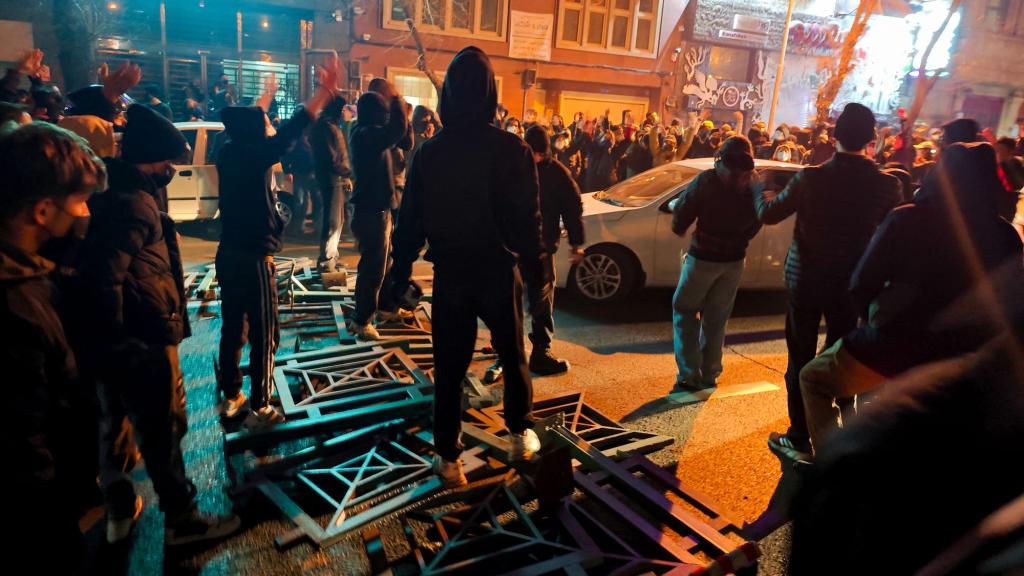
First published at MERIP.
On December 28, 2025, protests erupted across multiple cities in Iran in response to currency collapse and spiraling living costs. As the exchange rate grew more volatile, sections of Tehran’s Grand Bazaar and commercial centers shuttered. Rapidly shifting prices made imports, pricing and trade impossible.
The state moved quickly to implement an emergency measure embedded in its 2025–2026 fiscal-year budget package: It removed preferential foreign exchange rates for essential goods and key production inputs. Officials presented the move as anti-corruption reform and promised direct compensation through cash transfers and targeted support. In practice, the change accelerated an already rapid rise in prices and further eroded purchasing power, shifting the burden onto households. Official inflation in December was reported to be around 42 percent, but the cost of basic groceries rose much faster at 72 percent compared to a year earlier, pushing staples such as bread and dairy out of reach for large segments of the working class. By early January, the removal of preferential foreign exchange rates had only deepened the squeeze on everyday consumption, and protests escalated into mass demonstrations across the country that lasted for weeks.
It was not the first time Iranian officials have provoked unrest by introducing regressive measures in the name of reform. Over the past decade, successive governments have framed price liberalization and currency adjustments as necessary steps to stabilize markets and curb insider profiteering and corruption. In practice, these policies have functioned as austerity measures, transforming service-based welfare programs into cash-based handouts that quickly lose value amid chronic inflation.
The 2010, and later 2019, fuel price hikes are notable earlier examples of this shock politics, with the latter fomenting a mass uprising against deteriorating economic conditions. Both protests were put down with lethal repression. The current moment has followed the same arc at a higher intensity. This time, the masked austerity measures were implemented amid an economic protest. By mid-January the government was estimated to have killed thousands and had placed the country under an indefinite communication blackout (internet and phone) in one of the deadliest episodes in the Islamic Republic’s history since the purges of political dissent in the 1980s.
The political economy of sanctions
Most commentary on political crisis in Iran oscillates between two convenient, reductive narratives. The problem is either corruption and mismanagement, as if Iran’s economy operates in a vacuum untouched by global capitalism, or, echoing the state’s own narrative, sanctions and imperialist hostility are treated as the singular root of the country’s problems. Both stories flatten a complicated reality. The more useful question is how sanctions have been absorbed into Iran’s political economy in ways that serve the interests of the ruling class. Sanctions have not suspended market-oriented restructuring in Iran. They have reshaped it by widening the state’s discretionary power over who gets access to dollars, permits and contracts, and by generating new opportunities for insider profiteering under the guise of reform. Any serious account of Iran’s crisis must confront both the external sanctions regime and the internal machinery that manages crisis through austerity and repression.
Sanctions have shaped Iran’s political economy since 1979, with sharp escalations in 2012 targeting oil and finance, in 2018 after the US withdrawal from the nuclear agreement (when sanctions were reimposed) and again in late 2025 with the reinstatement of UN and EU-level “snapback” sanctions. Over the past 15 years, these punitive measures have translated into chronic inflation, collapsing real wages and a deepening crisis of social reproduction. Since late 2017, livelihood struggles have repeatedly spilled into open contention, from the 2017–2018 uprising to the 2019 fuel protests to recurring, decentralized mobilizations across workplaces and communities. A decade-long wave of organized labor protest has also persisted with teachers, pensioners and contract oil and petrochemical workers mobilizing over contracts, wages, pensions and basic living costs.
Sanctions did not contribute to the crisis simply by reducing resources. They have also reshaped who gains and how. By creating hard-currency shortages and blocking routine cross-border payments, they pushed trade into opaque channels, weakened the currency and made basic pricing increasingly unstable. One outcome is what many inside Iran call the “trustee economy,” referring to the expansion of intermediaries that keep exports moving, especially oil, by routing payments around banking and SWIFT restrictions. These brokers — often linked to state or quasi-state networks — profit through fees, exchange-rate markups and control over when payments are released, including by delaying or withholding export revenues that are supposed to be brought back into the country. Since 2018, official statements have repeatedly claimed that a significant share of export foreign currency has not been repatriated, with some estimates as high as 30 percent, amounting to tens of billions of dollars.
A related but distinct mechanism operates within the domestic economy. The state has attempted to manage volatility through multiple exchange rates, preferential foreign exchange and discretionary import permissions, turning political access into profit. When hard currency is scarce, the state’s allocation regime channels subsidized dollars and import license through institutional gatekeeping that predictively favors politically connected firms, creating lucrative opportunities for those positioned closest to these bottlenecks.
The Debsh Tea company scandal offers one glaring example. Between 2019 and 2022, Debsh Tea, a privately owned importer and producer, received billions of dollars in preferential foreign exchange earmarked for essential imports. In late 2023, Iranian oversight bodies and judiciary-linked reporting alleged that a significant portion of this subsidized currency was not used for the declared imports and was instead diverted into open-market transactions — turning access to cheap dollars into a quick profit by capturing the gap between the preferential and market exchange rates. The sums reported — upwards of $3 billion — was large enough to cover years of national tea demand or finance major public investment.
Not every case becomes a national headline, but the mechanism is familiar. Similar audit controversies have surfaced before, involving preferential access to foreign currency that did not match verified import records or any documented return of the money. One widely cited instance is the Supreme Audit Court dispute over $4.8 billion in preferential foreign exchange reportedly disbursed to importers with no corresponding imports documented.
When the resulting legitimacy crisis becomes intolerable, the state rolls out corrective packages presented as anti-corruption reforms. In practice, these policies entrench austerity and deliver sudden price shocks. Health policy offers a clear example. The Daroyar reform — a 2022 overhaul of drug subsidies — ended preferential foreign exchange for medicine and shifted the subsidy to an insurance-based reimbursement system. In theory, patients would pay less at the pharmacy while insurers and the state covered the difference. In practice, the financing chain never stabilized: Delayed reimbursements and liquidity shortages increased out-of-pocket costs and produced persistent gaps in access for patients and pharmacies alike. Meanwhile, the government captured fiscal gains from changes in the exchange rate, banks benefited as suppliers and importers relied more heavily on high-cost borrowing. Fuel policy has followed a similar pattern. Price hikes were justified as a way to fund targeted redistribution through cash transfers, but transfers quickly lagged behind high inflation, leaving households to absorb the widening gap between what they received and the real cost of fuel.
The broader state response to the sanctions driven fiscal crisis follows a familiar path. Rather than meeting its obligations through stable public funding, it has leaned on privatization, debt-for-asset swaps and “productive use” (Movaledsazi) schemes that transfer public assets into private hands. A notable example is the pension system. Instead of paying down its debt to Social Security in cash, the government has increasingly transferred shares in state-owned firms, effectively forcing the pension system to finance benefits through dividends, asset sales and investment returns. This policy shifts risk onto retirees by tying their livelihoods to market performance and inflation rather than stable entitlements.
The result is a sanctioned political economy in which austerity becomes a governing tool, and scarcity generates profit for those with privileged access. Instead of protecting households through social provision, so-called anti-corruption reforms shift the costs and risks downward through devaluation and subsidy removal while preserving the allocation systems that advantage well-connected elites. This pattern is widely noted in sanctions-era analyses of inequality and distribution. Recent official estimates put poverty at roughly a third of the population; similarly, the World Bank estimates that close to 10 million people fell into poverty over the past decade.
The downward redistribution is visible in how quickly economic shocks travel outward from the commercial core to outlying towns and provinces and in the forms of anger they produce. In western Iran’s long marginalized regions, in towns like Abdanan, the crisis has hit earlier and harder than in many central provinces, leaving deep underinvestment, high unemployment and entrenched poverty. During the recent protest wave, demonstrators stormed a supermarket and tore open bags of rice, scattering the grain across the floor and into the street rather than carrying it away. By late December, a 10kg bag of rice was selling for around several million toman, roughly equivalent to a month of minimum wage income. The gesture was not theft so much as refusal and a public rejection of a system that turns a basic staple into a luxury while demanding that people accept humiliation as everyday submission.
When crisis is managed through shock transfer rather than redistribution, policy becomes part of the problem, producing a vicious cycle. As economic instability intensifies, the state responds with new rounds of austerity framed as reform. Households do not experience these measures as repair; they experience them as a cost shift that deepens the crisis of everyday survival. The usual channels for complaint and mediation lose credibility. People can petition officials and institutions, but those same institutions are either implementing the damaging reforms or lack the power to reverse them. As that legitimacy erodes, pressure accumulates until a trigger can diffuse economic hardship into a national protest moment. Once dissent spills outside institutional channels, the state increasingly treats it as disorder. With fewer credible mechanisms of incorporation left, repression becomes routine because it is the only tool remaining to retain control.
External signaling, internal escalation
What has made this round of uprisings deadlier is the interplay between external and internal escalation. Iranians did not need outside encouragement to come to the streets: The currency collapse, unmatched wages to inflation and erosion of everyday survival were sufficient conditions for revolt. Rather, external escalation has raised the cost of dissent in a different way — less through material support than through narrative and signaling. When US and Israeli officials cast the protests as a theater of war and regime change, the state can more easily reframe mass dissent as a security threat and respond with counterinsurgency-style repression.
Exiled opposition figures, most prominently the wannabe king, Reza Pahlavi (son of Iran’s deposed Shah in the 1979 revolution) have tried to cast the uprising as a transition movement and have urged escalation, including repeated calls for foreign intervention to facilitate Pahlavi’s return as the national leader. At the same time, US and Israeli officials have publicly gestured at their own involvement, boasting of assets on the ground, speaking casually of arming protestors and promising “ help is on the way.” Their posturing only serves to strengthen the state’s claim that dissent is a foreign operation. Iranian officials have in turn framed the protests as an extension of the 12-day war with Israel in June 2025.
The result is a two-sided narrative that benefits everyone except ordinary Iranians. On one side, external signaling transforms real popular dissent into a proxy battlefield where death becomes collateral damage on the road to regime change. On the other, the Islamic Republic treats all regime change rhetoric as proof that protestors are terrorists, spies and enemy assets rather than citizens with legitimate grievances. In this sense, the response of the Iranian state and the politics of external powers share a core feature: both treat Iranian lives as expendable for the needs of power and profit.
The protests may be suppressed for now, but the conditions that generated them remain unchanged. There is little evidence that the state is able or willing to undertake the structural and welfare reforms needed to fundamentally address the crisis of everyday survival. While it cannot directly lift sanctions, it has shown little interest in reducing household exposure to inflation, curbing precarious living conditions or rebuilding the minimum credibility of welfare and representation. Currency instability and price volatility are increasingly governed as normal conditions, not emergencies to be solved. With each turn of the cycle from austerity to protest, the crisis deepens and heavier force becomes the default method of control. What comes next is uncertain, but the direction is not. As long as crisis is managed through austerity and bullets, and as long as external powers treat Iranian lives as instruments of pressure and regime change, the costs will keep rising and more will die.
MERIP Editor's note: Due to the ongoing internet shutdown in Iran, some Iran-based websites were inaccessible at the time of publication. Links are nonetheless included for reference.
Ida Nikou holds a PhD in sociology from Stony Brook University.

No comments:
Post a Comment