How Trump’s Greenland Threats Amount to an Implicit Rejection of the Legal Principles of Nuremberg
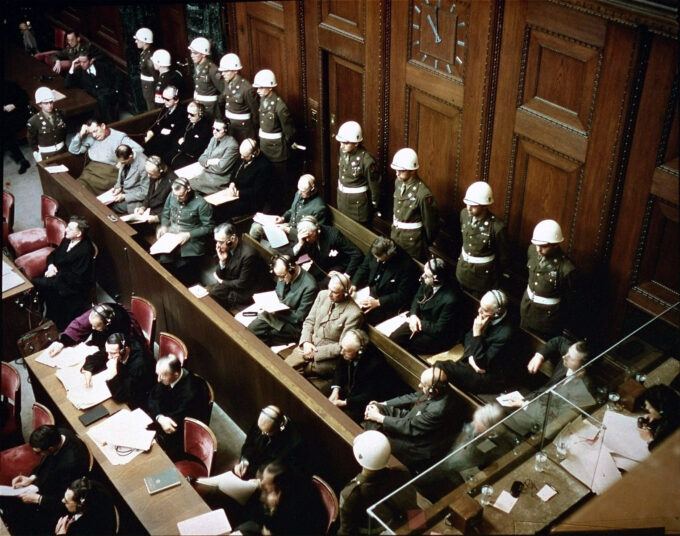
The defendants in the dock at the Nuremberg Tribunals. Photo: Raymond D’Addario. Public Domain.
U.S. President Donald Trump has, for the moment, indicated a willingness to abandon his threat to take over Greenland through military force – saying that he prefers negotiation to invasion. He is, however, continuing to assert that the United States ought to acquire ownership of the self-governing territory.
Trump has repeatedly raised the possibility of using military action, against both Greenland and Canada.
These threats were often taken as fanciful. The fact that he has, successfully, used military force to remove Venezuelan President Nicolas Maduro from power has lent some plausibility to these threats.
Crucially, these military possibilities have been justified almost exclusively with reference to what Trump’s administration sees as America’s national interests. Anything short of ownership in the case of Greenland, the president has emphasized, would fail to adequately protect American interests.
As a political philosopher concerned with the moral analysis of international relations, I am deeply troubled by this vision of warfare – and by the moral justifications used to legitimize the making of war.
This view of warfare is radically different from the one championed by the U.S. for much of the 20th century. Most notably, it repudiates the legal principle that informed the Nuremberg trials: that military force cannot be justified on the basis of national self-interest alone.
Those trials, set up after World War II to prosecute the leaders of the Nazi regime, were foundational for modern international law; Trump, however, seems to disregard or reject the legal ideas the Nuremberg tribunal sought to establish.
Aggressive war as international crime
The use of warfare as a means by which states might seek political and economic advantage was declared illegal by 1928’s Kellogg-Briand Pact – an international instrument by which many nations, including both Germany and the U.S., agreed to abandon warfare as a tool for national self-interests.
After 1928, invading another country in the name of advancing national interests was formally defined as a crime, rather than a legitimate policy option.
The existence of this pact did not prevent the German military actions that led to World War II. The prosecution for the International Military Tribunal at Nuremberg, accordingly, took two aims as central: reaffirming that aggressive warfare was illegal, and imposing punishment on those who had chosen to use military force against neighboring states.
The first charge laid against the Nazi leadership at Nuremberg was therefore the initiation of a “war of aggression” – a war chosen by a state for its own national interests.
The chief prosecutor in Nuremberg was Robert H. Jackson, who at the time also served as a justice on the U.S. Supreme Court. Jackson began his description of the crime by saying that Germany, in concert with other nations, had bound itself in 1928 to “seek the settlement of disputes only by pacific means.”
More particularly, Jackson noted, Germany had justified its invasion of neighboring countries with reference to “Lebensraum” – living room, or, more generally, space for German citizens – which marked those invasions out as illegal.
Germany used its own national interests as sufficient reason to initiate deadly force against other nations. In so doing, said Jackson, it engaged in a crime for which individual criminal punishment was an appropriate response.
In the course of this crime, Jackson noted, Germany had shown a willingness to ignore both international law and its own previous commitments – and had given itself “a reputation for duplicity that will handicap it for years.”
Jackson asserted, further, that the extraordinary violence of the 20th century required the building of some legal tools, by which the plague of warfare and violence might be constrained.
If such principles were not codified in law, and respected by nations, then the world might well see, in Jackson’s phrase, the “doom of civilization.” Nuremberg’s task, for Jackson, was nothing less than ensuring that aggressive war was forever to be understood as a criminal act – a proposition backed, crucially, by the U.S. as party to the Nuremberg trials.
The morality of warfare
It is fair to say that the U.S, like other nations, has had a mixed record of living up to the legal principles articulated at Nuremberg, given its record of military intervention in places like Vietnam and Iraq.
Trump’s prior statements about Greenland, however, hint at something more extreme: They represent an abandonment of the principle that aggressive war is a criminal act, in favor of the idea that the U.S. can use its military as it wishes, to advance its own national interests.
Previous presidents have perhaps been guilty of paying too little attention to the moral importance of such international principles. Trump, in contrast, has announced that such principles do not bind him in the least.
In a recent interview with The New York Times, Trump asserted that he did not “need international law” to know what to do. He would, instead, be limited only by “his own morality” and “his own mind.”
European leaders, for their part, have increasingly decried Trump’s willingness to go back on his word, or abandon previously insisted-upon principles, if such revisions seem to provide him with some particular advantage.
Trump’s statements, however, imply that his administration has adopted a position strikingly similar to that decried by Justice Jackson: The U.S., on this vision, can simply decide that its own moral interests are more important than those of other countries, and can initiate violence against those countries on its own discretion. It can do this, moreover, regardless of either the content of international law or of previously undertaken political commitments.
This vision, finally, is being undertaken in a world in which the available tools of destruction are even more complex – and more deadly – than those available during the Second World War.
It is, indeed, a historic irony that the U.S. of today has so roundly repudiated the moral values it both helped developed and championed globally during the 20th century.
Michael Blake is a Professor of Philosophy, Public Policy and Governance at the University of Washington.
This article is republished from The Conversation under a Creative Commons license. Read the original article.

Greenland Gambit: How Trump’s Arctic Ambition Shattered the Atlantic Alliance
A specter is haunting the transatlantic alliance – not from the East, but from within. What began as a seemingly quixotic real estate fantasy has evolved, through weeks of escalating pressure, into the most profound stress test of U.S.-European relations since the Cold War. President Donald Trump’s campaign to acquire Greenland has laid bare a stark reality: the alliance’s most powerful member is willing to wield coercion against its own partners, treating sovereignty as a transactional commodity. While an eleventh-hour tactical retreat has pulled the world back from the brink of immediate conflict, the crisis has illuminated a fatal flaw in the alliance’s foundation.
The Tactical Retreat: A “Framework” That Exposes More Than It Resolves
The immediate crisis abated not with a grand diplomatic triumph, but with a characteristically vague post on Truth Social. On January 21, following a meeting with NATO Secretary General Mark Rutte, President Trump announced he was withdrawing his threat to impose sweeping tariffs on eight European allies and ruled out using military force. In return, he claimed the two had formed the “framework of a future deal” for Greenland and the Arctic. This sudden de-escalation was less a resolution and more a revelation of pressure points. The threatened tariffs had sent Wall Street into its worst single-day decline since October, demonstrating the economic self-harm of his coercive strategy.
The substance of Trump’s “framework” remains conspicuously absent. Reports suggest discussions may involve the U.S. gaining “total access” to parts of Greenland for military purposes. Crucially, Trump’s language has shifted from “ownership” to “access,” a nod to political reality. Yet, the core ambition persists; he continues to frame Greenland as imperative for missile defense and minerals, bluntly stating the U.S. will achieve “all of its strategic goals… at very little cost, forever.” As Ole Wæver, a professor of international relations at the University of Copenhagen, skeptically notes, this is likely a “pretend” deal. He argues, “NATO can’t negotiate minerals or ownership of territory for bases… Most likely, the main process now goes back… to a bureaucratic committee.”
The Unbreakable Red Line: How European and Greenlandic Resolve Forced a Climbdown
Trump’s tactical pivot was forced by an unprecedented and unified wall of resistance. European leaders had declared they “will not allow ourselves to be blackmailed.” The non-negotiable line was drawn by Denmark and Greenland. Danish Prime Minister Mette Frederiksen stated unequivocally, “We cannot negotiate on our sovereignty.” This was echoed by Greenland’s Prime Minister Jens-Frederik Nielsen, who called sovereignty a “red line.” Perhaps more devastating was the visceral rejection from Greenlanders themselves; a new poll finds 85% of residents oppose joining the U.S.
Remarkably, this resistance transcended Europe’s political divides, isolating Trump even among ideological allies. In the European Parliament, typically pro-Trump, far-right figures condemned the threats. France’s Jordan Bardella called them “coercion,” while Germany’s Alice Weidel said Trump had “violated a fundamental campaign promise.” This unanimity was backed by concrete action: Denmark dispatched more troops to Greenland as part of “Operation Arctic Endurance,” making clear that its defense would be a collective endeavor.
The Permanent Fracture: Why “Normal” Can Never Return
The Greenland crisis has not been resolved; it has moved from explosive confrontation to a cold, permanent fracture. The events have proven that the foundational trust of the Atlantic Alliance – the belief that the United States is a reliable guarantor of its partners’ security and sovereignty – is irrevocably broken. It exposed Article 5’s fatal paradox: the collective defense clause is meaningless if the aggressor is the alliance’s own leader. Consequently, Europe’s frantic push for “strategic autonomy” is no longer a lofty ideal but an urgent necessity.
The fallout has also strategically weakened the United States. By alienating allies, Trump has galvanized a more unified and assertive Europe. The relationship has been reduced to a cold, transactional ledger. As a result, guided by this stark lesson, traditional allies are likely to remain on the sidelines during any future U.S. military intervention. Trump himself hinted at this doubt in an interview, asking, “Will they be there, if we ever needed them?” The crisis over Greenland was not an aberration but a brutal exposure of a new transatlantic reality. While formal structures may linger, the spirit of the alliance has been shattered. The break is not merely possible, and it is already here, buried in the permafrost of a disputed Arctic island.
Harris Jenner is a foreign policy advocate dedicated to promoting diplomatic and political measures for international de-escalation. Her work centers on building long-term strategic stability and advancing practical, peaceful pathways for conflict resolution.
Defend Greenland against the US’s raid - without any illusions about the Kingdom of Denmark and the EU
Tuesday 27 January 2026, by SAP (Denmark)

The Trump regime is still engaged in a fierce offensive for an imperialist American takeover of Greenland. All means have been used: political, economic and even military threats. In this situation, the Greenlandic self-government, a united Inatsisartut, has quite understandably chosen to seek refuge in a tactical alliance with the former colonial power (Denmark), the EU and the European NATO countries. At best, this alliance can stop Trump’s plans to formally take over power in Greenland here and now. However, neither the powers that be in Denmark nor the EU are reliable champions of the Greenlandic people’s right to self-determination – quite the contrary!
The massive popular support for, among other things, the demonstrations against Trump’s plans for conquest has very clearly focused on the Greenlanders’ right to self-determination. Hurrah for that! And even the Prime Minister has, in recent months – side by side with the leaders of the Self-Government – chosen this focus. But there is absolutely no reason to trust the Danish government and the other alliance partners or to embellish their motives.
As we described in a commentary about a year ago [1], Denmark’s relationship with Greenland continues to be characterized and driven by imperialist interests – first and foremost, perhaps, the interest in maintaining Denmark’s geopolitical significance. This is despite the limited self-government that the Greenlanders have managed to fight for.
The helpful EU partners have also occasionally revealed the EU’s undoubtedly deep interest in the resources in the Greenlandic subsoil – as well as the country’s strategically important location in relation to the defence of Europe.
Stand away from the hypocrisy
For true friends of Greenlandic independence – and not least for the Greenlanders themselves – it has been challenging to listen to the entire political public in Denmark praising the Greenlanders’ right to determine their own country, the rights of indigenous peoples, etc. in recent weeks. As if this were and always had been the basis for the “Kingdom”, as it is so beautifully described. The hypocrisy seems glaring when this fairy tale is compared with the Danish-Greenlandic colonial history. And with the continued Danish imperialist dominance, even after the self-government arrangement.
It is also outrageous when Denmark, England, France, the Netherlands and others now stand guard over respect for “an international legal order”. And claim that “we in the West” have safeguarded this since World War II. For example, a number of the same countries – not least Denmark – have been eager participants in the “coalition of the willing” which (led by the USA), without scruples under international law, violated the very territorial integrity and national sovereignty of Afghanistan – and, for many, later also Iraq!
Should the left wing – out of respect for the tactical alliance against the US – completely ignore this hypocrisy? Should we pretend that we completely share this view of the ‘Kingdom’ – and, for that matter, of our ‘EU friends’? This is overwhelmingly what the Red-Green Alliance has chosen to do.
And that is a mistake!
Firstly, because we suddenly come across as Eurocentric hypocrites who turn a blind eye to Western (including European and Danish) colonialism and imperialism, both historically and in the present day. This will obviously and with good reason complicate our solidarity-based, internationalist cooperation across borders. It will also strain our relationship with Greenlanders and other ethnic minorities in Denmark and Greenland, who are typically already painfully aware of this hypocrisy.
No rose-tinted view of Denmark and the EU
Secondly, to lay the groundwork for the continued struggle for the Greenlanders’ real right to self-determination. A struggle that – regardless of whether Trump and the US abandon a formal takeover, and even regardless of Trump and the US altogether – will be necessary.
Unless Trump succeeds fully in his conquest and, at the same time, completely breaks the economic and military imperialist alliance across the Atlantic, the Danish government and the EU will play a decisive role in shaping the future of Greenlandic self-determination – both in terms of military armament and the exploitation of Greenland’s subsoil resources.
For that reason alone, it would be reprehensible to contribute to the illusion that the Greenlanders can trust the powers that be in Denmark and the EU. For there is little doubt that the goal of these parties will be to find a solution that primarily serves their own imperialist interests in the Greenlandic subsoil and military control of the Arctic. Not the self-government of the Greenlanders, who have been very reluctant to accept both the arms race in the Arctic and environmentally hazardous mining.
No to the arms race in the Arctic
The arms race in the Arctic is a threat to both the security of the Greenlanders and world peace and must be stopped!
It may have sounded very reasonable to send some (more) Danish soldiers to “stand symbolic guard over Greenland against a US military takeover” – if the Greenlandic self-government, and even the left-wing party IA, wanted it.
They clearly did – and apparently everyone is also enthusiastic about the fact that, instead, a large contingent of European NATO troops will be coming to Greenland and the surrounding waters. The Red-Green Alliance’s enthusiasm was due to the massive “European solidarity on Greenland’s sovereignty”. This angle was also strongly emphasized by many journalists.
BUT: Officially, the large troop deployment is being presented as something completely different from protecting Greenland against the US, namely as protecting Greenland, NATO and, to a large extent, the US against Russia and China. In other words, as an attempt to demonstrate what Denmark and others have already said, namely that the Danish Realm willingly fulfils all of Trump’s dreams of insane armament – so he does not need to take over Greenland at all!
It is clear that the action serves both purposes – and that it is therefore a smart move if one wants to convince the US that a military takeover would be very difficult and costly - and that the US’s wildest dreams of arming Greenland and the Arctic will be fulfilled with joy and enthusiasm by Denmark with the support of the other European NATO countries.
However, this is where the chain breaks for a party like the Red-Green Alliance. Or rather: it should have broken.
We are staunchly opposed to the imperialist blocs arming themselves for war against each other. That is why we are also fighting for a demilitarized Arctic, for mutual disarmament – and thus against the obvious boost to the arms race that the recently launched NATO escalation around Greenland also represents.
Not a defence of either the Greenlanders or world peace
Denmark’s, NATO’s and the US’s joint armament plans around Greenland have very little to do with defending Greenland – and absolutely nothing to do with protecting the Greenlandic population.
For example, monitoring and combating Russian submarines in the waters around Greenland, which can prevent Russian submarines from coming close to threatening the US, and the construction of a missile shield over Greenland (“Golden Dome”) to protect the US from Russian missiles, are in no way “defensive defence” of the Kingdom. This armament in the Arctic will rather make Greenland and the Greenlanders a sure-fire first target in a war.
What does it mean for world peace if a “Golden Dome” actually succeeds in protecting the currently most aggressive imperialist power, the United States, from getting anything back in return if they start World War III? This increases the risk that a president like Trump, in an armed conflict with Russia/China, might take the chance and plunge the world into a nuclear war. And just last week, Trump highlighted the “Golden Dome” as a US “national security interest” that necessitates the conquest of Greenland.
Respect the Greenlanders’ respect for nature
Despite economic pressure, the Greenlandic self-government has on several occasions dug its heels in when greedy companies of various nationalities have had plans for environmentally damaging extraction of raw materials from the Greenlandic subsoil. And there is little doubt that one of the more rational arguments for Trump’s desire to gain overall formal authority over Greenland is precisely to remove all obstacles – such as environmental legislation – to American companies’ exploitation of Greenland’s raw materials in the long term. Therefore, there is also reason to fear that part of a negotiated solution may include unpleasant concessions to wishes in this direction. Regardless of whether Trump has already discussed this with the NATO Secretary General or not... And there is reason to fear that Denmark/the EU will be more interested in getting a piece of the pie themselves than in securing the Greenlanders’ veto.
In this context, it is not enough that the Greenlanders’ right to decide on environmental legislation, etc. is preserved. Greenland must also be guaranteed an economy that does not force them to sell out their nature conservation efforts due to economic pressure.
Real Greenlandic self-government requires economic independence. At present, the economy is a major barrier to the Self-Government taking on new tasks. A first requirement must be that the block grant be increased – and made unconditional, so that it also goes to an independent Greenland. An obvious additional requirement is Danish "colonial era compensation” to enable the Self-Government to invest heavily in sustainable, publicly owned and controlled business development that can create a stable economic foundation for a self-financing, independent Greenland.
The fight is not over
It is clear that right now it is a matter of creating as strong a front as possible against Trump’s threats, for the respect of Greenland’s borders and the Greenlandic people’s right to self-determination.
And, of course, it is entirely up to the Greenlanders to decide what they are ultimately willing to accept here and now in order to achieve a negotiated solution, in a situation where they face overwhelming threats from the US – and false promises from all sides.
But that does not mean that we, including the Red-Green Alliance, should cheer for a “solution” that essentially cements imperialist interests – neither those of the US nor those of Denmark and the EU.
The Red-Green Alliance should be clear from the outset about the problems of a “successful negotiated solution”, a “deal” with Trump that does not affect the sovereignty of the Realm, but entails a catastrophic Arctic arms race, increased opportunities for imperialist exploitation of Greenland’s natural resources and de facto shackling of Greenland in the so-called Realm.
The struggle for real Greenlandic independence and against environmental disasters and insane armament continues – under slightly different conditions, but regardless of the outcome of the ongoing arm wrestling. It will be necessary to maintain the impressive popular support behind the Greenlanders’ demands for self-determination – and for the further demands that can make self-determination a reality. Our most important task is to build popular, anti-imperialist solidarity and gather support for these demands in Denmark – and in the other imperialist countries.
Stop the imperialist plundering of the United States - Defend Greenland’s right to independence
Terminate the base agreement with the United States
Stop Denmark’s - and Europe’s - arms purchases from the United States
Economic EU sanctions against the US
Denmark must ensure Greenland’s economic opportunity for independence
Increased and unconditional continued block grants - and colonial compensation that the country can use for sustainable investments in an independent economy
No to exploitation and environmental destruction, no to imperialism through contracts
Greenlanders must be guaranteed full democratic control over the country’s subsoil
No to armament in the Arctic
Greenlanders must have the right to restrict/reject all military installations in their country and waters
26 January 2026
Translated from “Forsvar Grønland mod USA’s røvertogt - uden illusioner om Rigsfællesskabet og EU”.
Attached documentsdefend-greenland-against-the-us-s-raid-without-any_a9385-2.pdf (PDF - 1 MiB)
Extraction PDF [->article9385]
defend-greenland-against-the-us-s-raid-without-any_a9385-3.pdf (PDF - 1 MiB)
Extraction PDF [->article9385]
Footnotes
[1] See “For a free and demilitarized Arctic – Defend Greenland’s independence – Defend the Greenlandic people and nature”.
Denmark
The Unity List remains Copenhagen’s largest party
Return from Ukraine
Visiting a secret anarchist warehouse in Ukraine
Enhedslisten: Support for more defence - but which defence?
For a free and demilitarized Arctic – Defend Greenland’s independence – Defend the Greenlandic people and nature
Greenland
Trump, Europe and outraged virtue: malaise in imperial supremacism
Trump’s Greenland bid is really about control of the Arctic and the coming battle with China
Greenland has lost 20 per cent more ice than expected
SAP (Denmark)
The SAP (Socialistisk Arbejderparti) is the Danish section of the Fourth International. It participates in the Red Green Alliance. TIt was founded in 1980 as a continuation of Revolutionære Socialisters Forbund (RSF) - Revolutionary Socialists’ League.


No comments:
Post a Comment