Who Are the Criminals? Listen to Hind Rajab
January 29th, 2026, marks the second year since the Israeli military, using U.S. provisioned weapons, murdered Hind Rajab. Had she lived, this little Palestinian girl who liked to dress up as a princess would now be 7½ years old. An Israeli Defense Force unit fired a barrage of missiles at the car in which she and her relatives were fleeing from an Israeli military invasion of their neighborhood.
The family’s fatal ordeal began on January 29th, 2024, in Tel al-Hawa, an area south of Gaza City, when Israeli forces ordered Hind’s family to evacuate from their home. Hind’s mother, Wissam Hamada, and an older sibling set forth on foot. It was raining heavily, and Hind’s mother didn’t want her walking through the storm. Hind joined her aunt, uncle, and four cousins as they fled by car from invading Israeli forces. Hoping to reach a shelter at the Al Ahli hospital, Hind’s uncle sought advice from the Palestine Red Crescent office about what route would be safe to take. But before they could find refuge, the Israeli military fired on their car, immediately killing Hind’s aunt, uncle and three of her cousins.
Her surviving cousin, fifteen-year-old Layan, was able to re-connect, by phone, with relief workers at the Palestinian Red Crescent office. That conversation ended when Layan screamed that the tank was very near and the relief workers then heard an explosion. Hind watched in horror as Layan was killed. The relief workers called Hind. The utterly frightened girl answered, and they urged her to remain hidden in the car and try to be calm. Rescuers would come, they said. But it would be suicidal for relief workers to set forth without first coordinating with the Israeli military. It took several hours for the Israeli military to give clearance for two ambulance workers to travel the approved route, an eight-minute drive, in hopes of rescuing Hind.
Surrounded by the corpses of her family members, Hind pleaded with the Red Crescent workers to come soon. “I’m so scared,” she told them. “Please come.”
But when the rescuers were within 162 feet of the vehicle where Hind was trapped, Israeli tank fired missiles assassinated them.
Hind’s voice continues reaching people. Three award winning films have told her story, awakening consciences, worldwide, to Israel’s ongoing genocide.
Hind’s voice echoes, tragically, in the pleas of Palestinian children today who face torture and death at the hands of Israel’s genocidal policy makers and militarists. Palestinian children living in makeshift tents, soaked and chilled by winter storms, long for relief. Hind’s pure innocence speaks for them, also, these little ones who could never be mistaken for criminals or security threats, little ones who beg for warmth and protection. The vocabulary changes slightly: Please come. I’m so cold. Please come. I’m so sick.
Yet trucks laden with relief supplies remain blocked, at the border crossings, while children who are near death suffer under tortuous conditions.
More than 100 children are reported to have died in Gaza since the October 2025 ceasefire.
A January 26, 2026 UNICEF report notes that Israel’s relentless attacks have decimated water and sewage systems in Gaza. Since the onset of winter, heavy rainfall has caused unsafe water to flood densely populated areas where people are crowded into makeshift tents. The grounds become muddy, making hygiene nearly impossible as people sleep in saturated clothes and bedding. Storms have collapsed tents. Fuel for generators is scarce, and there has been no central electricity for over two years.
Lacking warm blankets and sleeping on cold, wet ground, children whose immunities are already weakened risk dying of hypothermia and waterborne illnesses.
So far, this winter. as of January 27, 11 infants under the age of one have died from hypothermia and extreme cold.
A 34-year-old mother in the al-Mawasi tent camp near Khan Younis remains devastated after she lost her two-week-old infant who died because of the extreme cold.
“I woke my husband immediately so we could take him to the hospital,” she told Al Jazeera, “but he couldn’t find any means of transportation to get us there.”
Heavy rains made it impossible to reach the hospital. The next morning, using a donkey cart, they raced to the hospital, but it was too late. Mohammad Abu al-Khair died on December 15, 2025.
In Khan Younis, 27-day old Ayesha Ayesh al-Agha died of hypothermia on January 17, 2026.
On January 20th, in Gaza City, Shaza Abu Jarad, three months old, died of hypothermia
Each infant lived in a tent, unprotected from the cold and rain.
Please listen to Hind’s voice, her whispers, her pleas. Allow her voice to resonate. Demand an immediate end to Israel’s grave violations of international human rights and humanitarian law. Urge the international community to ensure that Israel and all countries participating in its genocide are held accountable under international law. Boycott. Divest. And don’t buy into genocide.
Kathy Kelly (Kathy.vcnv@gmail.com) is board president of World BEYOND War. She has lived alongside ordinary people in war zones in Iraq, Afghanistan, Gaza, the West Bank, and Lebanon. Children were among her finest teachers.
A tragic drama on the side of truth
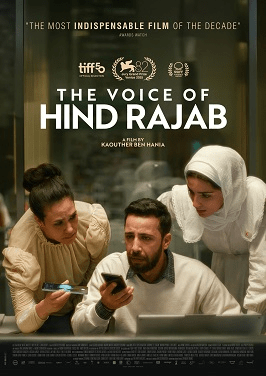
Ian Saville reviews The Voice of Hind Rajab.
This morning I watched The Voice of Hind Rajab, a new film by the Tunisian director Kaouther Ben Henia. It’s highly emotional and disturbing, as well as being an amazing piece of story-telling. It is told entirely within the setting of the Red Crescent Office in Ramallah, where the staff try desperately to be allowed to send an ambulance to a five-year old girl, Hind Rajab, trapped in Gaza in a car under attack by an Israeli tank, while six members of her family lie dead around her.
The ambulance is only eight minutes away, but in order to get the green light to proceed to the location, the call handlers and their worried boss have to ensure that they clear a passage with the layers of bureaucracy in charge – the Red Cross in Jerusalem, the Ministry of Health, and ultimately the IDF commanders. So the eight minute journey needs hours of coordination with these seemingly uncooperative agencies. And even when the green light arrives, after hours of begging and pleading, the tragedy continues.
The director decided to weave the film around the real-life soundtrack of the young girl’s call, rather than getting a child actor to speak the text, which she believes would have been disrespectful to Hind’s memory. This was done with the agreement of the girl’s mother, and the Red Crescent staff. It adds enormous power to the film, but also makes the experience harrowing.
This is much more than a documentary. It is a tragic drama. The scene in the office is tense and emotional, as conflict emerges between the call handler, who wants to just cut through the red tape and send the ambulance straight away, and his boss, who is determined not to lose more of his staff to Israeli murder. We also see the emotional toll on another, female, call handler, who tries desperately to reassure the girl, and establish an emotional connection with her. Those who followed the story on social media will know of the terrible outcome, and we see the arguments played out in the office over how useful it will be to broadcast the situation as it happens.
The tragedy is that even the caution of the boss doesn’t save his medics, as they also come under attack within metres of reaching their target.
Asked in an interview on BBC radio why she didn’t include the Israeli Government perspective in the film, the director said that the Israeli perspective is just one of denial, despite the undeniable research of investigative organisations Forensic Architecture, the Washington Post and Al-Jazeera. The film takes a position on the side of truth.
There has been some criticism of the film on the basis that using the real voice of Hind is somehow “in bad taste” in a drama which mixes the actuality with actors. But the mother of Hind, Wissam Hamada, who has since been evacuated from Gaza, has given her blessing to the film, though she can’t bring herself to watch it. She has expressed hope that it will raise awareness of the plight of children in Gaza, and some of the profits from the film will go to the Red Crescent and charitable organisations for Palestinian children.
This is a hard film to watch. But I hope it gets very widely distributed, so that more people begin to understand the senselessness of this war, and the reality of the living, and dying, people, like Hind, who are trapped in it.
Ian Saville is a socialist magician and an activist in Brent, northwest London.
Image: https://id.wikipedia.org/wiki/Berkas:The_Voice_of_Hind_Rajab_film_poster.jpg, licensed under a
Creative Commons Attribution-ShareAlike 4.0 License .


No comments:
Post a Comment