Transylvania isn’t only about Dracula and his castle – although another country’s leader has been trying to establish a rather vampiric hold on it. This region of Romania is home to one of the biggest ethnically-Hungarian communities in Europe, and Hungarian Prime Minister Viktor Orban has attempted to influence it for votes. In this new episode of "Growing up in Europe", ENTR travelled to the city of Targu Mures, where young people walk a tightrope between two cultures.
Issued on: 30/01/2026
By:
Jade BRIEND-GUY/
Claudia COLLIVA/
ENTR
Video by:
ENTR
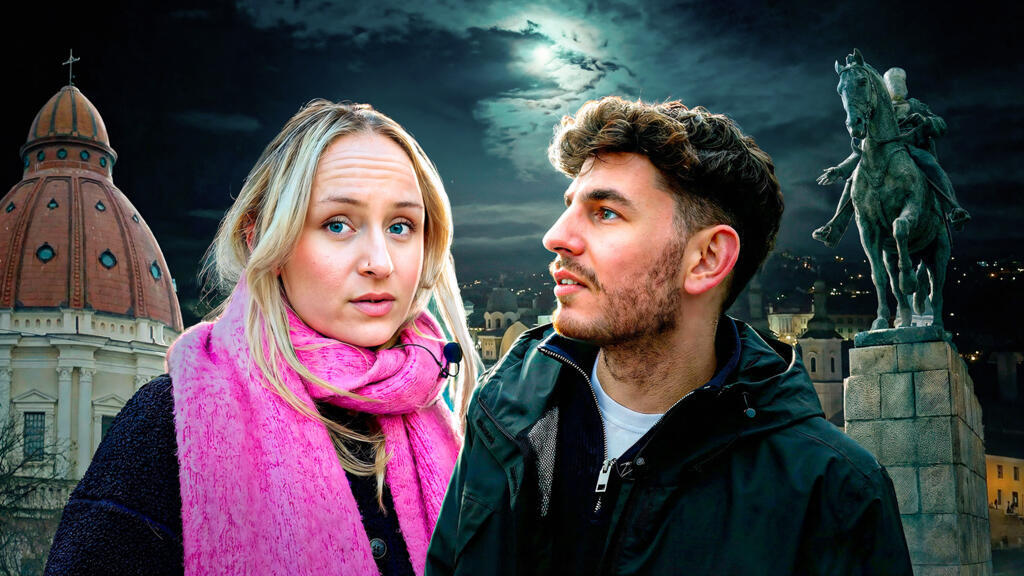
ENTR headed to Targu Mures, Transylvania, to meet two young people and ask them what it’s like to grow up pulled between two cultures. © ENTR
“I refuse to say that I'm from Romania or Hungary, I just will not say that,” states 25-year-old Dalma. “So I always say, ‘I'm from Transylvania, comma, Romania'.”
Dalma is keen to set the record straight: she was born into a Hungarian family in the Szekely Land, a sub-region of Transylvania. She is Romanian by nationality, but she grew up immersed in Hungarian culture and language. She therefore sees herself first and foremost through this identity: Hungarian, from Transylvania, in Romania.
In her home region, Dalma's case is far from isolated: the Szekely Land is home to more Hungarians than Romanians. Some villages are even exclusively Hungarian-speaking, while larger cities are bilingual. In Dalma’s native town of Targu Mures, known in Hungarian as Marosvasarhely, street names, signs and inscriptions at building entrances are all in both languages.
“I feel Romanian, Transylvania is a part of Romania,” says Radu, a 24-year-old medical student who also grew up in Targu Mures, in a Romanian family. He considers himself “100% Romanian” and like many Romanians in the region, he speaks almost no Hungarian, although he does acknowledge that knowing the language would be a significant advantage for practising medicine there.
A contested region
The presence of a large Hungarian community in Transylvania dates back centuries. And for good reason: until 1920, the region was part of Hungary. At the end of World War I, the Treaty of Trianon was signed in Versailles, marking the dismantling of the Austro-Hungarian Empire. Thus the Kingdom of Hungary lost part of its territory, and a large number of its Hungarian-speaking citizens, including those in Transylvania.
Today, the two communities cohabit rather peacefully in Transylvania, but some people still feel strongly about the issue. In 2018, several Hungarian parties in the region presented a plan for territorial and cultural autonomy, based on the model of Catalonia in Spain or South Tyrol in Italy. To date, this initiative has not been successful.
“It's a very taboo subject,” says Radu. “We have to respect our minorities, (...) [but] personally I view Transylvania as a part of Romania. I truly believe that Transylvania belongs to Romania.”
In Viktor Orban’s sights
In neighbouring Hungary, the highly conservative Viktor Orban continues to present this chapter in Transylvanian history as a gaping wound for his country. Although in many ways a rhetorical tool, the Hungarian prime minister's attachment to Transylvania is also reflected in very real investments in the region, with Hungary financing schools, nurseries, media outlets, places of worship, stadiums, and more.
In 2011, Orban also decreed that it was no longer necessary to reside on Hungarian territory to obtain Hungarian citizenship. Speaking the language and proving one's Hungarian origins have since then deemed sufficient criteria. Following his decree, over one million Hungarians residing abroad, most of them in Romania, obtained citizenship. And along with it, the right to vote…
Dalma also obtained a Hungarian passport, and she is grateful for it. She now lives and works in the Hungarian capital Budapest. But she also views Orban’s measures with skepticism. “When [being granted citizenship] is tied with the idea that (...) ‘I'm giving you the right to vote,’ I think it transfers a different message,” she says.
Political stakes on both sides of the border
Even though the votes of the Hungarian diaspora in Transylvania only account for a very small number of seats in the Hungarian Parliament, Orban may seek to stack the odds in his favour by securing them ahead of the next Hungarian parliamentary elections in April 2026.
READ MOREEndangered democracy: the struggles of youth in Orban's Hungary
Meanwhile, some right-wing Romanian politicians are playing the “Romanian patriotism” card to garner voter support, scapegoating minorities, including the large Hungarian minority, for their own political aims.
Faced with these mounting identity issues, where does the new generation stand? Find out more from Dalma and Radu's full testimonials in this new episode of the ENTR series “Growing up in Europe.”
ENTR is a digital space for open discussion about what really matters, what holds us back and what connects us all.
ENTR exists in 9 languages: English, Bulgarian, Dutch, French, German, Hungarian, Polish, Portuguese and Romanian.

No comments:
Post a Comment