German State Sponsors Neo-Nazism
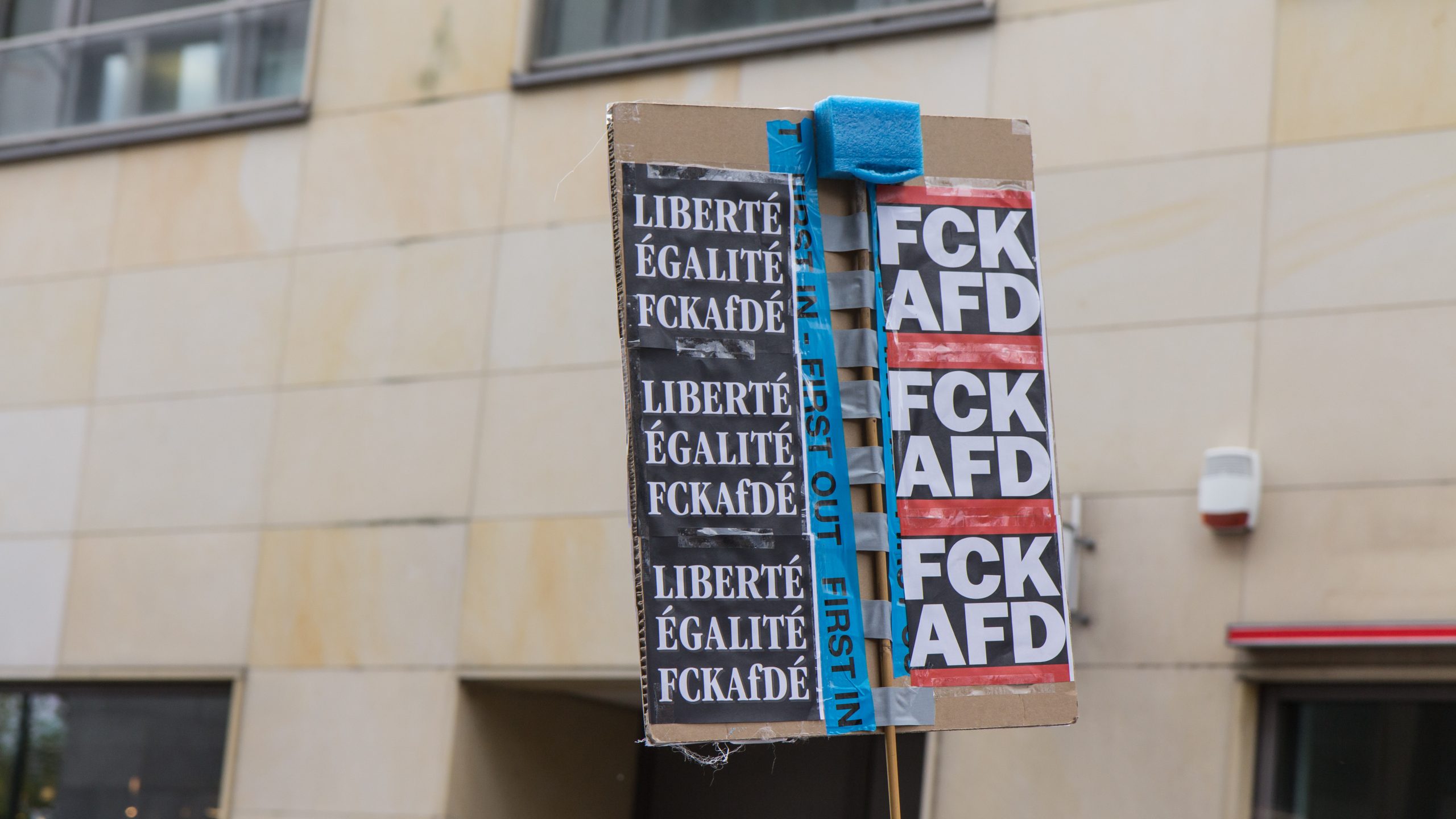
Conceivably, nobody has ever expressed the view of right-wing and Neo-Nazi parties towards the democratic state better than Hitler’s minister of propaganda, Joseph Goebbels, when acknowledging:
“It will always remain one of the best jokes of democracy
that it gave its deadly enemies the means by which it was destroyed.”
While the neo-fascist AfD has been extremely successful in presenting itself – at least outwardly – as just another, albeit right-wing populist party to far too many unsuspecting voters and rafts of gullible crypto-academics who studiously examine the AfD’s whitewashed party programme and other official documents, the AfD – at least since the insider book by Franziska Schreiber in 2018 – has been known by some to be everything but simply another democratic or right-wing populist party.
Despite infamous claims that Germans have learned from their past – Germany’s Nazi past, that is – taxpayers’ money continues to flow towards right-wing extremism in substantial volumes. In other words, Germany’s government props up the anti-democratic AfD to the tune of over €120 million ($143 million) every year to finance the neo-fascist AfD’s anti-democratic activities.
Despite having placed over 100 right-wing extremists, neo-fascists, and outright Neo-Nazis into German parliaments – camouflaged as “assistants”, “researchers”, “helpers” and the like; and despite – or perhaps because of – the classification of the AfD as right-wing extremist, bordering on a terrorist organisation, huge sums of state funds continue to flow to the anti-democratic AfD and its far-right cadres, as well as “ex” – or rather “not-so-ex!” – Neo-Nazis.
Only recently, the AfD–Neo-Nazi link came once again to the fore when East Germany’s Saxon Separatists (SS) were put on trial. Saxony’s SS had drawn up a list of democratic politicians to be executed – murdered – after the Neo-Nazi platoon had taken power. The SS had extensive links to the AfD. In some cases, both were one and the same.
Meanwhile, year after year, Germany’s federal government pays more than €120 million to a party that not only challenges but actively undermines and seeks to end Germany’s democracy, the principles of the rule of law, and human rights. Frequently, the neo-fascist AfD attacks democracy outright.
Worse, the €120 million is “only” for the electoral successes of the neo-fascist AfD at the federal level. Similar funding flows to the neo-fascist AfD at the level of Germany’s 16 states, where the AfD is similarly – or even more – successful, especially in East Germany.
This constitutes a massive financial injection for the far-right land grab: geographical areas where Neo-Nazis run the streets and the AfD runs local government – mostly in East Germany.
The classification by Germany’s Office for the Protection of the Constitution – Germany’s domestic intelligence service – has made it official: the entire AfD is a “right-wing extremist endeavour”. Yet Germany’s state actively supports a party that works against democracy.
That the neo-fascist AfD is a far-right extremist party is a realization that those affected by right-wing violence have had for a very long time. Only now has it finally reached Germany’s domestic intelligence service – after years of looking the other way and plenty of Neo-Nazi killings.
Never since the time of Adolf Hitler’s Nazi party has a far-right party – with extensive links to Neo-Nazism – managed to convince so many voters as in Germany’s 2025 federal election, when a whopping 20.4% of the vote supported the Neo-Nazis.
This is almost exactly the number that British-German journalist Sebastian Haffner, having escaped to the UK, suggested in Jekyll and Hyde – An Eyewitness Analysis of Nazi Germany (1940) for Germany in the late 1930s and early 1940s: 20% convinced Nazis, 40% loyal to them, 35% disloyal, and at most 5% constituting the opposition.
In today’s Germany, the AfD’s 20% voter support translates into the fact that one in five Germans has chosen a party that fuels hatred and fear; that is xenophobic and racist, anti-feminist, anti-Semitic, and anti-democratic. Predictions for the next state election in East Germany’s Saxony-Anhalt are double that: 40%.
The neo-fascist AfD seeks to undermine parliamentary processes, openly shares fascist overthrow fantasies, and dreams of ethnic cleansing – now repackaged as “remigration”.
Meanwhile, the long-overdue application to initiate proceedings for a ban of the neo-fascist party has been postponed time and again. While laughing at Germany’s democrats, the AfD can look forward to ample state funds continuing to flow its way.
Germany sees itself as a parliamentarian party democracy; consequently, political parties enjoy a special status. Yet there have always been exceptions – not so much for ex-Nazis, but for communists. The infamous historical exception is Germany’s Communist Party (KPD), which was banned in the 1950s. Its successor, the DKP, saw many of its members persecuted under the notorious Berufsverbote – professional bans under German law.
Overall, political parties are considered to make a significant contribution to the functioning of the state system. This presupposes, to a large extent, that these parties are democratic. In the case of the AfD, this assumption does not hold. The AfD is not interested in operating within the democratic system but against democracy itself.
It will pretend to be an ordinary political party for as long as this serves its interest in gaining power. Once in power, the story will change – as it did with Hitler’s Nazi Party, Orbán’s party in Hungary, and Donald Trump.
Within the democratic system – which serves merely as a vehicle for the AfD to gain power – and in the name of equal opportunity and incorruptibility, German parties and their elected representatives receive considerable public funding.
The core assumption is that, as long as a party’s anti-constitutional goals are not fully proven (which, astonishingly, has been proven in the case of the neo-fascist AfD), it will receive financial support from the state.
In short, Germany’s state finances political parties because they are seen as stabilising forces for the political and economic system – i.e. capitalism. The assumption of virtually all liberal-democratic systems is that it is better to channel protest against the pathologies of neoliberal capitalism into parliaments than to face anti-capitalist riots on the streets. Overall, this strategy has worked reasonably well since capitalism emerged.
For this reason, parties represented in the Bundestag – Germany’s federal parliament – receive extensive financial privileges and public funds.
Germany’s system of party financing consists of two forms of subsidies, each paid annually. On the one hand, parties receive 83 cents for each valid vote in Bundestag, European, and state elections. To open political competition to new parties, one euro (€1) is allocated for each of the first four million votes.
In the last federal election, the neo-fascist AfD received 10,328,780 votes – roughly ten million Germans supporting an ideology ranging from right-wing populism to outright Neo-Nazism.
This resulted in €9,252,887.40 for the AfD from the 2025 federal election alone. In other words, every election flushes the AfD with tax money – even though it is a hyper-neoliberal, anti-tax party. While publicly condemning taxation, the AfD is very much on the take.
And things get even better. In addition to federal election funds, the AfD receives money from state and European elections. On top of that, the party receives 45 cents for every euro it collects through donations, membership fees, and contributions from elected officials.
Unlike in the 1930s, when German corporations – Allianz, BASF, Bayer, IG Farben, Krupp, Thyssen, Siemens, Opel, and many others – bankrolled Hitler’s Nazi Party, the AfD receives very little corporate funding today. German capital is largely horrified by the AfD’s demands to leave the EU (DEXIT) and return to the Deutschmark – moves that would cost billions.
Instead, the AfD relies on small donations. According to the latest figures, it received €4,128,357.71 in membership fees in 2023 and €9,305,517.63 in individual donations under €3,300. This triggered an additional state grant of €6,045,243.90.
With growing membership since 2023 – officially 52,000, though more reliable figures suggest 39,673 at the end of that year – and rising donations, this share is likely even higher today.
Because Germany does not make it obvious that it finances neo-fascism, the exact amount of state funding for the AfD is difficult to determine. Still, it must remain below €200 million annually.
On top of party funding, members of the Bundestag earn €11,227.20 per month. For the AfD’s 152 MPs, this amounts to €20,478,412.80 per year, recently increased by another €600 per month – raising the total to €21.5 million.
Additionally, MPs receive a tax-free lump sum of €5,349.58 per month to cover office costs, travel, and accommodation in Berlin. For the AfD, this adds €9,757,633.92 annually. Office equipment allowances add another €1,824,000.
Personnel budgets provide €25,874 per month per MP. This results in €47,194,176 annually for AfD “employees”—often ex-hooligans, skinheads, hard-core Neo-Nazis, and members of far-right militias. In at least one case, they toured Neo-Nazi squads to assess how best to violently attack Germany’s parliament – Trump-style.
Parliamentary groups also receive funding. In 2025, each group received €512,553 per month plus €10,700 per member, with additional bonuses. This results in €28,541,711.40 annually for the AfD parliamentary group alone.
On top of all this, MPs receive free first-class rail travel (BahnCard 100). This is the infamous Freifahrtkarte – free railway ticket – Goebbels referred to:
The leaders of the NSDAP, as deputies,
enjoyed immunity, diets and a free railway tickets.
In total, German Neo-Nazis receive over €120 million in tax money each year. In 2025 alone, the figure amounts to precisely €123,094,065.40 – before additional funding at the state level.
Millions more flow through Germany’s 16 state parliaments, much of it directly or indirectly supporting the AfD as well as the AfD’s violent Nazi cadres, far-right think tanks, right-wing terrorists, Reichsbürger networks, and international extremist alliances – fuelling racist, anti-Semitic, anti-feminist, and neo-fascist campaigns.

No comments:
Post a Comment