The shoes were placed carefully on the frozen sidewalk outside a downtown Minneapolis hotel. Hospital clogs. The kind worn by nurses who work long, unglamorous shifts keeping strangers alive. A handwritten sign leaned against them: Alex was here. Alex mattered.
Alex Pretti, a 37-year-old ICU nurse and Minneapolis resident, was shot and killed by federal immigration agents during what authorities described as a lawful enforcement action. Witnesses and video footage tell a more disturbing story, one of confusion, escalation, and lethal force used against a civilian attempting to intervene. Days earlier, Renée Nicole Good, also a U.S. citizen, was killed in another ICE-related encounter. In both cases, official narratives arrived quickly. In both cases, many residents rejected them just as quickly.
This is the human terrain of Operation Metro Surge, a sweeping federal immigration crackdown that has turned Minneapolis into a national flashpoint. Thousands of ICE, Border Patrol, and Customs and Border Protection agents have flooded the city. Streets have been blocked. Chemical irritants deployed. Protesters arrested. Local officials have condemned the operation, and lawsuits now allege unconstitutional overreach and retaliation against a city long at odds with federal immigration enforcement.
But beneath the legal battles and political theater, a deeper crisis is unfolding, one that is moral and relational.
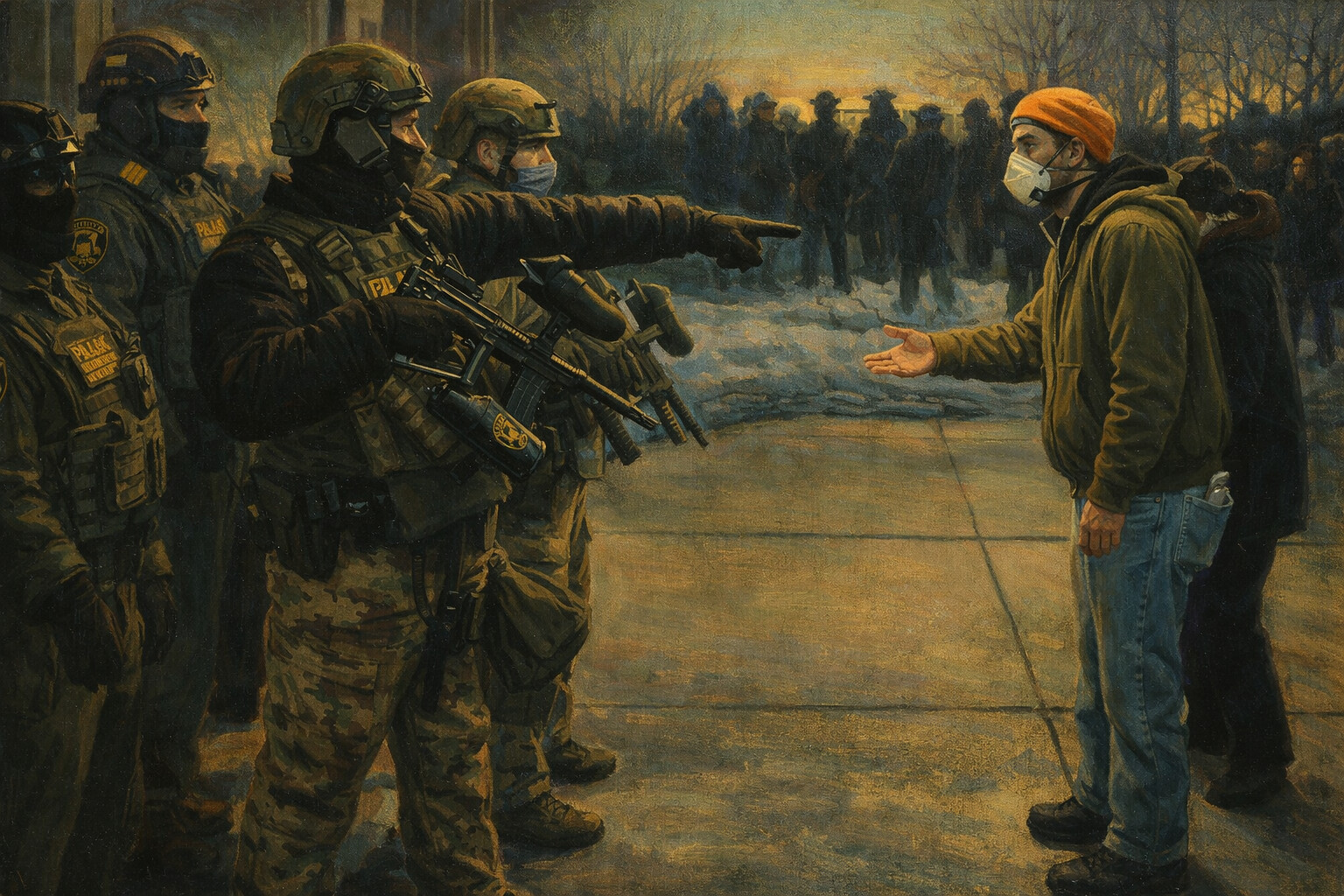
I recently spoke with artist and conflict mediator Dorit Cypis, who lived in Minneapolis for years. She pointed out something deceptively simple: the irony embedded in the word ICE itself. Agents move through the city armored and masked, faces covered, eyes hidden behind mirrored sunglasses, appearing almost entirely without emotion. To many residents, they look less like people than mechanisms, interchangeable parts in a vast state apparatus.
What struck me is that this appearance is not incidental. It is functional.
For agents, anonymity is not only physical protection. It is emotional insulation. Uniforms, badges, facemasks, armored vehicles—these are not just defenses against bodily harm. They shield against moral exposure. If you do not see faces, you do not have to meet eyes. If you are not in relationship, you do not have to confront the humanity of the people in front of you, or the weight of what you are doing to them.
Ice in the veins. Ice-cold blood. A posture of emotional suspension.
Hannah Arendt warned that some of the most devastating forms of violence arise not from cruelty but from distance. “The trouble with evil is that it is often committed by people who refuse to think,” she observed, people who follow procedures without confronting consequences. Bureaucracy makes harm possible without hatred, and enforcement without reckoning.
On the other side are protesters, neighbors watching what they believe to be profound injustices unfold in real time. They have seen people dragged into the snow, teenagers pepper-sprayed, families torn apart, citizens labeled domestic terrorists. They are witnessing what feels like rule-breaking backed by raw, unaccountable state power. They are not neutral observers. They are shaken, enraged, and, in many cases, traumatized.
Here, too, something hardens.
The more one side appears inhuman, the easier it becomes to respond in kind. Agents become monsters. Protesters become threats. Names are hurled. Objects are thrown. Homes are targeted. Dehumanization accelerates, and the freeze deepens.
Philosopher Martin Buber gives us language for this moment. He distinguished between I–Thou relationships—where we meet one another as full, irreducible beings—and I–It relationships, where others are reduced to objects: problems to manage, threats to neutralize, obstacles to remove. “When we relate to an It,” Buber wrote, “we do not meet a being, we experience a thing.”
What is happening in Minneapolis is a collision of I–It encounters, stacked atop one another until the space for recognition collapses.
ICE, in this sense, becomes more than an agency. It becomes a metaphor.
Ice is solid. Ice preserves. Ice stabilizes. Ice keeps us from falling into the abyss beneath certainty. It offers the illusion of safety through rigidity. But ice cannot flow. It cannot adapt. It cannot respond to warmth. It delays reckoning—it does not prevent it.
There are no easy solutions, and that cannot be overstated. This is not about everyone simply learning to get along. Minneapolis is carrying the weight of deep historical forces: racialized policing, immigration policy built on fear, political incentives that reward division, and power structures that benefit when communities turn on one another instead of questioning who profits from the status quo.
And yet, thawing is unavoidable.
Thawing is destabilizing. It requires letting go of ideas that once felt protective. It demands tolerance for uncertainty, grief, and moral ambiguity. To thaw is to risk falling, to encounter the abyss beneath certainty, and to discover whether something relational, something alive, exists there.
This is where the question becomes unavoidable.
What do you do when you see someone being beaten and shot in the back? Do you stand silently with a sign? Do you shout? Do you film? Do you intervene? When the other side appears unconcerned with rules, when you are facing an overwhelming display of state power, moral responses are no longer theoretical. What do you do when you are a male doctor and you see a woman being pepper sprayed? Do you watch her suffer from the sidelines?
To scold protesters for dehumanizing ICE agents ignores the gravity of this moment and profoundly misrepresents the imbalance of power. The state holds weapons, legal authority, and narrative control. Protesters hold bodies, voices, and witness. That asymmetry matters.
At the same time, resisting dehumanization does not require moral naïveté. Many of the agents in Minneapolis are not there because they want to terrorize communities. They are there because they took an oath—because they believe they are safeguarding public safety. The question is not whether safety matters. It is who defines it, who bears its costs, and whose lives are deemed expendable in its name.
An I–Thou encounter does not erase conflict. It does not magically resolve injustice. What it does is refuse the lie that violence becomes moral simply because it is institutional, or that rage becomes righteous simply because it is understandable.
Minneapolis is a test case. Masks invite masks. Armor invites armor. Freeze invites freeze. But in candlelit vigils, court filings, and acts of witness, people are insisting on presence, on the dangerous, necessary act of seeing and being seen.
This is where policymakers must be confronted.
If federal leaders continue to authorize militarized enforcement without meaningful local accountability; if courts hesitate while lives are lost; if elected officials reduce this to optics rather than ethics, then they are not neutral arbiters. They are participants in the freeze. They are choosing preservation over relationship, control over trust, force over legitimacy.
The question Minneapolis is asking is not rhetorical. Are we relating to one another as problems to solve, or as beings to meet? Policymakers will answer it not with speeches, but with structures, limits, transparency, and restraint. If they refuse to thaw, if they cling to ice as a substitute for moral courage, then the fracture we are witnessing will not heal.
Because ice always breaks eventually.
And when it does, what survives will depend on whether anyone was willing to risk relationship before the thaw became catastrophe.
George Cassidy Payne, syndicated by PeaceVoice, is a Rochester-based writer whose work sits at the intersection of politics, ethics, and lived experience. A poet, philosopher, and 988 crisis counselor, he covers issues of democracy, justice, and community resilience.
Treating Peaceful American Civilians as Enemy Combatants
The recent killing of Alex Pretti by ICE (Immigration and Customs Enforcement) agents in Minneapolis has generated a new wave of fury on the part of Americans upset about the mounting abuses that federal law enforcement personnel are committing. The alarm is fully warranted. ICE, the FBI, and other government entities increasingly both look and behave like ruthless military combat units. Unfortunately, too many people who are alarmed about the recent incidents seem to believe that the problem originated with Donald Trump’s presidency and that removing him from that post would end the ominous threat to civil liberties.
That belief is delusional. The dangerous militarization of law enforcement agencies and the corresponding contempt for constitutional rights that those agencies exhibit began many decades ago and the situation has inexorably worsened over that long period. We have witnessed the corrosive process take place with both Democrats and Republicans in the White House. Placing the entire blame on Trump is akin to misdiagnosing a life-threatening medical condition as a sudden heart attack when it actually is an insidious stage 3 cancer that has been entrenching itself for years.
There is still time to leash (or abolish) rogue law enforcement agencies and enable America’s democratic constitutional system to stage a recovery. But that outcome will require the American people to face some painful truths about both U.S. foreign and domestic policies.
There should always be a sharp distinction between the function of the U.S. military and that of domestic law enforcement entities. The rationale for the former is to defeat a designated enemy and eliminate a national security threat. To accomplish that task means sometimes having to “kill people and break things,” as several cynics have noted. The mandate for police personnel is supposed to be very different. Their function should be to protect the life, liberty, and property of people residing in the United States by apprehending criminals who violate those rights.
Unfortunately, those very different missions have become dangerously conflated in recent decades. The unpleasant reality is that the U.S. military has always treated designated enemies in a harsh, uncompromising fashion throughout the country’s history. Throughout Washington’s multiple wars of choice waged since World War II, U.S. forces frequently have treated “enemy” civilian populations in an appallingly brutal fashion. From the Korean “police action” in the early 1950s to the U.S. military interventions in Vietnam, Iraq, the Balkans, Afghanistan, Libya, Syria, and elsewhere, Washington’s human rights abuses are legendary. In a perverse and poignant fashion, U.S. imperial policy has now come home to roost.
Another key development that blurred the previously sharp distinction between foreign warfare and domestic law enforcement was the provision of surplus military hardware to police departments beginning in the 1980s. That aspect became even more important in 1990 with the expansion of the Pentagon’s 1033 program. It enabled local and state police departments to obtain sophisticated, heavy-duty weaponry and equipment at bargain prices – sometimes even for free. The new federal largesse led to an acquisition frenzy.
With Washington’s subsidies, the number of SWAT (Special Weapons and Tactics) programs ballooned throughout the United States. SWAT and other police personnel also increasingly became nearly indistinguishable from heavily armed combat units in the Army or Marines. Worse, such ostensibly civilian police often behaved like hardened combat troops, treating suspects and sometimes onlookers as the equivalent of enemy troops in wartime. The tendency became even more pronounced when police units in American towns and cities underwent training from hardened foreign police or military establishments, including Israel’s notoriously heavy-handed security forces.
Even bystanders who dared to record police conduct were considered hostile elements and treated as menacing adversaries, not fellow citizens exercising their First Amendment rights. That attitude has become pervasive, and it appeared to be especially relevant to ICE’s killing of Alex Pretti, who was using his cell phone to record the actions of agents.
The militarization process has inexorably infected a wide range of law enforcement entities, federal, state, and local. ICE has proven especially corruptible. That agency’s behavior epitomizes the growing mentality in the U.S. law enforcement system of viewing ordinary civilians not as people to be protected and served, but as potential enemies to be punished and neutralized.
That poisonous mentality did not begin with the Trump administration, and it will not end automatically when he leaves office. The brutal handling of the incidents at Ruby Ridge and Waco in the 1990s were earlier warning signals that went unheeded. In both cases, federal authorities treated the designated suspects not as American citizens, albeit with eccentric and extreme views, but as terrorists posing a dire threat to the country.
The raids also were conducted with callous indifference about the fate of innocent parties. Just as the killings of Pretti and Renee Good should enrage people today, the sight of Vicki Weaver being killed by an federal sniper during the August 1992 Ruby Ridge altercation as she held her infant daughter in her arms should have disgusted any decent human being. The incineration of 76 civilians, including children, during the April 1993 FBI assault on the Branch Davidian compound outside Waco, Texas, also epitomized the toxic, militarized mentality of dismissing the killing of civilian adversaries as an unfortunate tragedy that the victims brought on themselves. Unfortunately, the public’s outrage regarding both of those episodes was surprisingly limited. Such indifference helped pave the way for the current abuses.
Two crucial steps need to be taken. One is to emphatically reverse the militarization of police. SWAT units and similar entities under whatever names and bureaucratic structures that exist should be disbanded. Americans managed to enforce the law quite successfully without the existence of such outfits for the first two centuries of our country’s independence, and we can do so again. All law enforcement personnel should be unmasked, lightly armed, and not draped in combat gear and weaponry.
Equally important, the militaristic mentality that has taken root in law enforcement agencies throughout the country must be eradicated. That task will require extensive retraining of current police personnel and a major re-orientation of future training programs for incoming recruits. Among other changes, such reforms mean regarding military combat experience as a potential negative, not a positive, characteristic for applicants wanting to join police forces.
Without such vital policy and structural changes, the menace to America’s democratic constitutional system will persist and likely increase no matter who sits in the oval office.

No comments:
Post a Comment