Reverend stuns with speech at Trump's 'Rededicate 250' event: 'Shocking!'
Robert Davis
May 17, 2026
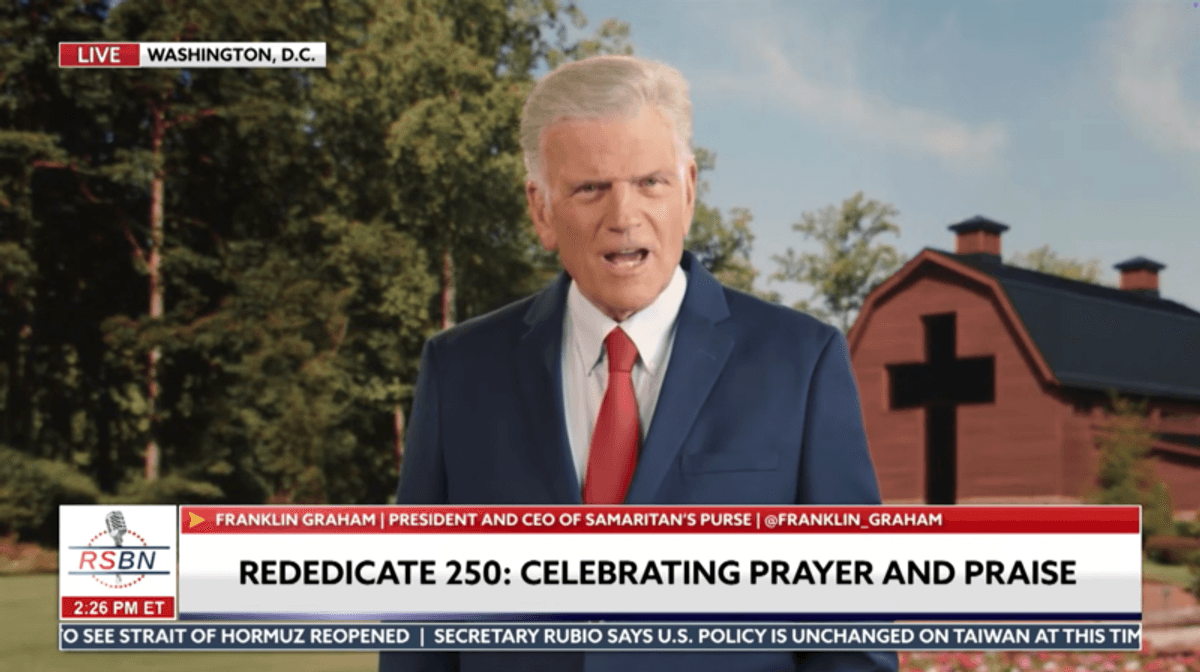
RSBN screenshot
A prominent Evangelical reverend stunned political analysts and observers on Sunday with his speech during President Donald Trump's "Rededicate 250" prayer event at the National Mall.
The Rev. Franklin Graham, the son of the late preacher Billy Graham, spoke via a pre-recorded video at the prayer event, describing America as a country that has become "morally rotten" and "completely sick with sin." He mentioned issues like "transgenderism" and "opening women's locker rooms to men" as a couple of examples.
"Why do we need to rededicate ourselves?" Graham said. "When God sent the flood and destroyed the earth, it was because man's heart had become so evil and violent. In the news, we see unimaginable violence: rapes, murders, [and] unimaginable violence. Video games are full of violence. We have an insatiable appetite for violence."
Graham's comments came at a time when the Trump administration was receiving significant scrutiny for its handling of the war in Iran, including the president's multiple threats to annihilate the Iranian civilization.
The "Rededicate 250" event was billed as a "historic gathering of Americans" at the National Mall for worship, prayer, and "giving thanks for God’s presence in our national life throughout 250 years of American history," according to the event's website.
Political analysts and observers reacted to Graham's speech on social media.
"No mention of corruption, starting illegal wars, carpet bombing schools, funding genocide, building concentration camps, torture, destruction of the constitution, kicking people off healthcare, cutting free school meals, giving all the money to the rich? SHOCKING!" liberal political commentator Kyle Kulinski posted on X.
"Did he mention an actual sin that seems all too common—sexual abuse by clergy?" Bill Kristol, editor at large for The Bulwark, posted on X.
"It’s telling that Graham is never this concerned about poverty, health care access, or anything that would actually make people’s lives better," Hemant Mehta, a former "Jeopardy!" champion, posted on X. "Just bigotry all the way down. That’s what Jesus taught him."
Robert Davis
May 17, 2026
RAW STORY
RSBN screenshot
A prominent Evangelical reverend stunned political analysts and observers on Sunday with his speech during President Donald Trump's "Rededicate 250" prayer event at the National Mall.
The Rev. Franklin Graham, the son of the late preacher Billy Graham, spoke via a pre-recorded video at the prayer event, describing America as a country that has become "morally rotten" and "completely sick with sin." He mentioned issues like "transgenderism" and "opening women's locker rooms to men" as a couple of examples.
"Why do we need to rededicate ourselves?" Graham said. "When God sent the flood and destroyed the earth, it was because man's heart had become so evil and violent. In the news, we see unimaginable violence: rapes, murders, [and] unimaginable violence. Video games are full of violence. We have an insatiable appetite for violence."
Graham's comments came at a time when the Trump administration was receiving significant scrutiny for its handling of the war in Iran, including the president's multiple threats to annihilate the Iranian civilization.
The "Rededicate 250" event was billed as a "historic gathering of Americans" at the National Mall for worship, prayer, and "giving thanks for God’s presence in our national life throughout 250 years of American history," according to the event's website.
Political analysts and observers reacted to Graham's speech on social media.
"No mention of corruption, starting illegal wars, carpet bombing schools, funding genocide, building concentration camps, torture, destruction of the constitution, kicking people off healthcare, cutting free school meals, giving all the money to the rich? SHOCKING!" liberal political commentator Kyle Kulinski posted on X.
"Did he mention an actual sin that seems all too common—sexual abuse by clergy?" Bill Kristol, editor at large for The Bulwark, posted on X.
"It’s telling that Graham is never this concerned about poverty, health care access, or anything that would actually make people’s lives better," Hemant Mehta, a former "Jeopardy!" champion, posted on X. "Just bigotry all the way down. That’s what Jesus taught him."
Heavily edited video of Trump address at national prayer event sparks outrage
Robert Davis
May 17, 2026
RAW STORY
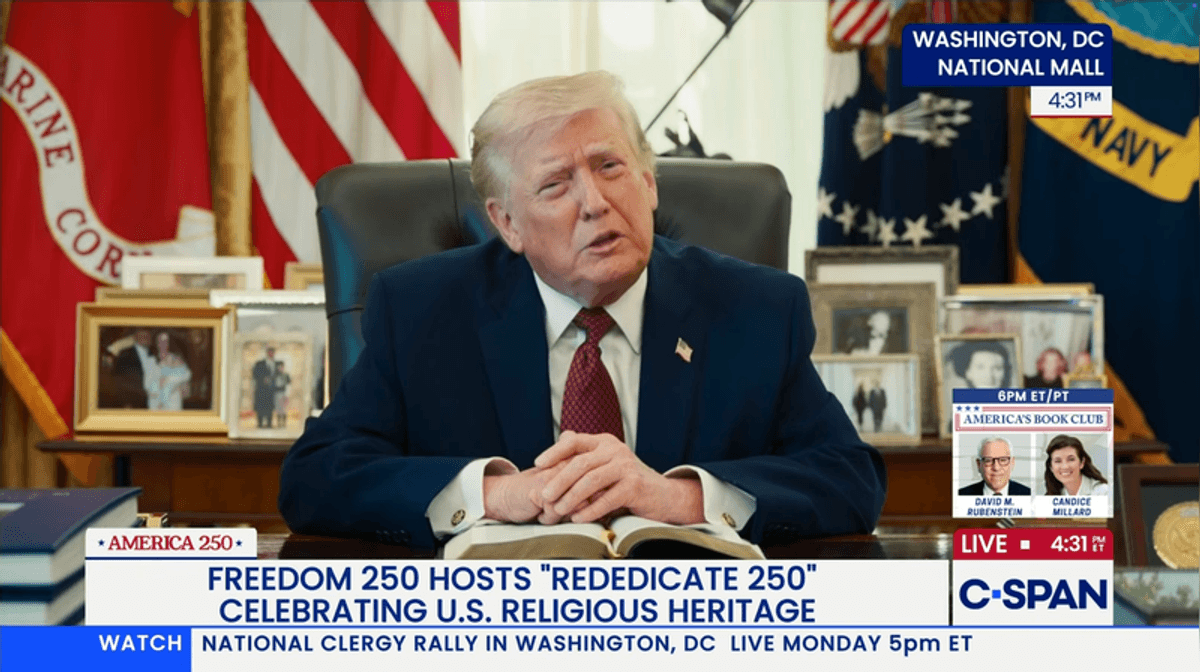
CSPAN screenshot
President Donald Trump sparked outrage on Sunday after his heavily edited recorded speech played at his national prayer event in Washington, D.C.
Trump addressed the crowd at his "Rededicate 250" event, billed as an effort to highlight "God’s presence in our national life throughout 250 years of American history," according to the event's website. It was held at the National Mall and featured appearances from Trump's Defense Secretary Pete Hegseth and several prominent MAGA and Evangelical Christian figures.
In the video, Trump appears to struggle to read a Bible verse. Onlookers also noted multiple edits to the video, which called the authenticity of Trump's message into question.
Political analysts and observers mocked the clip on social media.
"Holy s---," Ron Filipkowski, editor-in-chief of the MeidasTouch Network, posted on X. "This is a prerecorded message with lots of obvious edits, and this is the best he can do? He looks like a cadaver, sounds like he's on a ventilator, and can't even properly read the sections that come from a book he's never read."
"Lmao is Trump 'reading' a Bible verse from a teleprompter," political commentary account "Wu Tang is for the Children" posted on X.
"Disturbingly theocratic," Julian Andreone, Capitol Hill reporter for Drop Site News, posted on X.
CSPAN screenshot
President Donald Trump sparked outrage on Sunday after his heavily edited recorded speech played at his national prayer event in Washington, D.C.
Trump addressed the crowd at his "Rededicate 250" event, billed as an effort to highlight "God’s presence in our national life throughout 250 years of American history," according to the event's website. It was held at the National Mall and featured appearances from Trump's Defense Secretary Pete Hegseth and several prominent MAGA and Evangelical Christian figures.
In the video, Trump appears to struggle to read a Bible verse. Onlookers also noted multiple edits to the video, which called the authenticity of Trump's message into question.
Political analysts and observers mocked the clip on social media.
"Holy s---," Ron Filipkowski, editor-in-chief of the MeidasTouch Network, posted on X. "This is a prerecorded message with lots of obvious edits, and this is the best he can do? He looks like a cadaver, sounds like he's on a ventilator, and can't even properly read the sections that come from a book he's never read."
"Lmao is Trump 'reading' a Bible verse from a teleprompter," political commentary account "Wu Tang is for the Children" posted on X.
"Disturbingly theocratic," Julian Andreone, Capitol Hill reporter for Drop Site News, posted on X.
Opinion
What Freedom 250’s prayer wall reveals about Christian nationalism’s true believers
(RNS) — Again and again, the prayers on the site show a portrait of a nation in pain, and that America is a divinely chosen place that must protect itself from enemies.

A broad variety of submitted prayers on the America Prays website. (Screen grab)
Karen E. Park
May 15, 2026
RNS
(RNS) — As part of the “Rededicate 250” event in Washington, D.C., on Sunday (May 17), organizers are inviting Americans to submit prayers for the nation through a public online “prayer wall” on the affiliated America Prays website. While the so-called rededication of the United States as “One Nation Under God” is drawing a great deal of attention for its fusion of politics, theology and nationalism, the prayer wall itself has received little scrutiny.
A close look at the words found on the site — where Americans are exhorted to “share what’s on your heart” in the verbal formulation of contemporary American evangelicalism — offers a rare opportunity to watch what looks like real Christian nationalism. It appears not merely as political rhetoric from movement leaders, but as lived devotional language among the posted prayers, which seem, not surprisingly, to be entirely Christian in their orientation.
The prayers on the wall are divided by categories like “Country,” “Military,” “Family,” “Healing” and “Peace.” Since there is a form that must be filled out by anyone wishing to contribute a prayer, it is reasonable to assume not all the prayers shared with the government through the website are posted publicly.
Many of the prayers are deeply personal. For example: “I am believing God for a new vehicle, furniture and beds for our place. Thank you.” –Texas, May 13. Or “Pray for daughter in law to get help for bipolar schizophrenia. . .My heart aches, I know God is in control.” — California, May 12. Another person says they are going through a “bad divorce,” but knows “God is my lawyer and he will make things right.”
Taken together, these anguished personal prayers reveal a portrait of a nation in pain.
The prayers use colloquial grammar and spelling, and appear to be written by real people – with real names and actual problems like ALS, joblessness and loneliness. In this way, the prayer wall provides a strikingly authentic contrast to the “Voices of Liberty” quotations elsewhere on the Freedom 250 website, which purport to be the words of “real Americans” explaining “what freedom means to them” but which appear to be AI-generated fakes.
But in Prayer Wall sections dedicated to “Country” and “Military,” the devotional language of Christian nationalism emerges clearly. Here is one example from Missouri, May 11: “Lord Jesus, King Jesus dawn our nation from the festering pit we have fallen into the past decades. Destroy our enemies physical and spiritual. Allow us to be the city on the hill you desired us to be. Allow us to discipline ourselves and other nations for your glory alone. We love you and rededicate ourselves now in your holy mighty name Jesus, Amen”
The prayer includes vivid language about personal devotion, national decline, spiritual warfare, American exceptionalism and fantasies of political restoration. To this person, the nation itself has become a sacred object: fallen, endangered, chosen and in need of purification and recommitment. But the nation is, at the same time, a weapon that can be used to “discipline other nations for your glory alone.”

The prayers also reveal the continuing emotional power of older forms of American civil religion. References to the U.S. as a “city on a hill,” to national chosenness and to America’s divine purpose appear constantly throughout the submissions. What emerges is a vision of the nation not as a democratic republic governed by the people or of a constitutional order governed by laws, but as a sacred community whose religious identity is in need of urgent restoration and defense.
While the speeches that will be made on the National Mall by religious and governmental leaders like Speaker Mike Johnson, the Rev. Franklin Graham and Bishop Robert Barron will be important to analyze and contextualize, the prayer wall may actually tell us more about the emotional and spiritual structure of contemporary Christian nationalism than the speeches ever could. The Freedom 250 prayer wall offers a glimpse into how Christian nationalist ideas operate not only as political arguments or propaganda being imposed from above, but as useful and powerful frameworks through which many Americans interpret their own suffering, hope, fear and national identity.
(Karen E. Park, a historian of American Christianity, is co-editor of “American Patroness: Marian Shrines and the Making of US Catholicism.” She writes on Substack at Ex Voto. The views expressed in this commentary do not necessarily reflect those of Religion News Service.)
What Freedom 250’s prayer wall reveals about Christian nationalism’s true believers
(RNS) — Again and again, the prayers on the site show a portrait of a nation in pain, and that America is a divinely chosen place that must protect itself from enemies.
A broad variety of submitted prayers on the America Prays website. (Screen grab)
Karen E. Park
May 15, 2026
RNS
(RNS) — As part of the “Rededicate 250” event in Washington, D.C., on Sunday (May 17), organizers are inviting Americans to submit prayers for the nation through a public online “prayer wall” on the affiliated America Prays website. While the so-called rededication of the United States as “One Nation Under God” is drawing a great deal of attention for its fusion of politics, theology and nationalism, the prayer wall itself has received little scrutiny.
A close look at the words found on the site — where Americans are exhorted to “share what’s on your heart” in the verbal formulation of contemporary American evangelicalism — offers a rare opportunity to watch what looks like real Christian nationalism. It appears not merely as political rhetoric from movement leaders, but as lived devotional language among the posted prayers, which seem, not surprisingly, to be entirely Christian in their orientation.
The prayers on the wall are divided by categories like “Country,” “Military,” “Family,” “Healing” and “Peace.” Since there is a form that must be filled out by anyone wishing to contribute a prayer, it is reasonable to assume not all the prayers shared with the government through the website are posted publicly.
Many of the prayers are deeply personal. For example: “I am believing God for a new vehicle, furniture and beds for our place. Thank you.” –Texas, May 13. Or “Pray for daughter in law to get help for bipolar schizophrenia. . .My heart aches, I know God is in control.” — California, May 12. Another person says they are going through a “bad divorce,” but knows “God is my lawyer and he will make things right.”
Taken together, these anguished personal prayers reveal a portrait of a nation in pain.
The prayers use colloquial grammar and spelling, and appear to be written by real people – with real names and actual problems like ALS, joblessness and loneliness. In this way, the prayer wall provides a strikingly authentic contrast to the “Voices of Liberty” quotations elsewhere on the Freedom 250 website, which purport to be the words of “real Americans” explaining “what freedom means to them” but which appear to be AI-generated fakes.
But in Prayer Wall sections dedicated to “Country” and “Military,” the devotional language of Christian nationalism emerges clearly. Here is one example from Missouri, May 11: “Lord Jesus, King Jesus dawn our nation from the festering pit we have fallen into the past decades. Destroy our enemies physical and spiritual. Allow us to be the city on the hill you desired us to be. Allow us to discipline ourselves and other nations for your glory alone. We love you and rededicate ourselves now in your holy mighty name Jesus, Amen”
The prayer includes vivid language about personal devotion, national decline, spiritual warfare, American exceptionalism and fantasies of political restoration. To this person, the nation itself has become a sacred object: fallen, endangered, chosen and in need of purification and recommitment. But the nation is, at the same time, a weapon that can be used to “discipline other nations for your glory alone.”
A prayer card from the America Prays website of a prayer submitted from Missouri on May 11. (Screen grab)
 A prayer card from the America Prays website of a prayer submitted from Arizona on May 14. (Screen grab)
Another prayer in the “Country” section (from Arizona, May 14) reads: “Lord Jesus please hear our cries for this nation and the world. You and only You can truly fight this battle we are in. This spitiritual [sic] battle against evil. I pray for our leaders to seek You in all they do, trust You and Your plans for this nation. That You would protect them and their families as they believe and trust in You. I pray Psalm 91 over this nation, especially verse 11: ‘For He will give His angels orders concerning you, to protect you in all your ways.'”
Again and again, the prayers on the site return to similar themes: America as a divinely chosen nation that has drifted from God; enemies both internal and external; fears of moral collapse; hopes for restoration; calls for repentance; and requests for divine protection over the country and its leaders.
The prayer wall, taken as a whole, is especially striking for the way in which these grand national and religious narratives coexist alongside deeply ordinary personal anxieties. The result is an emotional public theology in which private suffering, national identity, religious symbolism and political longing are deeply intertwined.
The fusion of the theological and the political has long been part of American religious life. Historians have noted the persistence of providential language in American politics from the Puritans onward — the belief that the U.S. possesses a unique divine mission and stands in a covenantal relationship with God. But the prayers collected on the Freedom 250 site reveal how intensely devotional that language remains for many Americans. The nation is imagined as more than a political entity, but as a spiritual project whose fortunes rise and fall according to both divine favor and satanic power.
The language of spiritual warfare appears repeatedly on the prayer wall, across all categories. Participants pray against “darkness,” “evil forces” and enemies “physical and spiritual,” as well as attacks on Christianity itself. In many cases, the boundaries between political opponents, cultural change, demonic influence and national decline are impossible to separate.
A prayer card from the America Prays website of a prayer submitted from Arizona on May 14. (Screen grab)Another prayer in the “Country” section (from Arizona, May 14) reads: “Lord Jesus please hear our cries for this nation and the world. You and only You can truly fight this battle we are in. This spitiritual [sic] battle against evil. I pray for our leaders to seek You in all they do, trust You and Your plans for this nation. That You would protect them and their families as they believe and trust in You. I pray Psalm 91 over this nation, especially verse 11: ‘For He will give His angels orders concerning you, to protect you in all your ways.'”
Again and again, the prayers on the site return to similar themes: America as a divinely chosen nation that has drifted from God; enemies both internal and external; fears of moral collapse; hopes for restoration; calls for repentance; and requests for divine protection over the country and its leaders.
The prayer wall, taken as a whole, is especially striking for the way in which these grand national and religious narratives coexist alongside deeply ordinary personal anxieties. The result is an emotional public theology in which private suffering, national identity, religious symbolism and political longing are deeply intertwined.
The fusion of the theological and the political has long been part of American religious life. Historians have noted the persistence of providential language in American politics from the Puritans onward — the belief that the U.S. possesses a unique divine mission and stands in a covenantal relationship with God. But the prayers collected on the Freedom 250 site reveal how intensely devotional that language remains for many Americans. The nation is imagined as more than a political entity, but as a spiritual project whose fortunes rise and fall according to both divine favor and satanic power.
The language of spiritual warfare appears repeatedly on the prayer wall, across all categories. Participants pray against “darkness,” “evil forces” and enemies “physical and spiritual,” as well as attacks on Christianity itself. In many cases, the boundaries between political opponents, cultural change, demonic influence and national decline are impossible to separate.
The prayers also reveal the continuing emotional power of older forms of American civil religion. References to the U.S. as a “city on a hill,” to national chosenness and to America’s divine purpose appear constantly throughout the submissions. What emerges is a vision of the nation not as a democratic republic governed by the people or of a constitutional order governed by laws, but as a sacred community whose religious identity is in need of urgent restoration and defense.
While the speeches that will be made on the National Mall by religious and governmental leaders like Speaker Mike Johnson, the Rev. Franklin Graham and Bishop Robert Barron will be important to analyze and contextualize, the prayer wall may actually tell us more about the emotional and spiritual structure of contemporary Christian nationalism than the speeches ever could. The Freedom 250 prayer wall offers a glimpse into how Christian nationalist ideas operate not only as political arguments or propaganda being imposed from above, but as useful and powerful frameworks through which many Americans interpret their own suffering, hope, fear and national identity.
(Karen E. Park, a historian of American Christianity, is co-editor of “American Patroness: Marian Shrines and the Making of US Catholicism.” She writes on Substack at Ex Voto. The views expressed in this commentary do not necessarily reflect those of Religion News Service.)
Alexander Willis
May 17, 2026
RAW STORY
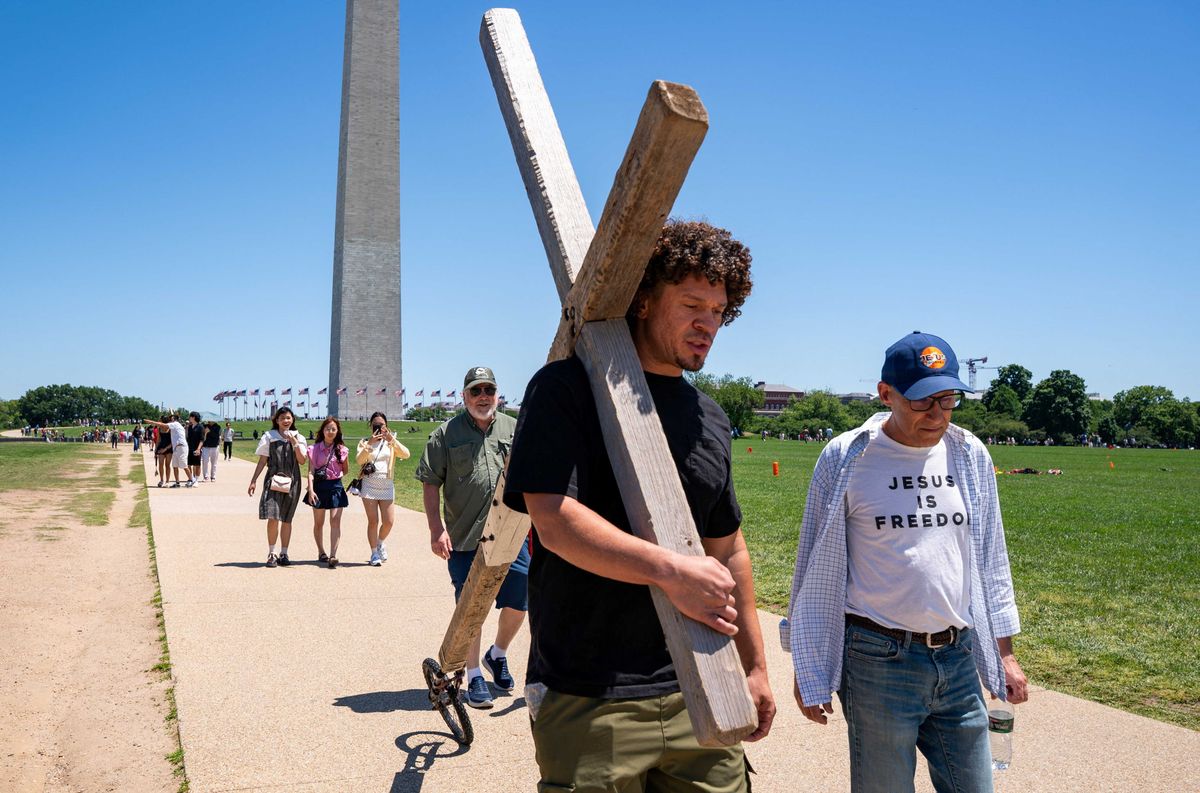
A man carries a wooden cross near the Washington Monument ahead of the "Rededicate 250: National Jubilee of Prayer, Praise and Thanksgiving" event aimed to celebrate America's 250th birthday, in Washington, D.C. , U.S. May 16, 2026. REUTERS/Seth Herald
President Donald Trump is expected to be joined by several of his top officials and allies Sunday in Washington, D.C. for Rededicate 250, a national prayer event hosted on the National Mall, and one Christian group is working to erect a “15-foot-tall” surprise for the president in protest.
Organized by Freedom250, a Trump-aligned group that has received millions of taxpayer dollars, the event has been decried by some critics as promoting Christian nationalism. The government watchdog group Public Citizen, for instance, condemned the event as being “less like a traditional religious event and more like a program for the Church of Trump.”
Thousands are expected to attend the free event, among them being protesters, some of whom belong to Faithful America, which describes itself as a “network of progressive Christians,” per a report published Sunday by The Washington Post, which described them as a “Christian group focused on opposing religious nationalism.”
Working in tandem with another group, Freedom From Religion Foundation, which the Post described as a “mostly secular group focused on church-state separation," the two groups have a surprise planned for the president, one that appears to parody the recent erection of a 22-foot-tall, $400,000 gold-plated statue of Trump at one of his golf clubs.
“The organizations said they will erect a 15-foot-tall balloon of ‘a golden calf with a Trump-like visage’ a few blocks from the prayer event,” the Post reported.
The nation’s capital has been host to a number of installations designed to mock the president, including the installation of satirical arcade game cabinets last week mocking Trump’s wildly unpopular war against Iran, and the erection of statues depicting Trump with convicted sex-offender Jeffrey Epstein.
A man carries a wooden cross near the Washington Monument ahead of the "Rededicate 250: National Jubilee of Prayer, Praise and Thanksgiving" event aimed to celebrate America's 250th birthday, in Washington, D.C. , U.S. May 16, 2026. REUTERS/Seth Herald
President Donald Trump is expected to be joined by several of his top officials and allies Sunday in Washington, D.C. for Rededicate 250, a national prayer event hosted on the National Mall, and one Christian group is working to erect a “15-foot-tall” surprise for the president in protest.
Organized by Freedom250, a Trump-aligned group that has received millions of taxpayer dollars, the event has been decried by some critics as promoting Christian nationalism. The government watchdog group Public Citizen, for instance, condemned the event as being “less like a traditional religious event and more like a program for the Church of Trump.”
Thousands are expected to attend the free event, among them being protesters, some of whom belong to Faithful America, which describes itself as a “network of progressive Christians,” per a report published Sunday by The Washington Post, which described them as a “Christian group focused on opposing religious nationalism.”
Working in tandem with another group, Freedom From Religion Foundation, which the Post described as a “mostly secular group focused on church-state separation," the two groups have a surprise planned for the president, one that appears to parody the recent erection of a 22-foot-tall, $400,000 gold-plated statue of Trump at one of his golf clubs.
“The organizations said they will erect a 15-foot-tall balloon of ‘a golden calf with a Trump-like visage’ a few blocks from the prayer event,” the Post reported.
The nation’s capital has been host to a number of installations designed to mock the president, including the installation of satirical arcade game cabinets last week mocking Trump’s wildly unpopular war against Iran, and the erection of statues depicting Trump with convicted sex-offender Jeffrey Epstein.
Rededicate 250 touts a star-studded prayer bash with politicians, Christian celebrities
(RNS) — But a new poll finds many Americans aren’t comfortable mixing religion and politics.

Work continues on the stage for the Rededicate 250 event on the National Mall, Tuesday, May 12, 2026, in Washington. (AP Photo/Alex Brandon)
Kathryn Post and Yonat Shimron
May 14, 2026
RNS
(RNS) — Bishops, evangelical influencers, Cabinet members and an actor who plays Jesus are a few of the speakers and performers scheduled to participate in “Rededicate 250,” the Trump administration’s daylong prayer celebration happening on the National Mall this weekend.
Advertised as a “rededication of our country as One Nation Under God” and a “once in a lifetime national moment,” the Sunday event is intended to reflect on the faith of America’s founders and to appeal to God to bless and guide the nation. It’s an initiative of Freedom 250, a White House-backed, public-private campaign staging patriotic events to celebrate the nation’s 250th birthday (not to be confused with the bipartisan America 250 efforts). Supporters welcome the event as a tribute to America’s roots, while critics say the Christian-saturated, MAGA-heavy festival casts an exclusionary vision of America’s past and present. Americans United for Separation of Church and State suggested the event advances Christian nationalism rather than religious freedom.
The rally has inspired both supportive and oppositional pre-events, the former led by activist and worship leader Sean Feucht, and the latter spearheaded by the Interfaith Alliance and a cadre of progressive religious leaders.
In recent days, a handful of Christian celebrities have been announced as Rededicate 250 participants. Grammy-winning Christian musician Chris Tomlin, known for the hits “Holy Forever” and “How Great Is Our God,” will headline the event. Jonathan Roumie, the Catholic actor, influencer and star of the hit Jesus show “The Chosen,” was recently added as a speaker. Roumie has spoken at the March For Life and starred in a Super Bowl ad. He will be joined by evangelical influencer, podcast host and “Duck Dynasty” alum Sadie Robertson Huff, who built a ministry platform catered to women and has over 5 million Instagram followers.
Other listed speakers include many of President Donald Trump’s closest friends and allies, most of them conservative Christians. Prominent political figures include House Speaker Mike Johnson (a Southern Baptist); Defense Secretary Pete Hegseth (who worships in churches linked to the Communion of Reformed Evangelical Churches); and Secretary of State Marco Rubio (a Catholic). Trump is expected to send a recorded video message.
Of the 19 faith leaders currently listed, 18 are Christian, and most are evangelical. Among them are the Rev. Franklin Graham, president and CEO of the Billy Graham Evangelistic Association; Pastor Samuel Rodriguez, president of the National Hispanic Christian Leadership Conference; Pentecostal preacher and White House faith office senior adviser Paula White-Cain; and Pastor Robert Jeffress, who leads First Baptist Church in Dallas.
Bishop Robert Barron, who leads the Diocese of Winona-Rochester, Minnesota, and Cardinal Timothy Dolan, who recently retired from his position as bishop of the Archdiocese of New York, both Catholic, are also scheduled speakers.
The only non-Christian religious leader currently listed is Rabbi Meir Soloveichik, who leads Congregation Shearith Israel in New York City and serves on Trump’s Religious Liberty Commission.
According to organizers, the speaker list is still being finalized.
If Trump’s religious revival is meant to encourage a fusion of Christianity and government, a new Pew Research poll released Thursday (May 14) shows Americans are not buying it. Although more than half of Americans say religion plays a positive role in society, they do not want their government to stop enforcing separation of church and state.
The poll, taken in April among 3,592 U.S. adults, shows that those views have barely budged over the past few years. Eight of out 10 Americans say religious congregations should not support candidates in elections. And two-thirds say churches and other houses of worship should keep out of political matters.

“17% of U.S. adults now say they want Christianity to be the official religion of the U.S.” (Graphic courtesy of Pew Research Center)
As for Christian nationalism, the poll shows, it is far from popular.
Only 17% of Americans think the government should declare Christianity the official religion of the U.S., a slight jump over 2024 when 13% said so. Generally, the idea of Christian nationalism remains more negative than positive: 31% view it unfavorably, 10% view it favorably and the rest don’t know enough or don’t have an opinion.
“To the extent that President Trump has a rally that explicitly espouses Christian nationalism, he’s not going to get very far beyond, perhaps, the people at the rally,” said John Green, professor emeritus of political science at the University of Akron. “There are people that have that view, but they’re a very small minority, even within the Republican Party.”
The poll also found 52% of U.S. adults think “conservative Christians have gone too far in trying to push their religious values in the government and public schools.” It had a margin of error of plus or minus 1.9 percentage points.
Feucht, the activist and musician, and Pastor Mark Driscoll, who were previously rumored to be Rededicate 250 participants, will instead be hosting a concert at Washington, D.C.’s Sylvan Theater. In a video this week, Feucht said Driscoll would join him at Saturday’s concert, which he described as a “four-hour revival meeting” that’s part of the battle for the “soul of America.”
Several groups have come out against Rededicate 250. The Council on American-Islamic Relations called for organizers to expand the speakers list to better reflect the nation’s diverse religious landscape.
“Muslims have been present in significant numbers in the country since the colonial era,” the advocacy organization said. “Inviting speakers who represent many faiths projects the strength of our religious liberty.”
Americans United for Separation of Church and State said the event advanced Christian nationalism rather than religious freedom, and on Friday, a group of progressive faith leaders — including the Rev. Paul Raushenbush, president and CEO of the Interfaith Alliance; Rabbi Jonah Pesner, director of the Religious Action Center of Reform Judaism; and the Rev. Adam Russell Taylor, president of Sojourners — will host a virtual press briefing that argues Rededicate 250 misrepresents how America’s founders approached religious tolerance.
As a counterpoint to the Rededicate event, Interfaith Alliance said it will team up with protest artist Robin Bell to project pro-religious freedom messages, including “Democracy NOT Theocracy” and “Reject Christian Nationalism,” on the walls of the National Gallery of Art on Thursday evening.
“Instead of leaning into the incredible tapestry of American religion, they’re really only highlighting a thin slice of American religiosity, and elevating it into a primary role and a privileged role, one could argue, with government funding,” Raushenbush said. “Unfortunately it feels more like a political rally than a religious one.”
Jack Jenkins contributed to this reporting.
(RNS) — But a new poll finds many Americans aren’t comfortable mixing religion and politics.
Work continues on the stage for the Rededicate 250 event on the National Mall, Tuesday, May 12, 2026, in Washington. (AP Photo/Alex Brandon)
Kathryn Post and Yonat Shimron
May 14, 2026
RNS
(RNS) — Bishops, evangelical influencers, Cabinet members and an actor who plays Jesus are a few of the speakers and performers scheduled to participate in “Rededicate 250,” the Trump administration’s daylong prayer celebration happening on the National Mall this weekend.
Advertised as a “rededication of our country as One Nation Under God” and a “once in a lifetime national moment,” the Sunday event is intended to reflect on the faith of America’s founders and to appeal to God to bless and guide the nation. It’s an initiative of Freedom 250, a White House-backed, public-private campaign staging patriotic events to celebrate the nation’s 250th birthday (not to be confused with the bipartisan America 250 efforts). Supporters welcome the event as a tribute to America’s roots, while critics say the Christian-saturated, MAGA-heavy festival casts an exclusionary vision of America’s past and present. Americans United for Separation of Church and State suggested the event advances Christian nationalism rather than religious freedom.
The rally has inspired both supportive and oppositional pre-events, the former led by activist and worship leader Sean Feucht, and the latter spearheaded by the Interfaith Alliance and a cadre of progressive religious leaders.
In recent days, a handful of Christian celebrities have been announced as Rededicate 250 participants. Grammy-winning Christian musician Chris Tomlin, known for the hits “Holy Forever” and “How Great Is Our God,” will headline the event. Jonathan Roumie, the Catholic actor, influencer and star of the hit Jesus show “The Chosen,” was recently added as a speaker. Roumie has spoken at the March For Life and starred in a Super Bowl ad. He will be joined by evangelical influencer, podcast host and “Duck Dynasty” alum Sadie Robertson Huff, who built a ministry platform catered to women and has over 5 million Instagram followers.
Other listed speakers include many of President Donald Trump’s closest friends and allies, most of them conservative Christians. Prominent political figures include House Speaker Mike Johnson (a Southern Baptist); Defense Secretary Pete Hegseth (who worships in churches linked to the Communion of Reformed Evangelical Churches); and Secretary of State Marco Rubio (a Catholic). Trump is expected to send a recorded video message.
Of the 19 faith leaders currently listed, 18 are Christian, and most are evangelical. Among them are the Rev. Franklin Graham, president and CEO of the Billy Graham Evangelistic Association; Pastor Samuel Rodriguez, president of the National Hispanic Christian Leadership Conference; Pentecostal preacher and White House faith office senior adviser Paula White-Cain; and Pastor Robert Jeffress, who leads First Baptist Church in Dallas.
Bishop Robert Barron, who leads the Diocese of Winona-Rochester, Minnesota, and Cardinal Timothy Dolan, who recently retired from his position as bishop of the Archdiocese of New York, both Catholic, are also scheduled speakers.
The only non-Christian religious leader currently listed is Rabbi Meir Soloveichik, who leads Congregation Shearith Israel in New York City and serves on Trump’s Religious Liberty Commission.
Why Hillsdale? The Christian liberal arts school hosting Erika Kirk for commencement
According to organizers, the speaker list is still being finalized.
If Trump’s religious revival is meant to encourage a fusion of Christianity and government, a new Pew Research poll released Thursday (May 14) shows Americans are not buying it. Although more than half of Americans say religion plays a positive role in society, they do not want their government to stop enforcing separation of church and state.
The poll, taken in April among 3,592 U.S. adults, shows that those views have barely budged over the past few years. Eight of out 10 Americans say religious congregations should not support candidates in elections. And two-thirds say churches and other houses of worship should keep out of political matters.
“17% of U.S. adults now say they want Christianity to be the official religion of the U.S.” (Graphic courtesy of Pew Research Center)
As for Christian nationalism, the poll shows, it is far from popular.
Only 17% of Americans think the government should declare Christianity the official religion of the U.S., a slight jump over 2024 when 13% said so. Generally, the idea of Christian nationalism remains more negative than positive: 31% view it unfavorably, 10% view it favorably and the rest don’t know enough or don’t have an opinion.
“To the extent that President Trump has a rally that explicitly espouses Christian nationalism, he’s not going to get very far beyond, perhaps, the people at the rally,” said John Green, professor emeritus of political science at the University of Akron. “There are people that have that view, but they’re a very small minority, even within the Republican Party.”
The poll also found 52% of U.S. adults think “conservative Christians have gone too far in trying to push their religious values in the government and public schools.” It had a margin of error of plus or minus 1.9 percentage points.
Feucht, the activist and musician, and Pastor Mark Driscoll, who were previously rumored to be Rededicate 250 participants, will instead be hosting a concert at Washington, D.C.’s Sylvan Theater. In a video this week, Feucht said Driscoll would join him at Saturday’s concert, which he described as a “four-hour revival meeting” that’s part of the battle for the “soul of America.”
Several groups have come out against Rededicate 250. The Council on American-Islamic Relations called for organizers to expand the speakers list to better reflect the nation’s diverse religious landscape.
“Muslims have been present in significant numbers in the country since the colonial era,” the advocacy organization said. “Inviting speakers who represent many faiths projects the strength of our religious liberty.”
Americans United for Separation of Church and State said the event advanced Christian nationalism rather than religious freedom, and on Friday, a group of progressive faith leaders — including the Rev. Paul Raushenbush, president and CEO of the Interfaith Alliance; Rabbi Jonah Pesner, director of the Religious Action Center of Reform Judaism; and the Rev. Adam Russell Taylor, president of Sojourners — will host a virtual press briefing that argues Rededicate 250 misrepresents how America’s founders approached religious tolerance.
As a counterpoint to the Rededicate event, Interfaith Alliance said it will team up with protest artist Robin Bell to project pro-religious freedom messages, including “Democracy NOT Theocracy” and “Reject Christian Nationalism,” on the walls of the National Gallery of Art on Thursday evening.
“Instead of leaning into the incredible tapestry of American religion, they’re really only highlighting a thin slice of American religiosity, and elevating it into a primary role and a privileged role, one could argue, with government funding,” Raushenbush said. “Unfortunately it feels more like a political rally than a religious one.”
Jack Jenkins contributed to this reporting.
Christian nationalists cling to Trump because they 'know they’re in decline'
President Donald Trump and his administration have openly preached for Christianity to shape national policy since he began his second term — yet the vast majority of Americans do not share this agenda.
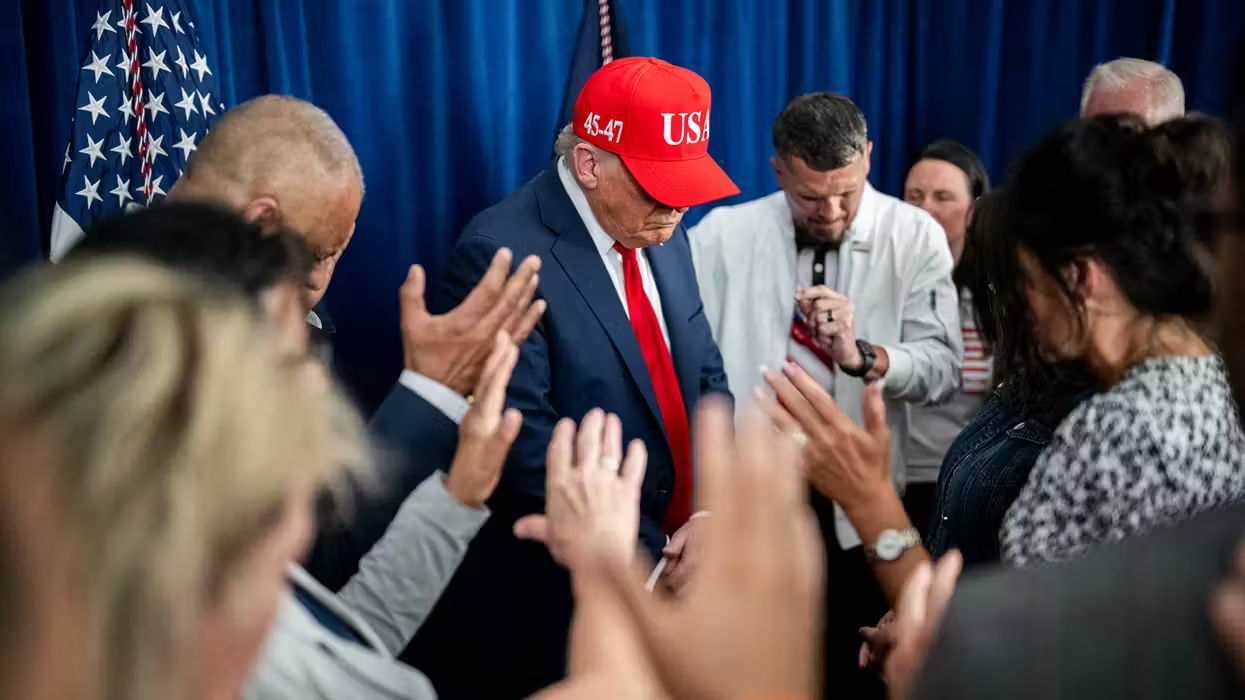
“The religious right has been ascendant during the second presidency of Donald Trump, and they’ve harnessed his disdain for rules and norms to blur the lines between church and state,” reported Vox's Christian Paz on Thursday. “Inside the White House, the secretary of defense has framed the war in Iran and American military action abroad as sanctioned and guided by God. Outside the government, this alliance between church and state often skirts near the edge of outright idolatry. Conservative pastors are erecting golden statues of Trump (but insisting it does not mirror the infamous golden calf of the Old Testament). They’re extending their hands over the president in prayer after comparing him to Jesus and standing by him, with some mild criticism, after he cast himself as an AI-slop Messiah.”
Yet despite this open call for religion to dictate American policy, Paz reported that a recent survey by Pew Research Center reveals that most Americans do not want this to happen. A mere 10 percent identify as Christian nationalists, compared to 31 percent who oppose them and 59 percent who have no opinion. When it comes to the division between church and state, 13 percent want it weakened while 54 percent support it and 32 percent have no opinion.
According to the Public Religion Research Institute’s president and founder Robert P. Jones, Trump and his administration are pushing for “one sector of Christianity" that has failed to catch on with both religious and non-religious Americans.
“It hasn’t resulted in major shifts in the landscape,” Jones explained. “In other words, they’re not pulling people into that worldview. They’re basically just appealing to a small subset of Americans who already hold those views and who just happen to be their political base.”
Even some former Trumpers oppose Trump’s Christian nationalism. In March former Republican US Rep. Joe Walsh said that the theocrats are “out of the closet. They're loud and proud. Speaker of the House Mike Johnson talks about this. Republican members of Congress talk about this. Republican and MAGA thought leaders talk about the fact that America needs to be a Christian country. It needs to be officially designated as a Christian country.”
Citing how Secretary of Defense Pete Hegseth openly cited Jesus Christ when discussing his war against Iran with US troops, Walsh added that Hegseth “knows that not every American worships Jesus Christ. So what's he doing? Here's what he's doing. Pete Hegseth is a white Christian nationalist. Pete Hegseth, the Secretary of Defense, is a white Christian nationalist. He wants America to be a white Christian nation.”
“Our founders were very enlightened,” Walsh continued, saying that even though many of them were religious Christians they made sure that “we do not have an official state religion. The very thought of that, the very notion of that is antithetical to what America is. … Christian nationalism is utterly un-American … as un-American as Islamism is. … Islamism is a radical concept that everybody's got to be Islam. Christian nationalism, same thing. Everybody's got to be Christian. Both are utterly un-American.”
He added, “And I guess what I'm saying right now is, as I close on this, this Un-American, and by the way, un-Christian belief, has overtaken the Republican Party. And we need everybody to wake up to it. Fast. and help all of us, help everyone defeat it.”

May 14, 2026
ALTERNET
President Donald Trump and his administration have openly preached for Christianity to shape national policy since he began his second term — yet the vast majority of Americans do not share this agenda.
“The religious right has been ascendant during the second presidency of Donald Trump, and they’ve harnessed his disdain for rules and norms to blur the lines between church and state,” reported Vox's Christian Paz on Thursday. “Inside the White House, the secretary of defense has framed the war in Iran and American military action abroad as sanctioned and guided by God. Outside the government, this alliance between church and state often skirts near the edge of outright idolatry. Conservative pastors are erecting golden statues of Trump (but insisting it does not mirror the infamous golden calf of the Old Testament). They’re extending their hands over the president in prayer after comparing him to Jesus and standing by him, with some mild criticism, after he cast himself as an AI-slop Messiah.”
Yet despite this open call for religion to dictate American policy, Paz reported that a recent survey by Pew Research Center reveals that most Americans do not want this to happen. A mere 10 percent identify as Christian nationalists, compared to 31 percent who oppose them and 59 percent who have no opinion. When it comes to the division between church and state, 13 percent want it weakened while 54 percent support it and 32 percent have no opinion.
According to the Public Religion Research Institute’s president and founder Robert P. Jones, Trump and his administration are pushing for “one sector of Christianity" that has failed to catch on with both religious and non-religious Americans.
“It hasn’t resulted in major shifts in the landscape,” Jones explained. “In other words, they’re not pulling people into that worldview. They’re basically just appealing to a small subset of Americans who already hold those views and who just happen to be their political base.”
Even some former Trumpers oppose Trump’s Christian nationalism. In March former Republican US Rep. Joe Walsh said that the theocrats are “out of the closet. They're loud and proud. Speaker of the House Mike Johnson talks about this. Republican members of Congress talk about this. Republican and MAGA thought leaders talk about the fact that America needs to be a Christian country. It needs to be officially designated as a Christian country.”
Citing how Secretary of Defense Pete Hegseth openly cited Jesus Christ when discussing his war against Iran with US troops, Walsh added that Hegseth “knows that not every American worships Jesus Christ. So what's he doing? Here's what he's doing. Pete Hegseth is a white Christian nationalist. Pete Hegseth, the Secretary of Defense, is a white Christian nationalist. He wants America to be a white Christian nation.”
“Our founders were very enlightened,” Walsh continued, saying that even though many of them were religious Christians they made sure that “we do not have an official state religion. The very thought of that, the very notion of that is antithetical to what America is. … Christian nationalism is utterly un-American … as un-American as Islamism is. … Islamism is a radical concept that everybody's got to be Islam. Christian nationalism, same thing. Everybody's got to be Christian. Both are utterly un-American.”
He added, “And I guess what I'm saying right now is, as I close on this, this Un-American, and by the way, un-Christian belief, has overtaken the Republican Party. And we need everybody to wake up to it. Fast. and help all of us, help everyone defeat it.”


No comments:
Post a Comment