Canada’s West Coast Ports Drive Trade Growth Beyond the U.S.
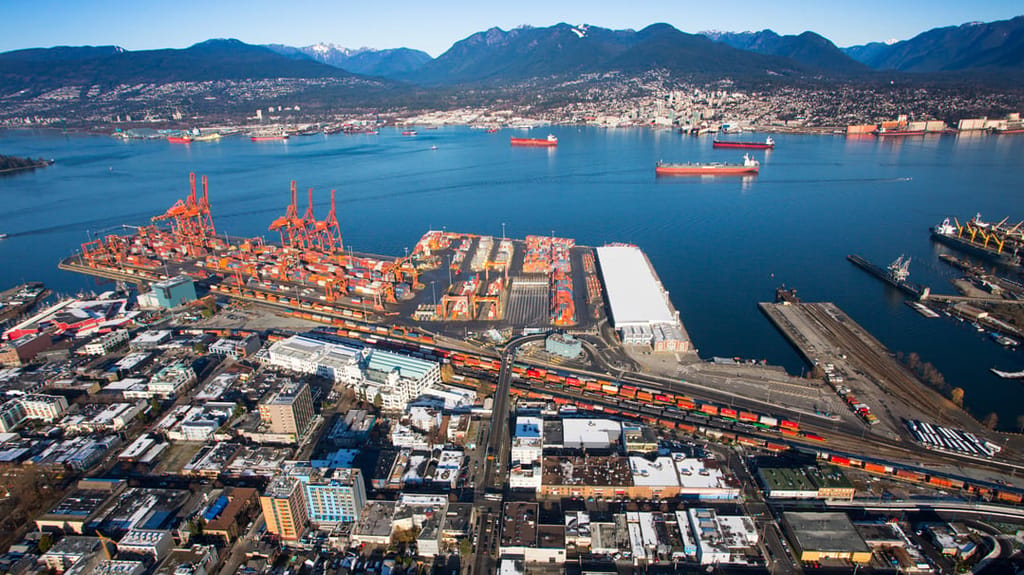
As it finds itself locked in a deepening trade war with the United States, Canada is successfully building its international trade. A newly released study sponsored by Canada’s West Coast ports shows that they are playing a critical role in growing foreign trade as the Canadian government highlights that it is investing in the country’s seaports.
The Economic Impact of West Coast Ports study, released today, August 26, highlights that British Columbia’s maritime gateways at the ports of Vancouver, Prince Rupert, and Nanaimo (sponsors of the study along with two trade associations) serve as the backbone of Canada’s international trade. The three ports handled more than 200 million metric tonnes of cargo in 2025 worth C$409 billion (US$295 billion), of which C$270 billion was Canada’s trade with overseas trading partners, or nearly half of Canada’s trade with markets outside North America.
The ports highlight that they are moving record volumes of what Canadians make, mine, harvest, and grow to global customers in more than 170 overseas markets. They handle a diverse mix of cargo, supporting the movement of everything from bulk exports of Canadian energy, forestry products, potash, grain, and critical minerals to two-way container trade and imports of Asian-made vehicles, manufacturing parts and household necessities.
Not included in the study, but also a key contributor was the opening of Canada’s LNG export terminal. It is the only North American Pacific Coast LNG terminal and is expected to make strong inroads into Asian markets. It is being followed by others and offers the advantage of shorter distance and eliminates the need to transit the Panama Canal.
“West Coast ports like Vancouver have an outsized role to play as Canada looks to double exports to non-U.S. markets over the next 10 years in support of a thriving national economy,” said Peter Xotta, President and CEO, Vancouver Fraser Port Authority.
The Port of Vancouver, with its 29 major deep-water terminals, is active in five key sectors: auto, bulk, breakbulk, container, and cruise. To the north, the Port of Prince Rupert handles raw materials as well as containers, and the Port of Nanaimo, located 30 nautical miles from the Port of Vancouver, is emerging on the Pacific coast. It supports containers, auto, bulk, breakbulk, cruise, and logistics services.
Canada's new government highlights that it is “laser-focused on building a stronger, more independent, more resilient Canadian economy.” Speaking on Monday, August 24, Prime Minister Mark Carney highlighted the government’s commitment to the ports. In the east, he pointed to the expansion of the Port of Montréal at Contrecoeur with a new container terminal and at the Port of Québec to move more Canadian products to global markets.
Port of Vancouver officials highlight their planned Roberts Bank Terminal 2 to expand container capacity as well as the new federal Port of Vancouver Gateway strategy that is currently being developed. Similarly, the Port of Prince Rupert points to C$3 billion (US$2.2 billion) in ports underway that will expand capacity and support diversification.
The West Coast ports are highlighting their economic contribution to Canada and the role they are playing in expanding Canadian trade globally. The full report is posted online.
Trillion-Dollar Port: Houston's Petroleum Trade Supports Millions of Jobs

Plenty of ports contribute billions of dollars in economic value to their respective regions, but only a few reach above that mark. Port Houston's latest economic impact assessment suggests that it supports nearly $1 trillion in economic activity - roughly three percent of U.S. gross domestic product.
The study is an update performed by Martin Associates on behalf of Port Houston, and builds on previous work in 2022. By 2025, economic activity supported by Port Houston rose by about $100 billion, reflecting substantial growth in business along the Houston Ship Channel.
The study also found that the port's economic activity supports 3.5 million jobs nationwide, one out of every 50 jobs in the country,d including 1.9 million jobs in Texas alone (up 22 percent since 2022). The vast majority of these positions depend to varying extents on trade through the port, but are not directly linked to its daily operations. A much smaller number, about 92,000 positions, are directly employed with the port, its terminal operator partners or various contractors. Those local waterfront posts are well-paid, according to the study's authors, and bring home $8.5 billion a year in wages (about $92,000 per person on average).
The national economic impact is driven in large part by the port's massive petroleum and chemical trade. Port Houston's terminals handle nearly 300 million tons of cargo every year, the overwhelming majority in the form of liquid bulk.
"The Houston Ship Channel is one of the country's most important economic corridors, and these findings demonstrate its impact far beyond our region," said Charlie Jenkins, CEO of Port Houston. "Manufacturers, energy producers, businesses, and consumers across the country depend on this critical gateway to move products."
Klaipeda Port Largest-Ever Expansion Project Moves Into Construction Phase
[By: Port of Klaipeda]
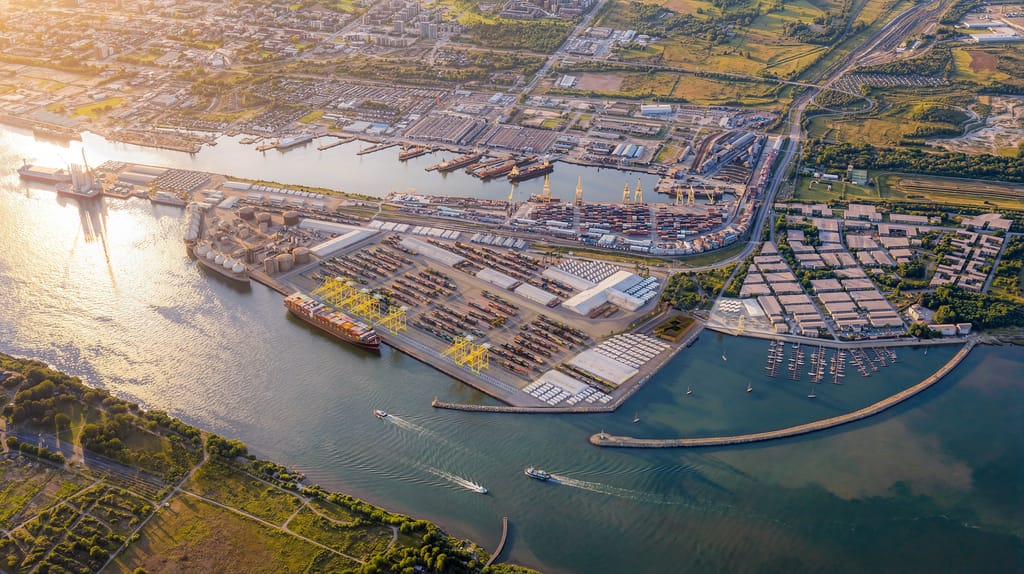
The Port of Klaipeda is moving into a new phase of the largest expansion project in its history, with the first works now getting underway. Site preparation has started in the southern part of the port, where a major new port area will be developed in the coming years.
“We are now very close to the start of the southern port expansion. After a long period of planning and preparation, work on site is beginning. Once the site is ready, construction of the southern breakwaters will start this autumn, marking the first stage of the largest expansion project in the history of the Port of Klaipeda. This project shows that we are steadily moving forward with our plans to build a stronger port for Lithuania. It will make the country more attractive to investors, strengthen our competitiveness in international markets and support military mobility needs that are important not only for Lithuania, but for the wider region,” says Algis Latakas, CEO of the Klaipeda Port Authority.
The southern breakwaters will be built by Tilsta, which won the tender launched earlier this year. The contract signed with the Klaipeda Port Authority is worth EUR 24.5 million excluding VAT. Construction is expected to begin this autumn.
The new breakwaters will also serve an important environmental purpose by helping to limit the flow of salt water into the Curonian Lagoon.
The southern port expansion will create new space and significantly increase the Port of Klaipeda’s capacity for port operations and cargo handling. Nearly EUR 600 million – the largest share of the Port’s investment programme for 2026–2029 – is planned for the project.
Together with investment expected from future investors, the total value of the development will exceed EUR 1 billion, making it one of the largest investment projects currently being developed in Lithuania.
The products and services herein described in this press release are not endorsed by The Maritime Executive.
Ningbo-Zhoushan Tops Singapore as World’s Second Busiest Container Port
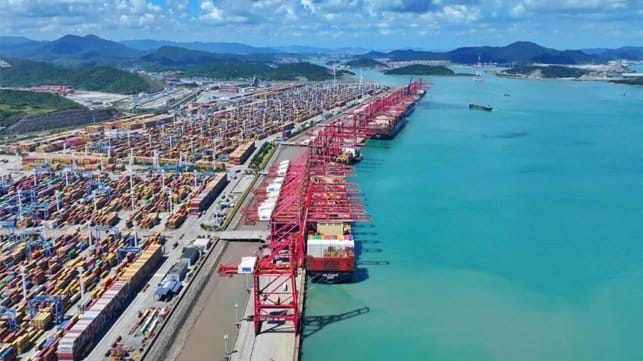
China’s ports are continuing to support the expansion of the country’s exports despite the Trump administration’s efforts at tariffs. China now has six of the top 10 ports by volume, according to Alphaliner’s latest rankings, and in a surprise move, the Ningbo-Zhoushan port complex edged out Singapore for the position of the world’s second busiest port.
Officials at the Zhejiang Provincial Seaport Group and Ningbo-Zhoushan Port Group highlighted that they had fully implemented their plans to strengthen work style and efficiency. The port complex has continued its rapid growth. It finished 2025 only about 800,000 TEU behind Singapore, and with the continued growth, it has now edged out Singapore and slipped into second position on Alphaliner’s Top-30 chart for global port throughput.
Ningbo-Zhoushan is growing at nearly twice the rate of Singapore, with the chart showing 8.8 percent growth for throughput in the first half of the year versus 4.7 percent for Singapore. Both ports showed slowing growth rates versus 2025, but still Ningbo-Zhoushan ended up ahead by 158,310 TEU.
The expectation is that the two ports will continue in a neck-and-neck race for the remainder of the year. However, China’s growth rates continue above those of most other countries.
Shanghai remains firmly atop the list at more than 28.7 million TEU, according to Alphaliner’s data. Last year, Shanghai broke the 55 million TEU mark for the first time, with officials pointing to the efficiency from the increasing levels of automation in the port. In July, recovering from the impact of a typhoon, Shanghai reported it smashed the record for a single-day volume, moving nearly 204,000 TEU.
China’s Shenzhen, Qingdao, Guangzhou, and Tianjin were also among the 10 busiest container ports in the first half of 2026. Tianjin also showed strong growth, helping it to edge out Busan by nearly 400,000 TEU over the six months to move up one spot, claiming number 7 on Alphaliner’s table.
Analyzing the changes, Alphaliner says the half-year data “shows the widespread impact of geopolitical trends on the global container market, as carriers adjusted their networks in reaction to the Middle East conflict and shippers responded to the US tariff policy.”
It highlights the most significant drops were in the Middle East, where the war and the closing of the Strait of Hormuz dramatically impacted the fortunes of Dubai’s Jebel Ali port and Abu Dhabi’s Khalifa Seaport. Jebel Ali’s volumes, they report, plummeted over 90 percent to just 374,000 TEU for the second quarter and 3.14 million TEU for the six months, which was down 23 percent.
As a result, Jebel Ali fell out of the top 30 ranking to 32nd place. Similarly, Khalifa Seaport fell from its previous position of 32nd out of the top 50 reports by Alphaliner. They note exact numbers have not been published, but they believe based on wider group results that Jebel Ali’s volumes fell at least 50 percent.
Most of the other global ports retained the order in the ranking or moved up or down one notch. Combined, the Port of Los Angeles and Long Beach came in again at number 9, handling just under 10 million TEU in the first half of the year. They are the only U.S. port to be in the top 10, with the Port of New York and New Jersey a distant second, falling one notch to 22 on the chart. It handled 4.4 million TEU, which was relatively stable compared to 2025.
CMA CGM and Saudi Arabia to Invest $434M to Expand Jeddah Islamic Port
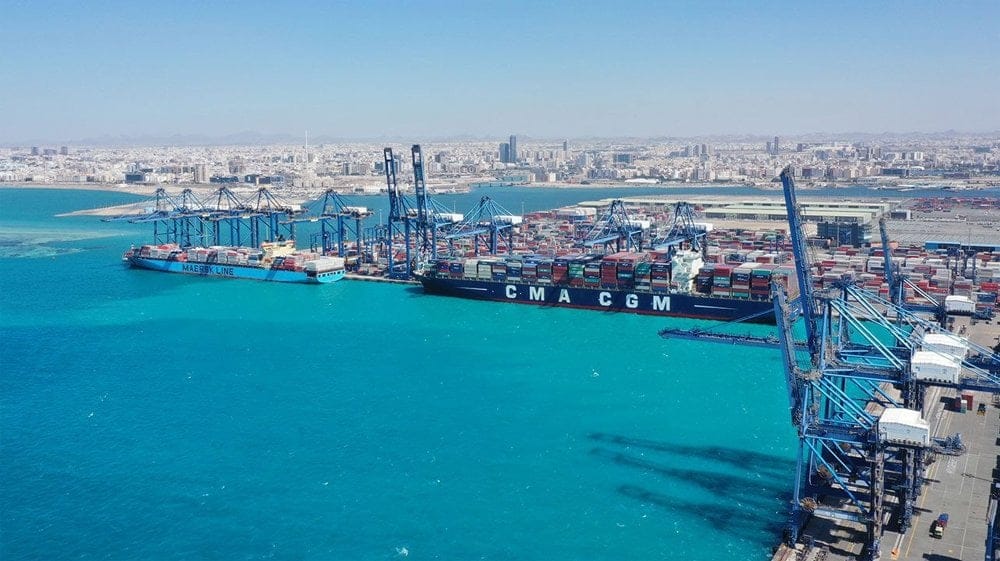
An agreement was signed in Paris during a French-Saudi Investment Roundtable that calls for CMA CGM and Red Sea Gateway Terminal (RSGT), Saudi Arabia's terminal operator, to expand the Red Sea Jeddah Islamic Port. Working in collaboration with the Saudi Ports Authority (Mawani), the companies will be marking one of the largest foreign direct investments in Saudi Arabia's maritime sector.
The project will bring approximately $434 million in investment into Jeddah Islamic Port and create a new state-of-the-art container terminal as part of RSGT’s existing concession. It will add up to approximately 2.6 million TEUs of annual handling capacity at the port, which currently has a capacity of 6.2 million TEUs. It will include new deep-water berths designed to accommodate the world's largest container vessels supported by advanced terminal technologies and 10 new ship-to-shore cranes.
RSGT calls the Jeddah operation its flagship terminal, noting that it is the largest and most advanced container terminal on the Red Sea. It accounts for nearly 40 percent of Saudi Arabia’s container throughput.
The companies highlighted that the development project will enhance productivity, efficiency, and service reliability for customers across the Kingdom and the wider region. They said the enhanced marine infrastructure will strengthen Jeddah Islamic Port's ability to efficiently serve larger vessels and major international shipping services, supporting greater trade volumes, stronger global connectivity, and more efficient access to international markets for Saudi imports and exports. The development also further reinforces the successful partnership between the Kingdom, represented by the Saudi Ports Authority (Mawani), RSGT, and CMA CGM Group.
The project will provide critical future capacity to accommodate the Kingdom's growing trade requirements while strengthening the port's position on major global shipping routes. The addition of deep-water berths will enable the terminal to efficiently accommodate larger, next-generation container vessels, helping attract and retain major shipping services, increase cargo flows and enhance the connectivity of Saudi businesses to global markets.
Red Sea Gateway Terminal (RSGT) is Saudi Arabia’s first privately funded terminal operator. To serve a broader range of customers and cargo types, RSGT also offers Multi-Purpose Terminals (MPT) services through a dedicated business unit that manages non-containerized cargo across four strategic locations on Saudi Arabia’s Red Sea coast. It handles containers, Ro/Ro, general cargo, dry and liquid bulk, as well as livestock.
The Red Sea ports have become critical to Saudi Arabia due to the disruptions in the Strait of Hormuz. However, it is now having to address the declared “blockade” by the Houthis to the south in Yemen, which is disrupting some operations. However, the Kingdom looks to expand its capabilities as part of its goal to expand its role as a trade hub for the region.

No comments:
Post a Comment