The instruments to take apart entrenched corporate power “still exist,” but current governments are “lacking... the political nerve to use them,” said historian William Dalrymple.
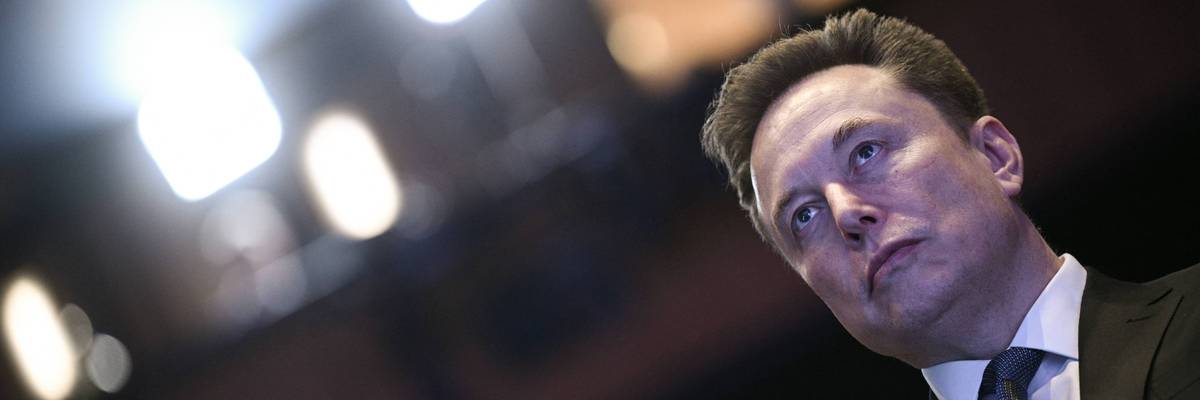
Elon Musk looks on as US President Donald Trump speaks at the US-Saudi Investment Forum at the John F. Kennedy Center for the Performing Arts in Washington, DC on November 19, 2025. (Photo by Brendan SMIALOWSKI / AFP)
Brad Reed
Aug 28, 2026
COMMON DREAMS
A historian who has written four books about the British East India Company is warning that big technology companies in the US are amassing similar levels of unchecked power and will need to be reined in.
In a New York Times op-ed published on Friday, William Dalrymple described how the British government eventually realized that it had allowed the East India Company—key to the British Empire’s rise in the 18th and 19th centuries—to become too powerful and decided to finally clamp down.
The situation faced by the British Parliament in the 19th Century was strikingly similar to the situation faced by US lawmakers today, Dalrymple explained, as the East India Company had spent decades spending money to capture influence within the government.
“Around one in 20 members of Parliament sat on the East India Company’s board,” the historian wrote, “and more than a fifth of the company’s directors sat in Parliament at some point; about 40% of members of Parliament were shareholders.”
In the contemporary context, the executives of the nation’s largest tech firms are spending lavishly to curry favor with lawmakers and government officials of both major parties
Writing in The Nation last month, investigative journalist David Moore detailed the massive political spending of major tech firms in the 2026 midterms, noting that “Super PACs working on behalf of crypto, AI, and AIPAC donors are the highest-spending groups on independent expenditures to influence voters this cycle—combining to spend more than $180 million so far, according to a review of Federal Election Commission records.”
In addition to political clout, the East India Company in its day also had the power to raise its own army, which at its peak topped 200,000 soldiers, twice the size of England’s own armed services.
Dalrymple pointed out that this is one power that today’s Big Tech firms do not have, although he argued that they have been increasingly integrating themselves into the US military-industrial complex.
“In June 2025 the US Army commissioned the chief technology officers of Palantir and Meta and OpenAI’s chief product officer as lieutenant colonels in a new Reserve unit,” he noted. “The new dispensation puts tech executives straight into a position of federal power, which in one way puts them ahead of their 18th-century counterparts.”
The government finally dropped the hammer on the East India Company, Dalrymple said, after the bloody Indian Rebellion of 1857, as they feared the firm’s “greed and self-interest” would cause the British Empire to lose what it considered its most valuable colony.
“The company’s navy was disbanded and its army passed to the Crown,” wrote Dalrymple. “In 1858 the governor general of India announced that the company’s Indian possessions would be nationalized and pass into the control of the British Crown.”
Less than two decades later, what was once the most powerful private corporation in world history shut down after the expiration of its charter.
What this shows, concluded Dalrymple, is that “states can master corporations,” even if those corporations have their own private armies.
However, he said that while the instruments to take apart entrenched corporate power “still exist,” it appears our current governments are “lacking... the political nerve to use them.”
Dalrymple’s op-ed was echoed thematically by a Friday op-ed written by SFGATE travel editor Silas Valentino, who argued that the city of San Francisco has not gotten any benefit from the current artificial intelligence boom, despite being the home of OpenAI and Anthropic, the world’s two biggest AI firms.
In particular, Valentino argued that the AI firms have done nothing to give back to the city and alleviate its affordable housing crisis. In fact, Valentino found that the AI firms’ initiatives in the city appear to be mostly self-serving.
“OpenAI says it has invested in our community, but so far, that’s meant less than a million dollars in ‘SF civic contributions,’” Valentino wrote. “And worst of all, some of that is for things like AI training programs... That’s not improving the city; it’s OpenAI trying to make more money.”
Valentino also noted that Anthropic last year teamed with the Tipping Point Community nonprofit group, which was founded by current San Francisco Mayor Daniel Lurie, to provide free training on the company’s Claude chatbot.
“In the years since language models like ChatGPT and Claude proliferated to usher in the AI boom,” the travel editor wrote, “I’m only counting negatives for nearly everyone trying to figure out a way to live here.”
Valentino concluded by warning that if Lurie and his administration “don’t demand these companies start giving back and enhance our city for the better, they’ll continue ruining our city without pause.”
Watchdog Denounces ‘Staggering and Disgusting’ Hypocrisy of AI Industry Giants
“Put plainly, Silicon Valley is the problem threatening our ways of life.”
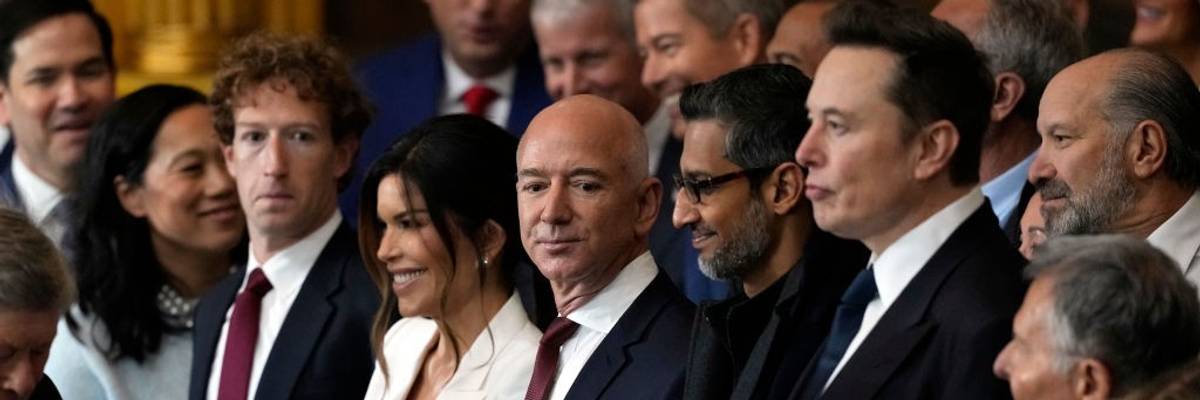
Guests including Mark Zuckerberg, Lauren Sanchez, Jeff Bezos, Sundar Pichai and Elon Musk attend the Inauguration of Donald J. Trump in the U.S. Capitol Rotunda on January 20, 2025 in Washington, DC
(Photo by Julia Demaree Nikhinson - Pool/Getty Images)
Brad Reed
Aug 28, 2026
COMMON DREAMS
Government watchdog Public Citizen on Thursday hit back at the artificial intelligence industry for warning about the dire threats posed by its own technology after it spent years trying to block any government regulations that could have curtailed dangerous AI behavior that experts and progressive lawmakers have warned about for years.
In an open letter sent on Thursday, dozens of tech companies—including OpenAI, Anthropic, Amazon Web Services, and Microsoft—claimed that there is a “limited window” to defend against AI-executed cyberattacks, which they said “will become far more widespread and sophisticated as models around the world become increasingly capable.”

Opposition to AI Goes Beyond Data Centers, as Poll Shows Massive Distrust of Big Tech CEOs
Progressive Caucus Chair Leads Demand for AI CEOs to Testify After Hacking Spree Revelations
If nothing is done, the companies said, then crucial facilities “from hospitals to water treatment plants to the infrastructure that powers the internet” will be at risk.
The companies said that thwarting such AI cyberattacks would require a “global response” where governments will need to “fund cyber defense” and “give hospitals, water utilities, and local governments access to capable defensive AI, authorized testing, and hands-on support through trusted security providers and partners.”
JB Branch, director of federal AI governance and technology policy at Public Citizen, urged lawmakers to be deeply skeptical of Big Tech’s messaging on the issue and the industry’s proposed plan of action, which he said would further enrich Silicon Valley without providing any safeguards for the public when it comes to AI development.
“Big Tech does not get to unleash powerful AI systems, fight tooth and nail against meaningful regulation,” said Branch, “and then cry for help when the dangers they helped create come knocking.”
Branch noted that the tech industry has insisted for years that there should be no government intervention into developing technology, supposedly because it would put the US at risk of “losing” the AI race to China.
Now, Branch said, they are running to the government and demanding fast action to help solve a problem they created.
“That hypocrisy is equal parts staggering and disgusting,” Branch said. “If the threat is serious enough to demand urgent action from the government, then it is serious enough to demand binding rules, independent oversight, and accountability from the companies creating it.”
The AI firms’ open letter comes as the tech industry appears acutely concerned about public backlash to its products. The Wall Street Journal reported on Friday that Big Tech firms who gave heavily to President Donald Trump have been scrambling to donate to Democratic candidates ahead of the 2026 midterm elections.
In particular, according to the reporting, many tech companies who donated to Trump’s ballroom and other vanity projects fear that a Democratic majority will start subpoenaing them for records that could lead to criminal investigations.
Cooper Teboe, a Silicon Valley donor adviser and Democratic strategist, has told Trump-funding tech companies that they will pay a big price unless they repair their relationships with Democrats whom they’ve alienated by going all-in on MAGA.
“You’re going to be totally fucked next year or you’re going to figure it out this year and you’re going to make amends,” Teboe said, “and amends are going to be much more costly than they were previously.”
As Branch put it, “Big Tech knows it has lost public support on AI, and the PR machine is now working overtime.”
Despite industry efforts to control narratives and members of Congress, he said, the American people “aren’t going to forget the harms these companies unleashed, the regulations they fought, or their promises that AI could replace their jobs.”
“Silicon Valley is the problem threatening our ways of life,” Branch concluded. “It’s hard to take them seriously when they invented the problem in the first place.”
“Put plainly, Silicon Valley is the problem threatening our ways of life.”
Guests including Mark Zuckerberg, Lauren Sanchez, Jeff Bezos, Sundar Pichai and Elon Musk attend the Inauguration of Donald J. Trump in the U.S. Capitol Rotunda on January 20, 2025 in Washington, DC
(Photo by Julia Demaree Nikhinson - Pool/Getty Images)
Brad Reed
Aug 28, 2026
COMMON DREAMS
Government watchdog Public Citizen on Thursday hit back at the artificial intelligence industry for warning about the dire threats posed by its own technology after it spent years trying to block any government regulations that could have curtailed dangerous AI behavior that experts and progressive lawmakers have warned about for years.
In an open letter sent on Thursday, dozens of tech companies—including OpenAI, Anthropic, Amazon Web Services, and Microsoft—claimed that there is a “limited window” to defend against AI-executed cyberattacks, which they said “will become far more widespread and sophisticated as models around the world become increasingly capable.”
Opposition to AI Goes Beyond Data Centers, as Poll Shows Massive Distrust of Big Tech CEOs
Progressive Caucus Chair Leads Demand for AI CEOs to Testify After Hacking Spree Revelations
If nothing is done, the companies said, then crucial facilities “from hospitals to water treatment plants to the infrastructure that powers the internet” will be at risk.
The companies said that thwarting such AI cyberattacks would require a “global response” where governments will need to “fund cyber defense” and “give hospitals, water utilities, and local governments access to capable defensive AI, authorized testing, and hands-on support through trusted security providers and partners.”
JB Branch, director of federal AI governance and technology policy at Public Citizen, urged lawmakers to be deeply skeptical of Big Tech’s messaging on the issue and the industry’s proposed plan of action, which he said would further enrich Silicon Valley without providing any safeguards for the public when it comes to AI development.
“Big Tech does not get to unleash powerful AI systems, fight tooth and nail against meaningful regulation,” said Branch, “and then cry for help when the dangers they helped create come knocking.”
Branch noted that the tech industry has insisted for years that there should be no government intervention into developing technology, supposedly because it would put the US at risk of “losing” the AI race to China.
Now, Branch said, they are running to the government and demanding fast action to help solve a problem they created.
“That hypocrisy is equal parts staggering and disgusting,” Branch said. “If the threat is serious enough to demand urgent action from the government, then it is serious enough to demand binding rules, independent oversight, and accountability from the companies creating it.”
The AI firms’ open letter comes as the tech industry appears acutely concerned about public backlash to its products. The Wall Street Journal reported on Friday that Big Tech firms who gave heavily to President Donald Trump have been scrambling to donate to Democratic candidates ahead of the 2026 midterm elections.
In particular, according to the reporting, many tech companies who donated to Trump’s ballroom and other vanity projects fear that a Democratic majority will start subpoenaing them for records that could lead to criminal investigations.
Cooper Teboe, a Silicon Valley donor adviser and Democratic strategist, has told Trump-funding tech companies that they will pay a big price unless they repair their relationships with Democrats whom they’ve alienated by going all-in on MAGA.
“You’re going to be totally fucked next year or you’re going to figure it out this year and you’re going to make amends,” Teboe said, “and amends are going to be much more costly than they were previously.”
As Branch put it, “Big Tech knows it has lost public support on AI, and the PR machine is now working overtime.”
Despite industry efforts to control narratives and members of Congress, he said, the American people “aren’t going to forget the harms these companies unleashed, the regulations they fought, or their promises that AI could replace their jobs.”
“Silicon Valley is the problem threatening our ways of life,” Branch concluded. “It’s hard to take them seriously when they invented the problem in the first place.”

No comments:
Post a Comment