Advocates asked a court to unseal more details on Trump’s surveillance of churches, schools, and libraries in Minnesota.
By Mike Ludwig ,
August 29, 2026
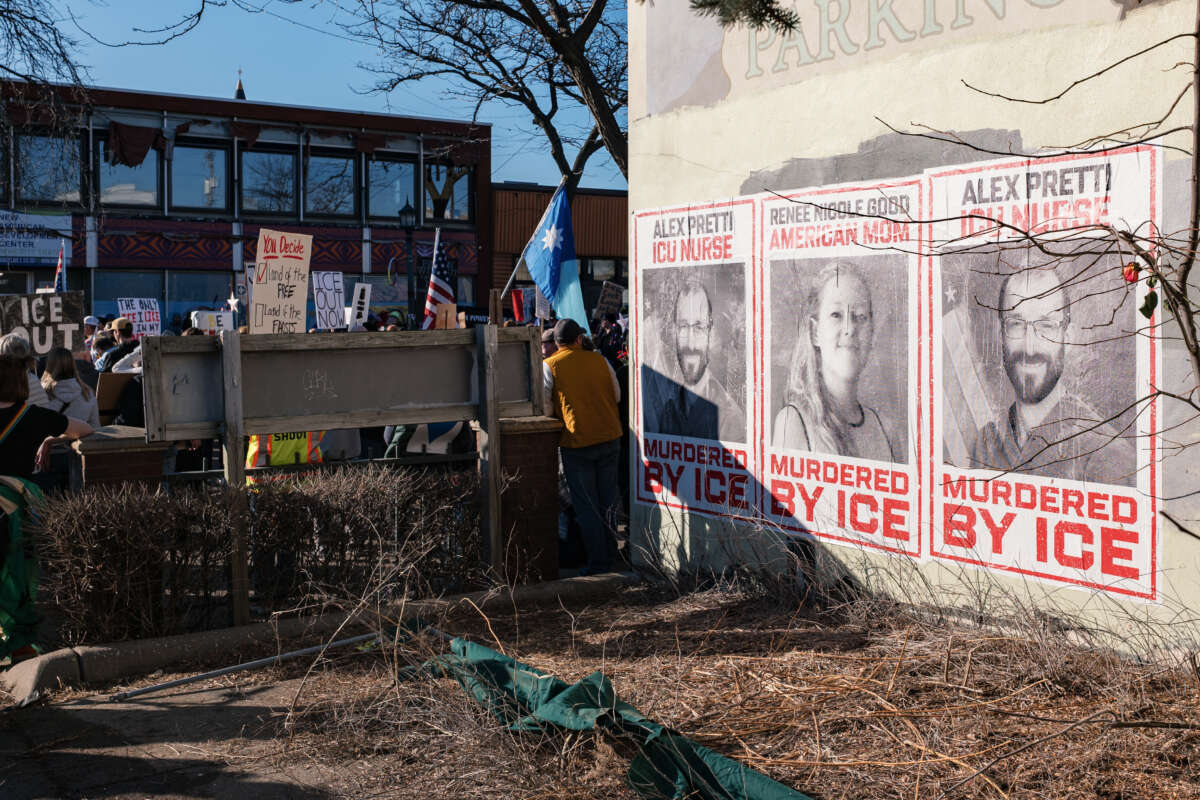
Several thousand people march for democracy at the call of several organizations and associations, demanding ICE out of Minnesota immediately, and justice and accountability for Renee Good, Alex Pretti, and all victims of ICE in Minneapolis, Minnesota, on February 16, 2026.Jerome Gilles / NurPhoto via Getty Images
Free speech groups across the country are sounding the alarm over the Trump administration’s surveillance of social movements in Minnesota and the prosecution of the Minnesota 15, a group of activists from Minneapolis-St. Paul who face federal conspiracy charges after organizing protests against brutal immigration sweeps earlier this year.
President Donald Trump and his allies in the Department of Homeland Security (DHS) and Justice Department have targeted the First Amendment-protected expression of protesters, civil society groups, journalists, universities, and the lawyers representing them at a scale that has “not been seen since the Second Red Scare,” according to an amicus brief filed with a federal court in Minnesota on August 25 by Protect Democracy and other groups.
Documents recently released in court filings show that DHS agents spied on churches, schools, and libraries to gather information on labor unions, nonprofits, and community groups large and small. In June, the Minnesota 15 were arrested and charged with conspiracy to stalk, impede, and assault immigration officers under a section of federal law the Trump administration has used to arrest anti-ICE protesters across the country.
Instead of attempting to tie the Minnesota 15 to one specific incident, prosecutors filed conspiracy charges linking the defendants to rapid response groups that coordinated to alert people about ICE raids and send volunteers into the streets in response — a loose set of tactics that became a model for anti-ICE organizers elsewhere.
Will Creeley, legal director of the Foundation for Individual Rights and Expression (FIRE), a nonpartisan group that defends speech across the political spectrum, compared Trump’s crackdown on Minnesota to the worst civil liberties abuses during the McCarthy era and COINTELPRO in the mid-20th century. At the time, paranoia about communism ran high on the right, and civil rights organizers, gay federal employees, and anti-war activists were targeted for surveillance, arrest, and interrogation due to perceived disloyalty to the United States or for holding pro-peace, anti-racist, and left-wing political beliefs.
“The idea is to stoke a culture of fear and have folks keep quiet rather than disagree with those in power,” Creeley told Truthout. “But the First Amendment is designed to protect just that kind of disagreement.”
However, by prosecuting the Minnesota 15 for political activism, the Trump administration has been forced through the legal discovery process to reveal details about the federal surveillance of protests against Operation Metro Surge, the immigration crackdown in Minnesota announced by Trump in December.
Documents released by a defense attorney earlier this month show that undercover agents with ICE’s investigative unit infiltrated multiple left-leaning groups in Minneapolis as part of an investigation called “Operation Puppet Master,” four days after a group of federal agents shot and killed Alex Pretti, the nurse who died while attempting to shield another protester from the agents on January 24.
In addition to killing Pretti and protester Renee Good, federal immigration agents terrorized tight-knit neighborhoods in the Twin Cities and across Minnesota in what Human Rights Watch calls a “manufactured crisis.” Protests and mutual aid efforts erupted as videos of violent arrests and confrontations between federal agents and residents went viral, resulting in dozens of arrests.
FIRE, the left-leaning Protect Democracy, the right-leaning Society for the Rule of Law, and the libertarian Cato Institute filed a brief on August 25 in support of a request by a defense attorney representing the Minnesota 15 defendants for the government to hand over more documents and records related to its surveillance of activist groups, including any correspondence between the White House and prosecutors. The coalition reflects growing bipartisan frustration over Trump’s excesses and power grabs.
The groups want additional documents from prosecutors made public to further understand the scope of government surveillance under the controversial NSPM-7 directive, a memo issued by Trump in 2025 that conflates “anti-Americanism” and “anti-Christianity” views with political violence. The NSPM-7 also orders the Joint Terrorism Task Force to target anti-fascist activism, which the administration wrongly conflates with terrorism.
In a hearing on August 27, defense attorney Kevin Riach said additional discovery is needed to determine whether DHS selectively or vindictively targeted the Minnesota 15 based on their political beliefs. Riach represents Isaac Sant, one of the Minnesota 15 facing conspiracy charges. U.S. District Judge David Schultz said he would issue an order as soon as possible but did not provide a timeline, according to the Minnesota Reformer.
“The purpose of this prosecution is to chill the conduct of the defendants and others and to squash dissent in this district,” Riach said.
While Trump’s crackdown brought trauma and heartbreak to Minnesota — which appears to be one of the administration’s unspoken goals in a bastion of Democratic voters, activists say — images of neighbors gathering to confront agents in freezing weather and organize meals and carpools to sustain immigrant families became a potent symbol of resistance to Immigration and Customs Enforcement (ICE) for the rest of the nation.
The Trump administration halted Operation Metro Surge — which it had billed as the largest immigration sting in U.S. history — on February 12 amid widespread public backlash. Gregory Bovino, the Border Patrol officer leading Operation Metro Surge, was forced to step down. Trump fired former DHS Secretary Kristi Noem amid a flurry of scandal on March 5.
“For myself, I’ve received nothing but support here,” said Cameron Kennedy, one of the Minnesota 15 defendants, in an August 12 interview with Truthout. “My neighbors have offered to help my partner and I any way they can, donating money and food. People recognize me on the street and thank me for the work I’m alleged to have done.”
Truthout has spoken to mutual aid activists in Minnesota who say they are taking precautions about speaking publicly but not backing down. Elianne Farhat, co-executive director of TakeAction Minnesota, said members of her organization — public school families, performers, and neighbors from across the state — have already proved they cannot be bullied after schools became a target during Operation Metro Surge.
“Instead, we stay calm, speak up, save the evidence, and stick with our friends — basic playground rules,” Farhat told Truthout in an email. “Public schools are a common good and the cornerstone of a multiracial, thriving democracy. And as our networks of care proved during the terror of Operation Metro Surge, they are vital hubs for community resilience and survival.”
FIRE’s Creeley said he believes that intimidating Minnesotans was part of a broader Trump administration strategy to send a clear message to the rest of the U.S. public — standing up to ICE and Trump has consequences for the public regardless of what the Constitution says about the right to assemble freely and criticize public officials.
“I think when you have a drumbeat of news stories about the executive branch infiltrating peaceful protest groups, demanding information from nonprofits and unions, and even sneaking into churches; yeah, I think the average American notices that and even thinks twice before speaking out and exercising their First Amendment rights,” Creeley said.
Indeed, ICE has created a nationwide web of surveillance. Civil rights groups recently sued ICE to challenge the mass surveillance of immigrants with ankle and wrist monitors equipped with GPS. In July, a nonprofit and three U.S. citizens who worked as legal observers during ICE raids in Minnesota filed a lawsuit alleging DHS agents have been using “facial recognition technology, license plate readers, body cameras and other methods” to stifle their efforts, in violation of the First Amendment and privacy law.
“They are 100 percent acting like constitutional restrictions on government do not apply to them; they’re flying in the face of established First Amendment law,” Creeley said of Trump administration officials.
This week FIRE and the Dartmouth Polarization Research Lab released a quarterly survey showing that only 28 percent of U.S. residents feel “very comfortable” discussing ICE operations without fear of reprimand. Respondents who identified as “very liberal” (41 percent) or “very conservative” (57 percent) were more likely to feel “very comfortable” discussing the mass deportation campaign, but Creeley said the data is evidence that the prosecutions and brutality seen in Minnesota are having a nationwide repressive impact on freedom of speech.
Particularly after the killings of Good and Pretti, those standing up to ICE and Trump must live with the implicit threat of state violence. However, the Minnesota 15 and other Twin Cities activists — including the many rapid response groups that quickly formed in the Twin Cities to confront ICE agents attempting to kidnap their neighbors — refuse to be intimidated.
“Take responsibility, take risks, take care of each other, and never rely on the very state that is ripping our communities apart and murdering our people to solve the problem that both political parties created,” Kennedy told Truthout.
Creeley said courts should find that the First Amendment also stands in the way of Trump’s authoritarian power grab.
“Secret visits from government agents and knocks on the door for statements critical of the country’s leaders — I have a feeling those are the exact kind of abuses that the founding generation fought against,” Creeley said.
Free speech groups across the country are sounding the alarm over the Trump administration’s surveillance of social movements in Minnesota and the prosecution of the Minnesota 15, a group of activists from Minneapolis-St. Paul who face federal conspiracy charges after organizing protests against brutal immigration sweeps earlier this year.
President Donald Trump and his allies in the Department of Homeland Security (DHS) and Justice Department have targeted the First Amendment-protected expression of protesters, civil society groups, journalists, universities, and the lawyers representing them at a scale that has “not been seen since the Second Red Scare,” according to an amicus brief filed with a federal court in Minnesota on August 25 by Protect Democracy and other groups.
Documents recently released in court filings show that DHS agents spied on churches, schools, and libraries to gather information on labor unions, nonprofits, and community groups large and small. In June, the Minnesota 15 were arrested and charged with conspiracy to stalk, impede, and assault immigration officers under a section of federal law the Trump administration has used to arrest anti-ICE protesters across the country.
Instead of attempting to tie the Minnesota 15 to one specific incident, prosecutors filed conspiracy charges linking the defendants to rapid response groups that coordinated to alert people about ICE raids and send volunteers into the streets in response — a loose set of tactics that became a model for anti-ICE organizers elsewhere.
Will Creeley, legal director of the Foundation for Individual Rights and Expression (FIRE), a nonpartisan group that defends speech across the political spectrum, compared Trump’s crackdown on Minnesota to the worst civil liberties abuses during the McCarthy era and COINTELPRO in the mid-20th century. At the time, paranoia about communism ran high on the right, and civil rights organizers, gay federal employees, and anti-war activists were targeted for surveillance, arrest, and interrogation due to perceived disloyalty to the United States or for holding pro-peace, anti-racist, and left-wing political beliefs.
“The idea is to stoke a culture of fear and have folks keep quiet rather than disagree with those in power,” Creeley told Truthout. “But the First Amendment is designed to protect just that kind of disagreement.”
However, by prosecuting the Minnesota 15 for political activism, the Trump administration has been forced through the legal discovery process to reveal details about the federal surveillance of protests against Operation Metro Surge, the immigration crackdown in Minnesota announced by Trump in December.
Documents released by a defense attorney earlier this month show that undercover agents with ICE’s investigative unit infiltrated multiple left-leaning groups in Minneapolis as part of an investigation called “Operation Puppet Master,” four days after a group of federal agents shot and killed Alex Pretti, the nurse who died while attempting to shield another protester from the agents on January 24.
In addition to killing Pretti and protester Renee Good, federal immigration agents terrorized tight-knit neighborhoods in the Twin Cities and across Minnesota in what Human Rights Watch calls a “manufactured crisis.” Protests and mutual aid efforts erupted as videos of violent arrests and confrontations between federal agents and residents went viral, resulting in dozens of arrests.
FIRE, the left-leaning Protect Democracy, the right-leaning Society for the Rule of Law, and the libertarian Cato Institute filed a brief on August 25 in support of a request by a defense attorney representing the Minnesota 15 defendants for the government to hand over more documents and records related to its surveillance of activist groups, including any correspondence between the White House and prosecutors. The coalition reflects growing bipartisan frustration over Trump’s excesses and power grabs.
The groups want additional documents from prosecutors made public to further understand the scope of government surveillance under the controversial NSPM-7 directive, a memo issued by Trump in 2025 that conflates “anti-Americanism” and “anti-Christianity” views with political violence. The NSPM-7 also orders the Joint Terrorism Task Force to target anti-fascist activism, which the administration wrongly conflates with terrorism.
In a hearing on August 27, defense attorney Kevin Riach said additional discovery is needed to determine whether DHS selectively or vindictively targeted the Minnesota 15 based on their political beliefs. Riach represents Isaac Sant, one of the Minnesota 15 facing conspiracy charges. U.S. District Judge David Schultz said he would issue an order as soon as possible but did not provide a timeline, according to the Minnesota Reformer.
“The purpose of this prosecution is to chill the conduct of the defendants and others and to squash dissent in this district,” Riach said.
While Trump’s crackdown brought trauma and heartbreak to Minnesota — which appears to be one of the administration’s unspoken goals in a bastion of Democratic voters, activists say — images of neighbors gathering to confront agents in freezing weather and organize meals and carpools to sustain immigrant families became a potent symbol of resistance to Immigration and Customs Enforcement (ICE) for the rest of the nation.
The Trump administration halted Operation Metro Surge — which it had billed as the largest immigration sting in U.S. history — on February 12 amid widespread public backlash. Gregory Bovino, the Border Patrol officer leading Operation Metro Surge, was forced to step down. Trump fired former DHS Secretary Kristi Noem amid a flurry of scandal on March 5.
“For myself, I’ve received nothing but support here,” said Cameron Kennedy, one of the Minnesota 15 defendants, in an August 12 interview with Truthout. “My neighbors have offered to help my partner and I any way they can, donating money and food. People recognize me on the street and thank me for the work I’m alleged to have done.”
Truthout has spoken to mutual aid activists in Minnesota who say they are taking precautions about speaking publicly but not backing down. Elianne Farhat, co-executive director of TakeAction Minnesota, said members of her organization — public school families, performers, and neighbors from across the state — have already proved they cannot be bullied after schools became a target during Operation Metro Surge.
“Instead, we stay calm, speak up, save the evidence, and stick with our friends — basic playground rules,” Farhat told Truthout in an email. “Public schools are a common good and the cornerstone of a multiracial, thriving democracy. And as our networks of care proved during the terror of Operation Metro Surge, they are vital hubs for community resilience and survival.”
FIRE’s Creeley said he believes that intimidating Minnesotans was part of a broader Trump administration strategy to send a clear message to the rest of the U.S. public — standing up to ICE and Trump has consequences for the public regardless of what the Constitution says about the right to assemble freely and criticize public officials.
“I think when you have a drumbeat of news stories about the executive branch infiltrating peaceful protest groups, demanding information from nonprofits and unions, and even sneaking into churches; yeah, I think the average American notices that and even thinks twice before speaking out and exercising their First Amendment rights,” Creeley said.
Indeed, ICE has created a nationwide web of surveillance. Civil rights groups recently sued ICE to challenge the mass surveillance of immigrants with ankle and wrist monitors equipped with GPS. In July, a nonprofit and three U.S. citizens who worked as legal observers during ICE raids in Minnesota filed a lawsuit alleging DHS agents have been using “facial recognition technology, license plate readers, body cameras and other methods” to stifle their efforts, in violation of the First Amendment and privacy law.
“They are 100 percent acting like constitutional restrictions on government do not apply to them; they’re flying in the face of established First Amendment law,” Creeley said of Trump administration officials.
This week FIRE and the Dartmouth Polarization Research Lab released a quarterly survey showing that only 28 percent of U.S. residents feel “very comfortable” discussing ICE operations without fear of reprimand. Respondents who identified as “very liberal” (41 percent) or “very conservative” (57 percent) were more likely to feel “very comfortable” discussing the mass deportation campaign, but Creeley said the data is evidence that the prosecutions and brutality seen in Minnesota are having a nationwide repressive impact on freedom of speech.
Particularly after the killings of Good and Pretti, those standing up to ICE and Trump must live with the implicit threat of state violence. However, the Minnesota 15 and other Twin Cities activists — including the many rapid response groups that quickly formed in the Twin Cities to confront ICE agents attempting to kidnap their neighbors — refuse to be intimidated.
“Take responsibility, take risks, take care of each other, and never rely on the very state that is ripping our communities apart and murdering our people to solve the problem that both political parties created,” Kennedy told Truthout.
Creeley said courts should find that the First Amendment also stands in the way of Trump’s authoritarian power grab.
“Secret visits from government agents and knocks on the door for statements critical of the country’s leaders — I have a feeling those are the exact kind of abuses that the founding generation fought against,” Creeley said.

No comments:
Post a Comment