ECOSOCIALISM
(Video) Why socialists must understand metabolic rifts
Israel Killing West Bank Children at Highest Rate in Decades ‘With Virtually No Accountability’
“The system does not merely back those who pull the trigger—it effectively grants them a license to kill,” said the Israeli human rights group B’Tselem.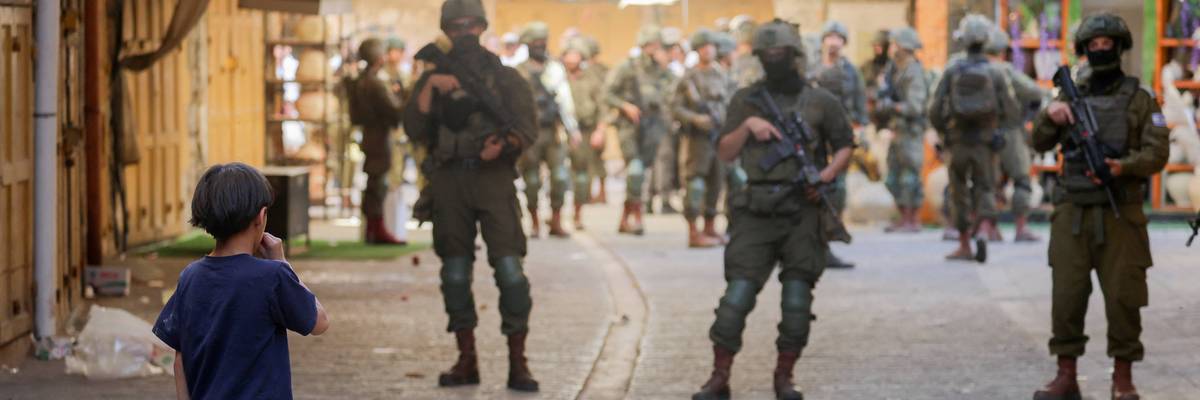
A Palestinian boy stands in an alleyway as armed Israeli soldiers stand guard in the occupied West Bank on June 13, 2026.
(Photo by Mosab Shawer / Middle East Images / AFP via Getty Images)
Obliterating Gaza’s Children: The Damning UN Report
By late 2024, the testimonies of health professionals on location indicated that the deaths of many children in Gaza were not just collateral damage, but outcomes of deliberate, targeted actions.
The testimony of Dr. Feroze Sidhwa, a young American trauma and general surgeon who had volunteered in Palestine including the European Hospital in Khan Younis, was particularly compelling.
“I’ve seen violence and worked in conflict zones,” Sidhwa said. “But of the many things that stood out about working in a hospital in Gaza, one got to me: Nearly every day I was there, I saw a new young child who had been shot in the head or the chest, virtually all of whom went on to die.”
The statement of Dr. Sidhwa, who subsequently became one of the endorsers of The Obliteration Doctrine, was supported by dozens of other remarkable and courageous medical volunteers in Gaza. And these testimonies, in turn, have been supported by many reports of multiple international NGOs and multilateral organizations.
So, the latest report of the UN Independent International Commission is hardly new. Nonetheless, it is among the most consequential documents to emerge from the Gaza war. Its conclusion is stark: Israeli authorities and security forces have deliberately targeted Palestinian children, actions that the Commission argues constitute genocide, crimes against humanity, and war crimes.
The Commission’s findings
The Commission’s report concludes that the deliberate targeting of Palestinian children is not incidental collateral damage but part of a recurring pattern of conduct. In line with the Genocide Convention, it argues that such actions are a key indicator of genocidal intent because they strike at the future existence of the Palestinian people.
According to the inquiry, more than 20,000 Palestinian children were killed between October 2023 and October 2025, representing roughly 30 percent of all fatalities, while over 44,000 were injured. Even after the October 2025 ceasefire, children reportedly continue to be killed and maimed.
The Commission cites cases involving sniper fire, quadcopter drones, precision-guided munitions, and high-yield bombs used in densely populated civilian areas. It argues that the nature of these weapons systems often allowed operators to identify their targets, including whether they were children.
Israel has rejected the findings as biased and defamatory.
Regardless of political positions, the significance of the report lies in its accumulation of evidence, legal analysis, forensic testimony, and witness accounts. It represents one of the most comprehensive international investigations yet conducted on the impact of the war on children.
It is a condemnation that casts a long dark shadow over the entire Israeli war government and its international collaborators, arms suppliers and financiers.
Children and the logic of genocide
In The Obliteration Doctrine, I showed that modern warfare in Gaza evolved beyond traditional military objectives toward the destruction of the social foundations of Palestinian existence. The Commission’s findings reinforce this interpretation.
Historically, genocide scholars have emphasized that attacks on children occupy a unique place in genocidal campaigns. The 1948 Genocide Convention identifies not only direct killing but also the infliction of conditions calculated to destroy a protected group. In Gaza, famine served the same genocidal function as starvation in the Warsaw ghetto.
Children embody demographic continuity, cultural reproduction, and collective future. Consequently, systematic violence against children has appeared repeatedly in cases later recognized as genocide, from the Armenian genocide to Rwanda.
The Commission explicitly states that targeting children attacks “the very capacity of the Palestinian people to exist and determine their future.” Its findings connect killings to broader patterns: destruction of schools, hospitals, pediatric facilities, neonatal care units, food systems, and water infrastructure.
That’s the ultimate objective: the genocide and ecocide of Palestine, its culture and children. Israel’s devastation of Lebanon follows in the footprints.
From an empirical perspective, the cumulative effect is measurable. Public-health research consistently demonstrates that childhood exposure to mass violence produces lifelong deficits in physical health, educational attainment, psychological resilience, and economic productivity.
Israel did not triumph in Gaza. Moral darkness did.
Human cost beyond death statistics
Death tolls alone understate the catastrophe. The Commission reports more than 44,000 wounded children.
Gaza now reportedly has one of the world’s highest concentrations of child amputees. Thousands face permanent disability from burns, blast injuries, spinal trauma, vision loss, and neurological damage. Worse, Israel has often denied treatment to thousands of Gazans who lost limbs in Israeli attacks.
Research from conflicts in Syria, Iraq, Afghanistan, and Bosnia demonstrates that severely injured children often experience decades of adverse outcomes.
Rates of post-traumatic stress disorder, depression, anxiety disorders, and developmental impairments can remain elevated throughout adulthood. Educational interruptions reduce lifetime earnings. Family structures collapse under caregiving burdens.
The Commission also documents starvation, disease outbreaks, displacement, and collapse of medical services. Such conditions affect not only present survival but the health of future generations through malnutrition, impaired fetal development, and maternal health crises.
The result is not merely a humanitarian emergency. It is the systematic destruction of human development on a societal scale.
Hind Rajab, the voice that refuses to disappear
This tragedy is symbolized by the short life and unwarranted execution of six-year-old Hind Rajab.
Trapped in a vehicle with relatives during military operations in Gaza, Hind’s desperate phone calls became known worldwide. Audio recordings captured a terrified child trapped in a car in Gaza, pleading for rescue while surrounded by the bodies of family members.
The story is depicted by a Venice-awarded 2025 docudrama by Kaouther Ben Hania about the young girl, whose desperate calls for help to the Red Crescent were recorded and went viral.
Rescue efforts reportedly failed, and Hind was later found dead. The Commission specifically references the case as emblematic of broader patterns under investigation.
Historically, certain victims become moral symbols because they crystallize a larger reality. During the Vietnam War, the photograph of Kim Phúc became such a symbol.
Hind Rajab has become one of the defining voices of Gaza because her case transforms abstraction into human reality.
Statistical discussions of thousands of deaths become impossible to separate from the image of a frightened child waiting for help that never arrived.
High technology and moral decay
One of the most troubling aspects of the Commission’s report is the relationship between technological sophistication and ethical collapse.
Israel possesses some of the world’s most advanced military technologies, including AI-assisted targeting systems, drones, surveillance platforms, precision-guided munitions, biometric monitoring, and integrated battlefield intelligence.
In theory, such capabilities should reduce civilian casualties by improving discrimination between combatants and noncombatants.
Already in The Fall of Israel, two long years ago, I showed that precisely the reverse has taken place. Despite all the official rhetoric of “targeting,” the Palestinians in Gaza were hammered for months by indiscriminate bombing, as even the U.S. intelligence community acknowledged already in late 2023.
In line with the Obliteration Doctrine, modern technology – AI-amplified bombing, or alcocide – was not deployed to optimize precision-targeting. Rather, it was used to maximize deaths. The execution of innocent civilians, particularly children, was no longer just collateral damage, but the tacit objective.
Even as these realities became known, that did not halt bombing, which prevailed over months despite official indignation. The maximized mass atrocities slowed only when the arms transfer supply chains could no longer satisfy the demand.
The Commission concurs. It points to incidents in which advanced systems allegedly enabled more precise killing rather than greater protection. Precision technology does not inherently produce ethical outcomes; it amplifies the intentions guiding its use.
In The Fall of Israel, this was one of the central themes. Technological superiority cannot compensate for moral deterioration. States may achieve unprecedented operational efficiency while simultaneously eroding the ethical restraints necessary for legitimate military conduct.
That’s the rotting moral swamp where the international community stands today.
The cost to Israeli society and soldiers
The consequences do not end with Palestinian victims. When perpetrators are done with their victims, they act out their moral ambivalence on themselves and their loved ones, one way or another.
A growing body of clinical evidence from military psychology demonstrates that participation in, witnessing of, or exposure to violence against civilians, especially children, can generate profound psychological injury among soldiers themselves.
This is what trauma centers in Israel know only too well (and what the government struggles to suppress from the media). The men who return from the indiscriminate killing fields of Gaza – and increasingly Lebanon – are no longer men. They are walking time bombs.
When you are expected to kill without any moral consideration, you continue killing: if not others, then yourself. Research on U.S. veterans from Iraq and Afghanistan has identified high rates of PTSD, depression, substance abuse, suicide risk, and what clinicians increasingly term “moral injury” – psychological damage resulting from participation in, failure to prevent, or witnessing acts that violate deeply held moral beliefs.
Studies consistently show that moral injury can be more persistent than fear-based trauma because it attacks personal identity and ethical self-understanding.
Prolonged occupation and repeated campaigns of collective punishment have contributed to a process of extraordinary social brutalization within Israeli society. The concern is not merely political polarization but normalization of violence. When civilian suffering becomes routine, moral thresholds shift.
History offers sobering parallels. Colonial wars in Algeria, Indochina, and elsewhere often left lasting psychological scars not only on the colonized but on the societies conducting the campaigns.
That’s what happens when the living dead return home.
If Gaza becomes the new norm
The broader international implications may be even more alarming. If the deliberate targeting of children becomes normalized, the consequences extend far, far beyond the Middle East.
International humanitarian law depends fundamentally on protecting civilians, especially children. If powerful states can openly disregard these norms without meaningful accountability, the deterrent effect of international law weakens everywhere.
Empirical evidence suggests that impunity encourages repetition. The failures to prevent atrocities in Rwanda, Bosnia, and Darfur contributed to future violations by signaling weak enforcement. Conversely, successful accountability mechanisms have historically reduced recurrence.
The risks include greater regional radicalization, transnational terrorism, refugee flows, intensified great-power rivalry, erosion of international institutions, and the spread of increasingly unrestricted warfare.
In The Obliteration Doctrine, I warned repeatedly that what happened in Gaza won’t stay in Gaza. The Strip became a laboratory for new forms of warfare later exported elsewhere.
The Commission’s findings raise precisely that concern. If the systematic destruction of children, schools, hospitals, and civilian infrastructure becomes accepted in one conflict, future belligerents may invoke the precedent.
The ultimate question raised by the report is therefore not only what happened to Gaza’s children. It is whether the international community is willing to preserve the principle that children remain beyond the reach of war itself.
For if that principle fails in Gaza, it will not survive elsewhere.
The original version was released by Informed Comment (US) on June 26, 2026.
JUNE 27. 2026
An unprecedented legal complaint has been submitted to the Warsaw prosecutor regarding the role of Polish state-owned company Nitrochem in supplying TNT for Israel’s key tools of genocide. The step could not only interrupt a hugely strategic component in the supply chain for genocide but also help end Polish state complicity in crimes against humanity.
Yesterday, three international organizations, the Hind Rajab Foundation, the International Federation for Human Rights and the European Legal Support Centre, filed a criminal complaint against representatives of Nitro-Chem, a state-owned company based in Poland and the largest producer of TNT in NATO, for alleged involvement in international crimes against Palestinians in Gaza.
In parallel, three leading Palestinian human rights organizations: Al-Haq, Al-Mezan, the Palestinian Centre for Human Rights, in addition to individual survivors of the genocide, will become parties to the proceedings against Nitro-Chem. Their submissions will detail the extent and scale of the destruction caused in Gaza.
The Supply Chain
The complaint is largely based on the report The Missing Ingredient: Polish TNT published by three research organizations — the Palestinian Youth Movement, Shadow World Investigations and the Movement Research Unit — drawing on Open-Source Intelligence.
According to the report, Nitro-Chem is the largest TNT producer supplying NATO and the EU, and a key supplier to the United States military. Polish officials have publicly stated that roughly 90% of the TNT imported by the U.S. comes from Poland. The report further alleges that Polish TNT has become an essential component in the production of large aerial bombs, particularly the Mk 80 series and BLU-109, as well as 155mm artillery shells.
These munitions are high-explosive, wide-area-effect weapons with a lethal radius that can extend across hundreds of meters. The artillery projectiles are also unguided. Their use in densely populated civilian areas breaches fundamental principles of international humanitarian law, on distinction, proportionality and precaution in attacks. Yet, Israel has reportedly employed tens of thousands of these types of munitions across Gaza, including in densely populated areas.
The report documents Nitro-Chem’s central role in this supply chain. In a 2018 presentation cited in the report, General Dynamics, the US company producing these munitions, described Nitro-Chem as “the only qualified TNT source for U.S. Bomb Programs.” The original 2016 contracts have been renewed and expanded repeatedly, even after October 2023 and with a new deal in April 2024, followed by another contract signed in April 2025 worth approximately US $310 million.
The report estimates that, between October 2023 and July 2024, the US transferred to Israel at least 14,000 Mk 84 bombs, 6,500 Mk 82 bombs and 1,000 BLU-109 bunker-busters. These figures are likely an undercount, given that some 30,000 one-ton bombs were dropped on Gaza between October 2023 and August 2024. Separately, the report documents that Nitro-Chem sold explosives, including TNT and RDX, directly to Israeli arms manufacturers such as IMI, Elbit, and Rafael.
The report’s findings have reshaped the demands and strategy of the anti-genocide movement in Poland. Since its publication, stopping the TNT supply chain and ending Polish complicity in the ongoing genocide against Palestinians in Gaza and in other international crimes have become key demands of the local Embargo Now! campaign (Embargo Teraz!).
The Complaint
Debates have since ensued in Poland over whether Nitro-Chem can be held accountable for selling TNT to the US, where it is mostly used to manufacture wide-area-effect munitions, including the Mk 80 series and 155mm artillery shells, which are likely transferred from the US to Israel and used against Palestinians in Gaza.
A coalition of legal organizations argues that this supply chain may engage criminal liability. In the coalition’s opinion, the evidence contained in the report and complemented by open-source investigations establishes that the TNT produced by Nitro-Chem served as an essential component for the production of aerial bombs (especially the Mk 80 series and BLU-109 bombs) and artillery shells manufactured in the US since at least 2004.
The coalition further submits that the US subsequently transferred these specific types of munitions to Israel for use in its military operations, particularly during its genocide against the Palestinians. Additionally, records confirm that Nitro-Chem exported TNT and other explosives directly to Israel.
Given the long-term and continuous supply lines between Nitro-Chem and the US, and the US and Israel, it is highly likely that Polish TNT was incorporated into the explosive ordnance manufactured by the US and deployed by Israeli forces during the bombardment of Gaza. Evidence confirms that Israel utilized these specific munitions to conduct systematic attacks against densely populated civilian areas — a campaign widely recognized by international bodies as constituting genocide, war crimes, and crimes against humanity — such that the continued provision of these critical raw materials by Nitro-Chem, whether via the US channel or through direct sales, may amount to aiding the perpetration of grave international crimes.
Polish criminal law punishes genocide, war crimes, and crimes against humanity (Articles 118, 118a and 122–126 of the Criminal Code), as well as anyone who aids such crimes.
The submission stipulates that a professional explosives manufacturer cannot credibly claim ignorance of these risks considering that Israel’s use of US-made bombs and artillery shells against the population of Gaza has been a matter of public record. Moreover, Nitro-Chem’s contracts with the US arms industry were renewed and expanded even after the International Court of Justice (ICJ) recognized a plausible risk of genocide in January 2024.
The supply of TNT continued after the International Criminal Court (ICC) issued arrest warrants against Israeli leaders for international crimes in Gaza in November 2024. Supplies also continued despite successive UN findings—including the UN Commission of Inquiry findings, released in September 2025 – that Israeli authorities and security forces have committed and are continuing to commit genocide against the Palestinians in the Gaza Strip.
The complaint argues that continuing to supply the material, while foreseeing and accepting these risks, may constitute aiding the commission of international crimes. The notifying parties call for those acting on behalf of Nitro-Chem to be investigated.
“A watershed moment”
Activist Ewa Jasiewicz, who took part in last autumn’s Global Sumud Flotilla to Gaza, told Labour Hub: “This strategic legal action marks a watershed moment and challenge to states for their constant failure to comply with their obligations under international law, laws which in large part were created in response to the genocide and crimes against humanity committed in living memory in Poland.
“We can still stop Israel’s genocide – which we know will not stop with Gaza, where around two million people are still alive, still fighting for survival and stay rooted in their land. It will continue throughout the West Bank and Jerusalem and historical Palestine and wider Levant region – all made possible with international state and corporate complicity. But it’s all defeatable by the power of our unified, collective, tactic-diverse social movements all over the world in solidarity with liberation for Palestine and all peoples fighting colonialism, racism, fascism and ecocide in all its forms.”
Read the report The Missing Ingredient: Polish TNT
Image: c/o Bryn Griffiths
25.06.2026, dpa

Photo: Daniel Karmann/dpa-Pool/dpa
French-British author and human rights lawyer Philippe Sands will be awarded the Peace Prize of the German Book Trade for his "unwavering defence of international law," the German Publishers and Booksellers Association announced on Thursday.
Sands, 65, regularly serves as counsel at the International Court of Justice (ICJ) in The Hague.
He was chosen as the winner for his efforts to champion "justice, peace and the unwavering defence of international law," the jury said in a statement, describing Sands as "one of the most important intellectual voices of our time."
"Descended from Holocaust survivors, he draws on his own family history to trace the emergence of this body of law, illuminating the experiences that lie behind the legal concepts of 'genocide' and 'crimes against humanity'," the jury said.
The prestigious award, which carries a prize of €25,000 ($28,382), honours individuals who have contributed to the realization of the idea of peace through literature, science or the arts.
Last year the prize went to historian Karl Schlögel. One of the most prominent recipients in recent years was the writer Salman Rushdie.
The German Publishers and Booksellers Association - the professional organization representing the trade - has awarded the prize since 1950.
This year's award ceremony will take place on October 11, at the close of the Frankfurt Book Fair.
Sands was born in London in 1960. Besides working as a lawyer, he is a professor of international law at University College London as well as a visiting professor at Harvard Law School.
He has worked on "several landmark cases in international law," including regarding former Chilean dictator Augusto Pinochet, according to the jury statement.
He has also advocated for the rights of Palestinians and the Rohingya, a persecuted ethnic minority in Myanmar.
Together with other legal experts, he campaigned to "establish ecocide as a criminal offence before the International Court of Justice," to classify the destruction of ecosystems as an offence punishable under international law.
Besides legal literature, Sands has also published an array of literary non-fictional works which link personal life stories to the big questions of international law, the foundation said.
Two criminal cases in which he was involved at the ICJ form the basis for "The Last Colony: A Tale of Exile, Justice and Britain's Colonial Legacy" (2022) and "38 Londres Street: On Impunity, Pinochet in England and a Nazi in Patagonia (2025)."
Inside Albania’s Youth-led ‘flamingo Revolution’

Just before dusk, a crowd began marching down Dëshmorët e Kombit Boulevard in Tirana, Albania’s capital, toward Prime Minister Edi Rama’s office. As they approached, the sound of drums and their chants calling for “revolution” got louder. Once they arrived, the national anthem echoed throughout the avenue.
Since May 31, protesters have been setting off every single day at 6 p.m. from Skanderbeg Square to take part in what has been dubbed the “Flamingo Revolution.” The iconic bird was chosen because of its connection to the natural protected area of Vjosa-Narta in Zvernec, where plans for a $1.4 billion luxury resort linked to Jared Kushner, an American real estate mogul and Donald Trump’s son-in-law, have caused fierce opposition. The project’s scale would require ecocide, endangering thousands of species in Europe’s last wild river delta. The lack of transparency and corruption has also riled up the local population, who were fenced off from their own land without notice.
The initial protests in Zvernec started as a dispute between residents joined by environmental groups against the developers who fenced off the area and brought heavy machinery into an extremely sensitive ecosystem. However, the protests exploded when a resident was assaulted and dragged by a private security member in the presence of the police, who stood by without intervening.
Protesters tell me this is the first time they have felt hopeful that the system will change. With an estimated 100,000-200,000 people joining the protests on the weekend, this is the biggest nationwide movement the country has seen since the fall of Enver Hoxha’s communist regime. Protesters chant “Albania is not for sale” and “Rama quit” to the tune of “Seven Nation Army” by The White Stripes, reminiscent of U.K. football fans.
Previously, protests such as those that occurred in February 2026 amid a corruption probe into then-Deputy Prime Minister Belinda Balluku have been co-opted by opposition parties. Between 2018 and 2019, a student movement against sweeping privatization reforms of higher education prepared many young people to become more politically conscious. They were successful in forcing the government to drop tuition fees, but it ended there. This time, protesters are demanding much more.
As a youth-led uprising, for many it has become a form of socializing. “We are joking that we have replaced meeting for coffee with going to the protest as a hangout,” said Sara, a 23-year-old protester.
Olsi Nika, who heads the environmental group EcoAlbania, says that the current political system has alienated Gen Z-ers. “The majority of the protesters are young people who were raised with a progressive European mentality,” he explained. “So, how on Earth can you set up a formula that … is driven by a political elite that is still operating on the mentality of the old regime?”
While the movement has no definitive leadership, everyone helps however they can. One elderly protester brings free fruit, and another elderly couple hands out bottles of water. Another group of friends picks up litter from the streets. One of them, named Thea, says that they got together and decided to do this so the municipality’s street cleaners don’t have to bear the brunt of the government’s actions that people are protesting. “This is an injustice done to the Albanian people. Our land is being sold to foreign investors with no transparency, and we are being sealed off from it,” she explained.
Other volunteers have also set up a “kids’ corner” for those coming with their families. I often see three generations of the same family together in the square. One of them is 42-year-old Elvira. “This is all about young people having a future in this country. I am here because of them, for my daughter,” she said.
Protesters are taking pride in mobilizing with dignity and unity like never before. Sidorela Vatnikaj, an activist working across social issues, says that she joined forces with others from a multitude of groups to support the protests with logistics. She even spent money out of pocket to set up a sound system and invite members of the public to come and speak without having to be on a list. Everyone — young, old, established activists, ordinary people, city residents and rural dwellers — has stepped forward to voice grievances and motivate the crowds to not give up on their cause.
Every evening, new people address the crowd. The 14th day featured people from the diaspora who had traveled back home to share their stories. They talked about the hardships of emigration and that they won’t stand for a country that forces its young people to leave. Vatnikaj says that many came in on a one-way ticket because they saw for the first time hope that things might change.
Similarly, Maya, a veterinary doctor in Sweden, said she used her annual leave to come back so she could protest with her people in Tirana. Elsewhere, across all major cities with sizable Albanian populations, diasporas and their allies have been marching in solidarity.
Sara also tells me that solidarity from abroad has overjoyed people in Albania. “Gen Z-ers are all fed up with their politicians and the system,” she said. “That’s a big thing we have in common. We see each other, how we have been rising, and we give each other hope.”
People connecting on the internet have been essential in propelling mobilizations.
“The movement is organized purely online,” said Gent Fetahaj, a tourism expert and protester. He shows me on his phone how the protest location has been geotagged on Google Maps as “Flamingo Revolution.” The reviews are all five stars.
Social media wasn’t only essential in organizing the protests because Gen Z is very digitally-oriented, but also because there is diminishing trust in traditional media. Marijola, a biology student who has joined the protests with classmates from her university, created online groups and chats with friends to share information and coordinate. “Using social media avidly was the only way to find out about the protest since mainstream Albanian media did not even report on it until much later.”
This is the case for Alis, a student who has been using her social media platforms to talk about the protests and the situation at large. “Social media became a necessity in Albania because the press here is not to be trusted,” Alis said. “Our local media, which we pay license fees to, did not cover our protests for more than five days until they had no option. So, we rely on alternative channels for informing each other and organizing.”
Protest humor has also become a defining characteristic of this movement as many attendees use meme references and pop culture to express their dissent. Every day at the protests feels like an unofficial competition about who will come up with the funniest protest sign for the day. Some of them poke fun at Ivanka Trump for claiming in an interview that she “discovered” Sazan island — where Kushner plans to develop a luxury resort with his company Affinity Partners — and climbed it barefoot.
Artists and creative individuals have also been banding together to create compelling visuals for the protest. “We are trying to convey our dissent through the beauty of art,” said Argita Dulaj, an urban planner and architect who was holding a placard reading “Hands off Vjosa-Narta.” She was at the protest because the government is acting arbitrarily, taking advantage of illegitimate means to build over protected areas without transparency or public consultation.
Albania transitioned to democracy only 35 years ago, and it has been under a two-party system that concentrated power in a few hands. Incomplete transitional justice after the fall of the communist regime has caused many unaddressed rifts that affect society today and are now becoming rallying points at the protests.
One of those issues is the fear of the state apparatus and land grabs by opportunists looking to exploit legal loopholes. “This is not the democracy we have been dreaming of. This anger has been building for a long time,” Vatnikaj said.
The state is trying to intimidate people by having unidentifiable plain-clothed police among the protesters who muscle people around. People also face threats of losing employment and legal troubles.
Almost everyone I talked to identified fear and censorship as key challenges to overcome. “They have killed our fear, and we have nothing to lose,” Alis said. “We are not scared anymore of the propaganda. We want to get rid of patronage politics and the intimidation.”
The concerns fueling the movement are evolving beyond what initially sparked the protests. People bring up material concerns, dilapidated infrastructure and public services, as well as increasing authoritarianism and corruption as their motivation. “We want the fall of the whole system. This government is only benefiting the oligarchs, and the divisions between the rich and poor are getting bigger,” Alis said. As I turn around on my left, a Wolt driver has plastered a sign on his moped that reads “economist by profession, delivery driver by need.”
Dulaj wants to see Law No. 21/2024 repealed, which has amplified the prime minister’s power to fast-track development projects in protected areas. But she also wants to see the whole government purged of corruption. “We have really big problems in Albania right now, and the kind of investments they make in tourist areas will solve none of that,” she said.
She has not migrated, because she wanted to use her knowledge and skills to contribute to her country, but opportunities are diminishing. “Our government invites foreign companies and their own people to work on all kinds of high-budget projects, and all they expect of us is to be cleaners and bartenders in their resorts,” she said. “As an architect, I learned that what makes you good at this job is staying in touch with the community you are serving. I want to use my skills and knowledge to help my country, not to work for billionaires in their resorts.”
For the movement to be successful and sustain itself, the demands will need to become more targeted.
Fetahaj explains that because the protected area is an issue that transcends borders, due to its significant biodiversity and its connection to the UNESCO-recognized Vjosa Valley Biosphere Reserve, it has attracted international pressure. If the protests were solely based on domestic problems, they wouldn’t have drawn the same attention. “This issue is linked to EU ascension and that’s the strategy we need to follow to see tangible results,” he said. “We should sharpen our demands into a few concrete points while working towards greater change. Chances of being successful are higher that way. I hope that the young people … will not tire until these demands are met.”
Evidently, the European Union’s recent call to the Albanian government to halt the construction in Vjosa-Narta has given people a major win. Construction at the site has stopped for now, but no one knows if this will last, so activists keep monitoring the situation.
Nika, echoing these points, placed the environmental issue at the center. “We insist on the environmental aspect because it’s about our dignity and identity as a country. That’s what our nature represents,” he said. “It’s tied to our history as a people, and if these values are gone, we will have lost connection with who we are. If the protests don’t produce clear political demands and all this energy is not put into producing a clear political plan, then we will have to wait another 30 years until the next student protests erupt.”
Vatnikaj is surprised by people’s readiness to protest. A really big weight has been shifted, she says, because people have not only become more politically conscious, but they feel like they are not alone anymore. “We have become stronger, united.”
Similarly, Marijola says that they are in this together. “Even though our government is not taking us seriously, we are the future of this country, and we will shape it together ourselves.”
As for Alis, protesters have already succeeded just by the fact that this is the first time in a long while that people have overcome their fears and come to the streets. “We are not turning back.”
