Saturday, May 02, 2020

THE PEACOCK ANGEL IN THE SPRING 
By E. S. DROWER 

Lecture given on July 31, 1940, 
Brigadier-General Sir Percy Sykes, ly&J.E.,
C.B., C.M.G., in the Chair.

I had an introduction from a Yezidi friend to a young man there,
Rashid ibn Sadiq, and my first call was on him. His father was away
in the Jebel Sinjar, so Rashid did the honours, preparing tea for me
himself as I sat under the pergola in his courtyard. I told him what
I wanted, and he promised to help in every way that he could, and was
as good as his word. He sent there and then for one of the qawwals,
and that evening two of them visited me. I must explain what qawwals
are. They are the third grade of the Yezidi priesthood, and it is they
who travel with the sanjak, the image of the sacred peacock. Their
chief duty is to chant, and their chants are transmitted from father to
son and never written down. They must also be able to play the
shebab and the daff, the sacred flute and tambour. Above the qawwals
are the pirs, and above these the shaikhs. All three orders are heredi¬
tary, and a member may only marry within his own rank. A fourth
hereditary order is that of the faqlrs, who are ascetics and wear next
their skins a black woollen tunic which is considered very holy, also a
sacred thread and belt. Then there is a lay order, the kocheks, who
wear white and are often made custodians of the shrines.
I became friendly with the qawwals, particularly with one of them
who had served in the Levies when he was young. Ever since then
he has polished his teakettle and Primus with Brasso and talked of the
English. When he joined the force he was told that he must cut off
his long hair and beard. He was horrified, and was taken before an
English officer. He explained to this officer mat a qawwal may not
cut his hair, and the Englishman, he told me, " asked me about my
THE PEACOCK ANGEL IN THE SPRING 393
religion, and talked to me as a friend." He was allowed to keep
his hair.
Rashid sent me a Yezidi midwife. She was far from clean, and
her hair straggled over her old face. People called her Mama, or
Hajjia, but my name for her was Sairey Gamp. From her I heard
about childbirth and the customs of Yezidi women at such times. She
took me to a Moslem patient directly the baby arrived, and to a Yezidi
woman who had just had a miscarriage, and at both I learnt a good
deal. No Yezidi woman obliged me by having a baby, but I heard
what happened both from a Yezidi woman and from Sairey. A visitor
told me one day that it was believed in the village that I wanted to take
a photograph of a woman having a baby because women in England
did not have their babies naturally, but by surgical operation. She
brought her daughters to see me. One was a tattooist, and as I had
examined many of the tattooings on Yezidi women I was glad to hear
from her exactly how it was done. A thick paste is made from sheep's
gall, black from olive-oil lamp smoke, and milk fresh drawn from
the breast of the mother of a girl-child if the baby is a boy the punc¬
tures fester. The design is drawn in this and then pricked in with a
needle, or two needles tied together. I noted the most common designs,
amongst which were a comb, the sun, the moon, a human figure called
" the doll," and various forms of cross.
Another of our friends was the headman of the village, a farmer,
who told me many interesting things for instance, of the dance per¬
formed when there is a drought. A boy and girl dance round die
village, and the villagers throw water on them.
We became friendly, too, with a delightful old lady of shaikhly
family, Sitt Gule, who had had a tragic life. She was living here in
exile, and her elder son was in prison because he aided some Yezidi
youths to evade military service by crossing the frontier from the Jebel
Sinjar into Syria. The younger son was imprisoned, too, because a
few months before he had stabbed his sister, who wished to marry out¬
side her caste. She was the only daughter, and he had murdered her
in her mother's presence. Sitt Gule was a very dignified old woman,
who always wore white, and had a hard struggle to keep the household
going, for it consisted of three daughters-in-law, eight children and
two servants. She was broken-hearted about her elder son, and begged
me to help to get him released.
Sitt Gule took me one day to see the shrine of her ancestor, Shaikh
Sajaddin. She told me as we came away, " The angel Gabriel is of our
394 THE PEACOCK ANGEL IN THE SPRING
family, too," in much the same tone as someone might mention that
they were distantly connected with the Duke of Norfolk. The ex¬
planation is that the companions of Shaikh 'Adi are by legend sup¬
posed to have been incarnations of angels, so that she could, quite
legitimately, claim angelic descent.
I must stop telling you about our friends in Baashika and describe
the village itself. Layard mentions the cleanliness of the Yezidis, and
I endorse every word he said. It was a delightfully clean village. No
rubbish was thrown down in the streets, there were no dead dogs or
donkeys left to decay, and, above all, there was no litter. Because few
could read there was no newspaper of any kind, and when one went to
the bazaar, one wrapped one's purchase in a kerchief. There was no
post-office, no telephone or telegraph and no radio; in fact, it was the
most blessed escape from the war that you can imagine. The scent of
flowers and herbs blew through the streets from end to end, and the
spring grass came right up to the village. When we climbed the hills
we could see the plain for miles, and just below, the mound of Tel
Billi, where the Americans were excavating till a year ago.

READ THE REST HERE


Gurdjieff, G.I. - The Four Ideals. A Contemplative Exercise.
George Ivanovich Gurdjieff (/ˈɡɜːriˌɛf/; 31 March 1866/14 January 1872/28 November 1877 – 29 October 1949) commonly known as G. I. Gurdjieff, was a mysticphilosopherspiritual teacher, and composer of Armenian and Greek descent, born in Alexandrapol (now Gyumri), Armenia.
Gurdjieff taught that most humans do not possess a unified
consciousness, and thus live their lives in a state of hypnotic "waking
sleep", but that it is possible to transcend to a higher state of
consciousness and achieve full human potential. Gurdjieff described a
method attempting to do so, calling the discipline "The Work"(connoting "work on oneself") or "the Method".
According to his principles and instructions,
Gurdjieff's method for awakening one's consciousness unites the methods of the fakir, monk and yogi, and thus he referred to it as the "Fourth Way".
The cult of the Peacock Angel [microform] a short account of the Yezîdî tribes of Kurdistân

by Empson, Ralph Horatio Woolnough, 1894-; Temple, Richard Carnac, Sir, 2nd baronet, 1850-

Publication date 1928
Topics Yezidis, Satanism
Publisher London : H.F.


Malak-Tāwūs: The Peacock Angel of the Yezidis, 
by Garnik Asatrian and Victoria Arakelova, 
in 37 pdf pages,
 from Iran and the Caucasus,
 Vol. 7, No. 1/2 (2003), pp. 1-36. 
Uploaded by Robert Bedrosian.


The Religion Of The Peacock Angel The Yezidis And Their Spirit World
by Garnik S. Asatrian and Victoria Arakelova


Preface vii

Part I: The one god 1
1 Malak-Tāwūs: the leader of the triad 9
2 Sheikh ‘Adi 37
3 Sultan Ezid 45
Part II: The Yezidis’ pantheon and the syncretic features of
their religion 51
4 The Yezidi minor deities, saints and holy men 53
5 Aspects of nature and celestial bodies in the Yezidi tradition 109
6 Yezidi religious syncretism 121
 Conclusion 133
Bibliography 135
 Index 145

FROM THE PREFACE


The main religious centre of the Yezidis is situated in the valley of Lalish, the Sheikhan region (north Iraq), where the sanctuaries of most of the Yezidi saints and holy men are located. It is also the centre of Yezidi traditional learning. The seat of the Yezidis’ spiritual leader, the Prince or mīr, is in the nearby village of Ba‘dre. The religion exclusive to the Yezidis constitutes one of the most enigmatic and least investigated phenomena of the Near Eastern non-dogmatic milieu. But it has beckoned increasing attention from scholars of religion studies, certainly more than ever before over the last three decades. Despite multiple references by travellers, missioners, military officers and intellectuals to the existence of this mysterious people, as well as to a number of their peculiar features, customs and rites, more or less fundamental researches on the Yezidi history and religion only started appearing from the 1970s. The close character of this esoteric community and difficulties in interpreting its religious lore – the primary source for the study of the tradition – still remain serious obstacles for scholars of the field. Yet the ongoing publication and translation of the Yezidi lore, its proper interpretation and commentaries – both by traditional connoisseurs and scholars of Yezidism – have facilitated a gradual understanding of the essence of its complicated religious doctrine. Yezidism is a unique phenomenon, one of the most remarkable illustrations of ethno-religious identity, centred on a religion the Yezidis call Sharfadin (see pp. 29–30). The peculiarities of this religious system are not only limited to its syncretism, some elements of which can be traced in Sufism, a number of extreme Shi‘ite sects, substrate pre-Islamic beliefs, Gnosticism and other related traditions surviving from the ancient world, but they also include specific features solely characteristic of the Yezidi faith which define the belonging of its followers to the Ezdikhana (Ēzdīxāna) − the esoteric community of the Yezidis itself. In this case, when providing characteristics of Yezidism in its current state, it is quite legitimate to speak of the unity of both the Yezidi religious identity and Yezidi ethnicity. Historical analyses of various ethno-religious communities in the Middle East and Central Asia have shown that their development has a clearly expressed vector − the drive for ethnicity.3 The dynamics of the development of ethno-religious communities − from religious identity to ethno-religiousness and, finally, to claims of special ethnicity in the modern context − look to be ix preface emerging as a coping stone, or at the very least a crucial paradigm, for explaining the ethnic vector in the development of any ethno-religious community in the long run. On this reading, the ethno-religious group in its process of establishment and development passes through several stages. First of all, it dissociates itself from its own prior religious surroundings, marking a new “dominant” around which a new syncretic doctrine is being formed. This dominant provides the basic religious specificity of the new community. Then a “closing” of the community takes place: a strict endogamy, indeed, becomes a guarantee of preserving the esoteric religious knowledge inside the community. (To a certain extent, endogamy is also determined by hostile surroundings, when outsiders impute the group with distorted doctrines and heresy.) It is specifically endogamy that distinguishes an ethno-religious community, that is, as distinct from any other esoteric group (mystical order and others) which one could join as a member by passing some ritual of initiation. And it is namely endogamy that defines the ethno-religious and thus, in the final analysis, the ethnic vector of the development of a new community whereby religion still remains the main differentiative indicator. The process of the formation of the Yezidis as a separate ethno-religious group took place in the period from the eleventh to the fourteenth century in the region of Sinjar in northern Iraq. The religious dissociation of the Yezidis from the local milieu took place in the very colourful religious scenery of Mesopotamia where different ideas of Islam and Christianity were interlaced with Gnostic ideas and local folk beliefs. In the tightly loyal surrounding of the Sufi ‛Adawīyya order, which became the core of a new community, there arose and developed a fundamentally new syncretic religious doctrine, and one curiously lacking a common dogma in the strict understanding of the term. By preserving a number of elements of mystical Islam, the Yezidis inhaled different and sometimes contradictory elements of many other religious streams in the region they inhabited. They were nourished by various marginal ideas found in their “fertile heretical” surroundings, distant from centres of orthodoxy. Some elements of Yezidism, however, are extremely specific, even unique in the whole new Iranian expanse, so that it becomes impossible to find echoes of them in other doctrines (even if typological parallels are commonly available). These peculiarities turn out, in fact, to be fundamental for Yezidi religious ideology, and have emerged as main indicators of their selfconsciousness, defining the Yezidis and the conceptions of Yezidism as they are in an assortment of shibboleths

E. S. Drower - The Book Of The Zodiac


https://archive.org/details/e.-s.-drower-the-book-of-the-zodiac/page/n1/mode/2up

FROM THE PREFACE

Like most of the longer Mandaic manuscripts, the Book of the
zodiac is a miscellany, a group of manuscripts of varying source and
date, the main subjects being astrology and omens. At every new
year Mandaean priests meet together and peruse its pages carefully
in an endeavour to pierce the veils of the near future for themselves
md the community. In thus doing they carry on traditions of the
cowtry, for in ancient Babylon on the eighth and eleventh days of
the New Year Festival, ceremonies to “ fix the fates ” of the coming
year took place in a part of the Nebo-temple.1 In times of personal
or national crisis, too, recourse was had to priest-astrologers and omen
readers, and 80 when during recent years Mandaean priests turned
anxiously the pages of the Book of the Zodiac they were following the
example of those who lived on the same soil thousands of years ago
and, in days of stress and war, hoped to and in the stars a promise
of peace and better times.
In form, the Sfar Malwdia is a kurasa, that is, a set of unbound
pages kept within a pair of stiff covers. The last word of a page is
repeated at the beginning of the first line of the next. My own
manuscript was completed by the copyist in the year 1247 A.H. A copy of
earlier date, 1212 A.H., in the Bibliotheque Nationale in Paris (library
reference number C.S. 26) was micro photographed for me ; and later
on, in Baghdad, J was able to make a word-for-word comparison with
a third copy dated 1350 A.H., lent me for the purpose by a Mandean
priest. Reference to these three MSS. is made respectively under
“ D.C. 31 ” (my own), “ C.S. 26 ” (the Paris MSS.), and “ A ” (the
priest’s copy). Access to German  libraries was, unfortunately, impossible.
My translation, therefore, is based on three copies. All three have
mistakes, miscopyings, and omissions, but they are not of importance
and in most cases it is possible to correct by comparison. Trifling
differences are only noted when they may affect sense or construction.
The nucleus around which the fragments were originally assembled
k, most probably, the last segment. It is racy in style and rich in
idiom.


Ethel Stefana Drower née Stevens (1 December 1879 – 27 January 1972) was a British cultural anthropologist who studied the Middle East and its cultures. She was considered the primary specialist on the Mandaeans, and the chief collector of Mandaean manuscripts.
She was a daughter of a clergyman. In 1906 she was working for Curtis Brown, a London literary agency when she signed Arthur Ransome to write Bohemia in London.
In 1911, she married Edwin Drower and after his knighthood became Lady Drower. As E. S. Stevens, she wrote a series of romantic novels for Mills & Boon and other publishers. In 1921, she accompanied her husband to Iraq where Sir Edwin Drower was adviser to the Justice Minister from 1921 to 1946. Her works include The Canonical Prayerbook of the Mandaeans (a translation of the Qolusta); The Secret Adam (Mandaeans); and The Peacock Angel (about the Yezidis). Among her grandchildren was the campaigning journalist Roly Drower.
The Mandaeans of Iraq and Iran: Their Cults, Customs, Magic Legends, and Folklore
by E. S. Drower (Author)
Publication date 1937
Topics Mandaeans, Gnosticism
Collection opensource
Language English
No anthropologist has conducted fieldwork among the Mandaeans, not even in recent decades and therefore Drower remains a singular figure. Scholars, students, and aficionados regard her book as the work that brings the people alive.
https://archive.org/details/themandaeansofiraqandirantheircultscustomsmagiclegendsandfolklore/page/n143/mode/2up


Ethel Stefana Drower née Stevens December 1879 – 27 January 1972) was a British cultural anthropologist who studied the Middle East and its cultures. She was considered the primary specialist on the Mandaeans, and the chief collector of Mandaean manuscripts.
She was a daughter of a clergyman. In 1906 she was working for Curtis Brown, a London literary agency when she signed Arthur Ransome to write Bohemia in London.
In 1911, she married Edwin Drower and after his knighthood became Lady Drower. As E. S. Stevens, she wrote a series of romantic novels for Mills & Boon and other publishers. In 1921, she accompanied her husband to Iraq where Sir Edwin Drower was adviser to the Justice Minister from 1921 to 1946. Her works include The Canonical Prayerbook of the Mandaeans (a translation of the Qolusta); The Secret Adam (Mandaeans); and The Peacock Angel (about the Yezidis). Among her grandchildren was the campaigning journalist Roly Drower.

E. S. Drower - Diwan Abatur. Progress Through The Purgatories


Ethel Stefana Drower née Stevens December 1879 – 27 January 1972) was a British cultural anthropologist who studied the Middle East and its cultures. She was considered the primary specialist on the Mandaeans, and the chief collector of Mandaean manuscripts.
She was a daughter of a clergyman. In 1906 she was working for Curtis Brown, a London literary agency when she signed Arthur Ransome to write Bohemia in London.
In 1911, she married Edwin Drower and after his knighthood became Lady Drower. As E. S. Stevens, she wrote a series of romantic novels for Mills & Boon and other publishers. In 1921, she accompanied her husband to Iraq where Sir Edwin Drower was adviser to the Justice Minister from 1921 to 1946. Her works include The Canonical Prayerbook of the Mandaeans (a translation of the Qolusta); The Secret Adam (Mandaeans); and The Peacock Angel (about the Yezidis). Among her grandchildren was the campaigning journalist Roly Drower.

PUBLISHED BY THE VATICAN PRESS 1960
PREFACE
In the year 1622 a Carmelite father, B. P. Ignatius, was dispatched by the Propaganda in Borne to the Nestorians of Mesopotamia, whilst in Basrah, he met with members of a sect who, as is their custom when’dealing with Christians, told him that their prophet was St. John the Baptist. Prom them he obtained a roll illustrated by curious drawings of beings which they described as angels or demons. On his return to Borne Ignatius published a treatise in Latin about this interesting group of heretics 1 whose ceremonies were at once like and unlike those of Oriental Christians, and whose creed was so strangely perverted and pagan. - The roll found its way into the Museo Borgiano in Borne where Julius Euting saw it in 1879 2 . Euting was deeply, interested and persuaded a friend, Dr. B. Pfdrtner, to photograph the manuscript. This photograph was published in Strasbourg in 1904, under the title “Mandaischer Diwan nach photographischer Aufnahme, von Dr. B. Pfoertner mitgeteilt yon Julius Euting It.was not translated. Early in my dealings with Mandaean priests in the marshes of Lower ‘Iraq I was shown a copy of the Diwan Abatur and after long negotiations, it was arranged that I should have the toll that I had seen after its owner had copied it for himself. The copy was.made with plrill and care and the original sent to me. Judging by the paper and other indications, my roll, D.C. 8,of my collection, is a]bout the same date as the manuscript taken to Borne by Ignatius. If either the Borgian manuscript nor mine is dated, although each has a long list of copyists, showing that the text was an ancient one. , A considerable part of the beginning is missing from the Boman roll, but I have been able to compare the remainder of the Borgian manuscript with my own. I discovered no other copy of the text in ‘Iraq, although, of course, other priests may have concealed possession of a copy since, in spite of the inferior and -childish quality of the com¬ position and mistakes due to constant recopying, it is looked upon as a precious and holy book. v The illustrations, archaic and suggestive of a Sub^st form of art, are identical in both manuscripts. The Subba are clever artists and craftsmen, but tradition dictates that, representation of celestial and infernal beings must follow a certain pattern. Drawings like these in the Diwan Abatur are found in the ritual rolls, so that we have here no childish inability to portray a subject, but deliberate convention of a very individual'order. A Subbi smith who drew naturalistic pictures for engraving on his silverwork, when asked by me to draw pictures of some celestial beings, produced similar 0(j^ geometrical-looking designs. ‘ In the following pages I have translated the word mafarta as purgatory ” instead of the literal “ place of detention ” or, as Lidzbarski translates “ Wachthaus ”. Since the mafarata are places where the sinful and impure are purged by punishment of sin and uncleanness, they are undoubtedly “ purgatories ”. The idea that the soul must pass through seven planetary spheres after death, shedding in its progress impure and earthly qualities connected astrologically with each of the seven planets, is familiar to the reader of Gnostic literature. In this Mandaean text, however, the rulers of the mafarata are not all planetary spirits. The planets Saturn, Jupiter, Mars, Mercury, Yenus, Moon and Sun have their mafarata, but so have V purely Mandaean beings such as Ptahil and his sons Bihram, Anufi, Hibil, Ginziel or Kanziel, Nbat, and Sitil; and the saviour-spirit, the personified Sunday. - - i The Puntanmcal nature of Mandaean religion, to which music, dancing, ornaments and coloured clothing are abhorrent, is evident throughout, and ancient tabus about women are reflected in heavy penalties for sexual impurity, witting or unwitting. Such rigid rules have helped, no doubt, to preserve the health and vigour of the race. Part of the text is one of many creation myths found in Mandaean literature. Through it, as in similar creation stories in the Ginza Rabba and DraSa d Yahia, runs a theme of discord amongst primeval spirits of creation; of jealousy, rebellion and pride eventually quenched and reconciled by divine wisdom. I gave a summary of D. 0. 8 in the first number of the Journal of the British School of Archaeology in ‘Iraq, but this is the first time that the complete text is published and translated. Finally, T have 'made little attempt to interpret what is seemingly unintelligible and probably corrupt, and I doubt whether this is possible. This applies particularly to the- descriptions of the’ drawings. A guess at any¬ thing but the literal translation would be an unwarrantable liberty.

Drower, E. S. - The Secret Adam. A Study Of Nasoraean Gnosis


INTRODUCTION
BY the rivers of ‘Iraq and especially in the alluvial land of AlKhaur 
where the Tigris and Euphrates squander their waters in
the marshes, meeting and mating at Qurnah before they flow
into the Persian Gulf, and in the lowland of Persia along the
Karun, which like its two sister rivers empties into the Gulf,
there still dwells the remnant of a handsome people who call
themselves Munduiiu, Mandaeans (‘gnostics’), and speak a 
dialect of Aramaic. When the armies of Islam vanquished the
Sassanids they were already there and in such numbers that the
Qur’Hngrantedthem protection as ‘people of a book’, calling them
‘Sabaeans’. To that name they still cling, both in its literary form
and as the vernacular q-Subbu, for it ensures their existence
as a tolerated community. The word (from SB’, Syriac ua )
means ‘submergers’ and refers to their baptism (mqhtu) and
frequent self-immersion. In the ninth book of his Fihrist ul-
‘ulzim, Al-Nadim, who wrote in the tenth century, calls them
ul-Mu&tasiluh, ‘the self-ablutionists’.
I chose none of these names when writing of them in this book
for, though this may appear paradoxical, those amongst the
 community who possess secret knowledge are called Nqruiiu
Nqoraeans (or, if the heavy ‘s’ is written as ‘z’, Nazorenes). 
At the same time the ignorant or semi-ignorant laity are called
‘Mandaeans’, Mmduiia-‘gnostics’. When a man becomes a
priest he leaves ‘Mandaeanism’ and enters tumidutu, ‘priesthood‘.
 Even then he has not attained to true enlightenment, for
this, called ‘Neirutha’, is reserved for a very few. Those possessed
 of its secrets may call themselves Nasoraeans, and ‘Nqomean’ 
today indicates not only one who observes strictly all
rules of ritual purity, but one who understands the secret doctrine.
When the head priests of the community learned some years
ago that two of their number had permitted certain scrolls to
pass into my possession they showed resentment and anger.
These scrolls, they said, contained ‘secrets’, knowledge 
imparted only to priests at ordination and never to laymen 
 or to outsiders. Their attitude is understandable. When I  
was advanced enough in their language to read these documents,
 I found at intervals stern insistence on secrecy. Only ‘one in a thousand
and in two thousand two’ would be found worthy of initiation
into certain mysteries and any initiate who permitted them to
become public was doomed to punishment in this world and
the next. 
Tiny Curly-Haired Baby Gorilla Shares Incredible Moment With Photographer

The adorable baby gorilla seemed fascinated by humans.

FOR MORE PHOTOS GO TO THE ORIGINAL ARTICLE HERE

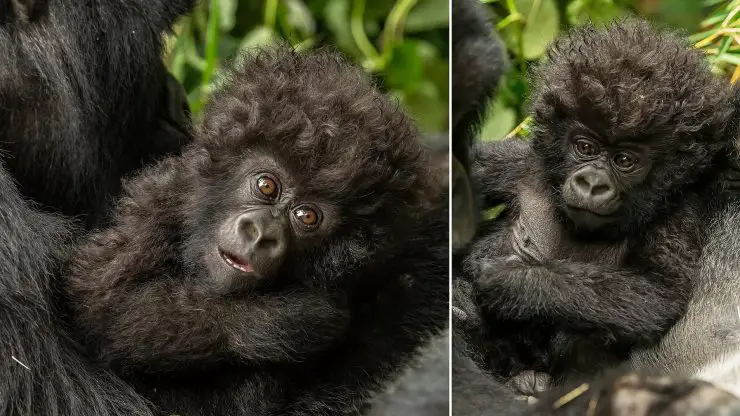
(TMU) — It must be surreal when a lifelong dream becomes reality and the moment is captured on film forever. Wildlife photographer Kirsty Taylor had her dream fulfilled when she shared an unbelievable moment with a gorilla mom and her tiny, adorable curly-haired baby in Rwanda.

As a little girl, Kirsty learned about mountain gorillas in an animal encyclopedia and watched them roam in an animated Tarzan film. She was enthralled by the beautiful animals and dreamed of one day seeing them in the wild.

Her choice of career as a photographer put her on the right path to realize her dream and she was fortunate to visit the Volcanoes National Park in Rwanda, which includes the Virunga Mountains, a range of extinct volcanoes that border the Democratic Republic of Congo, Rwanda and Uganda and home to a small population of Mountain Gorilla. Sure enough, Kirsty spotted some gorillas just over the Rwandan border.

A tiny, three-week old baby was being held in the arms of a female gorilla. As the group Kirsty was traveling with stopped to watch, the baby popped its head up to see what was happening.

According to Kirsty, the baby—with a shock of curly fur around its head—seemed fascinated by the humans. Kristy managed to capture her once in a lifetime, perfect shot of a loving mom and her curious baby, who happened to be looking straight at her camera.

Kirsty commented on the moment, saying: ‘’We only had a few minutes with the little family as we were on our way back down the mountain after our hour’s viewing was up, and were lucky to see them!

‘’I love the eye contact and the expression on the little baby’s face, looking at us like he’s not seen many humans before – and of course the cute curly hair!

‘’The pictures show the baby’s curly hair-do and how small and vulnerable he is compared to the adults.’’

Judging from Kirsty’s excitement of having finally seen mountain gorillas in the wild, I reckon she’ll be back for more.


According to the WWF’s website, the area Kirsten visited is the natural habitat of the smallest population of mountain gorillas in the world. Just over half of them live in the Virunga Mountains and the remainder in the Bwindi Impenetrable National Park in Uganda.

This mountain gorilla subspecies was first discovered in 1902 and had since suffered through years of war, hunting, habitat destruction and disease. The threat to their survival was so severe that it was thought they may be extinct by the end of the twentieth century. Due to conservation efforts both populations of mountain gorillas have increased despite ongoing civil conflict, poaching and loss of their natural habitat from an encroaching human population.

The bleak outlook for the subspecies just a couple of decades ago has improved in recent years. Despite ongoing civil conflict, poaching and an ever encroaching human population, both populations of the mountain gorillas have increased in numbers. The Virunga Massif population has grown from 480 in 2010 to 604 individuals, making a total population of 1,000 gorillas left in the wild, globally, with their status listed as endangered.


By Jade Small | Creative Commons | TheMindUnleashed.com