Sunday, August 09, 2020

UPDATE
Police and protesters clashed in Lebanon amid fiery demonstrations criticizing the government for the Beirut explosion

Sarah El Deeb and Bassem Mroue,
Associated Press

People clash with police during a protest against the political elites and the government after this week's deadly explosion in Beirut, Lebanon, Saturday, Aug. 8, 2020. Felipe Dana/APLarge crowds of protesters clashed with police during fiery demonstrations in Beirut, Lebanon, on Saturday amid mounting fury over the explosion that devastated the city earlier this week. 

Activists called for action against alleged negligence from officials after the explosion that killed nearly 160 people.

Officials are investigating the blast that was fueled by thousands of tons of ammonium nitrate that had been improperly stored at the city's port for more than six years.


BEIRUT (AP) — Security forces fired tear gas and clashed with stone-throwing demonstrators Saturday in Beirut, and a group of protesters stormed the foreign ministry amid mounting fury over this week's explosion that devastated much of the city and killed nearly 160 people. Dozens were still missing and nearly 6,000 people injured.

Activists who called for the protest set up symbolic nooses at Beirut's Martyrs' Square to hang politicians whose corruption and negligence they blame for Tuesday's blast.

The explosion was fueled by thousands of tons of ammonium nitrate that had been improperly stored at the city's port for more than six years. Apparently set off by a fire, the blast was by far the biggest in Lebanon's troubled history and caused an estimated $10 billion to 15 billion in damage, according to Beirut's governor. It also damaged 6,200 buildings and left hundreds of thousands of people homeless.
DIY NO GOVERNMENT HELP LATER THEY WILL PROTEST
Women with brooms pass by a historic building damaged by Tuesday's explosion in the Gemmayzeh neighborhood, Beirut, Lebanon, Saturday, Aug. 8, 2020. Hassan Ammar/AP

The disaster has taken popular anger to a new level in a country already reeling from an unprecedented economic and financial crisis and near bankruptcy.

"Resignation or hang," read a banner held by protesters, who also planned to hold a symbolic funeral for the dead. Some nooses were also set up along the bridges outside the Port.

Khodr Ghadir, 23, said the noose was for everyone who has been in power for the last 30 years. "What happened was a spark for people to return to the streets."

A placard listed the names of the dead, printed over a photo of the blast's enormous pink mushroom cloud. "We are here for you," it read.

In a televised speech Saturday evening, Prime Minister Hassan Diab said the only solution was to hold early elections, which he planned to propose in a draft bill. He called on all political parties to put aside their disagreements and said he was prepared to stay in the post for two months to allow time for politicians to work on structural reforms.

The offer is unlikely to soothe the escalating fury on the street.

In central Beirut, some protesters threw stones at security forces who responded with heavy tear gas. Near parliament, protesters tried to jump over barriers that closed the road leading to the legislature. The protesters later set on fire a truck that was fortifying barriers on a road leading to parliament.
THE ONLY SECTION OF THE GOVERNMENT TO APPEAR
People clash with police during a protest in Beirut, Lebanon, Saturday, Aug. 8, 2020. Hassan Ammar/AP

At least 142 people were hurt in the clashes, and 32 of them needed to be taken to the hospital, according to the Red Cross. Several protesters were seen being carried away with blood running down their faces. At one point, gunfire could be heard, but its source was not immediately clear.

In the capital's hard-hit Achrafieh district, a group of protesters, including retired army officers, stormed the building of the foreign ministry, vowing to make it the headquarters for the "revolution."


Documents that surfaced after the blast showed that officials had been repeatedly warned for years that the presence of 2,750 tons of ammonium nitrate at the port posed a grave danger, but no one acted to remove it. Officials have been blaming one another, and 19 people have been detained, including the port's chief, the head of Lebanon's customs department and his predecessor.

"We will support Lebanon through all available means," Ahmed Aboul Gheit, the secretary-general of the 22-member Arab League told reporters after meeting President Michel Aoun on Saturday morning. Aboul Gheit said he would take part in a donors conference for Lebanon in France on Sunday and convey Lebanon's demands to the international community.

Later on Saturday, the president of the European Council, Charles Michel, arrived in Beirut for a brief visit. Turkey's vice president and the country's foreign minister met Aoun and said that Ankara was ready to help rebuild Beirut's port and evacuate some of the wounded to Turkey for treatment.

At the site of the blast, workers continued searching for dozens of missing people. Bulldozers were also seen removing debris near a cluster of giant grain silos that were heavily damaged but still partly standing.


International aid has been flowing to Lebanon for days, and several field hospitals have been set up around Beirut to help treat the wounded.

President Donald Trump said Friday that he had spoken by telephone with Aoun and French President Emmanuel Macron, who paid a brief visit to Lebanon on Thursday. Trump noted that medical supplies, food and water were being sent from the United States, along with emergency responders, technicians, doctors and nurses.

The ammonium nitrate, a chemical used in fertilizers and explosives, originated from a cargo ship called MV Rhosus that had been traveling from the country of Georgia to Mozambique in 2013. It made an unscheduled detour to Beirut as the Russian shipowner was struggling with debts and hoped to earn some extra cash in Lebanon. Unable to pay port fees and reportedly leaking, the ship was impounded.

In 2014, the material was moved from the ship and placed in a warehouse at the port where it stayed until the explosion.Read the original article on Associated Press. Copyright 2020. Follow Associated Press on Twitter.
UPDATE
Beirut port blast crater 43 metres deep: security official


Issued on: 09/08/2020 

An aerial view of parts of the devastated Beirut port taken on August 7 shows the crater caused by the colossal explosion three days earlier of a huge pile of ammonium nitrate that had languished for years in a port warehouse - AFP

Beirut (AFP)

The huge chemical explosion that hit Beirut's port, devastating large parts of the Lebanese capital and claiming over 150 lives, left a 43-metre (141 foot) deep crater, a security official said Sunday.

The blast Tuesday, which was felt across the county and as far as the island of Cyprus, was recorded by the sensors of the American Institute of Geophysics (USGS) as having the power of a magnitude 3.3 earthquake.
It was triggered by a fire in a port warehouse, where a huge shipment of hazardous ammonium nitrate, a chemical that can be used as a fertiliser or as an explosive, had languished for years, according to authorities.

The huge blast also wounded at least 6,000 people and displaced more than 300,000 from their destroyed or damaged homes.

The revelation that the chemicals had languished for years like a ticking time-bomb in the heart of the capital has served as shocking proof to many Lebanese of the rot at the core of the state apparatus.

Demonstrators on Sunday called for renewed anti-government rallies after a night of angry protests saw them storm several ministries before they were expelled by the army.

It was a new tactic for a protest movement that emerged last October to demand the removal of a political class long accused of being inept and corrupt.

"The explosion in the port left a crater 43 meters deep," the Lebanese security official told AFP, citing assessments by French experts working in the disaster area.

The crater is much larger than the one left by the enormous blast in 2005 that killed former prime minister Rafic Hariri, which measured 10 metres across and two metres deep, according to an international tribunal investigating his murder.

French rescue and police teams are among a much larger group of international emergency response specialists that has flooded into Lebanon to ease pressure on local authorities unable to cope with the disaster relief on their own.

Qatari, Russian and German rescuers are also working at the port blast site.

BACKGROUNDER
The strange history of the chemical cargo that caused the Beirut blast

Issued on: 07/08/2020 -

Lebanese army soldiers stand guard in front of destroyed ships at the scene where an explosion hit on Tuesday the seaport of Beirut, Lebanon, Thursday, Aug. 6, 2020. © Hussein Malla, AP

Text by:Sébastian SEIBT

Thousands of tonnes of ammonium nitrate, believed to be responsible for the devastating explosion in Beirut on Tuesday, have been traced back by journalists to a Moldovan-flagged boat that was supposed to deliver the chemicals to Mozambique. An impecunious crew living as “hostages on a floating bomb” and repeated requests to the Lebanese authorities to shift the cargo, which went unheeded, are part of the cargo ship’s devastating story.

The story that led to the tragic explosion in Beirut port on Tuesday began more than six years ago, 1,300 kilometres from the Lebanese capital. The Moldovan-flagged vessel Rhosus left the port of Batumi, Georgia, with 2,750 tonnes of ammonium nitrate on board. It never reached its intended destination, Mozambique, where the cargo was supposed to be sold to a factory manufacturing explosives for civilian use.

Thus, the ammonium nitrate – which is now seen as the cause of the disaster that killed at least 154 people and injured at least 5,000 – should never have ended up at Beirut port. But a combination of mismanagement of the ship, technical problems and legal complications kept the cargo there.

The Lebanese authorities have not yet released the conclusions of the official investigation into the tragedy. However, several publications – including The New York Times, CNN and Der Spiegel – were able to piece together a chronology of the facts.

‘Do you expect Putin to send special forces?’

The Rhosus belonged to Igor Grechushkin, a Russian businessman living in Cyprus who had been paid a million dollars to transport ammonium nitrate to Mozambique, the ship’s captain Boris Prokoshev told The New York Times.

During a stopover in Greece, the boat’s Russian owner warned the crew that he lacked the funds to pay for salaries and maintenance costs on a journey through the Suez Canal. So he asked them to make their way to Beirut, where he intended to receive more money to transport extra cargo, Der Spiegel reported.

It was a difficult crossing through the eastern Mediterranean, explained Prokoshev, who is now retired. The ship was in a bad condition, he said, with a hole in the hull forcing the crew to regularly throw water out.

Contrary to its owner’s plans, the ship stayed in Beirut. During an inspection of the Rhosus, the Lebanese port authority said that its papers were not in order and that the boat was not in a good enough condition to sail, CNN noted. Meanwhile Igor Grechushkin dropped off the radar. The crew lacked the resources to pay for shipping costs.

Without the means to maintain the boat or even buy food, the crew were “hostages on a floating bomb”, to quote a prescient headline on maritime news website Fleetmon in July 2014.

Lebanon allowed six people to leave the country, keeping just four people in place, including the captain. Prokoshev said he contacted the Russian embassy. “Do you expect President Putin to send special forces to get you out?” one of his interlocutors reportedly said.

‘The judiciary never acted’

In desperation, Prokoshev sold some of the ship’s fuel to provide lawyers to argue his case, he told radio station Echo Moscow on Wednesday. Eleven months after arriving in Beirut, the sailors finally won the legal right to go home, Charbel Dagher, one of the lawyers representing the crew, told specialist website ShipArrested in 2015.

The 2,750 tons of ammonium nitrate were then transferred to warehouse 12 in the port of Beirut. They never moved from there. Port officials say they repeatedly alerted the Lebanese authorities to the danger of keeping a stock of highly explosive products in a single hangar so close to the centre of Beirut.

Between 2014 and 2017, six unsuccessful applications were made to the Lebanese courts, asking for permission to dispose of the ammonium nitrate, The New York Times reported. “In view of the serious danger of keeping these goods in the hangar in unsuitable climatic conditions, we reaffirm our request to please request the marine agency to re-export these goods immediately to preserve the safety of the port and those working in it, or to look into agreeing to sell this amount,” read one such letter, obtained by Al-Jazeera. There was no response.

The port authorities say they proposed the cargo be offered to the Lebanese army or that it be sold to an explosive manufacturer. But to no avail. “We were told the cargo would be sold in an auction,” Hassan Koraytem, the general manager of Beirut’s port, told The New York Times. “But the auction never happened and the judiciary never acted.”

Six months ago, a team of inspectors sounded the alarm once again that there was enough ammonium nitrate to cause a massive explosion in Beirut, according to an anonymous source cited by Reuters.

Lebanese authorities announced their own inquiry into Tuesday's explosion and a military prosecutor on Thursday said 16 people had been detained, including Koraytem, a judicial source told Agence France-Presse.

As for the ship, the Rhosus, Prokoshev learned that it sank in 2015 or 2016 in the port of Beirut. But unlike the ammonium nitrate, it went quietly – without causing one of the worst non-nuclear explosions in history.

This article was translated from the original in French.
Police, protesters clash in wake of Beirut blasts 
BEIRUT LOOKS LIKE PORTLAND, EH

Riot police fire tear gas against anti-government protesters during a demonstration outside of the Lebanese Parliament in Beirut, Lebanon, on Saturday. Photo by Wael Hamzeh/EPA-EFE

ONLY RIOT COPS 
NO OTHER REPRESENTATIVES 
OF THE GOVERNMENT
OR POLITICAL CLASS

Aug. 8 (UPI) -- Beirut police fired tear gas and rubber bullets Saturday toward thousands of protesters calling for government accountability for this week's explosions at a port that killed over 150 people.

Police also shot live ammunition in the air to disperse the crowd.

Demonstrators erected mock gallows in the city's central Martyrs Square where they gathered from early afternoon, and stormed the foreign ministry, the environment ministry and the economy ministry, as well as the Banking Association, Saturday night.

Protesters accused the government of corruption and incompetence, which they said contributed to the explosions.

RELATED Lebanon's foreign minister resigns, says country could become 'failed state'

"The people want the fall of the regime," protesters chanted.

The demonstrators held posters saying, "leave, you are all killers."

The first tear gas was deployed after a group of protesters attempted to break through a barrier blocking a street to Parliament, The Guardian reported.

Many children and older people in the demonstrators left as clashes between police and protesters escalated.

Lebanese President Michel Aoun said Friday that all officials responsible for Tuesday's explosion would be held accountable.

The country's prime minister, Hassan Diab, has also vowed to hold early elections and will remain in power for two more months as the major parties work toward an agreement.

The U.S. embassy in Beirut on Saturday tweeted support for the protesters.

2/2 We support them in their right to peaceful protest, and encourage all involved to refrain from violence.— U.S. Embassy Beirut (@usembassybeirut) August 8, 2020

Meanwhile, President Donald Trump said he plans to join a conference call with other global leaders to discuss aid to Lebanon.

The explosion in the port of the Lebanon's capital Tuesday killed at least 157 people, injured 5,000, and left many homeless, exacerbating the country's severe economic crisis, already worsened by COVID-19 pandemic.


France and the United Nations are leading the conference call for aid, which Trump will join Sunday.

"We will be having a conference call on Sunday with [French] President [Emmanuel] Macron, leaders of Lebanon, and leaders from various other parts of the world," Trump tweeted Friday. "Everyone wants to help!"

Trump called the blasts a "horrible event" and said that doctors, nurses and three large aircraft were on the way with medical supplies, food, water and other emergency equipment.

Late Friday, Secretary of State Mike Pompeo added in a tweet that the United States has pledged more than $17 million in disaster aid to Lebanon.

"We remain ready to assist the people of Lebanon as they recover from the horrible August 4th explosion," Pompeo also tweeted. "We keep everyone affected in this tragedy in our thoughts and prayers."

The blasts left about 300,000 people homeless and repairs are estimated to cost billions of dollars, Beirut Gov. Marwan Abboud said.

On Thursday, the U.S. Air Force delivered 11 pallets of food, water and medical supplies.

Lebanese officials on Thursday, arrested 16 people linked to their investigation into the explosion.

On the same day, Human Rights Watch invited international experts to do an independent investigation, saying that there was evidence that some judges knew ammonium nitrate was stored at the port and did nothing about it. The non-governmental human rights organization also said that there have been previous incidents where the judiciary failed to uphold the rule of law or conduct proper inquiry.

Lebanese security forces on Thursday clashed with protesters who blamed the explosion on government negligence. And UNICEF, the U.N. agency that oversees humanitarian aid for youth, said some 80,000 children are in need of support after being displaced by the blast.

A day earlier the government said it planned to place port officials under house arrest in as part of investigation into why 2,750 tons of ammonium nitrate were stored at nearby warehouses. 


Tear gas, clashes in Beirut amid fury over massive blast  In pictures


 Previous  \  


UPDATE
Chain reaction: disaster hastens Lebanon’s moment of reckoning

A corruption-riddled government has presided over rising poverty for decades. Could the anger released after the catastrophe in Beirut’s docks finally topple it?


Martin Chulov in Beirut 
The Observer Sun 9 Aug 2020

Beirut explosion
  
Video footage of the explosion in Beirut docks that killed more than 150 people. Photograph: Gaby Salem/ESN/AFP

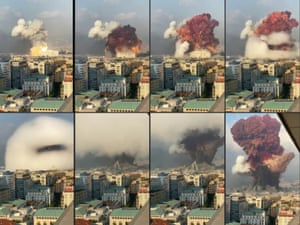
The first violent jolt seemed like a neighbourhood accident; a blown generator, or a car crash. Five seconds later, the thundering secondary blast arrived; a crushing surge of energy that instantly sucked the air out of the city, then plunged it back with devastating weight. Giant shards of debris blew through rooms, door frames collapsed and furniture became missiles – all in what seemed like a paralysing slow motion.

A deathly still followed, and then came a cascade of shattered glass from what appeared to be every home, or tower block; hundreds of thousands of panes and pieces falling to earth at once. Many who survived the blast wave did not live beyond the seconds that followed. Days later, giant pools and trails of blood littered pavements and roads, each telling their own tale of life or death in Beirut’s apocalypse. When the glass stopped falling, the screaming started. A yellow pall of dust, smoke and chemicals shrouded the eastern suburbs.

A car bomb had exploded, people shouted. But here? Why here? And why so huge? In a city accustomed to the savage aftermath of explosions, this was different. The road down the hill from the suburb of Achrafieh to the waterfront was in ruins; wrecked cars and mounds of glass. “They’ve killed Saad Hariri [the former prime minister],” shouted a guard outside the villa of Nissan executive Carlos Ghosn, who fled Japan earlier this year.

“It’s the port,” said another guard pointing to a yellow and pink mushroom cloud that was just starting to dissipate in the face of a westerly wind. “It’s been blown up.”

The chaos of heat, panic, ruins and traffic was quickly yielding to a new reality; things here would never be the same again. As night drew across what remained of a darkened Beirut on Tuesday, what had caused such catastrophic damage – nearly 2,750 tonnes of ammonium nitrate, stored in a flimsy shed at the entrance to town – had become clear.

Five days later, what ignited the huge stockpile is also taking shape, as is the litany of failings that led a shambolic government to expose its people to such mortal risk for more than six years, since the nitrate was seized in lieu of port dues from a rickety Russian freighter.

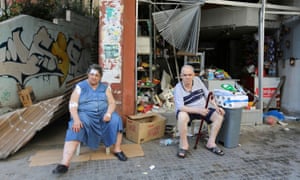
 A woman injured in Tuesday’s blast beside her husband outside their damaged grocery in Beirut. Photograph: Aziz Taher/Reuters

Divining outcomes from a multitude of past crises is fraught in Lebanon, where problems are usually more easily deduced than cures. But never before, during empire, world war, the troubled birth of the modern state, insurrection, civil war, occupation, and rampant kleptocracy has a resolve been so clear about what must happen next. Something new and terrifying had taken place. A moment of reckoning – and social impetus – like no other looms in Lebanon.

“If this doesn’t break the corrupt system, nothing will,” said Nidal Ayyoush, 36, a supervisor in a bank. “How can the same people that have led us sleepwalking to Armageddon be the ones to lead us out of it?”

The storage of ammonium nitrate at the port – of all places – for so many years shows they were keeping it there for a reason,” said Hikmat Abdullah, co-owner of a real estate firm. “That’s both because everyone knew it was important. Every big player in Lebanon knew it was there, including Hezbollah, who run the port. They are lying when they say they don’t.”

Play Video
4:36 What we know about the Beirut explosion – video explainer

Over several decades, the port of Beirut had been a site where disparate political and commercial interests converged. Billions of dollars had flowed through it annually. “Here the oligarchs and the political chieftains and their financiers ran one of the biggest rackets in the Middle East,” said a recently retired Lebanese intelligence official. “It financed the rot of the state, at the same time as destroying it. But nobody was expecting this.”

A gathering rage across the country is leading many Lebanese to believe that the events of 4 August could finally be the tipping point that has been predicted before, but never materialised. The assassination of former prime minister Rafik Hariri in February 2005 was another such moment. The weeks afterwards led Syrian forces occupying Lebanon at the time to withdraw, and gave birth to a political dawn that promised to usher in sovereignty and accountability.

But in the years of regional chaos since, Lebanon has remained captive to broader conflicts, and an incorrigible ruling class, which has turned all state institutions into fiefdoms, looting tens of billions of dollars in state funds. Earlier this year the state defaulted on the first of a series of Eurobond repayments and people watched helplessly as the local currency collapsed, wiping out the savings of many and sending much of the country into poverty.

THE ONLY TIME THE LEBANESE GOVT. ARMY AND STATE SHOWED UP WAS NOT TO HELP OR CLEAN UP BUT TO TOUR MACRON WITH THEIR HANDS OUT

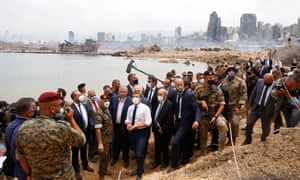
 French president Emmanuel Macron tours the wreckage last week. Photograph: Thibault Camus/EPA

The needs are now so great, and the corrupt superstructure of government so determined to dig in, that in the eyes of many Lebanese, something has to give. “Power may really be slipping from their hands this time,” said Layla Habib, 22 a student protester. “I can feel it.”

Throughout the decay, Hezbollah has consolidated its position as the strongest force in the land, and one of the most formidable militant organisations in the region.

Though the group has MPs in the government where it uses alliances to hold sway, it also wields power away from the legislative process. Hezbollah’s hold on the Lebanese state has made it all but untouchable in Lebanon, where even as it faces a period of intense scrutiny, other groups are wary about opening political, or military, fronts.

“And at this stage, I think the priority is to get rid of mobsters,” said Nadim Houry, executive director of the Arab Reform Initiative. “You can’t defeat the mobsters and Hezbollah at the same time. So to me, that is the only possibly hopeful scenario. Hopefully, new political forces would be sufficiently organised to win elections and start renewing political life on a new basis. But for now, the main thing is to get the criminals out.

“The risk is that some anti-Hezbollah may be hoping to use this to finally corner the group into submission. That would be a massive mistake. Not because of any sympathy to the group, but because the country cannot afford such a confrontation.

“Next step [is] in a salvation government from outside the political class with a special mandate to address the humanitarian and economic crisis. They need a limited mandate, two to three years max, and their duty would be to prepare for elections on the basis of a new electoral law after that period.”

As an anguished week drew to an angry end, calls for mass resignations from the parliament intensified, as did demands that the probe into the events leading to the explosion not be politicised by leaders invested in its outcome.

“The government must resign,” said Maha Yahya, director of the Carnegie Middle East Centre. “The Lebanese, even those initially willing to give it a chance, have zero trust in the political class: What happened is catastrophic and the result of criminal negligence, epic mismanagement and corruption that eats at the heart of Lebanon.

“In its stead the political parties should endorse a government of independents that has the trust of the Lebanese people and that has exceptional powers to lead the country out of this abyss. Accountability of the crime cannot stop at a few port employees. It must follow the chain of command.”

Mass resignations from the country’s parliament do seem almost inevitable, as does a vacuum that would need to be quickly filled. The installation of an interim leadership, potentially topped by the military, is being widely mooted – a move that would pose a serious challenge to patronage structures that an elite in the background would try to salvage.

“The only way out of this deadlock is for MPs to resign and an interim government be formed with one purpose – and that is to stabilise the situation and help aid arrive,” said Khaled Zaidan, 48, an investment banker. “With all of their issues the army is the most credible institution to lead us at the moment. We want an independent committee that needs to be created to make a new electoral law under international supervision.”
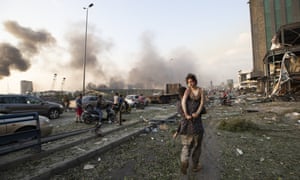
The aftermath of the blast on Tuesday. Photograph: Hassan Ammar/AP

On Friday, three days after the explosion, a verdict was due to be handed down in the trial of four alleged members of Hezbollah accused of assassinating Hariri on the Beirut waterfront, more than 15 years ago. The impact of the killing, regarded at the time as a watershed moment, had gradually faded, subsumed by one crisis after the other, culminating in an economic implosion that was more than most could withstand. Interest in Lebanon had dried up. So too had regional and foreign aid, which was now knotted to demands for structural reforms, which politicians – even now – are refusing to make.

But not only was last week’s explosion bigger by an order of magnitude than anything the country has seen before – so too is the fallout.

After he stood in the ruined Gemmayze district, less than a mile from ground zero, a place no Lebanese politician would dare go, French president Emmanuel Macron said: “It’s time for responsibility in Lebanon. We raised funds in the past, but we can only do it if the Lebanese authorities take their responsibilities to allow us to fully help Lebanon.”

Around the same time, Lebanese president Michel Aoun said the explosion had ended the aid blockade on Lebanon – a remark seized on by Beirutis as evidence of the leadership thinking that reforms no longer mattered. Macron was having none of it. “I guarantee you this aid will not go to corrupt hands,” he said.

As the clean-up continued in Gemmayze and elsewhere, led mainly by young volunteers with brooms and shovels, one shopkeeper said: “They’re misreading things if they think they can get away with this just because people are sending aid. If I have to lose my livelihood in sacrifice for a new state, then let it be,” he said. “But I won’t accept this being for nothing.”

In the downtown area, destroyed during the civil war and rebuilt by Rafiq Hariri who, together with his backers, reaped an enormous bounty from doing so, there was little recovery under way. Already empty shop fronts had been blown out.

“There’s no community here, just new money that disappeared,” said Mazen Sheikh, who had been stationed at an abandoned mall as a bodyguard. “We need to rebuild Beirut community by community. That’s the only solution.”

Videos


What we know about the Beirut explosion – video explainer


Beirut explosion: the volunteer clearing up the wreckage of her home city – video


UPDATE
Lebanon: Beirut blast deals fresh blow to a government struggling with popular discontent
 08/08/2020 

People clean an apartment damaged in the Beirut neighbourhood of Mar Mikhael on August 7, 2020, three days after a massive explosion in the capital's port. © Patrick Baz, AFP

Text by:FRANCE 24

The devastating blast that struck the heart of the Lebanese capital has dealt a fresh blow to the country's fragile government, already under fire for alleged financial mismanagement that has led the country to the brink of economic collapse. What lasting political consequences is the blast likely to have?

The colossal explosion that devastated Beirut's port and gutted entire neighbourhoods of the Lebanese capital deals a fresh blow to an already fragile and deeply unpopular government. The blast killed more than 150 people and injured 5,000 while leaving more than a quarter of a million people without homes.

Lebanon's ruling elite was already under enormous pressure from a protest movement that rejects it as inept, corrupt and beholden to the country's myriad sectarian groups rather than the national interest.

Battling runaway inflation, mass unemployment and rising poverty, the government is struggling. Many have seen their life savings simply evaporate. And despite weeks of talks, the cabinet failed to reached a deal with the International Monetary Fund on a rescue package after Lebanon defaulted on its debt earlier this year.

Lebanese security forces on Thursday fired tear gas at dozens of anti-government demonstrators angered by the devastation in Beirut and more protests were set for Saturday.

With public anger now at the boiling point over the epic destruction caused by a disaster blamed on governmental negligence, what will be the political impact for a country already suffering its worst-ever economic crisis?

>> ‘We've got nothing’: Millions in Lebanon struggle with cost of living amid economic collapse

Ahmed Bayram of Save the Children warned that a humanitarian crisis was unfolding as a result of the blast in an interview with FRANCE 24.


Beirut explosion : UN warns of possible humanitarian crisis in wake of blast


A disaster resulting from 'business as usual'?


Prime Minister Hassan Diab's government, billed as a technocratic line-up when it was formed in January, is seen as subservient to the party of President Michel Aoun and his Hezbollah political allies.

This week Nassif Hitti resigned as foreign minister to protest a lack of willingness to tackle much-needed reforms, warning that Lebanon risked becoming a "failed state".

Security officials told AFP that huge quantities of highly explosive ammonium nitrate had been stored for years in a rundown warehouse and that the hazard was known to the authorities.

"The catastrophe, while exceptionally severe, is the result of business as usual in Lebanon," Faysal Itani, a deputy director at the Center for Global Policy, wrote in The New York Times.

"There is a pervasive culture of negligence, petty corruption and blame-shifting endemic to the Lebanese bureaucracy, all overseen by a political class defined by its incompetence and contempt for the public good."

"Irrespective of how this explosion came to happen there is absolute criminal neglect," said Maha Yahya, director of the Carnegie Middle East Center.


'Major protests' expected in Beirut Saturday amid residents' anger over port-area explosion


Lebanon's Kataeb Party, a Christian group that opposes the Hezbollah-backed government, announced Saturday that its three lawmakers would resign from parliament. The announcement was made during the funeral of a leading Kataeb member who died in the port explosion.

But in the larger context of extreme geopolitical polarisation in the region – notably between the United States and Iran – the beleaguered government's global sponsors might seek to preserve it at all costs.

"
Despite popular anger ... a resignation still seems unlikely just now because there is no clear alternative," said Karim Bitar, a professor of international relations in Paris and Beirut.

>> ‘Beirut is destroyed, my heart is broken’: Locals in despair over Lebanon blast

Protesters vow to keep fighting

An unprecedented nationwide and cross-sectarian protest movement that erupted on October 17 had looked at one stage like it could topple the hereditary ruling elite.

The euphoria faded, however, as substantive change failed to materialise and the combination of economic hardship and the coronavirus pandemic left any nascent revolution in tatters.

Professot Bitar predicted that Tuesday's tragedy might give the protest camp "a second wind".

"The Lebanese will be more determined than ever to make a political class, which is corrupt to the bone, accountable," he said.

But the Carnegie center's Yahya argued that many among the protest camp could also see the port blast as the final straw that convinces them to leave the country for good, choosing to join Lebanon's massive diaspora instead of fighting for change at home.

The government announced a two-week state of emergency with immediate effect on Wednesday, which could also foil any plans for mass protests in the short term.


International aid workers sift through Beirut debris
Hezbollah on the defensive


The Iran-backed Shiite movement Hezbollah, a dominant political player in Lebanon, has appealed for unity, describing the explosion as "a major tragedy". The group's leader, Hassan Nasrallah, categorically denied that Hezbollah stored arms at the port.

But some note that Hezbollah's influence on the running of the port is well known to the public and the disaster could reflect badly on the organisation. "They will also be held accountable because they are part and parcel of the governing system," said Yahya.

Strangled by US sanctions, the Shiite movement is also bracing for the upcoming verdict in the trial over the 2005 assassination of former prime minister Rafic Hariri in a bomb blast. The main suspects are alleged Hezbollah members and a guilty verdict could increase pressure on the group both at home – heightened tensions between Hezbollah and Hariri supporters are one likely result – and abroad. The United States and many other Western countries, including Germany and Britain, already categorise Hezbollah as a "terrorist" group.

The special tribunal in The Hague handling the case announced on Wednesday it would be postponing the verdict, initially set for Friday, to August 18 as a result of the Beirut port blast.

Lebanon's information minister, Manal Abdel Samad, became the first political casualty of the explosions when she resigned on Sunday, apologising to the Lebanese people.

"After the enormous Beirut catastrophe, I announce my resignation from government," she said in a statement carried by local media.

(FRANCE 24 with AFP and AP)
UPDATE
Furious Lebanese vow new protests over deadly mega-blast

Issued on: 09/08/2020 -


"Prepare the gallows because our anger doesn't end in one day," warned one message circulating on social media in response to Tuesday's earthquake-strength blast of a huge pile of industrial chemicals - AFP

Beirut (AFP)

Lebanese protesters enraged by official negligence blamed for Beirut's enormous and deadly explosion vowed Sunday to rally again after a night of street clashes in which they stormed several ministries.

"Prepare the gallows because our anger doesn't end in one day," warned one message circulating on social media in response to Tuesday's earthquake-strength blast of a huge pile of industrial chemicals.

The calls for renewed protests came as French President Emmanuel Macron in Paris was to oversee a UN-backed virtual donors conference to raise aid for Lebanon, a country already mired in a painful economic crisis.


In Beirut, the fury on the streets has further shaken the embattled government of Prime Minister Hassan Diab, which saw its first cabinet resignation when the information minister, Manal Abdel Samad, quit Sunday.

"After the enormous Beirut catastrophe, I announce my resignation from government," she said, apologising to citizens for having failed them.

The revelation that Lebanese state officials had long tolerated a ticking time-bomb in the heart of the capital has served as shocking proof to many Lebanese of the rot at the core of the state apparatus.

The death toll from the explosion of a long-neglected pile of ammonium nitrate stood at 158 people, with 60 still reported missing, and a staggering 6,000 wounded, many by flying glass as the shockwave tore through the city.

The blast, whose mushroom cloud reminded many of an atomic bomb, left a 43-metre (141 foot) deep crater at Beirut's port, said a security official citing French experts working in the disaster area.

The mood was one of grief and fury in Beirut, a day after many of the dead were laid to rest and when thousands demonstrated in the biggest anti-government rally the country has seen in months.

- Teargas, rubber bullets -

The country's worst peace-time disaster has reignited a protest movement against the reviled ruling elite that first flared last October but had then faded amid economic hardship and the coronavirus pandemic.

As tensions have again escalated, the army Saturday used teargas and rubber bullets to clear hundreds of protesters from the central Martyr's Square, once more the epicentre of Lebanon's protest movement.

The street violence left 65 people injured, according to the Red Cross, with footage circulating online showing some demonstrators having sustained severe injuries.

In a new tactic, demonstrators temporarily occupied the foreign ministry building before being forced out by the army three hours later.

Protesters, some brandishing nooses, also stormed the economy and energy ministries and the Association of Banks, widely hated for cash shortages and asset freezes, before they were pushed back out by soldiers.

Rescuers meanwhile kept digging through the rubble of toppled buildings as hopes slowly faded of finding more survivors from the colossal blast that shook the country and was felt as far away as Cyprus.

The explosion was recorded by the American Institute of Geophysics as equivalent in power to a magnitude 3.3 earthquake.

It was triggered by a fire in a port warehouse, where a huge shipment of hazardous ammonium nitrate, a chemical that can be used as a fertiliser or as an explosive, had languished for years, according to authorities.

- 'Crime against humanity' -

Embattled Prime Minister Diab said Saturday he would propose early elections to break the impasse that is plunging Lebanon ever deeper into political and economic crisis.

"We can't exit the country's structural crisis without holding early parliamentary elections," Diab said in a televised address, promising a draft bill Monday.

At least six lawmakers have also quit since the August 4 explosion.

The head of Lebanon's Maronite church patriarch Beshara Rai joined the chorus of people pressing Diab's entire cabinet to step down over a blast he said could be "described as a crime against humanity".

The protesters demand the wholesale removal of Lebanon's ruling class, which they see living in luxury while millions endure job losses, deepening poverty, power blackouts and garbage mountains piling up in the streets.

Working with the mostly youthful protesters are a group of retired army leaders whose state pensions have been decimated by the collapse of the Lebanese pound.

Politics in multi-confessional Lebanon is dominated by former warlords from the 1975-1990 civil war who years ago exchanged their military fatigues for suits, or by their offspring and nephews.

While there Sunni Muslim, Christian and myriad other groups, the most powerful is the Shiite Hezbollah militia and political movement, which dwarfs the state in manpower and military strength.

The protesters charge that Lebanon's elite is fighting over the spoils of government, beholden to their personal and sectarian interests rather than the good of the nation.

© 2020 AFP


Lebanese protesters storm ministry buildings as anger over Beirut explosion grows
Issued on: 08/08/2020 -

Demonstrators take part in a protest, following Tuesday's blast, in Beirut, Lebanon August 8, 2020. © REUTERS/Issam Abdallah


Lebanese protesters forced their way into government ministries in Beirut and trashed the offices of the Association of Banks in Lebanon on Saturday as shots rang out in increasingly angry demonstrations over this week's devastating explosion.

More than 110 people were wounded during demonstrations in central Beirut on Saturday against this week's huge explosion and 32 people were taken to hospital, Lebanese Red Cross officials told local media.

Police confirmed shots and rubber bullets were fired during the clashes. It was not immediately clear who fired the shots. Riot police shot dozens of teargas canisters at protesters, who hit back with firecrackers and stones.

With security forces focused on a large gathering at the Martyrs' Square protest hub, a group led by retired army officers snuck into Lebanon's foreign ministry and declared the building a "headquarters of the revolution".

The stunt, which marked a new development in the strategy of a protest camp whose October 17 uprising had lost steam lately, was facilitated by the damage the port-blast shockwave had inflicted on the building.

But the takeover lasted barely three hours.


Beirut demonstrators showed 'level of rage' not yet seen in 10 months of protests

Large army reinforcements using rubber bullets and tear gas drove out the roughly 200 protesters, who only had time to chant celebratory slogans against the government and burn a portrait of President Michel Aoun.

At one point, protesters had stormed or taken over four key official buildings.

"We are officially at war with our government," said activist Hayat Nazer, as tear gas filled the air in downtown Beirut.

"This is war."

'Lebanon is ours'

Separate groups of protesters also stormed the economy ministry, the Association of Banks in Lebanon and the energy ministry before being forced out by the army shortly afterwards.

The latter is the focus of particular anger from the population, which has in recent months been subjected to worse-than-ever power cuts due to the de facto bankruptcy of the state.

"They ruled Lebanon for 30 years, now Lebanon is ours," said one protester speaking on live Lebanese television broadcasts.

"We entered the energy ministry and we are here to stay."

The Association of Banks in Lebanon, another obvious target for protesters who have routinely nicknamed their rulers "the government of banks", was ransacked, an AFP reporter said.

By 10:30 pm local time. however, protesters had been dispersed and security forces deployed across the city, where the broken glass and rubble from Tuesday's disaster mixed with the smoking remains of a night of rage.

The rallies claimed a human toll too, with one policeman falling to his death following an "assault" by "rioters", the police said. A policeman at the scene said the officer died when he fell into an elevator shaft in a nearby building after being chased by protesters.

Dozens of people wounded during the violence also needed treatment in hospitals already bursting with the injured from Tuesday's blast and coronavirus patients.

"We are staying here. We call on the Lebanese people to occupy all the ministries," one demonstrator said on a megaphone, as new protests erupted against the political leadership blamed for a massive explosion that killed more than 150 people in the capital this week.

Possible early elections

Speaking at a press conference on Saturday evening, Lebanon's Prime Minister Hassan Diab said he would request early parliamentary elections to defuse an escalating political crisis following the catastrophic explosion at the port of Beirut.

"We cannot get out of this crisis without early parliamentary elections," he said, reading a statement. He added he was not to blame for the country's deep economic and political woes.


Lebanese Prime Minister Hassan says he will call for early elections following the blast

The US Embassy in Beirut said the US government supported the demonstrators' right to peaceful protest and urged all involved to refrain from violence.

The embassy also said in a tweet that the Lebanese people "deserved leaders who listen to them and change course to respond to popular demands for transparency and accountability".

2/2 We support them in their right to peaceful protest, and encourage all involved to refrain from violence.— U.S. Embassy Beirut (@usembassybeirut) August 8, 2020

Explosion felt in neighbouring countries

A fire at Beirut port on Tuesday ignited a stock of ammonium nitrate and triggered an explosion that was felt in neighbouring countries and destroyed entire sections of the city.

The blast killed more than 150 people and injured 5,000 while leaving more than a quarter of a million people without homes. Spectacular videos of the disaster show a mushroom-shaped shockwave that swept from the port through the city.

According to the health ministry, more than 60 people are still missing.

"After three days of cleaning, removing rubble and licking our wounds ... it is time to let our anger explode and punish them," said Fares Halabi, a 28-year-old activist.

Thousands of people poured into Beirut’s main square, where they set up symbolic nooses to hang politicians whose corruption and negligence they blame for Tuesday's explosion at the Port of Beirut.

The lack of political change combined with a stinging economic crisis and the coronavirus pandemic all but snuffed out the revolutionary movement – until this week.it


Anti-government protests are continuing in Beirut


"Today is the first demonstration since the explosion, an explosion in which any one of us could have died," said Hayat Nazer, an activist who has contributed to solidarity initiatives for blast victims.

"This is the biggest warning for everyone now that we don't have anything to lose anymore. Everyone should be in the streets today, everyone," she told AFP.

>> ‘Beirut is destroyed, my heart is broken’: Locals in despair over Lebanon blast

International aid

Two days after a landmark visit by French President Emmanuel Macron, diplomatic activity was intensifying to organise international support for the disaster-hit country ahead of a Sunday aid conference to be co-hosted by Macron and the United Nations. The Arab League has also pledged support.

Three senior diplomats were in Beirut Saturday in a show of solidarity with the disaster-hit city, where 300,000 people were made temporarily homeless by the port explosion.

The first to meet top officials was Arab League chief Ahmed Aboul Gheit. Turkish Foreign Minister Mevlut Cavusoglu was also expected as was the president of the European Council, Charles Michel.


'Major protests' expected in Beirut Saturday amid residents' anger over port-area explosion


The president and prime minister of Lebanon have promised a government investigation but, more than a mere case of negligence, many Lebanese see the blast as a direct result of high-level corruption. Few Lebanese trust that the leadership would incriminate its own in an investigation chaired by some of the country's top officials.

Aoun, however, has rejected calls for an international independent investigation into the blast.

A total of 21 people have been detained so far, including Badri Daher, director-general of Lebanon's customs authority.

>> The strange history of the chemical cargo that caused the Beirut blast

'Wake-up call'

Lebanon defaulted on its debt earlier this year and the current leadership has so far consistently failed to address the economic emergency and agree on an international rescue package despite intense Western pressure.

Analyst Nasser Yassin, of the Issam Fares Institute for Public Policy and International Affairs, said Lebanon's leaders were clearly seeking to take advantage of the situation.

"The fear is that the authorities will benefit from this great disaster and from the international and Arab attention they are getting," he said.

Activist Hayat Nazer said the current crisis should not turn into a chance for the political elite to get a new lease of life but instead give fresh impetus to a drive for change.


Daily newsletterReceive essential international news every morningSubscribe

"I think it's the last wake-up call for people," she said.

"We need to save each other, we need to clean our country, to rebuild it, and to completely disregard that we have politicians," Nazer said.

"It's not just about protesting in the streets. We can make a change on a daily basis, the revolution is part of our lives, we can apply it every day."

(FRANCE 24 with AFP, AP and Reuters)


UPDATE 

Mauritius struggles to contain oil spill polluting its seas

Issued on: 09/08/2020 -

Attempts to stabilise the stricken vessel and pump 4,000 tonnes of fuel from its hold have failed Handout Satellite image ©2020 Maxar Technologies/AFP


Port Louis (Mauritius) (AFP)

Thousands of Mauritians raced to contain a catastrophic oil spill swamping its pristine ocean and beaches on Sunday as frustration mounts over why more wasn't done to prevent the ecological disaster.

The bulk carrier MV Wakashio has been seeping fuel into a protected marine park boasting unspoiled coral reefs, mangrove forests and endangered species, prompting the government to declare an unprecedented environmental emergency.

Attempts to stabilise the stricken vessel, which ran aground on July 25 but only started leaking oil this week, and pump 4,000 tonnes of fuel from its hold have failed, and local authorities fear rough seas could further rupture the tanker.

Japan said Sunday it would send a six-member expert team to assist, joining France which dispatched a naval vessel and military aircraft from nearby Reunion Island after Mauritius issued an appeal for international help.

Thousands of volunteers, many smeared head-to-toe in black sludge, are marshalling along the coastline, stringing together miles of improvised floating barriers made of straw in a desperate attempt to hold back the oily tide.

Mitsui OSK Lines, which operates the vessel owned by another Japanese company, said Sunday that 1,000 tonnes of fuel oil had escaped so far.

"We are terribly sorry," the shipping firm's vice president, Akihiko Ono, told reporters in Tokyo, promising to "make all-out efforts to resolve the case".
 DO THE HONORABLE THING;SEPPUKU 
But conservationists say the damage could already be done.

Aerial images show the enormous scale of the disaster, with huge stretches of azure seas around the marooned cargo ship stained a deep inky black, and the region's fabled lagoons and inlets clouded over.

T
hick muck has inundated unspoiled marine habitats and white-sand beaches, causing what experts say is irreparable damage to the fragile coastal ecosystem upon which Mauritius and its economy relies.

- Economy at risk -

Pressure is mounting on the government to explain why more wasn't done in the two weeks since the bulker ran aground.

The opposition has called for the resignation of the environment and fisheries ministers, while volunteers have ignored an official order to leave the clean-up operation to local authorities, donning rubber gloves to sift through the sludge.

"People by the thousands are coming together. No one is listening to the government anymore," said Ashok Subron, an environmental activist at Mahebourg, one of the worst-hit areas.

"People have realised that they need to take things into their hands. We are here to protect our fauna and flora."

Police said Sunday they would execute a search warrant granted by a Mauritius court to board the Wakashio and seize items of interest, including the ship's log book and communication as part of its investigation into the accident.

The ship's captain, a 58-year-old Indian, will accompany officers on the search, police said. Twenty crew members evacuated safely from the Japanese-owned but Panamanian-flagged ship when it ran aground are under surveillance.

Prime Minister Pravind Jugnauth has convened a crisis meeting later Sunday, after expressing concern that forecast bad weather could further complicate efforts to stymie the spill, and cause more structural damage to the hull.

Ecologists fear if the ship further breaks it could inflict a potentially fatal blow to on the island nation's coastline.

The Wakashio struck a reef at Pointe d'Esny, an ecological jewel fringed by idyllic beaches, colourful reefs, sanctuaries for rare and endemic wildlife, and unique RAMSAR-listed wetlands.

Mauritius and its 1.3 million inhabitants depend crucially on the sea for ecotourism, having fostered a reputation as a conservation success story and a world-class destination for nature lovers.

"Fishing is our only activity. We dont know how we will be able to feed our families," one fishermen, who gave his name as Michael, told AFP.


SEE
https://plawiuk.blogspot.com/2020/08/locals-in-mauritius-are-going-to-great.html

https://plawiuk.blogspot.com/2020/08/mauritian-prime-minister-seeks.html

https://plawiuk.blogspot.com/2020/08/the-oil-spill-at-mauritius-is-disaster.html

https://plawiuk.blogspot.com/2020/08/update-mauritius-battles-devastating.html

https://plawiuk.blogspot.com/2020/08/oil-spill-off-mauritius-is-visible-from.html

https://plawiuk.blogspot.com/2020/08/france-offers-aid-as-mauritius-declares.html


https://plawiuk.blogspot.com/2020/08/mauritius-facing-catastrophe-as-oil.html