Sunday, August 09, 2020

UK 
Where to now? End of eviction ban leaves tenants fearing for future

Soon landlords will be able to take action against renters again, which many fear could lead to a rise in homelessness

What now? Many renters whose income has been cut because of Covid, face eviction and don’t know where to turn. Photograph: Antonio Guillem Fernández/Alamy


Shane Hickey Sun 9 Aug 2020 08.00 BST

After being furloughed from her job as a cleaning manager during lockdown, Denise (54)* is fearful about what the future holds. Her rent and bills add up to £1,000 which leaves her with just £150 a month for groceries, so she has had to rely on her local food bank.

“My landlady keeps harassing me as she wants me out,” says the mother-of-one. “I asked her if we could come to an agreement on the rent while we saw what happened. She went ballistic and demanded I pay it all. I’ve managed to keep paying in full but she’s still on at me to get out. You’re always one step away from eviction.”

Since March, Denise has been able to take some comfort from the protections provided by the government at the beginning of lockdown. As the economy ground to a halt, evictions were banned in England and Wales, allowing some breathing space for tenants who have struggled to pay the rent. But that protection is soon to come to an end in just over two weeks.

From 24 August, private landlords will be able to go to the courts to start eviction procedures, prompting concern from housing groups that there could be a rush of cases which could eventually lead to a spike in homelessness.
How did we get here?

The government ban on evictions was initially supposed to last for three months, but was extended to August as the huge impact of the pandemic became apparent. Announcing the extension, housing minister Robert Jenrick tweeted “no one will be evicted from their home this summer due to coronavirus”.


The measure affects millions of people. Currently, there are eight million renters in the UK, of whom 4.5 million have private landlords, while the remainder rent from social landlords such as councils and housing associations.

When the extension ends, the government has said it wants the courts to be a last resort and landlords to “exhaust all possible options” before considering eviction. These include agreeing flexible rent payment plans.

But there are concerns that tenants who have fallen behind on their bills may be in danger of losing their homes.

“I’ve been hearing many, many stories of rent increases, threatened evictions and more,” says Martyn James of complaints website Resolver.

“From the landlord perspective, some tenants have stopped paying rent over lockdown – breaking contracts - and that’s led to some properties potentially facing repossession.”
What next?

Polly Neate, chief executive of homeless charity Shelter, says at least 170,000 people have already been threatened with eviction by their landlords, according to a poll.

“We fear this is only going to get worse when the eviction ban lifts, the furlough scheme ends and the recession bears down,” she says. “Almost 230,000 private renters have fallen behind on their rent since March, which makes them far more vulnerable to eviction.”

The lobby group Generation Rent estimates there will be 30,000 private sector evictions in the courts when the system comes live again on August 24, based on last year’s figures. It is expected that there will be a rise in the number subsequently.

“The government has to renew the moratorium on evictions, at least where the landlord has no grounds, or where arrears have been caused by coronavirus,” says Dan Wilson Craw from the group.

“The big increase in evictions will arise from tenants, who have lost income, getting into rent arrears. Even though the government has increased the local housing allowance, the rates will not be enough to cover the rent for most renters, particularly in expensive places like London, and many people aren’t eligible, particularly if their visas give them no recourse to public funds.”

The London Renters Union says the courts will not be prepared for the large number of cases expected when the ban is lifted.

“While the ban was a necessary piece of emergency legislation, the fact remains that it could not be ending at a worse moment,” says Resolver’s James. He echoes calls for it to be continued while the economic effects of the pandemic are still being felt so strongly.

“Extending the ban on evictions into 2021 would bring some much-needed respite through the really challenging months ahead,” he says. “But this needs to be combined with support for landlords whose tenants are not paying, leaving them facing repossession. So a repossession ban during the same period would also be required, along with support for landlords whose tenant-induced rent arrears are not at fault.”

The Ministry of Housing, Communities and Local Government did not comment on calls for an extension of the scheme. It says: “We will provide appropriate support to those who have been particularly affected by coronavirus when proceedings start again. New rules will require landlords to provide more information about their tenants’ situation with regards to the pandemic when seeking an eviction, with judges able to adjourn a case if this information isn’t provided.”

* Not her real name
What to do … the key points

The rules vary depending on the types of tenancy agreement but landlords must follow a specific process to legally evict someone. “If you receive a notice to quit, or the landlord is harassing you to leave, then seek help from a renters union, or legal advice provider,” says Wilson Craw.

Martyn James says there are key points of advice for renters:

• If behind in rent and the end of a contract is looming, contact the landlord or estate agent to pre-empt what may happen.

• If you are in arrears and a payment plan has been agreed, ensure that it is in writing and agree timescales for when the rent will be repaid.

• Claim for Universal Credit if you have been made unemployed. Rent payments go directly to you and not the landlord.

• Debt charities, such as StepChange, are available to help with advice on dealing with your creditors, putting together plans on what can be afforded and how cash can be freed up to stay afloat.

“If a landlord serves a tenant with an eviction notice, they should stay put for now,” says Polly Neate. “The courts are not going to evict anyone while the evictions ban is in place, and even after that landlords will have to follow proper procedure – they can’t just kick people out.”

She adds that landlords must give tenants written notice to leave in line with the latest government legislation, and it’s only when the notice period expires can they apply to the courts.

“Please don’t struggle alone. Anyone who is threatened with eviction or worried about losing their home when the ban lifts can contact Shelter for free and expert help, and to find out what their options are.
Researchers find abstract art evokes a more abstract mindset than representational art
by Bob Yirka , Medical Xpress 

AUGUST 4, 2020 REPORT
Credit: Unsplash/CC0 Public Domain

A team of researchers at Columbia University has found that abstract art tends to evoke a more abstract mindset than does representational art. In their paper published in Proceedings of the National Academy of Sciences, the group describes their online study involving art and paid viewers and what they learned from it.

Representational art depicts subject matter that is generally recognized by viewers. Paintings of people, buildings, fruit or other objects are examples of representational art, as are statues and busts. Abstract art, on the other hand, involves imagery that communicates ideas mainly without visual reference to the natural world. In this new effort, the researchers sought to learn more about the ways the two types of art impact the brains of the people who view them. To that end, they created a study that could be performed entirely online using a platform called Amazon Turk, a website owned by Amazon that allows researchers and others to pay workers to conduct tasks. In this effort, the tasks involved asking 840 workers to look at paintings by four abstract artists. Each of the paintings fell into one of three categories: clearly defined objects, somewhat abstract, and abstract. The workers were asked to place (in their minds) each of the paintings in a given exhibition. The exhibition choices included those representing "today" or those representing "in a year." They also had the option of placing them in an exhibit nearby, such as around the corner, or far away, such as in another state.

The researchers found some patterns in the responses—those looking at abstract art tended to see the paintings as depicting things in the future, or far away. They wanted to showcase them in the exhibits "in a year" and "another state." Those looking at more representational art, on the other hand, were more likely to want to showcase the art in a "today" exhibit "around the corner." The researchers suggest their findings indicate that looking at abstract art can evoke what they describe as psychological distance—seeing things more conceptually as opposed to realistically.


Explore further Neurosciences unlock the secret of the first abstract engravings

More information: Celia Durkin et al. An objective evaluation of the beholder's response to abstract and figurative art based on construal level theory, Proceedings of the National Academy of Sciences (2020). DOI: 10.1073/pnas.2001772117
Electric cookers can be used to sanitise N95 masks: StudyA worker sorts through N95 masks. (REUTERS)
Electric cookers can be used to sanitise N95 masks: Study3 min read . Updated: 09 Aug 2020, 02:03 PM ISTANI
The researchers hypothesized that dry heat might be a method to meet all three criteria - decontamination, filtration, and fit
The researchers see the potential for the electric-cooker method to be useful for health care workers and first responders

ILLINOIS : An add on to its many other benefits, electric multicookers can also be used to sanitize N95 respirator masks, according to a recent study.

The University of Illinois, Urbana-Champaign study found that 50 minutes of dry heat in an electric cooker, such as a rice cooker or Instant Pot, decontaminated N95 respirators inside and out while maintaining their filtration and fit. This could enable wearers to safely reuse limited supplies of the respirators, originally intended to be one-time-use items.

Led by civil and environmental engineering professors Thanh Helen Nguyen and Vishal Verma, the researchers published their findings in the journal Environmental Science and Technology Letters.N95 respirator masks are the gold standard of personal protective equipment that protects the wearer against airborne droplets and particles, such as the coronavirus that causes COVID-19.

"A cloth mask or surgical mask protects others from droplets the wearer might expel, but a respirator mask protects the wearer by filtering out smaller particles that might carry the virus," Nguyen said.High demand during the COVID-19 pandemic has created severe shortages for health care providers and other essential workers, prompting a search for creative approaches to sanitization.

"There are many different ways to sterilize something, but most of them will destroy the filtration or the fit of an N95 respirator," Verma said.

"Any sanitation method would need to decontaminate all surfaces of the respirator, but equally important is maintaining the filtration efficacy and the fit of the respirator to the face of the wearer. Otherwise, it will not offer the right protection," the researcher added.

The researchers hypothesized that dry heat might be a method to meet all three criteria - decontamination, filtration, and fit - without requiring special preparation or leaving any chemical residue. They also wanted to find a method that would be widely accessible to people at home. They decided to test an electric cooker, a type of device many people have in their pantries.

They verified that one cooking cycle, which maintains the contents of the cooker at around 100 degrees Celsius or 212 Fahrenheit for 50 minutes, decontaminated the masks, inside and out, from four different classes of the virus, including a coronavirus - and did so more effectively than ultraviolet light. Then, they tested the filtration and fit.

"We built a chamber in my aerosol-testing lab specifically to look at the filtration of the N95 respirators, and measured particles going through it. The respirators maintained their filtration capacity of more than 95% and kept their fit, still properly seated on the wearer's face, even after 20 cycles of decontamination in the electric cooker," Verma said.

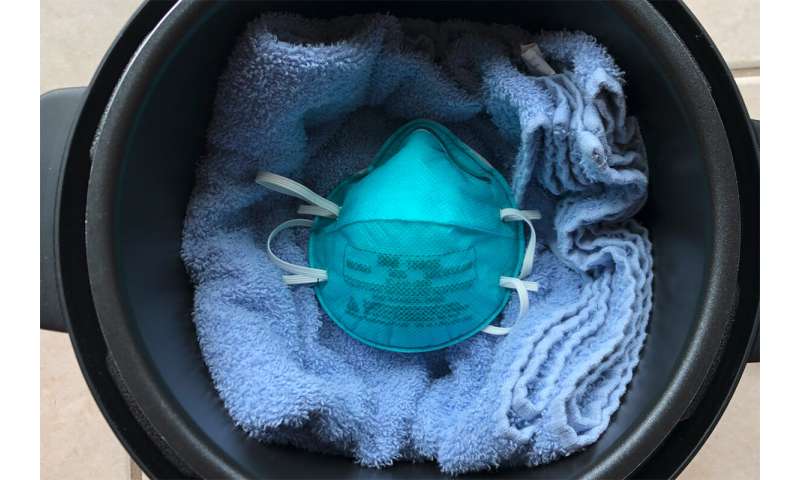
The researchers created a video demonstrating the method. They note that the heat must be dry heat - no water added to the cooker, the temperature should be maintained at 100 degrees Celsius for 50 minutes and a small towel should cover the bottom of the cooker to keep any part of the respirator from coming into direct contact with the heating element. However, multiple masks can be stacked to fit inside the cooker at the same time, Nguyen said.

The researchers see the potential for the electric-cooker method to be useful for health care workers and first responders, especially those in smaller clinics or hospitals that do not have access to large-scale heat sanitization equipment. In addition, it may be useful for others who may have an N95 respirator at home - for example, from a pre-pandemic home-improvement project - and wish to reuse it, Nguyen said.


Electric cooker an easy, efficient way to sanitize N95 masks, study finds
by Liz Ahlberg Touchstone, University of Illinois at Urbana-Champaign

One 50-minute, 212 F cooking cycle in a dry electric multicooker decontaminates an N95 respirator without chemicals and without compromising the filtration or fit. Credit: Chamteut Oh

Owners of electric multicookers may be able to add another use to its list of functions, a new study suggests: sanitization of N95 respirator masks.

The University of Illinois, Urbana-Champaign study found that 50 minutes of dry heat in an electric cooker, such as a rice cooker or Instant Pot, decontaminated N95 respirators inside and out while maintaining their filtration and fit. This could enable wearers to safely reuse limited supplies of the respirators, originally intended to be one-time-use items.

Led by civil and environmental engineering professors Thanh "Helen" Nguyen and Vishal Verma, the researchers published their findings in the journal Environmental Science and Technology Letters.

N95 respirator masks are the gold standard of personal protective equipment that protect the wearer against airborne droplets and particles, such as the coronavirus that causes COVID-19.

"A cloth mask or surgical mask protects others from droplets the wearer might expel, but a respirator mask protects the wearer by filtering out smaller particles that might carry the virus," Nguyen said.

High demand during the COVID-19 pandemic has created severe shortages for health care providers and other essential workers, prompting a search for creative approaches to sanitization.
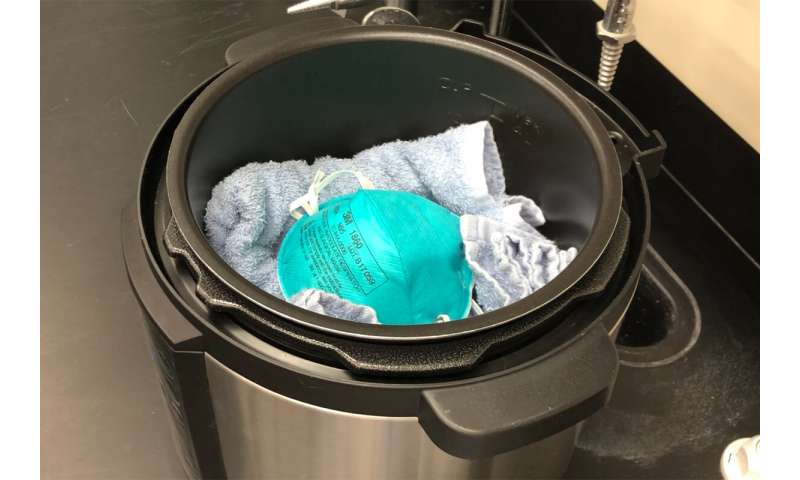
A towel keeps the respirator from touching the heating element on the bottom of the cooker. Credit: Chamteut Oh

"There are many different ways to sterilize something, but most of them will destroy the filtration or the fit of an N95 respirator," Verma said. "Any sanitation method would need to decontaminate all surfaces of the respirator, but equally important is maintaining the filtration efficacy and the fit of the respirator to the face of the wearer. Otherwise, it will not offer the right protection."


The researchers hypothesized that dry heat might be a method to meet all three criteria—decontamination, filtration and fit—without requiring special preparation or leaving any chemical residue. They also wanted to find a method that would be widely accessible for people at home. They decided to test an electric cooker, a type of device many people have in their pantries.

They verified that one cooking cycle, which maintains the contents of the cooker at around 100 degrees Celsius or 212 Fahrenheit for 50 minutes, decontaminated the masks, inside and out, from four different classes of virus, including a coronavirus—and did so more effectively than ultraviolet light. Then, they tested the filtration and fit.
"We built a chamber in my aerosol-testing lab specifically to look at the filtration of the N95 respirators, and measured particles going through it," Verma said. "The respirators maintained their filtration capacity of more than 95% and kept their fit, still properly seated on the wearer's face, even after 20 cycles of decontamination in the electric cooker."

The researchers created a video demonstrating the method. They note that the heat must be dry heat—no water added to the cooker, the temperature should be maintained at 100 degrees Celsius for 50 minutes and a small towel should cover the bottom of the cooker to keep any part of the respirator from coming into direct contact with the heating element. However, multiple masks can be stacked to fit inside the cooker at the same time, Nguyen said.

The researchers see potential for the electric-cooker method to be useful for health care workers and first responders, especially those in smaller clinics or hospitals that do not have access to large-scale heat sanitization equipment. In addition, it may be useful for others who may have an N95 respirator at home—for example, from a pre-pandemic home-improvement project—and wish to reuse it, Nguyen said.

Explore further
Researchers says autoclaving, alcohol not the best options for disinfecting, reusing face masks
More information: Chamteut Oh et al, Dry Heat as a Decontamination Method for N95 Respirator Reuse, Environmental Science & Technology Letters (2020).
SISI BE CURSED
Egypt highway uproots graves, homes in 'City of Dead'


Issued on: 09/08/2020 - 

For those unable to afford prohibitively high rents in Cairo, the burial chambers provide shelter to eke out a largely tranquil, if bizarre, existence side-by-side with dead sultans, singers and saints Khaled DESOUKI AFP

Cairo (AFP)

Egyptian mother-of-three Menna said she was caught off guard when a bulldozer clearing space for a controversial highway flattened much of a mausoleum that doubled as her home in a sprawling cemetery.

"The earth mover suddenly hit the wall and we found ourselves throwing our things in a panic" outside, she told AFP.

"They kicked us out on the street," she said, surrounded by rubble and dust in the UNESCO-listed world heritage site.

Menna's parents and grandparents had made their home among the graves of the City of the Dead, the oldest necropolis in the Muslim world.

For those unable to afford prohibitively high rents in Egypt's capital, the burial chambers provide shelter for thousands like her.

Many built extensions to the original mausoleums, eking out a largely tranquil, if bizarre, existence side-by-side with dead sultans, singers and saints in the sprawling east Cairo cemetery.

But Menna said her peace -- and that of the dead -- was shattered by the arrival of workmen.

"It was awful. We moved the dead on straw mats," she said.

She and her husband shifted several bodies, including the remains of her father, to a segment of her home still intact.

Menna is now living with neighbours in part of the cemetery that is not in the demolition area.

Dozens of bodies were displaced by the construction work in the second half of July, according to local media, to make way for the 17.5 kilometre (11 miles) Al-Ferdaous, or Paradise, highway.

- 'Bulldozer policy' -

Ferdaous, connecting major Cairo road arteries, is the latest instalment of President Abdel Fattah al-Sisi's urban vision.

He is intent on transferring the centre of political power to a new capital, about 45 kilometres east of Cairo -- a mega-project in the desert overseen by the military's engineering arm.

Sisi led the army's overthrow of elected president Mohamed Morsi in 2013 following mass protests against the Islamist leader's rule.

He won his first term as president in 2014 and was re-elected four years later with more than 97 percent of the vote.

It is not just residents of the City of the Dead who are upset by the demolition work undertaken there.

Galila El-Kadi, a Marseille-based veteran architect and urban researcher, said the site is "an important component" of the capital's urban history.

A final resting place for illustrious figures including singer Farid al-Atrash and writer Ihsan Abdel Kouddous as well as ordinary Egyptians, the Islamic necropolis founded in the seventh century stretches over 6.5 kilometres (four miles).

It is full of ornately designed domes with chiseled Koranic verses that have been the object of fascination for orientalist painters and historians.

Kadi, who authored a book on the City of the Dead (al-Qarafa in Arabic), said the demolition had reached a historic perimeter where luminaries are buried, including Sultan Abu Said Qansuh of the Mamluk dynasty in the 15th century.

She said the demolitions would result in a loss of Cairo's "visual identity and its memory".

They reveal the "blind and arbitrary" character of a haphazard urban planning vision, driven by a "bulldozer policy", Kadi alleged.

UNESCO told AFP that it was "neither informed nor consulted" about the demolition work undertaken in July.

"The World Heritage Centre is following up with the Egyptian authorities to review the matter and assess any potential impacts on the Outstanding Universal Value, authenticity and integrity of the property," it added.

- 'Abuse without mercy' -

On social media, Egyptians have documented the urban destruction with photos of their family vaults as well as historic ones.

A Twitter user with the handle @morocropolis said his maternal family had maintained a vault in Qunsah Street since the 1940s.

He declined to give his full name fearing his criticism of the highway project would land him in trouble.

The authorities "told us that they needed part of the women's burial chamber, but they started to destroy the fence and the tombstones before the remains were moved," he told AFP.

He said he will not be eligible for compensation since the crypt was partially, rather than fully, destroyed.

Egypt's ministry of antiquities defended the work undertaken in the cemetery last month and said "there was no destruction of monuments".

Only "recent graves" were moved, it said.

But Menna said she is haunted by the disturbed bodies.

"They abuse the living and the dead, without mercy... and in the end, no one cares about us."

ofha/mdz/ff/dwo

Nagasaki marks 75 years since atomic bombing

Issued on: 09/08/2020 - 


Doves fly during a ceremony marking the 75th anniversary of the atomic bombing of Nagasaki, at the city's Peace Park Philip FONG AFP

Nagasaki (Japan) (AFP)

The Japanese city of Nagasaki on Sunday commemorates the 75th anniversary of its destruction by a US atomic bomb, with the coronavirus pandemic forcing a scaling back of ceremonies.

Nagasaki was flattened in an atomic inferno three days after Hiroshima -- twin nuclear attacks that rang in the nuclear age and gave Japan the bleak distinction of being the only country to be struck by atomic weapons.

Early Sunday, people attended a mass held in memory of victims at Urakami Church, near the site of the bombing, while others took part in a memorial service at the city's Peace Park.


The number of participants has been reduced to roughly one tenth the figure in previous years, with proceedings broadcast live online in Japanese and English.

Terumi Tanaka, 88, who survived the Nagasaki bombing when he was 13 at his house on a hillside, remembers the moment everything went white with a flash of light, and the aftermath.

"I saw many people with terrible burns and wounds evacuating ... people who were already dead in a primary school-turned shelter," Tanaka told AFP in a recent interview, saying his two aunts died.

Atomic bomb survivors "believe that the world must abandon nuclear arms because we never want younger generations to experience the same thing", he said.

Tanaka suspects people have become complacent, believing another nuclear weapon will not be used.

"Human beings possess about 13,000 nuclear bombs now. Our question is how on Earth are we allowing that?" he said.

"Do people think they will never be used at all? You never know, really you never know."

The remembrance ceremonies come as worries linger over the nuclear threat from North Korea and growing tensions between the US and China over issues including security and trade.

The US dropped the first atomic bomb on Hiroshima on August 6, 1945, killing around 140,000 people. The toll includes those who survived the explosion itself but died soon after from radiation exposure.

Three days later, the US dropped a plutonium bomb on the port city of Nagasaki, killing 74,000 people.

Japan announced its surrender in World War II on August 15, 1945.

The United States has never acceded to demands in Japan for an apology for the loss of innocent lives in the atomic bombings, which many Western historians believe were necessary to bring a quick end to the war and avoid a land invasion that could have been even more costly.

Others see the attacks as unnecessary and even experimental atrocities.

Last year, Pope Francis met with several survivors on visits to Hiroshima and Nagasaki, paying tribute to the "unspeakable horror" suffered by the victims.

In 2016, Barack Obama became the first sitting US president to visit Hiroshima. He offered no apology for the attack but embraced survivors and called for a world free of nuclear weapons.

© 2020 AFP
Canadian brewer apologizes for naming beer 'pubic hair' in Maori

            ANOTHER MAORI LANGUAGE DRINK NAME FAUX PAS

Issued on: 09/08/2020 -

Montreal (AFP)

A Canadian brewery has apologized for naming one of its beers after the Maori term for "pubic hair", and not "feather" as it had intended, CBC reported.

Hell's Basement Brewery in Alberta province launched its Huruhuru (The Feather) New Zealand pale ale two years ago, using the Maori term they believed meant feather to reflect its light citrus taste for a summer brew.


But earlier this week Maori former TV personality Te Hamua Nikora posted a Facebook video to explain "huruhuru" was more commonly used in Te Reo Maori to refer to pubic hair, and said it would have been prudent and respectful to have consulted an expert on the language.


Brewery founder Mike Patriquin said they did not intend to offend anyone.

"We acknowledge that we did not consider the commonplace use of the term huruhuru as a reference to pubic hair, and that consultation with a Maori representative would have been a better reference than online dictionaries," he said in a statement to CBC.

"We wish to make especially clear that it was not our intent to infringe upon, appropriate, or offend the Maori culture or people in any way; to those who feel disrespected, we apologize."

Patriquin said the brewery intended to rename the offending brew.

Nikora has also called out a leather shop in the New Zealand capital Wellington, which was also named Huruhuru.


ps/roc/mtp/amj

Une brasserie de la province canadienne d'Alberta a présenté des excuses pour avoir baptisé une de ses bières d'un nom Maori voulant dire "poils pubiens" et non "plume" comme elle le croyait, selon la chaîne CBC.

La brasserie albertaine Hells's Basement (le sous-sol de l'enfer) a mis en vente il y a deux ans une bière appelée "Huruhuru - The Feather" (Huruhuru - la plume), brassée avec des houblons de Nouvelle Zélande, censés lui donner de la légereté et un petit goût d'agrumes idéal pour l'été, selon ses concepteurs.

Mais au début de la semaine, Te Hamua Nikora, un Maori, a expliqué sur Facebook que dans la langue utilisée par les Maoris, la population autochtone de Nouvelle Zélande, le mot Huruhuru ne voulait pas dire plume mais plutôt poils pubiens, soulignant qu'il aurait été "prudent et respectueux" de consulter un expert du Te Reo Maori, la langue des Maoris.

Le patron de la brasserie Mike Patriquin a indiqué dans un message à la CBC qu'il n'avait pas l'intention "de s'approprier ou d'offenser la culture ou le peuple maoris" et qu'il présentait des "excuses à tous ceux qui ont pu se sentir offensés".

"Nous reconnaissons que nous n'avons pas envisagé que Huruhuru pouvait être compris comme une référence à des poils pubiens dans la langue commune et que la consultation d'un représentant maori aurait été une meilleure référence que celle de dictionnaires en ligne", a-t-il ajouté.

M. Patriquin a aussi indiqué avoir l'intention de rebaptiser sa bière.

M. Nikora avait aussi pris à partie sur Facebook une maroquinerie ouverte récemment à Wellington, également baptisée Huruhuru.

© 2020 AFP
BELARUS
Lukashenko: Soviet-style autocrat on Europe's doorstep

Issued on: 09/08/2020 -
In power since 1994, Lukashenko has kept his landlocked homeland wedged between Russia and EU member Poland largely stuck in a Soviet time warp 
ON THE BORDER WITH UKRAINE, WAS ONCE PART OF UKRAINE, BELARUS IS AKA
WHITE RUSSIA AND LITTLE RUSSIA

Nikolay PETROV BELTA/AFP

Minsk (AFP)

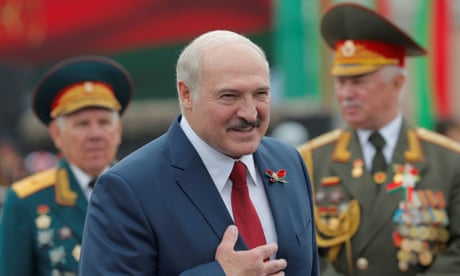
Strongman Alexander Lukashenko, who has ruled over ex-Soviet Belarus for nearly three decades, is facing down the greatest challenge to his rule ahead of presidential elections on Sunday.

In the run-up to the vote in which Lukashenko will seek a sixth term, protests have erupted across the country straddling Russia and Europe, with 37-year-old stay-at-home-mother Svetlana Tikhanovskaya emerging as his toughest rival.

Critics have mocked Lukashenko, claiming his approval ratings have hit single digits and nicknamed the 65-year-old authoritarian leader "Sasha 3 percent."


One of Lukashenko's would-be rivals, Tikhanovskaya's husband Sergei, dubbed the famously mustachioed Lukashenko "the cockroach" and his supporters waved slippers at protests to symbolise stamping out his rule.

In response, Lukashenko, who is Europe's longest serving leader, jailed his main rivals including Tikhanovsky and told opponents not to call him names.

"Insulting people is not allowed in any country in the world," he said at a meeting with Belarusians in late June.

"Do you really believe that a sitting president can have a 3-percent rating?"

During an animated address to the nation this week, Lukashenko wiped sweat from his brow as he accused the opposition of planning mass riots in the capital Minsk and urged voters to renew his tenure to stave off an uprising.

"All kinds of arrows, poisoned and COVID-ridden, are targeted at Lukashenko in order to bring him down, humiliate him, stamp on him, and destroy him," he told the packed auditorium of officials, church leaders and military personnel.

- Blunt-speaking folksiness -

He has spent the lead-up to the election touring military bases and overseeing police drills to signal that he will not tolerate attempts to unseat him.

Yet the crackdown appears only to have energised the opposition.

Tikhanovsky's wife Svetlana -- who was allowed to register as a candidate -- has joined forces with the wife of another Lukashenko opponent and the female campaign chief of an ex-banker who was jailed and barred from running.

The president has however insisted that Belarus is not ready for a female leader.

A female president "would collapse, poor thing," he said.

Amnesty International has accused Lukashenko's government of "misogyny" and targeting female activists with discriminatory tactics.

Lukashenko is known for his blunt-speaking folksiness and the former collective farm director is routinely pictured in agricultural settings like tractor factories or potato fields.

Despite tens of thousands of coronavirus infections, he has dismissed the pandemic as a hoax and refused to introduce a lockdown or postpone the election.

He has offered dubious tips on avoiding the virus, recommending driving tractors in the countryside, drinking vodka and taking steam baths.

He has also advised Belarusian men to "keep kissing" their partners but not to "run after another woman".

- Between Russia and West -

In power since 1994, Lukashenko has kept his landlocked homeland wedged between Russia and EU member Poland largely stuck in a Soviet time warp.

A quarter of a century after the collapse of the USSR the tightly controlled eastern European nation still has a security service called the KGB, adheres to a command economy and looks to former master Moscow as its main ally, creditor and energy provider.

But Lukashenko has not been afraid to cross swords with the Kremlin as he nervously eyed its intervention in neighbouring Ukraine, and has sought to mend fences with the West.

In February, Lukashenko welcomed to Minsk US Secretary of State Mike Pompeo, during the first visit to Belarus by a US Secretary of State since 1994.

Despite recurring financial crises Lukashenko has stood firmly by Soviet-era economic policies.

He has also signed the country up to the Eurasian Economic Union, Russian President Vladimir Putin's pet project.

But while Belarus remains the most closely aligned former Soviet republic to Moscow, Lukashenko insists he is no Kremlin patsy, often switching from speaking Russian to Belarusian to show his independence.

When Putin seized Crimea from Ukraine and was accused of sparking a rebellion after the February 2014 ouster of Kiev's Moscow-backed leader, Lukashenko appeared wary of Russia's aggressiveness.

He has rejected the idea of outright unification with Russia and has accused Moscow of meddling in the current presidential campaign.

Less than two weeks before the polls Belarus arrested more than 30 Russian "militants", saying they were on a mission to destabilise the country.

© 2020 AFP
UPDATE
Belarus presidential challenger demands 'honest election'


Issued on: 09/08/2020 -

Presidential candidate Svetlana Tikhanovskaya casts her ballot in Minsk 
Sergei GAPON AFP

Minsk (AFP)

The main opposition candidate challenging Belarusian strongman Alexander Lukashenko demanded a fair election as she cast her ballot in the presidential poll on Sunday.

"I really want the election to be honest, because if the authorities have nothing to fear, if all the people are for Alexander Grigoryevich (Lukashenko), then we will agree with that," Svetlana Tikhanovskaya said as she cast her ballot in the capital Minsk.

The 37-year-old English teacher and translator's campaign has emerged as the biggest challenge in years to Lukashenko, who has ruled the ex-Soviet country of 9.5 million since 1994.

She stood for election after authorities barred her husband, popular blogger Sergei Tikhanovsky, from running and then jailed him.

Tikhanovskaya's campaign office said Sunday that one of her key allies, Veronika Tsepkalo, had left the country for Russia out of concern for her safety.

Tsepkalo, whose ex-diplomat husband Valery Tsepkalo was barred from standing in the election, had backed Tikhanovskaya in the campaign and her husband had already fled to Moscow fearing arrest.
"We have been in contact with Veronika Tsepkalo. She says she is in Moscow and will vote there," the press service for the campaign said.

"We respect Veronika's decision, the situation is not easy. Everyone has the right to assess their personal risks on their own."

Tsepkalo and Maria Kolesnikova, campaign chief of ex-banker Viktor Babaryko who was also dropped from the polls and is in jail, joined forces with Tikhanovskaya to mount a united campaign against Lukashenko.


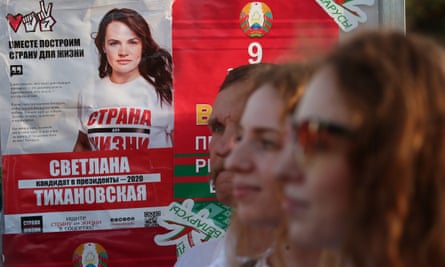
Photographs of the three women standing together and making their signature gestures -- Tikhanovskaya's punched fist, Kolesnikova's fingers in a heart shape and Tsepkalo's victory sign -- have become an emblem of the opposition.
Belarus opposition rallies voters with promise of change


Kolesnikova was briefly detained on the eve of the vote on Saturday


Tikhanovskaya: Stay-at-home mum rocking Belarus polls


Issued on: 09/08/2020 -

Presidential candidate Svetlana Tikhanovskaya describes herself as 'a symbol of change' for Belarus, which has been under strongman rule for nearly three decades Sergei GAPON AFP


Minsk (AFP)

Stay-at-home-mother Svetlana Tikhanovskaya never had presidential ambitions.

But in a tale worthy of a Hollywood script, in a matter of weeks the 37-year-old has gone from an unknown to the strongest rival to Belarus strongman Alexander Lukashenko, who is seeking a sixth term in the August 9 poll.

Tikhanovskaya says she is contesting the election to get her jailed blogger husband out of prison and win much-needed freedom for the ex-Soviet country of 9.5 million people.

"I love my husband very much so I am continuing what he started," she said.

"I love Belarusians and I want to give them an opportunity to have a choice."

Tikhanovskaya, an English teacher by training, only made the decision to stand for president in May.

Her husband Sergei Tikhanovsky -- a popular 41-year-old YouTube blogger -- had been detained and could not submit his own presidential bid in time.

The electoral commission allowed Tikhanovskaya to stand, dropping two stronger opposition candidates.

Despite a lack of political experience, she has quickly emerged as the country's top opposition figure, with tens of thousands taking to the streets to support her bid.

In speeches, Tikhanovskaya calls herself an "ordinary woman, a mother and wife" and pumps up crowds with calls for change.

"I have become the embodiment of people's hope, their longing for change," she told AFP in an interview.

She acknowledged that she is standing despite receiving threats.

Her husband has been accused of plotting mass unrest and collaborating with Russian mercenaries, claims Tikhanovskaya has called "very scary."

Their five-year-old daughter and 10-year-old son have been taken abroad for their own safety.

She said the separation from her children -- including her son who is hearing impaired -- was difficult.

Tikhanovskaya stresses that if elected, she would free her husband and other detained opposition figures and hold fresh polls.

- 'Joan of Arc' -

Her bid has prompted scepticism from some, while others have compared her to historical heroines.

The Village, a Minsk-based news site, called her "an accidental Joan of Arc," the 15th century French peasant who helped achieve a pivotal military victory against the English before she was burned at the stake.

"You're a wife of a Decembrist!" one supporter shouted at a rally, referring to 19th-century aristocrats who followed their husbands into Siberian exile.

Hesitant in early television appearances, Tikhanovskaya has won praise for recent speeches.

Allocated live slots on state television, she listed alleged lies by Lukashenko's regime, repeating: "They won't show you this on television".

"Unexpectedly her first speech on television was strong, without false notes or weak points," wrote opposition newspaper Nasha Niva.

Belarusian Nobel-prize winning author Svetlana Alexievich has said she will vote for Tikhanovskaya.

Tikhanovskaya's simple but direct speeches have prompted lengthy cheers at crowded rallies.

"Are you tired of enduring it all? Are you tired of keeping silent?" she asked supporters recently.

"Yes," the crowd roared.

She has accused Lukashenko of showing blatant disregard for the people during the coronavirus epidemic, which the strongman has dismissed as a hoax.

Her bid for president has come under pressure, with her campaign manager Maria Moroz arrested on Saturday, the second time in a week, Tikhanovskaya's spokeswoman said.

Tikhanovskaya says that she lacks the "massive charisma" of her husband, who has travelled round Belarus interviewing ordinary people for hard-hitting videos.

- Charlie's Angels -

Image-wise, she pulled off a transformation with help from two women with more experience and political drive.

These are Veronika Tsepkalo, whose ex-diplomat husband Valery Tsepkalo was barred from standing, and Maria Kolesnikova, campaign chief of ex-banker Viktor Babaryko who was also dropped from the polls and is in jail.

The two women, more sharply dressed and confident speakers, flank her at rallies -- with one Belarusian news outlet nicknaming them "Charlie's Angels."

The women wear t-shirts with a design featuring their signature gestures: Tikhanovskaya's punched fist, Kolesnikova's fingers in a heart shape and Tsepkalo's victory sign.

Tikhanovskaya has started wearing her hair down and swapped severe dark clothing for pastels.

She has appeared uncomfortable over mounting pressure to explain her political views, acknowledging she was not a politician but a "symbol" of change.

Tikhanovskaya grew up in Mikashevichi, a small town south of Minsk.

With top grades she studied to become a teacher of English and German in the historic city of Mozyr. It was there she met her future husband, who owned a nightclub there.

video-am-as/lc

© 2020 AFP
UPDATE Belarus opposition figures detained as Lukashenko faces challenge in presidential vote

Issued on: 09/08/2020 -


A voting soldier looks at information on candidates at a polling station in Minsk during the presidential election on August 9, 2020. © Sergei Gapon, AFP

Text by:NEWS WIRES

Belarus began voting in an election on Sunday pitting President Alexander Lukashenko against a former teacher who emerged from obscurity to lead the biggest challenge in years against the man once dubbed "Europe's last dictator" by Washington.

The 65-year-old Lukashenko is almost certain to win a sixth consecutive term but could face a new wave of protests amid anger over his handling of the COVID-19 pandemic, the economy and his human rights record.

An ongoing crackdown on the opposition could hurt Lukashenko's attempts to mend fences with the West amid fraying ties with traditional ally Russia, which has tried to press Belarus into closer economic and political union.

A former Soviet collective farm manager, Lukashenko has ruled since 1994.


International election observers 'haven't even been invited' for Belarus vote

He faces a surprise rival in Svetlana Tikhanouskaya, a former English teacher who entered the race after her husband, an anti-government blogger who intended to run, was jailed.

Her rallies have drawn some of the biggest crowds since the fall of the Soviet Union in 1991. Human rights groups say more than 1,300 people have been detained in a widening crackdown.

>> Belarus opposition figures detained on eve of presidential vote

Foreign observers have not judged an election to be free and fair in Belarus for a quarter of a century. Despite an election commission ban on the opposition holding an alternative vote count, Tikhanouskaya urged her supporters to monitor polling stations.

"We are in the majority and we don't need blood on the city streets," she said on Saturday. "Let's defend our right to choose together."

Opposition candidate in Belarus's presidential elections Svetlana Tikhanouskaya at a campaign rally in Minsk on July 30,2020. © AFP / FRANCE 24
Belarus’s ‘Joan of Arc’: The reluctant candidate taking on Europe’s ‘last dictator’

Portraying himself as a guarantor of stability, Lukashenko says the opposition protesters are in cahoots with foreign backers, including a group of 33 suspected Russian mercenaries detained in July and accused of plotting "acts of terrorism".

Analysts said their detention could be used as a pretext for a sharper crackdown after the vote.

"Lukashenko a priori made it clear that he intends to retain his power at any cost. The question remains what the price will be," said political analyst Alexander Klaskovsky.

(REUTERS)


UPDATE 

Belarus presidential challenger goes into hiding on eve of election
Svetlana Tikhanovskaya, who is trying to unseat Alexander Lukashenko, fled her home after police detained staffers

Tikhanovskaya was expected to emerge to vote on Sunday. Photograph: Tatyana Zenkovich/EPA
Andrew Roth in Moscow and Yan Auseyushkin in Minsk

Published on Sun 9 Aug 2020 

Belarus’s opposition candidate for president was forced to go into hiding the night before challenging the country’s longtime leader, Alexander Lukashenko, on Sunday in the country’s most dynamic election in a generation.

Candidate Svetlana Tikhanovskaya left her apartment after police detained two senior staffers and seven other campaign members in what they called an attempt to scare the opposition before the crucial vote. She was expected to re-emerge to vote on Sunday with an entourage of campaign staffers and journalists.


Belarus president says opponents trying to organise massacre
Read more


Polls opened on Sunday after an unprecedented campaign that has seen the country’s largest opposition political rallies since the fall of the Soviet Union. Lukashenko, who has consolidated immense power over 26 years of rule, is expected to claim victory, but anger over vote rigging is likely to trigger protests.

In a final appeal before the vote, Tikhanovskaya condemned security services for arresting peaceful demonstrators and called on troops deployed across the city “not to carry out criminal orders”.

“We need changes,” she said in a YouTube video filmed in front of a bay of shuttered windows. “We need a new president.”

Squares near government buildings have been cordoned off and armed troops have appeared at highway entrances to Minsk. Lukashenko, who was subjected to sanctions by the US and the EU for the government’s heavy-handed crackdown on the opposition after elections in 2010, has warned that illegal protests will be met with force.

At Minsk’s Belarusian State Economic University, voters streamed into two polling stations on Sunday morning from the capital’s unusually quiet streets. Viktor Chonovoy, a vote monitor for the organisation Honest People, was perched on a red plastic chair peering through a window at the ballot box and tallying turnout.

“Nobody is letting me monitor [the vote],” he said. “It is just pro-government monitors replacing one another.” He said that the early voting results showing 642 ballots cast was more than double the actual number of voters, indicating ballot stuffing.

Pro-Tikhanovskaya voters said they wanted to see change, a popular slogan for the campaign, or thought that Lukashenko had overstayed his time in office. Many were pessimistic about the chances of the vote being counted fairly.

“I want a new government but that’s not going to happen,” said Vadim, a pensioner, who wore a white ribbon on his arm and said he was voting for Tikhanovskaya. “If Lukashenko loses power, then it’s obvious where he will end up.”

Valentina said: “I’m going to vote not for Lukashenko, not because I consider him a bad president, he’s done much good for the country, but I think that two presidential terms of five years is enough.” Lukashenko is seeking a sixth term in office. “He’s sat for long enough.”

Supporters of the government said they wanted to preserve stability under Lukashenko’s strong leadership or were concerned with preserving government benefits.
An election commission member holds a ballot box in a car before home voting. Photograph: Valery Sharifulin/TASS

“We want stability, calm, to keep everything good that we’ve got,” said one pensioner going to vote for Lukashenko. “Of course I’m voting for Lukashenko, there’s no one else to vote for.”

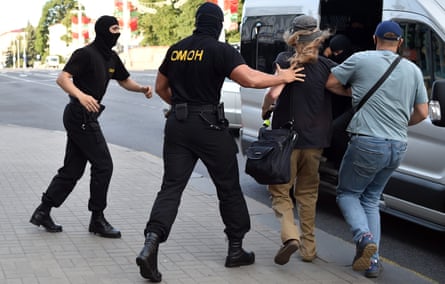
There were already signs of a crackdown heading into the vote. On Saturday evening, riot police in balaclavas made arrests to break up impromptu demonstrations against Lukashenko. Pro-Lukashenko adverts on state television showed chaotic scenes of “colour revolutions” from other post-Soviet states. Belarusian media have warned of a possible internet shutoff to stifle protests following Sunday’s vote, and local activists said that VPNs and an online platform used by vote monitors were knocked offline in the morning.

Tikhanovskaya’s press secretary Anna Krasulina said in an interview that the candidate would travel with staffers and journalists throughout the day. “We can’t defend ourselves physically against armed people or the security services,” she said. “This is the most trustworthy defence we have.”
Belarus riot police detain a man on Saturday during an opposition rally on the eve of the presidential election in central Minsk. Photograph: Sergei Gapon/AFP/Getty Images

Lukashenko is facing unprecedented anger over his handling of the economy and a bungled coronavirus response. Before the elections he has jailed opposition candidates and targeted foreign allies, accusing Moscow of sending mercenaries to destabilise the country.

Tikhanovskaya was initially a stand-in candidate for her husband, a popular YouTuber jailed in spring by the authorities. She has grown into an effective campaigner, attracting more than 63,000 people to a campaign rally last month in Minsk, and thousands more in small cities and towns usually dominated by Lukashenko. She has been joined onstage by two other female politicians in a “trio” that has transformed the image of the country’s male-dominated politics.

More than 40% of Belarusians were reported to have already cast ballots in early voting, an unprecedented number that critics say indicate ballot stuffing by the government. Vote monitors contacted by the Guardian said they had been blocked from polling stations in favour of loyalists who were unlikely to raise challenges. A photograph showing a vote monitor standing on a stool peering through a polling station window with a pair of binoculars went viral.

One monitor, Anastasia Kadomskaya, 30, said she had managed to count turnout at her Minsk polling station by sitting in front of an open door in view of the ballot box. She said that her polling station’s official turnout matched her own tally of around 17%, less than half of the national average. “You feel colossal pressure and stress at every moment because you have to keep defending your right to watch the vote as a citizen and observer,” she said in an interview.

The opposition has said it will challenge vote rigging at polling stations but has stopped short of calling supporters out on to the streets. “We’re not calling people to a maidan,” Tikhanovskaya told Belarusian news site Tut.by in an interview published on Friday, referring to the 2014 revolution in Ukraine. “We want honest elections. Is that a crime?