Sunday, August 09, 2020

Um, why is there a gigantic black cloud circling the globe?
Australia’s epic wildfires — along with freak thunderstorms — rocketed dust particles and ash 15 miles into the atmosphere. The massive 'fire cloud' is drifting around the Pacific Ocean.

By James Burch

The scientific name is cumulonimbus flammagenitus, but the more common nickname is ‘fire cloud.’ NASA calls them the "fire-breathing dragon of clouds," according to their website.

One of the largest fire clouds ever recorded has been drifting around the Southern Hemisphere for over a month. Heat and freak thunderstorms generated by Australia’s massive wildfires sent ash and toxic materials high into the atmosphere, where they formed a massive dark cloud of debris. It’s been measured at 15 miles high at some points, and at one point it covered more than 1 million square miles — about half the size of Canada.

NASA has been tracking the massive cloud from space as it slowly drifted over to South America and then looped back toward Oceania where it hovered over New Zealand, turning glaciers brown, and perhaps hastening their melting.

As Australian firefighters get their blazes under control, the cloud has been dissipating. Health experts say toxic chemicals and debris eventually drop back to Earth, through the air or within raindrops, where they can be inhaled or ingested by humans and animals.

The giant cloud may also impact global weather by blocking sunlight to the Earth’s surface, an effect known as "nuclear winter," named after a hypothesis that the world would become extremely cold due to the firestorms of a nuclear war. The same effect happens in major volcanic eruptions when giant plumes of ash sweep across continents. In 1815 the Mount Tambora volcano in Indonesia created the "year without summer" across much of the globe, including in the United States, where farmers lost crops as seasonal temperatures plummeted.

Right now, scientists aren’t sure when the Australian fire cloud will dissipate or whether it will start moving again.

VIDEO
Bill Gates: US only country to have coronavirus 'testing insanity'
BY ZACK BUDRYK - 08/09/20

Microsoft founder Bill Gates on Sunday lamented the U.S.’ coronavirus “testing insanity,” which he said had caused the country to fall behind the rest of the world, much of which has begun reopening after flattening infection growth.

“A variety of early missteps by the U.S. and then the political atmosphere meant that we didn’t get our testing going,” Gates said Sunday on CNN’s “Fareed Zakaria GPS.” “It’s nonsense that any sort of travel ban we did was at all beneficial. That doesn’t pass the common sense test… and now we’ve executed our lockdowns nationwide with less fidelity than other countries.”

Commercial labs, he said, have left customers struggling with long wait-times while “very wealthy people have access to these quick-turnaround tests.”

“It’s mind-blowing that you can’t get the government to improve the testing because they just want to say how great it is,” he continued. “I’ve said to them, look, have a CDC website that prioritizes who gets tested. Don’t reimburse any test where the result goes back after three days. You’re paying billions of dollars in this very inequitable way to get the most worthless testing results in the world.”

“No other country has the testing insanity, because they won’t talk about fixing it, because they think they need to just keep acting like they’ve done a competent job,” he added.

Without sufficiently rapid testing, Gates continued, people with the virus may not be able to self-isolate in time to contain the infection. He added that he believes a vaccine will likely be developed by the end of 2020 or within the first half of 2021.

President Trump has vocally defended the U.S.’ testing for the virus and repeatedly claimed that the country’s numbers are only high due to the testing regimen, despite the fact that the positive percentage rate of the tests remains high as well.
What Trump got wrong by pushing coal
BY CAROLYN KISSANE, OPINION CONTRIBUTOR — 08/09/20
THE HILL

© Greg Nash

While campaigning in Columbus, Ohio, in March 2016, Hillary Clinton said something that she later cited as the comment she “regret[s] the most” from her presidential run. Clinton announced that she would put coal miners and companies out of business if she became president. Her comments likely cost her significant support across the coal-mining states of Ohio, Kentucky, Wyoming, Montana and Pennsylvania.

In the end, it wasn’t Clinton who put the hurt on coal country but instead the rapidly declining costs of renewable energy, especially solar and wind, uber-cheap natural gas and an array of states and cities with ambitious climate change action plans requiring sharp reductions in carbon dioxide emissions. Four years ago, the writing was on the wall: Saving coal would require disregarding the market and reversing the plans towards decarbonization.

Over the course of Donald Trump’s presidency, the U.S. has remained the world’s premiere oil and gas producer. But coal has continued to struggle. Bringing back coal in the United States was not something that could be achieved by executive decree.

In 2016 “Trump digs coal” became a campaign slogan, and in almost every speech he pledged to revive the sector. “We're gonna put the miners back to work. We're gonna get those mines open," he said on numerous occasions.

 Trump assured coal companies and communities that he would bring coal-mining jobs back and protect the industry. He saw what he considered to be alienated and angry coal miners who were seeing their livelihoods disappear, and he capitalized on their frustration. He captured their attention, won votes and in the first year of his presidency continued to tout his ability to resuscitate the industry. Clinton’s comments are closer to today’s reality. With the 2020 election around the corner, it’s clear Trump hasn’t kept his promises.

Hydrocarbons are not going away, but an energy transition is well under way. Many developed countries are moving away from coal, oil and gas, and even states and cities in the United States are saying no to future use of fossil fuels. To understand why requires understanding the evolution of energy systems and development, and the resolve of many state and local governments to use cleaner energy.

Coal production depends on demand, and the sector has relied on the power sector for over 90 percent of its use. As the power sector evolves, coal consumption has declined. Cheaper and cleaner sources of energy, such as wind and solar, are displacing coal, and moving into the market share of natural gas in different states such as California and New York.

The position of natural gas in the U.S. energy space is illustrated by the evolution of coal-fired plants. According to recently released EIA data, between 2011 and 2019, 121 U.S. coal-fired power plants were repurposed to burn other types of fuels, with 103 converted to or replaced by natural gas-fired plants.

Coal was in decline before 2016. Thirteen years ago, coal consumption peaked and has declined every year since. In 2019, only 966,000 gigawatts of electricity was generated by coal, and in the first half of 2020 thousands coal workers lost their jobs. Meanwhile, before the COVID crisis, solar energy was experiencing exponential growth, averaging 49 percent a year.

The COVID-driven recession has hastened coal’s demise. Demand for coal fell over 18 percent during April and May as the virus shrunk demand for power. According to the U.S. Energy Information Administration, U.S. electric generation is forecast to drop by 5 percent, with fossil fuels such as coal hit the hardest. With domestic demand falling and coal exports in decline, there’s no future scenario for coal’s comeback.

Coal’s contribution to U.S. economic development and industrialization must be acknowledged. The energy source once fueled almost half of all U.S. electricity but now powers less than a quarter and continues to decline. Coal provided a reliable and affordable source of energy and enhanced energy security. But with climate change posing untold risks and threats, coal’s high-carbon emissions will eventually make it a stranded asset.

Every new beginning comes from some other beginning’s end. Trump came into office selling a vision he wasn’t able to fully implement and maintain. Clinton may regret her anti-coal comments, but does Trump regret his misplaced promises and his failure to deliver?

Carolyn Kissane, PhD, is academic director and a clinical professor at the New York University Center for Global Affairs and a non-resident fellow at the Payne Institute at the Colorado School of Mines.
UK  Hundreds join rapper Wretch 32 at protest against police use of Tasers

The peaceful event called for ‘justice’ for a list of people who have died after coming into contact with police.


Rapper Wretch 32 attends a rally against police use of Tasers at Tottenham police station, north London (Helen William/PA)

By Helen William, PA August 08 2020

Hundreds of people have gathered outside a north London police station to support rapper Wretch 32 – whose father was Tasered by police – and to protest against racism in the force.

The crowd gathered peacefully in scorching temperatures to hear speeches and demonstrate outside Tottenham Police Station.

It comes after the 35-year-old musician, whose real name is Jermaine Scott, posted a video on Twitter of his father Millard Scott, 62, falling downstairs after being Tasered by officers in north London in April.

The Metropolitan Police has said no further action will be taken over the incident.

We have got to keep on protesting because this is for all of our kids and our future. They can tear down your family from top to bottomSon of Cynthia Jarrett

Wretch 32 could be seen mingling in the crowd on Saturday, as protesters spoke of their own treatment at the hands of police.

The crowd called for officers to stop what they called the over-policing of black communities, along with the use of excessive force, Tasers, stop-and-search and the disproportionate use of handcuffing during arrest.

A list was pinned to a barrier outside the police station featuring the names of people – both black and white – who have died after coming into contact with police, dating back to the 1980s.

Banners called for “justice” for Cynthia Jarrett, Joy Gardner, Mark Duggan, Smiley Culture, Roger Sylvester, Ian Tomlinson and Jean Charles de Menezes.

Messages which read “The Met Police must cease and desist” and “Defund the police, invest in our lives” were pinned to a door at the police station.

Mina Agyepong, 42, told the crowd her 12-year-old son Kai “is traumatised and he is angry” after armed police raided her north London home late at night in July to arrest him.

He had been playing with a toy gun. Suspicions had been raised by a passer-by who said they saw a black male holding a firearm on the sofa.

She said: “I worry now what his relationship is going to be with the police – that sense of distrust. Stop criminalising our children.”

The 1985 Tottenham riots began when Broadwater Farm resident Ms Jarrett died of heart failure after four policemen burst into her home during a raid on October 5.

Winston Silcott, who was one of the Tottenham Three, was a steward at the rally (Helen William/PA)

Her son fought back tears as he told the crowd: “I get emotional when I think about my mother because I love her.

“We have all got to stick together and keep on marching. We have got to keep on protesting because this is for all of our kids and our future. They can tear down your family from top to bottom.”

Winston Silcott was one of the Tottenham Three, alongside Engin Raghip and Mark Braithwaite, convicted in 1987 of Pc Keith Blakelock’s murder during the riots.

Their convictions were quashed by the Court of Appeal in 1991, after questions were raised about the way police interviews were carried out.

Mr Silcott helped steward Saturday’s demonstration.

Scotland Yard said officers had gone to the address of Wretch 32’s father in Tottenham on April 21 as part of an operation to tackle a drugs supply linked to serious violence in Haringey.

The police watchdog, the Independent Office for Police Conduct (IOPC), has said it will not investigate the incident and the matter should be dealt with within the Met Police.

Deputy Police Commissioner Sir Stephen House told a London Assembly Police and Crime Committee in July that the IOPC had decided “this matter should be returned to you, the Metropolitan Police, to be dealt with in a reasonable and proportionate matter”.

Protester pinned up posters on the doors to the police station (Helen William/PA)

The Metropolitan Police had reviewed the incident at the time and said it had found no misconduct, but the IOPC called the matter in to make its own assessment.

The police said no further action is being taken as there is no public complaint and no indication of misconduct.

It added that should a public complaint be made or information provided about injuries, it would refer the matter again to the IOPC.

Treena Fleming, the Metropolitan Police commander of the North Area Command Unit, said: “I can understand why any use of Taser can look alarming, and why it did look alarming in this case.

“We never underestimate the impact such an incident can have on a family and the wider community.”

She said officers “are highly trained to engage, explain and try to resolve situations, using force only when absolutely necessary”.

PA
Finland Sends Anti-Maskers To The United States
AUGUST 8, 2020 BY ANDREW HALL


Helsinki, Finland – The government of this Northern European country of approximately 5.5 souls is sending citizens who refuse to wear face masks to the United States.

“We didn’t want to be cruel to the states who have been making a good faith attempt at managing the pandemic,” Finnish Prime Minister Andrew Canard said. “So, we’re sending our citizens who refuse to obey basic public health procedures to Texas, Florida, and South Dakota.”
Finland Was Prepared

The New York Times reported that Finland was well prepared at the beginning of the crisis

“Finland is the prepper nation of the Nordics, always ready for a major catastrophe or a World War III,” said Magnus Hakenstad, a scholar at the Norwegian Institute for Defence Studies

Though year after year Finland has ranked high on the list of happiest nations, its location and historical lessons have taught the nation of 5.5 million to prepare for the worst, Tomi Lounema, the chief executive of Finland’s National Emergency Supply Agency, said on Saturday.

“It’s in the Finnish people’s DNA to be prepared,” Mr. Lounema said, referring to his country’s proximity to Russia, its eastern neighbor. (Finland fought off a Soviet invasion in 1939.)


The Finnish government was gobsmacked when a minority of citizens refused to put on face masks. Due to the high quality of education in the country, there is typically great respect for science. However, some individuals still balked at donning a mask and in doing so protect others from catching COVID-19.

“We don’t have time for their paskapuhe. Why not send them to the States?” reflected Prime Minister Canard.

Those Fins kicked out will still enjoy free healthcare. While they may not be wanted in their home country many in Finland believed putting them at the mercy of the American for-profit healthcare system would be a crime against humanity.


Meet the only man to witness all 3 WWII atomic bomb blasts


Richard Sisk,
Military.com


Manhattan Project officials, including Dr. Robert J. Oppenheimer, in the white hat, and next to him Gen. Leslie Groves, inspect the remains of the Trinity test tower on September 9, 1945. Los Alamos National Laboratory/The LIFE Picture Collection/Getty Images

August is the 75th anniversary of the first and only use of the atomic bomb in warfare, the bombings of Hiroshima and Nagasaki on August 6 and 9.

Only one person witnessed both those bombings and the Trinity test in the United States — the three major atomic blasts that led to the end of World War II.

More than 600,000 men and women worked on the Manhattan Project nationwide, but only one of them bore witness to all three major atomic blasts in 1945 that led to the end of World War II.

Lawrence Johnston was aboard B-29 Superfortress bombers tending to instruments measuring the power of the world's first nuclear explosions in the "Trinity" test in New Mexico, as well as for the bombs dropped on Hiroshima and Nagasaki, which prompted Japan's surrender and brought the war to a close.
As the nation approaches the 75th anniversary of Japan's capitulation on August 15, 1945, when Emperor Hirohito went on the radio to announce that the time had come to "bear the unbearable" and accept the allied terms for unconditional surrender, Johnston's story is unique.

A young physicist born to missionary parents in China, Johnston had done groundbreaking work on the atomic bomb's intricate trigger mechanism.

When the bomb dropped on Hiroshima, Japan, on August 6, 1945, his first reaction on seeing the blinding flash and the mushroom cloud was: "Praise the Lord, my detonators worked."

He was well aware of the immense destructive power and carnage that the bomb would inflict on the city after witnessing the Trinity test but -- like most of the scientists at Los Alamos who created the weapon -- saw its use as the horrific means to achieve the final end to a war that was causing far more killing.

The final death toll from the Hiroshima bombing may never be known, but estimates say at least 80,000 were killed in the initial shock waves and firestorm, some vaporized and leaving only silhouettes to their existence on walls. About 135,000 died overall.
Lawrence Johnston with Fat man core on Tinian Island in 1945. Los Alamos National Laboratory

Johnston said he knew that, "All those people that were going to be killed -- I was praying for them. … I was praying that God would help us bring an end to the war."


"So many people were being killed every day, so many Japanese being killed every day by the bombers" with conventional weapons, he said.

Johnston reflected on his role in ushering in the "Atomic Age" in an oral history for the National World War II museum in New Orleans before he died at age 93 in 2011 at his home in Moscow, Idaho.

In a statement, Rob Wallace, of the WWII Museum's education team, said that Johnston "was the only person to see all three atomic detonations in 1945. He was at the Trinity Test, and he was part of the scientific team accompanying deployment over both Hiroshima and Nagasaki."

He studied physics at Los Angeles Community College and the University of California at Berkeley, and received a Bachelor's degree in 1940 from Berkeley, then a center for the study of atomic structure and the transformation of matter into energy.


It was at Berkeley that he came in contact with the brilliant polymath and eventual Nobel laureate Luis Alvarez, who would become his mentor, Wallace said.
Reconciling with pacifist daughter
National Archives

In the years after the war, his biggest critic for taking part in the use of nuclear weapons was his own daughter, Mary Virginia, Johnston said.

"My daughter was a pacifist, and she gave me a lot of criticism," he said. "I got a lot of flak from her, but we get along very well together now."

Mary Virginia "Ginger" Johnston would become pastor of a church in Oregon, he said.

After graduating from Berkeley in 1940, Johnston said he expected to continue his studies there for a doctorate under his mentor, but Alvarez was called East to the Massachusetts Institute of Technology Radiation Laboratory to work on ground-controlled approach radar.

He brought Johnston along for his expertise in electronics, which Alvarez surmised from one of their conversations, Johnston said.

At one point, Alvarez asked him, "What do you like to do?"

Johnston said he replied, "Oh, I like to play with radios," and that was enough for Alvarez.

Alvarez was later called to Los Alamos to work with the fractious group of great minds and even greater egos brought together by theoretical physicist J. Robert Oppenheimer, director of the Manhattan Project.

The project was named for the office building that still stands at 270 Broadway in Manhattan, across the street from City Hall, where the original planning began.

Alvarez again summoned Johnston to come work with him. Upon arriving in the New Mexico desert, "I had no idea what they were doing except that it must be important to the war effort," he said.

Alvarez "put me to work on detonators," Johnston said, seeking to devise a precisely timed implosion of conventional explosives that would trigger the nuclear core of the bomb to a chain reaction.


He came up with what was called the "exploding-bridgewire detonator," a series of 32 detonators around the core that would go off within milliseconds of one another. The principles of the exploding-bridgewire detonator have since been used in automobile airbags, Johnston said.

3 B-29 flights into history
US Air Force via Wikimedia Commons

In the early morning hours of July 16, 1945, the world's first atomic bomb had been hoisted atop a tower in in what was then the US Army Air Forces Alamogordo Bombing and Gunnery Range, now part of the White Sands Missile Range, for the test that Oppenheimer christened "Trinity."

Oppenheimer was in a bunker about 5 miles away and had ordered all others beyond a select few to be at least 25 miles away, including Johnston and Alvarez. Nobody knew for sure how powerful the blast would be.

Alvarez was "mad as socks about that," Johnston said. He convinced Oppenheimer to let him commandeer a B-29 and took Johnston with him to work instruments measuring the force of the blast.

"We saw this big flash, and then we saw this column rising, the first mushroom cloud," he said. "I had developed all of the recording equipment that recorded the pressure wave."

Then, it was off to the island of Tinian in the Northern Marianas chain with Alvarez to prepare for the bombings of Hiroshima and Nagasaki.

They were aboard a B-29 called the "Grand Artiste" that flew in formation with the B-29 called the "Enola Gay" that dropped the "Little Boy" atomic bomb on Hiroshima on August 6, 1945.

Johnston was again aboard the Grand Artiste when another atom bomb called "Fat Man" was dropped on Nagasaki on August 9, but Alvarez did not make that flight.

"Alvarez said, 'You will be the only one who saw all three of the A-bombs go off.' That made me oh so happy," Johnston said.

He returned to the States and completed his Ph.D. in physics in 1950. He would become an associate professor at the University of Minnesota in Minneapolis and later worked at the Stanford Linear Accelerator Center as head of the electronics department.

He was a professor at the University of Idaho in Moscow, Idaho, until his retirement. He died in Idaho in 2011.

Reflections on Hiroshima

A photograph of Hiroshima, Japan, shortly after the "Little Boy" atomic bomb detonated in 1945. Universal History Archive/UIG via Getty images

Aboard the Grand Artiste on August 6, 1945, Johnston and Alvarez had a 1,300-mile flight ahead of them from Tinian to the target area over Hiroshima

"On the long flight to Japan, I figured, 'Man, I don't know how big this explosion is going to be,'" Johnston said. Alvarez was asleep in the tunnel leading from the cockpit to the tailgunner's position, he said.

"Finally, I decided I better talk to him" about the recording equipment. He said, 'I don't care. Set it up wherever you think,'" Johnston said.

On the way back to Tinian, Alvarez sought to collect his thoughts on the immensity of what they had just witnessed. He jotted them down in a letter to his young son dated August 6 — "10 miles off the Jap coast at 28,000 feet."

"The story of our mission will probably be well known to everyone ... but at the moment, only the crews of our three B-29s and the unfortunate residents of the Hiroshima district of Japan are aware of what has happened to aerial warfare," Alvarez said in the letter, now in the National Archives.

"What regrets I have about being a party to maiming and killing thousands of people are tempered with the hope that this terrible weapon we have created may bring the countries of the world together and prevent further wars," he wrote.


— Richard Sisk can be reached at Richard.Sisk@Military.com.Read the original article on Military.com. Copyright 2020. Follow Military.com on Twitter.
Trump’s presidency is a death cult
The fact that Trump and his supporters want us to tolerate preventable deaths from COVID reveals their true nature

Trump supporters during a rally (Getty/Chip Somodevilla)


SONALI KOLHATKAR  SALON AUGUST 9, 2020

This article was produced by Economy for All, a project of the Independent Media Institute.

When President Donald Trump was challenged by Axios national political correspondent Jonathan Swan to respond to the fact that, "a thousand Americans are dying a day" due to COVID-19, the president responded as though the grim tally was perfectly acceptable, saying, "They are dying, that's true. And it is what it is." While observers were aghast at the callousness of his statement, it should not have surprised us. Trump had warned that the death toll would be high, and he had asked us months ago to get used to the idea. In late March, the White House Coronavirus Task Force had projected that 100,000 to 240,000 Americans would die from the virus. Rather than unveil an aggressive plan to tackle the spread and prevent the projected mortality figures, the president had said, "I want every American to be prepared for the hard days that lie ahead."

The New York Times saw this warning as a contradiction to Trump's stance in February and early March when he had said that "we have it totally under control" and "it's going to be just fine." The paper seemed to heave a sigh of relief that a few weeks later, "the president appeared to understand the severity of the potentially grave threat to the country." But the report's authors failed to grasp that Trump is willing to accept anything—including mass deaths—in service of his political career.
Advertisement:

In fact, mass death appears to be part of Trump's reelection strategy as per a July 30 Vanity Fair report on the administration's strategy to contain the pandemic. The investigative piece explained that Trump's adviser and son-in-law Jared Kushner was part of a group of White House staffers that corresponded frequently to discuss the rapidly spreading virus. According to a public health expert who was described as being "in frequent contact with the White House's official coronavirus task force," one of the members of Kushner's team had concluded that, "because the virus had hit blue states hardest, a national plan was unnecessary and would not make sense politically." The unnamed expert told Vanity Fair, "The political folks believed that because it was going to be relegated to Democratic states, that they could blame those governors, and that would be an effective political strategy."

If it is true that Kushner embraced the idea of COVID-19 deaths as part of a political strategy for Trump's reelection, there can be no clearer evidence that the Trump presidency fits the definition of a "death cult."

But Trump's team is also deeply inept, and its macabre tactics appear to have backfired. If Kushner expected a highly contagious virus to follow his political rules and relegate itself to Democratic-run states, he was proven very wrong, very quickly with Republican-run states like Florida, Texas, Alabama, Georgia, and Arizona being among the hardest hit.
Advertisement:
For years, the Republican Party has cast itself as a self-righteous force for morality, embraced the "pro-life" movement, and claimed to align with "Christian values." But just as Trump—arguably the most criminal of all U.S. presidents—has adopted a mantle of "law and order" with no hint of irony, the GOP as a whole has also shown time and again that its embrace of morality and law is a purely political tool. Now, as the nation grapples with mass deaths from a disease that a Republican president spectacularly and willfully failed to contain, conservative politicians appear willing to simply accept it. Their silence is deafening compared to the angry denunciations many Republican lawmakers hurled at President Barack Obama over his response to the Ebola epidemic—a crisis that resulted in a nationwide total of 11 infections and two deaths.

Ultimately it may be Trump's own base that suffers as it internalizes the president's mixed and confused messaging on ignoring social distancing guidelines, eschewing protective masks, swallowing hydroxychloroquine preventatively, and even accepting the inevitability of their own death (because "it is what it is" according to Trump). Even after more than 150,000 Americans have died from the virus, a majority of Republicans trust Trump's coronavirus comments.

When Trump loyalist and former presidential candidate Herman Cain died of COVID-19, testing positive 11 days after attending Trump's Tulsa, Oklahoma, rally without a mask on, his death did not change minds. The 74-year-old was reportedly on a ventilator during his last days, but conservatives are vehemently opposed to "politicizing" Cain's death. Right-wing commentator and talk show host Ben Shapiroslammed those who made a connection between Cain's refusal to take the virus seriously and his own infection and death. Shapiro said, "The kind of dunking on people after they die of COVID is pretty gross." Certainly, Cain did not deserve to be vilified for his own sad fate. But his death offers a cautionary tale about the dangers of the Trump death cult—a point Shapiro of course refused to acknowledge.
Advertisement:

We should hardly be surprised at this acceptance of death as inevitable. For years, conservatives have responded to gun violence with angry renunciations of any links to gun proliferation or lax gun control laws, offering instead "thoughts and prayers." The one exception where Republicans express outrage is over the "death" of fetal cells inside women's bodies—indicating that the fight is less about "murder," as the anti-abortionists like to call it, than it is about controlling women's bodies. By and large, the nation's right-wing factions have for years wanted us to accept mass deaths and preventable mortality as a price for our "freedom." They expect the same during a pandemic.

But we do not have to all be members of the death cult. According to a new study, states where people live the longest also have the strictest environmental laws, stronger gun control and stronger protections for minorities. These are also states that tend to be run by Democrats. California, for example, which has among the most stringent protections for minorities and the environment, also has one of the highest average life expectancy rates in the United States.

COVID-19 infections and deaths are hardly inevitable, and Americans are starting to see it. A Texas woman named Stacey Nagy penned an obituary for her late husband David that has garnered widespread attention. She wrote in her local paper that, "Family members believe David's death was needless. They blame his death and the deaths of all the other innocent people, on Trump, [Gov. Greg] Abbott and all the politicians who did not take this pandemic seriously and were more concerned with their popularity and votes than lives." Nagy also blamed "the many ignorant, self centered and selfish people who refused to follow the advice of the medical professionals, believing their 'right' not to wear a mask was more important than killing innocent people."

Perhaps the only way out of Trump's death cult is to speak out as Nagy has done.

The Washington Post, which interviewed Nagy, explained, "Feeling helpless, Stacey approached her husband's obituary as a chance to speak out about how she felt her country had failed her family." While Trump's most loyal supporters might choose death in his service, the rest of us need not be bound by their blind, cultish and suicidal ideology.
SOUTH KOREA
Local virus cases on high plateau due to rising church-traced infections
National 11:13 August 09, 2020
SEOUL, Aug. 9 (Yonhap) -- South Korea's new coronavirus cases hovered above 30 for the second straight day on Sunday, as local infections traced to religious gatherings continued to rise amid a fall in cases coming in from overseas.

The country identified 36 virus cases, including 30 local infections, raising the total caseload to 14,598, according to the Korea Centers for Disease Control and Prevention (KCDC).

The tally marked a fall from 43 additional cases reported Saturday.

The Seoul metropolitan area has accounted for most of the newly added virus cases this month.

Of the locally transmitted cases, 25 were reported in densely populated Seoul and nearby metropolitan areas, where around half of the country's 50-million population resides.

In particular, many cases were tied to church gatherings in Goyang, just northwest of Seoul.


Concertgoers at Olympic Park in eastern Seoul read precautions to prevent the spread of the coronavirus infections on Aug. 7, 2020. (Yonhap)hide caption

Two churches in Goyang have emerged as an epicenter of cluster infections that have spread to a day care center in the city.

South Korea had been banning church members from having gatherings other than regular worship services amid the soaring number of related patients, but it decided to lift the regulation on July 24.

Cases coming in from overseas fell to a single digit after increasing by double-digit numbers for 43 consecutive days. Among the 6 additional cases, one was detected at a quarantine checkpoint at an airport.

The country suffered a sharp increase in the number of such cases due to South Korean workers returning home from Iraq, along with sailors from Russian ships docked at its port.

Since June, 94 seafarers from nine Russia-flagged ships docked in Busan have tested positive for COVID-19.

The country reported one more virus death, keeping the number of fatalities at 305, according to the KCDC. The fatality rate reached 2.09 percent.

The number of patients fully cured of the virus reached 13,642, up 13 from the previous day. This indicates 93.45 percent of patients reported here have recovered.

ksnam@yna.co.kr
A new study suggests using animals to help predict earthquakes

Cheryl Santa Maria
Digital Reporter
Tuesday, July 7th 2020


 We still can't accurately predict quakes, but animals may be able to help with that.

Geologists can't forecast the strength of an earthquake or predict when one will occur, but studies suggest nature may be able to help us decipher when a tremor is on the way.

There is evidence that several types of animals -- from fish, to birds, to insects -- behave unusually before an earthquake. Now, researchers are taking a closer look at some animals to see if their insight can help develop better earthquake detectors.

In a new study, an international team of researchers from the Max Planck Institute of Animal Behavior in Konstanz/Radolfzell and the Cluster of Excellence Centre for the Advanced Study of Collective Behaviour at the University of Konstanz, attached motion sensors to cows, sheep, and dogs in earthquake-prone areas of Northern Italy and monitored their movements over several months.

Researchers found the animals were increasingly restless up to 20 hours before an earthquake, and the closer they were to the epicentre of the incoming quake, the earlier they began behaving unusually.

While experts still aren't sure if earthquakes can be accurately predicted, the study's authors believe animals could help provide some insight into the nature of tremors.

But study author Martin Wikelski, director at the Max Planck Institute of Animal Behavior and Principal Investigator at the Centre for the Advanced Study of Collective Behaviour, says the patterns only become evident when animals are analyzed collectively, rather than individually.

"Collectively, the animals seem to show abilities that are not so easily recognized on an individual level," he says in a statement.

 
File photo: Getty Images.


HOW DO ANIMALS PREDICT EARTHQUAKES?

\
Scientists aren't sure how animals can predict earthquakes, but they have a few theories.

For example, their fur may sense ionization of the air caused by large rock pressure in earthquake zones.

They may also be able to smell gases released by quartz crystals before an earthquake.


VIDEO: EARTHQUAKE SCIENCE

Before researchers can seriously start to consider using animal behaviour as a reliable earthquake predictor, a larger number of animals will need to be observed for a longer period of time, and over a larger geographical area.

The next phase of research will involve the global animal observation system Icarus, aborad the International Space Station, the study's authors s
CRYPTOZOOLOGY;RUSSIAN FAVORITE KIND OF NEWS


Another Nessie? Fishing trip footage appears to capture Canada’s legendary ‘60 ft-long’ lake monster Ogopogo 

(VIDEO AT THE END)

26 Jan, 2020 RT
Get short URL


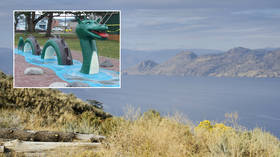
Main image: Lake Okanagan British Columbia © CHROMORANGE / Alexander Bernhard; inset: A statue of Ogopogo in Kelowna. © Wikimedia Commons

A father and son enjoying a fishing trip believe they captured footage of the mythical monster dubbed Ogopogo who, legend has it, lives in the murky depths of Canada’s beautiful Okanagan Lake.

Tales of the curious creature in the British Columbia lake date all the way back to the 19th century but no concrete evidence has ever been discovered.

Outdoor enthusiast Blake Neudorf believes he and his father finally found some while fishing off a dock in the town of Kelowna.

Neudorf captured video appearing to show a very long, snake-like figure slithering through the lake’s blue waters.

The pair can be heard reacting with shock as they watch the head-scratching scene unfold in front of their eyes.

The teen says the creature he saw was at least 60ft long and it could be seen rolling through the water. He uploaded the footage to YouTube earlier this month after recording it on July 10, 2018.

ALSO ON RT.COMMystery behind China’s ‘Loch Ness monster’ has finally been revealed… or has it? (VIDEOS)

Interestingly, there were several other apparent sightings of the beast in the months after the video was taken.

In September, Kelowna native David Halbauer believes he caught the legendary animal on camera while enjoying a day at the lake with his family.